New 5-year TIPS gets a real yield of 1.670% to potentially lukewarm demand

By David Enna, Tipswatch.com

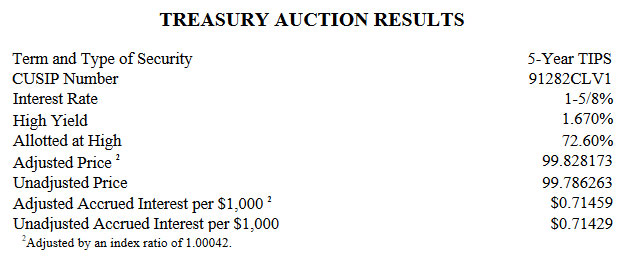
The Treasury’s offering of $24 billion in a new 5-year TIPS, CUSIP 91282CLV1, auctioned today with a real yield to maturity of 1.670%, the lowest for this term since April 2023.

This one is a bit hard to read because of the unusual nature of the October TIPS auction each year, which almost always gets a real yield below the apparent market rate. I talked about this in my preview article on this auction.

The Treasury’s estimate of the real yield of a full-term 5-year TIPS closed Wednesday at 1.82%, but yields have been sliding lower this morning. The most recent TIPS on the secondary market, maturing in April 2029, was trading at about 1.76%. But the new TIPS auctioned each October gets a lower real yield than the April TIPS because it won’t be exposed to weak non-seasonally adjusted inflation in its closing months to maturity.

The key number to look at is the “when issued” prediction for this auction, released just before the close. That number predicted a real yield of 1.641%, so today’s auction result came in higher than expected at 1.670%. The bid-to-cover ratio, a good indication of investor demand, was 2.40, below recent auctions of this term. All of that indicates investor demand wasn’t strong.

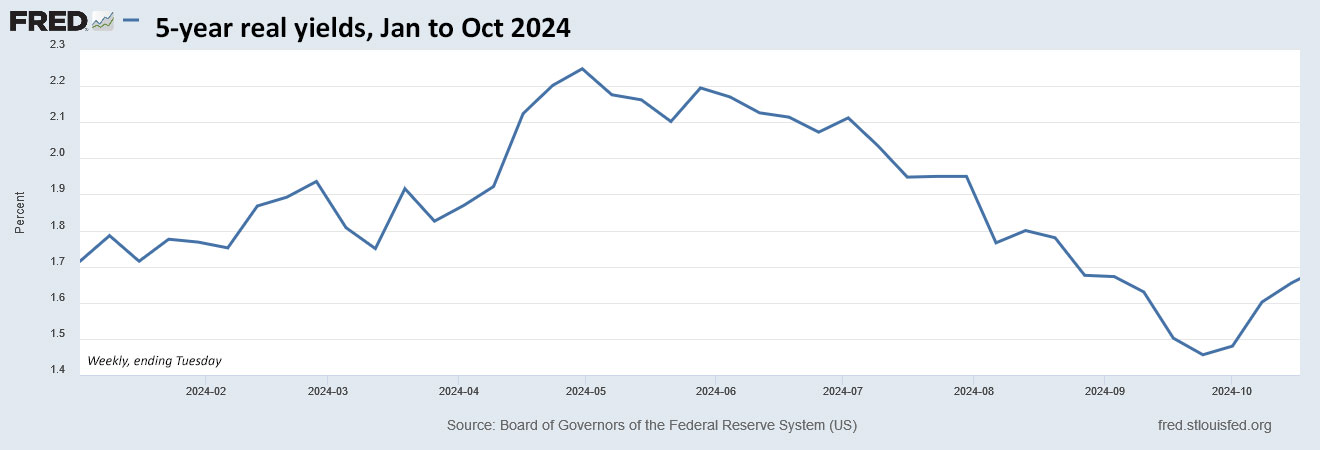
The October auction is always a bit of an outlier. Here is the trend in the 5-year real yield through 2024, showing the sharp decline beginning in May and then reversing in late September:
Click on image for larger version.

Pricing

This was a new TIPS, so the Treasury set its coupon rate at 1.625%, one notch below the real yield of 1.670%. It will carry an inflation index of 1.00042 on the settlement date of Oct. 31. All this means investors got it at a slight discount, an unadjusted price of 99.786263. Here is how a purchase of $10,000 par would be priced:

  • Par value: $10,000.
  • Principal on settlement date: $10,000 x 1.00042 = $10,004.20.
  • Cost of investment: $10,004.20 x 0.99786263= $9,982.82.
  • + accrued interest of $7.15.

In summary, an investor purchasing $10,000 par paid $9,982.82 and will receive principal of $10,004.20 on Oct. 31. The accrued interest will be returned at the first coupon payment.

Inflation breakeven rate

With the nominal 5-year Treasury note trading at 4.01% at the auction’s close, this TIPS gets an implied inflation breakeven rate of 2.34%. I say implied because of the unusual nature of the October auctions. Maybe a better estimate would be around 2.29%. If anyone can find a more-official number, let me know.

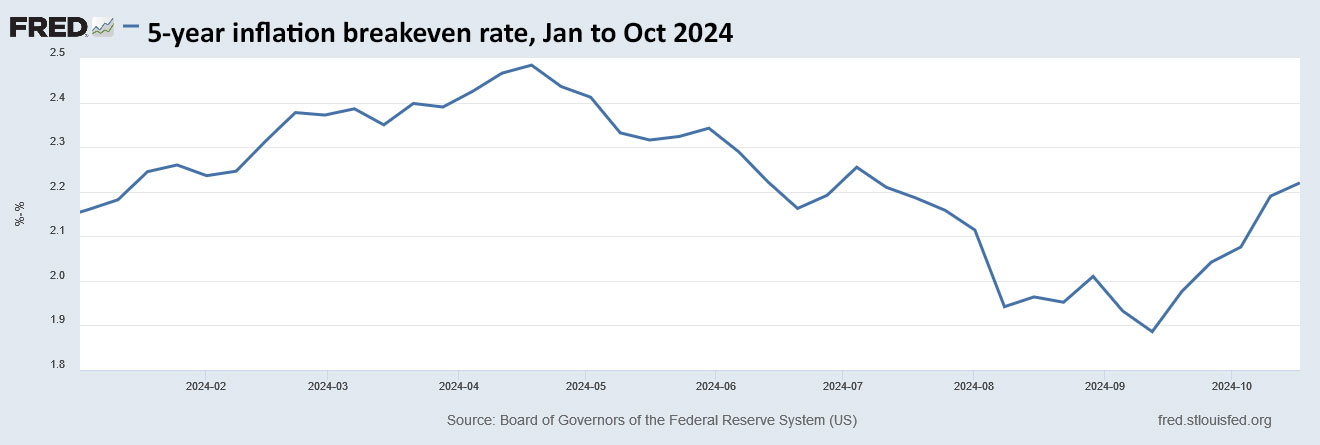
Here is the trend in the 5-year inflation breakeven rate through 2024, showing a recent surge in inflation expectations:
Click on image for larger version.

Thoughts

TIPS yields were trending slightly lower on Thursday morning, after three weeks of increases. Today’s auction result of a 1.670% real yield looks attractive, despite the appearance it was below the “market.” That’s just the way this October auction works. But it is below the results of October auctions in 2022 (1.732%) and 2023 (2.440%).

No media service covers TIPS auctions live anymore, but I found this snippet a day later from MarketWatch, via MSN, on Friday:

Treasury’s $24 billion auction of 5-year Treasury Inflation-Protected Securities was weak, with below-average bidding by non-dealers, according to BMO Capital Markets strategist Vail Hartman.

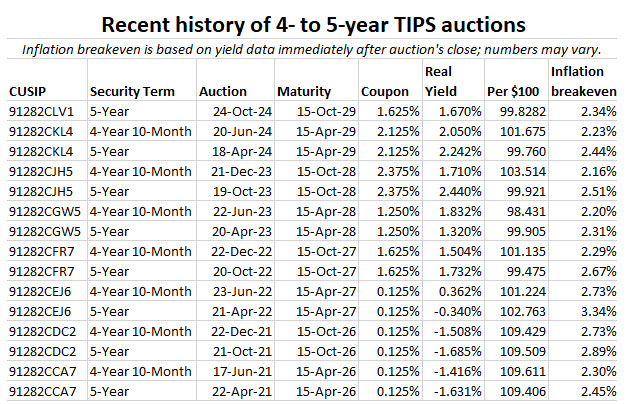
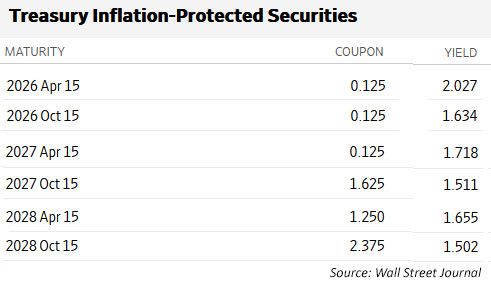
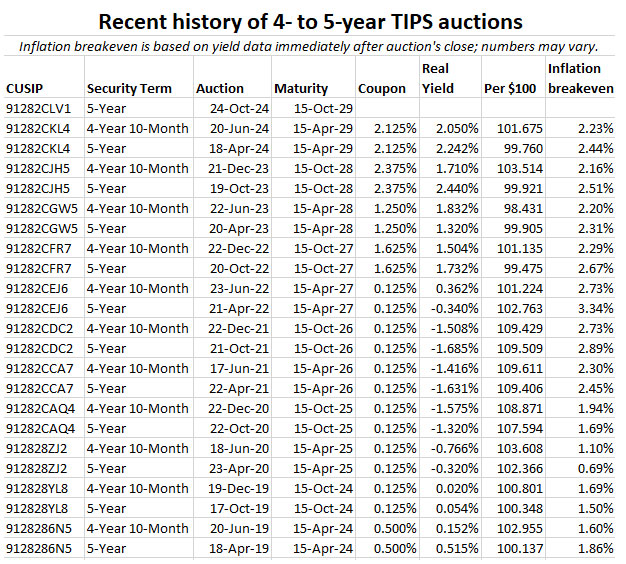
This TIPS will be reopened at auction on December 19. Here are results for recent auctions of this term, showing the transition from real yields deeply negative to inflation in 2021:
Now is an ideal time to build a TIPS ladder

Confused by TIPS? Read my Q&A on TIPS

TIPS in depth: Understand the language

TIPS on the secondary market: Things to consider

TIPS investor: Don’t over-think the threat of deflation

Upcoming schedule of TIPS auctions

* * *

Follow Tipswatch on X (Twitter) for updates on daily Treasury auctions and real yield trends (when I am not traveling).

Feel free to post comments or questions below. If it is your first-ever comment, it will have to wait for moderation. After that, your comments will automatically appear. Please stay on topic and avoid political tirades. NOTE: Comment threads can only be three responses deep. If you see that you cannot respond, create a new comment and reference the topic.

David Enna is a financial journalist, not a financial adviser. He is not selling or profiting from any investment discussed. I Bonds and TIPS are not “get rich” investments; they are best used for capital preservation and inflation protection. They can be purchased through the Treasury or other providers without fees, commissions or carrying charges. Please do your own research before investing.

Posted in Inflation, Investing in TIPS, TreasuryDirect | Tagged , , , , , , , , | 11 Comments

Deciphering TreasuryDirect’s mysterious gift-box email

By David Enna, Tipswatch.com

Update, Jan 31, 2025: I noted in this article that I was going to make a “test” I Bond purchase in January 2025 to see if it would trigger a purchase limit because of gift box deliveries in 2024. The transaction was scheduled for Jan. 29 and the money was withdrawn by the Treasury on that date. A day later, TreasuryDirect showed the I Bond in the account, dated Jan 1 2025. So it all worked without a hitch.

Update, Oct 24, 2024: Read through the comments section below for a fascinating discussion on client conversations with TreasuryDirect, which seems to be settling on a clearer “party line” for investors.

For example, this is from reader James S:

Well, I had another call with Treasury Direct this morning. I explained my situation very clearly (my significant other and I each have four sets of Ibonds in gift boxes, each at $10,000, for a total of $40,000). I asked if there would be any repercussions if ALL of those gifts were delivered now and the answer was no, it is perfectly acceptable to deliver all gift Ibonds now. The only restriction is that the recipient would NOT be able to make any further purchases this year.

The reasoning given is that they are “switching to a new system” and want as many gifts delivered as possible before the switch. I assume this means gift Ibonds are going to be phased out.

The same sort of thing can be seen in the Bogleheads thread, with the great majority of people reporting that TreasuryDirect states it will allow gift-box deliveries over the purchase limit: For example:

I also contacted Treasury Direct today. The rep I spoke to was R***y who communicated the following to me:

  • There is no limit to how many bonds that can be delivered to a recipient.
  • The $10,000 limit references that each bond is limited to $10,000. There is no limit to how many bonds can be delivered to a recipient, even if the recipient has already purchased $10,000 in their own name.
  • R***y was aware that I had 3×10,000 bonds sitting in my gift box waiting for delivery to my DW. I was instructed to deliver all the bonds to DW
  • I asked if I would be subject to any repercussions or penalties for delivering all the bonds at once right now. I was told “no”.
  • I asked if any changes to rules or communications could be expected in the near future to provide better clarity. I was told, “possibly” and something along the lines of “sure as technology changes permitted”

What this means: All indications are that your gift-box purchases can be delivered now. That action makes sense because if you wait until 2025, the delivery will count against the recipient’s ability to purchase additional I Bonds in 2025. So you will have more flexibility if you deliver the I Bonds in 2024.

Am I certain about this path? No, sorry, but that is what TD is indicating.

What I did: I volunteered to be a lab experiment and just went in and delivered our two gift sets of I Bonds, purchased in April and September 2024. The process was quite easy, and I was also able to change the I Bonds to our standard “with” ownership after the deliveries.

When you do this: You will obviously need to know the account number and password for each account, and you will need to reenter the recipient’s account number as the last step before submitting.

————————————————–

TreasuryDirect this week began sending out emails to investors holding U.S. Series I Savings Bonds in gift boxes, suggesting that these bonds should be delivered “as soon as possible.” Here is what investors are seeing:

At first, this odd email set off “phish” alarms for recipients because it is highly unusual for TreasuryDirect to suggest urgency for delivery of gift savings bonds. That confusion caused TreasuryDirect to post an equally unspecific explanation that this is an authentic email. That page says:

The US Treasury is asking customers with undelivered bonds to deliver them to their recipient, who have ownership of the bond(s).

Something clearly is up. Some investors fear an end to the gift-box program is looming. (Could be right). Some fear I Bonds will be eliminated entirely. (Not likely). Many are just plain confused. (Understandable). See the Bogleheads discussion.

The TreasuryDirect rules governing gift-box purchases have always been clear that the purchase does not apply to the purchaser’s limit of $10,000 per person per year. It has been less clear, but always assumed, is that the amount will apply to the recipient’s purchase limit in the year it is delivered.

Bonds purchased or transferred as gifts will be included in the computation of this limit for the account of the recipient for the year in which the bonds are delivered to the recipient.

However, does that mean delivery of the I Bonds counts against the $10,000 cap, meaning the recipient could not purchase additional I Bonds? But the recipient could still receive gifts above the cap?

I just got off the phone with TreasuryDirect representative Vanessa. Here is the conversation:

Is this email suggesting that investors should quickly deliver any I Bonds in gift boxes? Does the email mean to suggest there is urgency to do this?

We would like the gift savings bonds to be delivered.

Does this mean that deliveries in 2024 will be allowed to people who have already purchased I Bonds up to the purchase cap?

If you wanted to, you could wait until January 2025 to make the delivery.

But it would be acceptable to make the delivery in 2024 to someone already at the purchase cap?

Correct. We would like the gift box purchases to be delivered.

I have heard that changes are coming to the gift box program? Could it be eliminated in the future?

I am not sure about that.

This information is similar to what Jennifer Lammer, a reliable financial blogger on YouTube, got from TreasuryDirect yesterday:

What do we do now?

I haven’t yet received the gift-box email, but that isn’t unusual. Lammer’s source said the emails are being sent out in waves. I consider the email a monumental failure in communication by TreasuryDirect. It is vague and unspecific, while also seeming to recommend urgency.

So … I think I want to ponder this situation for a few days. If the “deliver now” information continues to seem to be correct, I would go ahead and deliver my two sets of gift-box (husband and wife) purchases before Oct. 31. Delivering in 2024 instead of January 2025 makes sense because it leaves the door open for additional I Bond purchases in 2025.

Something could be changing at the November 1 reset, and that would explain the implied “urgency” in the TreasuryDirect email. We could see an announcement that the gift-box program is ending, along with further instructions.

I do not think that I Bonds will be discontinued, but I have seen speculation on that.

In my wildest imagination, I could see two things happening on January 1:

  1. The gift box program is ended, similar to the end of the paper I Bond program we saw in late August.
  2. The Treasury raises the purchase limit for savings bonds to $20,000 per person per year, which would be a long-overdue improvement.

Is that likely to happen? Probably not. So in the meantime, I will watch for additional information and plan to deliver my gift-box purchases later this month. And then hope I don’t get a slap on the wrist.

I will update this post or write an update if I see additional information.

———–

Confused by I Bonds? Read my Q&A on I Bonds

Let’s ‘try’ to clarify how an I Bond’s interest is calculated

Inflation and I Bonds: Track the variable rate changes

I Bonds: Here’s a simple way to track current value

I Bond Manifesto: How this investment can work as an emergency fund

* * *

Follow Tipswatch on X (Twitter) for updates on daily Treasury auctions and real yield trends (when I am not traveling).

Feel free to post comments or questions below. If it is your first-ever comment, it will have to wait for moderation. After that, your comments will automatically appear. Please stay on topic and avoid political tirades. NOTE: Comment threads can only be three responses deep. If you see that you cannot respond, create a new comment and reference the topic.

David Enna is a financial journalist, not a financial adviser. He is not selling or profiting from any investment discussed. I Bonds and TIPS are not “get rich” investments; they are best used for capital preservation and inflation protection. They can be purchased through the Treasury or other providers without fees, commissions or carrying charges. Please do your own research before investing.
Posted in I Bond, Inflation, Savings Bond, TreasuryDirect | Tagged , | 85 Comments

What about Thursday’s auction of a new 5-year TIPS?

Real yields are holding up, but the curve is widening.

By David Enna, Tipswatch.com

The October auction of a new 5-year Treasury Inflation-Protected Security is always a baffler. The auctioned real yield is highly likely to be lower than many investors expect. Plus, this 5-year maturity is sensitive to potential near-term actions by the Federal Reserve.

Thursday, the Treasury will offer at auction $24 billion of CUSIP 91282CLV1, a TIPS that will mature on Oct. 15, 2029. Some facts:

  • $24 billion is the largest auction size in history for this term. A year ago, in October 2023, the auction size was $22 billion.
  • The coupon rate and real yield to maturity will be set by the auction’s result.
  • As of Friday’s market close, the Treasury’s estimate of the real yield to maturity of a full-term 5-year TIPS was 1.65%, up 21 basis points since Oct. 1.

The October ‘surprise’

Why is the auctioned real yield of this TIPS likely to be lower than expected? It’s complicated, but real yield expectations are often based on the secondary-market trading of the most recent TIPS of that term. The most recent TIPS of this term is CUSIP 91282CKL4, auctioned on April 18, 2024.

That April auction got a spectacular result, with a real yield to maturity of 2.242%. Since then, real yields have been slipping lower. On the secondary market, the April TIPS is currently trading with a real yield of 1.64%. But the key factor is that any April TIPS tends to have a higher-than-market real yield, because it will be exposed to weak non-seasonally adjusted inflation data in its final months to maturity. By comparison, the October TIPS will get a slightly lower-than-market yield.

For example, in October 2023, the auction of a new 5-year TIPS was expected by many investors (including me) to get a real yield of about 2.57%, but instead auctioned at 2.44%. That sent me hunting for an explanation, and I found it. Read this: “There is an explanation for everything, right?

Data back this up, as you can see in this chart of secondary-market TIPS yields, with the October yields consistently lower than April yields. The effect is magnified as the TIPS gets closer to maturity:

So … when looking at this new 5-year TIPS, understand that the real yield to maturity is likely to come in lower than the Treasury estimate, which is currently 1.65%, or the secondary market trading at 1.64%. Things will change by Thursday, of course.

The yield trend

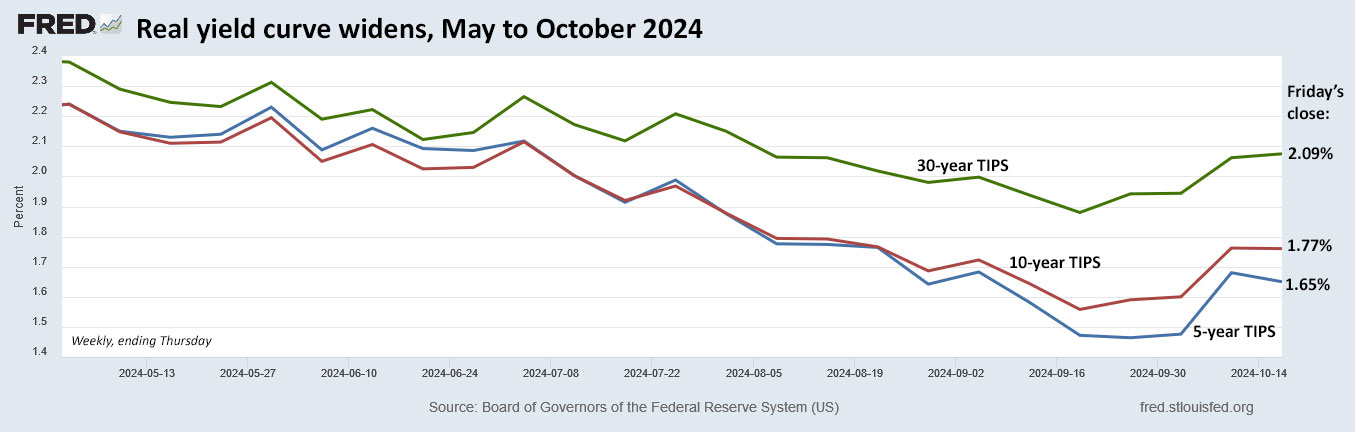
Real yields (meaning the yield above inflation) have declined mightily since the fall of 2023, but remain in an attractive range. What has been interesting is that the yield curve is widening, and actually beginning to look “normal,” with longer-term TIPS having higher yields than shorter-term TIPS.

Click on image for larger version.

This is a predictable result of the Federal Reserve’s path toward lower short-term interest rates. The Fed controls short-term rates, but generally can’t control longer-term rates, unless it relaunches quantitative easing (which it shouldn’t). Of the standard maturities, the 5-year TIPS is most sensitive to Fed actions.

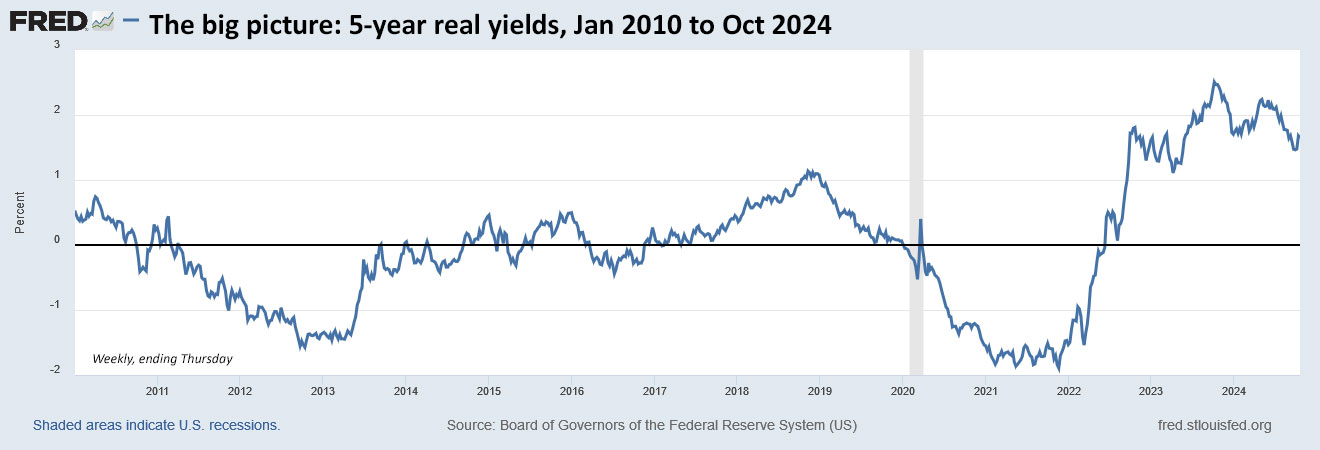
So today the baseline 5-year real yield is hovering around 1.65%, down a whopping 94 basis points since the 2023 high of 2.59% set on October 3. In my view, 1.65% remains historically attractive, as shown in this chart of 5-year real yields over the last 14 1/2 years:

Click on image for larger version.

No one can say where real yields are heading, but getting a return 1.65% above inflation seems attractive enough, while not spectacular.

Inflation breakeven rate

At Friday’s close, a 5-year nominal Treasury note was yielding 3.88%, which at this point indicates an inflation breakeven rate of 2.23% for this new TIPS. That is more or less in line with recent trends. U.S. inflation over the last 5 years has run at 4.2%, but seems unlikely to reach that level over the next 5 years. Or …. maybe it will?

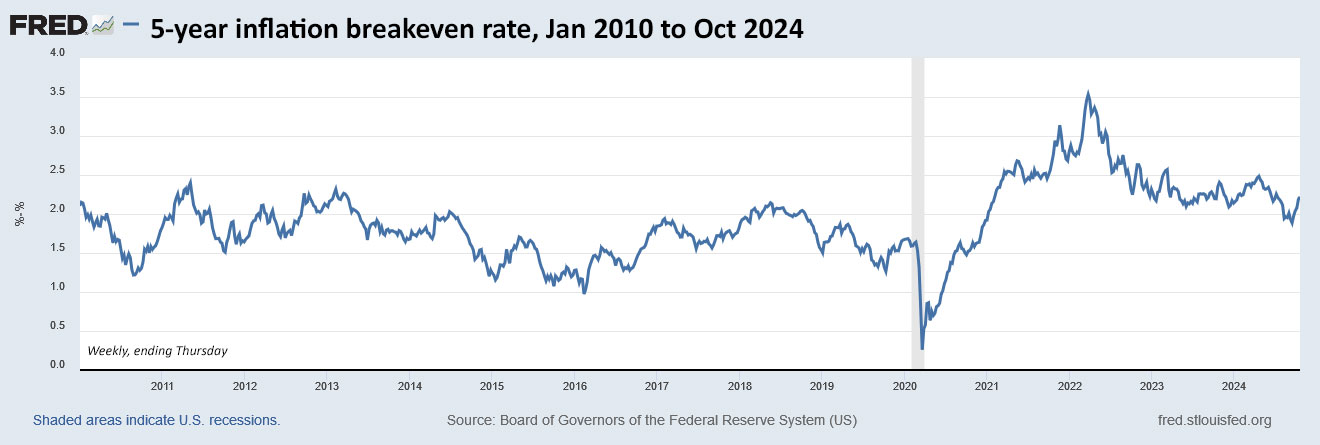
Do you think inflation will run higher than 2.23% over the next 5 years? If so, this TIPS is a sensible investment versus the nominal 5-year Treasury. Here is the trend in the 5-year inflation breakeven rate over the last 14 1/2 years, showing that 2.2% is on the slightly high side of normal:

Pricing

This is a new TIPS, so investors should be paying very close to par value, or slightly less. CUSIP 91282CLV1 will have an inflation index of 1.00042 on the settlement date of October 31, which means an investor buying $10,000 par will be getting $4.20 additional principal. That is negligible.

Thoughts

This auction looks attractive enough, but I have no need to add to the 2029 rung of my TIPS ladder. So I will be passing. Investors could also look at the U.S. Series I Savings Bond, with a real yield of 1.3% for purchases this month. Because of the simplicity and safety of I Bonds, I’d say these two investments are equally attractive. But the $10,000 purchase cap on I Bonds limits their usefulness for many investors.

If you are investing, you can track the Treasury yield estimate each day on this page, and see the yield of the most-recent April TIPS in real time on the Bloomberg U.S. Yields page. But just keep in mind that the result at Thursday’s auction could be 5 to 10 or more basis points lower than what you are seeing on those pages.

This TIPS auction closes Thursday at 1 p.m. EDT. Non-competitive bids at TreasuryDirect must be placed by noon Thursday. If you are putting an order in through a brokerage, make sure to place your order Wednesday or very early Thursday, because brokers cut off auction orders before the noon deadline.

I will be posting the auction results soon after the close on Thursday. Here is a history of auction results for this term over the last 5 years:

—————————-

Now is an ideal time to build a TIPS ladder

Confused by TIPS? Read my Q&A on TIPS

TIPS in depth: Understand the language

TIPS on the secondary market: Things to consider

TIPS investor: Don’t over-think the threat of deflation

Upcoming schedule of TIPS auctions

* * *

Follow Tipswatch on X (Twitter) for updates on daily Treasury auctions and real yield trends (when I am not traveling).

Feel free to post comments or questions below. If it is your first-ever comment, it will have to wait for moderation. After that, your comments will automatically appear. Please stay on topic and avoid political tirades. NOTE: Comment threads can only be three responses deep. If you see that you cannot respond, create a new comment and reference the topic.

David Enna is a financial journalist, not a financial adviser. He is not selling or profiting from any investment discussed. I Bonds and TIPS are not “get rich” investments; they are best used for capital preservation and inflation protection. They can be purchased through the Treasury or other providers without fees, commissions or carrying charges. Please do your own research before investing.
Posted in Federal Reserve, I Bond, Inflation, Investing in TIPS, TreasuryDirect | Tagged , , , , | 20 Comments

The one key rule for using TreasuryDirect …

By David Enna, Tipswatch.com

TreasuryDirect gets a lot of bad press, mostly deserved, for presenting a clunky website with a bureaucratic mess of rules and usually lousy customer service.

I’ve been using TreasuryDirect services for at least 32 years, even before the website launched in 2002. Overall, the system has worked for me, but obviously I am a very experienced user.

The Wall Street Journal last week presented an “exclusive” on one of the major faults of TreasuryDirect: You cannot sell traditional Treasury purchases on the site. The securities have to be transferred to a brokerage (a tedious process), and then sold. And TreasuryDirect, shockingly, says the process can take up to 12 months.

That leads to my one key rule for using TreasuryDirect: Never purchase anything that you may have the slightest need to sell before maturity. There are two exceptions to that rule:

  1. U.S. Savings Bonds, which after a year can be redeemed at TreasuryDirect and then have money sent to your bank or brokerage within a couple days. TreasuryDirect is the only place you can buy electronic versions of Series I and EE Savings Bonds, and is the only place you can redeem them. This process works well.
  2. Short-term T-bills, which will mature in 4 to 52 weeks. Buyers can wait out the maturity period. And smart investors can stagger their purchases to always have access to some money within a month. I am a fan of using TreasuryDirect to purchase T-bills, because the rollover process is flawless. A T-bill matures and a new one is purchased on the same day. At some brokerages, the rollover process can lead to a one-week delay.

It makes no sense to buy traditional Treasurys (TIPS, notes or bonds) at TreasuryDirect if you think you would need to sell them before maturity. The Wall Street Journal article says this about transfers:

TreasuryDirect tries to complete most of them within six weeks, but can take 12 months, depending on capacity. A notice on the TreasuryDirect website says some customer-service requests “may require 12 months or more to process.” The notice had said the longest delays were about six months until the end of July.

A spokesperson for the Treasury’s Bureau of the Fiscal Service said the program has “significant processing delays due to resource and technology constraints.” The Treasury Department is looking to modernize its program “to ensure better, more modern experiences.”

In a followup article on CNBC, the Treasury tried to spin a more positive outlook:

When asked about wait times, the spokesperson said that it “depends more on complexity than capacity” and that processing times are “well under one year right now and declining daily.”

“The website’s processing timeframes are meant to give the longest potential times for the complex, difficult cases — these processing times are often much shorter and continue to decrease as we dedicate more resources,” they said.

OK. But imagine if your brokerage told you it might need a year to complete your sales order. That brokerage would be out of business in weeks. Transferring securities is not a core goal of TreasuryDirect, clearly.

The WSJ article includes an anecdote about an investor who purchased a 20-year Treasury bond in January to lock in 4.75% returns. And then:

(The investor) was prepared to hold on to the bond through a mandatory 45-day waiting period before he could transfer it to his brokerage account.

Over the summer, he called TreasuryDirect’s customer-service line to check on the status of his transfer and was told processing could take up to a year. “I never in a million years would have put away $10,000 that I couldn’t get for a year if I needed it,” he said.

What is interesting in this anecdote is that the investor purchased the 20-year bond with the intention of moving it quickly to his brokerage account. When I read that, I screamed out loud at the breakfast table, “You have a brokerage account! Why didn’t you buy the Treasury bond in that brokerage account?”

But the story continues:

Even before learning about the delay, (the investor) had to print a transfer request form and get a medallion signature, a notary-style stamp to verify security transfers, before mailing it to the Treasury Department. The delay prompted him to file several complaints with the site and write a letter to his congressional representative hoping to expedite the process.

Again, all of this could have been avoided by simply purchasing any longer-term Treasury investment in a brokerage account, not TreasuryDirect. But the Wall Street Journal reports: “About two-thirds of the purchases on TreasuryDirect so far this year have been marketable securities instead of savings bonds.” I suspect a lot of those were T-bills, which are fine.

Treasurys of all types can be purchased in a brokerage account, usually with zero commission. Want to participate in a Treasury auction? You can do that at a brokerage, too, almost always with zero commission. You will get exactly the same yield and price as any auction buyer on TreasuryDirect.

Treasurys are liquid investments. Any Treasury you hold at a brokerage usually can be sold within days, but will incur a small commission and possible bid/ask spread. The sole advantage of TreasuryDirect for Treasury auctions is its minimum purchase of $100, much lower than the typical brokerage minimum of $1,000.

And one final point: You cannot open a tax-deferred account at TreasuryDirect. So if you want to purchase Treasury Inflation-Protected Securities in a retirement account, you must do that at a brokerage. This is the preferred way to purchase TIPS.

My experiences

I started using TreasuryDirect in its “legacy” form in the 1990s and transferred all securities to the current TreasuryDirect in 2002. Over the years, I have purchased many Treasury Inflation-Protected Securities there and all but six have matured. Those six will mature in years 2025 to 2029, plus 2041.

Back in 2018, our hourly-fee financial adviser (the noted author Allan Roth) suggested that we move all our TIPS holdings out of TreasuryDirect to a brokerage and then sell them, because TIPS don’t belong in a taxable account. That is the correct advice, but I didn’t do it. I wasn’t going to sell my TIPS holdings before maturity.

When I purchased these TIPS, I was absolutely certain I would hold them to maturity. So TreasuryDirect’s clunky transfer policies were not a concern. And I have never felt TIPS absolutely should be limited to a tax-deferred account. When these TreasuryDirect TIPS mature, I get the proceeds with nearly zero taxes owed (it’s all been prepaid).

One strange “advantage” of holding TIPS at TreasuryDirect is that the website will never show you — or calculate — market value. The only value it presents is somewhat recent par value x inflation index, which is what you will receive at maturity. Because TIPS can’t be traded at TreasuryDirect, the value it shows does not fluctuate with market jumps. I find this calming. Others would disagree.

But since 2018, I have never purchased another TIPS at TreasuryDirect. The reason: I have moved all these transactions to a traditional IRA at Vanguard, where money can be redistributed without any tax concerns.

The key takeaway from all this is that TreasuryDirect is exclusively great for one thing: purchasing, holding and redeeming savings bonds. It is also useful for purchasing and reinvesting T-bills. Beyond that, I’d recommend using a brokerage account for Treasury purchases.

* * *

Follow Tipswatch on X (Twitter) for updates on daily Treasury auctions and real yield trends (when I am not traveling).

Feel free to post comments or questions below. If it is your first-ever comment, it will have to wait for moderation. After that, your comments will automatically appear. Please stay on topic and avoid political tirades. NOTE: Comment threads can only be three responses deep. If you see that you cannot respond, create a new comment and reference the topic.

David Enna is a financial journalist, not a financial adviser. He is not selling or profiting from any investment discussed. I Bonds and TIPS are not “get rich” investments; they are best used for capital preservation and inflation protection. They can be purchased through the Treasury or other providers without fees, commissions or carrying charges. Please do your own research before investing.
Posted in Cash alternatives, I Bond, Investing in TIPS, Savings Bond, Treasury Bills, TreasuryDirect | 59 Comments

September inflation sets I Bond’s new variable rate at 1.90%

Social Security COLA will be 2.5% for payments beginning in January.

By David Enna, Tipswatch.com

The September inflation report, just released by the U.S. Bureau of Labor Statistics, gives the final pieces of data to determine 1) the new variable rate for U.S. Series I Savings Bonds (it will be 1.90%) and the Social Security cost-of-living adjustment for payments beginning in January (it will be 2.5%).

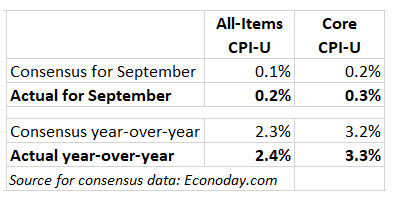
Plus, the report may give stock and bond markets a bit of a jolt today, with inflation running at a higher-than-expected rate for both the all-items and core measurements. This news, combined with last week’s positive jobs report, could cause the Federal Reserve to scale back its planned cuts in short-term interest rates.

I Bond variable rate

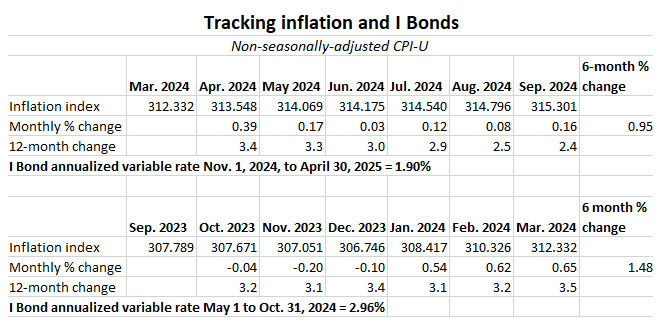
The September report provided the last month of a six-month string of inflation that determines the I Bond’s new variable rate, to be reset for purchases after November 1 and eventually rolling into effect for all I Bonds.

The BLS set September non-seasonally-adjusted CPI-U at 315.301, an increase of 0.16% over the August number. For the six months of April to September 2024, inflation increased 0.95%, which translates to a new variable rate of 1.90%, a sizable decline from the current rate of 2.96%. Here are the data:

The I Bond’s permanent fixed rate will also be reset on November 1, and seems likely to fall below the current rate of 1.3%. I have projected the rate to be 1.2%, but that is an informed guess. If the fixed rate is 1.2%, the I Bond’s new composite rate will be 3.11%, down from the current 4.28%.

Keep in mind that I Bonds purchased in October will lock in the 1.3% fixed rate and get a full six months of the 4.28% composite rate. If you were planning to invest in I Bonds in 2024, or to add to holdings through gift-box or trust strategies, you should make that move before the end of this month.

Opinion: A new variable rate of 1.90% combined with a fixed rate of 1.2% (if that happens) would mean I Bonds will remain an attractive investment into 2025. That is because a high fixed rate is the most important factor. However, older I Bonds with very low fixed rates (for example, 0.2% or lower) are going to have yields well below market rates, for six months at least.

Treasury Inflation-Protected Securities

Investors in TIPS are also interested in non-seasonally adjusted inflation, which is used to adjust principal balances on these investments. The September inflation report means TIPS principal balances will increase 0.16% in November, after increasing just 0.08% in October. Here are the new November inflation indexes for all TIPS.

Social Security COLA

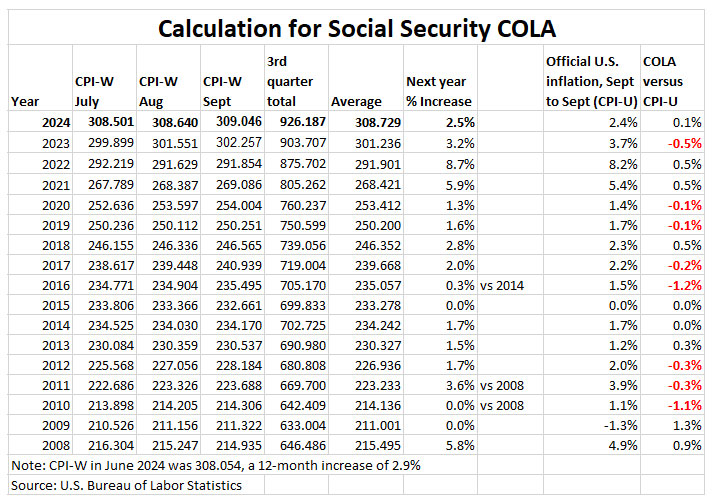
The September inflation report was the third of three — for July to September — that determine the Social Security Administration’s cost-of-living adjustment for payments in 2025. The SSA uses a three-month average of a different index, the Consumer Price Index for Urban Wage Earners and Clerical Workers (CPI-W), to set its COLA.

For September, the BLS set CPI-W at 309.046, which produced a three-month average of 308.729, an increase of 2.5% over the same average for 2023. That means the Social Security COLA will be 2.5% for payments beginning in January. The numbers:

The increase of 2.5% will be the lowest since 2021, but it is slightly higher than the overall increase in U.S. inflation over the last year, 2.4%. The 2.5% increase will boost the average Social Security payment by about $50.

This year, the average monthly benefit payment for retirees is $1,927, according to the Social Security Administration. After the 2.5% increase, that will rise to $1,976 a month.

The inflation report

I’ll be honest: I was not expecting U.S. inflation to come in higher than expectations for September. Gasoline prices fell 4.1% in the month and are down 15.3% for the year. But other factors offset that decline:

  • Food at home prices increased 0.4% in September after being pretty tame for most of this year. The BLS said five of the six major grocery store food group indexes increased over the month.
  • For example, the index for meats, fish and eggs increased 0.8% in September. And costs for fruits and vegetables were up 0.9%.
  • Shelter costs increased 0.2% in September, down from 0.5% from August. But these costs remain 4.9% higher year over year.
  • Costs of medical care services increased 0.7% for the month after declining the previous two months.
  • Apparel costs were up 1.1% for the month.
  • Costs of motor vehicle insurance were up 1.2% for the month and a disturbing 16.3% year over year.

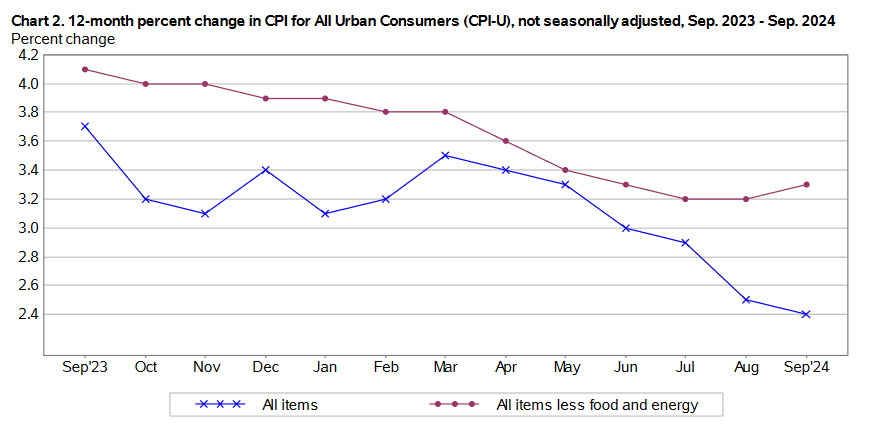
On the positive side, the overall annual inflation rate fell to 2.4%, the lowest level since February 2021. Here is the trend in annual all-items and core inflation over the last 12 months, showing that core inflation remains stubbornly high and in September actually trended higher:

The Federal Reserve

The combination of last week’s positive U.S. jobs report and this higher-than-expected inflation report should be giving the Fed jitters as it moves toward further cuts in short-term interest rates. I am pretty sure we won’t be seeing another 50 basis-point cut in 2024. From this morning’s Bloomberg report:

“Inflation is dying, but not dead,” said Olu Sonola, head of US economic research at Fitch Ratings. “Coming on the heels of the surprisingly strong September employment data, this report encourages the Fed to maintain a cautious stance with the pace of the easing cycle. The likely path is still a quarter point rate cut in November, but a December cut should not be taken for granted.”

I’d agree that a 25-basis-point cut is likely in November, and probably again in December. The Fed has room to move lower with annual inflation currently running at 2.4%. A neutral level for the federal funds rate could be around 3.5%, if inflation remains in this range.

The stock and bond markets seem to be taking today’s inflation news in stride, with the S&P 500 down only about 0.2% in early trading. Real yields have fallen slightly this morning, with the 5-year TIPS trading at 1.67%, down from 1.70% at yesterday’s close.


Considering an I Bond rollover? Do it the right way.

Confused by I Bonds? Read my Q&A on I Bonds

Let’s ‘try’ to clarify how an I Bond’s interest is calculated

Inflation and I Bonds: Track the variable rate changes

I Bonds: Here’s a simple way to track current value

I Bond Manifesto: How this investment can work as an emergency fund

* * *

Follow Tipswatch on X (Twitter) for updates on daily Treasury auctions and real yield trends (when I am not traveling).

Feel free to post comments or questions below. If it is your first-ever comment, it will have to wait for moderation. After that, your comments will automatically appear. Please stay on topic and avoid political tirades. NOTE: Comment threads can only be three responses deep. If you see that you cannot respond, create a new comment and reference the topic.

David Enna is a financial journalist, not a financial adviser. He is not selling or profiting from any investment discussed. I Bonds and TIPS are not “get rich” investments; they are best used for capital preservation and inflation protection. They can be purchased through the Treasury or other providers without fees, commissions or carrying charges. Please do your own research before investing.
Posted in Cash alternatives, Federal Reserve, I Bond, Inflation, Investing in TIPS, Savings Bond, Social Security | Tagged , , , , | 22 Comments