April inflation matches expectations; markets celebrate

Both all-items and core inflation increased 0.3% in April, as predicted.

By David Enna, Tipswatch.com

After three months of higher-than-expected inflation, U.S. prices in April increased on target, setting off a euphoric mood in the stock and bond markets.

The Consumer Price Index for All Urban Consumers increased 0.3% in April on a seasonally adjusted basis, the U.S. Bureau of Labor Statistics reported today. Over the last 12 months, the all items index increased 3.4%. Those numbers exactly matched expectations.

Core inflation, which removes food and energy, also matched expectations, coming in at 0.3% for the month and 3.6% year over year.

For stock and bond markets, meeting expectations was just fine. By 11 a.m. EDT, the Standard & Poor 500 index was up about 0.85% for the day, and the total bond market was up about 0.57%. A lot of media headlines were putting a positive spin on the BLS report, noting that annual inflation dipped from 3.5% in March to 3.4% in April.

Of course, I could point out that all-items inflation had fallen to 3.1% in January, well below the current 3.4%. On the other hand, core inflation has been steadily declining since November 2023, and fell from 3.8% in March to 3.6% in April, a positive trend.

So, yes, overall this was a positive inflation report and one the markets needed to see. The BLS noted that increases in shelter costs (up 0.4% in April and 5.5% year over year) and gasoline prices (up 2.8% for the month but only 1.1% for the year) accounted for 70% of the all-items increase for April. More from the report:

  • The cost of food at home fell 0.2% in April and is up only 1.1% year over year. The overall food index was unchanged for the month.
  • Costs of used cars and trucks fell 1.4% for the month and are down 6.9% for the year.
  • New vehicle prices fell 0.4% for the month and year.
  • Costs for motor vehicle insurance increased 1.8% for the month and a whopping 22.6% over the last year.
  • Apparel costs increased 1.2% in April and are up 1.3% year over year.
  • The medical care index rose 0.4% in April after rising 0.5% in March.

What this means for TIPS and I Bonds

Investors in Treasury Inflation-Protected Securities and U.S. Series I Savings Bonds are also interested in non-seasonally-adjusted inflation, which is used to adjust principal balances on TIPS and set future interest rates for I Bonds. For April, the BLS set the CPI inflation index at 313.548, an increase of 0.39% over the March number.

For TIPS. The April inflation report means that principal balances for all TIPS will increase 0.39% in June, after rising 0.65% in May. Keep in mind that non-seasonally adjusted inflation tends to run higher that headline CPI from January to June, and then lower from July to December.

Here are the new June Inflation Indexes for all TIPS.

For I Bonds. The April inflation report is the first of a six-month string that will determine the I Bond’s new inflation-adjusted variable rate, which will be reset on November 1 based on inflation from April to September 2024. So far, for one month, inflation has increased 0.39%. We can’t make any assumptions from that single month. Here are the relevant data:

View historical information on my Inflation and I Bonds page.

What this means for future interest rates

The April report solidifies the Federal Reserve’s recent statements that short-term interest rates may not need to rise higher. And it probably could create momentum toward a cut in the federal funds rate later this summer. But it was just one month, and inflation came in “as expected,” still well above the Fed’s potential target of 2.0%. (The Fed more closely follows a different inflation index, Personal Consumption Expenditures, but can’t ignore a high rate of CPI.)

From today’s Bloomberg report:

While the figures may offer the Fed some hope that inflation is resuming its downward trend, officials will want to see additional readings to gain the confidence they need to start thinking about cutting interest rates. … “It does open the door to a potential rate cut later in the year,” said Kathy Jones, Charles Schwab’s chief fixed-income strategist. “It will take a few more readings indicating that inflation is coming down for the Fed to act.”

The report had an immediate effect on longer-term nominal and real yields, with the yield on a 10-year Treasury note falling about 9 basis points to 4.36% — far below the 4.65% reading at the beginning of May. The real yield on a 10-year TIPS fell about 7 basis points today to 2.05%.

* * *

Feel free to post comments or questions below. If it is your first-ever comment, it will have to wait for moderation. After that, your comments will automatically appear.Please stay on topic and avoid political tirades.

David Enna is a financial journalist, not a financial adviser. He is not selling or profiting from any investment discussed. I Bonds and TIPS are not “get rich” investments; they are best used for capital preservation and inflation protection. They can be purchased through the Treasury or other providers without fees, commissions or carrying charges. Please do your own research before investing.
Posted in Federal Reserve, I Bond, Inflation, Investing in TIPS, Savings Bond | Tagged , , , , | 5 Comments

My schedule … and what’s coming up

By David Enna, Tipswatch.com

No, we are not hiking El Camino de Santiago, but will walk on it a bit.

If you’ve been reading this Tipswatch site for long, you know what that headline means. I am traveling again. By the time you read this Tuesday morning, I will be somewhere in northern Spain.

And that means I will have an uncertain schedule and possibly awful Internet connections for the next two weeks. While I will try to check in on reader comments and financial news, expect my responses to be minimal.

Fortunately, we are heading into a fairly slow time for this site, since the I Bond’s fixed rate and composite rates were just set for the May to October cycle.

For certain, we can expect:

Wednesday, May 15: April CPI report. This will be issued at 8:30 a.m. Wednesday EDT, which equates to 2:30 p.m. in northwestern Spain. I am sure I will be out and about most of that day, but I will try to post a basic update in the evening. We’ll see. This report isn’t crucial, since it is the first of six that will determine the I Bond’s next fixed rate. But it could give the bond market the shivers.

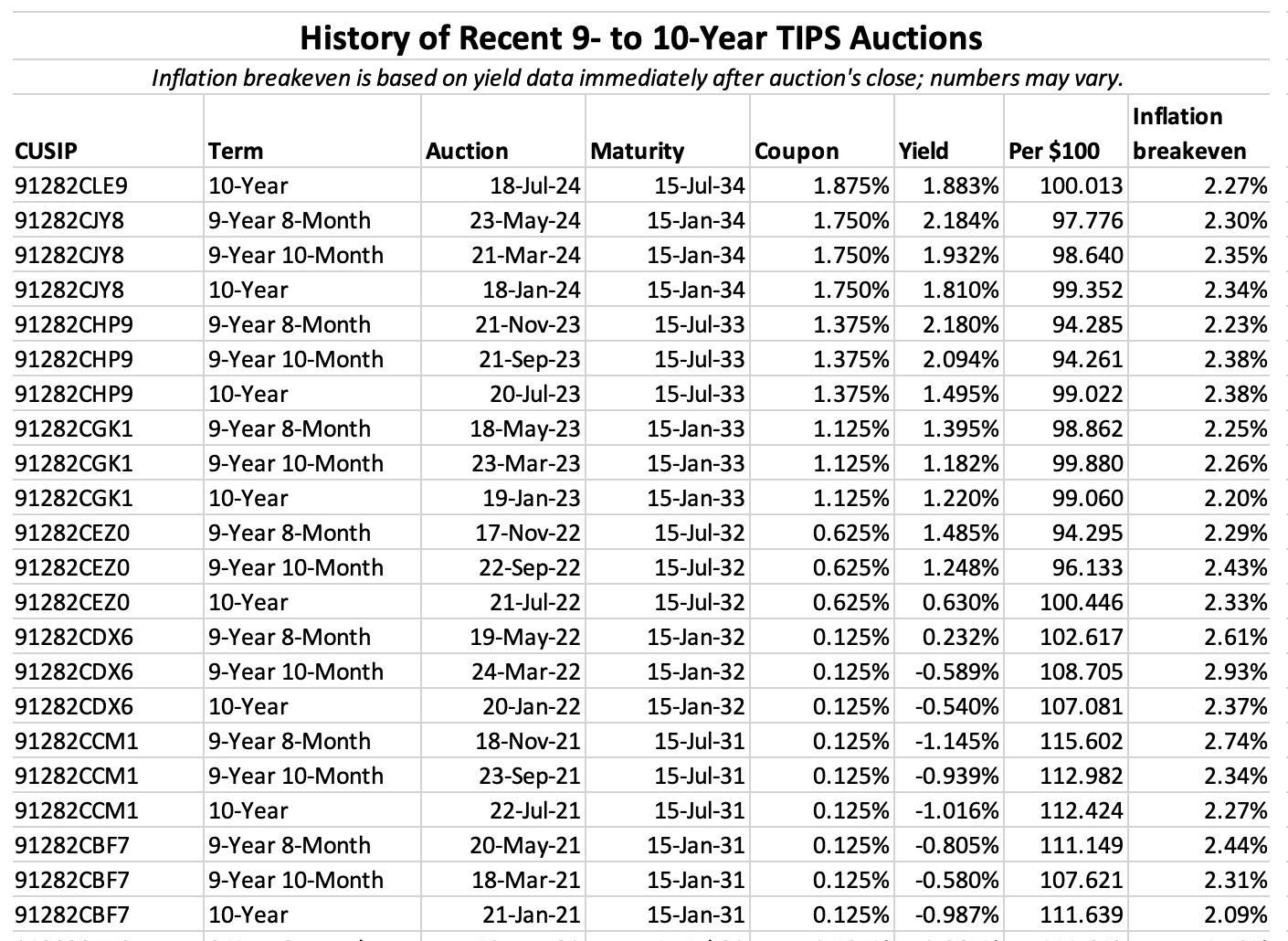
Sunday, May 19, preview of 10-year TIPS auction. Because I can write this a day or two in advance, I should be able to post a preview Sunday morning on the 9-year, 8-month TIPS reopening auction set for May 23. It should be an attractive auction, but real yields have been volatile over the last week, dropping 10 basis points from Wednesday to Friday.

Thursday, May 23, 1 p.m., result of 10-year TIPS auction. If all goes well, I should be back in Charlotte by May 23 to post the auction results. Beware of jet-lagged conclusions, however.

There is an unfortunate tradition to my travels: They always seem to trigger some sort of financial crisis. It’s probably just my imagination. (And by the time I get home everything seems back to normal.) Let’s hope for calm days.

* * *

Feel free to post comments or questions below. If it is your first-ever comment, it will have to wait for moderation. After that, your comments will automatically appear.Please stay on topic and avoid political tirades.

David Enna is a financial journalist, not a financial adviser. He is not selling or profiting from any investment discussed. I Bonds and TIPS are not “get rich” investments; they are best used for capital preservation and inflation protection. They can be purchased through the Treasury or other providers without fees, commissions or carrying charges. Please do your own research before investing.

Posted in I Bond, Inflation, Investing in TIPS | 8 Comments

How much are your I Bonds actually earning?

By David Enna, Tipswatch.com

Last week, the Treasury set the fixed rate for I Bonds purchased from May to October 2024 at 1.3%, which combined with a variable rate of 2.96% results in a composite rate of 4.28% for six months.

As it turns out, that 4.28% composite rate also applies to I Bonds purchased from November 2023 to April 2024, because those also had a fixed rate of 1.3%. But what about I Bonds purchased in previous years, with fixed rates as low as 0.0%?

All I Bonds — no matter when they were purchased — will have the inflation-adjusted 2.96% variable rate applied for a full six months. The starting month depends on the original month of purchase, following this chart from TreasuryDirect:

For example: If you bought I Bonds in January 2024, that investment will earn a composite rate of 5.27% for six months, and then in July will begin earning 4.28% for six months. A purchase in April 2024 will earn 5.27% for six months, and then in October begin earning 4.28% for six months.

But what about those earlier I Bonds in your inventory, with much lower (or possibly higher) fixed rates? Any I Bond with a fixed rate of 0.0% is going to earn the variable rate, with no added fixed rate. So those will transition from earning the previous variable rate of 3.94% for six months to 2.96% for six months.

In this chart, I have compiled the new composite rates (which will roll into effect based on the original month of purchase) for all I Bonds back to November 2016, and then selected I Bonds with varying fixed rates back to May 1999. The chart also shows the current value of these I Bonds, assuming the I Bonds were purchased in the first month of each time period:

Note that the May 1 value shows total interest earned, ignoring the Treasury’s three-month penalty for redemptions before five years.

Thoughts

Because of the inflation protection built into I Bonds, earning 2.96% for six months isn’t a dreadful thing. Get over it! But … at a time when 4-week Treasury bills are yielding 5.47%, that 2.96% is looking weak. You can reach a similar conclusion with other low fixed rates:

  • A fixed rate of 0.10% will generate a composite rate of 3.06% for six months.
  • 0.20% = 3.16%
  • 0.30% = 3.26%
  • 0.40% = 3.37%
  • 0.50% = 3.47%
  • 0.70% = 3.67%

As I have written recently, this year I have redeemed 0.0% I Bonds to purchase the new 1.3% I Bonds, both in the traditional way in March and in gift-box swaps in April. I still have one set of 0.0% bonds remaining (from 2017) and a rather large collection of 0.1% fixed-rate I Bonds dating back to 2013.

At this point, I would not redeem any I Bond with a fixed rate of 0.2% or higher.

Also in the chart, notice the I Bonds issued from May to October 2007 with a fixed rate of 1.3%, same as today’s. Those I Bonds are very close to doubling in value in 17 years. They have generated a tax-deferred, annualized nominal return of 3.92% over a time when inflation averaged 2.4%. We can expect similar performance from these 2024 I Bonds.

My thinking: If market real yields remain high into the end of 2024, I will be looking to redeem — selectively — my remaining set of 0.0% I Bonds and some 0.1% versions to make gift-box purchases at 1.3%. I am in no rush to do this, because the 1.3% fixed rate will apply to all I Bond purchases through the end of October.

But what if real yields start declining, deeply? Then I will be definitely looking to make the swap to the 1.3% fixed rate because the November fixed-rate reset will be likely be lower than 1.3%.

At this point, there is no way to know. So just wait it out to October.

I am not a fan of stacking 10+ sets of gift-box swaps, because that will lock up the money for future distribution. One of the advantages of I Bonds is the ability to redeem after one year. But no one can redeem an I Bond that can’t be delivered because of the purchase cap.

Another option. If you are committed to redeeming low-fixed-rate I Bonds to buy the 1.3% version later this year, you could redeem now, place the proceeds in a money market account or in rolling 4-week T-bills earning 5.5% and then use that cash to buy the I Bonds in October, or possibly November.

You’d probably earn more than the 2.96% variable rate for several months. But there are two negatives to this strategy: 1) You will owe 2024 federal taxes on the interest earned, and 2) There is a slim chance that short-term yields could fall off sharply in the next few months.

Here’s a decent summary of the situation from CNBC, which includes (of course) a financial adviser telling you to sell your I Bonds:

If you need the money …

I keep stressing that the proper approach to I Bonds is to build a large reserve of inflation-protected, tax-deferred cash. At some point, you should start spending that money, either in retirement or to achieve other life goals. If you need the money, target the lower-fixed-rate I Bonds for the first redemptions.

Confused by I Bonds? Read my Q&A on I Bonds

Let’s ‘try’ to clarify how an I Bond’s interest is calculated

Inflation and I Bonds: Track the variable rate changes

I Bonds: Here’s a simple way to track current value

I Bond Manifesto: How this investment can work as an emergency fund

* * *

Feel free to post comments or questions below. If it is your first-ever comment, it will have to wait for moderation. After that, your comments will automatically appear.Please stay on topic and avoid political tirades.

David Enna is a financial journalist, not a financial adviser. He is not selling or profiting from any investment discussed. I Bonds and TIPS are not “get rich” investments; they are best used for capital preservation and inflation protection. They can be purchased through the Treasury or other providers without fees, commissions or carrying charges. Please do your own research before investing.

Posted in Cash alternatives, I Bond, Inflation, Retirement, TreasuryDirect | 29 Comments

Treasury holds I Bond fixed rate at 1.3%; composite rate falls to 4.28%

EE bond’s fixed rate stays at 2.7%; doubling period holds at 20 years

By David Enna, Tipswatch.com

After signaling for a few days that it would hold off to May 1 to announce new rates for U.S. Series I Savings Bonds, the ever-unpredictable Treasury did it early anyway, and it matched my expectations.

The I Bond’s new fixed rate holds at 1.3% for purchases from May to October, and the composite rate falls from April’s 5.27% to 4.28% for new purchases.

The I Bond’s fixed rate is important for investors. It is permanent and stays with an I Bond until redemption or maturity in 30 years. This new fixed rate only applies to I Bonds purchased from May to October 2024.

The inflation-adjusted variable rate applies to all I Bonds, no matter when they were issued. It changes every six months and the starting date of the change depends on the month you bought the I Bond. This new 2.96% variable rate is based on non-seasonally adjusted inflation from October 2023 to March 2024.

The composite rate is based on a combination of the fixed and variable rates, using this formula:

The new inflation-adjusted variable rate rolls out over time, as I noted. For example, if you bought an I Bond in April 2024, it would earn 5.27% through September, and then transition to 4.28% for six months beginning in October.

Track the history of the I Bond’s variable rate on my Inflation and I Bonds page.

No surprises

I Bond watchers (like me) had been forecasting that the fixed rate would hold at 1.3%, based on a ratio of 0.65 applied to the six-month average of 5- and 10-year real yields. and then rounded to the tenth decimal point. It was reassuring to see the forecast worked, this time. This gives us a little more supporting data on how the Treasury makes this decision.

Reaction

I have been recommending making your 2024 I Bond purchase in April to lock in both the 1.3% fixed rate and 5.27% composite rate for a full six months. Now that the fixed rate held at 1.3%, that strategy looks solid. Now we can await the November 1 rate reset.

Timing your investments can be important, because I Bond purchases are limited to $10,000 per person per year unless you use your tax return to get paper I Bonds or add to your holdings through gift-box, trusts, or business-owner strategies. Whatever rate is set in November will be available for purchase in January 2025, when the purchase limit resets.

Even though T-bills have yields higher than the I Bond’s new composite rate of 4.28%, these savings bonds still make sense for investors looking to build a large cash reserve that is inflation-adjusted, tax-deferred and totally safe. Right now, it is T-bills for the short-term, I Bonds for the long-term.

EE Savings Bond

The Treasury decided to hold the fixed rate on the EE Savings Bond at 2.70%, well below the yield of comparable nominal Treasury investments. I had been predicting the rate could rise to 2.8% or 2.9%, based on the trend in yields for the 10-year Treasury note (currently yielding 4.63%).

The Treasury also held the EE bond’s doubling period at 20 years, meaning this savings bond will yield 3.53% compounded if held for 20 years. I had expected that decision, but honestly, it would be more fair to set the doubling period at 18 years, creating an effective yield of 4%.

I doubt there will be much interest in EE Savings Bonds when T-bills are earning nearly 5.5% and the 20-year Treasury bond yields 4.86%. Both of those make more investment sense. Too bad.

What’s your reaction?

Investors are sorting through a lot of issues when considering I Bonds these days. T-bills offer a better rate of short-term return, with no fear of a penalty for early redemption. Treasury Inflation-Protected Securities offer better real returns, but with more complexity and potential market fluctuations.

I suspect most I Bond investors have already purchased their allotment for 2024 and are now ready to sit back and enjoy life.

FYI, earlier today (April 30) I looked on TreasuryDirect and it “appeared” you could still set a purchase for April 30, 2024, which in theory would get the higher April composite rate. Forget it. I have already gotten feedback from a reader that a purchase entered today is getting the May rate.

The Treasury really needed to clarify its wording, which said for several days, “The current rate of 5.27 percent is available until 11:59 p.m. Eastern Time on Tuesday, April 30. The new rate becomes available at midnight.”

That was highly suspect.

Now, on the afternoon of April 30, TreasuryDirect has gone in and changed the wording on its I Bond FAQ page to this bizarre past-tense instruction:

The rate of 5.27 percent was available until 11:59 p.m. Eastern Time on Tuesday, April 30. The current rate of 4.28 percent became available at midnight.

Treasury, you screwed this one up.

Post your ideas and thoughts in the comments section below.

Confused by I Bonds? Read my Q&A on I Bonds

Let’s ‘try’ to clarify how an I Bond’s interest is calculated

Inflation and I Bonds: Track the variable rate changes

I Bonds: Here’s a simple way to track current value

I Bond Manifesto: How this investment can work as an emergency fund

* * *

Feel free to post comments or questions below. If it is your first-ever comment, it will have to wait for moderation. After that, your comments will automatically appear.Please stay on topic and avoid political tirades.

David Enna is a financial journalist, not a financial adviser. He is not selling or profiting from any investment discussed. I Bonds and TIPS are not “get rich” investments; they are best used for capital preservation and inflation protection. They can be purchased through the Treasury or other providers without fees, commissions or carrying charges. Please do your own research before investing.

Posted in Cash alternatives, EE Bonds, I Bond, Retirement, Savings Bond, TreasuryDirect | 56 Comments

Real yields are rising, but haven’t yet hit highs of 2023

By David Enna, Tipswatch.com

I’ve been watching with fascination as market real yields of Treasury Inflation-Protected Securities have been steadily rising in recent weeks. We can look at several apparent causes:

  • U.S. inflation has perked higher since the beginning of the year, with the annual rate of all-items CPI rising from 3.1% in January to 3.5% in March.
  • The U.S. economy is showing few signs of stalling, with the job and housing markets remaining robust. The unemployment rate stands at 3.8%, still close to a 10-year low.
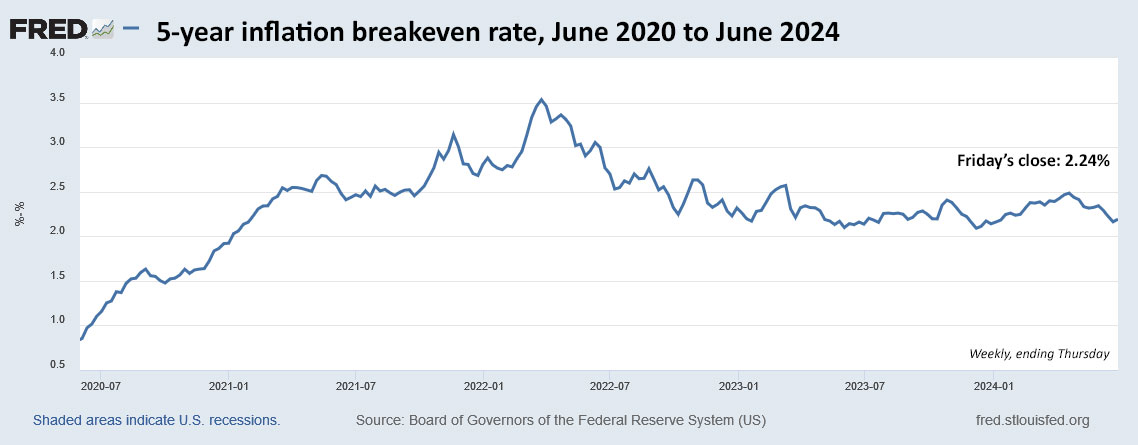
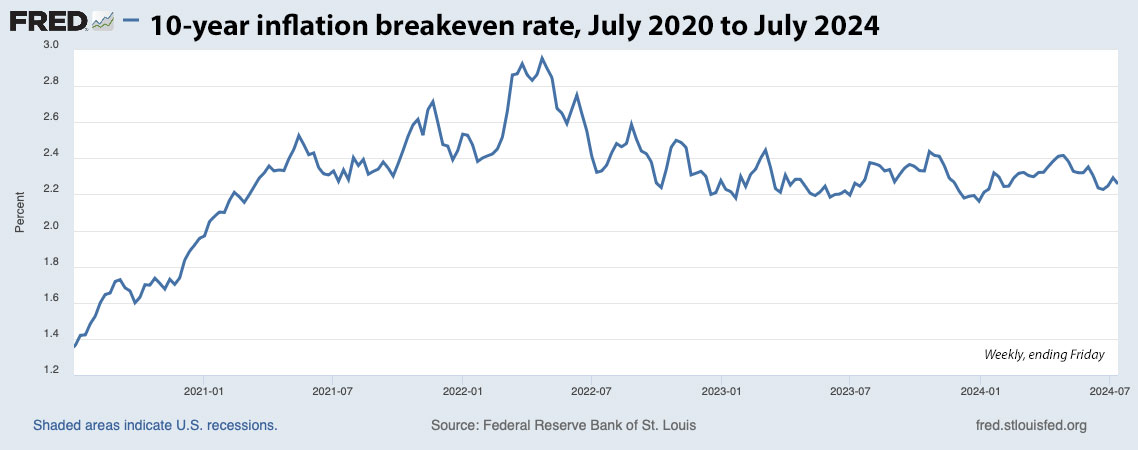
  • The bond market’s inflation expectations have been steadily increasing, with the 10-year inflation breakeven rate rising from 2.21% on Jan. 2 to 2.42% on April 24.
  • The Federal Reserve has backed off dovish talk and is now preaching a “higher for longer” message for U.S. short-term interest rates.
  • The U.S. Treasury’s funding needs continue to rise with ever-growing federal deficits, causing longer-term yields to remain elevated.

Definition: The real yield to maturity of a TIPS is its above-inflation annual return over the life of the investment. For example, on April 18 the Treasury auctioned a new 5-year TIPS with a real yield of 2.242%, which means that TIPS will out-perform official U.S. inflation by 2.242% over the 5-year term.

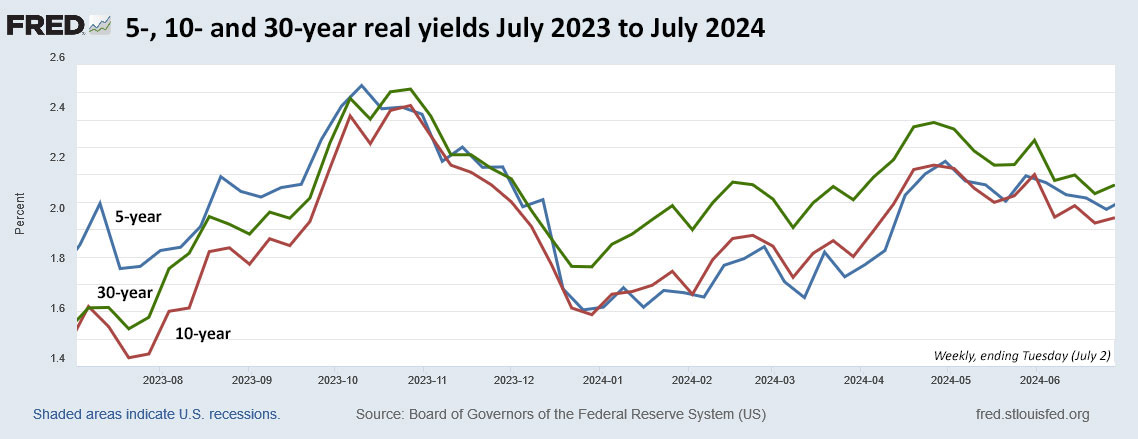
Here is the trend in 5-, 10- and 30-year real yields since July 2023:

Click on image for larger version.

As you can see, real yields peaked in October 2023 at a higher level than today’s market. The real yield curve at the time was essentially flat, with the entire maturity spectrum yielding in a range from 2.47% to 2.58%. That trend continued for about a month, before real yields began falling, fairly dramatically.

What’s interesting is that the September 2023 annual inflation rate (which was announced Oct. 12, 2023) came in at 3.7%, not much higher than today’s 3.5%.

Also at the time, the Federal Reserve was pushing the idea that short-term interest rates might not need to go any higher. And in fact, the Fed has held its federal funds rate in the range of 5.25% to 5.50% since July 2023. No cuts, no increases.

It was the Fed’s “no higher” message that helped cause interest rates to begin a steady decline into January 2024. In addition, the U.S. entered a mildly disinflationary trend through the end of 2023. As a result, real yields fell sharply through the end of the year:

But now, inflation is seemingly again a rising threat, and the Fed is hinting that it might need to increase interest rates if the trend continues. I think an increase is unlikely, but once-likely rate cuts might be out of the picture for the rest of 2024. Stock investors seem to be taking that news with a yawn, but the bond market is in turmoil, with the total bond market producing a total return of -3.0% year to date.

Here are how real yields stand today compared with their highs of October 2023:

As you can see, the 2023 yields were about 30 basis points higher than today’s elevated levels. October 2023 was a great month for building a ladder of TIPS investments, with all maturities yielding close to 2.5% above inflation. April 2024, in fact, is also an opportune time for making new TIPS investments.

But as this chart shows, real yields could go higher. Or, as happened in the months after October 2023, they could move sharply lower. A lot will depend on inflation trends and what actions the Fed decides to take through the end of the year … an election year.

What this means

I am always looking for a “new investing era” and I am certain we are well into an era of normalized interest rates, after a decade-plus of Federal Reserve actions to hold rates at ultra-low levels.

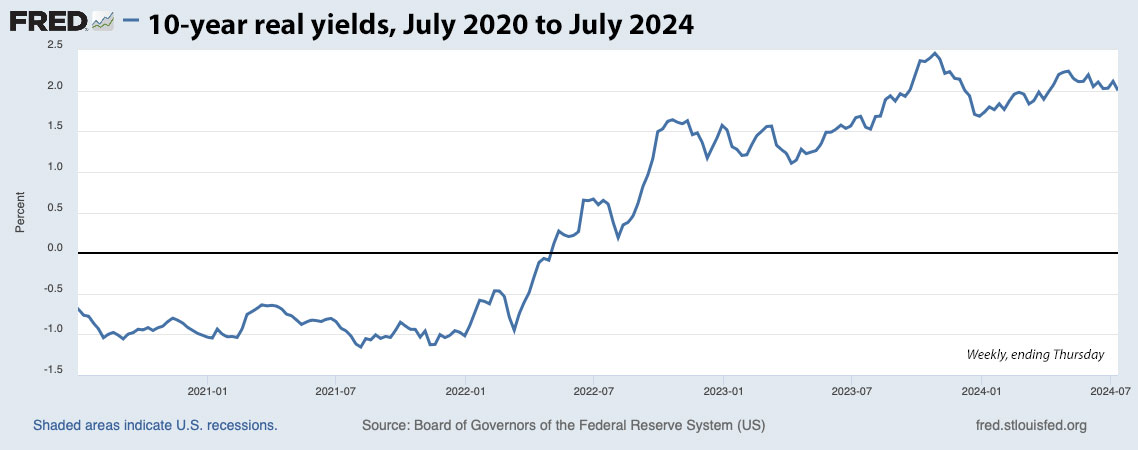
By historical standards, a 10-year Treasury note with a nominal yield of 4.67% and a 10-year TIPS with a real yield of 2.24% aren’t outliers. These were fairly normal in the past. In fact, the 10-year Treasury note had a nominal yield above 5% for nearly three decades from 1970 to 2000, as shown in this chart:

Click on image for larger version.

So are interest rates peaking in April 2024? My guess is: Probably. But it will depend on actions and direction from the Federal Reserve, which right now seems fairly happy with higher yields keeping the U.S. economy (and potentially inflation) under control.

Any change for I Bonds?

The Treasury will be resetting the fixed rate of the U.S. Series I Bond on Wednesday, May 1. The current fixed rate is 1.3%. That rate, which was the highest in 16 years, was set on Nov. 1, 2023, just after the October surge in real yields. The same thing is happening now, with a surge in April 2024.

My guess is that the Treasury will hold the I Bond’s fixed rate at 1.3%, and when combined with a new variable rate of 2.96%, I Bonds issued from May to October will be getting a composite rate of 4.27%, down from the current 5.27%.

Could the fixed rate rise, maybe to 1.4%? It could, if the Treasury attempts to factor in higher future real yields. Seems iffy to me.

The I Bond rate announcement could be coming on the morning of Tuesday, April 30, or more likely on the morning of Wednesday, May 1. TreasuryDirect has this message posted on a link from its homepage:

The current rate of 5.27 percent is available until 11:59 p.m. Eastern Time on Tuesday, April 30. The new rate becomes available at midnight.

That would seem to indicate TreasuryDirect will still be accepting orders for April I Bonds on Tuesday. But I would not risk that. If you are buying and want the higher April rate, buy Monday at the latest.

Now is an ideal time to build a TIPS ladder

Confused by TIPS? Read my Q&A on TIPS

TIPS in depth: Understand the language

TIPS on the secondary market: Things to consider

Upcoming schedule of TIPS auctions

* * *

Feel free to post comments or questions below. If it is your first-ever comment, it will have to wait for moderation. After that, your comments will automatically appear.Please stay on topic and avoid political tirades.

David Enna is a financial journalist, not a financial adviser. He is not selling or profiting from any investment discussed. I Bonds and TIPS are not “get rich” investments; they are best used for capital preservation and inflation protection. They can be purchased through the Treasury or other providers without fees, commissions or carrying charges. Please do your own research before investing.

Posted in Federal Reserve, I Bond, Inflation, Investing in TIPS, Savings Bond, TreasuryDirect | 20 Comments