10-year TIPS reopening auction gets a real yield of 1.592%

By David Enna, Tipswatch.com

Too often, the bond market tricks you. It happened again Thursday in the wake of Wednesday’s “sort-of surprise” action by the Federal Reserve to cut short-term interest rates by 50 basis points.

The initial (and expected) reaction after the Fed announcement was that real yields for 5- and 10-year Treasury Inflation-Protected Securities dropped by about 5 to 7 basis points. The stock market moved higher. And then … things turned around, with stock prices dipping and Treasury yields rising.

All that led into today’s $17 billion reopening auction of CUSIP 91282CLE9, creating a 9-year, 10-month TIPS. This TIPS trades on the secondary market, and at one point on Wednesday afternoon its real yield dipped to about 1.53%, before rising back to about 1.58% at the market close.

Thursday’s auction, which closed at 1 p.m. EDT, resulted in a real yield to maturity of 1.592%, which should look acceptable to investors. The “when-issued” prediction was 1.59%. The bid-to-cover ratio was a solid 2.44. By any measure, this auction went off without a hitch.

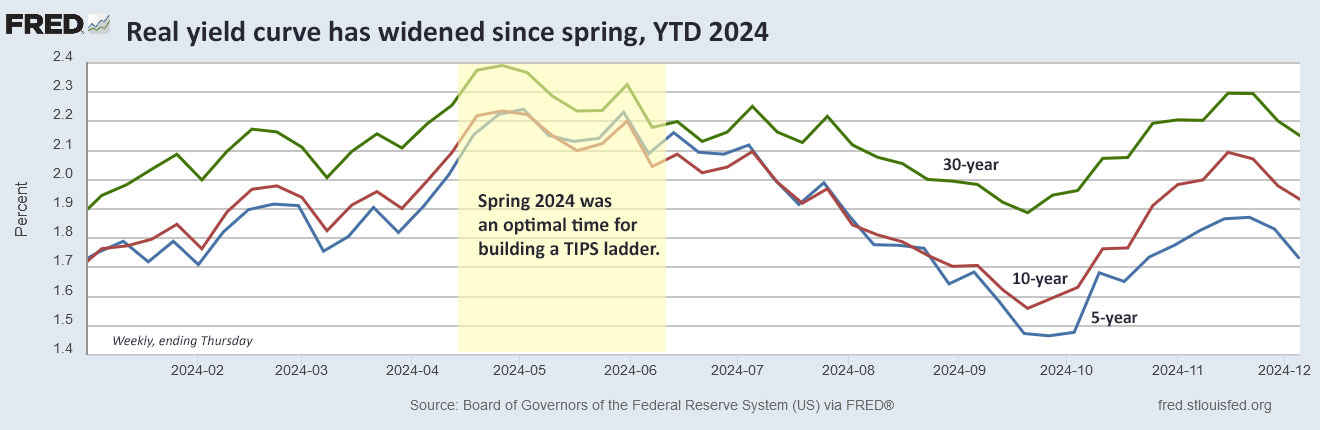
Of course, real yields have declined mightily in 2024 as the Fed began signaling its intention to cut interest rates. As recently as May 23, 2024, a similar 10-year TIPS auction generated a real yield of 2.184%, the highest since 2009. Yields have fallen 59 basis points since then.

Here is the trend in the 10-year real yield since January 2023, with today’s result falling close to the middle of the yield range:

Click on image for larger version.

For now, the days of 2.0% real yields are over, even for very long-term TIPS. The 30-year TIPS is trading today at 1.92%.

Pricing

CUSIP 91282CLE9 has a coupon rate of 1.875%, which was set by the originating auction on July 18. Because the auctioned real yield was well below the coupon rate, investors had to pay a premium price for this TIPS. The unadjusted price was 102.554561. In addition, it will carry an inflation index ratio of 1.00237 on the settlement date of September 30:

With that information, we can look at the actual investment cost of a purchase of $10,000 par value at this auction:

  • Par value: $10,000.
  • Principal purchased as of Sept. 30: $10,000 x 1.00237 = $10,023.70.
  • Cost of investment: $10,023.70 x 1.02554561 = $10,279.76.
  • + Accrued interest of about $39.33.

In summary, an investor purchasing $10,000 par at this auction paid $10,279.76 for $10,023.70 of principal and will now earn inflation accruals plus an annual coupon of 1.875% on accrued principal.

Inflation breakeven rate

With a 10-year nominal Treasury trading at 3.75% at the auction’s close, this TIPS gets an inflation breakeven rate of 2.16%, well below recent trends. In fact, this is the lowest breakeven rate for an auction of this term since January 2021. It indicates that this TIPS will outperform a nominal 10-year Treasury if inflation averages more than 2.16% over the next 9 years, 10 months.

Here is the trend in the 10-year inflation breakeven rate since January 2023, showing the sharply downward trend since May 2024:

Click on image for a larger version.

I think it would be logical that the Fed’s dovish cut of 50 basis points would increase fears of potential inflation, since the Fed now seems to be focusing its attention on labor markets versus U.S. inflation. And the result? This rate of 2.16% is slightly higher than the breakeven at Tuesday’s market close, 2.12%.

Reaction to the auction

As I noted, this auction result looks right on target with expectations. Both the Treasury and investors can be pleased with the result. Demand was reasonably strong and the real yield was reasonably high.

CUSIP 91282CLE9 will have one more reopening auction on November 21, 2024, two weeks after 1) the U.S. presidential election on Nov. 5, and 2) another rate-cutting decision by the Federal Reserve on Nov. 6. A whole lot could change by then.

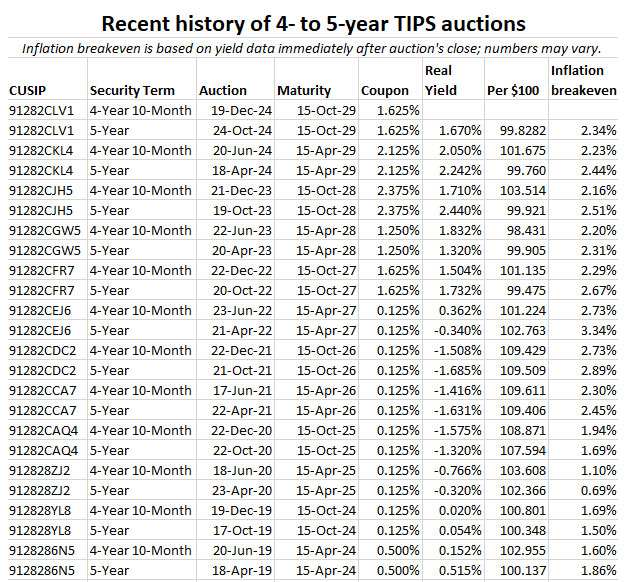
Here is the history of 9- to 10-year TIPS auctions going back to January 2021:

—————————-

Confused by TIPS? Read my Q&A on TIPS

TIPS in depth: Understand the language

TIPS on the secondary market: Things to consider

TIPS investor: Don’t over-think the threat of deflation

Upcoming schedule of TIPS auctions

* * *

Follow Tipswatch on X (Twitter) for updates on daily Treasury auctions and real yield trends (when I am not traveling).

Feel free to post comments or questions below. If it is your first-ever comment, it will have to wait for moderation. After that, your comments will automatically appear. Please stay on topic and avoid political tirades. NOTE: Comment threads can only be three responses deep. If you see that you cannot respond, create a new comment and reference the topic.

David Enna is a financial journalist, not a financial adviser. He is not selling or profiting from any investment discussed. I Bonds and TIPS are not “get rich” investments; they are best used for capital preservation and inflation protection. They can be purchased through the Treasury or other providers without fees, commissions or carrying charges. Please do your own research before investing.


Posted in Federal Reserve, Inflation, Investing in TIPS, TreasuryDirect | Tagged , , , , | 4 Comments

Real yields are sinking. What does this mean for Thursday’s 10-year TIPS reopening auction?

By David Enna, Tipswatch.com

First off, let’s point out that the Federal Reserve has not yet lowered interest rates by a single basis point and, in fact, the federal funds rate has been stable since July 2023.

But changes are coming this week, with the Fed likely to cut short-term rates by 25 to 50 basis points, beginning a string of rate-cutting decisions that will likely stretch well into 2025. The market has been repricing longer-term Treasurys in reaction to the potential Fed moves, and in reaction to a gradually weakening U.S. economy.

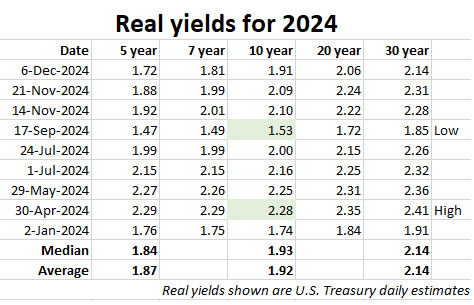
Real yields (meaning yields above inflation) hit a 2024 high on April 30, with the 10-year yield on a Treasury Inflation-Protected Security topping off at 2.28%. This is the trend since then:

In the middle of that trend, on July 18, the Treasury auctioned a new 10-year TIPS, CUSIP 91282CLE9, with a real yield to maturity of 1.883%. On Thursday this week, it will stage the first reopening auction, creating a 9-year, 10-month TIPS. The auction size is $17 billion, the highest in history for a 10-year reopening.

Obviously, a lot has changed in two months. CUSIP 91282CLE9 trades on the secondary market, and closed Friday with a real yield of 1.57%, 31 basis points below the originating auction.

Is this TIPS still attractive?

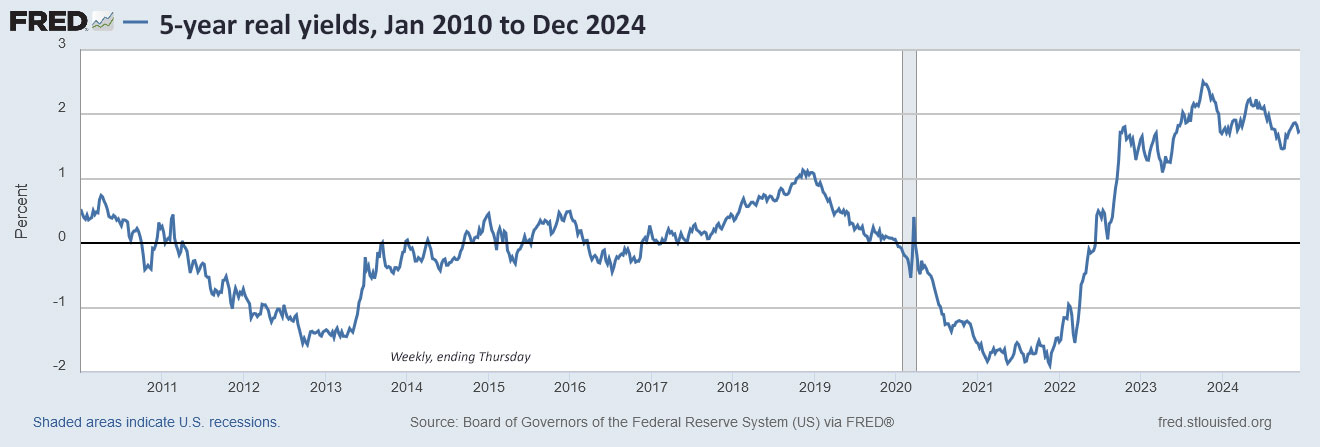
It’s definitely less attractive, we have to admit. But getting a real yield above 1.50% is at least historically appealing, or maybe at least “normal.” Here is a chart of 10-year real yields over the last 14 1/2 years:

Click on image for larger version.

I pushed this chart back to 2010 to reflect the period just before the Federal Reserve began aggressive quantitative easing in mid 2011. In April 2010 real yields peaked at 1.70% but did not again top 1.50% until November 2018. So based on “recent history” 1.50%+ looks like an attractive real yield.

I filled out my TIPS ladder in the late summer of 2023 with TIPS yielding mostly in the 1.7% to 2.2% range. A few months later, it looked like I acted too early because yields continued climbing into October. But today I can say: “I did all right.”

And that is where investors are today, but in reverse. If you are looking to add to your TIPS holdings, should you act now to lock in 1.57% in fear of falling yields, or wait in the hopes that TIPS real yields will bounce higher in the near future? Tough question.

Pricing

The July originating auction for CUSIP 91282CLE9 set its coupon rate of 1.875%, well above today’s market real yield of 1.57%. So it is currently trading at a premium price of about 102.77. In addition, it will have an inflation index of 1.00237 on the settlement date of Sept. 30. With that information, we can estimate the investment cost of $10,000 par at the current real yield of 1.57% (which will likely change by Thursday’s auction):

  • Par value: $10,000.
  • Actual principal purchased: $10,000 X 1.00237 = $10,023.70
  • Cost of investment: $10,023.70 x 1.0277 = $10,301.36
  • + Accrued interest: About $39.32.

In summary, an investor placing a order for $10,000 par at Thursday’s auction will pay about $10,301.36 for $10,023.70 in principal and from that point on will earn accruals on principal matching U.S. inflation plus a coupon rate of 1.875%.

These numbers will change before Thursday’s auction, so this is just an estimate. CUSIP 91282CLE9 trades on the secondary market and could be purchased at any time before the auction, or after, if you see a real yield you like.

Inflation breakeven rate

With the 10-year nominal Treasury note closing Friday at 3.65%, CUSIP 91282CLE9 currently has an inflation breakeven rate of 2.08%, potentially the lowest level at auction since November 2020, in the heart of the pandemic-triggered collapse in yields. A low breakeven rate indicates that a TIPS is “cheap” versus a nominal Treasury of the same term.

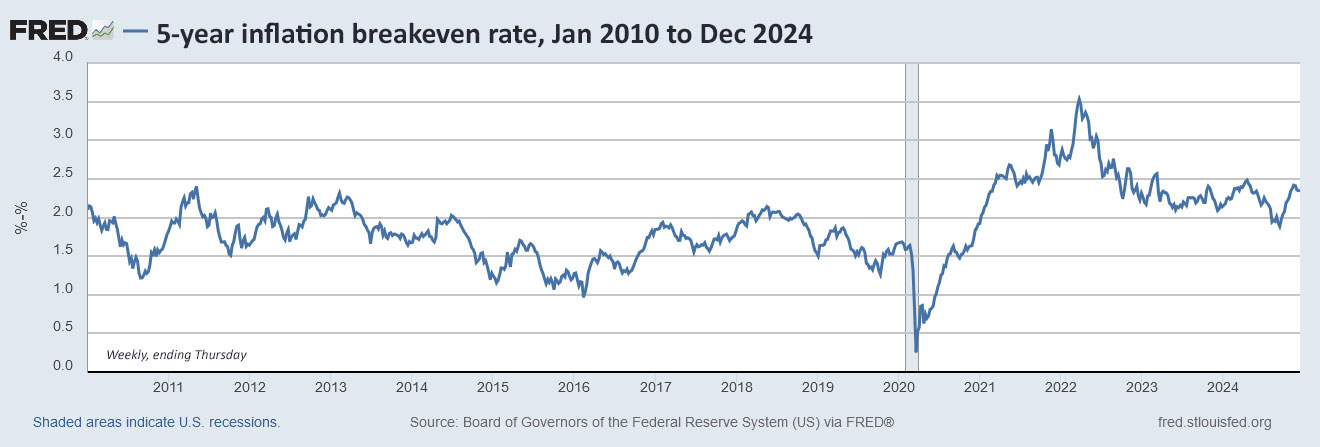
Here is the trend in the 10-year inflation breakeven rate over the last 14 1/2 years, which shows the recent decline from levels nearing 3.0% in April 2022 and then 2.4% in April 2024:

Click on image for larger version.

Do you think inflation will average more than 2.08% over the next 10 years? If so, this TIPS is attractive versus a nominal 10-year Treasury.

I Bond alternative

As real yields decline, the current U.S. Series I Savings Bond — with a fixed rate of 1.3% above inflation — is looking attractive. At Friday’s close, a 5-year TIPS had a real yield of 1.48%, only an 18-basis-point advantage over the I Bond. That is an extremely low spread. At the last rate reset, on May 1, the spread was 95 basis points.

I Bonds with a fixed rate of 1.3% are going to get more and more attractive if TIPS real yields continue to decline through October. The fixed rate, which is permanent, could decline for I Bonds issued after November 1, but it’s too early to make that call.

Final thoughts

There is no particular reason to buy this TIPS at auction instead of on the secondary market, unless you want to use TreasuryDirect (where the minimum purchase is just $100). You can check Bloomberg’s Current Yields page to track the yield of CUSIP 91282CLE9 in real time.

If the real yield was still in the 1.75% range, I’d be tempted to make a purchase. But I have filled the 2034 rung of my TIPS ladder (real yields of 1.81%, 1.89% and 2.04%) and I am awaiting the Jan. 23, 2025, auction of a new 10-year TIPS to mature in January 2035. Real yields seem likely to be lower by then, but I am going to wait it out.

This TIPS auction closes Thursday at 1 p.m. ET. Non-competitive bids at TreasuryDirect must be placed by noon Thursday. If you are putting an order in through a brokerage, make sure to place your order Wednesday or very early Thursday, because brokers cut off auction orders before the noon deadline.

I plan on posting the results after the auction’s close. Meanwhile, here is a history of recent 9- to 10-year TIPS auctions. Notice that less than three years ago the auctioned real yield was -1.145%, the lowest in history for this term:

—————————-

Confused by TIPS? Read my Q&A on TIPS

TIPS in depth: Understand the language

TIPS on the secondary market: Things to consider

TIPS investor: Don’t over-think the threat of deflation

Upcoming schedule of TIPS auctions

* * *

Follow Tipswatch on X (Twitter) for updates on daily Treasury auctions and real yield trends (when I am not traveling).

Feel free to post comments or questions below. If it is your first-ever comment, it will have to wait for moderation. After that, your comments will automatically appear. Please stay on topic and avoid political tirades. NOTE: Comment threads can only be three responses deep. If you see that you cannot respond, create a new comment and reference the topic.

David Enna is a financial journalist, not a financial adviser. He is not selling or profiting from any investment discussed. I Bonds and TIPS are not “get rich” investments; they are best used for capital preservation and inflation protection. They can be purchased through the Treasury or other providers without fees, commissions or carrying charges. Please do your own research before investing.
Posted in Federal Reserve, I Bond, Inflation, Investing in TIPS, Savings Bond, TreasuryDirect | Tagged , , , | 9 Comments

U.S. annual inflation in August fell to 2.5%, lowest since February 2021

By David Enna, Tipswatch.com

U.S. annual inflation continued on a downward trend in August, falling from 2.9% in July to 2.5%, the lowest annual rate in 3 1/2 years.

For the month, seasonally-adjusted inflation rose 0.2%, the Bureau of Labor Statistics reported, which matched expectations. But the annual number was below expectations of 2.6%. Core inflation, which removes food and energy, rose 0.3% for the month (slightly higher than expectations) and held steady at 3.2% for the year.

Once again, shelter costs were the trouble-maker in this inflation report. The index for shelter rose 0.5% in August and was up 5.2% year-over-year. The BLS called shelter “the main factor” in the increase in all-items inflation. Also in the report:

  • Gasoline prices fell 0.6% for the month and are down 10.3% year-over-year.
  • The costs of food at home increased just 0.1% and are up 2.1% for the year.
  • Apparel costs rose 0.3% and were also up 0.3% for the year.
  • The costs of medical care services fell 0.1% for the month but are up 3.2% for the year.
  • Costs of used cars and trucks fell 1.0% (the third monthly decline in a row) and are down 10.4% for the year.
  • Costs of new vehicles held steady and are down 1.2% for the year.
  • Motor vehicle insurance costs increased 0.6% for the month and are up a lofty 16.5% over the last year.
  • Airline fares rose 3.9% for the month, after declining five months in a row.

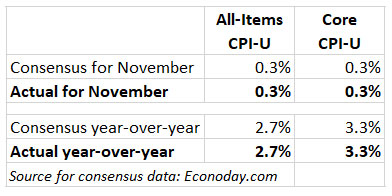
So this report, overall, shows a positive trend of declining U.S. inflation, with the annual rate dropping to its lowest level since February 2021. Inflation watchers know that 2.5% for CPI-U is entering a normal historical range. Here is the trend in U.S. inflation over the last 12 months, showing the sharp decline in all-items inflation, despite lingering high costs of shelter:

What this means for TIPS and I Bonds

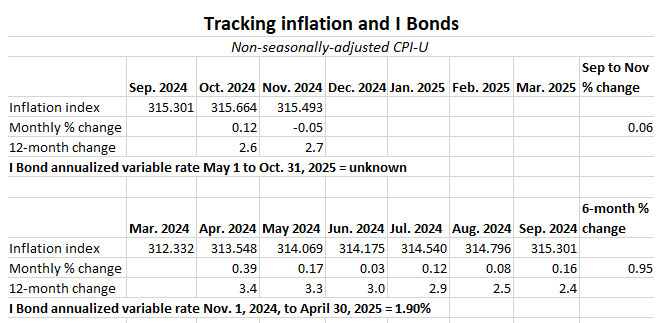
Investors in Treasury Inflation-Protected Securities and U.S. Series I Bonds are also interested in non-seasonally adjusted inflation, which is used to adjust principal balances on TIPS and set future interest rates for I Bonds. For August, the BLS set the CPI-U inflation index at 314.796, an increase of 0.08% over the July number.

For TIPS. Today’s report means that principal balances for all TIPS will increase 0.08% in October, after rising 0.12% in September. Here are the new October Inflation Indexes for all TIPS.

For I Bonds. The August inflation report is the fifth of a six-month string that will determine the I Bond’s new variable rate, which will be reset on November 1 and eventually roll into effect for all I Bonds. After five months, inflation has increased 0.79%, which would translate to a variable rate of 1.58%, down from the current 2.96%.

View historical data on my Inflation and I Bonds page.

One month remains, so we could be looking at a variable rate in the range of 1.78% to 1.98%, which would disappoint I Bond investors. But that’s the trend in inflation over the last half year. And September’s rate is not likely to bump higher, given the current trend in gasoline prices:

I Bonds, in my opinion, remain attractive with the current fixed rate of 1.3%, which remains in place for the potential 30 years to maturity. But older I Bonds with fixed rates of 0.0% to 0.2% are likely to deliver weak returns for six months.

What this means for Social Security COLA

The Social Security Administration uses a different inflation index — CPI-W — to determine the next year’s cost-of-living-adjustment. And it looks only at the average of three months of data, from July to September, compared with the average for the same three months of the previous year. For August 2024, the BLS set the CPI-W index at 308.640, an increase of 2.4% over the last year.

Here is the current trend, with a COLA of 2.4% looking increasingly likely:

My earlier projection of 2.7% is not looking good.

What this means for future interest rates

The August inflation report is good news for the Federal Reserve, even though shelter costs remain a nagging sore point and monthly core inflation was a tick higher than expectations. Annual CPI-U has fallen to 2.5%, and the Fed’s preferred index, Personal Consumption Expenditures, is also trending lower.

The Fed’s Open Market Committee will meet next week and we can be nearly 100% certain that meeting will result in a cut in short-term interest rates. I would guess 25 basis points, because I believe the Fed will want to act cautiously. There is little evidence that the U.S. economy, while slowing, is heading toward a steep decline.

This morning’s Wall Street Journal report includes the subhead: “CPI data tees up Fed to begin gradually cutting rates next week.” That’s on target.

Confused by I Bonds? Read my Q&A on I Bonds

Let’s ‘try’ to clarify how an I Bond’s interest is calculated

Inflation and I Bonds: Track the variable rate changes

I Bonds: Here’s a simple way to track current value

I Bond Manifesto: How this investment can work as an emergency fund

—————————-

Now is an ideal time to build a TIPS ladder

Confused by TIPS? Read my Q&A on TIPS

TIPS in depth: Understand the language

TIPS on the secondary market: Things to consider

TIPS investor: Don’t over-think the threat of deflation

Upcoming schedule of TIPS auctions

* * *

Follow Tipswatch on X (Twitter) for updates on daily Treasury auctions and real yield trends (when I am not traveling).

Feel free to post comments or questions below. If it is your first-ever comment, it will have to wait for moderation. After that, your comments will automatically appear. Please stay on topic and avoid political tirades. NOTE: Comment threads can only be three responses deep or the display breaks on the mobile site. If you see that you cannot respond, create a new comment and reference the topic.

David Enna is a financial journalist, not a financial adviser. He is not selling or profiting from any investment discussed. I Bonds and TIPS are not “get rich” investments; they are best used for capital preservation and inflation protection. They can be purchased through the Treasury or other providers without fees, commissions or carrying charges. Please do your own research before investing.
Posted in Federal Reserve, I Bond, Inflation, Investing in TIPS, Retirement, Savings Bond, Social Security | Tagged , , , | 23 Comments

Looking back at my longest-held stocks

By David Enna, Tipswatch.com

After writing my memorial to financial guru Bob Brinker last week, I thought it would be interesting to look back at my individual stock investments over the years, or at least the ones I am still holding.

Back in 1999, I will admit to being caught up in the stock-trading mania of the time, purchasing stocks like Oracle, AT&T Corp., Broadcom, 3M, Waste Management, Gillette, Phillip Morris, Eli Lilly, etc., etc. I no longer hold any of those stocks. I made profits on some, lost money on some. Trading that often was a bad idea.

After the year 2000, and especially after I retired in 2016, I started to concentrate my holdings in low-cost, quality index ETFs, such as Vanguard Total Stock Market (VTI), Vanguard Total International (VXUS), Vanguard Dividend Appreciation (VIG) and Vanguard Small-Cap Value (VBR). When stocks I held went down enough to minimize capital gains, I sold them and reallocated to these funds.

So today my wife and I own very few individual stocks. Most of the remaining holdings have high capital gains and would best be donated to charity or simply held to … whenever. But how well have these stocks actually performed? That was the question I wanted to answer.

This chart shows every individual stock we currently own, with one exception. The only new holding is Element Solutions Inc. (ESI) which I bought (for some reason) in July 2024. Right now it is down slightly from the purchase price.

The key thing to note here is that the Vanguard Total Stock Market ETF has had an annual total return of 13.63% over the last 15 years, which is better than every one of my longer-term holdings other than Lowe’s Corp., which has returned 18.36%.

On the other hand, my two shorter-term holdings, NVDA and UNH, have done better than the total stock market’s return of 13.72% over the last 5 years.

Why Nvidia?

I am a big fan of computer video games (mostly ones involving dragons) and back in late 2018 Nvidia was producing the highest-quality graphic processing units (GPUs) for gaming. Its stock was tumbling at the time so I bought some. I didn’t pay much attention to the stock until …. 1) the cryptocurrency craze of 2020, when Nvidia chips were highly coveted for crypto mining, and then 2) this year’s artificial intelligence craze, which we are still enduring.

So today the stock is up a ridiculous 3,100%, despite declining sharply in recent weeks. In the past couple years I have sold off about 4 times my original investment, so I am comfortable just holding. NVDA is not my typical investment. There is only one thing to say: I got lucky. Thank the dragons.

The bigger lesson

The stocks I currently own are my “winners” with large capital gains and therefore not attractive to sell. Across the years, there have been plenty of losers and mediocre holdings I’ve sold and then moved proceeds into index funds.

The easy conclusion is that I would have been much better off investing in the total stock market instead of making bets on individual stocks, even with the happy accident of buying Nvidia at just the right time.

Bob Brinker would agree.

* * *

Follow Tipswatch on X (Twitter) for updates on daily Treasury auctions and real yield trends (when I am not traveling).

Feel free to post comments or questions below. If it is your first-ever comment, it will have to wait for moderation. After that, your comments will automatically appear. Please stay on topic and avoid political tirades. NOTE: Comment threads can only be three responses deep or the display breaks on the mobile site. If you see that you cannot respond, create a new comment and reference the topic.

David Enna is a financial journalist, not a financial adviser. He is not selling or profiting from any investment discussed. I Bonds and TIPS are not “get rich” investments; they are best used for capital preservation and inflation protection. They can be purchased through the Treasury or other providers without fees, commissions or carrying charges. Please do your own research before investing.
Posted in Investing in TIPS | Tagged , , , , | 13 Comments

Remembering Bob Brinker … and his life-changing advice

By David Enna, Tipswatch.com

January 26, 1986, was a big day in my life. The Chicago Bears, my longtime favorite team, were playing in the Super Bowl. That afternoon, I was driving with my future wife to a Super Bowl party of Chicago-area folks now living in Charlotte.

Bob Brinker: Oct. 1, 1941 – Aug. 18, 2024

We were listening to WBT-AM radio, because I liked to hear talk and there were no sports-talk radio stations in Charlotte back then. At 4 p.m., on came a new show, “Bob Brinker’s MoneyTalk.” OK, let’s give this guy a try.

I swear, within 15 minutes I turned to my future (and still) wife and said, “This guy is good.” There were other financial guys on the radio back then, but they were usually selling something, probably disastrous. Bob Brinker was just doling out excellent advice: 1) invest in low-cost index mutual funds, 2) favor quality companies like Vanguard, 3) commit to the plan, 4) and aim for “critical mass.”

By the way, the Bears won that Super Bowl, 46-10. And I got married in May 1986. It was a very good year.

From that day on, I tried really hard to listen to Brinker’s radio show, which aired from 4 to 7 p.m. ET on Saturdays and Sundays. I’d carve out part of my weekend to try to hear at least some of what he had to say. In later years, the show got preempted on some Sundays by Carolina Panthers post-game shows (my new favorite team), but I’d try to catch the replay later that night.

Here is Brinker in 2011 criticizing the “sharks” circling investors and the do-it-yourself approach to reaching “critical mass”:

Bob Brinker was financial comfort food. His advice was rock solid because it focused on a do-it-yourself approach emphasizing index funds and low-cost investing. In the late 1990s he began talking — often — about newly minted investments called Treasury Inflation-Protected Securities and U.S. Series I Savings Bonds. I had never heard of them. But I did some research and liked what I saw.

Through the year 2001 — triggered by Bob’s advice — I bought TIPS and I Bonds with real yields of 3.0% and higher. At the time, I didn’t realize how great these yields were. I still hold all the I Bonds and one of the TIPS (all the others have matured) with an above-inflation coupon rate of 3.875%, very close to day’s nominal return of 4.2% on a 30-year Treasury bond. It will mature in April 2029.

He also had an occasional segment where he recommended investment books, all solid choices. I read quite a few of them. Here is a top 10 list compiled by his son.

Brinker published a newsletter called “Marketimer,” which I subscribed to for a few months. The title was a misnomer because Brinker rarely advised trading. He just presented model portfolios for various risk levels, and not much changed.

His one big call

While Brinker very rarely made timing calls, he did look at factors like the state of the economy, monetary policy, valuations and investor sentiment. In January 2000 he advised his newsletter readers to switch to a 60% cash reserve after years of high market gains. The radio listeners got that call a few weeks later.

One thing to keep in mind is that the U.S. stock market was soaring after the greatest bull market of our lifetimes. The S&P 500 net asset value increased every year except one from 1982 to 1999. Baby boomers who were investing created a lot of wealth in those years.

I can remember hearing this caution while driving somewhere in the North Carolina mountains. I also remember I owned a Janus mutual fund that had gained 100% over the last year. So when I got home, I sold that fund and moved a bit more to cash. Or, more probably, I bought Vanguard’s GNMA fund, which Brinker was often recommending. It had a total return of 11.2% in 2000, 7.9% in 2001 and 9.7% in 2002.

My feeling is that Brinker did sense doom in early 2000 and he made a great call. He reached legendary status after that call, but his later timing advice was randomly good and bad. Investment researchers have found that his overall track record on market timing was so-so. Reminder: No one can predict the market.

Brinker retired from the radio show in 2018 and his newsletter closed down in June 2023. He died Aug. 18, 2024, at the age of 82. Here is the obituary.

Reaching ‘critical mass’

I feel fortunate to have been investing through all those boom years. The severe bear market after the dot-com bubble taught me a lesson about asset allocation: Don’t swing for a home run every time. Rebalancing after big gains (and losses) is smart. Safety is also a very good thing. TIPS and I Bonds fit a need for me, creating a life-long interest.

Brinker’s idea of critical mass was reaching a level of financial security where your money is working for you and you can just enjoy life, with few concerns. I can remember when I was a teenager and our garbage disposal broke. My mother told me, “We don’t have the money to fix this.” My dad was a corporate accountant. I didn’t want to live like that.

With his solid and sensible advice, Bob Brinker offered a path to a secure financial future, what he sometimes called “the cat bird’s seat.” I am grateful for that financial inspiration. RIP, Bob Brinker.

* * *

Follow Tipswatch on X (Twitter) for updates on daily Treasury auctions and real yield trends (when I am not traveling).

Feel free to post comments or questions below. If it is your first-ever comment, it will have to wait for moderation. After that, your comments will automatically appear. Please stay on topic and avoid political tirades. NOTE: Comment threads can only be three responses deep or the display breaks on the mobile site. If you see that you cannot respond, create a new comment and reference the topic.

David Enna is a financial journalist, not a financial adviser. He is not selling or profiting from any investment discussed. I Bonds and TIPS are not “get rich” investments; they are best used for capital preservation and inflation protection. They can be purchased through the Treasury or other providers without fees, commissions or carrying charges. Please do your own research before investing.
Posted in Federal Reserve, Inflation, Investing in TIPS, Retirement | 46 Comments