Let’s take a look back at IVOL, a once-hot inflation-fighting ETF

By David Enna, Tipswatch.com

Back in the fall of 2020, when I was still writing for SeekingAlpha, I was getting a lot of questions about a new ETF with a tongue-twisting title: the Quadratic Interest Rate Volatility and Inflation Hedge ETF. Fortunately, everyone knew this fund by its ticker: IVOL.

The ETF’s creator, Nancy Davis of Quadratic Capital, was hailed as an innovator for this fund. Barron’s named her one of its top 200 Women in Finance in March 2020. But for me, IVOL was never particularly attractive. It was very new, with just a year of trading history. It was a fixed-income fund with a 1% expense ratio and a complex hedging strategy I couldn’t understand.

But … the interesting thing about IVOL is that it holds about 85% of its assets in SCHP, Schwab’s U.S. TIPS ETF, my favorite full-maturity-spectrum TIPS fund. On top of that, it overlays hedging strategies that seek to benefit from interest rate volatility. Quadratic’s information on the fund includes this summary of its strategy:

IVOL is a fixed income ETF that seeks to hedge relative interest rate movements, whether these movements arise from falling short-term interest rates or rising long-term interest rates, and to benefit from market stress when fixed income volatility increases, while providing the potential for enhanced, inflation-protected income.

Since IVOL launched in May 2019, we’ve certainly had a lot of interest rate volatility, but not in the way IVOL was targeting. Short-term interest rates have surged dramatically higher, while long-term rates have stabilized well below short-term rates, resulting in an inverted yield curve. So the performance of IVOL has suffered.

Remember, IVOL holds 85% of its assets in SCHP, but has an expense ratio about 25x higher than SCHP, 1% versus 0.04%. Here is a comparison of the total return for IVOL over the last three years versus SCHP, the total bond market ETF (BND) and Vanguard’s short-term TIPS ETF (VTIP).

Click on the image for a larger version.

From the chart, it is easy to see why IVOL, a shiny new invention, was such a hot fund in 2020, when it trounced the performance of similar investments, nearly doubling the return of the total bond market, 14.6% versus 7.7%. It benefited from having hedged positions that gained from falling short-term interest rates. The yield on a 13-week Treasury fell from 1.54% on Jan. 2, 2020, to 0.09% on Dec. 31.

In 2021, as both short- and long-term interest rates stabilized at very low levels, IVOL under-performed its two TIPS fund competitors by a wide margin. In 2022, when interest rates across all maturities surged strongly higher, all of these funds did poorly with the exception of the shorter-duration VTIP.

In summary, over the last three years, IVOL has out-performed the overall bond market, while under-performing the overall TIPS market. So I conclude that it has failed, so far, in its goal to provide “enhanced, inflation-protected income.” As a high-expense bond fund, I’d give it a B rating. But as a high-expense TIPS funds, it gets a C-.

A trial investment?

In September 2020 I decided to make small investments ($5,000) in both SCHP and IVOL and then track the results over time, with dividends being reinvested. But when I went to purchase IVOL, Vanguard informed me that its trading volume was too small for dividend reinvestments. I threw out that story idea and pretty much forgot about IVOL: too new, too small, too complex, and too expensive.

IVOL today

Nancy Davis still pops up often on Bloomberg and CNBC as a financial expert, and that makes sense because she has a lot of insight into the bond market. Here is a recent CNBC interview where she expresses a view I agree with: That we should see a less-inverted yield curve going forward:

A Forbes article this week took a look at IVOL, noting its celebrated launch in 2019 but mediocre performance since late in 2021. Here is a chart from the article, which is behind the Forbes paywall but also appears on MSN.com here:

Click on image for larger version.

The author, Brandon Kochkodin, has a certain way with words. Just take a look:

While others were asking whether inflation was dead, Davis was pitching her firm’s Interest Rate Volatility & Inflation Hedge ETF (IVOL). IVOL is a chimera, a lion with a goat’s head sticking out of its back. Most of its assets are held in a bond ETF that any mom or pop can buy. The rest of the money goes to options bets that are off limits to even many professional asset managers because of the sophisticated ways they offer investors of losing their shirts. It’s the options, however, that make IVOL unique and what could, if inflation expectations rise sharply and quickly enough, provide a windfall.

Davis’ timing couldn’t have been more perfect. By 2021, fretting about inflation moved from the fringe to the frontline. IVOL’s assets under management soared to more than $3.5 billion …

Nearly four years after raising the curtains … IVOL is in a rut.

Now, after attracting $3.5 billion in assets under management during its surge of popularity two years ago, IVOL today has total assets of $929.1 million. It’s daily volume is about 426,339 shares, compared with 2.47 million for SCHP and 3.46 million for VTIP.

I was wary of IVOL back in 2020, but that is my nature: I am wary of every new-fangled idea I can’t quite understand. The expense ratio of 1% turned me off. The complexity turned me off. The newness and small trading volume turned me off. That was 4 strikes, and I was out.

In coming months, if the yield curve does indeed begin widening back to normal, IVOL should do better. But it still doesn’t interest me.

* * *

Feel free to post comments or questions below. If it is your first-ever comment, it will have to wait for moderation. After that, your comments will automatically appear.Please stay on topic and avoid political tirades.

David Enna is a financial journalist, not a financial adviser. He is not selling or profiting from any investment discussed. I Bonds and TIPS are not “get rich” investments; they are best used for capital preservation and inflation protection. They can be purchased through the Treasury or other providers without fees, commissions or carrying charges. Please do your own research before investing.

Posted in ETFs, Inflation, Investing in TIPS | 8 Comments

TreasuryDirect 1099s: How to find your tax forms, decipher them

And of course, because it’s TreasuryDirect, it’s complicated.

By David Enna, Tipswatch.com

If you hold Treasury issues of any kind (except possibly Savings Bonds) at TreasuryDirect, you should be getting a friendly email this week. It will say something like:

TreasuryDirect 1099 Statement Information

Dear Account Owner: Please check the Investor InBox section of your TreasuryDirect account and all linked accounts, if applicable, for important tax information.

OK, so there you go. No clickable link, which is probably a good idea in a time of escalating phishing attempts. But there is one link in the email, to a 2-minute video explaining how to find and print the 1099s for your main and linked TreasuryDirect accounts:

The video is fine, but it does end abruptly in the middle of a sentence, and makes no attempt to explain what you will actually see in the 1099s. If you hold Treasury Inflation-Protected Securities at TreasuryDirect, or if you have had maturing TIPS, there could be some complications. I’ve had many readers tell me they couldn’t find the 1099-INT for TIPS, and that they didn’t even know a 1099-OID exists, or what it is. These forms are there.

TreasuryDirect is NOT going to mail you these forms. You need to hunt them down.

Note: If your only holdings at TreasuryDirect are I Bonds or EE Bonds, and you didn’t have any matured or redeemed savings bonds in 2022, you won’t find 1099s for that year. Those savings bonds earn tax-deferred interest by default, and so there are no tax forms unless you redeemed an issue or had it mature.

1099 hunt: Step-by-step process

1. Log into your TreasuryDirect account. Simple enough, right? Yes, if you remember your password and can clear the two-step verification.

2. Go to ManageDirect. Once you log in, you will notice you have a message in your Inbox, which informs you the 1099s are available:

To view a summary of your taxable transactions, and to print your 1099, please access your account and go to the ManageDirect tab, then click the appropriate tax year under the heading “Manage My Taxes.”

Important: Once you are inside the account section of TreasuryDirect, never click on your browser’s back button. If you do, you will be booted out of TreasuryDirect and you will have to log in again. To navigate, either click on the top row of tabs or click “return” at the bottom of most pages.

To get to ManageDirect from the account home page, click on “ManageDirect” in the top row of tabs:

3. Click on ‘Year 2022’ in the Manage My Taxes section, bottom left.

This is what the ManageDirect page looks like. Click on “Year 2022” under “Manage My Taxes.”

4. Click on ‘View your 1099 for tax year 2022’ When the Year 2022 page opens, you will see a lot of information about every transaction in 2022, but what you want is the 1099, not this listing. So find the tiny little link to your 1099 and click.

5. Successfully respond to the security question. Yes, one more step before you get to the 1099. You have to answer the security question. This can be difficult if you created your account 20 years ago and your taste in movies has advanced since then …

Sometimes the security question is: “You were born in what city?” … A bit easier to answer.

6. Bingo! Your 1099 now opens. But this is not like any 1099 you’d see from any other bank or brokerage. It is long-winded (mine was 11 printed pages) and not really crystal clear. But thank God the form complies with “Paperwork Reduction Act Notices.”

7. Print it. There is no print button on this page. To print it from your computer, click on the page and then do a “CONTROL P.” (Or on a Mac, “Command P.”) That should open your computer’s print menu. If that doesn’t work, you could copy the entire thing into a Word document and then print that.

Form 1099-INT

If you hold TIPS at TreasuryDirect, you will have at least two 1099s included in these pages: 1099-INT for the coupon interest you earned, and 1099-OID for taxable inflation accruals you received in 2022. Here is what the opening lines of form 1099-INT look like.

At the very end of the 1099-INT listing, you will see the total. On your tax return, this will be entered into Box 3 on the form for 1099-INT. Correct me if I am wrong. The definition of Box 3:

The information displayed above in the 1099-INT section shows interest paid to you for tax year ending 12-31-2022. … Shows interest on U.S. Savings Bonds, Treasury Bills, Treasury Notes, Treasury Bonds and Treasury Inflation-Protected Securities (TIPS). … This interest is exempt from state and local income taxes.

Form 1099-OID

Inflation accruals for TIPS held in a taxable account are taxable in the year they were accrued, even though they were not yet paid out. These accruals are tallied in 1099-OID, with OID standing for Original Issue Discount. These are listed in another section of the 1099, and here is what the top looks like:

At the bottom is the total, which is entered into Box 8 of the 1099-OID section of your tax return. And here is the TreasuryDirect definition:

Original issue discount (OID) is the excess of an obligation’s stated redemption price at maturity over its issue price. OID on a taxable obligation is taxable as interest over the life of the obligation. If you are the holder of a taxable OID obligation, you generally must include an amount of OID in your gross income each year you hold the obligation.

For Box 8: Shows OID on a U.S. Treasury obligation for the part of the year you owned it. Report this amount as interest income on your federal income tax return. … This OID is exempt from state and local income taxes. If the number in this box is negative, it represents a deflation adjustment.

Form 1099-B

If you had a Treasury issue that matured in 2022, you may find tax information in this section, as I did for a TIPS that matured April 15, 2022. I bought that TIPS at a Dec. 21, 2017, reopening. It had a discounted price of $98.96 for $100 of value. So apparently this triggered a very small long-term capital gain. Here is how TreasuryDirect shows this, with the amounts hidden:

TreasuryDirect says these proceeds should be reported to the IRS on form 8949, part D, which is for a long-term gain, but the gain goes in Box 1f, which is for an adjustment to a gain. All of this is a bit of a mystery to me and I don’t recall getting a 1099-B in the past. But the amount is quite small. I’ll let TurboTax handle this.

What about a conventional brokerage?

I have no idea how forms 1099-INT and 1099-OID for TIPS are handled at a typical brokerage, because all my TIPS holdings at a brokerage are in a tax-deferred account. If others have information, provide it in the comments section below.

Final thoughts

It should be obvious at this point that I am no tax expert, so nothing you just read should be considered tax advice. Still, getting these 1099s from TreasuryDirect is EXTREMELY IMPORTANT. You are going to get one email with a fairly cryptic message. That’s it. Nothing in the mail. No easy-to-read tax summary like you receive from your broker. It’s up to you to go to TreasuryDirect, find the 1099s, print them, decipher them and report them on your tax return for 2022.

Happy hunting.

Confused by TIPS? Read my Q&A on TIPS

TIPS in depth: Understand the language

Upcoming schedule of TIPS auctions

* * *

Feel free to post comments or questions below. If it is your first-ever comment, it will have to wait for moderation. After that, your comments will automatically appear.Please stay on topic and avoid political tirades.

David Enna is a financial journalist, not a financial adviser. He is not selling or profiting from any investment discussed. I Bonds and TIPS are not “get rich” investments; they are best used for capital preservation and inflation protection. They can be purchased through the Treasury or other providers without fees, commissions or carrying charges. Please do your own research before investing.

Posted in Investing in TIPS, Treasury Bills, TreasuryDirect | 59 Comments

New 10-year TIPS auctions with a real yield of 1.22%, to apparently high demand

By David Enna, Tipswatch.com

After a week of declining yields in the Treasury market, a new 10-year TIPS auctioned Thursday with a real yield to maturity of 1.22%, a bit lower than looked likely just before the auction’s close.

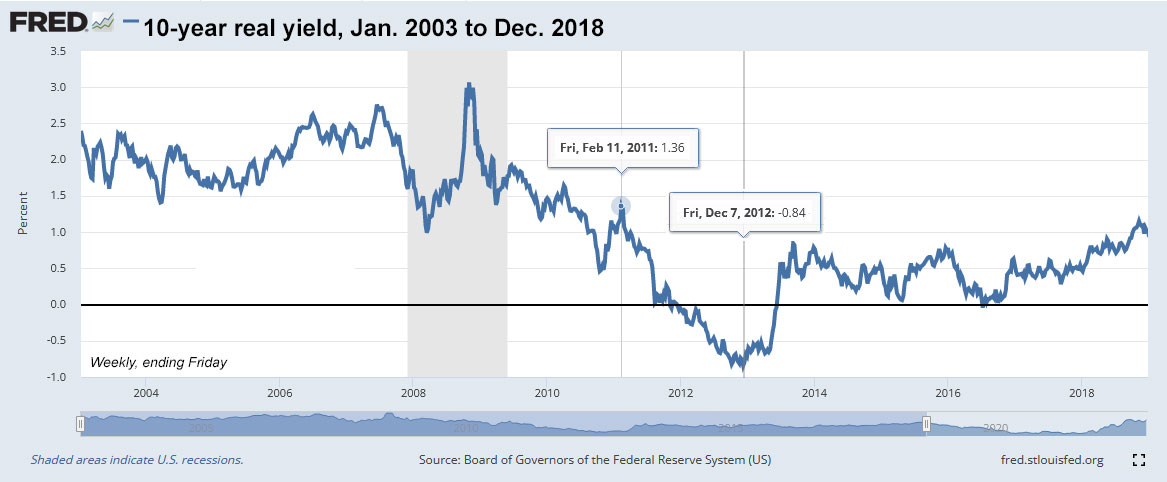
This is CUSIP 91282CGK1, and its coupon rate was set at 1.125%, the highest coupon rate for any new 10-year TIPS since an auction in January 2011, which had a surprisingly similar result: real yield of 1.17% and coupon rate of 1.125%. A few months after that 2011 auction, 10-year real yields fell sharply, hitting -0.13% by August 10.

All morning, CUSIP 91282CGK1 looked likely to get a real yield of about 1.24%, and the “when issued” premarket was set at 1.26%. So the result of 1.22% appears to have been caused by high investor demand. The bid-to-cover ratio was set at 2.79, well above any recent auction of this term.

Definition: The “real yield” of a TIPS is its yield above official future U.S. inflation, over the term of the TIPS. So a real yield of 1.22% means an investment in this TIPS will exceed U.S. inflation by 1.22% for 10 years. If inflation averages 2.2%, you’d get a nominal return of 3.42%, on par with a nominal 10-year U.S. Treasury, currently 3.42%. But if inflation averages 4.5%, you’d get a nominal return of 5.72%.

Pricing

This new 10-year TIPS is a bit unique because it auctioned with an adjusted price below par value, which is fairly rare for a new offering. The details:

The key factors here are that the unadjusted price was $99.11 for $100 of value and the inflation index on the settlement date of Jan. 31 will be 0.99948. Accrued interest will be about 49.6 cents per $1,000 investment. Here is how the pricing works out:

Inflation breakeven rate

With a 10-year nominal Treasury note trading with a yield of 3.42% at the auction’s 1 p.m. close, this TIPS gets an inflation breakeven rate of 2.20%, just slightly higher than the market rate earlier in the day. This is the lowest auctioned breakeven rate for this term since January 2021. I’d say this is an attractive rate, making this TIPS appealing versus a nominal Treasury.

Reaction to the auction

This one was a bit ill-fated, with a slew of economic reports arriving this week pointing to a downturn in the economy. That is putting more pressure on the Federal Reserve to call a halt to its current hawkish interest rate increases. But a lot of this sentiment is cyclical. We could see rates rising next week. Or maybe falling.

As I have noted before, this is only the fifth TIPS auction of this term since January 2011 to get a real yield to maturity higher than 1%. There have been 72 auctions of this term over that time span, so today’s result is welcome, even if real yields dipped a bit in the closing hours.

This chart shows the market’s quick reaction to the auction’s close at 1 p.m. ET, with the broad-based TIP ETF surging higher in reaction to the apparently strong demand.

I know a lot of new TIPS investors jumped aboard this auction, and I want to reinforce my view that the result was positive for investors: A rare real return on your money surpassing 1.2%, over 10 years, while also priced slightly below par value. Of course, there will be two more reopening auctions of this issue — in March and May — and then a new 10-year TIPS will be auctioned in July. So more opportunities to come.

Here are auction results for this term over the last five years:

* * *

Feel free to post comments or questions below. If it is your first-ever comment, it will have to wait for moderation. After that, your comments will automatically appear.Please stay on topic and avoid political tirades.

David Enna is a financial journalist, not a financial adviser. He is not selling or profiting from any investment discussed. I Bonds and TIPS are not “get rich” investments; they are best used for capital preservation and inflation protection. They can be purchased through the Treasury or other providers without fees, commissions or carrying charges. Please do your own research before investing.

Posted in Investing in TIPS | 58 Comments

Let’s do a quick check-in on Thursday’s 10-year TIPS auction

By David Enna, Tipswatch.com

After another day of turmoil in financial markets, real yields slipped lower Wednesday heading into Thursday’s originating auction for CUSIP 91282CGK1, creating a 10-year Treasury Inflation-Protected Security.

A lot happened, I guess. I was out of the house all day today and couldn’t follow financial developments. But here is the gloomy collection I could gather from Bloomberg’s afternoon report:

  • Growth in producer prices slid more than expected last month.
  • The drop in retail sales exceeded estimates.
  • Business equipment production slumped.
  • Microsoft Corp. plans to cut 10,000 jobs.
  • Bank of America started telling executives to pause hiring.
  • Crypto firm Genesis Global Capital is laying groundwork for bankruptcy.
  • The S&P 500 fell 1.6% in the day’s trading.
  • And … bonds rallied as yields fell in line with fears of recession.

That’s a lot to digest. The nominal yield on a 10-year Treasury note fell 16 basis points to 3.53%, according to Treasury estimates. And the real yield of a 10-year TIPS dropped to 1.25%, down 11 basis points in one day. On the secondary market, the real yield of the most recent 10-year TIPS fell to 1.23% in late trading, according to Bloomberg’s Current Yields.

It’s interesting that the market has decided to place the 10-year TIPS at the lowest point of the yield curve. On the other hand, this is the “sweet spot” of TIPS investing, and the term that is in highest demand.

So what’s ahead?

My crystal ball has become very cloudy and I have no idea where tomorrow’s 10-year TIPS auction is heading. But I went ahead and placed a brokerage order to purchase this TIPS.

As I have noted before, I am looking to fill the 2033 slot in my TIPS ladder. I looked at that ladder this afternoon. It has 18 TIPS issues with maturities from April 2023 to February 2043. Of those 18, only six were purchased with a real yield higher than 1%. CUSIP 91282CGK1 is going to be the seventh.

Better opportunities may be coming later in 2023, and I will add to my holdings if I see the chance. It looks like tomorrow’s auction will end up with a real yield somewhere around 1.25% and a coupon rate of 1.125% to 1.25%. But nothing is certain.

I will be reporting the auction results soon after the auction closes at 1 p.m. ET.

* * *

Feel free to post comments or questions below. If it is your first-ever comment, it will have to wait for moderation. After that, your comments will automatically appear.Please stay on topic and avoid political tirades.

David Enna is a financial journalist, not a financial adviser. He is not selling or profiting from any investment discussed. I Bonds and TIPS are not “get rich” investments; they are best used for capital preservation and inflation protection. They can be purchased through the Treasury or other providers without fees, commissions or carrying charges. Please do your own research before investing.

Posted in Investing in TIPS | 23 Comments

A 10-year TIPS matured Sunday. How did it do as an investment?

Despite a real yield deeply negative to inflation, CUSIP 912828UH1 outperformed a nominal 10-year Treasury.

By David Enna, Tipswatch.com

Sometimes what looks like a perfectly awful investment will end up surprising you. That is the case with CUSIP 912828UH1, a 10-year Treasury Inflation-Protected Security that had an originating auction on Jan. 24,2013. It matured Sunday, 10 years later. So how did it do as an investment?

The originating auction got a real yield to maturity of -0.630%, a really bad-looking number. It means investors were willing to accept a return 0.630% less than inflation over the next 10 years. Why would they do that? Because yields for all safe investments were deeply depressed. At the time, a 10-year Treasury note had a nominal yield of 1.86%, also highly unattractive.

So this ends up being a matter of which ugly-duckling investment did better if purchased in January 2013 — a 10-year TIPS or a 10-year Treasury note?

The auction set CUSIP 912828UH1’s coupon rate at 0.125%, the lowest the Treasury will go for a TIPS. And its 10-year inflation breakeven was a lofty 2.49%, much higher than today’s rate of 2.18%, even after two years of ultra-high inflation. In January 2013, annual inflation was running at 1.6%, versus today’s 6.5%.

All of this makes CUSIP 912828UH1 look like an awful investment.

In reality … not so bad

This TIPS ended its life Sunday with an inflation index of 1.29050, meaning it got a cumulative gain from inflation of about 29.1%, or an annualized increase of about 2.6%. Since the inflation breakeven rate was 2.49%, it outperformed the 10-year nominal Treasury by about 0.11% a year. Not spectacular, but this does demonstrate that even a TIPS with a negative real yield and a high inflation breakeven rate can turn out to be a “relatively” good investment.

For most of the last 12 years, TIPS have under-performed nominal Treasurys of the same term, because inflation ran at unexpectedly low levels through much of that time. But the trend has reversed because of the high inflation of the last two years.

Click on the image for a larger version.

My investment in 912828UH1

I didn’t buy at the originating auction, but I did cave in at the May reopening and bought $15,000 of par value, getting a “more attractive” real yield to maturity of -0.225%. This was in a taxable account at TreasuryDirect, and the inflation breakeven also was more attractive at 2.14%. I had to pay $15,511 because of the premium price and inflation index of 1.00837. This TIPS matured Sunday and TreasuryDirect delivered $19,357.50 to my bank account.

That’s a gain of 24.8% on my purchase price, plus I collected 0.125% annually, rising with inflation. So the annualized return was around 2.6%. Was it a great investment? Not really. But good enough. And now I have cash to fund my I Bond purchases in 2023.

One more thing: A followup

Back in early September I wrote an article titled: “What’s up with those crazy real yields on ultra-short-term TIPS?” In the article I used CUSIP 912828UH1 as an example, because I was getting a lot of questions about it, based on this market quote showing a gaudy real yield of 4.047%:

The article explained that because there was only one more coupon payment remaining, and only a few months of highly iffy inflation accruals, the market was probably pricing this issue correctly. Go back and read the article, if you want, but I said it looked like buying on Sept. 1 at the then-current price would result in an annualized return of about 4.28%, better than the yield at the time on a 6-month Treasury, then at 3.34%.

But it did a bit better than that. Here is how it turned out:

So an investor putting $10,000 into this TIPS on Sept. 1 ended up with an investment return of $252, which equates to a nominal return of 2% in 4 1/2 months, or an annualized return of 6.0%, much better than what a 6-month Treasury was paying at the time.

Notes and qualifications

My TIPS vs. nominals chart is an estimate of performance, because annualized inflation rates are based on a full month of inflation in the beginning and ending months, when actually TIPS accruals are based on a half month for the first and last months, with the origination and maturity occurring on the 15th of the month.

Keep in mind that interest on a nominal Treasury and the TIPS coupon rate is paid out as current-year income and not reinvested. So in the case of a nominal Treasury, the interest earned could be reinvested elsewhere, which would potentially boost the gain. For certain, we don’t know what the investor could have earned precisely on an investment after re-investments.

In the case of a TIPS, the inflation adjustment compounds over time, and that will give TIPS a slight boost in return that isn’t reflected in the “average inflation” numbers presented in the chart.

Confused by TIPS? Read my Q&A on TIPS

TIPS in depth: Understand the language

Upcoming schedule of TIPS auctions

* * *

Feel free to post comments or questions below. If it is your first-ever comment, it will have to wait for moderation. After that, your comments will automatically appear.Please stay on topic and avoid political tirades.

David Enna is a financial journalist, not a financial adviser. He is not selling or profiting from any investment discussed. I Bonds and TIPS are not “get rich” investments; they are best used for capital preservation and inflation protection. They can be purchased through the Treasury or other providers without fees, commissions or carrying charges. Please do your own research before investing.
Posted in Inflation, Investing in TIPS, TreasuryDirect | 5 Comments