30-year TIPS auction gets a real yield of 1.55%, highest in nearly 12 years

By David Enna, Tipswatch.com

A new 30-year Treasury Inflation-Protected Security — CUSIP 912810TP3 — auctioned today with a real yield to maturity of 1.550%, the highest auctioned yield for this term since June 2011.

The auction seems to have attracted lukewarm demand. A 29-year TIPS was trading on the secondary market all morning with a real yield of 1.53% and the “when issued” yield prediction for this TIPS was also 1.53%. The bid to cover ratio was a middling 2.38.

So investors were able to nab a slightly higher real yield, and that’s a good result. The real yield to maturity of 1.55% was the highest for any 29- to 30- year TIPS at auction since June 2011, when a 29-year, 8-month TIPS got a real yield of 1.744%. The Treasury set the coupon rate at 1.50%, the highest for any TIPS since a February 2011 new-issue auction at 2.125%.

Definition: The “real yield” of a TIPS is its yield above official future U.S. inflation, over the term of the TIPS. So a real yield of 1.55% means an investment in this TIPS will exceed U.S. inflation by 1.55% for 30 years. If inflation averages 2.3%, you’d get a nominal return of 3.85%, on par with a nominal 30-year U.S. Treasury. But if inflation averages 4.5%, you’d get a nominal return of 6.05%.

Here is the trend in the 30-year real yield since January 2021, more than a year before the Federal Reserve began aggressive moves to increase interest rates and fight inflation:

Pricing for this TIPS

The unadjusted price was $98.804809 for $100 of value, meaning that investors actually paid less than par value for this TIPS.

The key factors here are that the unadjusted price was about $98.80 for $100 of value and the inflation index on the settlement date of Feb. 28 will be 0.99857. Accrued interest will be about 53.8 cents per $1,000 investment. Here is how the pricing works out:

One note: Anyone who purchased $10,000 in this TIPS got $10,000 in par value, but the actual principal total on the settlement date of Feb. 28 will be $9,985.70, because the inflation index was less than 1.0. This reflects deflation of 0.31% recorded in December 2022. But in March, this TIPS will get an inflation accrual of 0.8%, based on non-seasonally adjusted inflation recorded in January 2023.

Inflation breakeven rate

With a 30-year nominal Treasury trading with a yield of 3.90% at the auction’s close, this TIPS gets an inflation breakeven rate of 2.35%, a bit higher than recent results for this term. In the February 2022 auction for this term, the breakeven rate was 2.11%. Here is the trend in the 30-year inflation breakeven rate since January 2021, showing the fairly strong variations caused by the financial market’s hot and cold opinions of U.S. inflation:

Reaction to the auction

Source: Yahoo Finance

It was a good result for investors, with both the real yield and coupon rate topping 1.5%, the highest in nearly 12 years. The TIPS market seems to be reacting with a yawn, with the TIP ETF barely nudging higher after the auction’s close. The 30-year maturity isn’t highly traded and makes up only a small portion of the TIP ETF’s holdings. No big deal, it appears.

For people with the fortitude to buy a highly volatile 30-year Treasury, this is an attractive purchase, locking in a yield 1.55% higher than official U.S. inflation over 30 years.

Here is a recent history of auctions of this term:

Confused by TIPS? Read my Q&A on TIPS

TIPS in depth: Understand the language

TIPS on the secondary market: Things to consider

Upcoming schedule of TIPS auctions

* * *

Feel free to post comments or questions below. If it is your first-ever comment, it will have to wait for moderation. After that, your comments will automatically appear.Please stay on topic and avoid political tirades.

David Enna is a financial journalist, not a financial adviser. He is not selling or profiting from any investment discussed. I Bonds and TIPS are not “get rich” investments; they are best used for capital preservation and inflation protection. They can be purchased through the Treasury or other providers without fees, commissions or carrying charges. Please do your own research before investing.

Posted in Investing in TIPS | 15 Comments

January inflation came in higher than expected, rising 0.5% to an annual rate of 6.4%

Non-seasonally adjusted inflation rose 0.8%, giving a boost to investors in TIPS and I Bonds.

By David Enna, Tipswatch.com

The January inflation report, just released by the Bureau of Labor Statistics, showed a return to higher-than-expected U.S. price increases, after several months of mild inflation.

The Consumer Price Index for All Urban Consumers rose 0.5% in January on a seasonally adjusted basis, the BLS said. Over the last 12 months, the all-items index increased 6.4%. January’s monthly number equaled economist expectations, but the year-over-year rate was above expectations of 6.2%. Core inflation, which removes food and energy, increased 0.4% for the month and 5.6% for the year. Both of those numbers were higher than expectations.

Looking for a positive spin? The all-items annual increase of 6.4% was the smallest 12-month increase since the period ending October 2021, the BLS said.

Both all-items and core inflation were heavily influenced by the cost of shelter, which accounted for nearly half of the all-items increase in January. Shelter costs were up 0.7% for the month and 7.9% year-over-year. Shelter costs tend to be controversial, at least to CNBC talking heads, because they are considered a lagging indicator. More from the report:

  • Costs for food at home increased 0.4% in January and were up 11.3% year over year. The index for eggs rose 8.5% for the month. In contrast, the fruits and vegetables index fell 0.5%.
  • Gasoline prices increased 2.4% for the month after falling 9.3% over the previous two months. Gas prices are now up just 1.5% year-over-year.
  • Costs for utility gas service increased 6.7% for the month and are up 26.7% for the year.
  • The medical care services index fell 0.7% in January, to an annual rate of 3.0%.
  • Costs for used cars and trucks fell 1.9% for the month, the 7th straight month of decreases. These costs are now down 11.6% from the elevated level of 2022.
  • Costs for new vehicles rose 0.2% for the month and are up 5.8% for the year.

The January report incorporates reweightings of the sector indexes to reflect consumer survey information from 2021. For more on this, see the BLS fact sheets. Based on BLS estimates, this reweighting could have slightly increased the all-items number versus the old weightings, since costs of shelter got a higher weighting and used vehicles got a lower weighting.

Here is the one-year trend for annual all-items and core inflation, showing how the two rates are aligning as shelter prices rise and gasoline prices moderate. Both all-items and core inflation, while remaining high, have been trending lower since September:

What this means for TIPS and I Bonds

Investors in Treasury Inflation-Protected Securities and U.S. Series I Savings Bonds are also interested in non-seasonally adjusted inflation, which is used to adjust principal balances on TIPS and set future interest rates for I Bonds. For January, the BLS set the CPI index at 299.170, an increase of 0.80% over the December number.

For TIPS. The January inflation report means that principal balances for all TIPS will increase 0.8% in March, after falling 0.1% in January and 0.31% in February. As I noted in a recent article, non-seasonal inflation tends to track lower in the last six months of the year and higher in the first six months. Here are the new March Inflation Indexes for all TIPS.

For I Bonds. January’s inflation report is the fourth in a six-month string that will determine the I Bond’s new variable rate, which will be reset on May 1 based on inflation from October 2022 to March 2023. For the first three months of that period, inflation ran at 0.0%, but January’s number boosts the total to 0.8%. That would translate to a variable rate of 1.6%, down from the current 6.48%. But two months remain, and those months are likely to record positive inflation.

I had been saying I thought the May variable rate reset would be at least 2%,but now it looks like it could be a bit higher, possibly above 3%. Of course, with inflation, nothing is certain.

Here are the data I am tracking, so far:

View historical data on my Inflation and I Bonds page.

What this means for future interest rates

Because January inflation came in higher than already-elevated expectations, I’d say there is nothing here that would change the Federal Reserve’s stated course toward at least one more (and probably two) 25-basis-point increases in its federal funds rate.

In pre-market trading, stocks across the board are down this morning, but the NASDAQ is taking the bigger hit because of its interest rate sensitivity. Bloomberg’s headline this morning is: “US Inflation Stays Elevated, Adding Pressure for More Fed Hikes.” From the article:

“It could’ve been worse,” said Stephen Stanley, chief US economist at Santander US Capital Markets LLC, noting declines in used-car prices and airfares. However, “as long as shelter costs are going up as rapidly as they have been, it’s going to be tough to get inflation down anywhere close to where the Fed would like to see it.”

The figures, when paired with January’s blowout jobs report and signs of enduring consumer resilience, underscore the durability of the economy — and price pressures — despite aggressive Fed policy.

Richmond Fed President Thomas Barkin was just interviewed on Bloomberg TV, giving his thoughts on the January inflation report. “I just think there is going to be a lot more inertia, a lot more persistence to inflation than maybe we all want,” he said. Watch the interview:

I Bonds: A not-so-simple buying guide for 2023

Confused by I Bonds? Read my Q&A on I Bonds

Let’s ‘try’ to clarify how an I Bond’s interest is calculated

Inflation and I Bonds: Track the variable rate changes

I Bond Manifesto: How this investment can work as an emergency fund

Confused by TIPS? Read my Q&A on TIPS

TIPS in depth: Understand the language

TIPS on the secondary market: Things to consider

Upcoming schedule of TIPS auctions

* * *

Feel free to post comments or questions below. If it is your first-ever comment, it will have to wait for moderation. After that, your comments will automatically appear.Please stay on topic and avoid political tirades.

David Enna is a financial journalist, not a financial adviser. He is not selling or profiting from any investment discussed. I Bonds and TIPS are not “get rich” investments; they are best used for capital preservation and inflation protection. They can be purchased through the Treasury or other providers without fees, commissions or carrying charges. Please do your own research before investing.

Posted in I Bond, Inflation, Investing in TIPS | 55 Comments

This week’s 30-year TIPS auction will be another milestone event

Real yield to maturity could be the highest in 12 years.

By David Enna, Tipswatch.com

The Treasury on Thursday will offer $9 billion at auction for a new 30-year TIPS, CUSIP 912810TP3. The real yield to maturity and coupon rate will be determined by the auction results, but it’s looking like this TIPS will get the highest real yield at auction for this term since at least 2014, possibly back to 2011.

The U.S. Treasury on Friday was estimating the real yield of a 30-year TIPS at 1.53%, up 20 basis points since the beginning of February. If that real yield holds through the auction on Thursday, this new TIPS would get a coupon rate of 1.5%, the highest since an originating auction in February 2011.

Oh no, nostalgia!

Ah, 2011 … that was the year I created Tipswatch.com, with the first post on April 10, 2011. A couple months later I weighed in on a 30-year TIPS reopening auction, for CUSIP 912810QP6. My preview was fairly negative. In the last few months, a few readers have quoted that article back to me to demonstrate how unpredictable the Treasury market can be. (Oh yes, I am fully aware of that.)

That 30-year TIPS auction on April 10,2011, ended up getting a real yield to maturity of 1.744%, which looks outstanding today, but was rather disappointing at the time. Hard to believe, isn’t it? Here is what I said in my preview article:

The auction yield should be around 1.8%, probably a bit higher. This is 110 basis points higher than the going rate on a 10-year TIPS, and a whopping 230 basis points higher than a 5-year TIPS. You will get that yield for 30 years, on a principal base that is constantly increasing with inflation. …

That yield is not great. In fact, this TIPS was first issued four months ago with a base rate of 2.19%. It is likely that the TIPS rates will begin – eventually – moving more toward ‘normal’ levels, and for a 30-year that would be nearly 3%. However, I have been saying that for quite awhile, and I have been wrong.

Why did I say a real yield of 3% was “more normal”? That was based on data available in 2011. The Treasury had stopped issuing 30-year TIPS from October 2001 to February 2010. So this was the total history of 30-year TIPS auctions at the time:

Still, I did invest in CUSIP 912810QP6, which ended up getting a real yield to maturity of 1.744% (a record-low for this term at the time). In 2011, I was disappointed. Today, I am quite happy and I am still holding that TIPS, which has a solid coupon rate of 2.125% and an inflation index of 1.357.

Point of this history lesson: We can’t accurately predict where interest rates are headed. What looked disappointing in 2011 ended up being a prize investment in my TIPS portfolio.

Back to this week’s auction!

For two kinds of investors, a 30-year TIPS with a real yield of 1.50% could be attractive: 1) a buy-and-hold-to-maturity investor who is young enough to survive 30 years, and 2) a TIPS trader who believes that real yields are likely to fall in the relatively near future, which would bring capital gains on a trade.

I am neither 1 nor 2, so I am no longer interested in investing in 30-year TIPS. These TIPS are highly volatile investments and require discipline to hold through wild swings higher or lower in market value.

Although real yields on the secondary market for this term were higher in October 2022, 1.53% remains attractive. Just a year ago, in February 2022, a new 30-year TIPS auctioned with a real yield of 0.195%.

Definition: The “real yield” of a TIPS is its yield above official future U.S. inflation, over the term of the TIPS. So a real yield of 1.53% means an investment in this TIPS will exceed U.S. inflation by 1.53% for 30 years. If inflation averages 2.3%, you’d get a nominal return of 3.83%, on par with a nominal 30-year U.S. Treasury. But if inflation averages 4.5%, you’d get a nominal return of 6.03%.

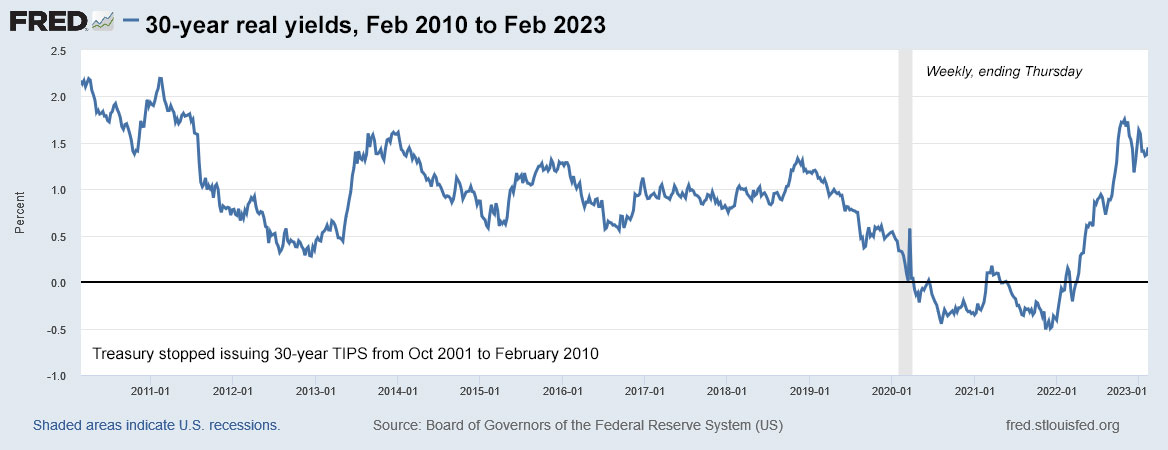
This chart shows the history of 30-year real yields since the Treasury reinstated the 30-year TIPS in February 2010:

Click on the image for a larger version.

For much of this 13-year period, the 30-year real yield lingered in a range around 1.0%, but keep in mind that real yields were suppressed by the Federal Reserve’s quantitative easing. Now we are in a period of quantitative tightening, and there is no way to predict how long that will last or the eventual result on real yields.

For an investor of the right age looking to build a buy-and-hold TIPS ladder, this 30-year TIPS looks like a reasonable investment. As long as that investor can ignore market volatility, which could be extreme in either direction.

Inflation breakeven rate

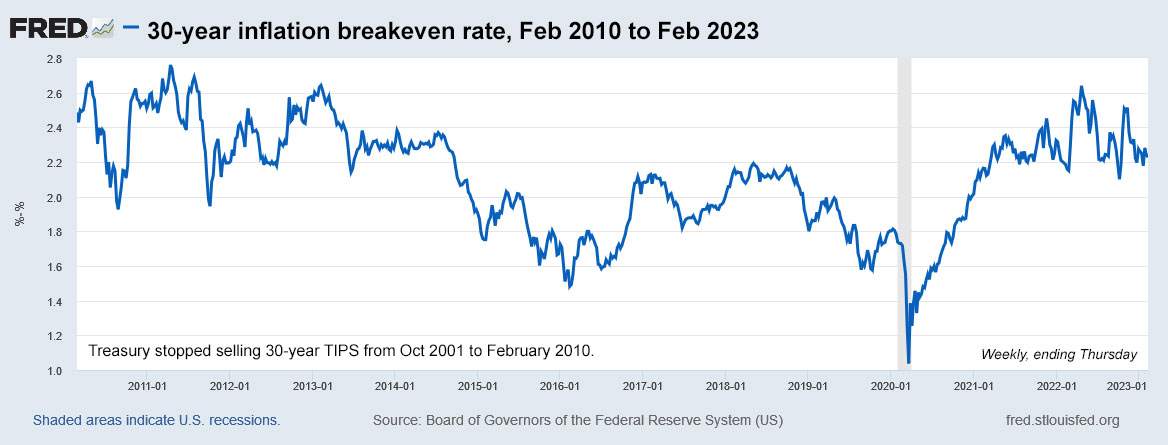
With the 30-year nominal Treasury bond closing Friday with a real yield of 3.83%, a new 30-year TIPS with a real yield of 1.53% would have an inflation breakeven rate of 2.3%, a bit higher than recent auctions of this term. But 2.3% looks reasonable. Over the last 30 years, inflation has averaged 2.5% a year. For all 30-year periods beginning in 1971, only one period has had inflation lower than 2.3% — 1990 to 2020 at 2.2%.

Here is the trend in the 30-year inflation breakeven rate from 2010 to 2023:

Click on the image for a larger version.

Final thoughts

I won’t be a buyer, but that is based on my age and ability to hold to maturity. My current TIPS ladder stretches out to February 2043, when I will be approaching 90. I still have some spots to fill, but I will be focusing on TIPS maturing in 5 to 19 years. For example, next month on March 23 we will have a 10-year TIPS reopening auction, and then on April 20 a new 5-year TIPS will be issued.

Investors looking at this new 30-year TIPS should focus on buying it in a tax-deferred account, but because the coupon rate will be around 1.5%, that should be adequate to cover “phantom income taxes” in a taxable account. Investors in a taxable account have to pay taxes on TIPS inflation accruals in the current year.

You can track the Treasury’s daily Yield Curve updates here. Yields are likely to continue to be volatile into next week. This auction closes at noon Thursday for non-competitive orders at TreasuryDirect. If you are putting an order in through a brokerage, make sure to place your order Wednesday or very early Thursday, because brokers cut off auction orders before the noon deadline. I’ll be posting results soon after the auction closes at 1 p.m. ET Thursday.

Here is a history of all 29- to 30-year TIPS auctions over the last eight years:

Confused by TIPS? Read my Q&A on TIPS

TIPS in depth: Understand the language

TIPS on the secondary market: Things to consider

Upcoming schedule of TIPS auctions

* * *

Feel free to post comments or questions below. If it is your first-ever comment, it will have to wait for moderation. After that, your comments will automatically appear.Please stay on topic and avoid political tirades.

David Enna is a financial journalist, not a financial adviser. He is not selling or profiting from any investment discussed. I Bonds and TIPS are not “get rich” investments; they are best used for capital preservation and inflation protection. They can be purchased through the Treasury or other providers without fees, commissions or carrying charges. Please do your own research before investing.

Posted in Inflation, Investing in TIPS, TreasuryDirect | 29 Comments

Monthly U.S. inflation for 2022 just got revised … a bit

This has no effect on annual inflation or on earnings for TIPS and I Bonds.

By David Enna, Tipswatch.com

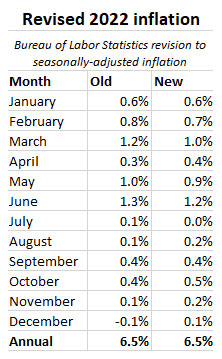
While I was searching Friday for consensus estimates on the January inflation report, to be released Tuesday, I noticed something odd. The Bureau of Labor Statistics had altered the seasonally-adjusted inflation rate for December, increasing that month’s inflation to 0.1% from the once-official -0.1%.

Huh? What does that mean? Inflation increased in December, when we all thought it decreased? This is not what I needed heading into Super Bowl weekend, when I want my focus on the other green stuff … guacamole.

To be clear, these are routine revisions to the BLS’s monthly seasonally-adjusted inflation numbers, and don’t affect the annual rates of inflation, or the non-seasonally adjusted inflation numbers that are used to adjust principal balances on Treasury Inflation-Protected Securities and set future interest rates for U.S. Series I Savings Bonds.

But it’s still unsettling to learn that these revisions show monthly inflation was actually higher in October, November and December than was originally reported by the BLS. These reports move the stock and bond markets.

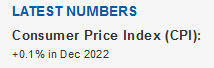
Now, when you go to the BLS homepage, you’ll see this statistic for December inflation, even though the “once-official” number for December was -0.1% when it was released Jan. 12:

The BLS hasn’t really supplied much information on these revisions, other than posting this statement on its website, along with a very complex Excel file:

Updated seasonal factors introduced February 10, 2023

Each year with the release of the January CPI, seasonal adjustment factors are recalculated to reflect price movements from the just-completed calendar year. This routine annual recalculation may result in revisions to seasonally adjusted indexes for the previous 5 years. Recalculated seasonally adjusted indexes as well as recalculated seasonal adjustment factors for the period January 2018 through December 2022 were made available on Friday, February 10, 2023.

Core CPI, which excludes food and energy, also saw upward revisions of 0.1 percentage points in December and November.

In these changes, the BLS is basically re-allocating its seasonal adjustments, which have no effect on the annual numbers. In essence, annual inflation of 6.5% is being reallocated across the 12 months of 2022. However, you have to wonder how consumers and financial markets would have reacted to slightly higher monthly inflation numbers in the last quarter of 2022, when “disinflation” suddenly became a buzzword.

The Reuters report on this change noted that the revisions could indicate a slight uptick in inflation in coming months:

“On the whole, we don’t see major implications for our inflation outlook coming from the updated seasonal factors,” said Daniel Silver, an economist at JPMorgan in New York. “But the stronger recent trend for the seasonally adjusted data does generate some upside risk looking ahead.”

In case you are curious, I did eventually find the consensus estimates for January inflation, which will be released Feb. 14 at 8:30 a.m. Economists are projecting monthly all-items inflation of 0.5% and an annual rate of 6.2%. Core inflation is projected at 0.3% for the month and 5.5% year over year. If those projections are accurate, annual inflation would be continuing a gradual decline.

The BLS revisions shouldn’t affect the year-over-year result for January, which remained at 0.6% in January 2022.

No effect on I Bonds or TIPS

As I noted, the 2022 revisions are focused on seasonal adjustments, so they don’t affect annual inflation or the non-seasonally adjusted numbers that are used to adjust TIPS principal balances or set future interest rates for I Bonds.

* * *

Feel free to post comments or questions below. If it is your first-ever comment, it will have to wait for moderation. After that, your comments will automatically appear.Please stay on topic and avoid political tirades.

David Enna is a financial journalist, not a financial adviser. He is not selling or profiting from any investment discussed. I Bonds and TIPS are not “get rich” investments; they are best used for capital preservation and inflation protection. They can be purchased through the Treasury or other providers without fees, commissions or carrying charges. Please do your own research before investing.
Posted in I Bond, Inflation, Investing in TIPS | 10 Comments

Mystery solved: ‘Inflation Guy’ explains the upcoming CPI reweightings

Is this a conspiracy to make inflation look tamer? No. It’s a routine but important update.

By David Enna, Tipswatch.com

Over the last few weeks, I’ve gotten questions about “surprise” price-index reweightings coming in the January inflation report about to be issued by the Bureau of Labor Statistics.

Uh-oh. Sounds like a conspiracy, right? The BLS is going to find a way to make inflation look tamer than it really is, right? All of our inflation-linked investments are going to suffer, right?

Wrong.

This reweighting of the CPI price indexes is a rather routine affair. Until 2002, the reweighting was done every 10 years, but the BLS realized that was no longer practical. So the schedule was increased to every two years. Now, with this January inflation report, the schedule is being changed to every year, taking effect with the January report each year. The BLS explains:

“Beginning with the January 2023 index, scheduled for publication on February 14, 2023, BLS plans to update the spending weights in the calculation of the CPI every year instead of every 2 years. Spending weights indicate what share of total expenditures each item represents. This change will improve the relevance of CPI spending weights by using the most recent consumer spending information. By improving the relevance of spending weights, BLS can improve the accuracy of the CPI.”

These reweightings are created through surveys by the BLS of consumer spending information. For the 2023 weightings, the BLS will use consumer data collected in 2021.

When I learned about these reweightings, I sent out a plea to Michael Ashton of Enduring Investments for an explanation, minus the conspiracy theories. I guess I wasn’t the only person asking. Ashton, who is known as @inflation_guy on Twitter, created a podcast explaining the logic behind the change in the weighting schedule. Here it is:

In explaining the reasoning behind these reweightings, Ashton talks about the balance between “core goods inflation” and “core services inflation.” In 2022, the BLS was giving a higher weight to core goods inflation, based on its consumer surveys in 2020, during the depths of the pandemic. Supply issues caused the cost of goods to soar in 2020, so goods got a higher weight in 2022. But in 2022, core goods inflation shrank to nearly 2%.

On the flip side, consider the cost of “core services” in 2020: How many times did you eat in a restaurant? Travel by airplane? Get a big raise for working at home? So based on its 2020 surveys, the BLS reduced the weight of core services for 2022. But in 2022 the cost of core services began escalating. So the CPI was missing the real inflation picture, at least slightly.

The BLS is switching to annual reweightings to try to get a more accurate snapshot of U.S. inflation. If the BLS continued to use the 2020 survey weightings, inflation in 2023 would be underestimated because of the skew toward goods over services. Consider this from the Wall Street Journal in its preview of the December inflation report:

The root problem for investors is that inflation itself has become more complicated. Core goods inflation has turned negative in recent months, thanks to increased supply of many products and reduced demand. But services inflation has remained elevated—the result, many argue, of a stubbornly hot jobs market and escalating labor costs.

Ashton notes: “In 2020 we had this thing called Covid and consumption patterns changed dramatically and the BLS very carefully considered if they should use intervention analysis. … but they ultimately decided hands off.

“People are always saying that the BLS monkeys with the CPI to keep inflation reported lower than it really is. There is no conspiracy, but there are factors that … do have that result. And those things happen in both directions, obviously.”

We won’t know exactly what the new weights will be until the BLS issues the January inflation report. Ashton expects core services to get a higher weighting, and core goods to get a lesser weighting.

Why does it matter?

“If you believe that inflation is going to fall back to 2% … you have to believe that something is going to happen in core services,” Ashton says. “It’s going to have to happen from the services side,” because core goods is already down to about 2% inflation.

“It’s easy to exaggerate overall how important this is. … Normally the reweighing is a snoozer, it doesn’t matter at all. Nobody cares. It doesn’t really change very much.”

In 2023 we will get bigger-than-normal weighting changes, but they are still what Ashton calls a “rounding error.”

“If you have a 1% change in the weight of a category that is inflating 2% faster than the average, then that adds 2 basis points to the annual inflation. … So it’s not a big deal. Now you know if you should care about it. Probably not.”

For a positive spin, we will let the BLS have the final word: “Transitioning from biennial spending weights to annual spending weights is another milestone towards our goal to improve the accuracy and timeliness of the CPI.”

Who is Michael Ashton?

His audiences know him as the “Inflation Guy.” He is a pioneer in the U.S. inflation derivatives market. Before founding his company, Enduring Investments, Ashton worked in research, sales and trading for several large investment banks including Bankers Trust, Barclays Capital, and J.P. Morgan.

Since 2003, when he traded the first interbank U.S. CPI swaps, and 2004 when he was the lead market maker for the CME’s CPI Futures contract, he has played an integral role in developing new instruments and methods for accessing and hedging various inflation exposures. In 2016, Ashton published What’s Wrong With Money? The Biggest Bubble of All. He is a graduate of Trinity University and lives in Morristown, New Jersey.

Have a question? Get the Inflation Guy app in the Apple App Store or Google Play, or email InflationGuy@enduringinvestments.com.

* * *

Feel free to post comments or questions below. If it is your first-ever comment, it will have to wait for moderation. After that, your comments will automatically appear.Please stay on topic and avoid political tirades.

David Enna is a financial journalist, not a financial adviser. He is not selling or profiting from any investment discussed. I Bonds and TIPS are not “get rich” investments; they are best used for capital preservation and inflation protection. They can be purchased through the Treasury or other providers without fees, commissions or carrying charges. Please do your own research before investing.
Posted in Inflation | 10 Comments