May 1 update: Series I Savings Bonds to pay 0.0% interest; EE Bonds bump up to 0.3%

Savings-Bond-IThe US Treasury just announced that the fixed rate on Series I Savings Bonds will remain at 0.0% from May to October, meaning I Bonds purchased in this period will earn a composite rate of 0.0% for six months. In addition, the Treasury raised the EE Bond fixed rate to 0.3% and left intact the guarantee that EE Bonds will double in value if held for 20 years.

The earnings rate for Series I Savings Bonds is a combination of a fixed rate, which applies for the 30-year life of the bond, and the semiannual inflation rate, also called the variable rate.

The new I Bond variable rate of -1.60% (annualized) was set in stone when the Bureau of Labor Statistics released the March inflation number. This May 1 adjustment is determined by non-seasonally adjusted CPI-U for September to March. Here are the numbers, from my Tracking Inflation and I Bonds page:

six monthsThe composite I Bond rate is determined by adding the variable rate (-1.60%) to the fixed rate (depends on when the I Bond was issued). Any I Bond with a fixed rate of 1.60% or less – and that is every I Bond issued in the past 13 years – will get a composite rate of 0.0% for six months. This is because I Bonds cannot pay negative interest; the lowest they can go is 0.0%. The starting date of that 0.0% period depends on which month you purchased the I Bond, but they will all get six months of it.

One point to consider: Since inflation fell at an annual rate of 1.60% over the last six months, your I Bond paying 0.0% is beating inflation by 1.60%. This is one of the benefits of I Bonds: They lose no value in times of deflation, which isn’t true of the principal balance of TIPS, which declines with each deflationary month.

Should you dump your I Bonds paying 0.0%? One word answer: No. Since you are limited to I Bond purchases of $10,000 a year per person (plus $5,000 as a tax refund), I don’t think selling your I Bonds is a good idea. Unless: 1) you need the money today to meet current expenses, or 2) the I Bond has reached its 30-year maturity (none have as of yet, of course). The idea in I Bond investing is to build as large a cache of inflation-protected money as possible, to use as a resource in the future. Selling out of I Bonds will keep you from reaching that goal. Just be patient; wait out the six lousy months.

Should you buy I Bonds paying 0.0%? One word answer: No. It makes no sense to buy I Bonds in this May to October period. Instead, wait until the November 1 adjustment, which could bring a positive variable rate and the possibility of a fixed rate higher than 0.0%. You’d still have two months to buy your 2015 allocation. Inflation has already started ticking up, rising 0.6% in March on a non-seasonally adjusted basis. There is a good chance I Bonds will be paying a decent variable rate starting November 1.

What about EE Bonds? The Treasury’s decision to pump the fixed rate from 0.1% to 0.3% was a nice gesture, but in effect it is meaningless. The key to EE Bonds is this clause:

All Series EE bonds issued since May 2005 earn a fixed rate in the first 20 years after issue.  At 20 years, the bonds will be worth at least two times their purchase price.

The Treasury kept intact the 20-year doubling of value, which in effect creates a 20-year, tax-deferred Treasury bond paying 3.5%. This is an outstanding value, given that a 30-year traditional Treasury is currently paying 2.75%, and a 20-year is paying 2.49%, more than 100 basis points lower. That is a huge difference in a 20-year investment.

EE Bonds are the investment of choice in mid-2015, if … and only if … you can afford to hold them for the full 20 years.
Posted in Investing in TIPS | 10 Comments

5-year TIPS auctions with a real yield of -0.335%

A new five-year Treasury Inflation-Protected Security – CUSIP 912828K33 – auctioned today with a real yield (after inflation) to maturity of -0.335%. The coupon rate was set at 0.125%, the lowest the Treasury allows on a TIPS.

This is the lowest yield for any 4- to 5-year TIPS at auction since Dec. 19, 2013, when a 4-year, 4-month TIPS auctioned with a yield of -0.375%. Because the yield ended up well below the coupon rate, buyers at today’s auction had to pay about $102.52 for $100 of value.

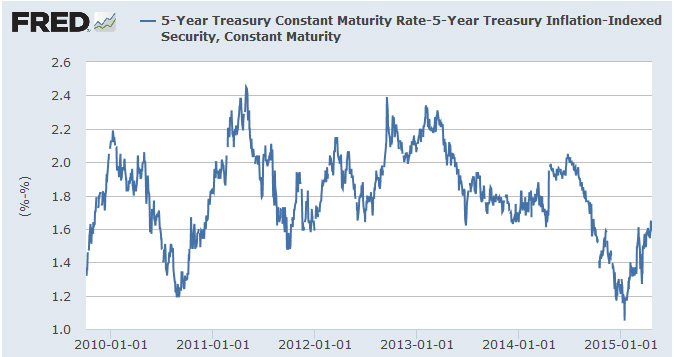
Inflation breakeven rate. With a nominal 5-year Treasury currently trading at about 1.41%, this sets up an inflation breakeven rate of 1.74% for this TIPS. That means if inflation averages higher than 1.74% over the next five years, this TIPS will outperform a nominal Treasury. Although this number is low by historic standards, inflation has been running at -0.1% over the last 12 months.

This chart shows the 5-year inflation breakeven rate since 2010, and shows that the 5-year TIPS have bounced off very low levels in recent months. The lower the breakeven rate, the ‘cheaper’ TIPS are against a nominal Treasury. It’s clear that TIPS are getting more expensive, and that indicates that inflationary fears are rising:

5-year breakeven rates

Reaction to the auction

We can get a quick read on reaction to the auction by looking at how the TIP ETF performed in the minutes after the 1 p.m. auction close. The ETF had been trading up slightly all morning, and took a minor move downward after the closing, indicating a trend of higher yields. This isn’t a significant move, however.

auction reaction

Bloomberg’s report on the auction noted that investors are again beginning to factor inflation into their investments:

“The market likes TIPS,” said Edward Acton, a U.S. government-bond strategist in Stamford, Connecticut, for Royal Bank of Scotland’s RBS Securities unit, one of 22 primary dealers obligated to bid at U.S. auctions. “This disinflationary pressure has eased off, and we’re just waiting to see how strong and how quickly inflation pressures can surprise to the upside.” …

Pacific Investment Management Co., which runs the world’s biggest bond fund, has been among the buyers of TIPS.

“With the oil price drop, we felt that break-evens in the Treasury Inflation-Protected Securities market were pricing in inflation that was too low,” New York-based portfolio manager David Braun said in a note published online Thursday. “So we prefer to own TIPS in lieu of nominal Treasuries.”

The Wall Street Journal also noted the gentle rise in inflation as a source for demand for TIPS, noting that “investors are piling into U.S. government bonds that protect against inflation at the fastest pace in three years.”

“The big picture is that the deflation scare may be behind us,’’ said Gemma Wright-Casparius, senior bond-fund manager at Vanguard Group, which has over $3.26 trillion in global assets under management. “The overall sentiment will be inflation moving higher over the next 12 months.”

Posted in Investing in TIPS | 2 Comments

Checking in on today’s 5-year TIPS auction

A new 5-year Treasury Inflation-Protected Security – CUSIP 912828K33 – will be created today, with the coupon rate and real yield to maturity determined at auction. Non-competitive bids, like those placed through Treasury Direct, close at noon; competitive bids continue until 1 p.m. when the auction closes.

At 10:07 a.m., here is what we know:

  • The coupon rate is going to be 0.125%, because this TIPS will auction with a negative yield to maturity, and 0.125% is the lowest coupon rate the Treasury allows.
  • After yesterday’s close, the Treasury’s Real Yield Curve page estimated that a full-term 5-year TIPS would yield -0.19%. This should be the starting point for today’s auction, since the most recent 5-year TIPS on the secondary market has only four years remaining.
  • That said, Bloomberg’s Current Yields page shows that 4-year TIPS trading today with a real yield to maturity of -0.51%. That’s substantially below the Treasury’s estimate.
  • The Wall Street Journal’s TIPS Closing Yields page shows that 4-year TIPS, which matures in April 2019, closed yesterday with a yield of -0.470%. There is also a TIPS maturing in July 2020 with a yield of -0.448%, and one maturing in January 2020 with a yield of -0.428%.
  • Finally, the TIP ETF – which holds a broad range of maturities – is trading up very slightly this morning at $114.41, indicating that yields could be dipping, but only slightly.

These numbers would lead me to guess that today’s auction will result in a yield below -0.20%. Will the number be closer to -0.45% or even -0.50%? Seems possible. That’s a pretty wide span of probabilities; I would guess a yield near -0.45% looks likely.

Since the coupon rate will be set at 0.125% on this new issue, buyers at today’s auction will have to pay up to generate a negative yield to maturity. If the yield comes in around -0.21%, the price will be about $101.85 per $100 of value. If it falls to -0.50%, the price will be closer to $103 per $100 of value, as a rough guideline.

I will be posting an update after the auction closes at 1 p.m., and then adding market reaction later in the afternoon.

Posted in Investing in TIPS | Leave a comment

Variable interest rate on I Bonds will drop to -1.60% on May 1

The Consumer Price Index for All Urban Consumers (CPI-U) increased 0.2% in March on a seasonally adjusted basis, the U.S. Bureau of Labor Statistics reported today. Over the last 12 months, the all items index declined 0.1%.

This is an important inflation report, because it provides the last number needed to determine the new variable interest rate for Series I Savings Bonds, which will reset on May 1. Because non-seasonally adjusted inflation dropped 0.8% from September 2014 to March 2015, the new I Bond variable rate will fall to -1.60% annualized on May 1. That variable rate will be applied against any fixed rate that I Bonds hold, meaning that all I Bonds issued in the last 13 years will pay zero interest for six months beginning on May 1. (But the trigger date for the 0.0% period will depend on the month you first bought the I Bond, a tricky I Bond feature.)

I have updated my Tracking Inflation and I Bonds page to reflect these updated numbers.

The inflation report. An increase of 0.2% in March was expected, so no surprise there. Energy prices rose again in March, with gasoline prices rising 3.8% after a 2.1% rise in February. Fuel oil prices were up a strong 5.9%. On the other hand, natural gas prices dropped 2.7% and food prices fell. 0.2%.

Holders of I Bonds and Treasury Inflation-Protected Securities are also interested in the non-seasonally adjusted CPI-U, which is used to determine the future variable interest rate on I Bonds and to adjust the principal balance of TIPS. In March, non-seasonally adjusted CPI rose 0.6% to an index level of 236.119. That number stood at 238.031 in September, meaning non-seasonally adjusted inflation fell 0.80% from September to March. This number determines the I Bond’s new variable rate of -1.60% annualized for the six months from May to October.

six months

What this means for I Bonds.  Since the variable rate is added to the fixed rate to determine the I Bond’s composite rate, this means that the -1.6% will wipe out any fixed rate of 1.6% or lower. And that means those I Bonds will have a composite rate of 0.0% for the six months beginning in May, since the I Bond rate can’t fall below zero.

We don’t yet know what fixed rate the Treasury will apply on May 1, but the most likely number is 0.0%, where the fixed rate stands today. As a rough guide – not always accurate – the I Bond fixed rate usually falls about 1% below the yield of a 10-year TIPS. Right now a 10-year TIPS is yielding 0.05% – so unless the Treasury is feeling unusually generous, the I Bond’s fixed rate will hold at 0.0% on May 1.

Should you buy I Bonds this year? If the fixed rate stays at 0.0% on May 1, we can assume the market for new purchases of I Bonds will dry up. There’s not much sense in guaranteeing a 0.0% return, since you can wait for the rate reset on Nov. 1 and buy your 2015 allocation then. (I Bond purchases are limited to $10,000 per person per year.)

If the fixed rate rises above 0.0% – unlikely – then I Bonds again are attractive because the fixed rate stays with the I Bond for 30 years. You won’t get rich getting an extra 0.1% over inflation, but every little bit helps.

Or you can buy your annual allocation before May 1 and get six months of 1.48% annualized, followed by 0.0% annualized, for a combined rate of 0.74% for one year. Why bother?

The most logical action will be to keep your cash earning money somewhere until Nov. 1, and then deciding if the I Bond composite rate looks attractive. On Nov. 1, you could also take a long look at Series EE Savings Bonds, which currently pay 0.1% annual interest but will double in value if held for 20 years, for an effective rate of 3.5%.

(Another option: Buy the EE Bonds before May 1, to head off any possible change in Treasury policy. What if the Treasury extends the EE doubling to 25 years? Or 30 years? It could happen, since a 20-year Treasury currently pays 2.31%, well below the EE’s return.)

Here is the trend in inflation over the last 12 months:

Inflation

Posted in I Bond, Inflation, Investing in TIPS | 1 Comment

Up next: New 5-year TIPS will auction April 23, 2015

The Treasury will announce later this morning that it will be offering a new 5-year Treasury Inflation-Protected Security at auction on Thursday, April 23. This will be CUSIP 912828K33. Update: Here is the announcement.

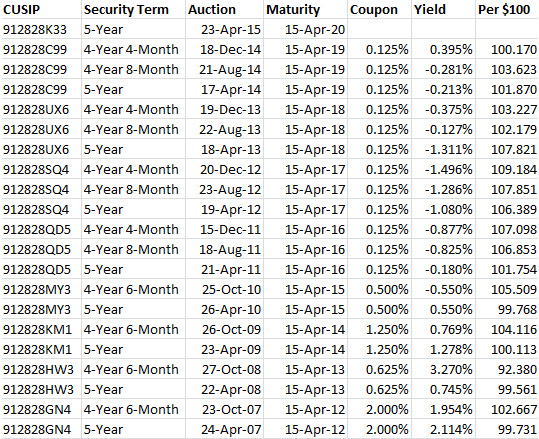
The market for 4- to 5-year TIPS has changed dramatically since the Treasury’s last auction of this term, on Dec. 18, 2014, when a a 4-year, 4-month TIPS auctioned with a yield of 0.395%, highest in 4 1/2 years.

Today we are looking at a yield in the range of -0.26%, a decline of 65 basis points since December. But that’s still well above the record low of -1.496% for the auction of a 4-year, 4-month TIPS on Dec. 20, 2012.

Because the lowest-possible coupon rate for this TIPS is 0.125%, buyers will likely be paying up at next Thursday’s auction, somewhere around $101.92 for $100 of value to produce a yield to maturity of -0.26%. (A lot can change in a week, of course.)

Inflation breakeven rate. With the 5-year Treasury currently yielding about 1.33%, this sets up an inflation breakeven rate of 1.59% for this TIPS, meaning that it will outperform a 5-year nominal Treasury if inflation averages more than 1.59% over the next 5 years. Inflation has been running at 0.0% over the last 12 months.

Alternatives. The 5-year term sets up good comparisons with other ultra-safe investments. For example, you can buy an I Bond today and be assured that you will earn at least the inflation rate over the next five years. That return will be 0.26% better than the return of this TIPS, and so an I Bond – as weak as it seems right now – is a better investment.

Another alternative is 5-year insured bank CDs, which pay 2.00% to 2.25% right now at several banks. The 2.25% return sets up an inflation breakeven rate of 2.51% for this TIPS. If you don’t believe inflation will average higher than 2.51% over the next 5 years, the bank CD is a better investment.

Why buy it? I like the 5-year term, and I was a buyer last December when the yield hit a favorable 0.395%. But next Thursday’s auction will be interesting mainly to big-money investors like central banks, pension funds and hedge funds — where small-dollar alternatives make no sense. I suspect many small investors will pass and look for better alternatives.

Here is the history of all 4- to 5-year TIPS auctions since 2007:

5 year TIPS

Posted in Investing in TIPS | 3 Comments