A 5-year TIPS is maturing April 15. How did it do as an investment?

It had a real yield negative to inflation. And it was a winner.

By David Enna, Tipswatch.com

One of the basic rules of investing in Treasury Inflation-Protected Securities is: Get the highest possible real yield and ignore all the other noise.

But it doesn’t always work that way. Let’s time-shift back to the depressing early days of the COVID pandemic, when stock and bond markets were reeling. On April 23, 2020, the Treasury auctioned a new 5-year TIPS, CUSIP 912828ZJ2, with a real yield of -0.32%.

In other words, this new TIPS was guaranteed to under-perform inflation by 0.32% over the next five years. That was totally undesirable, right?

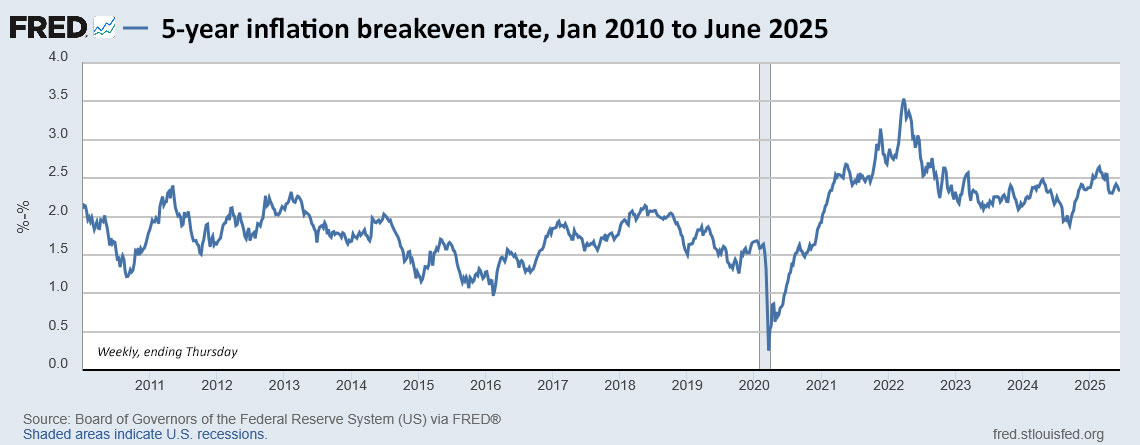
Wrong. At the time, a 5-year nominal Treasury was yielding just 0.37%, meaning this TIPS got an inflation breakeven rate of 0.69%. a wildly low number. Investors were betting that inflation would average just 0.69% from April 2020 to April 2025.

As often happens, investors were very wrong. In fact, inflation over the last five years has averaged 4.3%. And so investors in CUSIP 912828ZJ2 did much better than investors in a nominal Treasury at the time.

We know CUSIP 912828ZJ2’s final return because the February inflation report issued on March 12 set its inflation index at 1.23240 as of April 15, the maturity date.

The data page for this TIPS on EyeBonds.info shows it produced a nominal return of 3.904%, crushing the 5-year Treasury’s note return of 0.37% by an annual margin of 3.61%. That was a direct result of the soaring inflation we saw beginning just a year later, rising to 4.2% in April 2021 and topping off at 9.1% in June 2022.

Here are data for all 5-year TIPS that have matured since April 2012. Note that the early trend of under-performance has dramatically shifted because of the ultra-high inflation of recent years.

Click on image for larger version. View more data on my TIPS vs Nominals page.

To view this chart at a glance, the annual variance number in the last column shows how the inflation breakeven rate compared to actual 5-year annual inflation. When the numbers are green, a TIPS was the superior investment. When they are red, the nominal Treasury was the better investment.

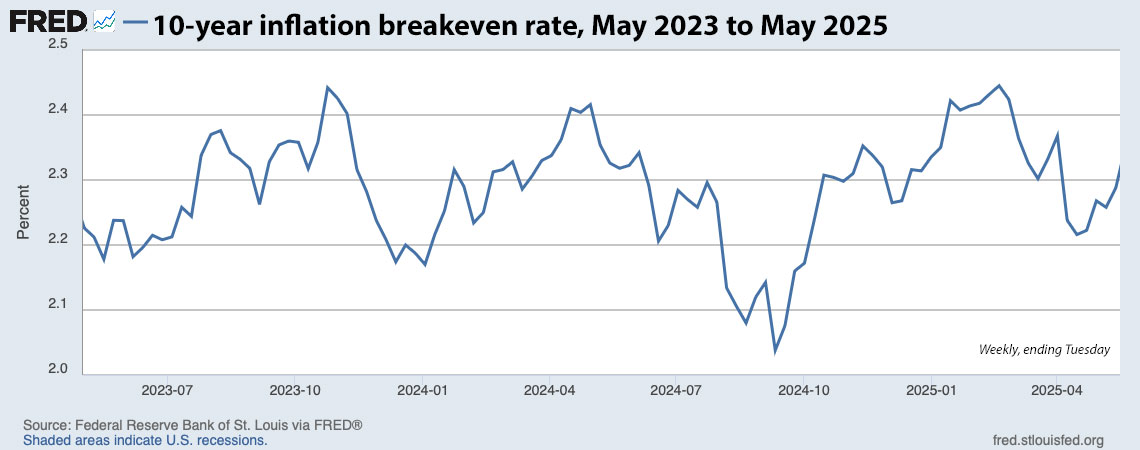
Fair warning: The next decade could be entirely different, especially since inflation breakeven rates are now running much higher, around 2.4%.

Big winner: The I Bond

Here things get interesting. In April 2020, you could have invested in an Series I Savings Bond with a fixed rate of 0.20%, which seems crazy but again demonstrates the lagging effects of the Treasury’s fixed-rate decisions. That fixed rate was set in November 2019, when 5-year real yields were higher. It remained in effect until the end of April 2020.

Clearly, an I Bond with a fixed rate of 0.20% is going to outperform a TIPS with a real yield of -0.32%. Data on EyeBonds.info show a $10,000 purchase of this April 2020 I Bond is now worth $12,412, for an annual return of about 4.4%.

Notes and qualifications

My TIPS vs. Nominals chart is an estimate of performance.

Keep in mind that interest on a nominal Treasury and the TIPS coupon rate is paid out as current-year income and not reinvested. So in the case of a nominal Treasury, the interest earned could be reinvested elsewhere, which would potentially boost the gain. For certain, we don’t know what the investor could have earned precisely on an investment after re-investments.

In the case of a TIPS, the inflation adjustment compounds over time, and that will give TIPS a slight boost in return that isn’t reflected in the “average inflation” numbers presented in the chart.

Confused by TIPS? Read my Q&A on TIPS

TIPS in depth: Understand the language

TIPS on the secondary market: Things to consider

TIPS investor: Don’t over-think the threat of deflation

Upcoming schedule of TIPS auctions

* * *

Follow Tipswatch on X (Twitter) for updates on daily Treasury auctions and real yield trends (when I am not traveling).

Feel free to post comments or questions below. If it is your first-ever comment, it will have to wait for moderation. After that, your comments will automatically appear. Please stay on topic and avoid political tirades. NOTE: Comment threads can only be three responses deep. If you see that you cannot respond, create a new comment and reference the topic.

David Enna is a financial journalist, not a financial adviser. He is not selling or profiting from any investment discussed. I Bonds and TIPS are not “get rich” investments; they are best used for capital preservation and inflation protection. They can be purchased through the Treasury or other providers without fees, commissions or carrying charges. Please do your own research before investing.
Posted in Cash alternatives, I Bond, Inflation, Investing in TIPS | Tagged , , | 15 Comments

Howard Marks: The world economy has been shaken ‘like a snow globe’

By David Enna, Tipswatch.com

What a week. I made a point to watch President Trump’s tariff announcement on Wednesday live and yes, it was a shock. Beyond the politics, I felt the United States was pushing the world into a new, and probably dangerous economic era.

Obviously, I was not alone. Just before Trump spoke, the S&P 500 index closed Wednesday at 5669. Friday, it closed at 5075, a drop of 10.5% in two days.

Friday morning, I was taking my morning walk when I happened to hear Bloomberg’s best contrarian anchor, Lisa Abramowicz, interviewing Oaktree Capital’s Howard Marks about the state of credit and world markets in the aftermath of the tariff decisions.

This was a fascinating and insightful interview, especially since Abramowicz simply let him talk. Marks, 78, is a noted author, credit expert and financial theorist who publishes “memos” detailing his market insights. “When I see memos from Howard Marks in my mail,” Warren Buffet once said, “they’re the first thing I open and read. I always learn something.”

His company focuses on high-yield debt, an area I know little about or care to follow. But Marks has some great insights into U.S. markets. Here is the interview:

And here are some highlights from the interview:

Marks: You know, obviously the state of the world, which equity prices depend on, is completely in flux and has been radically changed. Most investors think for the worse. That’s why prices are down. The question, of course, is whether they’re down too much, just right or not enough. And almost nobody can say.

Abramowicz: How do you start to even measure something like a potential paradigm shift, like the tariffs that were announced earlier this week?

Marks: Well, first of all, of course, measure is the wrong word because that suggests some quantification, which is impossible. There’s nothing to measure.

This is the biggest change in the environment that I’ve seen probably in my career. You know, we we’ve gone from free trade and world trade and globalization to this system, which implies significant restrictions on trade in every direction and a step toward isolation for the United States.

I believe that the last 80 years since World War II have been the best economic period in the history of mankind. And one of the major reasons was the growth of trade.

There was a 25-year period which I cited in one of my memos ten years ago in which the cost of durables in the U.S. went down by 40% in inflation-adjusted terms. That kept a lid on inflation here. It made goods available cheaply to all Americans. If we don’t have world trade, we don’t have that benefit. …

The tariffs are designed to encourage production at home. But who could imagine that that most things produced in the United States will be as cheap as they are coming from abroad. In other words, things will cost more. There were financial benefits from globalization, including keeping a lid on inflation.

And so, you know, tariffs are an increased cost. Somebody has to pay them. And, you know, most people think the consumer will pay them.

Abramowicz: You’ve thrived during your almost five-decade career during times of dislocation. Is this a time of dislocation to play or not to?

Marks: Well, it’s a time of dislocation. Everybody has to judge for themselves whether the reduction in asset prices so far is right, inadequate or excessive. If it’s excessive, you should jump in with both feet. If it’s inadequate, you should wait until things adjust further. And it’s impossible to make that judgment qualitatively.

Normally, we think we know what’s going to happen in the future. We normally assume the future will look mostly like the past. We extrapolate. And usually it works because the world doesn’t change that much. But the world economy and the world order beyond the economy, meaning geopolitics and international relationships, has been shook up like a snow globe by the events of the last days. And nobody knows what it’s going to look like. Nobody knows.

And today, whatever your forecast may be, you have to say the probability that I’m right is lower than ever. Because the probability that we know what the future is going to look like is lower than ever.

Abramowicz: Do you still think that the US is the best place to invest?

Marks: It’s I think it’s probably still the best place, but it’s less best than it used to be.

Thoughts

I try very hard to keep Tipswatch.com focused on policy and economics, not politics. And I define myself politically as “an observer,” but of course I have opinions. This was a dangerous week for the U.S. economy and the nation’s role in the world, especially if you care about the U.S. dollar’s status as the world’s reserve currency.

I think the case can be made for some logical retaliatory tariffs in cases where the United States — the richest nation on Earth — is being abused. But because we are so rich, and so consumer-oriented, we will always run trade deficits with many nations where products can be produced at lower cost.

I am sure some readers will agree, some disagree. Please keep comments focused on the issues, not name-calling or taunting. Thank you for reading.

* * *

Follow Tipswatch on X (Twitter) for updates on daily Treasury auctions and real yield trends (when I am not traveling).

Feel free to post comments or questions below. If it is your first-ever comment, it will have to wait for moderation. After that, your comments will automatically appear. Please stay on topic and avoid political tirades. NOTE: Comment threads can only be three responses deep. If you see that you cannot respond, create a new comment and reference the topic.

David Enna is a financial journalist, not a financial adviser. He is not selling or profiting from any investment discussed. I Bonds and TIPS are not “get rich” investments; they are best used for capital preservation and inflation protection. They can be purchased through the Treasury or other providers without fees, commissions or carrying charges. Please do your own research before investing.

Posted in Federal Reserve, Inflation, Investing in TIPS, Tariffs, Treasury Bills | 65 Comments

My I Bond fixed-rate projection just fell to 1.10%

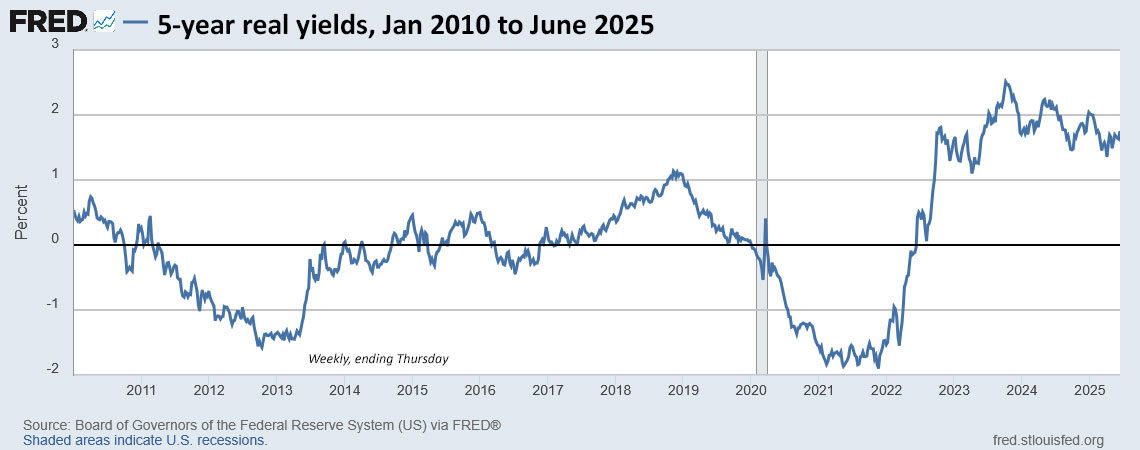
The benchmark 5-year real yield continues to fall.

By David Enna, Tipswatch.com

April 11, 2025, update: Welcome to the I Bond ‘buying season’

April 10, 2025, update: I Bond’s variable rate will rise to 2.86% on May 1

Amid all this week’s financial chaos, I am trying to focus on something I more or less understand: Projecting the May 1 fixed-rate reset for the U.S. Series I Savings Bond.

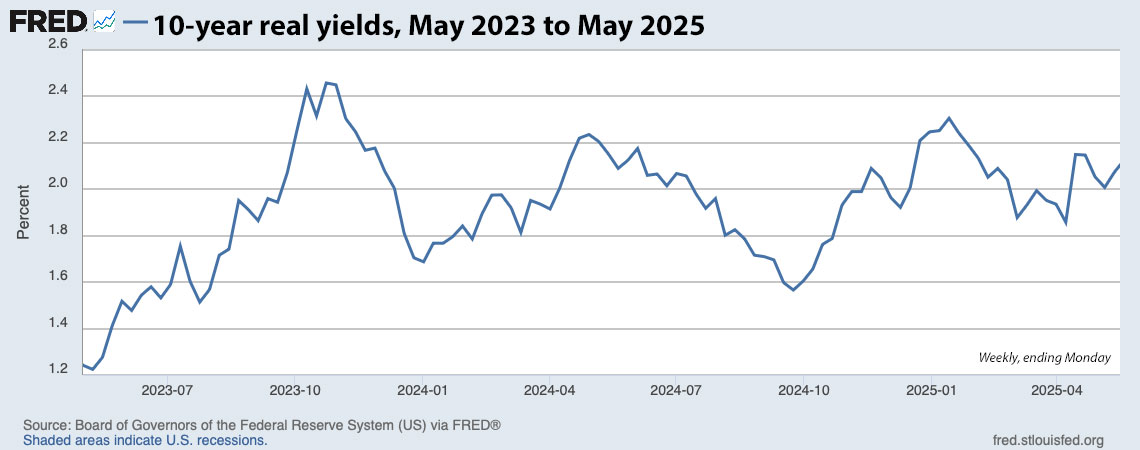
When I last looked at this topic on March 9 the real yield of a 5-year TIPS was trading at 1.57%, which was down 40 basis points from the start of this year. In the past month, the 5-year real yield has continued declining. It closed Wednesday at 1.44% according the Treasury’s daily estimate , but in the midst of tariff paranoia this morning is trading at 1.12%.

I’d expect a bounce higher, but who knows? But even ignoring this morning’s decline, it looks likely that the I Bond’s fixed rate is going to fall from the current 1.2% to 1.1% at the May 1 reset.

The 5-year real yield is key

The Treasury has never revealed a formula for setting the I Bond’s fixed rate, but it has stated it looks at real yield trends over time. I Bond watchers have observed that over the last decade one formula has accurately predicted the Treasury’s fixed rate decision: Apply a ratio of 0.65 to the average 5-year real yield over the preceding six months. This formula has worked without fail at least since 2017.

This morning I calculated the 5-year real yield data from the date of the last reset on November 1, 2024, to Wednesday’s close. And this week, for the first time, the data show the trend has tilted toward the 1.10% fixed rate.

Note that the I Bond’s fixed rate is always set to the one-tenth decimal point and that means the result of the 0.65 ratio calculation has to be rounded. Now that it has dropped below the 1.15% level, it rounds to 1.10%. And that level is likely to stick with the 5-year real yield plummeting this morning.

Back on March 9 I projected that the average 5-year real yield would need to remain above 1.57% through March and April for the 1.20% fixed rate to carry over to May 1. That is not happening.

Is there a strategy?

As I noted last month, the Trump administration could decide to ditch the long-standing formula for setting the I Bond’s fixed rate. Or it could be swayed by the current low yield of a 5-year TIPS and opt to go lower. Or it could decide to eliminate the savings bond program entirely. (Not likely). So we don’t know.

But from what we do know, it looks like the wisest choice for committed I Bond investors to buy their 2025 allocation late in the month of April, to capture the current 1.20% fixed rate. I ended up completing my 2025 purchases on March 28 because I had available cash and I could see the fixed rate wouldn’t be going any higher.

Are I Bonds still attractive? Absolutely. An I Bond purchased today will earn 1.2% over inflation, while a 5-year TIPS will earn 1.12%. We are back to the strange days when the I Bond has a yield advantage over a TIPS. When that happens, I Bonds are clearly the superior investment because they earn tax-deferred interest, have rock-solid deflation protection and a flexible maturity term.

Next week, on April 10, we will get the March inflation report, the final piece of data needed to set the I Bond’s new variable rate. The official seasonally-adjusted inflation number could be close to zero, but non-seasonally adjusted inflation should be higher, maybe 0.2%. That would give us a new six-month variable rate of 2.80%, up from the current 1.90%.

But that is next week’s news and I will be doing an update on the fixed-rate projection after the March inflation report is revealed.

Confused by I Bonds? Read my Q&A on I Bonds

Let’s ‘try’ to clarify how an I Bond’s interest is calculated

Inflation and I Bonds: Track the variable rate changes

I Bonds: Here’s a simple way to track current value

I Bond Manifesto: How this investment can work as an emergency fund

* * *

Follow Tipswatch on X (Twitter) for updates on daily Treasury auctions and real yield trends (when I am not traveling).

Feel free to post comments or questions below. If it is your first-ever comment, it will have to wait for moderation. After that, your comments will automatically appear. Please stay on topic and avoid political tirades. NOTE: Comment threads can only be three responses deep. If you see that you cannot respond, create a new comment and reference the topic.

David Enna is a financial journalist, not a financial adviser. He is not selling or profiting from any investment discussed. I Bonds and TIPS are not “get rich” investments; they are best used for capital preservation and inflation protection. They can be purchased through the Treasury or other providers without fees, commissions or carrying charges. Please do your own research before investing.

Posted in Cash alternatives, I Bond, Inflation, Investing in TIPS, Savings Bond, TreasuryDirect | Tagged , , , , , | 25 Comments

iShares unveils new ETF holding exactly one TIPS, for now

The new target-date ETF, ticker IBIL, matures in October 2035.

By David Enna, Tipswatch.com

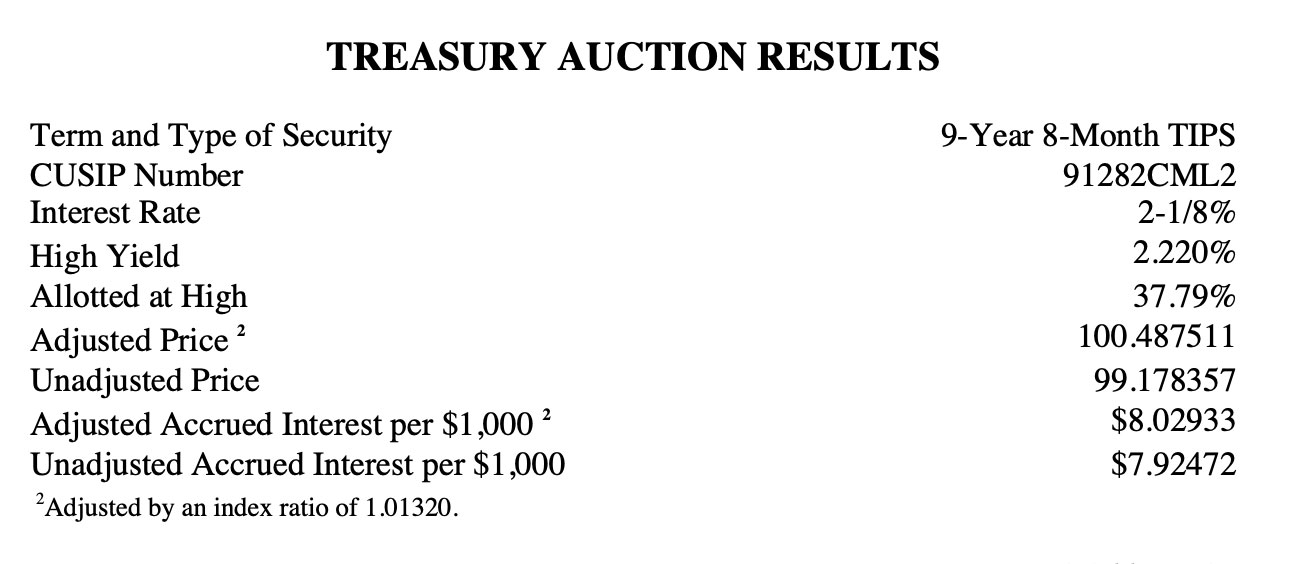
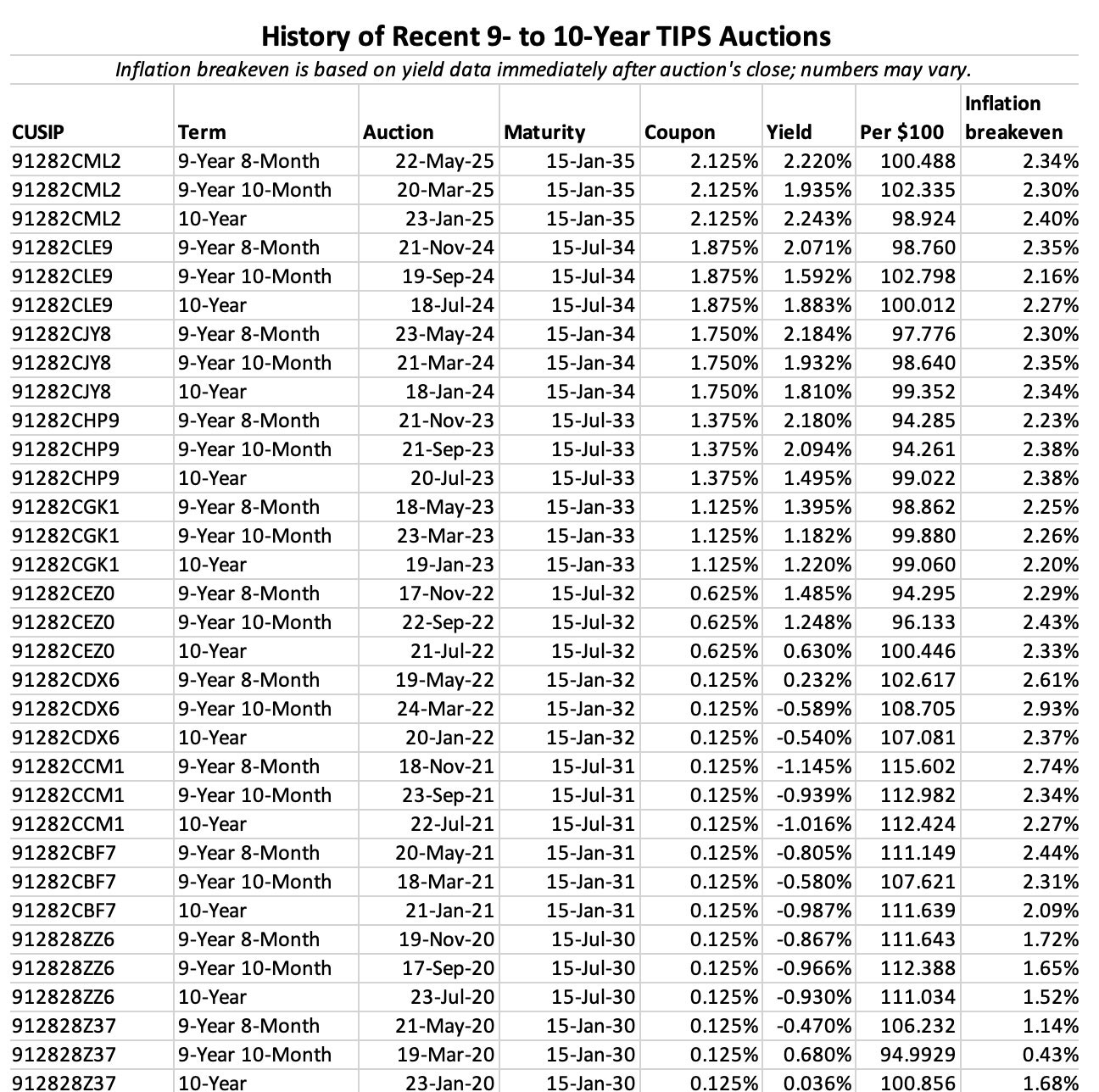
Blackrock’s iShares division last week launched a unique ETF holding just one bond: CUSIP 91282CML2, a 10-year TIPS that matures in January 2035.

The formal name is the “iShares iBonds Oct 2035 Term TIPS ETF,” going by the ticker IBIL. The goal is simple: To track the performance of U.S. Treasury Inflation-Protected Securities maturing in 2035. Later this year IBIL will add a second TIPS, to be issued in July, and then add two more 5-year TIPS to be issued in April and October 2030.

In 2035, these TIPS will mature and iShares will begin moving proceeds to cash. After October 15, iShares will dissolve the fund and return all proceeds to investors. You can download the prospectus here.

Source: iShares.com

As I have noted before, I’m not a fan of Blackrock using the term iBonds in the fund name, since this can easily cause confusion with U.S. Series I Savings Bonds, usually called I Bonds. But ignoring that fault, IBIL joins a collection of defined-maturity, single-year TIPS funds, which began maturing in October 2024 and now run through 2035 with the addition of IBIL.

These are useful ETFs, I think, especially for an investor looking to quickly build a diversified TIPS ladder out to 2035. These funds should closely track the performance of the underlying TIPS. Here is a comparison of data for each ETF, along with Vanguard’s Short-Terms TIPS fund for comparison:

The expense ratios for the iShares ETFs are only 0.10%, higher than VTIP’s 0.03% but quite good for such small funds.

Analysis

These funds are designed to be held to maturity and the asset value will rise and fall with market trends through maturity, just like any other bond fund.

Because the expense ratio is just 0.10%, I really have no problem with using these funds as an alternative to buying individual TIPS. You could quickly build a ladder through 2035 in 15 to 30 minutes, assuming the small daily volume doesn’t create issues.

However, the limited span of maturities means these ETFs aren’t the total solution for building an inflation-protected ladder of investments to cover 20 to 30 years.

Is there a required minimum investment?

No. The minimum investment would be the cost of one share (around $25.18 for IBIL on Friday afternoon) plus any possible brokerage commission. There are no limits on redemptions. iShares notes there can be a bid/ask spread on purchases and sales. That seems especially likely for an ETF that trades at such a low volume. The iShares prospectus notes:

When the Fund’s size is small, the Fund may experience low trading
volume and wide bid/ask spreads. In addition, the Fund may face the risk of being delisted if the Fund does not meet certain conditions of the listing exchange.

Traders in individual TIPS face these same bid-ask issues and at times can have trouble buying or selling TIPS in small numbers. This new ETF resolves the small-lot issue, at least. You can buy as little as one share.

Morningstar data indicate the spreads can be fairly small, such as about 0.12% for IBIK and 0.38% for IBIJ. But that compares to 0.06% for the highly-traded VTIP.

The small daily trading volumes could also be a roadblock to a large purchase. For example, if you wanted to buy $40,000 of IBII, maturing in 2032, you would buying about 1,540 shares, very close to the daily trading volume of 1,632. You might have to spread purchases over several days.

Income and inflation accrual distributions

One of the advantages of owning a TIPS to maturity is that inflation accruals continue to build over time, increasing the amount of principal and also increasing the semi-annual coupon payment as the principal increases. An individual TIPS gets the benefit of compounding, even though the coupon is distributed twice a year.

But one of the disadvantages of a TIPS is that if held in a taxable account, those inflation accruals are subject to “phantom” federal income taxes in the current year, even though they are not paid out. Plus, if your account is at TreasuryDirect, you will face the “dreaded 1099-OID,” the cryptic form reporting your taxable accruals.

The ETF plus. These defined-maturity ETFs “fix” the OID issue because inflation accruals will be paid out in the current year, along with the coupon interest. (This is the same way traditional TIPS funds work). That distribution makes these iShares TIPS ETFs more attractive for holding in a taxable account, because it eliminates the phantom income problem.

I assume this also means your broker will provide a single 1099-DIV tax form covering both coupon payments and inflation accruals.

The ETF minus. Distributing the inflation accruals in the current year means that at maturity you will be receiving only the original par value and final coupon payment, since all the inflation accruals would have been distributed.

In essence, this means if you buy IBIL at around $25 a share this week, in 2035 you are going to get back about $25 at maturity, but you will have earned inflation accruals and coupon payments along the way.

To get the full benefits of compounding and true inflation protection you would need to reinvest all inflation-accrual distributions back into these TIPS ETFs or another similar product. That could be a problem because of the very low volume. For example, Vanguard says this on reinvestments in general: “A security’s distributions will not be reinvested if the security has a low average daily trading volume.”

I have gotten feedback from readers saying they have been able to reinvest the dividends in these low-volume funds. Beyond the cost of any bid-ask spread, that is great news. If anyone has further experience with buying these funds and/or reinvesting the dividends, please provide the information in the comments section.

Final thoughts

I won’t be investing in this new ETF, IBIL, because I have already purchased CUSIP 91282CML2 as part of my TIPS ladder, filling the 2035 rung. But I can see the appeal for investors looking for a simpler way to invest in TIPS, especially in a taxable account.

The expense ratio of 0.10% is very good, especially if you can make your trades commission-free. But I do warn against using these ETFs in an assets-under-management account, which could wipe out 1% or more of your annual earnings. And in fact, I suspect these ETFs may have been designed for AUM financial advisers who really don’t understand TIPS (a lot of them don’t).

One other issue is the fact that these funds don’t offer true inflation protection over the long term, since they pay out the inflation accruals in the current year. That is great for people seeking cash flow. But an investor seeking inflation protection would need to figure out a way to reinvest distributions.

In summary, these target-maturity TIPS are good investment for cash flow. Individual TIPS are a better investment for inflation protection over the long term.

Now is an ideal time to build a TIPS ladder

Confused by TIPS? Read my Q&A on TIPS

TIPS in depth: Understand the language

TIPS on the secondary market: Things to consider

TIPS investor: Don’t over-think the threat of deflation

Upcoming schedule of TIPS auctions

* * *

Follow Tipswatch on X (Twitter) for updates on daily Treasury auctions and real yield trends (when I am not traveling).

Feel free to post comments or questions below. If it is your first-ever comment, it will have to wait for moderation. After that, your comments will automatically appear. Please stay on topic and avoid political tirades. NOTE: Comment threads can only be three responses deep. If you see that you cannot respond, create a new comment and reference the topic.

David Enna is a financial journalist, not a financial adviser. He is not selling or profiting from any investment discussed. I Bonds and TIPS are not “get rich” investments; they are best used for capital preservation and inflation protection. They can be purchased through the Treasury or other providers without fees, commissions or carrying charges. Please do your own research before investing.

Posted in ETFs, I Bond, Inflation, Investing in TIPS | Tagged , , | 18 Comments

Today’s not-good-news: Treasury plans ‘substantial’ layoffs

By David Enna, Tipswatch.com

Court documents filed by a U.S. Treasury official indicate the department is planning a “substantial number” of layoffs, according to reporting from Bloomberg.

The revelation came in court documents filed by Treasury to a federal judge in Maryland. The judge has placed a 14-day restraining order reinstating probationary employees who were fired in a mass action by the Department of Government Efficiency, or DOGE.

The affidavit was one of a collection meant to update the status of the probationary employees. It was submitted by Trevor Norris, the Treasury’s assistant secretary for human resources. It stated:

As of Monday, March 17, 2025, Treasury had 7,611 Affected Probationary
Employees, as defined in paragraph I0(c) of the Temporary Restraining Order. As of that date, Treasury had reinstated 7,560 Affected Probationary Employees.

… All Affected Probationary Employees have had their Removal Personnel Action Requests cancelled and have been placed in a paid Administrative Leave status. … Employees in an Administrative Leave status continue to have their access to Treasury duty locations, computer networks, and email suspended pending their return to regular duty status.

(In other words, these 7,560 employees are being paid but are not allowed to enter Treasury offices or view emails.)

… In addition, the Department is finalizing plans in response to President Trump’s February 11, 2025 Executive Order Implementing the President’s “Department of Government Efficiency” Workforce Optimization Initiative. These plans will be tailored for each bureau, and in many cases will require separations of substantial numbers of employees through reductions in force (RIFs).

The Treasury has more than 100,000 employees across several bureaus, including the IRS, Bureau of the Fiscal Service (which controls TreasuryDirect), US Mint and Office of the Comptroller of the Currency.

Clearly, the Treasury intends to remove most or all of the 7,560 probationary employees, who are not currently allowed to work or even view email. The document said:

In some case, bureaus may determine that the likelihood of ce11ain reinstated probationary employees being separated is sufficiently high that restoring them to full duties in advance of the planned RIF would be unduly disruptive to both the employees and the bureau.

Plus, additional “reductions in force” seem likely. A Treasury spokesman told Bloomberg that no final decisions have been made.

Thoughts

In following the news of firings of probationary U.S. government employees, I keep asking myself one question: What is the most likely job for a very new Treasury employee? My thought: “Answering the phone and giving customers support.”

I have been hearing anecdotally that it has been nearly impossible to get information or help from TreasuryDirect by phone or even email in recent weeks, and this turmoil is most likely the cause. You have 7,560 Treasury employees being paid but not allowed work.

In its response to Bloomberg a Treasury spokesman said the staffing cuts are meant to “increase efficiency” by consolidating support functions to improve quality of service. TreasuryDirect had been improving its customer service in recent years, but now its customers face another setback.

A bigger issue would be the potential elimination of the savings bond program, which does involve a lot of customer service because it focuses on small-scale investors. I don’t think that will happen, but let’s stay alert.

* * *

Follow Tipswatch on X (Twitter) for updates on daily Treasury auctions and real yield trends (when I am not traveling).

Feel free to post comments or questions below. If it is your first-ever comment, it will have to wait for moderation. After that, your comments will automatically appear. Please stay on topic and avoid political tirades. NOTE: Comment threads can only be three responses deep. If you see that you cannot respond, create a new comment and reference the topic.

David Enna is a financial journalist, not a financial adviser. He is not selling or profiting from any investment discussed. I Bonds and TIPS are not “get rich” investments; they are best used for capital preservation and inflation protection. They can be purchased through the Treasury or other providers without fees, commissions or carrying charges. Please do your own research before investing.
Posted in EE Bonds, I Bond, Investing in TIPS, Savings Bond, TreasuryDirect | Tagged , , , , | 55 Comments