Back on October 22, 2020, a new 5-year Treasury Inflation-Protected Security — CUSIP 91282CAQ4 — auctioned with a depressingly low real yield to maturity of -1.320%, which at the time was the second-lowest real yield ever recorded for a 5-year TIPS at auction.
Think back: Just five years ago, investors were willing to accept a real yield that was guaranteed to under-perform inflation by 1.320% for five years. Seems mind-boggling today. But that was the investment reality in 2020, as the Federal Reserve ramped up bond-buying quantitative easing at the height of the COVID-19 pandemic. At one point, the Fed held more than one-fifth of total TIPS outstanding.
It is therefore amazing that this TIPS ended up being a decent investment, especially if you compare it to a nominal 5-year Treasury note at the time, which was yielding an insanely low 0.37%. That created an inflation breakeven rate of 1.69%. (At the time U.S. inflation was running at 1.2%.)
In my preview article for this auction, I noted the seriously ugly real yield still offered appeal versus the nominal Treasury:
In the current environment of ultra-low interest rates for safe investments, this TIPS should be considered “above average.” Why? Because it provides a hedge against unexpected future inflation. The Federal Reserve has openly committed to forcing annual U.S. inflation higher than 2% a year, for an extended period of time, as long as the labor market remains weak.
I also pointed out that the Series I Savings Bond was a much better investment with a fixed rate of 0.0%, more than 120 basis points higher than the 5-year TIPS:
I Bonds are better than TIPS, across the entire maturity spectrum.
How did this TIPS do?
As it turned out, inflation over the last 5 years averaged 4.5%, well above the auction’s inflation breakeven rate of 1.69%. So CUSIP 91282CAQ4 outperformed the nominal 5-year Treasury by a whopping 2.81% a year. It ended up producing a nominal return of 3.117%, versus the 5-year Treasury note’s 0.37%.
This result continues a five-year string of out-performance of TIPS over nominal Treasurys, thanks to the 40-year-high surge in inflation that peaked in June 2022 at 9.1%. Inflation continues today at 2.9%, well above the expectation of 1.69% in October 2020.
Click on image for larger version. View more data on my TIPS vs Nominals page.
I Bond was the winner
Obviously, an I Bond with a 0.0% fixed rate (which is equivalent to its real yield) is going to out-perform a TIPS with a negative real yield. If you purchased an I Bond in October 2020 with a fixed rate of 0.0%, it will have created a nominal yield of 4.03% through April 2026, about 91 basis points better than the TIPS (Source: Eyebonds.info).
And bond funds?
Vanguard’s Total Bond Fund ETF (BND) has had a total annual return of -0.33% over the last five years, according to Morningstar. That poor performance was caused by the beating it took in 2022, when its annual return was -13.1%.
Vanguard’s Short-Term TIPS ETF (VTIP) has had a total annual return of 3.71% over the last 5 years, a bit better than CUSIP 91282CAQ4’s performance. It benefits from a shorter duration and counter-acting gains from higher inflation.
The iShares TIPS ETF (TIP), which holds the full range of maturities, has had a total annual return of 1.32% over the last five years, under-performing CUSIP 91282CAQ4.
Moral of the story
Two very important takeaways: 1) An I Bond with a fixed rate of 0.0% will be a very attractive investment any time the Federal Reserve decides to repress interest rates through quantitative easing. (Let’s hope we don’t see that again.) And 2) Even a TIPS with a negative real yield can be “relatively” attractive if the inflation breakeven rate is lower than seems likely.
Notes and qualifications
My TIPS vs. Nominals chart is an estimate of performance.
Keep in mind that interest on a nominal Treasury and the TIPS coupon rate is paid out as current-year income and not reinvested. So in the case of a nominal Treasury, the interest earned could be reinvested elsewhere, which would potentially boost the gain. For certain, we don’t know what the investor could have earned precisely on an investment after re-investments.
In the case of a TIPS, the inflation adjustment compounds over time, and that will give TIPS a slight boost in return that isn’t reflected in the “average inflation” numbers presented in the chart.
Donate? This site is free and I plan to keep it that way. Some readers have suggested having a way to contribute. I would welcome donations. Any amount, or skip it, your choice. This is completely optional.
Follow Tipswatch on X for updates on daily Treasury auctions and real yield trends (when I am not traveling).
Feel free to post comments or questions below. If it is your first-ever comment, it will have to wait for moderation. After that, your comments will automatically appear. Please stay on topic and avoid political tirades.NOTE: Comment threads can only be three responses deep. If you see that you cannot respond, create a new comment and reference the topic.
David Enna is a financial journalist, not a financial adviser. He is not selling or profiting from any investment discussed. I Bonds and TIPS are not “get rich” investments; they are best used for capital preservation and inflation protection. They can be purchased through the Treasury or other providers without fees, commissions or carrying charges. Please do your own research before investing.
It was inevitable that the trend of lower 5-year real yields would eventually push my I Bond fixed rate protection to 0.90%, down from the current 1.10% for I Bond purchases through this month.
The inevitable became fact on Friday, when the Treasury’s estimate of the 5-year real yield closed at 1.30%.
As I noted in an October 5 posting, the Treasury has no announced formula for setting the I Bond’s fixed rate, which is permanent for the potential 30-year life of the savings bond. However, I Bond watchers have settled on a forecasting tool that seems to work: Apply a ratio of 0.65 to the average 5-year TIPS real yield over the preceding six months. This formula has worked without fail at least since 2017.
As of Friday’s close, here is the updated forecast:
Friday’s close marked the first day the 0.65 ratio formula has resulted in a rounded fixed rate of 0.90% versus 1.00% earlier in October. The new fixed rate will take effect on November 1 and apply to I Bonds sold between November 2025 and April 2026.
Obviously, the ratio result of 0.9499% is a razor-thin margin (0.95100% would round up to 1.00%) but the trend is clear: The fixed rate is going to be 0.90% at the November reset, if the Treasury continues practices it has used over the last decade. To get back to 1.00%, the average over the next 12 market days would have to be 1.47% or higher, which doesn’t seem likely.
Is there a strategy?
Fill the purchase cap this month. If you are a committed I Bond investor and haven’t yet purchased up to the full $10,000 per person limit this year, I recommend that you do that this month at TreasuryDirect. In its BuyDirect system, you can schedule the purchase for later this month. I recommend setting the date for Oct. 28 or 29, to give some time to complete the process before the rate reset. An I Bond purchased late in a month earns a full month of interest.
Use the gift box to add to your purchases. I am not a “fan” of the gift-box loophole for purchasing I Bonds above the limit, but it is legit and can be used if you have a trusted partner for swapping purchases. I did that last year for two two extra sets at a fixed rate of 1.30%, and had no plans to do it again. However … I am doing it again this month.
For more on the gift-box process, read Harry Sit’s excellent summary, updated in 2023.
My plan is to purchase the I Bond gift-box sets in late October and deliver them in November, before the end of the calendar year. (Gift-box deliveries count against the purchase cap, but only if the recipient has not yet purchased that year. Delivering in 2025 leaves the option open for a traditional purchase in 2026.)
Why use the gift box now? Because it looks likely that the changes are coming to the gift-box program, as I noted in an article last week: “TreasuryDirect email is an omen of coming changes.” I don’t know what’s coming, or when. But something is up.
The logical choice is to buy I Bonds at 1.10% instead of 0.90%. If you were going to make the purchase in January anyway, it makes sense to move it up to this month, if you can swing it financially.
Clarity coming on variable rate
The government shutdown was threatening to send the inflation-reporting process into chaos, but that situation was eased last week when the Trump administration allowed Bureau of Labor Statistics staffers to return to prepare the September inflation report. That report is crucial mainly because it will determine the 2026 Social Security cost-of-living adjustment, which by law must be set by November 1. It also will set a new variable rate for all I Bonds, no matter when they were issued.
We will get the September inflation report at 8:30 a.m. Friday, Oct. 24, just a few days before the Federal Reserve will meet Oct. 28-29 to decide if it will reduce short-term interest rates. The inflation report will set the I Bond’s new variable rate. On the morning of Friday, Oct. 31, we should learn the new fixed and composite rates for I Bonds purchased from November to April.
I haven’t yet seen projections for the September rate of non-seasonally adjusted inflation, but I would expect it to be in a range of 0.20% to 0.40%. Combine that with a fixed rate of 0.90% and you get these results:
0.2% = variable rate of 3.02%, composite rate of 3.93%
0.3% = variable rate of 3.22% composite rate of 4.13%
0.4% = variable rate of 3.42%, composite rate of 4.34%
If the result falls into this range, the new composite rate should be close to or higher than the current rate of 3.98%, even with the fall in the fixed rate to 0.90%. Purchases in October will receive the 3.98% composite rate for a full 6 months, and then transition to the next variable rate, combined with the current fixed rate of 1.10%.
Here are the potential future composite rates for I Bonds purchased in October with the higher fixed rate of 1.10%:
0.2% = variable rate of 3.02%, composite rate of 4.14%
0.3% = variable rate of 3.22% composite rate of 4.34%
0.4% = variable rate of 3.42%, composite rate of 4.54%
Keep in mind that the actual rate of non-seasonally adjusted inflation will be something like 0.25% or 0.34%, so a lot of variations are possible. These numbers are a rough guide.
At this point, the I Bond’s composite rate is competitive with the 13-week T-bill at 4.02%, and will gradually be even more appealing as the Fed cuts short term interest rates into next year. I remind, as always, that the three-month interest penalty for redemptions within five years reduces the I Bond’s advantage as a short-term investment. So think longer term.
I Bonds with a fixed rate of 0.90% will remain an attractive way to store inflation-protected cash for future uses.
Donate? This site is free and I plan to keep it that way. Some readers have suggested having a way to contribute. I would welcome donations. Any amount, or skip it, your choice. This is completely optional.
Follow Tipswatch on X for updates on daily Treasury auctions and real yield trends (when I am not traveling).
Feel free to post comments or questions below. If it is your first-ever comment, it will have to wait for moderation. After that, your comments will automatically appear. Please stay on topic and avoid political tirades.NOTE: Comment threads can only be three responses deep. If you see that you cannot respond, create a new comment and reference the topic.
David Enna is a financial journalist, not a financial adviser. He is not selling or profiting from any investment discussed. I Bonds and TIPS are not “get rich” investments; they are best used for capital preservation and inflation protection. They can be purchased through the Treasury or other providers without fees, commissions or carrying charges. Please do your own research before investing.
Again, a prod to deliver gift-box savings bonds. Quickly.
Series I Savings Bonds are a U.S. Treasury investment.
By David Enna, Tipswatch.com
Savings Bond investors who are holding I Bonds in “gift-box” storage are getting emails from TreasuryDirect this week advising them to deliver the bonds to the intended recipient. Like (hint, hint) now.
I haven’t received the email, because I delivered all our gift-box I Bonds in 2024, also the year they were purchased. But readers have sent me the text:
Dear TreasuryDirect Customer,
Treasury is always looking for ways to enhance your experience. This includes simplifying the gift bond delivery process. Our records show that your account holds undelivered gift bond(s). To best prepare for coming changes, we recommend delivering your gift bond(s). Delivering gift bond(s) enables your recipient to experience the full benefit of your gift.
Promotes Timely Access and Ownership: Maybe you’re waiting for a certain milestone to gift your bond or simply haven’t gotten around to it. Remember, the registered recipient is the sole legal owner of the bond as soon as you purchase it. Delivering the gift bond promptly ensures the smoothest gifting process.
Grows Investments and Financial Awareness: Delivering gift bond(s) to younger recipients can give them a head start on financial literacy. These bonds may also serve as valuable resources for tuition costs or other important life expenses down the road.
This email echoes the rather vague instructions TreasuryDirect sent a year ago, which I wrote about in this post: “Deciphering TreasuryDirect’s mysterious gift-box email.” In that email, Treasury advised: “Please deliver your gift to the recipients account as soon as possible.” Then in early January 2025, TreasuryDirect sent out a survey about the gift-box process, raising more questions. But since then … silence.
The key words of this new email are “coming changes.” That is an explicit signal that changes are coming to at least the gift-box program and possibly in a broader sense to the entire savings bond system.
Plus, we now have an FAQ
The TreasuryDirect email includes a link to frequently asked questions about this gift-box issue. Here are the Qs and As, along with my thoughts:
How do I deliver a gift savings bond?
Visit TreasuryDirect, log into your account, visit the Gift Box tab on your account page, select the bond, and click “deliver.” You will then enter your recipient’s information, including your recipient’s TreasuryDirect account number. Visit the “How to deliver a gift savings bond — TreasuryDirect” page for more information and to view a video tutorial.
Reaction: The video has good step-by-step instructions. Notice that you need the TreasuryDirect account number of the recipient to complete this process. This should be no problem for most people (couples, for example) but could be a sticking point if the recipient is your niece currently living in France.
How is Treasury enhancing the experience of TreasuryDirect customers?
Treasury is always looking to improve your experience. Future enhancements are still being determined, but we will share information as it becomes available.
Reaction: Purposely vague, but a clear indication that changes are coming to the savings bond process. Hint: I would suggest raising the annual per person purchase limit from $10,000 to $20,000 (or higher), which would mostly eliminate the need for gift-box purchases.
I am sure that TreasuryDirect realizes that the gift-box process is heavily used by sophisticated investors looking to expand their inflation-protected holdings in a very safe investment, the I Bond. So why not adjust I Bond sales to reflect that demand?
Is the gift bond program being eliminated?
At this time, the gift bond program is not being eliminated. However, we will share more information as it becomes available.
Reaction: Vague and not conclusive. I read it as “we are considering all options,” but I suspect Treasury has some solid ideas to de-emphasize gift-box purchases.
Is there a deadline for delivering gift bonds?
Delivering gift bonds proactively prepares you for upcoming enhancements and enables your recipient to experience the full benefit of your gift.
Reaction: Again, this is an all-out announcement that changes are coming.
Is delivering my gift bonds mandatory?
You are encouraged to deliver gift bonds now to ensure you are prepared for coming enhancements and so your recipient can experience the full benefit of the gift bond.
Reaction: Last year, I Bond investors were dizzy when TreasuryDirect seemed to ask them to deliver gift-box purchases “as soon as possible.” That was counter to “accepted” beliefs about delivery limits per year.
We all thought a $10,000 delivery would not be allowed in a year when the recipient had reached the purchase cap. Wrong. We thought multiple purchases and immediate deliveries would never be allowed. Wrong. We thought maybe future purchases by the recipient would be limited. Wrong.
New instructions: You are encouraged to deliver gift bonds now. Got it?
What happens if I don’t deliver my gift bond(s)?
Gift bond recipients are the sole legal owners as soon as they are purchased, so holding undelivered gift bonds introduces potential complications.
Reaction: Potential complications? Not under the current gift-box system, but possibly after changes are made. I am not sure what to make of this.
Is there a limit to how many gift bonds I can deliver to their recipient(s)?
You can only deliver one gift bond at a time. There is no limit to the amount a recipient can receive; however, once they have received $10,000, they should not purchase additional savings bonds that year because gift amounts are applied towards the purchase limit.
Reaction: BOOM! There are two very important messages here: 1) You can deliver gift-box purchases one at a time, but as often as you like, which means unlimited deliveries are possible. 2) The gift-box delivery will count toward the recipient’s purchase cap, but only if they have not yet made a standard purchase this year.
In other words: Have the recipient make the standard $10,000 purchase first, then deliver any or all gift-box items to the recipient, one at a time. That’s how I read this and it is also how the process worked last year, surprisingly.
This is an “almost-clear confirmation” of what we have been experiencing.
Can my recipient cash out gift bonds over the annual purchase limit once they’re deposited into their account?
There is no limit to the amount of bonds a recipient can cash out from their TreasuryDirect account, regardless of how the bonds were acquired. Bonds can only be cashed out if it has been at least one year since the bond was purchased.
Reaction: There never was any restriction on the number of bonds any person could redeem, once the bonds are in their account and have passed the one-year deadline. But this clarifies that is true.
Does the recipient have to accept the gift bond for it to be delivered?
The recipient does not have to accept the gift bond for it to be delivered. … Undelivered gifts remain in the purchaser’s gift box, which prevents the intended recipient from benefiting from the gift.
Reaction: A person might logically reject the gift bond if that person wanted to first purchase I Bonds the standard way, before receiving the gift. I would guess that most “trusted partners” would coordinate on the deliveries. Also, if the recipient has not yet opened a TreasuryDirect account, that would delay the process.
What happens to undelivered gift bonds in the account of someone who has died?
A Treasury gift bond belongs to the recipient and is considered the property of the named recipient from the moment it’s purchased. Estate laws vary from state to state — please work with the executor or legal representative if either the gift giver or the recipient is deceased.
Reaction: If you think you could be close to death, deliver those gift I Bonds immediately. No reason to get probate courts involved in this process. I think it is a good idea to reduce TreasuryDirect holdings as you get closer to “lifetime expiration.” Let the T-bills mature, for example. I Bonds in a “with” ownership account with your spouse are probably OK; others may have different advice.
Still having trouble?
If you can’t find the answer to your question, call us at 844-284-2676 from Monday-Friday, 8am-6pm.
Reaction: Before you call, locate your TreasuryDirect account number. I called. The answering phone message immediately confirms that the gift-box email was legitimate. I punched through to get to a Fiscal Services agent.
I told the agent I was a journalist and asked: “Can you tell me what changes are coming to the TreasuryDirect system?” Answer: “I can’t provide information on that at this time.” Question: “But you do know about the changes?” Very long pause. “No.”
I also asked for clarification on the “have recipient purchase first and then deliver unlimited gift-box sets to that person” question. Answer: “That will work but the system may reject the purchase.” Question: “But it will be OK if the deliveries are done one at a time?” Answer: “That is correct.”
Question: “So a person could go in today and buy multiple sets of gift-box I Bonds and then deliver them this year?” Answer: “Yes, but you’d have to wait five days to make the delivery.” (The 5-day rule has always been in effect).
Can I guarantee that this is accurate information? No, but it is exactly in keeping with the FAQ that TreasuryDirect provided, so I believe it is.
Is there a strategy?
I have more or less given up on the gift-box strategy after diving in last year. Now I am warming up to buying one set (in my account and my wife’s) later this month. The reason: I was going to make a 2026 purchase anyway, and the fixed rate is likely to fall from 1.10% to 0.90% at the November 1 reset. I might as well buy a couple months early and lock in the higher fixed rate.
Remember, there are no tax consequences incurred when you deliver or receive a gift I Bond. Taxes on interest earned are only owed at redemption.
Eventually, we are going to learn what TreasuryDirect is planning. I thought that last year also with the prodding email followed up by the survey in January. Maybe we will see changes before then end of 2025.
My suggestion to TreasuryDirect, again, is to raise the savings bond purchase limit to at least $20,000 and eliminate the need for excess gift-box purchases. On the other hand, maybe the gift-box loophole will get severely curtailed.
But maybe something weirder is coming, like privatizing or outsourcing savings bond support and management? Emptying the gift-box rolls would make management of savings bonds much simpler. I doubt this would happen, but who knows?
Donate? This site is free and I plan to keep it that way. Some readers have suggested having a way to contribute. I would welcome donations. Any amount, or skip it, your choice. This is completely optional.
Follow Tipswatch on X for updates on daily Treasury auctions and real yield trends (when I am not traveling).
Feel free to post comments or questions below. If it is your first-ever comment, it will have to wait for moderation. After that, your comments will automatically appear. Please stay on topic and avoid political tirades.NOTE: Comment threads can only be three responses deep. If you see that you cannot respond, create a new comment and reference the topic.
David Enna is a financial journalist, not a financial adviser. He is not selling or profiting from any investment discussed. I Bonds and TIPS are not “get rich” investments; they are best used for capital preservation and inflation protection. They can be purchased through the Treasury or other providers without fees, commissions or carrying charges. Please do your own research before investing.
Oct. 10, 2025 update: The Trump administration has allowed the BLS to recall staff to prepare the September inflation report, which was due to be released Oct. 15. It will now be released at 8:30 a.m. Oct. 24, before the Federal Reserve meeting Oct. 28-29.
This is a wise move. The BLS noted: “This release allows the Social Security Administration to meet statutory deadlines necessary to ensure the accurate and timely payment of benefits.” The report will set the Social Security cost-of-living adjustment, Medicare fees and IRMAA levels, and the I Bond’s new variable rate.
By David Enna, Tipswatch.com
With the U.S. government on indefinite shutdown and the Treasury market showing signs of unease, the November 1 rate reset for the U.S. Series I Savings Bond is looking mighty unpredictable. It’s reasonable to ask: Will they call the whole thing off?
Time will tell. Naturally, I would love to see a resolution to this shutdown crisis in the next week, well before crucial release of the September inflation report on October 15 at 8:30 a.m. If we get that report before the end of October, a lot — but maybe not all — of the unpredictability will fade away.
The Series I Savings Bond is a unique inflation-linked U.S. Treasury issue that earns interest based on combining a fixed rate and an inflation rate. All these rates will change November 1 for purchases between November 2025 and April 2026:
The I Bond’s current composite rate is 3.98%, annualized, for a full six months for any bond purchased through October.
The fixed rate will never change. Purchases through October will have a fixed rate of 1.10% for the 30-year life of the I Bond.
The inflation-adjusted rate (often called the variable rate) changes each six months to reflect the running rate of inflation. That rate is currently set at 2.86% annualized. It will adjust again November 1. Each new variable rate applies to all I Bonds, no matter when they were purchased.
The problem: Variable rate
Without the release of the September inflation report, there is no way the Treasury can accurately set the I Bond’s new variable rate or composite rate in any traditional way. The same is true for the updated composite rates for all I Bonds ever issued. We need that September inflation report.
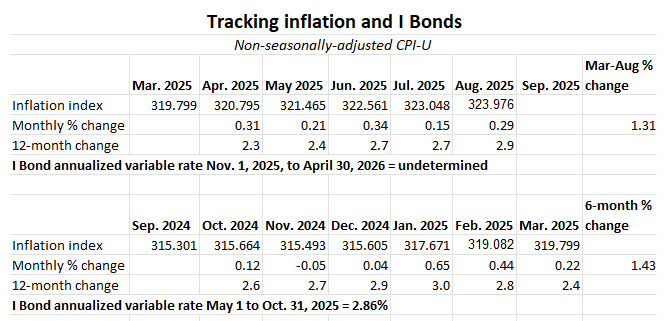
The new variable rate will be based on inflation for the six months of April to September 2025, which through five months has totaled 1.31%. That translates to a variable rate of 2.62%. If non-seasonally adjusted inflation for September runs at 0.3% (seems possible), the six-month inflation number becomes 1.61% and the variable rate rises to 3.22%, higher than the current 2.86%.
Without the September number, this calculation becomes impossible. So what will the Treasury do on November 1 if the shutdown continues? Regular reader and commenter Patrick found a potential answer in the Code of Federal Regulations.
If the CPI-U for a particular month is not reported by the last day of the following month, we will announce an index number based on the last 12-month change in the CPI-U available. Any calculations of our payment obligations on the inflation-indexed savings bonds that rely on that month’s CPI-U will be based on the index number that we have announced.
The I Bond regulations don’t give any further information on the process or formula, but inflation analyst Michael Ashton wrote about this in a September 2023 article on TIPS titled: What Happens if CPI Isn’t Released?
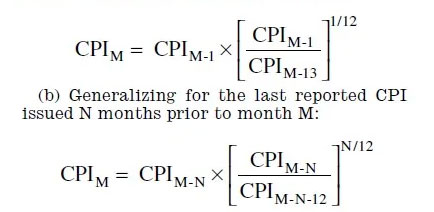
Title 31 of the Code of Federal Regulations spells out what would happen if the BLS didn’t report a CPI by the end of October. In a nutshell, the Treasury would use the August CPI index, inflated by the decompounded year-over-year inflation rate from August 2022-August 2023.
Today’s relevant calculation would be for inflation from August 2024 to August 2025. And look out, here comes the formula:
I find this to be gibberish (I’m just a journalist) but Tipswatch reader D did post an attempt at the calculation:
September 2025 = August 2025 * (August 2025 / August 2024)^(1/12)
= 323.976 * (323.976/314.796)^(1/12) = 324.753
If the fabricated September number ends up being 324.753, you get non-seasonally adjusted inflation of 0.24% for September, a six-month inflation rate of 1.55% and a new variable rate of 3.10%. My guess is that could be slightly underestimating current inflation, but we won’t know until the true September inflation report is issued.
One thing remains unclear: Once it has the correct number, would the Treasury immediately update the composite rates for all I Bonds ever issued? This isn’t a huge factor in the short run, since I Bonds assign interest at the end of each month. Any redemption in October would get an accurate payment based on the September total. But I would hope the composite rates would be updated to be accurate.
Another problem: The fixed rate
Now we have a quandary that has nothing to do with the government shutdown: What will be the I Bond’s next fixed rate? This is important to investors because the fixed rate is permanent and creates the “real yield” — the yield above inflation — for the I Bond.
The Treasury has no announced formula for setting the I Bond’s fixed rate, meaning there is no calculation required by law or regulation enforcing the process. It is up to a decision by Treasury officials. However, I Bond watchers have settled on a forecasting tool that seems to work: Apply a ratio of 0.65 to the average 5-year TIPS real yield over the preceding six months. This formula has worked without fail at least since 2017.
With less than a month to go, I looked at 5-year real yield data from the date of the last reset on May 1, 2025, to the close of Oct, 3, 2025. Looking at just that data, the forecast is for a new fixed rate of 1.00% at the reset.
I Bond fixed rates are always set to the tenth decimal point, so that means the projection has to be rounded. If you look at the top of the chart, you can see the 0.65 ratio results in 0.9539%, a razor-thin margin to round to 1.00%. So at this point, with 18 market days remaining, the fixed rate would “likely” be 1.00%.
But what if the 5-year real yield continued at the current level — 1.34% — for those 18 market days? If that happened, the 0.65 ratio results in 0.9421% and rounds down to a fixed rate of 0.90%. Again, this is a razor-thin margin.
My “guess” is that we are heading toward a fixed rate of 0.90% but that won’t happen if real yields begin to climb for the next few weeks. We have already seen the Treasury’s estimate of the 5-year real yield climb from 1.17% on Sept. 16 to 1.34% at Friday’s close. That could be caused by unease over future Federal Reserve rate cutting or the government shutdown causing a distaste for U.S. Treasury investments, or both.
Whatever happens, I feel confident the Treasury will set the fixed rate at either 0.90% or 1.00% at the November reset, as long as it continues following practices of the last decade.
What’s the strategy?
Will the Treasury call the whole thing off? No. It looks like it has a backup plan, even if it is a lousy backup plan.
My thinking: I Bond investors who haven’t purchased their full allocation ($10,000 per person per calendar year) should consider making a purchase before the end of October — I’d suggest Oct. 28 to give a margin of safety. An I Bond purchase late in the month earns a full month of interest. But don’t cut this too close to Oct. 31.
Buying in October locks in the current fixed rate of 1.10%, which is likely to go lower for purchases after November 1. It also locks in the current composite rate of 3.98% for a full six months, and then a potentially higher composite rate in the next six months. That sort of yield should be competitive with T-bills if the Fed continues reducing interest rates this year and next.
More aggressive I Bond investors could also look to bypass the purchase cap by making “gift box” transactions in October, which require a trusted partner. More on this. Additional purchases can also be made through trusts or business-owner strategies.
Is a fixed rate of 0.9% to 1.10% still attractive? I say yes, if you consider I Bonds to be a secondary store of emergency cash, always adjusting higher for inflation. Hold for five years and then redeem when you need the money.
Donate? This site is free and I plan to keep it that way. Some readers have suggested having a way to contribute. I would welcome donations. Any amount, or skip it, your choice. This is completely optional.
Follow Tipswatch on X for updates on daily Treasury auctions and real yield trends (when I am not traveling).
Feel free to post comments or questions below. If it is your first-ever comment, it will have to wait for moderation. After that, your comments will automatically appear. Please stay on topic and avoid political tirades.NOTE: Comment threads can only be three responses deep. If you see that you cannot respond, create a new comment and reference the topic.
David Enna is a financial journalist, not a financial adviser. He is not selling or profiting from any investment discussed. I Bonds and TIPS are not “get rich” investments; they are best used for capital preservation and inflation protection. They can be purchased through the Treasury or other providers without fees, commissions or carrying charges. Please do your own research before investing.
It’s Day One of the U.S. government shutdown, and the crucially important, non-partisan Bureau of Labor Statistics now has one working employee: acting commissioner William Wiatrowski. The other 2,054 employees have been (or will soon be) furloughed.
The Labor Department last week published a contingency plan for the shutdown, which included these details:
The Labor Department’s working employees will be reduced from 12,916 to 3,141.
The BLS is listed in the group that will “completely cease operations.”
No economic data will be released.
All active data collection activities for BLS surveys will cease.
The quality of data collected in the future could be impaired.
The BLS website will not be updated.
The one qualification for the BLS was that activities related to backing up systems may take up to three days.
Antoni
Coinciding with the shutdown, President Trump on Tuesday withdrew the nomination of E.J. Antoni to lead the BLS. A White House official offered the New York Times no reason for the sudden change, saying only that Antoni was a “brilliant economist” and that Trump would announce a new nominee soon.
Antoni turned out to be an extremely controversial choice for a job typically filled by non-partisan, lifelong government statisticians. Trump chose him for the job after firing Erika McEntarfer in August and claiming the BLS “rigged” data to make his administration look bad.
Antoni, who authored parts of Project 2025, has been critical of how the BLS collects data. He also called for McEntarfer’s firing during an appearance on Steve Bannon’s “War Room” podcast, agreeing with the host that they needed a “MAGA Republican” at BLS.
That was a bad look for a non-partisan job, but Antoni’s nomination was further hurt by photos and video showing he was in the crowd at the Jan. 6 riot at the U.S. Capitol. Antoni contends he was a “bystander.” And then his nomination was doomed after CNN’s KFile investigative team discovered Antoni ran a since-deleted X account with sexually degrading and bigoted attacks.
All of this made me wonder if Antoni would even get to a confirmation hearing, where a lot of this inflammatory material would be discussed and Antoni would have to respond under oath. The hearing was “scheduled” for September but was continuously delayed. Apparently Republican senators Susan Collins and Lisa Murkowski refused to even meet with Antoni and others said privately they were not likely to confirm him, according to CNN.
So the nomination was pulled, and this is a good thing for the BLS on a day when 2,054 workers are being furloughed. Trump will name another nominee soon and I have a suggestion: Elevate William Wiatrowski, the interim commissioner, to the job. He was acting BLS commissioner from January 2017 to March 2019, during Trump’s first term.
The BLS shutdown
About 11 a.m. the BLS.gov website finally posted a notice about the shutdown: “This website is currently not being updated due to the suspension of Federal government services. The last update to the site was Wednesday, October 1, 2025. Updates to the site will start again when the Federal government resumes operations.”
These economic reports, among others, will not be issued during the shutdown:
Oct. 3: September employment report
Oct. 15: Consumer Price Index for September
Oct. 16: Real earnings for September
Oct. 17: Producer Price Index for September
The Bureau of Economic Analysis, which is part of the Commerce Department, has posted a notice on its site: “Due to a lapse in appropriations, this website is not being updated.” The BEA issues the Personal Consumption Expenditures Index, the Federal Reserve’s favored measure of inflation. The next report is due Oct. 31. Let’s hope the shutdown has been resolved by then.
Things are going to get tense if the BLS cannot release a CPI report for September, which is the last month of data needed to determine next year’s Social Security cost-of-living adjustment and the new variable rate for the U.S. Series I Savings Bond. In addition, that September data is important in calculating next year’s Medicare rates, IRMAA levels and even 2026 income tax brackets.
The Federal Reserve is going to be flying blind until the shutdown is resolved, with both jobs and inflation data being locked down. From the New York Times:
“It pains me that we wouldn’t be getting official statistics at exactly a moment when we’re trying to figure out is the economy in transition,” said Austan Goolsbee, president of the Federal Reserve Bank of Chicago and a voting member on this year policy-setting committee.
What’s ahead?
It’s difficult on day one to see how this crisis will be resolved, since the Trump administration seems perfectly willing to embrace the shutdown and Democrats won’t take action to end it.
Assuming the White House doesn’t go “nuclear” by implementing widespread firings of federal workers, Democrats could possibly work out a separate deal (outside of the continuing resolution) assuring consideration of legislation to extend Affordable Care Act subsidies. A lot of Republicans want those ACA subsidies extended, as noted by the Wall Street Journal:
GOP leaders are already hinting that they are open to negotiating, and some are floating ideas that would give Democrats much of what they want. “I don’t love the policy, OK?” Speaker Mike Johnson said recently. “But I understand the political realities.”
My opinion is that the GOP has the upper hand in the “spin war,” and that is why you see Republican after Republican on television extolling their “clean 7-week continuing resolution,” without any baggage they’ve added in the past (build the wall, abolish Obamacare, etc.)
Any solution is going to take time, ticking toward that crucial Oct. 15 inflation report. From the Wall Street Journal:
House lawmakers aren’t expected to return to Washington until next week and any compromise funding proposal would need their approval. Congress hasn’t passed any appropriations bills, so unlike during the 34-day partial shutdown that ended in 2019, no government offices have been funded.
Nothing about this shutdown is good news.
NOTE: While this posting has triggered ‘healthy debate,’ I have decided to shut down commenting so we can go back to focusing on real yields, inflation and safe investments.
—————————
Donate? This site is free and I plan to keep it that way. Some readers have suggested having a way to contribute. I would welcome donations. Any amount, or skip it, your choice. This is completely optional.
Follow Tipswatch on X for updates on daily Treasury auctions and real yield trends (when I am not traveling).
Feel free to post comments or questions below. If it is your first-ever comment, it will have to wait for moderation. After that, your comments will automatically appear. Please stay on topic and avoid political tirades.NOTE: Comment threads can only be three responses deep. If you see that you cannot respond, create a new comment and reference the topic.
David Enna is a financial journalist, not a financial adviser. He is not selling or profiting from any investment discussed. I Bonds and TIPS are not “get rich” investments; they are best used for capital preservation and inflation protection. They can be purchased through the Treasury or other providers without fees, commissions or carrying charges. Please do your own research before investing.









I was already forced onto the ID.me boat before TreasuryDirect moved to it, so it's not affected my I-Bond purchase…