Europe strikes again – and TIPS get more expensive

This is from today’s Wall Street Journal:

Worries over the financial health of a major Portuguese lender spooked global markets Thursday, drubbing shares in southern Europe and sending U.S. stocks on an early swoon.

The broad, sharp market moves were reminiscent of the euro zone’s debt crisis in 2011: A shock in a small country spread across the continent …

And that little jolt, involving a major bank in a small Euro-zone country, resulted in this move in TIP, the ETF holding a wide range of Treasury Inflation-Protected Securities:

tipeuro

Note that the TIP ETF outperformed overall intermediate Treasuries (IEI) and the overall bond market (BND) in the aftermath of a Eurozone banking issue.

The TIP ETF is up 1% this week (so far), outpacing the overall bond market. When you see TIP outperforming intermediate Treasurys (I’m using the IEI ETF here), you know that TIPS are getting more expensive versus the overall bond market.

  • The nominal 10-year Treasury was yielding 2.58% on July 1 and it closed yesterday at 2.51%, down 7 basis points.
  • The 10-year TIPS was yielding 0.32% on July 1 and it is trading right now at .22%, down 10 basis points.

This morning you are looking at a 10-year inflation breakeven point of 2.29%, still in the middle range, but TIPS will be worth watching as reaction to the Euro crisis continues.

If investors believe the crisis will force continued monetary easing, TIPS could be seen as more attractive than traditional Treasuries because of their inflation protection.

Here is the long term trend in inflation breakevens – with a number below 2.0% generally indicating that TIPS are ‘cheap’ versus Treasurys and a number above 2.5% indicating they are expensive:

breakeven trendView interactive version of this chart.

Posted in Investing in TIPS | 2 Comments

Global financial group warns of Fed’s role in ‘risk-taking’ markets

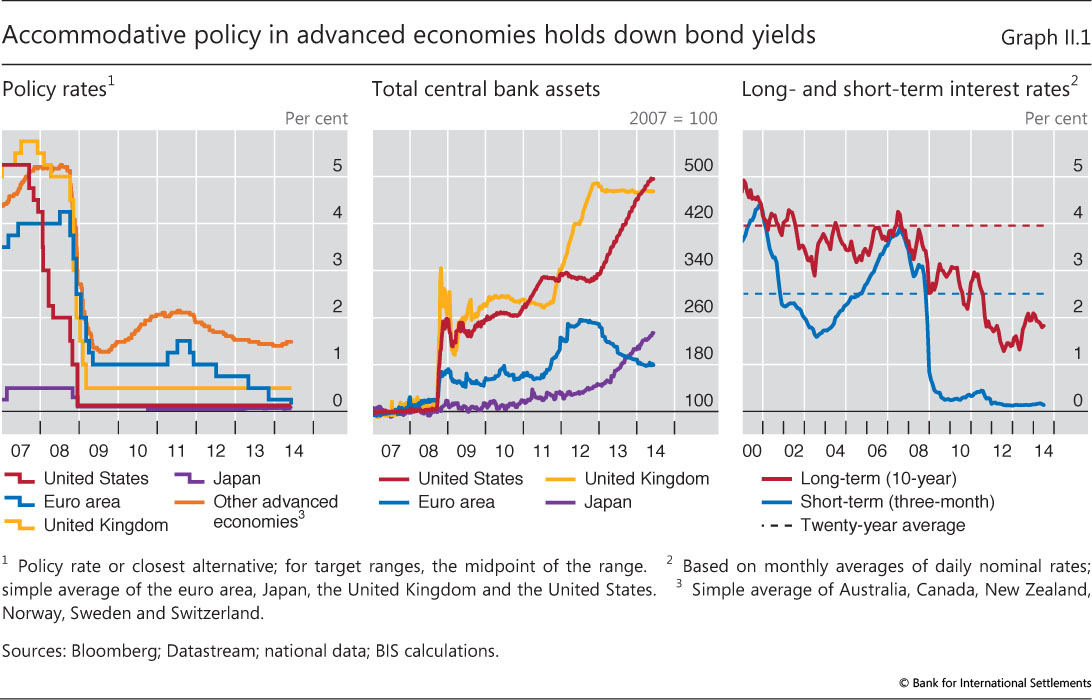
The Bank for International Settlements (BIS) issued its annual report last week, and it got some attention because it warned of excesses building in the financial system, at the same time Fed Chair Janet Yellen was defending the Fed’s policy of maintaining ultra-low interest rates well into the future.

Its opinion does warrant attention. The BIS — based in Basel, Switzerland — defines its purpose as  serving ‘central banks in their pursuit of monetary and financial stability, to foster international cooperation in those areas and to act as a bank for central banks.’

In its annual report, the BIS notes that ‘markets have been acutely sensitive to monetary policy,’ keeping volatility low and forcing investors to search for higher yields. This results in greater risk-taking, and leading to ‘high valuations on equities, narrow credit spreads, low volatility and abundant corporate bond issuance.’

I’ll excerpt some of the findings from the full report:

Monetary policy is boosting markets. “Highly accommodative monetary policies in the advanced economies played a key role in lifting the valuations of risk assets throughout 2013 and the first half of 2014. Low interest rates and subdued volatility encouraged market participants to take positions in the riskier part of the investment spectrum. ”

Ultra-low interest rates create risks. “The search for yield moved into riskier European sovereign bonds, lower-rated corporate debt and emerging market paper… ”

BIS interest ratesLong-term interest rates increased … “The short end of the US yield curve (up to two-year maturities) remained anchored by current rates and forward guidance. But with new uncertainty about the nature and timing of policy normalisation, long-term bond yields rose by 100 basis points by early July (2013), with a corresponding surge in trading volume and volatility. … ”

… And central banks over-reacted. “Responding to mere perceptions of future changes in monetary policy, markets thus induced tighter funding conditions well before major central banks actually slowed their asset purchases or raised rates. To alleviate the market-induced tightening, central banks on both sides of the Atlantic felt compelled to reassure markets.

“Markets in advanced economies quickly shrugged off the tapering scare, and the search for yield resumed.”

Central banks influenced the markets. “The sensitivity of asset prices to monetary policy stands out as a key theme of the past year. Driven by low policy rates and quantitative easing, long-term yields in major bond markets had fallen to record lows by 2012. Since then, markets have become highly responsive to any signs of an eventual reversal of these exceptional conditions. Concerns about the course of US monetary policy played a central role – as demonstrated by the mid-2013 bond market turbulence and other key events during the period under review. But monetary policy also had an impact on asset prices and on the behaviour of investors more broadly.

“The events of the year illustrated that – by influencing market participants’ perceptions and attitudes towards risk – monetary policy can have a powerful effect on financial conditions, as reflected in risk premia and funding terms. Put another way, the effects of the risk-taking channel of monetary policy were highly visible throughout the period.”

Riskier assets became more appealing.”Fuelled by the low-yield environment and supported by an improving economic outlook, equity prices on the major exchanges enjoyed a spectacular climb throughout 2013. In many equity markets, the expected payoff from dividends alone exceeded the real yields on longer-dated high-quality bonds, encouraging market participants to extend their search for yield beyond fixed income markets. Stocks paying high and stable dividends were seen as particularly attractive and posted large gains.”

Central banks had a ‘powerful impact’. “The developments in the year under review thus indicate that monetary policy had a powerful impact on the entire investment spectrum through its effect on perceived value and risk. Accommodative monetary conditions and low benchmark yields – reinforced by subdued volatility – motivated investors to take on more risk and leverage in their search for yield.”

Posted in Investing in TIPS | 7 Comments

The Goldilocks markets: This trend can’t continue

Here it is, July 2, and half of 2014 has already escaped us. It hasn’t been much of a year for new investments: Both stocks and bonds have rallied this year, making them more expensive, bank CD rates have dropped, and even the I Bond fixed rate has dropped from 0.2% to 0.1%. Not much out there is attractively priced.

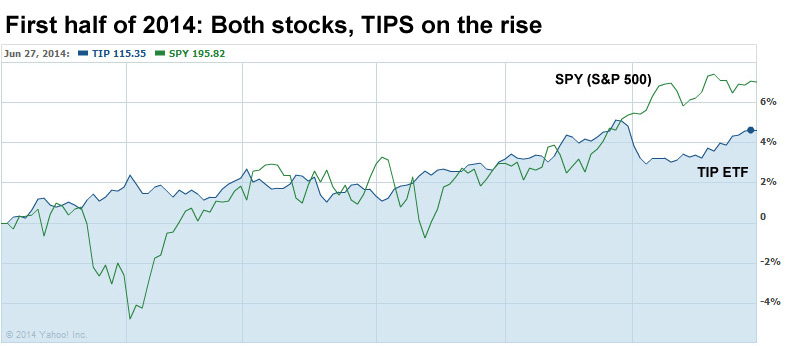
So here it is: Stocks versus TIPS in the first half of 2014. If you held either, you were a winner. This is the ‘Goldilocks market,’ not too hot, not too cold, just plain perfect.

tipspyBut here is the problem:

  • Stock prices are increasing because the market expects increasing economic growth, and thus, higher corporate profits. Stocks are a leading indicator, and they are indicating a strong economy.
  • Bond prices are increasing (and yields are decreasing) because the markets fear slowing economic growth, as indicated by the shocking decrease of 2.9% in the U.S. gross national product in the first quarter.

Obviously, both of these assumptions can’t be true. The economy is going to 1) grow, 2) decline or 3) stagnate. Either stocks or bonds, and possibly both, are flashing a false signal.

Monetary stimulus in Europe is a factor, because Europe is pouring money into the Euro system in a desperate attempt to keep interest rates low and spur economic growth. And so you get anomalies like this:

  • A 10-year US Treasury is yielding 2.61%.
  • A 10-year German government bond is yielding 1.25%.
  • A 10-year French government bond is yielding 1.72%.
  • A 10-year Spanish government bond is yielding 2.64%.
  • A 10-year Italian government bond is yielding 2.83%.
  • A 10-year Portuguese government bond is yielding 3.59%.

I’d say the risk factor for the German and U.S. bonds are similar: zero. And so why aren’t the yields closer? The risk factors in France, Spain, Italy and Portugal are much higher than zero, but the yields don’t reflect that risk.  The low yields in Europe are placing a cap on U.S. yields — you could argue that 2.61% remains too high in this environment.

TIPS yields have declined. The best day of 2014 to buy a 10-year TIPS on the secondary market was Jan. 3. The yield that day was 0.75%, and has been lower every single day since then, bottoming out at 0.22% on May 29. It stands at 0.32% today.

This decline in yield has returned TIPS to the ‘unattractive’ shelf in the investment store. They are expensive. Although I had two TIPS mature this year, I haven’t yet replaced them. The money is stashed in a short-term corporate ETF, awaiting a better buying opportunity.

Inflation and TIPS. We have seen a gradually rising inflation rate over the last six months, creating a rate of 2.1% over the last 12 months. The Federal Reserve will get uncomfortable if inflation rises much higher. Here is the trend:

inflation trendIs rising inflation good news for holders of TIPS? I’d say yes, if inflation rises to ‘expected’ levels. We buy TIPS to insure against an ‘unexpected’ increase in inflation, but a TIPS will under-perform when inflation lags behind expectations, as it has the last two years.

So if inflation rises to an expected level, the TIPS performs as expected, and that’s boring and fine. If inflation rises to very high levels, the TIPS holder benefits from the ‘insurance’ that this investment provides. But very high inflation could ravage our other holdings. It’s not a desirable thing.

Also, many people think that rising inflation will cause TIPS values to increase on the secondary market — and that TIPS mutual funds, for example, will soar in value. That is true as long as interest rates do not also rise.

If higher inflation results in higher interest rates, the yields on TIPS will rise in lockstep, and the value of TIPS will decline. If the 10-year Treasury rises to 3.5%, you can expect a 10-year TIPS to be yielding at least 1.0%, possibly 1.1% or 1.2%, or higher.

The TIP ETF is trading today at $114.13 and I have speculated in the past that it is heading to $110 as interest rates increase. That is a decline of 4%, which correlates to an increase of 52 basis points in the yield of 10-year TIPS (assuming a duration of 7.66). That would put the yield of a 10-year TIPS at 0.87%, where it closed on Sept. 16, 2013. The TIP ETF closed at $110.14 on that day. In other words: This is entirely possible, not a wild fantasy.

I have no idea where the stock market is heading, but this is what I see as the future of TIPS. How long will it take? Who knows?

This trend can’t continue.

Posted in Investing in TIPS | 7 Comments

Barrons: ‘No Exit from Bond Funds?’

Barrons columnist Randall Forsyth is writing this week about an intriguing – and somewhat scary – proposal: That the Federal Reserve is considering placing exit fees on bond mutual funds to prevent a potential run when interest rates rise. Here is his core paragraph:

(I)t might be well that the Federal Reserve appears to be thinking about the consequences of the end — and eventual reversal — of its massive experiment in monetary stimulation. Last week, the Financial Times reported that the central bank is mulling exit fees on bond mutual funds to prevent a potential run when interest rates rise, which, given the ineluctable mathematics of bond investing, means prices fall. Quoting “people familiar with the matter,” the FT said that senior-level discussions had taken place, but no formal policy had been developed.

Forsyth says that Fed Chair Janet Yellen, when asked last week about the possible move, answered that the matter “is under the purview” of the Securities and Exchange Commission. In other words, she didn’t deny it.

That was the first I heard of the proposal. Here’s a link to the Financial Times article: ‘Fed looks at exit fees on bond funds‘ and the core paragraphs:

Officials are concerned that bond funds are becoming “shadow banks”, because investors can withdraw their money on demand, even though the assets held by the funds can be hard to sell in a crisis. The Fed discussions have taken place at a senior level but have not yet developed into formal policy, according to people familiar with the matter. …

Exit fees would seek to discourage retail investors from withdrawing funds, thereby making their claims less liquid and making a fire sale of the assets more unlikely.

The idea of exit fees wouldn’t be popular with investors, who likely would be trying to sell bond funds during an already sharp fall. The exit fee would increase their losses. I haven’t seen any indication how large a fee is being considered.

Interest rates are likely to rise over the next two years. And if bond yields rise, and prices fall, bond-fund holders will benefit from the higher yields, eventually regaining the lost asset value. A sharp decline in bond prices could actually create a buying opportunity, just as many people are selling out.

But an ‘exit fee’ proposal seems to indicate the Fed and SEC are worried about a market reaction to higher interest rates and the potential of a ‘crash’ in the bond market. And that worries me.

Posted in Investing in TIPS | 10 Comments

30-year TIPS reopening auctions with yield of 1.116%

The Treasury just posted that CUSIP 912810RF7 reopened with a yield to maturity of 1.116%, slightly higher than the market rate earlier this morning. This is a 29-year 8-month TIPS with a coupon rate of 1.375%.

Because the yield is well under the coupon rate, buyers will pay up for this issue, with an adjusted price of $108.34 for $100 of value, but buyers are getting about $1.70 of accrued inflation since this TIPS was originated in February. The unadjusted price was $106.51.

Today’s yield is well below yields at the last three 29- to 30-year TIPS auctions — 1.495% on Feb. 20, 2014; 1.330% on Oct. 24, 2013; and 1.420% on June 20, 2013.

Inflation breakeven rate. With the nominal 30-year Treasury trading today at 3.43%, this sets up an inflation breakeven rate for this TIPS of 2.31%. That means if inflation averages more than 2.31% over the next 30 years, this TIPS will outperform the traditional Treasury.

Inflation has been running 2.1% over the last 12 months, but has been showing a rising trend in the last several months.

Market reaction. The higher-than-expected yield indicated less-than-stellar demand for this TIPS, and trading in the TIP ETF – which was showing a price increase in the morning – also indicated a negative reaction:

TIPS reaction
Despite that initial reaction, media reports are saying the auction was well received, and that is reflected in the lowest yield for any 29- to 30-year TIPS auction since February 2013, when yields were half what they are today.

From the Wall Street Journal report:

A $7 billion sale of 30-year Treasury inflation bonds drew strong buying interest. Traders said some investors allocated cash out of Treasury bonds to buy TIPS, a popular instrument to hedge against inflation. …

“The TIPS auction was well received, which dovetails with my point that the market isn’t buying [Fed Chairwoman Janet]Yellen’s explanation that the recent hot CPI report was the results of statistical noise,” said Adrian Miller, director of global markets strategy at GMP Securities.

Bloomberg took a more negative outlook, noting the uptick in yield:

Treasury 30-year bonds fell the most in three months after an auction of inflation-protected securities drew a higher-than-forecast yield. …

But Bloomberg also noted the rising concern about inflation:

“It’s the inflation story — clearly people are becoming more concerned about it and the Fed seemed to discount it,” Larry Milstein, managing director in New York of government-debt trading at R.W. Pressprich & Co. discount it. “The Fed came out yesterday and said they’re going to stay at these low levels, probably longer than people had anticipating, after we got the recent inflation prints.”

Posted in Investing in TIPS | Leave a comment