Why the U.S. budget deal might lead to higher interest rates

The new, bipartisan budget deal in Congress – crafted to avert another government shutdown – could have a ‘surprise’ effect: It could lead to higher interest rates in 2014.

  • The big reason is that it opens the door for the Federal Reserve to begin tapering its bond-buying economic stimulus. This fall, just before the shutdown, the Fed backed off on tapering, a move the market had already anticipated with higher interest rates. Part of the Fed’s reasoning was the budgetary gridlock and its possible effect on the U.S. economy. Now, with that threat apparently gone, the Fed has a freer hand to begin the tapering, which should in turn cause Treasury rates to rise.
  • Also the budget deal does nothing to slow down government spending, it just rearranges it. But it does soften the blow of coming sequester cuts to defense spending, which should in turn help the economy continue improving. This also opens the door to tapering.

From a Wall Street Journal report:

“The budget deal takes away uncertainty and the deal adds to spending marginally which should help economic growth be a bit stronger than expected next year,” said Thomas Roth, executive director in the U.S. government bond trading group at Mitsubishi UFJ Securities (USA) Inc. in New York.

I was surprised Wednesday that the TIPS market reacted to the budget deal with a yawn. The TIP ETF dropped about 0.1%, a meaningless move after trading slightly higher through the day.

But yields have risen noticeably as the budget deal became more likely. The 10-year nominal Treasury is yielding 2.86%, 12 basis points off the high for the year – 2.98% on Sept. 5. The 10-year TIPS is yielding 0.71%, 21 basis points off its high – 0.92% on Sept. 5.

So far, TIPS yields haven’t made a ‘giant’ move in reaction, but the trend is up. The 10-year inflation breakeven point stands at 2.15%, better than it has been recently.

Posted in Investing in TIPS | 2 Comments

Frank talk from Fidelity about TIPS

fundOne side benefit of establishing even a small stake in the Fidelity Inflation-Protected Bond Fund (FINPX) is getting Fidelity’s annual and semiannual shareholder reports. The managers of this fund – William Irving and Franco Castagliuolo – seem to be straight shooters. They have been unusually frank in the past two years about the risks building in TIPS mutual funds as yields sank negative to inflation over much of the maturity ladder.

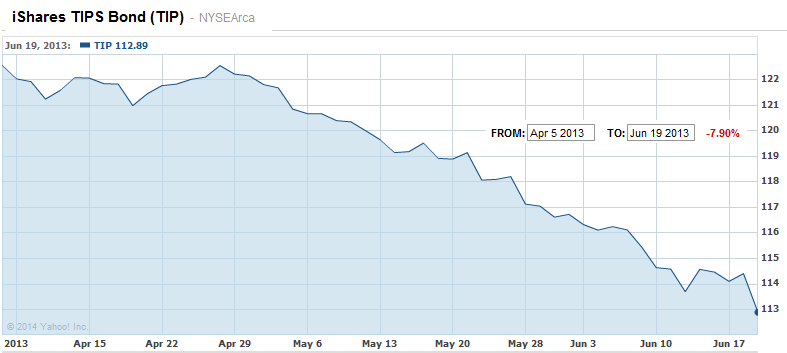
Those risks became reality in May 2013 when TIPS yields began rising from extremely low levels, slamming holders of TIPS mutual funds with about an 8% loss for the year so far, at a time of very low inflation and thus, very low income from the fund.

Here is how the Fidelity Inflation-Protected Bond Fund has performed this year against the Fidelity Total Bond Fund (FTBFX):

finpzSo that’s the backdrop for Fidelity’s current semiannual report, dated Sept. 30, 2013. It opens with a message from Abigail Johnson, Fidelity’s chairman, about the overall bond  market and prospects for higher interest rates:

As 2014 approaches, the Fed once again appears unsure about the sustainability of U.S. economic expansion. Policymakers continue to grapple with the difficult task of balancing the ongoing need for economic support with their desire to begin the process of normalizing monetary policy. While the associated uncertainty may result in further bond market volatility in coming months, we haven’t yet seen economic conditions that would justify dramatically higher interest rates. That said, we believe the global economy is recovering, slowly but surely. Over time, the recovery should drive interest rates higher, offering bond investors the opportunity to reinvest at higher rates.

Then comes a Q&A with the FINPX managers, Irving and Castagliuolo, which I am reproducing here in its entirety:

Q. Bill, how did the fund perform?

W.I. For the six months ending September 30, 2013, its Retail Class shares returned -6.58%, while the Barclays® U.S. Treasury Inflation-Protected Securities (TIPS) Index (Series-L) — which tracks the types of securities in which the fund invests — returned -6.40%. To provide a sense of how the fund performed relative to its competitors during the period, the LipperSM Treasury Inflation-Protected Securities Funds Average returned -5.76%. For the 12-month period ending September 30, 2013, the fund’s Retail Class shares returned -6.44%, the Barclays index returned -6.10% and the Lipper peer group average returned -5.51%.

Q. Why did TIPS perform so poorly during the six-month period?

W.I. Simply put, interest rates rose and inflation expectations diminished. In May, the U.S. Federal Reserve signaled it could begin scaling back its purchases of Treasury and government-backed mortgage securities, triggering a steep sell-off of government bonds — including TIPS — in May and June. At the same time, inflation expectations receded because investors believed the Fed was set to decrease its support of the economy even though growth was still weak — a potentially deflationary move. TIPS ended the period on a better note, when the Fed surprised most market observers in September with its decision to refrain from tapering its stimulative bond-buying program.

Q. Turning to you, Franco, what was your investment approach?

F.C. Throughout the six-month period, we adhered to our investment mandate, investing virtually all of the fund’s assets in TIPS with maturities ranging from one to 30 years. This helps explain why the fund trailed its Lipper peer group average. Many funds in our peer group were focused solely on the better-performing short-term TIPS, which helped them significantly outperform those with a broader mandate to invest in the entire TIPS market. We kept the fund’s risk profile similar to that of the Barclays index by maintaining interest rate sensitivity that was about in line with the benchmark. Additionally, our yield-curve positioning — how our holdings were invested in TIPS across the maturity spectrum — was similar to that of the benchmark. We also looked for ways to add incremental return through security selection. Various factors — including which part of a given year a TIP security was issued — can result in mispricing, and we sought to take advantage of those inefficiencies by purchasing only securities we believed to be attractively priced and selling those we felt were fully valued. After accounting for expenses, these strategies helped the fund keep pace with the Barclays index during the six-month period. And while the fund, like the TIPS market itself, experienced significant outflows, they occurred at a consistent pace and, as such, had generally no impact on the fund’s absolute or relative performance.

Q. What’s ahead for the TIPS market?

W.I. At the end of the period, there was a lot of negative sentiment weighing on the U.S. government bond market, including TIPS. In our view, we are not in a secular bear market. We believe that higher interest rates would likely choke economic growth. Furthermore, inflation has remained benign and the Fed seems to be skittish about pulling away its monetary stimulus. Without significant economic growth or inflation, and with a central bank that appears willing to continue to buy bonds, we don’t think the case for a secular bear market holds much credibility.

F.C. Given that outlook, we believe that TIPS offered investors reasonably priced inflation protection at the end of the period. While our best case scenario doesn’t forecast a significant rise in inflation over the foreseeable future, there’s the possibility that the Fed has been too pessimistic in its economic outlook and that inflation ratchets higher.

Posted in Investing in TIPS | 1 Comment

TIPS mutual funds got a reality check in 2013, more trouble to come?

Yes, it has been a bad year for Treasury Inflation-Protected Securities, but as I will explain, it all depends on how you define ‘bad.’ As a buy and hold-to-maturity investor in TIPS, with a ladder crossing many years of maturities, I don’t really worry much about market swings after I make my purchase.

The Wall Street Journal last week gave an article about TIPS fairly major play: ‘TIPS Poised for Worst Year Ever.‘ The article pointed out that TIPS underperformed traditional Treasuries this year, mainly because TIPS were overbought through 2012, pushing yields negative to inflation. And then, inflation fizzled:

For years, TIPS owners accepted negative real yields, expecting they’ll get compensated down the line when inflation rises. Payments on TIPS increase as the consumer-price index rises. Now, not only is realized inflation in the economy still tepid, but the Fed’s inflation-inducing stimulus program looks set to wind down without having stirred up much inflation at all.

Quite frankly TIPS got way too expensive from July 2011 to about April 2013. I simply stopped buying during that time, and I got completely out of TIPS mutual funds, way back in 2011 (too early, I admit). But that changed this year, as yields improved:

  • I again started buying TIPS at auction – cautiously in the May, July and September auctions, mainly to fill holes in my TIPS ladder caused by two years without purchases.
  • On June 21, I reestablished small positions in the Vanguard and Fidelity TIPS funds, and I am dollar-cost averaging contributions in IRA accounts. On June 21, the TIP ETF stood at $110.44 and today it trades at $111.19, so most of the damage was done by June 2013.

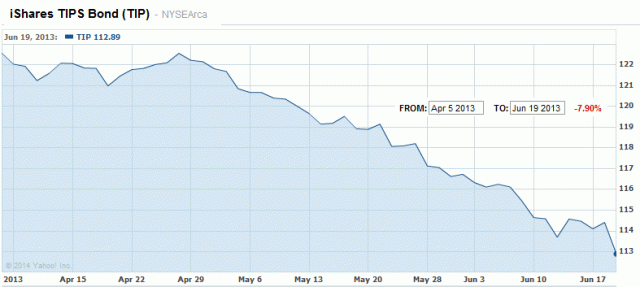
TIPS mutual funds, especially, have been hard hit, with the TIP ETF dropping 8.5% so far in 2013. Yields started rising in the summer, as fears rose that the Federal Reserve would stop its bond-buying stimulus program. Back on June 9, when the TIP ETF stood at $114.64 and the 10-year Treasury was yielding 2.22%, I wrote this (call me psychic):

My theory is that the 10-year Treasury could rise to about 2.75% by the end of the year, and if it does, that would set the 10-year TIPS yield at about 0.5%, about 47 basis points higher than it is today. If that happens, the TIP ETF would fall another 4%, or maybe to the $111 to $110 range. At that point, I might be a buyer.

And voila, within a month the 10-year Treasury yield hit 2.70% and the TIP ETF dropped to $110.50, and I, the psychic, became a cautious buyer.

TIPS mutual funds hit a low-water mark on Sept. 5, when the 10-year TIPS yield soared to 0.92%. Today it stands at 0.66%, 26 basis points lower. I expect that next year, if the economy improves and the Federal Reserve abandons bond buying, the 10-year TIPS yield will begin to ‘normalize,’ possibly somewhere around 1.5% with a traditional Treasury yielding 3.8%.

I laid out my logic in this post back in August: How high will TIPS and Treasury yields rise?

A yield of 1.5% on a 10-year TIPS would be an 84 basis point rise from today’s yield and would cause about a 6% drop in the TIP ETF, giving you a price somewhere in the $104 to $105 range.

I am not saying this will happen, but I do think it could happen, and possibly is likely to happen. In the Wall Street Journal article, J.P. Morgan experts make an even more dire prediction:

J.P. Morgan expects inflation to remain tame next year, seeing year-over-year CPI running no higher than 1.7%. That, alongside an expected 120 basis point rise in real yields, translates into a -8.4% total loss on TIPS in 2014.

Posted in Investing in TIPS | 7 Comments

10-year TIPS reissue auctions at 0.560%

The Treasury site is suffering hiccups today, but it has finally posted results for the $13 billion reissue of CUSIP 912828VM9, creating a 9-year 8-month Treasury Inflation-Protected Security. It auctioned with a yield of 0.560%, indicating decent demand for this TIPS. View the Treasury announcement.

After opening down, the overall TIPS markets steadily improved through the morning. Around 10 a.m., this same TIPS was selling on the secondary market with a yield of 0.62% and it closed yesterday at 0.587%. The final yield of 0.560% indicates demand was good for today’s auction.

This was the highest yield for any 9- or 10-year TIPS auction since July 2011, but just barely, because this same TIPS was reissued on September 19, 2013 with a yield to maturity of 0.5%.

Because this TIPS carries its original coupon rate of 0.375%, today’s buyers are getting it at a discount, with an adjusted price of about $98.86, which includes about 60 cents of inflation-adjusted principal.

Inflation breakeven rate. The 10-year nominal Treasury is currently trading at 2.79%, creating an inflation breakeven rate for this TIPS of 2.23%. That means this TIPS will outperform a traditional 10-year Treasury if inflation – currently running at 1.0% – averages more than 2.23% over the next 10 years.

Posted in Investing in TIPS | 1 Comment

Checking in on today’s 10-year TIPS reopening

The Treasury today is reopening CUSIP 912828VM9, creating a 9-year 8-month Treasury Inflation-Protected Security. This TIPS trades on the secondary market, so we can get a pretty good idea of the likely yield, which was 0.587% (plus inflation) at the market close on Wednesday.

It’s trading around 0.62% right now, so the race is on to a higher yield when the auction closes at 1 p.m.

There’s been a big bump in yield in the last week, a good thing for buyers. Last week, when I previewed this auction, the TIPS was trading at 0.481%. The TIPS ETF has seen a fairly sharp two-day decline leading up to this auction:

TIPS 5 dayI’m speculating, but a well-publicized negative opinion on TIPS from the investment firm BlackRock might have something to do with this jump in yields. Barrons picked this up in an article titled: ‘TIPS Are Still Expensive, Keep Avoiding Them‘. I can’t argue with the main points: That Treasurys are still overbought and TIPS are hurt by the current rate of inflation, which is extremely low. This was double-confirmed in Wednesday’s inflation report.

From the BlackRock report:

(W)e don’t believe investors need to increase holdings that are designed to protect against inflation, especially if those asset classes are expensive. In particular, we have a negative view toward Treasury Inflation-Protected Securities (TIPS). The absence of inflation is a key reason why TIPS have underperformed so much in 2013.

An update on inflation

Inflation in October fell 0.1 percent on a seasonally adjusted basis, and was just 1.0% over the last 12 months, the U.S. Bureau of Labor Statistics reported Wednesday.

The non-seasonally-adjusted CPI-U, which is used to adjust the principal balance of TIPS and set future inflation-adjusted interest rates on I Bonds, was even worse, falling 0.3% in October and rising only 1.0% over the last year.

For TIPS buyers, this is a double whammy. Buyers have been accepting yields near or below inflation over the last two years, and now inflation has turned into deflation. This stark reality ought to cast a pall over today’s auction.

On the other hand, the weak inflation report leaves the door open for continued economic stimulus from the Federal Reserve, a fact that in normal times would heighten inflation fears and boost the desirability of TIPS. That’s not likely to happen, today at least.

Conclusion. While buyers are getting a better-than-expected yield, this TIPS auction ought to have all the appeal of a moldy coffee mug. With inflation this low, TIPS buyers should be demanding a yield at least approaching 1.0% over inflation. Let’s see how it goes.

Posted in Investing in TIPS | 3 Comments