Up next: 10-year TIPS reissue will auction Nov. 21, 2013

announcement

Click on image to see larger version

The U.S. Treasury formally announced yesterday that on Nov. 21 it will reopen CUSIP 912828VM9, creating a 9-year 8-month Treasury Inflation-Protected Security.

View the Treasury announcement.

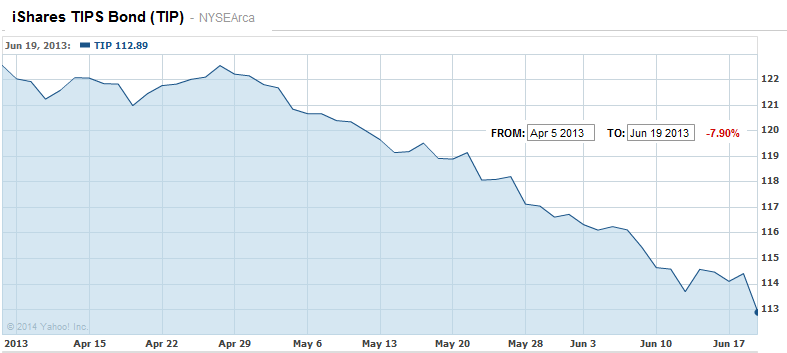
This TIPS has an interesting history, because it was reissued on Sept. 19, the day after Ben Bernanke and the Federal Reserve backed off on any tapering the Fed’s bond-buying economic stimulus program. This ‘extension’ of QE3 gave the TIPS market a double boost, because 1) it meant the Fed would continue manipulating the Treasury markets, driving down yields and 2) it raised fears of future inflation based on runaway currency creation. I said at the time that TIPS buyers had been ‘Bernanked.’

So here is CUSIP 912828VM9’s history:

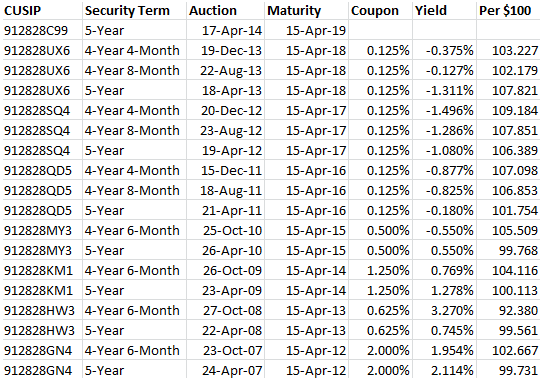
  • First auctioned on July 18, 2013 with a coupon rate of of 0.375% and a yield to maturity of 0.384%, the highest in two years for any 9- to 10-year TIPS.
  • Reissued on September 19, 2013 with a yield to maturity of 0.5%. But this yield was down substantially from the prevailing yield of 0.8% this TIPS was trading at before Bernanke blinked.
  • It is now trading on the secondary market with a yield of 0.481%.

I consider the 10-year maturity the ‘sweet spot’ for TIPS purchases, because buyers benefit from the higher yield while also retaining a manageable maturity. By manageable I mean: I’ll be alive when this thing matures.

So looking at the big picture, this reissue is attractive. Buyers will get the TIPS at a discount, around $99 for $100.05 of value, calculating in the meager 0.5% inflation we’ve seen since July.

But I still hear a voice calling out: ‘This yield should be higher.’ The Fed’s efforts to keep longer-term interest rates low has had an effect: Just look at stock prices soaring while Treasury yields are holding at relatively low levels. Something has to give.

With the 10-year Treasury trading at 2.69% and this TIPS yielding around 0.48%, you are looking at an inflation breakeven rate of 2.21%, in the moderate zone but definitely not cheap. Back in July this number was 2.136%, indicating that TIPS have gotten more expensive relative to nominal Treasurys.

It has been a wild year for TIPS yields and I suspect we will see more of the same in 2014. The 10-year yield started 2013 at -0.62% and rose to 0.92% on  Sept. 5. That is an amazing swing of 154 basis points. Since September, though, yields have fallen more than 40 basis points.

So the best deals for TIPS buyers happened to be in the late summer and early fall. But the boost in yields gave us a hint of what may be coming: ‘Normalized’ yields, returning to possibly 1.5% or even 2.0% on a 10-year TIPS.

Confession: I purchased 912828VM9 back in July in the heady days of positive yield! Waiting would have turned out better. But one thing is always true: Buying TIPS and holding them to maturity is never a bad investment.

Posted in Investing in TIPS | 11 Comments

How have short-term TIPS funds performed?

A year ago, on Oct. 28, 2012, I wrote a post titled ‘Vanguard’s new short-term TIPS funds: Better than cash?‘ and asked if funds investing in short-term Treasury Inflation-Protected Securities could be an alternative to a money-market fund.

Back then, short-term bond funds were the rage, and short-term TIPS funds were even more popular (which might have ended up skewing their returns.) I noted then that these funds are conservative:

  • Since they hold only Treasurys, there is no credit risk.
  • Since they hold only short-term maturities, there is lessened interest-rate risk.
  • Their return will be bolstered if we see a period of unexpected inflation.

On the other hand, there are negatives:

  • The return is miniscule.
  • We have seen extremely low inflation.
  • Although interest-rate risk is minimized, there is still a real risk that these funds will decline in value.

As an alternative, an investor could simply buy 5-year TIPS each year at auction  and hold them to maturity, building a ladder of 1- to 5-year TIPS and eliminating all risks. But that would eliminate liquidity, and that is a key part of the appeal of short-term TIPS funds.

But can they really substitute for a cash account? Here is how the Short-Term Inflation-Protected Securities ETF (VTIP) performed against cash (0.0% return) in the year since I wrote that article:

Short Term TIPS

VTIP has lost 0.82% in value since Oct. 31, 2013, and according to Morningstar data, it has had a trailing 12-month total return (including dividends) of -0.88%. So it has not outperformed cash paying zero interest.

So, answering my question of a year ago: No, VTIP was not better than cash.

The fund showed unusual volatility in the summer of 2013 as the bond market grew worried about the potential end of Federal Reserve bond-buying. VTIP has since recovered, but you don’t expect to see this kind of volatility in a fund you are holding as a cash alternative.

Take a look at how VTIP has performed against another ETF, the Vanguard Short-Term Corporate Bond ETF (VCSH), a fund that would be considered slightly more risky than a short-term Treasury ETF:

corporate

While VTIP initially outperformed short-term corporates, the performance of the two funds ends up being nearly identical over the last year, with both losing about 0.8% of value in NAV.

However, VSCH with its better yield had a much better total return over the last 12 months: 1.44%.

This chart sums up the year for VTIP and other bond funds, adding in Vanguard Prime Money Market (VMMXX) and Vanguard Total Bond ETF (BND).

total returnIn conclusion:

  • VTIP underperformed cash as its net-asset value fell through 2013.
  • VTIP underperformed short-term corporates, because in a time over very low inflation it couldn’t match the yield of corporate bonds.
  • VTIP outperformed the total bond market, which yields more but faces higher interest-rate risk.
Posted in Investing in TIPS | 2 Comments

New Treasury Floating-Rate Notes: Bad deal for small investors?

floating rateThe Treasury Department said today it will hold its first Floating-Rate Note auction on Jan. 29. These 2-year-term FRNs are a new product, and are drawing a lot of attention as a possible replacement or add-on to fixed-income holdings like TIPS and I Bonds.

Floating-rate notes are the first new debt product from the U.S. government since 1997. Should you plan to invest in them?

TIPS and I Bonds have a special place in portfolio allocation because they 1) are super safe, 2) provide a rate of return that usually is equal to or better than nominal Treasurys of the same term, and 3) provide insurance against unexpected future inflation.

FRNs will also be super safe and will provide insurance against an unexpected future rise in interest rates. But will they outperform similar-term Treasuries or other safe investments of similar terms? Very possibly not.

What is an FRN? The Treasury says: “An FRN is a security that has an interest payment that can change over time.  As interest rates rise, the security’s interest payments will increase.  Similarly, as interest rates fall, the security’s interest payments will decrease.” Read the Treasury’s term sheet for FRNs.

So it is important to note that inflation is not part of the picture for FRNs. While TIPS and I Bonds are tied to future inflation, the FRN is tied to future interest rates, specifically short-term rates.

What will be the index for FRNs? The Treasury says, “FRNs will be indexed to the most recent 13-week Treasury bill auction High Rate, which is the highest accepted discount rate in a Treasury bill auction.” Depending on demand at auction, the FRN could end up yielding a few basis points more than the 13-week Treasury.

The current 13-week yield is 0.05% and the current 2-year Treasury yield is 0.32%. So even if buyers of an FRN get a 15-basis-point premium (too generous?), they’d be giving up 12 basis points in anticipation of higher shorter-term rates in the future.

It’s important to note that short-term Treasury yields have actually declined in the last year while longer-term Treasurys have seen yields rise nearly 100 basis points.

  • On Nov. 6, 2012, the 13-week yield was 0.10%, now it is 0.05%, a decline of 5 basis points.
  • On Nov. 6, 2012, the 2-year yield was 0.30%, now it is 0.32%, an increase of 2 basis points.
  • On Nov. 6, 2012, the 10-year yield was 1.78%, now it is 2.69%, an increase of 91 basis points.

The point is: Either way, with an FRN or a 2-year nominal Treasury, you are getting an awful return, well below likely inflation.

For example, let’s say inflation averages 2.3% over the next two years and short-term interest rates rise 25 basis points during that time. You are making a two-year investment today (pretend that FRNs are now being issued at a 15 basis-point premium over the 13-week Treasury). Here is what you could expect:

  • FRN. Over two years your yield will rise to about .45% and you will trail inflation by at least 1.85% a year.
  • 2-year Treasury. Your yield will be 0.32% and you will trail inflation by 1.98%.
  • 2-year bank CD. Your yield will be 1.10% and you will trail inflation by 1.2%.
  • I Bond. Your yield will beat inflation by 0.2% (the current fixed rate on I Bonds). But you will pay a three-month interest penalty if you sell after 2 years. That will drop your return to about 2.18%, just about equal to inflation.

So, I am thinking the FRN looks unattractive for the average investor. In fact, I don’t think it is meant for individual investors at all, as noted in this Financial Times story:

“Demand for the new floating rate security will come from money funds, short-term funds and corporate Treasurers who want something that is a hedge against rising interest rates and is high-quality collateral,” said Ira Jersey, strategist at Credit Suisse. ..

“For companies that sell floating rate debt, the arrival of a new Treasury security stands to create a new benchmark for this area of fixed income and, over time, encourage a move away from using the London interbank offered rate as a floating reference rate.”

A PIMCO analysis of FRNs came to a similar conclusion:

Foreign central banks may be natural buyers for FRNs. They currently hold about 25% of the T-bill supply and 40% of the Treasury coupon supply. Rolling T-bill holdings is a core strategy for these risk-adverse investors. So holding FRNs, which minimize roll-related transaction costs, may be appealing.

The Wall Street Journal noted some investor unease about the super-low interest rates and pricing uncertainty of the first FRN auction in January:

Others questioned how attractive the debt will be. The ultralow rates on short-term U.S. Treasury bills, which mature in a year or less, will hold down returns on the floating-rate notes unless there is a significant uptick in market interest rates.

Yields on floating-rate Treasury notes are linked to the results of the weekly three-month Treasury-bill sale. That bill yielded 0.05% on Wednesday.

“I don’t know how excited to be until we see where they price,” said David Sylvester, head of money funds at Wells Fargo Advantage Funds, which had more than $121 billion of money-market fund assets under management as of Sept. 30.

Posted in I Bond, Inflation, Investing in TIPS | 7 Comments

More evidence: Why I Bonds are a no-brainer buy

Four days into November, and I am still amazed that the U.S. Treasury added a 0.2% fixed base rate to its Savings I Bonds purchased from Nov. 1, 2013 to April 30, 2014. OK, it is true that 0.2% is going to earn you very little interest ($20 a year on a $10,000 investment, growing with inflation). But it was basically a gift from the Treasury, because it keeps I Bonds the super-hero of super safe investments.

The way I Bonds work. An I Bond is a security that earns interest based on combining a fixed rate and an inflation rate.

The fixed rate – now 0.2% for as long as you hold the bond, up to 30 years – will never change. So if you bought an I Bond earlier this year with a zero fixed rate, it will continue to have a zero fixed rate. Purchases through April 30, 2014, will have a fixed rate of 0.20%. I Bonds I bought back in 2000 still carry a fixed rate of 3.4% and will continue to do so through 2030.

The inflation-adjusted rate changes each six months to reflect the running rate of inflation. That rate is currently set at 1.18% annualized. It will adjust again on May 1, 2014, for all I Bonds, no matter when they were purchased. (Although the effective start date of the new interest rate can vary depending on the month you bought the I Bond, a Treasury oddity.)

Why they are a great investment.

  • First, I Bonds are the most conservative and most safe of all investments. Your principal is 99.9999999% safe and it will never decline, ever. If inflation falls to below zero, the inflation-adjusted rate will fall to zero, but not below zero. This is not true of TIPS, where accrued principal declines when deflation strikes. This means I Bonds are a superior investment to TIPS in times of deflation.
  • I Bonds allow you fantastic flexibility. You can redeem them after one year, costing you three months of interest. Or redeem them after five years and pay no penalty, or just hold them for 30 years and cash out.
  • I Bonds protect you against unexpected inflation. If inflation in the next 30 years suddenly soars to 7%, 10%, 15%, your principal will increase by that amount because of the inflation-adjusted interest rate.
  • I Bonds allow you to defer federal income taxes until you redeem them, so you pay zero in taxes until they are sold. This is a big advantage over TIPS, which carry current-year income taxes for both the coupon rate and the inflation adjustment to principal. (Both TIPS and I Bonds are free of state income taxes, an advantage over bank CDs.)
  • I Bonds are very simple to track as an investment. Just download the Savings Bond Wizard, update your information, and check it a couple times a year. This is another huge advantage over TIPS held at TreasuryDirect, which is a do-it-yourself proposition, even for downloading yearly tax forms. Want to track current value of your TIPS? Open up Excel and get to work. TreasuryDirect is not going to tell you.

So with all these I Bond advantages, how do they compare with other super-safe investments? I contend that that tax advantages alone make an I Bond paying a fixed rate of 0.2, plus inflation, preferable to all super-safe investments through 10-year maturities.

I Bond Treasury TIPS Bank CD
1 year Inflation plus 0.2%* 0.09% Inflation minus 1.16% 1.00%
5 years Inflation plus 0.2% 1.35% Inflation minus 0.59% 1.95%
10 years Inflation plus 0.2% 2.59% Inflation plus 0.45% NA
30 years Inflation plus 0.2% 3.68% Inflation plus 1.35% NA
* 3-month interest penalty

The 10-year TIPS pays 0.45% plus inflation, only 25 basis points better than the I Bond. But if held in a taxable account, you’d owe taxes every year on both interest and the principal adjustment. Compare TIPS and I Bonds.

Conclusion. I Bonds outshine other super-safe investments in the short term, and their tax advantages make them attractive to hold for the long term.  Because you can buy only $10,000 a year per person (plus your income tax refund, if you wish), I say continue to buy them to the max each year and sell them only if you need cash.

Posted in I Bond, Investing in TIPS | 3 Comments

Amazing news: Treasury adds 0.20% fixed rate to the I Bond

The U.S. Treasury just announced that I Bonds purchased from Nov. 1, 2013, to April 30, 2014, will pay a fixed-rate of 0.20%, along with an inflation-adjusted rate of 1.18% (annualized) over the next six months. That means I Bonds purchased during this period will pay 1.38% annualized.

The inflation-adjusted rate will change again on May 1, 2014, but that fixed rate of 0.20% will remain with these new I Bonds for 30 years.

This is big news because the fixed rate on I Bonds has been zero since May 2010, and it appeared almost certain that the Treasury would keep the rate at zero, given the recent decline in TIPS yields. The yield on a 10-year TIPS for example, peaked at 0.92% on Sept. 5. But then the Fed backed off on tapering and the yield has dropped a nasty 52 basis points.

So this makes these I Bonds a screaming good buy. I’ve been looking at the spreads between the I Bond yield and a 10-year TIPS. It looked to me that it would take a yield of 1.2% on the TIPS to cause Treasury to move the I Bond above zero. With a 10-year TIPS currently trading at 0.40%, that squeezes the spread down to 20 basis points.

Date I Bond fixed interest TIPS yield TIPS spread over I Bond
Nov 1 2013 0.20 0.40 0.20
May 1 2010 0.20 1.32 1.12
Nov 1 2009 0.30 1.41 1.11
May 1 2009 0.10 1.80 1.70
Nov 1 2008 0.70 3.09 2.39
May 1 2008 0.00 1.52 1.52

This is a deal because I Bonds are a much more flexible and investor-friendly product than TIPS. Taxes are deferred until the I Bond is sold (for TIPS, both interest and inflation adjustment is taxable each year), and I Bonds can be sold after one year with a minor penalty and after five years with no penalty.

Should I sell my zero-rate I Bonds to buy these?

I would say definitely not, especially if you are trying to build a large cache of I Bonds by buying to the maximum each year ($10,000 per person at TreasuryDirect). If you haven’t bought your 2013 allotment because you were waiting to see if you could get a fixed rate, you just got a very nice present from the Treasury. Buy now.

Otherwise, the rest of us will be able to grab this 0.20% interest rate in January, when we can again buy I Bonds up to the limit.

Selling your I Bonds is not a good idea, I think, unless you need the cash. Because you can only buy $10,000 a year, you can only swap $10,000 a year, old for new, but your total investment in I Bonds then would be stable, not growing.

Here is the Treasury’s statement, which includes some nice information:

I Bond Earnings Rate of 1.38% includes a Fixed Rate of 0.20%
The earnings rate for Series I Savings Bonds is a combination of a fixed rate, which applies for the life of the bond, and the semiannual inflation rate. The 1.38% earnings rate for I bonds bought from November 2013 through April 2014 applies for the first six months after the issue date. The earnings rate combines a 0.20% fixed rate of return with the 1.18% annualized rate of inflation as measured by the Consumer Price Index for all Urban Consumers (CPI-U). The CPI-U increased from 232.773 in March 2013 to 234.149 in September 2013, a six-month increase of 0.59%.

Posted in I Bond, Investing in TIPS, Savings Bond | 11 Comments