30-year TIPS auction gets real yield of 2.403%, highest in 23 years

By David Enna, Tipswatch.com

The market for Treasury Inflation-Protected Securities made a bit of history today, with the auction of $9 billion in a new 30-year TIPS getting a real yield of 2.403%, the highest for this term since October 2001.

Of course, we have to recognize that the Treasury stopped issuing 30-year TIPS from October 2001 to February 2010. Since that restart, no 29- to 30-year TIPS auction has received a real yield higher than 2.29%. Until today.

This is CUSIP 912810UH9, and the auction sets its coupon rate at 2.375%, also the highest for this term in 23 years. The auction appears to have come in right on target. The “when-issued” yield prediction — revealed just before the close at 1 p.m. EST — was very close at 2.400%. The bid-to-cover ratio was a solid 2.48.

This is a good result for investors, who will earn 2.403% over official U.S. inflation for the next 30 years. Just a reminder: As recently as March 9, 2022 — less than three years ago — the nominal yield on a 30-year Treasury bond was 2.29%, less than the real yield of today’s result. This is a nice turn for investors seeking safety.

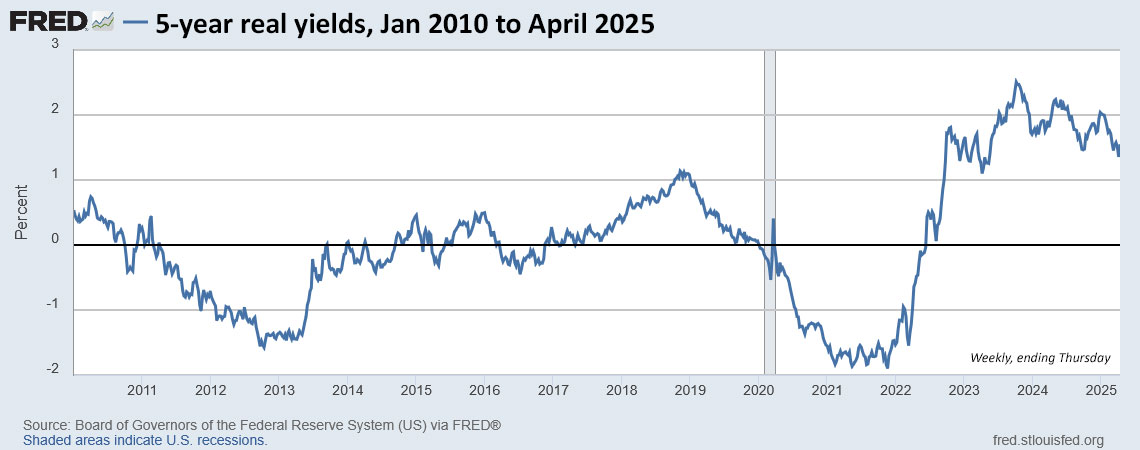
Here is the trend in the 30-year real yield over the last five years, showing the remarkable surge higher after the end of the Federal Reserve’s pandemic-era quantitative easing in March 2022:

Click on image for larger version.

Pricing

This is a new TIPS, so investors could be assured that the coupon rate (2.375%) would be set slightly below the real yield of 2.403%. That resulted in a discounted unadjusted price of 99.403433. In addition, this TIPS will have an inflation index of 1.00016 on the settlement date of February 28.

With this information, we can calculate the exact cost of a purchase of $10,000 par value of this TIPS at today’s auction:

  • Par value: $10,000.
  • Adjusted principal purchased: $10,000 x 1.00016 = $10,001.60
  • Cost of investment: $10,001.60 x 0.99403433 =$9,941.93
  • + accrued interest of $8.53

In summary, an investor buying $10,000 par of this TIPS at today’s auction paid $9,941.93 for $10,001.60 of principal and will now earn inflation adjustments equal to inflation for 30 years, plus an annual coupon of 2.375% paid on inflation-adjusted principal.

Inflation breakeven rate

At the auction’s close, the 30-year Treasury bond was trading with a nominal yield of 4.74%, meaning this TIPS gets an inflation breakeven rate of 2.34%, a bit high compared to recent trends. This reflects a lack of investor confidence in the Federal Reserve’s ability to put tight controls on future inflation. Inflation over the last 30 years, ending in January, has averaged 2.5%.

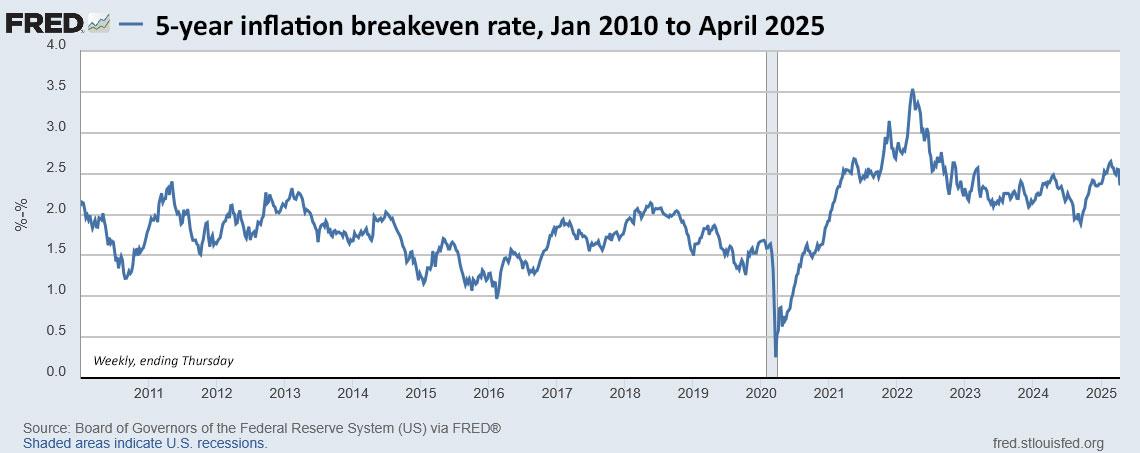
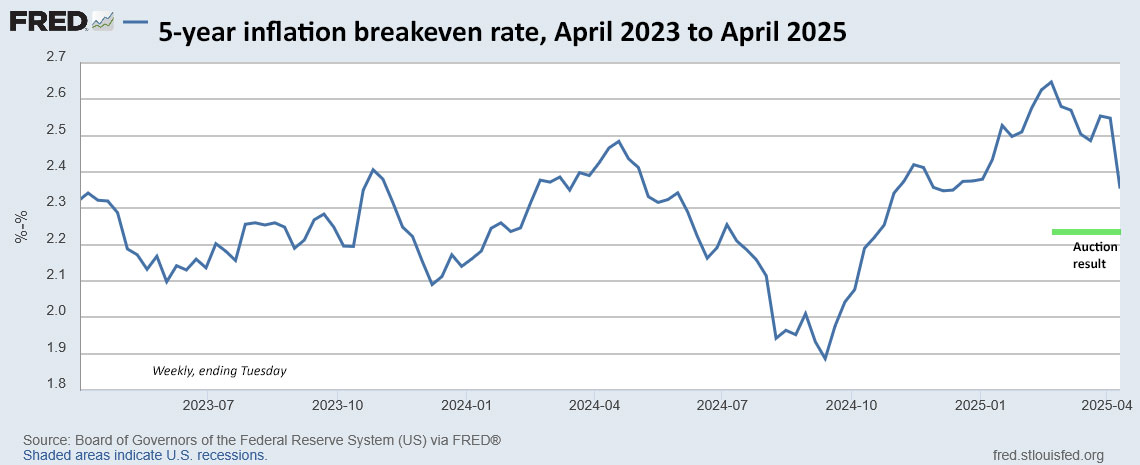
Here is the trend in the 30-year inflation breakeven rate over the last five years, showing how inflation expectations have been locked in a narrow pattern (but highish) for the last three years:

Thoughts

This is a very good result for investors who can accept the 30-year time frame and hold to maturity. CUSIP 912810UH9 is the most attractive 30-year TIPS issued in 24 years, in my opinion. But I wasn’t a buyer because the long maturity doesn’t fit into my likely lifespan.

We are heading into uncertain economic times. Both real and nominal yields could be heading higher. Still, getting 2.403% over inflation for 30 years, guaranteed, is attractive and sensible, in my opinion.

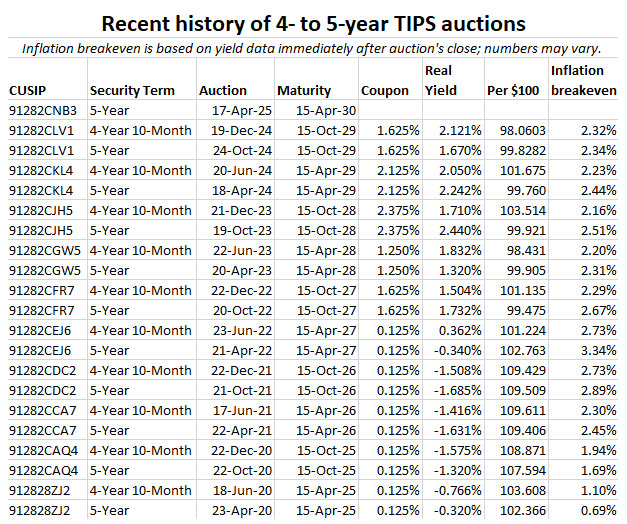
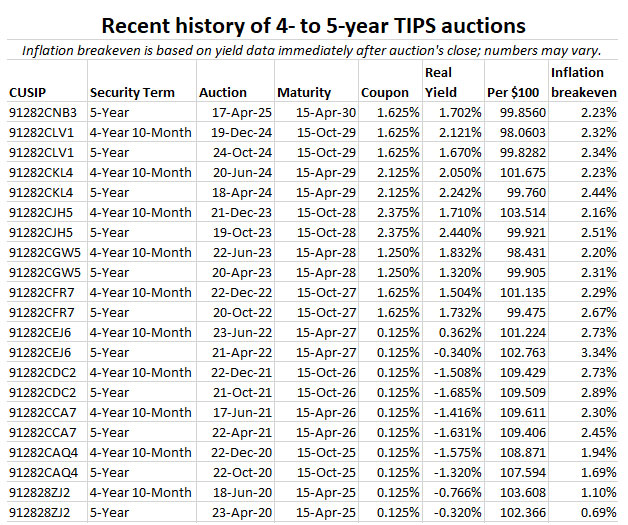
Here is a history of TIPS auctions of this term over the last five years:

Now is an ideal time to build a TIPS ladder

Confused by TIPS? Read my Q&A on TIPS

TIPS in depth: Understand the language

TIPS on the secondary market: Things to consider

TIPS investor: Don’t over-think the threat of deflation

Upcoming schedule of TIPS auctions

* * *

Follow Tipswatch on X (Twitter) for updates on daily Treasury auctions and real yield trends (when I am not traveling).

Feel free to post comments or questions below. If it is your first-ever comment, it will have to wait for moderation. After that, your comments will automatically appear. Please stay on topic and avoid political tirades. NOTE: Comment threads can only be three responses deep. If you see that you cannot respond, create a new comment and reference the topic.

David Enna is a financial journalist, not a financial adviser. He is not selling or profiting from any investment discussed. I Bonds and TIPS are not “get rich” investments; they are best used for capital preservation and inflation protection. They can be purchased through the Treasury or other providers without fees, commissions or carrying charges. Please do your own research before investing.
Posted in Federal Reserve, Inflation, Investing in TIPS, TreasuryDirect | Tagged , , , , | 28 Comments

For the right investor, this week’s 30-year TIPS auction could have appeal

By David Enna, Tipswatch.com

Rapa Nui on a glorious day.

I am writing this on a gorgeous Friday night in Rapa Nui, also known as Easter Island. I am sitting in the open-air lobby of a nice hotel, because everywhere else the Internet is non-existent.

So OK, let’s try to focus on this week’s auction of a new 30-year Treasury Inflation-Protected Security, CUSIP 912810UH9. This is a new TIPS, so its coupon rate and real yield to maturity will be set by the auction results.

At Friday’s market close, the Treasury estimated the real yield of a 30-year TIPS at 2.38%. If that real yield holds through the week, this TIPS would get the highest yield above inflation of any originating or reopening TIPS auction of this term since the Treasury re-started issuing the 30-year TIPS in February 2010.

Definition: The “real yield” of a TIPS is its yield above official future U.S. inflation, over the term of the TIPS. So a real yield of 2.38% means an investment in this TIPS would provide a return that exceeds U.S. inflation by 2.38% for 30 years.

Potentially, the coupon rate could be set as high as 2.375%. All of this looks very good.

The problem with this TIPS — for me and many others — is the 30-year term. My investing style is to buy TIPS and hold to maturity. This TIPS will mature February 15, 2055, when I will be 101 years old. it’s not a good choice for me.

The other thing to realize about any 30-year TIPS is that it will be a highly volatile investment, plummeting in value if real yields rise, but also producing a big interim gain if real yield fall.

For example, the 30-year TIPS issued in February 2022 got a real yield of only 0.195% and it is now selling at a price of about 56.33. In other words, it has lost about 43% of its value in only three years. This week’s auction will get a much much better real yield, but it will still be volatile. That’s my warning.

For a 30- to 50-year old investor who could easily hold to maturity, this TIPS is attractive as the top line of a 30-year TIPS ladder. Getting around 2.38% above inflation is going to work out well, even if real yields continue to rise. But only if you can hold to maturity.

Here is the trend in the 30-year real yield over the last 15 years (since the Treasury began to issue 30-year TIPS after a 9-year pause):

Click on image for larger version.

Take a look at this graph and you can see the 30-year real yield is now in a desirable place. But it could go higher. It could go lower.

Inflation breakeven rate

With a 30-year nominal Treasury note yielding 4.69% at Friday’s market close, this TIPS currently would have an inflation breakeven rate of 2.31%, which is high but not out of the range of recent results. Over the last 30 years, inflation. has averaged 2.5%.

At some point, a high inflation breakeven rate would make the nominal Treasury attractive, but there is no way I’d be buying 30-year nominal at this point.

Pricing

CUSIP 912810UH9 will carry an inflation index of only 1.00016 on the settlement date of Feb 28. Because its coupon rate will be set slightly below the auctioned real yield, it is likely to have an investment cost very close to par value.

If you order $10,000 of this TIPS, you will be paying a price close to $10,000.

Thoughts

I am not investing in this. But for the right person with the ability to hold to maturity, CUSIP 912810UH9 should end up being an attractive, sensible investment.

This TIPS auction closes Thursday at 1 p.m. EST. Non-competitive bids at TreasuryDirect must be placed by noon Thursday. If you are putting an order in through a brokerage, make sure to place your order Wednesday or very early Thursday, because brokers cut off auction orders before the noon deadline.

I will be posting the auction results sometime Thursday. Who knows? I am on vacation. Here is a history of auction results for this term over the last 5 years:

Now is an ideal time to build a TIPS ladder

Confused by TIPS? Read my Q&A on TIPS

TIPS in depth: Understand the language

TIPS on the secondary market: Things to consider

TIPS investor: Don’t over-think the threat of deflation

Upcoming schedule of TIPS auctions

* * *

Follow Tipswatch on X (Twitter) for updates on daily Treasury auctions and real yield trends (when I am not traveling).

Feel free to post comments or questions below. If it is your first-ever comment, it will have to wait for moderation. After that, your comments will automatically appear. Please stay on topic and avoid political tirades. NOTE: Comment threads can only be three responses deep. If you see that you cannot respond, create a new comment and reference the topic.

David Enna is a financial journalist, not a financial adviser. He is not selling or profiting from any investment discussed. I Bonds and TIPS are not “get rich” investments; they are best used for capital preservation and inflation protection. They can be purchased through the Treasury or other providers without fees, commissions or carrying charges. Please do your own research before investing.
Posted in Inflation, Investing in TIPS, TreasuryDirect | 37 Comments

January’s inflation report was a bit of a disaster

All-items and core inflation both rose much higher than expectations.

By David Enna, Tipswatch.com

The January inflation report, just released by the Bureau of Labor Statistics, demonstrated that U.S. inflation is far from tamed. This was not good news.

There is no silver lining here. Seasonally-adjusted all-items inflation increased 0.5% for the month and 3.0% for the year, both above expectations. Core inflation, which removes food and energy, rose 0.4% for the month and 3.3% for the year, also above expectations. Annual inflation by both measures increased over December levels.

This one graph, tracking the year-over-year trend line, shows it all, with all-items inflation steadily rising higher since fall 2024 and core remaining stubbornly above 3.0%:

The BLS noted that shelter costs increased 0.4% for the month and 4.4% for the year, a major factor in the overall increase. And gasoline prices rose 1.8% for the month, after rising 4.0% in December. Food at home prices increased 0.4% for the month and are now up 2.5% for the year. The price of eggs, for those curious, rose 15.2% for the month. It’s time to switch to breakfast cereal, where prices declined 3.3% for the month.

The BLS said prices were up across all major categories except apparel, which saw costs decline 1.4%.

What this means for TIPS and I Bonds

Investors in Treasury Inflation-Protected Securities and Series I Savings Bonds are also interested in non-seasonally adjusted inflation, which adjusts principal on TIPS and sets future interest rates for I Bonds.

The BLS set the January inflation index at 317.671, a sharp increase of 0.65% for the month. A high number was expected, because non-seasonally adjusted inflation runs higher than adjusted inflation from January to June. But 0.65% was higher than I expected.

For TIPS. The January inflation number means that principal balances for all TIPS will increase 0.65% in March, after rising just 0.04% in February. For the year ending in February, principal balances will have increased 3.0%.

For I Bonds. January is the fourth of a six-month string that will determine the I Bond’s new variable rate, which will be reset on May 1 and eventually roll into effect for all I Bonds. At this point, with two months remaining, inflation has increased 0.75%, which translates to a variable rate of 1.50%. The next two months are likely to push the variable rate up to around 3.0%, or higher. We’ll have to wait and see.

Here are the numbers so far:

View historical data on my Inflation and I Bonds page.

What this means for future interest rates

The January surge in inflation (which has been a January trend for several years) supports the Federal Reserve’s decision to hold interest rates at current levels, and probably means no rate-cutting is coming for many months.

This is from Bloomberg this morning:

Seema Shah, chief global strategist at Principal Asset Management, says these numbers are “very uncomfortable” for the Fed. Here’s her view: “If this persists into the next few months, inflation risks may become too heavily weighted to the upside to permit the Fed to cut rates at all this year.”

And this:

The danger is that this elevated inflation reading and the news headlines it produces will add to inflation expectations. They had already been ticking up amid all the discussion of tariff hikes from the Trump administration.

In essence, it would make no sense for the Federal Reserve to make any rate decisions (or even signals) for several months. We are on pause and the potential for rate increases is slightly rising.

I am writing this morning from Santiago, Chile. That is the reason for the abbreviated analysis. And it is time for my vacation to continue!

* * *

Follow Tipswatch on X (Twitter) for updates on daily Treasury auctions and real yield trends (when I am not traveling).

Feel free to post comments or questions below. If it is your first-ever comment, it will have to wait for moderation. After that, your comments will automatically appear. Please stay on topic and avoid political tirades. NOTE: Comment threads can only be three responses deep. If you see that you cannot respond, create a new comment and reference the topic.

David Enna is a financial journalist, not a financial adviser. He is not selling or profiting from any investment discussed. I Bonds and TIPS are not “get rich” investments; they are best used for capital preservation and inflation protection. They can be purchased through the Treasury or other providers without fees, commissions or carrying charges. Please do your own research before investing.
Posted in Federal Reserve, I Bond, Inflation, Investing in TIPS, Savings Bond | Tagged , , , , | 38 Comments

My schedule, and what’s coming next

Plus, a few other thoughts on a changing Treasury market.

Parque Nacional Torres del Paine, Patagonia, southern Chile

By David Enna, Tipswatch.com

Long-time readers of this site know what that headline signals: I am on the move. Over the next 3+ weeks I will be traveling in Argentina and Chile, including Rapa Nui, also known as Easter Island.

For me, this trip breaks a long stretch of home life — my last overseas trip (the Alps) ended August 2 and I have enjoyed this break from travel. But now … onward!

Much of the time I will be in remote island and mountain areas, and may not have strong Internet connections. I will attempt to keep up with financial news and reading & answering your comments, but no promises. Expect delays. My article updates will be spotty and ill-timed, I expect. Don’t look for posts every Sunday morning.

What’s ahead

Wednesday, February 12. The Bureau of Labor Statistics will release the January inflation report at 8:30 a.m. ET. I will be in Santiago, Chile, on that day and the time will be 10:30 a.m. This will be a “light activity” day so I hope to get an article posted.

The January inflation report is interesting because it turns the corner on non-seasonally adjusted inflation, which is used to adjust principal balances of Treasury Inflation-Protected Securities and set future interest rates for Series I Savings Bonds. At this point, economists are predicting an increase of 0.3% in seasonally adjusted inflation. The non-seasonal number will be higher.

In January 2024, seasonally adjusted inflation rose 0.3% for the month, but the non-seasonal number was 0.54%. We could see something similar on Wednesday. What to watch: Any upside surprise on inflation would not be good for today’s shaky stock and bond markets.

Sunday, February 16. I will post a preview article (probably brief) on the auction of a new 30-year TIPS set for Feb. 20. I have noticed feedback from readers that this auction is drawing some interest, which is unusual for the 30-year TIPS.

Thursday, February 20. I will be in Buenos Aires on this day, visiting the grave of Eva Perón and then touring the Paraná Delta. The auction closes at 1 p.m. ET (3 p.m. in Argentina). I’ll post a summary of the auction, when I can, probably later in the day.

On Friday, Feb. 21, I will be moving much farther south and beginning my Internet-hunting adventure. Again, please realize that I may not be able to post thoughts or respond to comments.

In other news …

TIPS auction sizes

The Wall Street Journal ran this headline last week: “Treasury Signals No Changes to Bond Auction Sizes.” There had been some speculation the new administration would begin shifting focus from T-bills to longer maturities. It is likely that U.S. borrowing needs will continue to increase in coming months. From the Treasury statement:

But for TIPS, the Treasury is making an exception. It said:

Given the intermediate- to long-term borrowing outlook and the structural balance of supply and demand for TIPS, Treasury believes it would be prudent to continue with incremental increases to TIPS auction sizes in order to maintain a stable share of TIPS as a percentage of total marketable debt outstanding. Over the February to April 2025 quarter, Treasury plans to maintain the February 30-year TIPS new issue auction size at $9 billion, increase the March 10-year TIPS reopening auction size by $1 billion to $18 billion, and increase the April 5-year TIPS new issue auction size to $25 billion.

This follows the trend of recent years, with the 5-year and 10-year TIPS auctions increasing in size for both originating and reopening auctions, but the 30-year remaining at $9 billion, where it has been for four years.

I view this Treasury announcement as an endorsement of TIPS, a valuable and unique inflation-linked investment.

Speaking of Treasury borrowing …

White House Press Secretary Karoline Leavitt on Friday laid out the tax priorities of the Trump administration:

  • No tax on tips.
  • No tax on seniors’ Social Security.
  • No tax on overtime pay.
  • Renew Trump’s 2017 tax cuts, set to expire in 2026.
  • Increase the deduction for state-and-local taxes, now limited at $10,000.

While I would benefit from many of these tax cuts, I have to ask: What is the actual cost and what additional taxes or spending cuts would be needed to ensure that the federal deficit will not increase dramatically in coming years?

Plus, eliminating the tax on Social Security benefits (for higher-income seniors) would speed up the draw-down of its trust fund, which will eventually lead to benefits being slashed by around 23% (now likely to happen in 2033). It could also reduce potential Medicare surcharges, known as IRMAA. While retirees hate IRMAA, those surcharges help keep Medicare afloat.

From a Bloomberg article last week:

President Donald Trump’s tax cut wish list would cost would the federal government between $5 trillion and $11.2 trillion in lost revenue over the next decade, according to a new analysis from … the Committee for a Responsible Federal Budget.

… Without more tax increases or new spending cuts, the proposed tax cuts would drive up the federal government’s debt to between 132% and 149% of gross domestic product by 2035, compared to nearly 100% of GDP currently and 118% in a decade without changes to tax law, the committee forecast. …

Trump proposed a few tax increases, including eliminating the carried interest deduction and ending tax breaks for sports team owners, but those only have a small impact on the deficit, the group estimated.

From the committee’s study:

All along, I have been assuming that the 2017 tax cuts will be extended, with some changes (like the potential SALT deduction increases). OK, that is a given. I realize I cannot foresee the administration’s entire budget-cutting plan, but I suspect taxes will not be increasing enough, and spending won’t be decreasing enough, to cover the potentially giant shortfall.

As investors in Treasurys, we are lending money to the federal government. We should be able to expect some financial discipline.

Reminder: This should not be a political issue. Most Republicans and moderate Democrats agree that the federal deficit should, at least, not be increasing in future years. And in fact, efforts should be made to get the number lower.

Inflation fears are rising

Last week, the real yield of a 10-year TIPS briefly dipped below 2.0%, down about 23 basis points in two weeks, before bouncing back up to 2.07% at Friday’s close. That continues a recent trend, with TIPS real yields declining more than nominal yields, which translates to an increase in the inflation breakeven rate:

Interesting fact to note: Across the board, inflation expectations are well above the Federal Reserve’s target of 2.0% (using a different index), going all the way to 30 years. Investors don’t have confidence that the Federal Reserve, combined with U.S. government policies, can get the job done.

* * *

Follow Tipswatch on X (Twitter) for updates on daily Treasury auctions and real yield trends (when I am not traveling).

Feel free to post comments or questions below. If it is your first-ever comment, it will have to wait for moderation. After that, your comments will automatically appear. Please stay on topic and avoid political tirades. NOTE: Comment threads can only be three responses deep. If you see that you cannot respond, create a new comment and reference the topic.

David Enna is a financial journalist, not a financial adviser. He is not selling or profiting from any investment discussed. I Bonds and TIPS are not “get rich” investments; they are best used for capital preservation and inflation protection. They can be purchased through the Treasury or other providers without fees, commissions or carrying charges. Please do your own research before investing.

Posted in Federal Reserve, Inflation, Investing in TIPS, Medicare, Retirement, Social Security, Taxes | 18 Comments

The unique serenity of holding TIPS at TreasuryDirect

AI-generated image for “investor in serene place.” Source: Perchance.org

By David Enna, Tipswatch.com

Want to find your happy place? Sometimes you have to go your own way.

The consensus advice is to buy individual Treasury Inflation-Protected Securities in a tax-deferred account, most likely a traditional IRA. These bonds pay taxable interest, after all, plus they dole out “phantom income” in the form of taxable inflation accruals.

Before I retired (laid off, technically) in 2016, I had limited investment space in traditional IRAs. But once I was freed from the corporate world, I moved my Vanguard 401k to a self-directed traditional IRA at Vanguard and began looking to restructure my inflation-protected investments. Since 2016, all my TIPS purchases and ladder-building have been in that IRA brokerage account.

But I still had an account at TreasuryDirect, a compilation of many purchases of I Bonds and TIPS for more than 20 years. I’ve been letting the TIPS mature, one by one, and just spending the proceeds. I have maturities still coming every year from 2025 through 2029, plus one in 2041.

Although I know I am not supposed to own TIPS in a taxable account, I view these TIPS holdings fondly. They bring me joy. So, why?

You can’t sell a TIPS at TreasuryDirect.

Actually, you can’t sell any traditional Treasury investment — bill, note, bond, TIPS, FRN — at TreasuryDirect. (Savings bonds are the one exception to this rule.) To sell a TIPS, you need to transfer the security to a bank or brokerage, where it can then be sold. This process, which can be exceedingly tedious and time consuming, is explained here.

However, as a committed buy-and-hold investor, I view this barrier as a plus. I have never sold a TIPS before maturity and plan to never let that happen.

Works for me. But if you are not 100% positive you can hold a Treasury security to maturity, DO NOT invest at TreasuryDirect. Use your brokerage instead, where any Treasury investment can easily be sold.

There is no such thing as ‘market value’ at TreasuryDirect.

Because there is no way to sell a TIPS inside TreasuryDirect — and the fact that TreasuryDirect does not allow tax-deferred accounts where RMDs could come into play — there is no need for the site to track the constantly changing market value of your investment.

Instead, for a TIPS, the only factor TreasuryDirect tracks is:

Par value x inflation index.

And the way TreasuryDirect tracks this amount (which will eventually determine the value at final maturity) is sort of amazing. Although TreasuryDirect publishes TIPS inflation indexes for every day of the year, the site ignores that information on your investment summary page.

Instead, it shows the par value x inflation index as of the date of the last coupon payment. Eventually, this information will be six months old and then finally update. Amazing, isn’t it? An example from last week:

When you buy a TIPS at a brokerage, within a day you will see its market value has changed — rising with falling market real yields and falling with rising real yields. You may see your investment slide “into the red.” But your underlying investment really hasn’t changed. You locked in your real yield to maturity when you made the purchase.

My alternative for tracking these TIPS at TreasuryDirect is to set up a simple Excel spreadsheet to calculate current accrued principal, the only factor that matters to me. I update the inflation index occasionally, with data from this site.

Is it realistic to ignore market value and focus on adjusted principal? In the serene world of TreasuryDirect it makes sense, and it works for me as a buy-and-hold investor. However, many people on Bogleheads would loudly disagree with me.

Obviously, in a tax-deferred account at a brokerage, market value comes into play because of potential required minimum distributions, which are based on market value, not adjusted principal. Plus, you need market information if you decide to sell. Brokerages have a duty to report market value. TreasuryDirect doesn’t.

A taxable brokerage account will also track market value, for the same reason. The TIPS can be sold there and you need that information.

TreasuryDirect is unique in ignoring market value. That being said, I know many investors shun TreasuryDirect (mostly because of account complications or estate considerations) and would never buy a TIPS there.

I Bonds versus TIPS.

For the I Bonds you hold at TreasuryDirect, the accrued principal updates monthly and the site always shows you the accurate current value (minus any potential 3-month interest penalty). Why the difference? Because you can redeem an I Bond on the TreasuryDirect site, and you need to know its current accrued value.

But remember: I Bonds have no secondary market and the accrued principal is the current value. There is no “market value.” And this is the same way TreasuryDirect treats the value of a TIPS — accrued principal as of the last coupon payment. This wipes out the concept of “market value,” which is something I appreciate.

Taxes? Not a problem. They are prepaid.

People don’t like holding TIPS in a taxable account because of the phantom income created by the inflation accruals, which create a tax liability even though they aren’t paid out until the TIPS is sold or matures. With a TIPS in a taxable account, you pay the phantom tax each year. At maturity you owe very little tax — just on a part-year inflation accrual and the final coupon payment.

This comes in handy in retirement. The TIPS matures and the investor gets cash to spend, owes little tax, and gets the benefit of the state income-tax exemption. With a TIPS in a traditional IRA, all taxes are shifted to the date of withdrawal. Once you make a withdrawal the entire amount is taxable at both federal and state levels, where applicable.

But, all things being equal …

If you want to be a serious investor in TIPS, creating a ladder of investments many years into the future, you will want to do this in a tax-deferred brokerage account, not TreasuryDirect. You will need the secondary market to fill the ladder and to take advantage of buying opportunities when you see them.

On TreasuryDirect, you can only buy TIPS at auction. That’s fine, but it will be difficult to build a comprehensive ladder that way. By using a tax-deferred account, you can shift money into TIPS from other investments without facing tax liability for the sales. You could build a multi-year ladder within days when real yields are highly attractive, as they are today.

So, take your choice: Serenity vs. efficiency.

Now is an ideal time to build a TIPS ladder

Confused by TIPS? Read my Q&A on TIPS

TIPS in depth: Understand the language

TIPS on the secondary market: Things to consider

TIPS investor: Don’t over-think the threat of deflation

Upcoming schedule of TIPS auctions

* * *

Follow Tipswatch on X (Twitter) for updates on daily Treasury auctions and real yield trends (when I am not traveling).

Feel free to post comments or questions below. If it is your first-ever comment, it will have to wait for moderation. After that, your comments will automatically appear. Please stay on topic and avoid political tirades. NOTE: Comment threads can only be three responses deep. If you see that you cannot respond, create a new comment and reference the topic.

David Enna is a financial journalist, not a financial adviser. He is not selling or profiting from any investment discussed. I Bonds and TIPS are not “get rich” investments; they are best used for capital preservation and inflation protection. They can be purchased through the Treasury or other providers without fees, commissions or carrying charges. Please do your own research before investing.

Posted in Cash alternatives, Inflation, Investing in TIPS, Retirement, Taxes, TreasuryDirect | 36 Comments