
By David Enna, Tipswatch.com
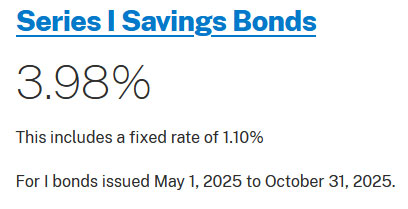
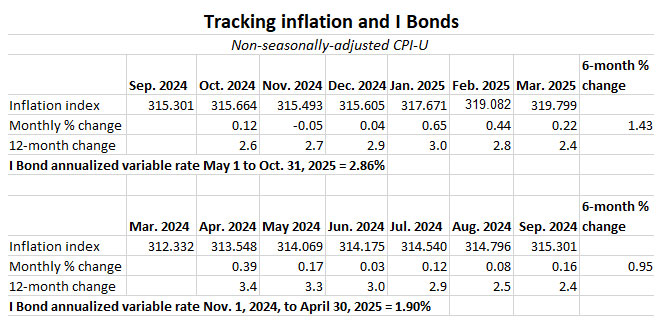
The Treasury just set the new composite rate for I Bonds purchased from May to October 2025: 3.98% for six months, based on a combination of a permanent fixed rate of 1.10% and an inflation-adjusted variable rate of 2.86%.
But what about all those I Bonds you are holding from past purchases? What composite rate will they be earning? The answer is a bit complicated, of course. You knew that was coming. Let’s dive in.
Rate calendar
The 2.86% inflation-adjusted variable rate will roll into effect for all I Bonds, no matter when they were issued. But the starting date depends on the month of your original purchase. Each month has a different schedule, because when you purchase an I Bond, it gets a full six months of the starting composite rate before transitioning to the next rate. This is the schedule, from TreasuryDirect:

Example 1: Purchase in April 2024
If you bought an I Bond in April 2024 with a fixed rate of 1.30%, it will be earning a composite rate of 3.21% from April to September 2025, before transitioning to 4.18% for October 2025 to March 2026.

In this case, if you used the Savings Bond Calculator to check your composite rate, for May 2025 it would show the current 3.21% rate in effect through September.

But in the calculator you can update the “Value as of” variable to October 2025 and see the next composite rate of 4.18%:

Keep in mind that the Savings Bond Calculator will not show interest for the last three months if the I Bond is not yet 5 years old. I used $1,000 in these examples because the SBC does not allow a $10,000 calculation. (In theory, it is limited to paper I Bonds, which are no longer issued.) Weird, I know.
Example 2: Purchase in May 2024
If you bought an I Bond in May 2024, also with a fixed rate of 1.30%, you transitioned this month to earning 4.18% from May to October 2025.

This matches the composite interest result rate shown in the Savings Bond Calculator with a “value as of” May 2025:

For this I Bond, if you set the “value as of” October 2025 you will get the same composite rate, 4.18%. If you try to enter a “value as of” November 2025, the SBC will give you “NA,” because it does not yet know the next variable rate.
In summary. This might seem complicated, but the key thing to remember is that the I Bond will earn the current composite rate for a full six months before transitioning to the next fixed rate / variable rate combination.
The rate calculation
You can’t just add the current variable rate to your I Bond’s fixed rate to calculate the I Bond’s composite rate, although that will give you a decent estimate. The Treasury uses a formula that adjusts for compounding factors of the fixed rate:
[Fixed rate + (2 x semiannual inflation rate) + (fixed rate x semiannual inflation rate)]
So with a fixed rate of 1.10% and inflation rate of 1.43%, the current composite rate calculation looks like this:
0.011 + (0.0286) + (0.0001573) = 0.0397573
Rounding gives you 0.03976. Turning the decimal number to a percentage gives a composite rate of 3.98%.
This same rate formula applies to all I Bonds, no matter when they were issued. If the fixed rate is 0.0%, then the composite rate is simply the current variable rate. So, for example, an I Bond issued in May 2021 with a fixed rate of 0.0% will be earning 2.86% from May to October 2025:

If you know the month you purchased the I Bond, you can use Eyebonds.info or the Savings Bond Calculator as a resource to track your current fixed rate / variable rate / composite rate combination.
Full list of composite rates
The author of the Eyebonds.info site, Bob Hinkley, who is known as #cruncher on the Bogleheads forum, recently posted a slick summary chart of all the composite rates going into effect with the May reset:

Using this information (thank you #cruncher!) I compiled a list of all the composite rates that will take effect when the 2.86% inflation-adjusted variable rate rolls in, depending on the original month of purchase. Here it is, ranked by largest to smallest and by newest to oldest. The first two lines set the pattern for months in effect for each reset, May to October and then November to April:

• Confused by I Bonds? Read my Q&A on I Bonds
• Let’s ‘try’ to clarify how an I Bond’s interest is calculated
• Inflation and I Bonds: Track the variable rate changes
• I Bonds: Here’s a simple way to track current value
• I Bond Manifesto: How this investment can work as an emergency fund
* * *
Follow Tipswatch on X for updates on daily Treasury auctions and real yield trends (when I am not traveling).
Feel free to post comments or questions below. If it is your first-ever comment, it will have to wait for moderation. After that, your comments will automatically appear. Please stay on topic and avoid political tirades. NOTE: Comment threads can only be three responses deep. If you see that you cannot respond, create a new comment and reference the topic.
David Enna is a financial journalist, not a financial adviser. He is not selling or profiting from any investment discussed. I Bonds and TIPS are not “get rich” investments; they are best used for capital preservation and inflation protection. They can be purchased through the Treasury or other providers without fees, commissions or carrying charges. Please do your own research before investing.









 Treasury Inflation-Protected Securities
Hi, and thanks for the nice synopsis of the upcoming auction expectations. I will be a buyer since I need…