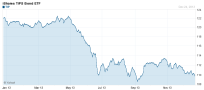
It hasn’t been a pretty year for the TIPS ETF. Click on the image for a larger version.
Holders of mutual funds investing in Treasury Inflation-Protected Securities won’t be sad to see 2013 fade away: It’s been the worst year for TIPS values since the Treasury instrument was launched in 1997. The TIP ETF – which holds a wide range of maturities – started the year at $120.03 and closed Dec. 24 at $109.86, a decline of 8.5%.
And so you are probably seeing a lot of negative press about Treasurys and TIPS in particular, with headlines like these:
But here’s the thing: If you are a buy-and-hold-to-maturity investor in TIPS and I Bonds, both these investments are a lot more attractive in December 2013 than they were in December 2012. And that is why I would say that 2013 was a good year – a much needed year – in TIPS history. Yields are creeping up, back to more-normal levels. At the same time, the once-inflated value of the TIPS you are holding to maturity is declining, but so what? You are holding to maturity.
And 2014 is going to offer some buying opportunities for those of us who have been sitting on the sidelines since mid-2011. Here’s a recap of the year’s TIPS auctions:
10-year TIPS, CUSIP 912828UH1
First auctioned: Jan. 24, with a yield to maturity of -0.630% (plus inflation), well above the record-low yield of -0.750% for any 9- to 10-year TIPS. This was an early indication of yields creeping higher. I took a negative view of this auction.
Reopened: March 21, with a yield to maturity of -0.602%, very close to the original auction. At the time, the 10-year inflation breakeven point was 2.54%, pretty expensive.
Reopened: May 23, with a yield of -0.225%. I took a positive view of this auction, and in fact, this is one of three TIPS I bought at auction in 2013. At this point the 10-year breakeven rate had dropped to a more reasonable 2.255%.
30-year TIPS, CUSIP 912810RA8
First auctioned: Feb. 21, with a coupon rate of 0.625%, and a yield to maturity of 0.639%. Although the yield was above the record low, TIPS traders who bought this issue were going to see a massive decline in market value over the course of 2013.
Reopened: June 20, with a yield to maturity of 1.42%, capping a spectacular run-up in yield as the Federal Reserve began raising the possibility of tapering its bond-buying economic stimulus. This TIPS had been trading at 0.750% one month earlier. The market value of this TIPS had fallen 17.9% since it was first auctioned.
Reopened: Oct. 24, with a yield to maturity of 1.33%. This auction came after the Fed backed off tapering, and yields had backed off from early-September highs.
5-year TIPS, CUSIP 912828UX6
First auctioned: April 18, with a yield to maturity of -1.311%, which broke a string of record lows for 5-year TIPS. Before the auction I had asked: Is buying a 5-year TIPS the most insane move ever?, suggesting that I Bonds were clearly a superior investment.
Reopened: Aug. 22, with a yield to maturity of -0.127%, the highest yield for any 4- or 5-year TIPS issued in more than three years. I was a buyer at this auction, mainly because I needed a 5-year maturity to fill a hole in my TIPS ladder. The Federal Reserve gave the yield a boost by hinting at tapering in a statement one day before the auction.
Reopened: Dec. 19, with a yield to maturity of -0.375%. This auction came after the Federal Reserve officially announced it would slow down its bond-buying, but the yield still didn’t reach the Aug. 22 high.
10-year TIPS, CUSIP 912828VM9

The master manipulator
First auctioned: July 18, with a yield to maturity of 0.384%, the highest in two years for any 9- to 10-year TIPS. This auction looked very promising until Fed Chairman Ben Bernanke – on the eve of the auction – tried to scale back fears of future Fed ‘tapering’ of its aggressive bond buying. The result was that the yield dropped in a few days from an expected 0.64% to the resulting 0.384%. I was a buyer at this auction.
Reopened: Sept. 19, with a yield to maturity of 0.5%, the highest yield for any 9- or 10-year TIPS auction since July 2011. I was on vacation in remote Nova Scotia during early September when the Treasury market was roiled by fears of tapering. TIPS yields hit their high point for the year on Sept. 5, 0.92% for a 10-year TIPS. And then … Ben Bernanke – again on the eve of the TIPS auction – stepped in to rule out tapering in the near term. The result was a drop of 30+ basis points in the yield for this TIPS.
Reopened: Nov. 21, with a yield to maturity of 0.560%, slightly higher than the September auction’s 0.5%.
Where we stand now
A lot has happened this month, with the Federal Reserve announcing on Dec. 18 that it will indeed launch tapering – in a minimal form – in January. Yields for both TIPS and Treasurys have been inching up over the last week.
- The 5-year TIPS is yielding 0.05%, according to the Treasury’s Daily Treasury Real Yield Curve Rates, below its high for the year of 0.14%.
- The 10-year TIPS is yielding 0.80%, still off its high of 0.92% for the year.
- The 30-year TIPS is yielding 1.61%, just below its high of 1.64%.




Look for menu item 'Fixed Income, Bonds & CDs', then 'New issue' and you can select TIPS in the drop…