4-year, 8-month TIPS auctions at -0.127%, a 3-year high

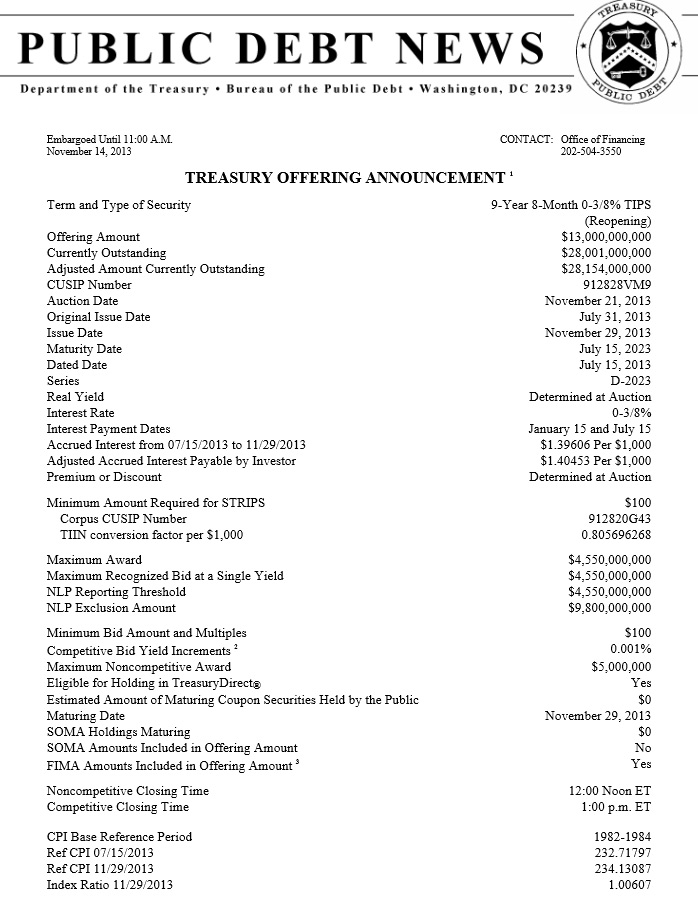
Treasury logoThe U.S. Treasury just announced that its reissue of a 4-year, 8-month TIPS auctioned with a yield to maturity of   -0.127%, the highest yield for any 4- or 5-year TIPS issued in more than three years. Read the announcement.

This is CUSIP 912828UX6. It carries a coupon interest rate of 0.125%, meaning that today’s buyers at auction had to ‘pay up’ to get that coupon rate, about $102.18 per $100 of value, a cost that includes about $1 of accrued inflation since April 15. This TIPS was originally issued in mid-April with a yield to maturity of -1.311% and a cost of $107.82 per $100 of value.

The auction demonstrates the incredible surge in Treasury yields since April, when Treasuries of nearly all types were trading with yields more than 100 basis points below where they stand today.

Just before the auction, this TIPS was trading in the secondary market with a yield of -0.20% or lower, so the -0.127% yield looks like a good deal for buyers, and indicates demand was probably lukewarm for this issue.

But the yield did remain barely negative, marking the 8th consecutive auction of a 4- to 5-year TIPS with a yield negative to inflation. (Holders of TIPS see their principal rise with inflation until maturity.) The last positive 5-year auction was a new issue in April 2010 with a yield of 0.550%.

Reaction to the auction. From a report by the Wall Street Journal‘s Min Zeng:

TIPS have sold off more sharply compared to regular Treasury bonds as the prospect of the Fed cutting back on easy-money stimulus reduce fears over inflation. Demand for inflation-hedging products has pulled back sharply this year …

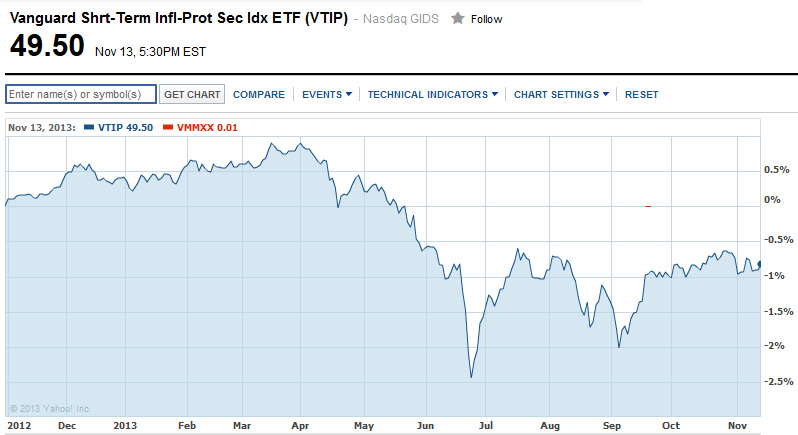
So far this year, investors have yanked $16.5 billion out of TIPS bond funds and ETFs, already surpassing the redemption of $2.9 billion in 2006, the biggest calendar-year outflow since Lipper started tracked the data in 2002.

“It is a terrible environment as rising yields and low inflation are bad combination for TIPS,” said Jeff Tjornehoj, head of Lipper Americas Research.

Inflation breakeven rate. The 5-year nominal Treasury is currently trading at 1.70%, creating an inflation breakeven point for this TIPS of 1.827%. That means if inflation averages more than 1.8% over the next five years, this TIPS will outperform the nominal Treasury.

Posted in Investing in TIPS | 7 Comments

TIPS watchers ask: What exactly did the Federal Reserve minutes say?

It was quite an auction-eve day in the market yesterday, with Federal Reserve minutes released at 2 p.m., setting both the stock and bond markets into a tizzy. We are setting up for an interesting Treasury auction today for a 4-year, 8-month TIPS, a reissue of CUSIP 912828UX6.

I can depict the market’s reaction visually with this chart:

Aug 21 chart

Both the stock market (depicted in red with the SPY ETF) and the TIPS market (in blue with the TIP ETF) took an immediate dive after the Fed minutes were released at 2 p.m. The stock market tried to rally, but fell back.

So what did the Fed say to cause this reaction? You can read the Federal Reserve minutes and judge for yourself.  I’ll just hit some of the high points:

  • The economy. “(E)conomic activity expanded at a modest pace in the first half of the year. Private-sector employment increased further in June, but the unemployment rate was still elevated. … The staff continued to forecast that the rate of real GDP growth would strengthen in 2014 and 2015.”
  • Inflation. “Consumer price inflation slowed markedly in the second quarter, likely restrained in part by some transitory factors, but measures of longer-term inflation expectations remained stable. … The staff continued to judge … that inflation would pick up somewhat in the second half of this year. … (I)nflation was forecast to be subdued through 2015.”
  • Employment. “Private nonfarm employment rose at a solid pace in June, as in recent months, while total government employment decreased further. The unemployment rate was 7.6 percent in June, little changed from its level in the prior few months.”
  • Consumer spending. “(S)ome key factors that tend to support household spending were more positive in recent months; in particular, gains in equity values and home prices boosted household net worth, and consumer sentiment … rose in July to its highest level since the onset of the recession. … However, a few participants expressed concern that higher household wealth might not translate into greater consumer spending.”
  • Housing. “The housing sector continued to pick up, as indicated by increases in house prices, low inventories of homes for sale, and strong demand for construction.”
  • A slap at Congress. “Participants reported further signs that the tightening in federal fiscal policy restrained economic activity in the first half of the year: Cuts in government purchases and grants reportedly had been a factor contributing to slower growth in sales and equipment orders.”
  • The ‘Fed-effect.’ “Financial markets were volatile at times during the intermeeting period as investors reacted to Federal Reserve communications and to incoming economic data.”
  • Tapering of QE3 bond-buying. “(I)f economic conditions improved broadly as expected, the Committee would moderate the pace of its securities purchases later this year. And if economic conditions continued to develop broadly as anticipated, the Committee would reduce the pace of purchases in measured steps and conclude the purchase program around the middle of 2014.”
  • Tapering data points. “(U)nemployment would be in the vicinity of 7 percent, and inflation would be moving toward the Committee’s 2 percent objective.”

What it all means

For TIPS holders and purchasers, there are a couple of important points: 1) the Federal Reserve remains on track to begin tapering its bond-buying program, possibly in the next few months, and 2) the Fed is committed to getting inflation to 2%, or above.

The end of bond-buying is already being priced into the bond market, and thus since May we’ve had more than 100 basis point increases in yields for 5-, 10- and 30-year TIPS.

Today’s 5-year TIPS auction looks like it will price with a yield as high as -0.20%, maybe even higher. I’d guess it will be in the -0.20% to -0.25% range, looking at data right now. Four months ago, it auctioned with a yield of -1.311%. Amazing.

Posted in Investing in TIPS | 1 Comment

Tips on TIPS: How to estimate (guess) a yield for an upcoming auction

Interest rates fluctuate, day by day, hour by hour. That fact makes predicting the future auction yield of a Treasury Inflation-Protected Security pretty difficult, even impossible. But you can guess, and sometimes you can get fairly close, if you watch indicators right up to the morning of the auction.

So in this post I will share some of the data sources I use to check on TIPS yields. And I will use Thursday’s reissue auction of a 5-year TIPS as an example.

1. Check the Treasury’s Daily Real Yield Curve rate

The Treasury posts this each day, and you can track data going back many years. As of Friday, a ‘pure’ 5-year TIPS was yielding -0.19%, up 10 basis points from the day before. Since this is an estimate for a TIPS maturing in a full 5 years, it isn’t perfect for Thursday’s reissue, which has a term of 4 years, 8 months. But it should be close.

Where does the Treasury get this number? Good question. It explains in a footnote that the numbers are “calculated from composites of secondary market quotations obtained by the Federal Reserve Bank of New York.” However they do it, the numbers seem pretty accurate and often signal a future trend.

2. Check the secondary market for TIPS

I use the Wall Street Journal’s data site, which also provides historical data, just use the little calendar icon in the top right corner of the chart. When a TIPS is reopening, like at Thursday’s auction, these numbers are especially helpful, because that TIPS is already trading on the secondary market. Here is last Friday’s close for the TIPS that matures April 2018 and will be reissued Thursday:

April 2018 TIPSAs you can see, the yield here, -0.315%, is much lower than the -0.19% projected by the Treasury. So we have a discrepancy, and that would make me think an auction today would produce a number higher than -0.315%. Another helpful item is the bid and asked price – notice the very wide spread. That also indicates a coming change in yield. It also gives you a rough estimate of what you will pay for this TIPS at auction — maybe about $10,132 for $10,000 of value. (Buyers back in April paid dearly, $10,782 for $10,000 of value to get a 0.125% coupon.)

This chart is helpful even for new issues, you can check a TIPS with the closest maturity date. But these numbers aren’t perfect as predictors.

3. Check Bloomberg’s current yields for U.S. government bonds

This is the closest thing you can get to a ‘real-time’ quote, but it also isn’t perfect at predicting an auction price. Right now, at 10 a.m. Monday, it is showing a yield of -0.28% for the 5-year TIPS being auctioned Thursday. It shows a price of 101-29, very close to the bid price shown in the Wall Street Journal’s data. So it looks like the combination of Friday’s Treasury data and the secondary market data did accurately predict a rise in rates this morning.

Another number on this page worth watching is the nominal 10-year Treasury, which is currently trading at a yield of 2.86%. It closed at 2.84% on Friday, so this also shows weakness in the Treasury market.

4. Check the current price of the TIP ETF

I use Yahoo Finance for this. On the morning of the auction, after 9:30 am and before noon when the auction closes to non-competitive bids, check the TIP stock price. If it is down, you are likely to get a higher yield that you expected; if it is up, you are probably going to get a lower yield.

Today, at 10:05 a.m., it is trading at 110.14%, down 0.33%, and confirming weakness in the TIPS market. So we can expect yields to rise slightly if this trend continues.

It’s also fun to check the ETF after the auction announcement at 1 p.m. The TIP market often has a pretty strong reaction to auction results, positive or negative, and you can see the move right at 1 p.m. Here’s an example from July 18, 2013:

july18And still … it ain’t perfect. Predicting a TIPS yield at auction can make you humble. New issues, especially, are difficult to predict because new inventory is being added to the market. Another factor is Federal Reserve bond buying; you can’t be sure what influence that is having in the market. It’s hard to be a buyer competing with the Fed, and it can use its financial might to set a rate where it wants, when it wants.

But using these data sources can give you a pretty good idea where a TIPS yield is heading on the day of the auction.

Posted in Investing in TIPS | 9 Comments

U.S. inflation ran a moderate 0.2% in July

‘Headline’ inflation, technically called the Consumer Price Index for All Urban Consumers (CPI-U), increased 0.2% in July on a seasonally adjusted basis, the U.S. Bureau of Labor Statistics reported today. Over the last 12 months, CPI-U has increased 2.0%.

For TIPS and I Bond holders, the important number is the non-seasonally adjusted CPI-U, which is used to adjust the principal of TIPS and set the future interest rate of I Bonds. That number for July was zero – no change – but the last-12-months number remains at 2.0%.

Core inflation, which strips out volatile food and energy prices, was up 0.2% in July, and is up 1.7% over the last 12 months, below the Federal Reserve’s 2.0% target and 2.5% ‘danger’ level. This number, which is closely watched by the Fed, is significant because it  gives the Fed no reason to taper or halt its bond-buying stimulus.

Some highlights from the CPI-U statistics for July:

  • Energy was the biggest factor in an otherwise mild inflation month. Gasoline was up a strong 1%, and fuel oil, 1.1%. But utility gas service was down 2.8%.
  • Over the last 12 months, gasoline prices are up 5.2%.
  • Apparel was up a strong 0.6%, after posting a 0.9% increase in June.
  • Medical care services prices continued rising very slowly, up 0.1% in July and only 2.6% over the last 12 months.
  • Prices for used cars and trucks fell 0.4% and are down 2.1% over the last 12 months.

And here is the CPI trend over the last 12 months:

CPI over one yearWhat it all means. The July inflation number came in just as predicted, at 2.0% seasonally adjusted. This is a moderate rate that the Federal Reserve can live with, and it wants to see inflation rising above 2.0% a year. So today’s report shouldn’t have much of an effect on the Fed’s bond-buying, and it probably won’t have much effect on TIPS yields.

If you are looking at next Thursday’s auction of a 5-year TIPS reissue, the yield on the secondary market for CUSIP 912828UX6 closed at -0.501%, up a bit since I wrote about it last week. The Treasury’s statistical site is showing a real 5-year yield of -0.38%, substantially higher.

Update at 1:30 p.m.: While Thursday’s inflation number was muted, other economic reports out today gave a rosier economic picture:

  •  Initial jobless claims fell by 15,000 last week to 320,000, marking their lowest level since October 2007.
  • In a Wednesday report, European GDP rose 0.3% in the second quarter, better than expected and marking an end to European recession.
  • In reaction, Treasury yields rose sharply this morning, with the 10-year nominal Treasury hitting 2.77% (the highest rate of the year) and the 10-year TIPS rising to 0.57%, The 5-year TIPS, according to Bloomberg data, rose to -0.40%.
Posted in Investing in TIPS | 2 Comments

Up next: 5-year TIPS reissue will auction Thursday, Aug. 22, 2013

This auction is two weeks away, so I thought I’d take a preliminary peek at it. This will be a reissue of CUSIP 912828UX6, which first auctioned on April 18 with a yield to maturity of -1.311%. This 4-year, 8-month reissue will carry the existing coupon rate of 0.125%.

If you liked it in April … Obviously, a lot has happened since April, with TIPS yields rising dramatically for two reasons: 1) the Federal Reserve’s announced plan to begin tapering its Treasury-buying program if the economy continues improving, and 2) a trend of sluggish U.S. inflation, which makes TIPS less attractive to investors.

Here’s a recap of 5-year TIPS yields in 2013, demonstrating that even as nominal Treasury rates rose, and even after a recent decline in TIPS yields, TIPS have become less expensive compared to a traditional Treasury:

Date 5-year TIPS 5-year Treasury Inflation Breakeven
2-Jan-13 -1.36 0.76 2.12
1-Feb-13 -1.46 0.88 2.34
1-Mar-13 -1.45 0.75 2.20
1-Apr-13 -1.47 0.76 2.23
1-May-13 -1.33 0.65 1.98
3-Jun-13 -0.86 1.03 1.89
1-Jul-13 -0.41 1.39 1.80
1-Aug-13 -0.45 1.49 1.94
7-Aug-13 -0.55 1.38 1.93

Although you see negative yields in this list for the TIPS, that negative rate is offset by inflation. The base principal of a TIPS increases with inflation until maturity. That is why the breakeven rate is so important. Right now, a 5-year TIPS will outperform a 5-year Treasury if inflation averages more than 1.93% over the next 5 years.

Inflation over the last five years has averaged 1.3%, but that was only the second time it has been under 2.0% in a five-year period in the last 50 years. See a chart.

As of Wednesday,  CUSIP 912828UX6 was trading on the secondary market at -0.670%, a little worse than the Treasury estimate listed above for a full 5-year TIPS.

Because it carries a coupon rate of 0.125%, buyers will be ‘paying up’ to get the resulting negative yield. My guess currently is about $10,325 for $10,000 of value, down from about $10,782 when the TIPS was first auctioned.

Danger in paying up. While your principal is guaranteed at maturity, the amount you pay up is not guaranteed. If we see 5 years of deflation, a buyer paying $10,325 this month will get $10,000 back at maturity, along with earning 01.25%. I consider this highly unlikely, but it is worth noting.

Alternatives? There is no doubt that the US Savings I Bond is superior to a 5-year TIPS. It pays the rate of inflation, minus nothing, has rock-solid deflation protection and is tax-deferred until maturity, which can be anywhere (without penalty) from 5 years to 30 years. The hitch is that you can buy only $10,000 per person per year. (You can also get additional paper I Bonds in lieu of income tax refund.)

What about insured bank CDs? My local credit union is paying 1.30% on 5-year CD, less than a 5-year Treasury. You can shop around and find better rates, possibly up to 2.0%, which would push the breakeven rate up to 2.55%. A bank CD with a high rate is pretty competitive, if you can find those ‘lofty’ rates.

Trend is working against buyers. The 5-year TIPS yield has dropped 10 basis points since Aug. 1, and 28 basis points since July 5. It’s a trend worth watching. While I would like to add this TIPS to my bond ladder, I am going to keep an eye on that yield.

A lot can happen in two weeks.

Posted in Investing in TIPS | 5 Comments