Fed Chairman Bernanke’s ‘taper talk’ roils markets

Federal Reserve Chairman Ben Bernanke today told the world what we already knew: The U.S. economy is gradually improving, and if this improvement continues, the Fed will begin tapering off its bond-buying stimulus program, possibly this year.

Bernanke set this all up on May 22, giving the markets just enough of a peek at the policy to send investors into shivers. Today he embellished on the path we knew was coming: The gradual end of ‘eternal QE.’ He said:

  • The economy. “Based on its review of recent economic and financial developments, the committee sees the economy continuing to grow at a moderate pace, notwithstanding the strong headwinds created by current federal fiscal policies.”
  •  Inflation.  “Inflation has been running below the committee’s longer run objective of 2% for some time and has been a bit softer recently. … The committee expects inflation to move back to the 2% longer-term objective.”
  • Interest rates. “The committee reaffirmed its expectation that the current exceptionally low range for the funds rate will be appropriate at least as long as the unemployment rate remains above 6.5% so long as inflation and inflation expectations remain well behaved.:
  • Asset purchases. ” The committee has been purchasing $40 billion per month in agency-backed securities and $45 billion per month in Treasury securities. …  Although the committee left the pace of purchases unchanged at today’s meeting it’s stated that it may vary the pace of purchases as economic conditions evolve.”
  • Tapering and then ending the asset purchases. “The committee currently anticipates that it will be appropriate to moderate the monthly pace of purchases later this year, and that the subsequent data remain broadly aligned with our current expectations for the economy, we will continue to reduce the pace of purchases in measured steps through the first half of next year ending purchases around mid-year.”

My reaction: About time.

This is s pretty cautious approach by the Fed, keeping short-term interest rates extremely low into probably 2016 and continuing its bond purchases for the time being, gradually tapering them down later this year and ending them in 2014. In other words, the Fed will lock short-term rates down, but will allow mid- to longer-term interest rates to begin rising to a ‘more normal’ level, which would mean positive to expected inflation.

If that happens, TIPS yields will need to also rise, probably to the ‘more normal’ yields (plus inflation) of maybe 0.5% for a 5-year, 1.5% for a 10-year, and 2.5% for a 30-year. That would be a painful transition for holders of TIPS mutual funds and TIPS traders, but it would be fantastic for net buyers of TIPS, the buy-and-hold investors looking to preserve capital into retirement.

The market’s reaction: Horror.

Bernanke began speaking at 2:30 p.m. and he had an immediate negative effect on stocks, bonds and even gold. This chart shows exactly what happened, comparing the one-day returns for the S&P 500 (SPY), TIPS ETF (TIP) and gold ETF (GLD):

June 19, 2013

I keep repeating, ‘None of this was a surprise.’ But the stock, bond and gold markets seem to be living in that Fed-fantasy world of eternal QE. It’s time to get off the bond-buying methadone and bring yields back to reality.

Thursday’s 30-year TIPS reissue. Things are shaping up very well for buyers, with the likely yield rising to about 1.25%, plus inflation. Remember that this TIPS, CUSIP 912810RA8, first auctioned four months ago with a yield of 0.639% and a coupon rate of 0.625%. That means Thursday’s buyers will snag this TIPS at a massive discount, paying about $84.20 for $100 of value.

Of course, yields may be rising in the future and that discount could get even more extreme. But this is the most attractive TIPS auction in about 18 months.

I’ll probably pass on the 30-year (maturity is too long) and hope this trend continues for the new issue 10-year TIPS coming in July.

Posted in Investing in TIPS | Leave a comment

U.S. inflation rises a meek 0.1% in May

U.S. inflation continued at a mild pace in May, rising just 0.1% on a seasonally adjusted basis and creating a ‘headline’ inflation rate of 1.4% over the last 12 months. Here’s the summary report.

The non-seasonally adjusted number was 0.2%, resulting in the same 1.4% number over the last 12 months.

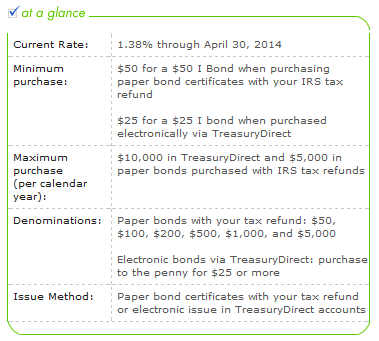
Non-seasonally adjusted ‘headine’ inflation – technically called Consumer Price Index for All Urban Consumers (CPI-U) – is important to TIPS investors because it used to adjust the principal balance on Treasury Inflation-Protected Securities and determines future interest rates on US Savings I Bonds.

Energy prices have been a key factor in keeping inflation muted, but the overall energy sector rose 0.4% in May (after strong declines in March and April). However, gasoline prices held steady and fuel oil was down 2.9%. Food prices fell 0.1%, and medical care commodities fell 0.5%. Housing was up 0.3%.

The medical care index has risen 2.2% over the last 12 months, its smallest increase since September 1972.

‘Core’ inflation, which strips out food and energy, rose 0.2% in May after rising 0.1% in both March and April, resulting in 1.7% inflation over the last 12 months, still below the Federal Reserve’s ‘danger’ area of 2.5%.

What’s does it mean? Inflation remains muted, which has two contradictory effects on Treasury Infation-Protected Securities: 1) Investors see little need for inflation protection, keeping a lid on demand for TIPS, and 2) The Federal Reserve will feel no inflationary pressure to slow its bond-buying, which helps lower the yield on TIPS and props up prices.

While a rise of 0.1% is mild, it also offsets fear of deflation, which consumers had seen in March and April, when energy prices declined sharply. Here is the trend over the last 12 months:

12 month inflation

Here is additional insight from Michael Ashton’s E-piphany blog:

The important part of this CPI report is that CPI-Housing is finally turning up again, as I have been expecting it would “over the next 1-3 months.” Hands down, the rise in housing inflation (41% of overall consumption) is the greatest threat to effective price stability in the short run. Home prices are rising aggressively in many places around the country, and it is passing through to rents. ….

We have not changed our 2014 expectation that core CPI will be at least 3.0%.

Posted in I Bond, Inflation, Investing in TIPS | Leave a comment

TIPS rebound, but what’s ahead?

Over the last couple of years, Treasury Inflation-Protected Securities were the toughest prizefighter in the investment world: You could knock them around a little, but they always came roaring back.

Then … Ben Bernanke spoke.

220px-Ben_Bernanke_officialIt was May 22, and the Federal Reserve chairman was speaking to the Congress’ Joint Economic Committee. Although the Fed chairman said a lot of middle-of-the-road mumblings about economic stimulus, jobs and interest rates, the markets seized on this comment about the Fed’s monthly purchases of $45 billion of Treasuries and $40 billion of mortgage bonds:

“At its most recent meeting, the Committee made clear that it is prepared to increase or reduce the pace of its asset purchases to ensure that the stance of monetary policy remains appropriate as the outlook for the labor market or inflation changes.”

Later, in response to a question, Bernanke suggested – but only suggested – that the bond buying could be trimmed back in the next few months, if the economy continues improving.

Even before May 22, yields on TIPS had been rising, because of recent reports showing very weak inflation – running just 1.1% over the last 12 months. Now, with the suggestion that Federal bond-buying might slow down or even halt, the trend was locked. Here’s what has happened in those 23 days:

Yield 22-May 13-Jun Basis points
5-year Treasury 0.91% 1.11% 20
5-year TIPS -1.06% -0.69% 37
10-year Treasury 2.03% 2.19% 16
10-year TIPS -0.24% 0.15% 39
30-year Treasury 3.21% 3.33% 12
30-year TIPS 0.83% 1.17% 34
TIP ETF $117.77 $114.57 -2.8%

What’s interesting here?  Yields on TIPS are rising much faster than the overall bond market, hitting 2-year highs. Yields on nominal Treasuries, however, are increasing at a slower pace and really haven’t hit unusual levels. For example, on March 19, 2012, the 10-year Treasury hit 2.39%, 20 basis points higher than the current level. On that same day, a 10-year TIPS was yielding -0.03%, 18 basis points lower than today’s level. That’s a 38 basis-point swing.

And so … the ugly truth. TIPS are being battered because investors have lost their lust for this one particular product. That’s a hard trend to reverse. And when overall interest rates do begin climbing, TIPS will be battered even more. When you see a 10-year Treasury at 2.75%, you can expect to see a 10-year TIPS yielding around 0.6%.

For TIPS traders and mutual fund holders, if overall rates really do rise, that’s going to mean more bad news, possibly a decline of another 5%, especially if inflation remains muted.

The bright spot. This trend also means that TIPS are getting cheaper against nominal Treasurys, and more attractive to the buy-and-hold investor. If you are a buying small amounts with each auction, the outlook is good. Higher yields are a good thing.

Posted in Investing in TIPS | 3 Comments

Up next: Reissue of a 30-year TIPS on June 20, 2013

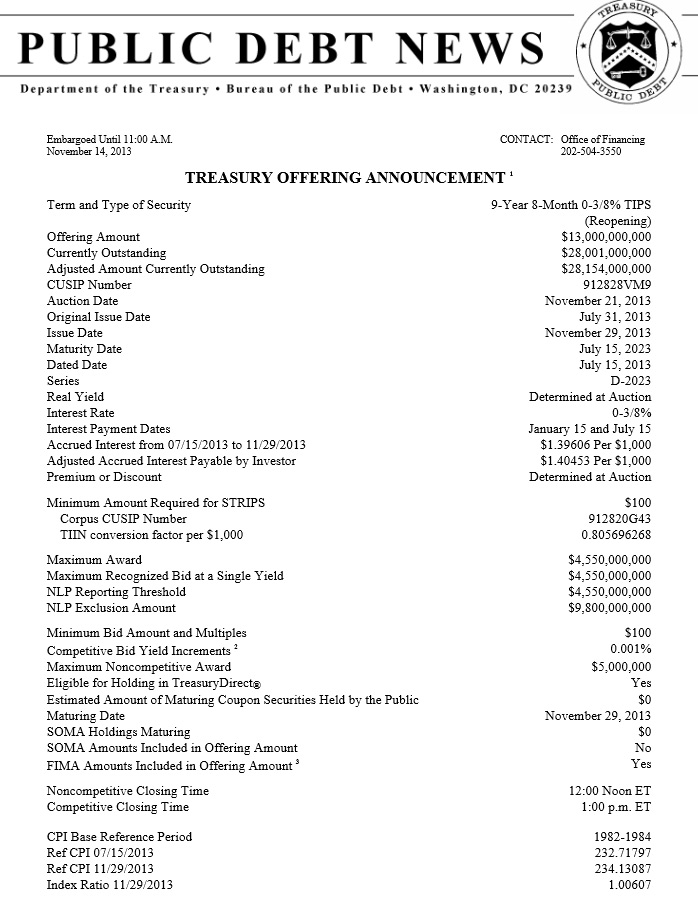
The Treasury will announce tomorrow that it will reopen CUSIP 912810RA8, creating a 29-year, 8-month Treasury Inflation-Protected Security that will auction Thursday, June 20. Update: Here is the announcement.

This TIPS will have something going for it that’s been extremely rare: a discount. It originally auctioned Feb. 21 with a coupon rate of 0.625%, and a yield to maturity of 0.639%. It is currently selling on the secondary market for about $87 for $100 of value and a yield of 1.132%.

Yields on TIPS have been rising sharply since May 1. According to the Treasury Resource Center, the yield on a 30-year TIPS rose from 0.44% on May 1 to 1.14% on June 11. That’s an increase of 70 basis points, and it makes this 30-year offering a lot more interesting.

Buyers will get around 1.14%, plus inflation, over 30 years. Sound appealing?

The negatives. There are a couple of caveats, though.

Number 1 is: Will you be holding this issue to maturity? If so, you need to be ready to ride out — and ignore — some wild price swings. This TIPS originally auctioned for $99.61 and has fallen to $87. That’s a drop of 12.7% in four months.

If you are holding to maturity, no problem. You’ll get your 1.14%, plus inflation, and you can ignore the market noise. But this brings up negative Number 2: Will you be alive in 30 years? This is especially important if you are buying this TIPS in a taxable account. Here’s why:

Let’s say you put $10,000 into this TIPS, which will pay that coupon rate of 0.625% on a principal balance that will rise with inflation. And let’s say inflation averages 2.5% over the next 30 years. You will owe current-year taxes on $313 a year, and that number will rise. If you are in a high tax bracket your bill will be maybe $140 a year. But the coupon on this TIPS will provide you with only $62.50 a year, not enough to pay the taxes owed.

So this TIPS will be cash-flow negative until maturity. If inflation escalates, it will be even more negative.

So you will want to live to maturity, to see that money you’ve been paying taxes on for 30 years. If you die, you lose.

This is why I prefer buying 10-year TIPS and having them mature at a set date in the future, when I can decide to spend the money or reinvest.

The appeal. A yield to maturity of 1.14% (or possibly higher) will be the best yield on any TIPS auctioned in more than two years. I can see the appeal of adding that to a TIPS portfolio, just to get a boost in income. It is still below the ‘more normal’ yield of 2% to 2.5% that long-term TIPS buyers expected in the past, as this chart shows:

30-year TIPS auctionsAnother positive is the inflation breakeven rate versus a nominal 30-year Treasury, which closed Wednesday with a yield of 3.33%, up 50 basis points since May 1. That sets the probable breakeven rate for this TIPS at 2.19%, and that number could drop a bit before the auction.

It’s not much of a gamble to expect inflation higher than 2.19% over the next 30 years.

One more thing to consider. If the Treasury follows its usual pattern – and I expect it will – this 30-year TIPS will be reopened one more time in October. So you’ll need to ask yourself: Where are rates headed over the next four months? Buy in June, or wait for October?

Also, a new 10-year TIPS is coming in July.

Posted in Investing in TIPS | 4 Comments

Monday: More blood in the streets for TIPS

After a month of very sharp rises in the yield on Treasury Inflation-Protected Securities, the trend continued Monday, with the yield on the benchmark 10-year TIPS rising to 0.11%, plus inflation, marking two trading days in a row the yield has gone positive.

That is an incredible gain of 75 basis points since May 1, when the yield stood at -0.64%. This is the first time the 10-year TIPS yield has gone positive since Dec. 15, 2011. That has been a very long, painful slog for net buyers of TIPS (buying more than mature each year).

The trend has reversed. TIPS are interesting again, for the buy-and-hold investor.

Buy and hold is my TIPS philosophy. That means buying TIPS at TreasuryDirect and holding them to maturity. There is very little risk in this strategy. You aren’t trading, you can ignore the secondary price and never consider ‘duration.’ Along with I Bond purchases, it is a very conservative way to preserve capital, for a portion of your portfolio. (And a poor way to build wealth, I must say.)

However, buyers should be choosy. I stopped buying TIPS in June 2011, a 30-year TIPS with a yield of 1.774%. Nearly two years later, last month, I got back in the game, purchasing the 10-year TIPS reissue with a yield of -0.225%.

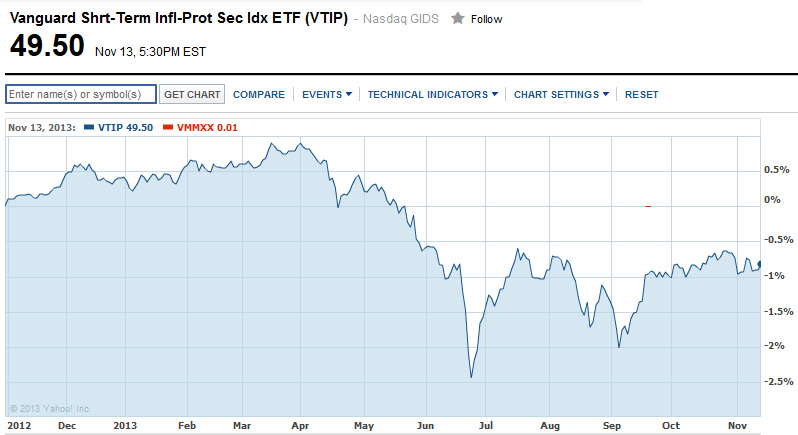
Painful day. But for investors in TIPS mutual funds and ETFs, these are painful times. The flagship ETF, with the ticker TIP, declined $0.80 today to close at $114.64, down 0.69% on the day and down 5.9% since May 1.

Obviously, money is pouring out of TIPS funds, just as it poured in during a heady 20-month period from July 1, 2011, to April 30, 2013, when TIP increased from $105.96 to $122.15, or 13.3%.

Unlike a stock mutual fund, there are no ‘fundamentals’ to support the price of the ETF or other TIPS mutual funds. No one looks at 200-day moving averages or strange chart formations. The value of TIPS is determined by the yield to maturity, and the yield is rising. That means the price is falling, and will keep falling as long as the yield increases.

There are several factors at work here:

  • Overall interest rates are rising. The nominal 10-year Treasury closed today at 2.22%, up 56 basis points since May 1.
  • The yield on TIPS is rising even faster – 77 basis points since May 1. That means TIPS are getting cheaper versus traditional Treasurys. Today’s 10-year inflation breakeven rate stands at 2.11%, getting close to my 2.0% ‘cheap’ marker.
  • Inflation is currently muted, running just 1.1% over the last 12 months. Since TIPS offer extremely low yields, low inflation is a double whammy for TIPS holders.
  • Despite the pain for traders and mutual fund investors, TIPS are a much better deal for investors today than they were 40 days ago. This chart shows just how rarely the breakeven rate drops below 2.0%:

10-year breakeven

At some point, I might get interested in TIPS mutual funds. I speculate (not with money, just my mind) that the TIP ETF is heading down to about $110 and the 10-year Treasury will hit 2.75%. At that point, a 10-year TIPS would be yielding maybe 0.55%, maybe higher, but still substantially below the 1% to 2% that TIPS investors saw in the past.

I am often wrong. Very wrong. Back in May 2011, I wrote a blog explaining why I was exiting Fidelity Inflation Protected Bond (FINPX) in favor of Vanguard Total Bond Fund. I was doing this at EXACTLY the wrong time, and to my embarrassment, this was one of my most popular blog posts of all time. It still gets viewed, every day.

Oh well, here is how that worked out:

FINPX

I looked wise for about a month, then very stupid as the Federal Reserve launched QE after QE, buying Treasurys and creating money to stimulate the economy.

But my bond portfolio is more about preserving capital, along with a minimal interest-rate return. Vanguard Total Bond Fund is still one of my favorites. And here’s how it has gone since May 1:

total bond

I won’t claim to know what the future holds. I have long believed that yields on TIPS were unnaturally low, and that trend had to – and would – reserve. I think that trend has started. Let’s watch to see if I am right.

Posted in Investing in TIPS | Leave a comment