Should TIPS holders root for higher inflation?

Interesting article today in the Wall Street Journal, with the enticing headline: ‘TIPS Investors Rush for Exit.’ Here’s the premise:

A surprise drop in gasoline prices has jolted a corner of the bond market, easing investors’ inflation fears and triggering an exodus from a popular form of Treasury securities. …

The move was triggered by a deterioration in the economic outlook. “People are feeling less positive, so they’re taking that out in inflation expectations,” (said Chris McReynolds, head of U.S. Treasury trading at Barclays).
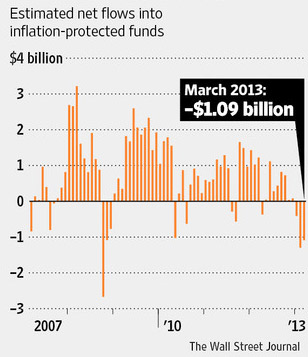
outflowBefore we get to rooting for inflation, let’s look at the article’s premise, that investors are suddenly pouring out of TIPS and into stocks, traditional Treasurys or high-yield bonds. This Wall Street Journal chart does show that TIPS mutual funds have been seeing net outflows for the last three months. These outflows have been fairly rare, and we haven’t seen three consecutive months of outflows since the financial crisis of 2008, when TIPS yields skyrocketed upward, and TIPS values plummeted.

It’s also true that TIPS breakeven rates have been trending down, which was long overdue. As of Tuesday, for example, the nominal 10-year Treasury closed at 1.75%, and the Jan 2023 TIPS closed at -0.699%, putting the breakeven rate at 2.449%, still rather high but a drop from the 2.531% of Jan. 1, 2013.

But overall, I’d say the TIPS market had a pretty mild reaction to this week’s inflation news. In fact, I’d say it was remarkably mild. Here’s a chart of closing prices of the TIP ETF over the last month, versus the AGG (aggregate bond market ETF):

The TIPS market has outperformed the overall bond market in the last month. And look at the volume bar below the chart. Not much action this week. So there’s not much evidence that TIPS investors are fleeing for the hills … yet. Possibly today’s Wall Street Journal article will change that trend. It certainly will get some TIPS investors thinking.

So, do TIPS holders root for higher inflation? The answer is ‘no’ if you have a sensible asset allocation, divided among stocks and fixed-income investments, with maybe 20% of your assets in TIPS and I Bonds. I don’t endorse putting 100% of your investments in TIPS, especially now with yields so low.

TIPS and I Bonds are insurance against inflation, while at the same time providing modest, super-safe returns. Insurance is something better left uncollected. If your house burns down, you don’t say, ‘Wow! I got to collect the insurance!’ Not when your belongings are smoldering in front of you.

TIPS and I Bonds are often described as a hedge against unexpected inflation. If inflation continues in the 1.5% to 3% range, TIPS holders have a boring, safe investment.When the TIPS matures, the investor collects the money and reinvests. That’s how a super-safe investment works.

If inflation suddenly rises to 6% or 7% or 20%, TIPS holders have a safe, protected investment. It won’t be a time to cheer, because your other investments (stocks, bonds and fixed pensions) might be smoldering in front of you.

You’ll never cheer for inflation. But you will be able to say, ‘I did a very smart thing.’
Posted in Inflation, Investing in TIPS | 1 Comment

U.S. inflation fell 0.2% in March

Bureau of Labor Statistics

Today’s tip: Check out the new design of the Bureau of Labor Statistics website at bls.gov. It is user friendly and pretty slick. Impressive for a government site.

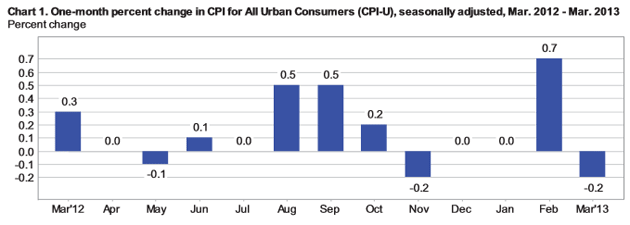
The Bureau of Labor Statistics reported this morning that ‘headline’ inflation – the Consumer Price Index for All Urban Consumers (CPI-U) – fell 0.2% in March on a seasonally-adjusted basis, partly reversing the sharp 0.7% increase in February.

That means inflation over the last 12 months was just 1.5%, down from 2.0% in February.

Read the full CPI report.

The decline, which was deeper than expected, was primarily caused by a 4.4% drop in gasoline prices. The energy index fell 2.6 percent in March after a 5.4 percent increase in February. The food index was unchanged in March. Also interesting is a 1% drop in apparel, which could possibly be linked to the payroll tax increase that took effect in 2013.

Headline inflation is important, because it is the number (minus seasonal adjustment) used to adjust the principal on TIPS holdings and to set the future inflation-adjustment interest rates on I Bonds.

Without the seasonal adjustment, CPI-U rose 0.3% in March, but the number for the last 12 months remains at 1.5%. As a side note, the 5-year TIPS being auctioned Thursday will go off with a yield to maturity of at least -1.5%, meaning a zero return or less in the current inflation environment.

In the last half year, inflation has increased only about 0.5%. Here’s a summary of month-by-month changes in headline inflation:

Month-to-month inflation‘Core inflation,’ which strips out food and energy and is closely watched by the Federal Reserve, increased 0.1% in March and stands at 1.9% for the last 12 months, below the Fed’s implicit ‘danger’ level of 2.5%.

Curious about ‘chained’ CPI, which is being discussed as a new index to lower federal spending? It increased 1.4 percent over the last 12 months. For the month, the index increased 0.2 percent on a not seasonally adjusted basis.

And for the future? Here is some commentary from the Associated Press report:

The figures come a day after the prices of many commodities, including copper and oil, fell in response to a report of slower than expected growth in China. That suggests U.S. consumer prices will likely stay low in the coming months.

The drop “marks the start of what will likely turn out to be a string of declines stretching into the summer,” Paul Ashworth, an economist at Capital Economics, said in a note to clients.

Posted in Inflation | 1 Comment

Buying a 5-year TIPS? The trend is working against you

The U.S. Treasury on Thursday issued its formal announcement for the April 18, 2013, auction of a new 5-year Treasury Inflation-Protected Security.

This will be CUSIP 912828UX6, and although the coupon rate will be set at auction, we can say with 100% certainty that it will be 0.125%, the lowest rate the Treasury allows on TIPS. The yield to maturity is likely to be somewhere near -1.69%, maybe a bit higher.

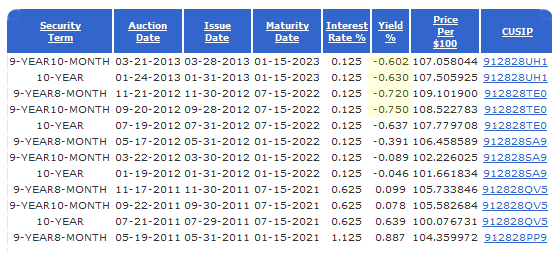
Although several consecutive 10-year TIPS auctions have failed to set record low yields, this 5-year TIPS will probably blow out the record low for any 4- to 5-year TIPS, -1.496% for an auction last December. Here is a history of 5-year TIPS auctions running back to 2005:

5 -year TIPS auctionsI’ve highlighted the last three auctions to show the trend of a sharply declining yield, and that trend appears likely to continue in Thursday’s auction. Compare that with the reverse trend in 10-year TIPS:

10-year TIPSSo 5-year TIPS must have some sort of magical appeal? Why are they so desirable? I can think of only one reason: There has been a surge of money pouring into shorter-term TIPS funds and this has expanded demand for TIPS of 5-year maturities or less.

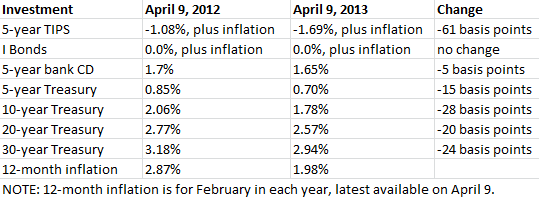
For the small investor, maybe those short-term TIPS funds make sense, although they offer very little, if any, return. But buying this new 5-year TIPS will have you fighting a trend – one that’s working against you. To demonstrate this, I will compare this year’s TIPS auction versus last year’s (April 2012) and other similar investments:

5-year TIPS, 2013 vs. 2012The key here is that the yield to maturity on a 5-year TIPS has dropped 61 basis points, double, triple or quadruple the decline for nominal Treasuries. An insured 5-year bank CD has barely budged. I Bonds, of course, still pay inflation minus nothing. And this has happened at a time of declining inflation, creating a double whammy for TIPS buyers.

But what about the ‘real’ return, after inflation? Isn’t that where a TIPS should shine? This chart shows the real return buyers could expect at the time of purchase, 2012 vs. 2013:

Real returnBecause inflation has declined and the TIPS yield has also dropped, the current TIPS yield of -1.69% is dramatically more expensive than similar investments, all of which are yielding a better return against current inflation, compared with last year. Except for I Bonds, of course, which pay inflation no matter what.

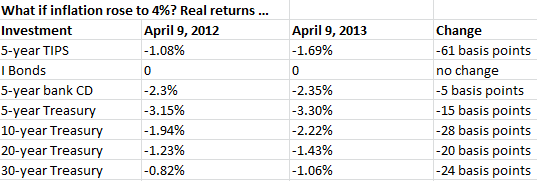
OK, let’s say you believe the current rate of inflation can’t continue, and you believe it is going much higher. (The current trend in housing prices supports that theory, but the weak job market counters it.) Let’s say inflation doubles, to 4%. How would this 5-year TIPS perform, versus 2012 and similar investments?

4 percent inflationHere’s a manta for TIPS buyers: The yield to maturity is the real return. When you buy a TIPS with a yield of -1.69%, you are getting an after-inflation return of -1.69%, no matter how high inflation goes. However, this chart shows that in 2013, a 5-year TIPS provides a better real return at 4% inflation than similar investments, except the stalwart I Bond, which is clearly superior.

It also shows that a 5-year TIPS has gotten much more costly than similar investments in the last year.

That is the trend buyers at next week’s auction are fighting.

Posted in Investing in TIPS | Leave a comment

Bad day for TIPS, worse day for the Federal Reserve

The TIP ETF was down about a half percentage-point today, closing at $121.24 but still not far off  the all-time high of $123.44. The chart for the last five days is looking a bit sickly:

5-day TIP chart

The TIP ETF rebounded nicely after dipping to near $120 in mid-March. So much for warnings of a ‘bond bubble.’ But in the last five trading days it has again dipped, under-performing the AGG EFT (aggregate bond index.)

Today the Federal Reserve pulled a shocker by accidentally releasing minutes of its latest policy meeting 19 hours before the expected time. The Wall Street Journal reports:

The Fed said Wednesday that a staff member in its congressional liaison office accidentally released minutes of a March 19-20 policy meeting Tuesday afternoon to many of his contacts, including Washington representatives at Goldman Sachs Group Inc., Barclays Capital, Wells Fargo & Co., Citigroup Inc. and UBS AG. …

Officials at the Fed didn’t notice the mistake until about 6:30 a.m. Wednesday, after which they scrambled to release the information to the wider public, which was done at 9 a.m. A Fed spokesman said: “Every indication is that [the release] was entirely accidental.”

So the slip-up overshadowed the actual news in the minutes, which is that the Federal Reserve seems to be considering a halt to its bond-buying stimulus program, possibly this year.  Here is another Wall Street Journal report:

The minutes of the March 19-20 meeting showed that “all but a few” Fed officials agreed the central bank would likely want to keep the program going “at least through midyear.” After that, officials had a wide range of views about how they might proceed. …

For now, Fed officials agreed, “additional purchases would be necessary to achieve a substantial improvement in the outlook for the labor market,” the minutes showed

I don’t think anyone seriously believed the Fed was considering an immediate end to the bond-buying, which has forced Treasury interest rates to extreme lows. So the news here was more that the stimulus could end earlier than the ‘sometime in 2014’ that was once planned, or at least hinted.

The stock market liked the news, with both the Dow and the S&P 500 closing today at all-time highs. Bonds took a hit, though, with the 10-year Treasury yield climbing to 1.84% from yesterday’s 1.78%.

An end to stimulus will mark a major change for nominal Treasurys and TIPS. Their extremely low yields have been supported by lavish Federal Reserve purchases, and when that ends – even if the Fed doesn’t begin selling its stockpile – interest rates will rise.

So I think the Fed’s message was read two very different ways: 1) The stock market saw easy money continuing through at least midyear, and 2) the Treasury market saw bond-buying possibly ending after midyear.

The result was that – finally – stocks and bonds diverted. It’s been amazing to see the stock market hitting all-time highs while at the same time the Treasury market was returning toward all-time low yields.

Something was wrong with that picture.

Posted in Investing in TIPS | 1 Comment

Is buying a 5-year TIPS the most insane move ever?

Investors get another chance to demonstrate insanity on Thursday, April 18, 2013, when the U.S. Treasury will auction a new 5-year Treasury Inflation-Protected Security.

This thing will be expensive. CUSIP 912828UX6 will have a coupon rate of 0.125% and will probably auction with a yield of about -1.7%. That means buyers will be paying up for a 1.825% boost to yearly income, probably about $109 for every $100 of value. (The last new issue of a 5-year TIPS went off in April 2012 with a yield to maturity of -1.080% and a cost of $106.38 per $100 of value.)

I get a lot of feedback from readers who dismiss buying short-term TIPS because of the negative yield, and I understand that. And paying up for a TIPS is a poor strategy because it undercuts the deflation protection TIPS provide. When you pay $100 for $100 of a TIPS (as in the good old days), at maturity you get back $100 plus inflation. When you pay up, your premium is at risk because at maturity you get back $100 plus inflation. If there was no inflation, you get back $100.  Bad deal.

But is buying this 5-year TIPS an act of insanity? No, it is not. Actually, it makes some sense for the big-money folks: Hedge funds, foreign banks, foreign governments. They are looking to stash money in a super-safe, inflation-protected investment and can afford to make little or no income.

And … it matures in five years. That makes it easy to buy and hold-your-nose.

For the small investor, though, this 5-year TIPS looks like a loser. The 5-year time-frame opens up competing investments, such as bank CDs and especially U.S. I Bonds, that aren’t practical for the super-big-money investors. When comparing these investments, you need to look at how they will perform under varying inflation rates.

Actual 5-year returnsThis chart of actual returns shows that a bank CD paying 1.7% (you might find better) will outperform a 5-year TIPS and I Bonds up to an inflation rate of 1.7%. Once inflation reaches 1.8% – the current rate is 2.0% – or higher, I Bonds outperform. A 5-year TIPS won’t outperform a bank CD until inflation reaches 3.5% or higher.

But what if you look at after-inflation return?

real 5-year returnsThe bank CD outperforms up to an inflation rate of 1.7%. The I Bond outperforms at inflation rates of 1.8% and higher. The TIPS outperforms the bank CD only when inflation reaches 3.5% or higher.

Conclusion: When there’s actual inflation, I Bonds are clearly superior, and you should buy them to the max ($10,000 per person per year at TreasuryDirect). Purchases through April will pay the inflation-adjustment rate of 1.76% for six months. Earnings are tax-free until you sell the bonds.

After the I Bonds, where do you go with money you want in a super-safe investment, a 5-year TIPS or a 5-year bank CD?

  • If you think we are heading toward deflation and economic Armageddon, buy insured bank CDs or traditional U.S. Treasurys.
  • If you think inflation will remain tame over the next five years, buy bank CDs.
  • If you believe inflation will average 3.5% or higher over the next five years, feel free to buy the new 5-year TIPS being auctioned April 18.

It’s not insanity. It’s math.

Posted in Investing in TIPS | 4 Comments