February inflation brings good news for markets

Annual rates for both all-items and core inflation fell from January levels and came in under expectations.

By David Enna, Tipswatch.com

Finally, some good news on inflation. The February inflation report just released by the Bureau of Labor Statistics shows inflation moderating, with annual rates for both all-item and core inflation declining.

All-items inflation, measured on a seasonally adjusted basis, came in at 0.2% for the month and 2.8% for the year. Core inflation, which removes food and energy, was 0.2% for the month and 3.1% for the year. This was below expectations, and also below January’s annual numbers of 3.0% for all-items and 3.3% for core.

The BLS noted that shelter costs rose 0.3% in February, accounting for nearly half the February all-items increase. Shelter costs were up 4.2% for the year, but the BLS noted that was the smallest 12-month increase since December 2021. Also from the report:

  • Food at home prices were unchanged for the month and up 1.9% for the year.
  • The price of eggs was up 10.4% for the month and a frightening 58.8% for the year.
  • Gasoline prices fell 0.9% and are now down 3.2% annually.
  • Electricity costs, however, were up 1.0% for the month and 2.5% for the year.
  • Costs of used cars and trucks rose 0.9% for the month but are up only 0.8% over 12 months.
  • New vehicle prices fell 0.1% for the month and are down 0.3% for the year.
  • Airline fares fell a sharp 4.0% for the month and are down 0.7% for the year.
  • Costs of motor vehicle insurance rose 0.3% for the month and are up 11.1% for the year.

Here is the 12-month trend in annual all-items and core inflation, showing how both all-items and core inflation broke lower in February, with core reaching its lowest annual level since April 2021:

What this means for TIPS and I Bonds

Investors in Treasury Inflation-Protected Securities and U.S. Series I Savings Bonds are also interested in non-seasonally adjusted inflation, which is used to adjust principal balances on TIPS and set future interest rates for I Bonds. For February, the BLS set the inflation index at 319.082, an increase of 0.44% over the January number.

For TIPS. The February inflation index means that principal balances for all TIPS will increase by 0.44% in April, after rising 0.65% in January. Keep in mind it is normal for early-year non-adjusted inflation to run higher than the adjusted CPI. That will reverse later in the year. Here are the April Inflation Indexes for all TIPS.

For I Bonds. February marks the fifth of a six-month string that will determine the I Bond’s new variable rate, which will be reset on May 1 and eventually roll into effect for all I Bonds. As of February, with one month remaining, inflation has increased 1.20%, which would translate to a variable rate of 2.4%. The March number seems likely to push that up to about 3.0%, much higher than the current 1.90%.

This trend is going to make I Bonds an interesting investment in 2025, potentially offering a composite rate of about 4.1% or 4.2% for six months, at a time when short-term rates could be declining. I’ll have more on that after the March inflation report is issued on April 10. Here are the data so far:

View historical data on my Inflation and I Bonds page.

What this means for future interest rates

The February inflation report provides good news for the Federal Reserve, with annual inflation finally moderating after increasing from 2.4% in September 2024 to 3.0% in January. As it stands, 2.8% for all-items and 3.1% for core remains too high. But the upward creep has ended.

There are still a lot of unknowns, with the effects of tariffs, federal layoffs, deportations and a potentially weakening economy lingering out there in our future. On balance, I’d say the possibility of short-term rate cuts in 2025 has been increasing. But the key question is: Can inflation continue moderating?

From this morning’s Bloomberg report:

While Wednesday’s report offers some relief, several measures still indicate that inflation is rearing back up again. And with President Donald Trump rolling out a series of tariffs, prices are expected to rise on a variety of goods from food to clothing, testing the resilience of consumers and the broader economy. …

“The combination of easing inflationary pressures and rising downside risks to growth suggest that the Fed is moving closer to continuing its easing cycle,” Kay Haigh, global co-head of fixed income and liquidity solutions in Goldman Sachs Asset Management, said in a note.

And the Wall Street Journal:

Wednesday’s report largely predates President Trump’s recent tariff actions, which means the full effect of the new tariffs aren’t captured.

My reaction is: This February inflation report takes a positive (but small) step toward lower inflation. A lot of uncertainty remains. The Fed will be on hold for the near term.

* * *

Follow Tipswatch on X (Twitter) for updates on daily Treasury auctions and real yield trends (when I am not traveling).

Feel free to post comments or questions below. If it is your first-ever comment, it will have to wait for moderation. After that, your comments will automatically appear. Please stay on topic and avoid political tirades. NOTE: Comment threads can only be three responses deep. If you see that you cannot respond, create a new comment and reference the topic.

David Enna is a financial journalist, not a financial adviser. He is not selling or profiting from any investment discussed. I Bonds and TIPS are not “get rich” investments; they are best used for capital preservation and inflation protection. They can be purchased through the Treasury or other providers without fees, commissions or carrying charges. Please do your own research before investing.

Posted in I Bond, Inflation, Investing in TIPS | Tagged , , , , , , | 22 Comments

I Bond’s fixed rate could fall at May 1 reset. Or not.

5-year real yields are declining. What does it mean for TIPS and I Bonds?

By David Enna, Tipswatch.com

April 11, 2025, update: Welcome to the I Bond ‘buying season’

April 10, 2025, update: I Bond’s variable rate will rise to 2.86% on May 1

April 3, 2025, update: My I Bond fixed-rate projection just fell to 1.10%

I’ve just returned from 3+ weeks in very southern South America — much of the time with limited internet access — and gosh, you folks have been busy.

Tariffs on. Tariffs off. Stock market down, up, then down. Treasury yields all over the place. Although I could monitor news some of the time, I am a bit lost about what’s been happening.

During that time away, I had three interview requests from separate Wall Street Journal reporters, plus NPR and Bottom Line. Something was triggering interest. At least twice during the trip, I noticed the 5-year real yield had fallen midday to 1.30%, down from 1.74% when I left on February 10. Things have stabilized a bit, but volatility is obviously a key market factor in March 2025.

In this brief time, the real yield of a 5-year Treasury Inflation-Protected Security has fallen much farther than the yield of the 10-year TIPS. Note in this one-year chart how the two yields tracked closely until October 2024, and then have widened dramatically:

Click on image for larger version.

The gap between the current 5-year real yield (1.57%) and the 10-year (1.99%) has been partially caused by higher inflation expectations over the next 5 years, now at 2.57%, compared with the 10-year inflation expectation at 2.35%. For a long period of 2024, the 10-year inflation breakeven rate was running higher than the 5-year.

Markets are concerned about future inflation, and that increases demand for TIPS, which in turn lowers yields. From a Bloomberg article this week:

But rising inflation is a real possibility now even if many investors are bracing for rate cuts, said Nicolas Trindade, who runs a number of funds at AXA Investment Managers. He expects volatility to increase amid the unpredictable economic strategy.

“The main risk for 2025 is a sharp resurgence in US inflation on the back of tariffs, tax cuts and immigration restrictions that could lead the Fed to open the door to hiking interest rates again,” he said. “The market is definitely not priced for that.”

This comparison of the real yields is important now for several reasons:

  • On March 20, the Treasury will reopen a 10-year TIPS at auction. The real yield at this point would be 1.99%, a decline from 2.243% at the originating auction on Jan. 23. That’s down about 25 basis points.
  • Then, on April 17, a new 5-year TIPS will be issued at auction. At this point the real yield looks likely to be about 55 basis points lower than the 2.121% set in the last auction of this term, a reopening on Dec. 19, 2024.
  • And two weeks after that auction, the Treasury will reset the I Bond’s fixed interest rate for purchases from May to October 2025. My analysis of data through March 7 indicates the new fixed rate could hold at 1.20%, or potentially drop to 1.10%.

The 5-year real yield is key

The Treasury has never revealed a formula for setting the I Bond’s fixed rate, but it has stated it looks at real yield trends over time. TreasuryDirect has provided this cryptic information:

The Secretary of the Treasury, or the Secretary’s designee, determines the fixed rate. The rate is based on market rates that have been adjusted to account for the value of components unique to savings bonds. These include the early redemption put option, tax deferral feature, deferred purchase feature, and Treasury’s administrative costs.

I Bond watchers have observed that over the last decade one formula has accurately predicted the Treasury’s fixed rate decision: Apply a ratio of 0.65 to the average 5-year real yield over the preceding six months. This formula has worked without fail at least since 2017.

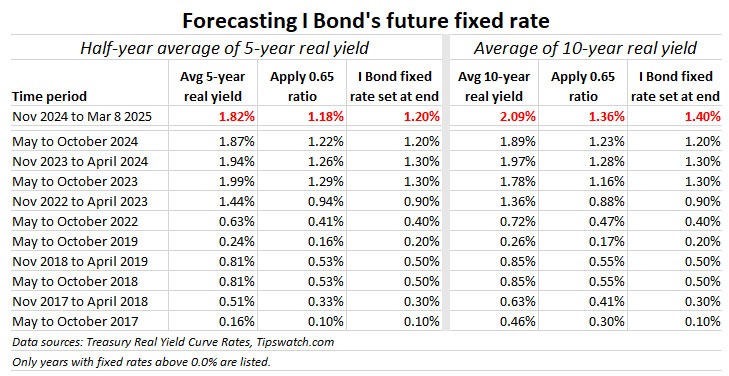
So now I am going to use that formula to look at how recent declining real yields could affect the Treasury’s May 1 decision. Here are the data:

I include the 10-year TIPS data in this chart simply as a back-check, but it is interesting to note that 10-year real yields would point to a higher fixed rate of 1.40%. (The fixed rate is always rounded to the one-tenth decimal.) But … ignore that. The 10-year real yield hasn’t been a reliable indicator of the rate reset.

At this point, as of March 7, 2025, the average real yield of a 5-year TIPS since November 1, 2024, has been 1.82%, much higher than the current rate of 1.57%. Applying a ratio of 0.65 to 1.82% gets you to 1.18%, which rounds to 1.20%, same as the current fixed rate.

So, yes, the fixed rate could hold at 1.20%.

But what if the 5-year real yield stays around this 1.57% level through April, or goes lower? If that happens, the I Bond’s fixed rate is likely to decline to 1.10%, at least. There are 57 market days remaining until late April. If you add in 57 days at 1.57%, the real yield average drops to 1.132%, which would round to 1.10%.

So, yes, the fixed rate could drop to 1.10%.

What we don’t know

The Trump administration could decide to ditch the long-standing formula for setting the I Bond’s fixed rate. That is certainly possible. Remember, there is no set formula required by law. Keep that in mind.

Or, maybe it could eliminate the savings bond program entirely, cutting off all new issues? Highly improbable, I’d say.

Also, real yields have been highly volatile over the last month and may continue to rise and fall unpredictably. We’ll have more certainty by mid-April.

Also read: A great mystery: I Bond buying guide for 2025

Suggested strategy: Wait

Maybe you haven’t noticed, but I Bonds are getting more and more attractive as the 5-year TIPS yield declines. An I Bond can be redeemed after 5 years with no penalty, so it is directly comparable to a 5-year TIPS, but has advantages of tax deferral, better deflation protection and no market fluctuations.

An I Bond with a fixed rate of 1.20% is more attractive than a TIPS with a real yield of 1.30% or 1.40%, in my opinion. So if TIPS yields continue declining, I Bonds with a fixed rate of 1.20% — or even 1.10% — will remain attractive.

My opinion: The best strategy for investing in I Bonds in 2025 is to wait at least until April 10, when the March inflation report will be released. Then you will know for certain what the new variable rate will be (probably higher than the current 1.90%) and have a better idea of the potential fixed-rate reset.

I am thinking an investment near the end of April will make the most sense. There is no harm in waiting. But if the fixed rate looks likely to rise, May would be the better choice. I will have more to say on this topic in mid-April.

Confused by I Bonds? Read my Q&A on I Bonds

Let’s ‘try’ to clarify how an I Bond’s interest is calculated

Inflation and I Bonds: Track the variable rate changes

I Bonds: Here’s a simple way to track current value

I Bond Manifesto: How this investment can work as an emergency fund

* * *

Follow Tipswatch on X (Twitter) for updates on daily Treasury auctions and real yield trends (when I am not traveling).

Feel free to post comments or questions below. If it is your first-ever comment, it will have to wait for moderation. After that, your comments will automatically appear. Please stay on topic and avoid political tirades. NOTE: Comment threads can only be three responses deep. If you see that you cannot respond, create a new comment and reference the topic.

David Enna is a financial journalist, not a financial adviser. He is not selling or profiting from any investment discussed. I Bonds and TIPS are not “get rich” investments; they are best used for capital preservation and inflation protection. They can be purchased through the Treasury or other providers without fees, commissions or carrying charges. Please do your own research before investing.

Posted in I Bond, Inflation, Investing in TIPS, Retirement | Tagged , , , | 46 Comments

30-year TIPS auction gets real yield of 2.403%, highest in 23 years

By David Enna, Tipswatch.com

The market for Treasury Inflation-Protected Securities made a bit of history today, with the auction of $9 billion in a new 30-year TIPS getting a real yield of 2.403%, the highest for this term since October 2001.

Of course, we have to recognize that the Treasury stopped issuing 30-year TIPS from October 2001 to February 2010. Since that restart, no 29- to 30-year TIPS auction has received a real yield higher than 2.29%. Until today.

This is CUSIP 912810UH9, and the auction sets its coupon rate at 2.375%, also the highest for this term in 23 years. The auction appears to have come in right on target. The “when-issued” yield prediction — revealed just before the close at 1 p.m. EST — was very close at 2.400%. The bid-to-cover ratio was a solid 2.48.

This is a good result for investors, who will earn 2.403% over official U.S. inflation for the next 30 years. Just a reminder: As recently as March 9, 2022 — less than three years ago — the nominal yield on a 30-year Treasury bond was 2.29%, less than the real yield of today’s result. This is a nice turn for investors seeking safety.

Here is the trend in the 30-year real yield over the last five years, showing the remarkable surge higher after the end of the Federal Reserve’s pandemic-era quantitative easing in March 2022:

Click on image for larger version.

Pricing

This is a new TIPS, so investors could be assured that the coupon rate (2.375%) would be set slightly below the real yield of 2.403%. That resulted in a discounted unadjusted price of 99.403433. In addition, this TIPS will have an inflation index of 1.00016 on the settlement date of February 28.

With this information, we can calculate the exact cost of a purchase of $10,000 par value of this TIPS at today’s auction:

  • Par value: $10,000.
  • Adjusted principal purchased: $10,000 x 1.00016 = $10,001.60
  • Cost of investment: $10,001.60 x 0.99403433 =$9,941.93
  • + accrued interest of $8.53

In summary, an investor buying $10,000 par of this TIPS at today’s auction paid $9,941.93 for $10,001.60 of principal and will now earn inflation adjustments equal to inflation for 30 years, plus an annual coupon of 2.375% paid on inflation-adjusted principal.

Inflation breakeven rate

At the auction’s close, the 30-year Treasury bond was trading with a nominal yield of 4.74%, meaning this TIPS gets an inflation breakeven rate of 2.34%, a bit high compared to recent trends. This reflects a lack of investor confidence in the Federal Reserve’s ability to put tight controls on future inflation. Inflation over the last 30 years, ending in January, has averaged 2.5%.

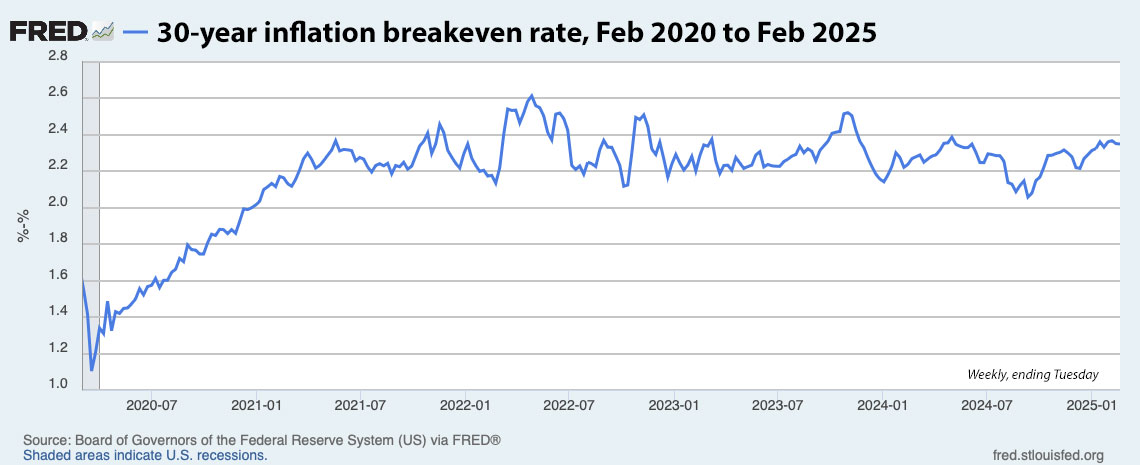
Here is the trend in the 30-year inflation breakeven rate over the last five years, showing how inflation expectations have been locked in a narrow pattern (but highish) for the last three years:

Thoughts

This is a very good result for investors who can accept the 30-year time frame and hold to maturity. CUSIP 912810UH9 is the most attractive 30-year TIPS issued in 24 years, in my opinion. But I wasn’t a buyer because the long maturity doesn’t fit into my likely lifespan.

We are heading into uncertain economic times. Both real and nominal yields could be heading higher. Still, getting 2.403% over inflation for 30 years, guaranteed, is attractive and sensible, in my opinion.

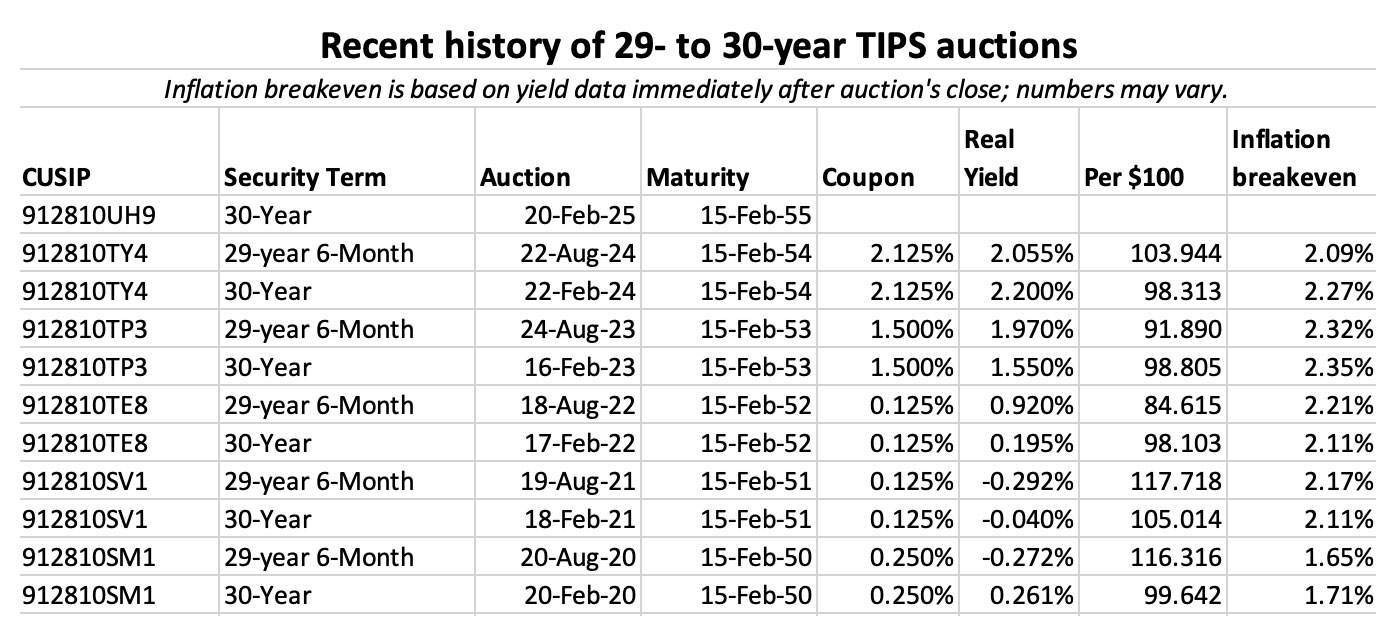
Here is a history of TIPS auctions of this term over the last five years:

Now is an ideal time to build a TIPS ladder

Confused by TIPS? Read my Q&A on TIPS

TIPS in depth: Understand the language

TIPS on the secondary market: Things to consider

TIPS investor: Don’t over-think the threat of deflation

Upcoming schedule of TIPS auctions

* * *

Follow Tipswatch on X (Twitter) for updates on daily Treasury auctions and real yield trends (when I am not traveling).

Feel free to post comments or questions below. If it is your first-ever comment, it will have to wait for moderation. After that, your comments will automatically appear. Please stay on topic and avoid political tirades. NOTE: Comment threads can only be three responses deep. If you see that you cannot respond, create a new comment and reference the topic.

David Enna is a financial journalist, not a financial adviser. He is not selling or profiting from any investment discussed. I Bonds and TIPS are not “get rich” investments; they are best used for capital preservation and inflation protection. They can be purchased through the Treasury or other providers without fees, commissions or carrying charges. Please do your own research before investing.

Posted in Federal Reserve, Inflation, Investing in TIPS, TreasuryDirect | Tagged , , , , | 28 Comments

For the right investor, this week’s 30-year TIPS auction could have appeal

By David Enna, Tipswatch.com

Rapa Nui on a glorious day.

I am writing this on a gorgeous Friday night in Rapa Nui, also known as Easter Island. I am sitting in the open-air lobby of a nice hotel, because everywhere else the Internet is non-existent.

So OK, let’s try to focus on this week’s auction of a new 30-year Treasury Inflation-Protected Security, CUSIP 912810UH9. This is a new TIPS, so its coupon rate and real yield to maturity will be set by the auction results.

At Friday’s market close, the Treasury estimated the real yield of a 30-year TIPS at 2.38%. If that real yield holds through the week, this TIPS would get the highest yield above inflation of any originating or reopening TIPS auction of this term since the Treasury re-started issuing the 30-year TIPS in February 2010.

Definition: The “real yield” of a TIPS is its yield above official future U.S. inflation, over the term of the TIPS. So a real yield of 2.38% means an investment in this TIPS would provide a return that exceeds U.S. inflation by 2.38% for 30 years.

Potentially, the coupon rate could be set as high as 2.375%. All of this looks very good.

The problem with this TIPS — for me and many others — is the 30-year term. My investing style is to buy TIPS and hold to maturity. This TIPS will mature February 15, 2055, when I will be 101 years old. it’s not a good choice for me.

The other thing to realize about any 30-year TIPS is that it will be a highly volatile investment, plummeting in value if real yields rise, but also producing a big interim gain if real yield fall.

For example, the 30-year TIPS issued in February 2022 got a real yield of only 0.195% and it is now selling at a price of about 56.33. In other words, it has lost about 43% of its value in only three years. This week’s auction will get a much much better real yield, but it will still be volatile. That’s my warning.

For a 30- to 50-year old investor who could easily hold to maturity, this TIPS is attractive as the top line of a 30-year TIPS ladder. Getting around 2.38% above inflation is going to work out well, even if real yields continue to rise. But only if you can hold to maturity.

Here is the trend in the 30-year real yield over the last 15 years (since the Treasury began to issue 30-year TIPS after a 9-year pause):

Click on image for larger version.

Take a look at this graph and you can see the 30-year real yield is now in a desirable place. But it could go higher. It could go lower.

Inflation breakeven rate

With a 30-year nominal Treasury note yielding 4.69% at Friday’s market close, this TIPS currently would have an inflation breakeven rate of 2.31%, which is high but not out of the range of recent results. Over the last 30 years, inflation. has averaged 2.5%.

At some point, a high inflation breakeven rate would make the nominal Treasury attractive, but there is no way I’d be buying 30-year nominal at this point.

Pricing

CUSIP 912810UH9 will carry an inflation index of only 1.00016 on the settlement date of Feb 28. Because its coupon rate will be set slightly below the auctioned real yield, it is likely to have an investment cost very close to par value.

If you order $10,000 of this TIPS, you will be paying a price close to $10,000.

Thoughts

I am not investing in this. But for the right person with the ability to hold to maturity, CUSIP 912810UH9 should end up being an attractive, sensible investment.

This TIPS auction closes Thursday at 1 p.m. EST. Non-competitive bids at TreasuryDirect must be placed by noon Thursday. If you are putting an order in through a brokerage, make sure to place your order Wednesday or very early Thursday, because brokers cut off auction orders before the noon deadline.

I will be posting the auction results sometime Thursday. Who knows? I am on vacation. Here is a history of auction results for this term over the last 5 years:

Now is an ideal time to build a TIPS ladder

Confused by TIPS? Read my Q&A on TIPS

TIPS in depth: Understand the language

TIPS on the secondary market: Things to consider

TIPS investor: Don’t over-think the threat of deflation

Upcoming schedule of TIPS auctions

* * *

Follow Tipswatch on X (Twitter) for updates on daily Treasury auctions and real yield trends (when I am not traveling).

Feel free to post comments or questions below. If it is your first-ever comment, it will have to wait for moderation. After that, your comments will automatically appear. Please stay on topic and avoid political tirades. NOTE: Comment threads can only be three responses deep. If you see that you cannot respond, create a new comment and reference the topic.

David Enna is a financial journalist, not a financial adviser. He is not selling or profiting from any investment discussed. I Bonds and TIPS are not “get rich” investments; they are best used for capital preservation and inflation protection. They can be purchased through the Treasury or other providers without fees, commissions or carrying charges. Please do your own research before investing.
Posted in Inflation, Investing in TIPS, TreasuryDirect | 37 Comments

January’s inflation report was a bit of a disaster

All-items and core inflation both rose much higher than expectations.

By David Enna, Tipswatch.com

The January inflation report, just released by the Bureau of Labor Statistics, demonstrated that U.S. inflation is far from tamed. This was not good news.

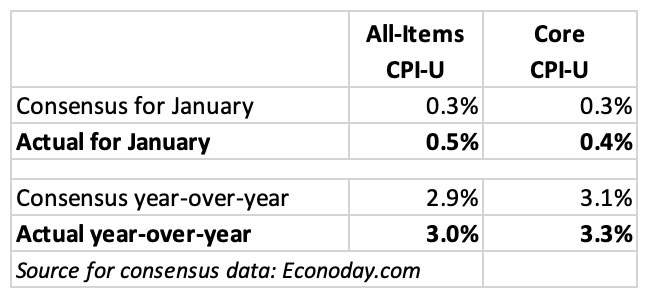
There is no silver lining here. Seasonally-adjusted all-items inflation increased 0.5% for the month and 3.0% for the year, both above expectations. Core inflation, which removes food and energy, rose 0.4% for the month and 3.3% for the year, also above expectations. Annual inflation by both measures increased over December levels.

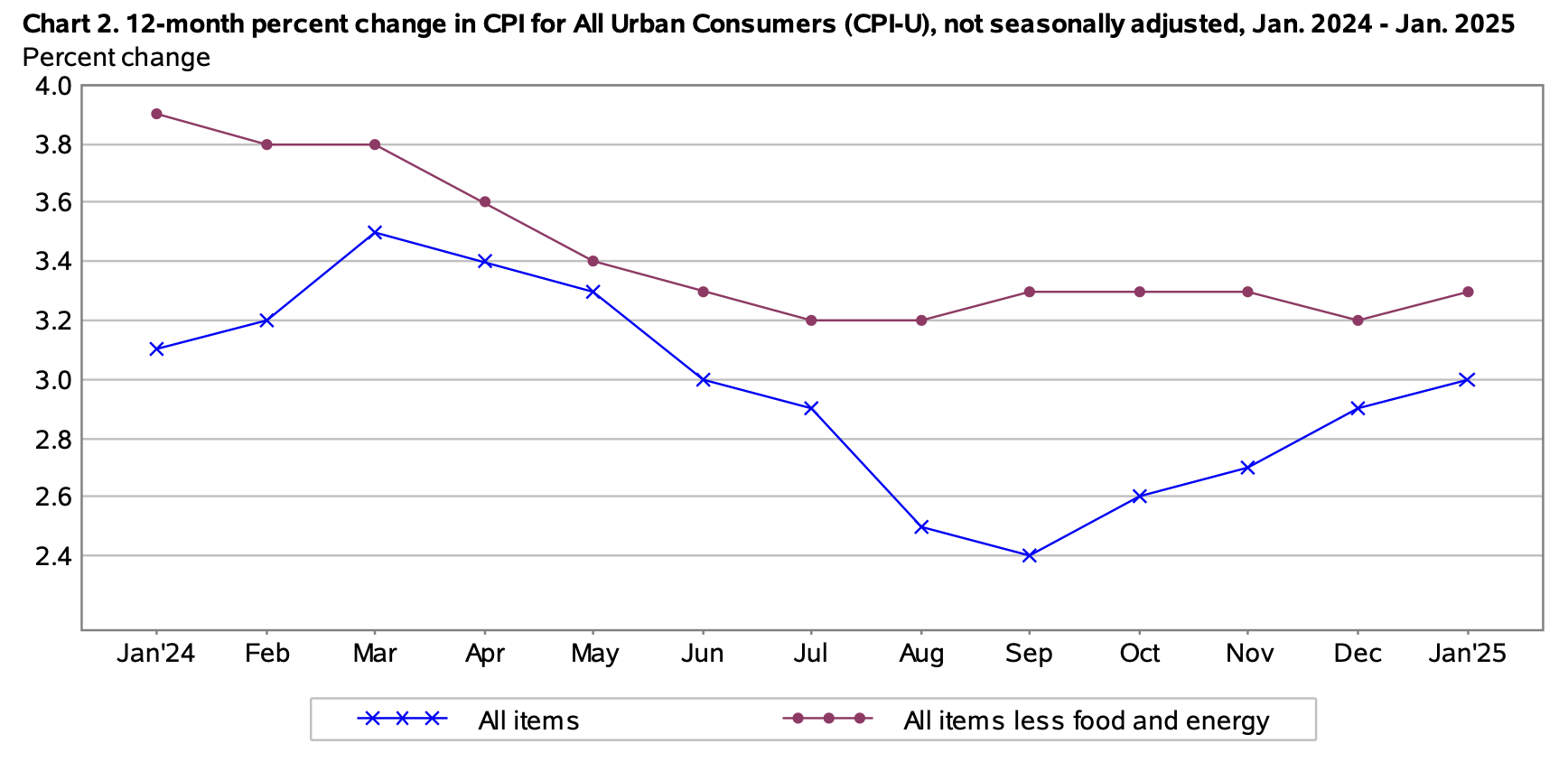
This one graph, tracking the year-over-year trend line, shows it all, with all-items inflation steadily rising higher since fall 2024 and core remaining stubbornly above 3.0%:

The BLS noted that shelter costs increased 0.4% for the month and 4.4% for the year, a major factor in the overall increase. And gasoline prices rose 1.8% for the month, after rising 4.0% in December. Food at home prices increased 0.4% for the month and are now up 2.5% for the year. The price of eggs, for those curious, rose 15.2% for the month. It’s time to switch to breakfast cereal, where prices declined 3.3% for the month.

The BLS said prices were up across all major categories except apparel, which saw costs decline 1.4%.

What this means for TIPS and I Bonds

Investors in Treasury Inflation-Protected Securities and Series I Savings Bonds are also interested in non-seasonally adjusted inflation, which adjusts principal on TIPS and sets future interest rates for I Bonds.

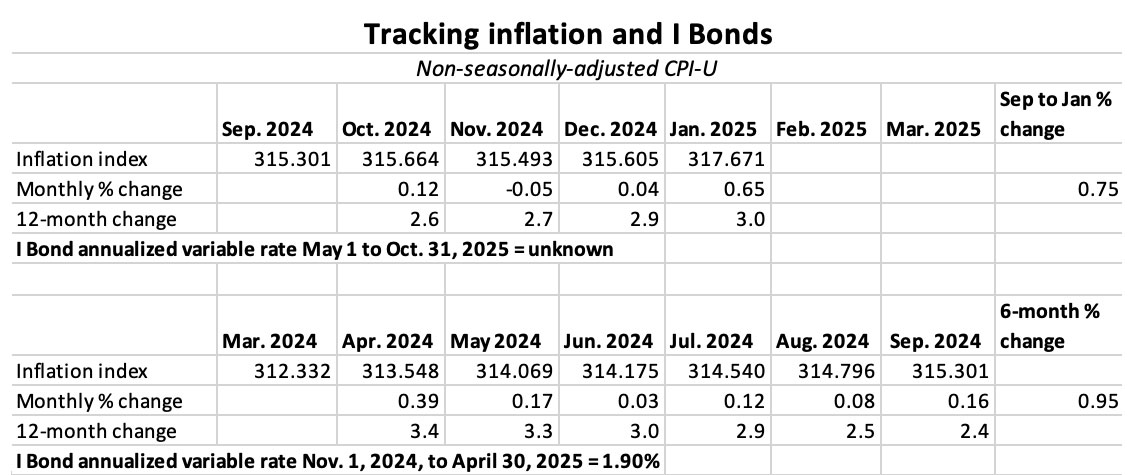
The BLS set the January inflation index at 317.671, a sharp increase of 0.65% for the month. A high number was expected, because non-seasonally adjusted inflation runs higher than adjusted inflation from January to June. But 0.65% was higher than I expected.

For TIPS. The January inflation number means that principal balances for all TIPS will increase 0.65% in March, after rising just 0.04% in February. For the year ending in February, principal balances will have increased 3.0%.

For I Bonds. January is the fourth of a six-month string that will determine the I Bond’s new variable rate, which will be reset on May 1 and eventually roll into effect for all I Bonds. At this point, with two months remaining, inflation has increased 0.75%, which translates to a variable rate of 1.50%. The next two months are likely to push the variable rate up to around 3.0%, or higher. We’ll have to wait and see.

Here are the numbers so far:

View historical data on my Inflation and I Bonds page.

What this means for future interest rates

The January surge in inflation (which has been a January trend for several years) supports the Federal Reserve’s decision to hold interest rates at current levels, and probably means no rate-cutting is coming for many months.

This is from Bloomberg this morning:

Seema Shah, chief global strategist at Principal Asset Management, says these numbers are “very uncomfortable” for the Fed. Here’s her view: “If this persists into the next few months, inflation risks may become too heavily weighted to the upside to permit the Fed to cut rates at all this year.”

And this:

The danger is that this elevated inflation reading and the news headlines it produces will add to inflation expectations. They had already been ticking up amid all the discussion of tariff hikes from the Trump administration.

In essence, it would make no sense for the Federal Reserve to make any rate decisions (or even signals) for several months. We are on pause and the potential for rate increases is slightly rising.

I am writing this morning from Santiago, Chile. That is the reason for the abbreviated analysis. And it is time for my vacation to continue!

* * *

Follow Tipswatch on X (Twitter) for updates on daily Treasury auctions and real yield trends (when I am not traveling).

Feel free to post comments or questions below. If it is your first-ever comment, it will have to wait for moderation. After that, your comments will automatically appear. Please stay on topic and avoid political tirades. NOTE: Comment threads can only be three responses deep. If you see that you cannot respond, create a new comment and reference the topic.

David Enna is a financial journalist, not a financial adviser. He is not selling or profiting from any investment discussed. I Bonds and TIPS are not “get rich” investments; they are best used for capital preservation and inflation protection. They can be purchased through the Treasury or other providers without fees, commissions or carrying charges. Please do your own research before investing.

Posted in Federal Reserve, I Bond, Inflation, Investing in TIPS, Savings Bond | Tagged , , , , | 38 Comments