For me, this week’s 10-year TIPS auction is a ‘must buy’

Others may want to wait and watch for higher real yields.

Jan. 23 update: New 10-year TIPS gets real yield of 2.243%, highest for this term in 16 years

By David Enna, Tipswatch.com

I picked up the December issue of Kiplinger Personal Finance from my nightstand last week and began paging through. And chuckling. Why? Because nearly the entire issue was devoted to investing in a new era of declining interest rates.

Some sample headlines and topics:

  • How lower interest rates affect your finances.
  • Dividend payers are poised to benefit from falling rates.
  • At long last, rates are dropping.
  • Rate-cut winners and losers.
  • Columnist: “I am wary of long-term Treasurys.”

As it turns out, Kiplinger got it wrong. Even though the Federal Reserve continued to cut its federal funds rate by 25 basis points in November and again in December, these cuts had no effect on medium- and longer-term Treasurys. In fact, both nominal and real yields have increased strongly since December 1, 2024.
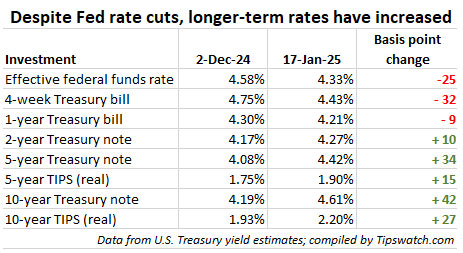
Let’s give Kiplinger a break, however. I was right with them in expecting to see at least slightly lower medium-term Treasury rates going into 2025. Instead, because of positive economic news and uncertainty about policies of the incoming president, medium- and longer-term rates have been rising.

And this all leads up to Thursday’s auction of a new 10-year Treasury Inflation-Protected Security, CUSIP 91282CML2. This will be the first TIPS in history to mature in 2035, and because of that I have long been targeting a purchase at this auction. I need to fill year 2035 in my TIPS ladder. I am pleased to see the potential real yield hovering around 2.20%, despite slipping a bit last week because of a so-called “soft” December inflation report.

Definition: The “real yield” of a TIPS is its yield above official future U.S. inflation, over the term of the TIPS. So a real yield of 2.20% means an investment in this TIPS would provide a return that exceeds U.S. inflation by 2.20% for 10 years.

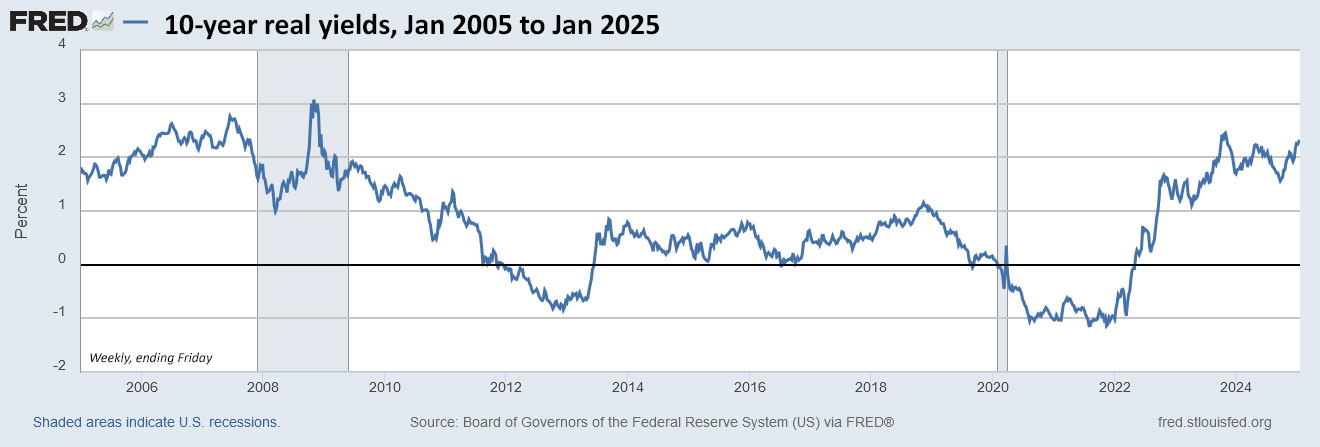
By historical standards, a real yield of 2.20% is attractive. It is actually quite a bit above the historical real return (1.80%) of 10-year Treasurys from 1928 to 2024. Take a look at this chart of the 10-year real yield over the last 20 years:
Click on image for larger version.

The lower yields from 2011 to early 2022 were caused by aggressive bond-buying programs of the Federal Reserve, which kept longer-term interest rates suppressed. Now we are in an era of moderate quantitative tightening and yields have returned to more normal levels.

So for me– if rates hold this week — I am going to jump at Thursday’s chance to lock in a 10-year TIPS with a real yield of around 2.20%. A few more things to consider:

  • The Treasury is offering $20 billion of this TIPS, the highest ever for an auction of this term. Last year’s January auction was for $18 billion.
  • If the real yield to maturity ends up above 2.20%, it would be the highest real yield for any 9- to 10-year TIPS at auction since January 2009.
  • If the coupon rate is 2.125% or higher, it would be the highest for this term since January 2009.

Pricing

This is a new TIPS, so its coupon rate will be set at the 1/8th percentage point level below the auctioned real yield (most likely 2.125% or 2.250%). Because of that, this TIPS is going to auction at a slightly discounted price. Plus, its inflation index on the settlement date of Jan. 31 will be 0.99972, providing another very slight discount.

In other words, a purchase of $10,000 par of this TIPS is probably going to cost just a little less than $10,000 or maybe right at $10,000 after you add in a small amount of accrued interest, maybe $10 or so.

Inflation breakeven rate

With the 10-year nominal Treasury note closing Friday at 4.61%, this TIPS currently would have an inflation breakeven rate of 2.41%, higher than any auction of this term since September 2022. However, U.S. inflation has averaged 3.0% over the last 10 years, so the number isn’t unreasonable. (In my opinion, a 10-year nominal Treasury at 5% would start to get interesting.)

Here is the trend in the 10-year inflation breakeven rate over the last 20 years:

Click on image for larger version.

That’s a crazy chart, isn’t it? The shaded areas show the strong effect recessions have on inflation expectations. And yet, over the 20 years, the 10-year inflation breakeven rate never quite reached the 3.0% level of the 2014-to-2024 period. Remember: the inflation breakeven rate is a measure of sentiment, not at all an accurate predictor of future inflation.

Buy now … or wait?

Several readers have asked me why I am going to buy CUSIP 91282CML2 at Thursday’s auction (if yields hold reasonably steady). Why not just wait and buy it later on the secondary market? Waiting could definitely work. … Or not.

Waiting is a bet that real yields will continue to rise, and that definitely could happen. … Or not. My philosophy of TIPS investing is buy a yield you like and don’t look back.

Buying at auction assures me of getting the same high yield as the big-money investors, with no bid-ask spread. Also, because this is a new TIPS, you may not see many small-lot sale offers on the secondary market for several weeks.

The negative of an auction is the uncertainty about the actual yield you will receive. The advantage of the secondary market is that you can see exactly the price and real yield you will get. The negative is that you may face a small bid-ask spread. Most of the time, it doesn’t make a huge difference.

So either way is probably fine, auction or secondary market. I am choosing to go with the auction because this is a new TIPS with a good yield and good pricing. Over this week, you can track the Treasury estimate of the 10-year real yield on this page. Financial markets will be closed Monday in honor of Martin Luther King Jr.

This TIPS auction closes Thursday at 1 p.m. EST. Non-competitive bids at TreasuryDirect must be placed by noon Thursday. If you are putting an order in through a brokerage, make sure to place your order Wednesday or very early Thursday, because brokers cut off auction orders before the noon deadline.

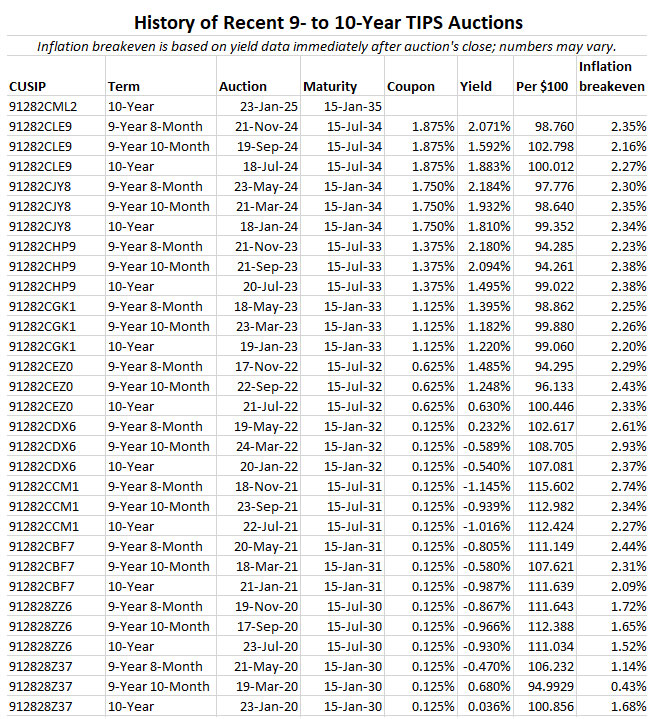
I will be posting the auction results soon after the close on Thursday. Here is a history of auction results for this term over the last 5 years:
Now is an ideal time to build a TIPS ladder

Confused by TIPS? Read my Q&A on TIPS

TIPS in depth: Understand the language

TIPS on the secondary market: Things to consider

TIPS investor: Don’t over-think the threat of deflation

Upcoming schedule of TIPS auctions

* * *

Follow Tipswatch on X (Twitter) for updates on daily Treasury auctions and real yield trends (when I am not traveling).

Feel free to post comments or questions below. If it is your first-ever comment, it will have to wait for moderation. After that, your comments will automatically appear. Please stay on topic and avoid political tirades. NOTE: Comment threads can only be three responses deep. If you see that you cannot respond, create a new comment and reference the topic.

David Enna is a financial journalist, not a financial adviser. He is not selling or profiting from any investment discussed. I Bonds and TIPS are not “get rich” investments; they are best used for capital preservation and inflation protection. They can be purchased through the Treasury or other providers without fees, commissions or carrying charges. Please do your own research before investing.
Posted in Federal Reserve, Inflation, Investing in TIPS, Treasury Bills, TreasuryDirect | Tagged , , , | 53 Comments

U.S. inflation rose 0.4% in December, higher than expected

By David Enna, Tipswatch.com

The December inflation report issued this morning by the Bureau of Labor Statistics can be viewed only one way: U.S. inflation is not yet under control.

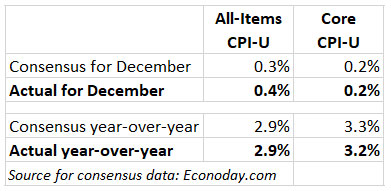
Seasonally adjusted inflation increased 0.4% in December, higher than expectations. Annual inflation increased from 2.7% to 2.9% in December, which matched expectations but isn’t great news. Core inflation, removing food and energy, increased 0.2% for the month and 3.2% for the year, breaking a three-month string at 3.3%. That’s the one bit of positive news.

So officially, U.S. inflation ran at 2.9% for the year 2024, down from 3.4% in 2023.

Gasoline prices reentered the inflation picture in December, rising 4.4% for the month, but fell 3.4% for the year. Fuel oil prices also rose 4.4% for the month. The BLS said energy prices accounted for about 40% of the overall CPI increase. Also from the report:

  • Shelter costs showed no sign of abating, rising 0.3% for the month and 4.6% for the year.
  • Food at home prices rose 0.3% for the month and 1.8% for the year.
  • Apparel prices rose 0.1% for the month and just 1.2% year over year.
  • Airline fares rose 3.9% for the month and 7.9% for the year.
  • Costs of used cars and trucks rose 1.2% for the month but were down 3.3% for the year.
  • New vehicle prices rose 0.5% in December but fell 0.4% for the year.
  • Motor vehicle insurance costs rose 0.4% for the month and 11.3% for the year.

Looking for a bright spot? The costs of alcoholic beverages fell 0.3% for the month and rose just 1.4% for the year.

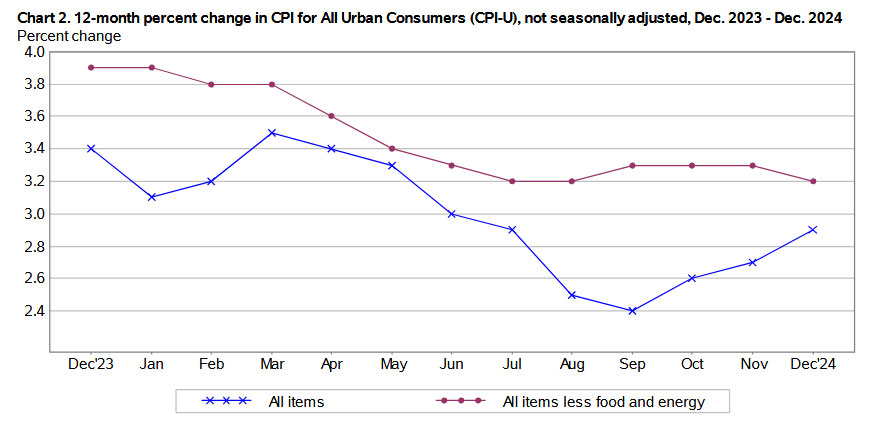
There aren’t a lot of bright spots in this December report, with prices increasing across a broad spectrum of products and services. Here is the trend in annual inflation rates over the last year, showing the clear trend of higher all-items inflation:

What this means for TIPS and I Bonds

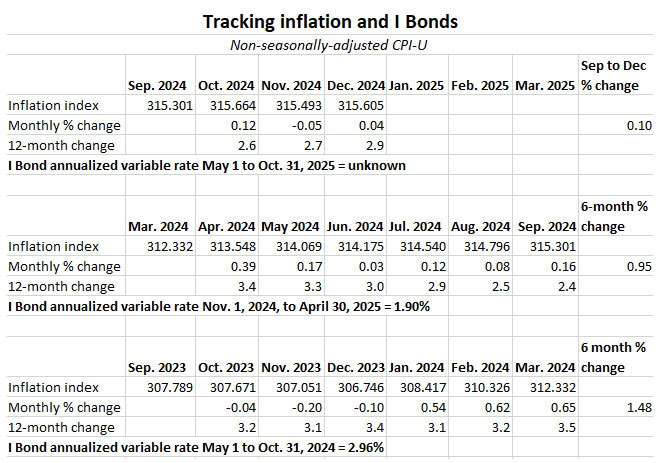
Investors in Treasury Inflation-Protected Securities and U.S. Series I Savings Bonds are also interested in non-seasonally adjusted inflation, which is used to adjust principal balances on TIPS and set future interest rates for I Bonds. For December, the BLS set the inflation index at 315.605, an increase of 0.04% over the November number.

It is normal for non-seasonally adjusted inflation to run lower than official inflation in December. In fact, last month was the first December since 2021 to not record non-seasonally adjusted deflation for the month. The numbers will turn around in January, with non-seasonal running higher than seasonal.

For TIPS. December inflation means that principal balances for all TIPS will increase by 0.04% in February, after falling 0.05% in January. Here are the new February Inflation Indexes for all TIPS.

For I Bonds. The December report is the third of a six-month string that will determine the new variable rate, to be reset as of May 1 and eventually roll into place for all I Bonds. As of December, inflation has increased just 0.1% for the three months, translating to a variable rate of 0.2%.

However, that is pretty meaningless. Non-seasonally adjusted inflation will pick up in January. For example: In 2023, inflation for October to December was -0.34%, but the next three months brought the variable rate up to 2.96%. Here are the data:

What this means for future interest rates

This might not be a “nightmare” inflation report for the Federal Reserve, but it certainly isn’t good news. Annual inflation hit a low of 2.4% in September but now has ticked steadily higher to 2.9%. Core inflation has been steadily above 3.0%, but finally ticked lower in December.

In Bloomberg’s morning report, some analysts are pointing the drop in core inflation has a strong positive. This is from Anna Wong and Stuart Paul of Bloomberg Economics:

We think the Fed will likely view the December CPI report favorably. We still expect officials to hold rates steady in January, but the report bolsters the case for the dot plot’s outlook of 50 basis points of rate cuts this year.

A counter view from Bloomberg’s Molly Smith:

While the easing in the CPI is welcome, Fed officials would need to see a series of subdued readings after months of elevated prints to reassure them that inflation progress has resumed. Lingering price pressures have contributed to a deep selloff in global bond markets and fueled concerns that the Fed eased policy too quickly at the end of last year.

My opinion: For the time being, especially as we enter a period of uncertain government policies, I think the Fed is likely to delay any future cuts in interest rates. Before any change, it will begin sending signals. For now, we are on hold.

* * *

Follow Tipswatch on X (Twitter) for updates on daily Treasury auctions and real yield trends (when I am not traveling).

Feel free to post comments or questions below. If it is your first-ever comment, it will have to wait for moderation. After that, your comments will automatically appear. Please stay on topic and avoid political tirades. NOTE: Comment threads can only be three responses deep. If you see that you cannot respond, create a new comment and reference the topic.

David Enna is a financial journalist, not a financial adviser. He is not selling or profiting from any investment discussed. I Bonds and TIPS are not “get rich” investments; they are best used for capital preservation and inflation protection. They can be purchased through the Treasury or other providers without fees, commissions or carrying charges. Please do your own research before investing.
Posted in Federal Reserve, I Bond, Investing in TIPS | Tagged , , , | 20 Comments

A 10-year TIPS is maturing Jan. 15. How did it do as an investment?

By David Enna, Tipswatch.com

In a few days, CUSIP 912828H45 – a 10-year TIPS that originated at auction on Jan. 22, 2015 – will mature. This was a ho-hum TIPS that came to life at a strange time in the U.S. bond market.

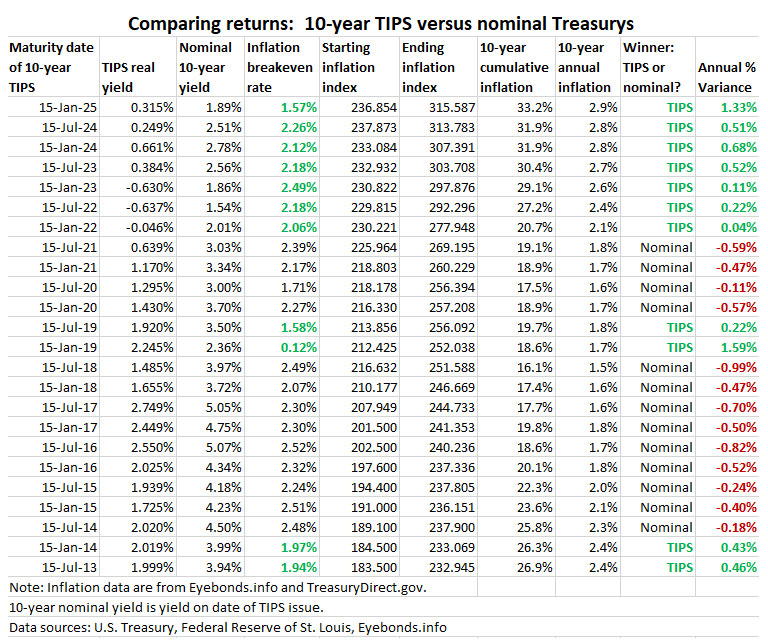
At the originating auction, it got a real yield to maturity of 0.315% and an inflation breakeven rate of 1.57%. At the time, a 10-year Treasury note had an ultra-low nominal yield of just 1.89%, well below today’s 10-year real yield of about 2.34%.

In my preview article for that auction, I noted intense volatility in the U.S. Treasury market. I wasn’t a fan and I wasn’t a buyer.

So at this point, with the auction a week away, it appears this new TIPS issue will get a coupon rate of 0.250% and a real yield (after inflation) a bit higher than that. A year ago, a 10-year TIPS went off with a yield of 0.661% – about 37 basis points higher.

Now, 10 years later … that very low inflation breakeven rate made CUSIP 912828H45 a very attractive investment, at least compared to the nominal 10-year Treasury of the time. Annual inflation over the next 10 years averaged 2.9%, well above the breakeven rate of 1.57%. This TIPS absolutely walloped the comparable Treasury note by 133 basis points a year.

The final investment results for this TIPS were set by the November inflation report issued Dec. 11. Data from Eyebonds.info show this TIPS generated a 10-year nominal annual return of 3.241%, crushing the comparable Treasury note at 1.89%.

OK, 3.24% may not seem like much, but keep in mind that the 10-year nominal Treasury yield didn’t didn’t reach 3.0% from January 2015 until fall 2018, and that was a brief period before slipping below that level again until spring 2022.

As a reader pointed out in the comments, over the last 10 years Vanguard’s Total Bond ETF (BND) has had an annual total return of 1.14%. Total return of the TIP ETF was 1.93%, and VTIP (shorter-term TIPS) was 2.51%, all below the 10-year average inflation rate.

For its time, CUSIP 912828H45 was a very good investment, with the widest gap over a 10-year nominal Treasury since I started tracking this auction data in 2013.

TIPS versus an I Bond

If you purchased an I Bond in January 2015, it had a fixed rate of 0.0%, below the real yield of this TIPS at 0.315%. According to Eyebonds.info, that I Bond will have generated an average annual return of 2.85% as of July 2025. So again, the TIPS was the superior investment at 3.241%.

However, the I Bond has outperformed the 10-year nominal Treasury.

Thoughts

TIPS have been on a winning streak for several years, caused by the surge to 40-year high inflation that peaked in June 2022 at 9.1%. Even today, annual inflation is running higher than the auctioned breakeven rates of 2015. And so TIPS have been the winners versus nominal Treasurys in recent years.

View more data on my TIPS vs. Nominals page.

Notes and qualifications

My chart is an estimate of performance comparing inflation breakeven rates versus actual inflation.

Keep in mind that interest on a nominal Treasury and the TIPS coupon rate is paid out as current-year income and not reinvested. So in the case of a nominal Treasury, the interest earned could be reinvested elsewhere, which would potentially boost the gain. For certain, we don’t know what the investor could have earned precisely on an investment after re-investments.

In the case of a TIPS, the inflation adjustment compounds over time, and that will give TIPS a slight boost in return that isn’t reflected in the “average inflation” numbers presented in the chart.

Now is an ideal time to build a TIPS ladder

Confused by TIPS? Read my Q&A on TIPS

TIPS in depth: Understand the language

TIPS on the secondary market: Things to consider

TIPS investor: Don’t over-think the threat of deflation

Upcoming schedule of TIPS auctions

* * *

Follow Tipswatch on X (Twitter) for updates on daily Treasury auctions and real yield trends (when I am not traveling).

Feel free to post comments or questions below. If it is your first-ever comment, it will have to wait for moderation. After that, your comments will automatically appear. Please stay on topic and avoid political tirades. NOTE: Comment threads can only be three responses deep. If you see that you cannot respond, create a new comment and reference the topic.

David Enna is a financial journalist, not a financial adviser. He is not selling or profiting from any investment discussed. I Bonds and TIPS are not “get rich” investments; they are best used for capital preservation and inflation protection. They can be purchased through the Treasury or other providers without fees, commissions or carrying charges. Please do your own research before investing.

Posted in I Bond, Inflation, Investing in TIPS | Tagged , , , , | 18 Comments

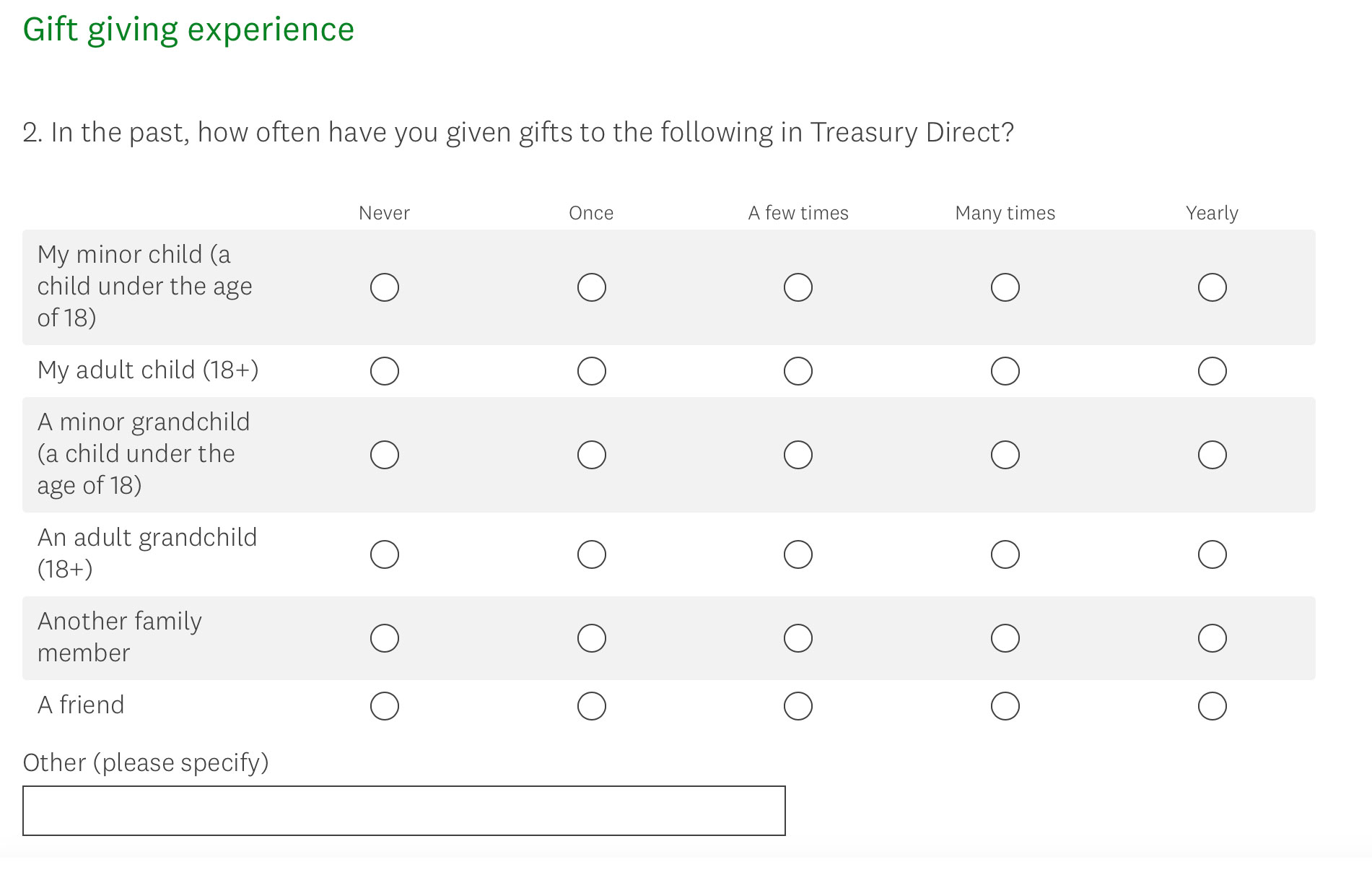
TreasuryDirect is sending out a survey on the savings bond gift-box. Here are the details.

By David Enna, Tipswatch.com

As I have noted many times in recent months, I believe there are changes coming in TreasuryDirect’s “gift box” program, which creates a loophole for buying I Bonds beyond the $10,000 per person annual limit for people with a trusted partner.

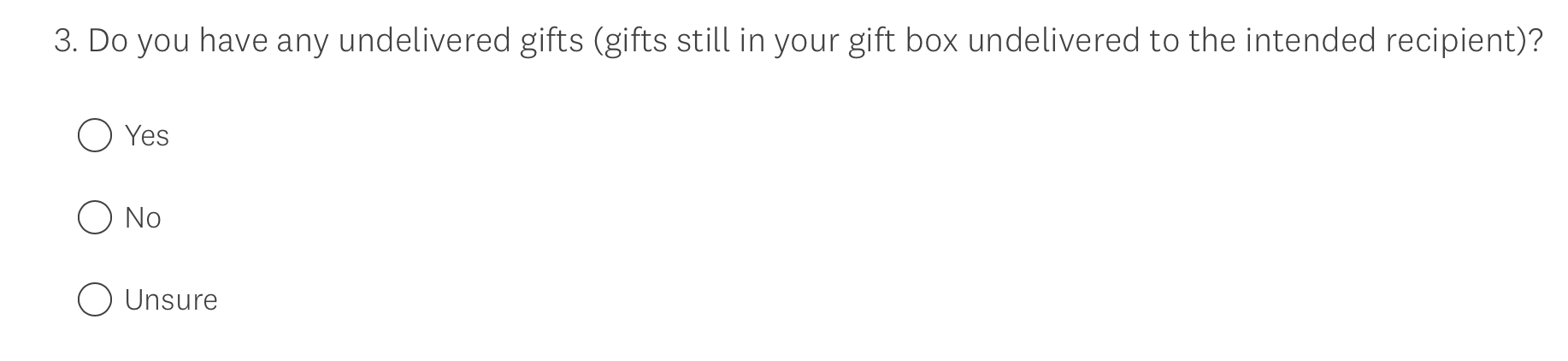
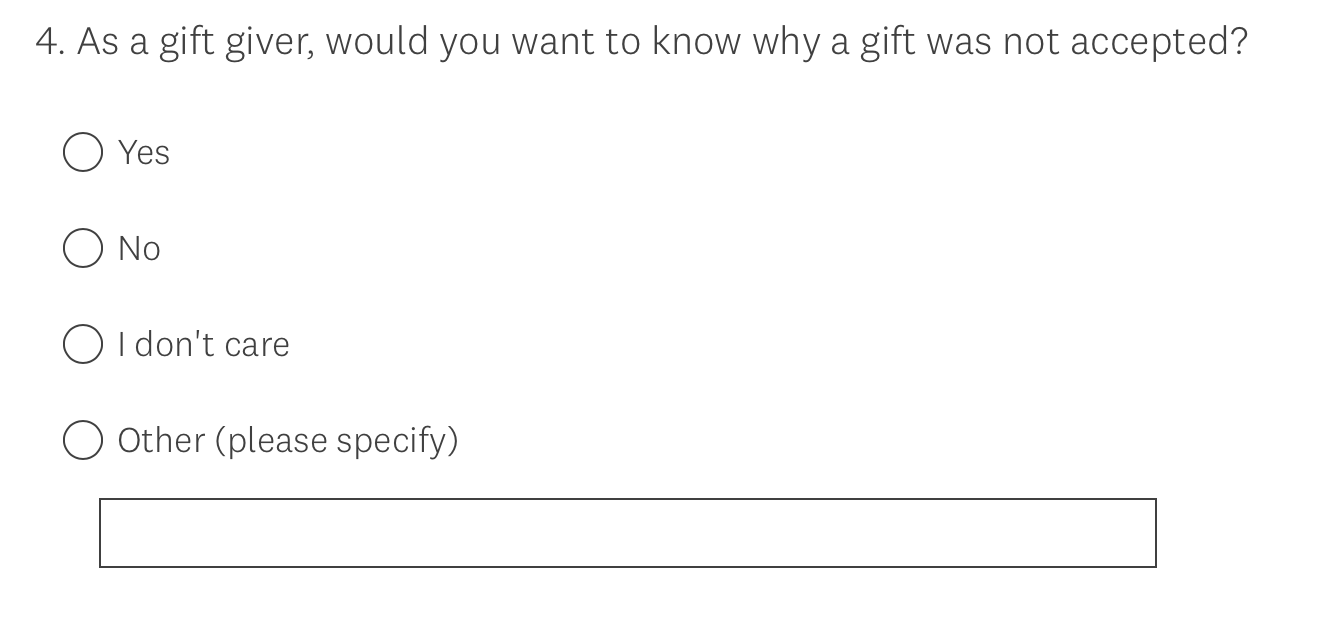
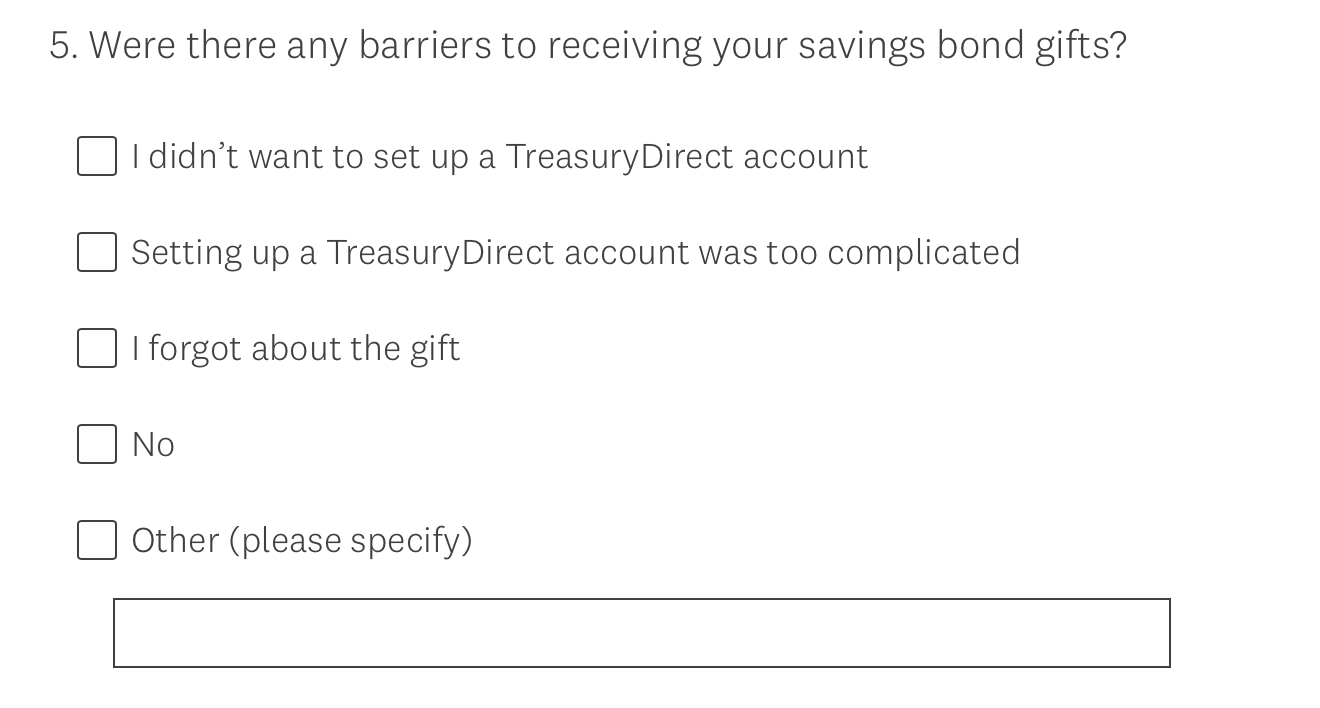
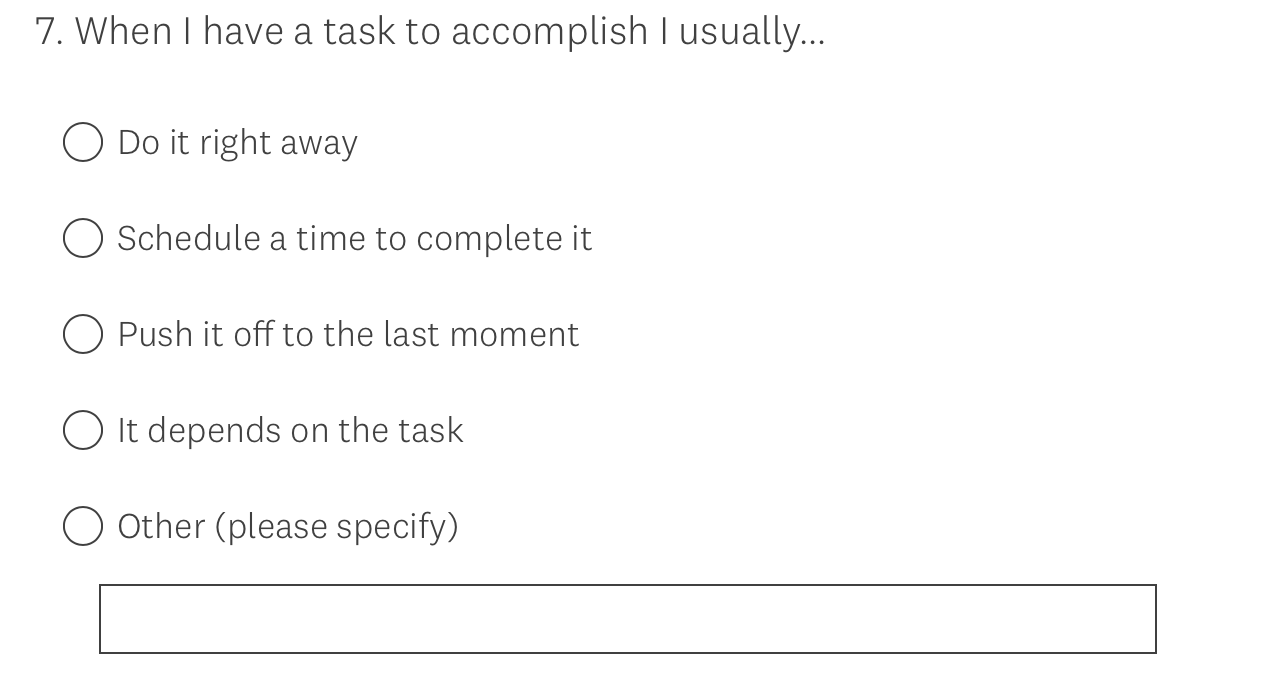
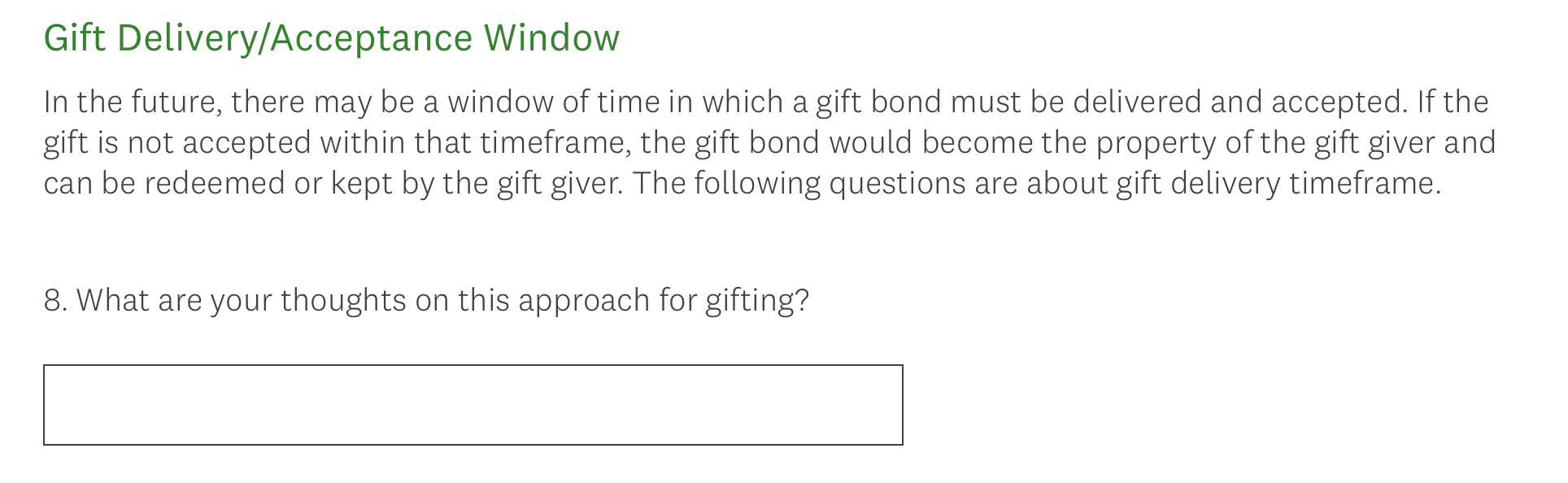
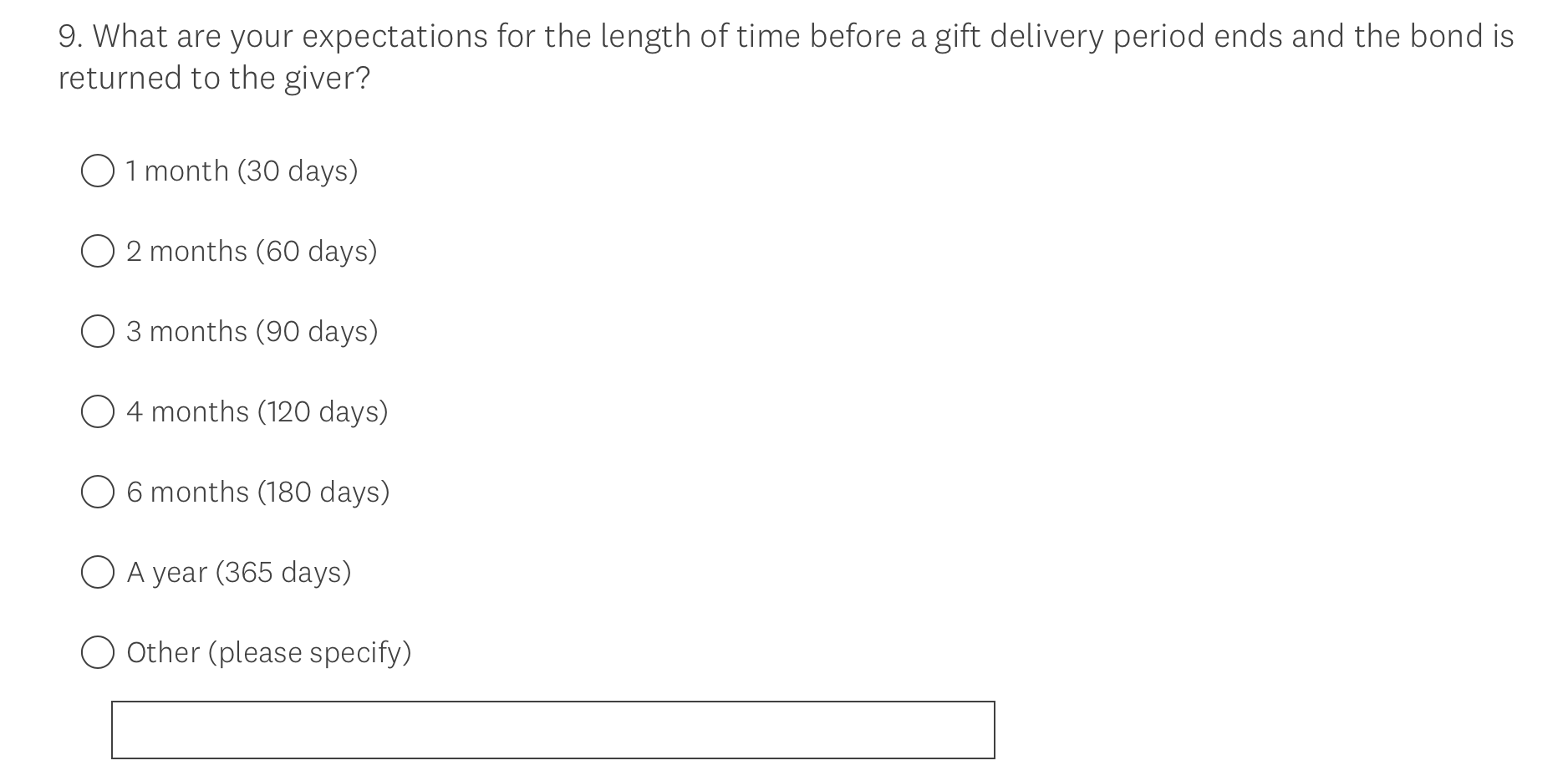
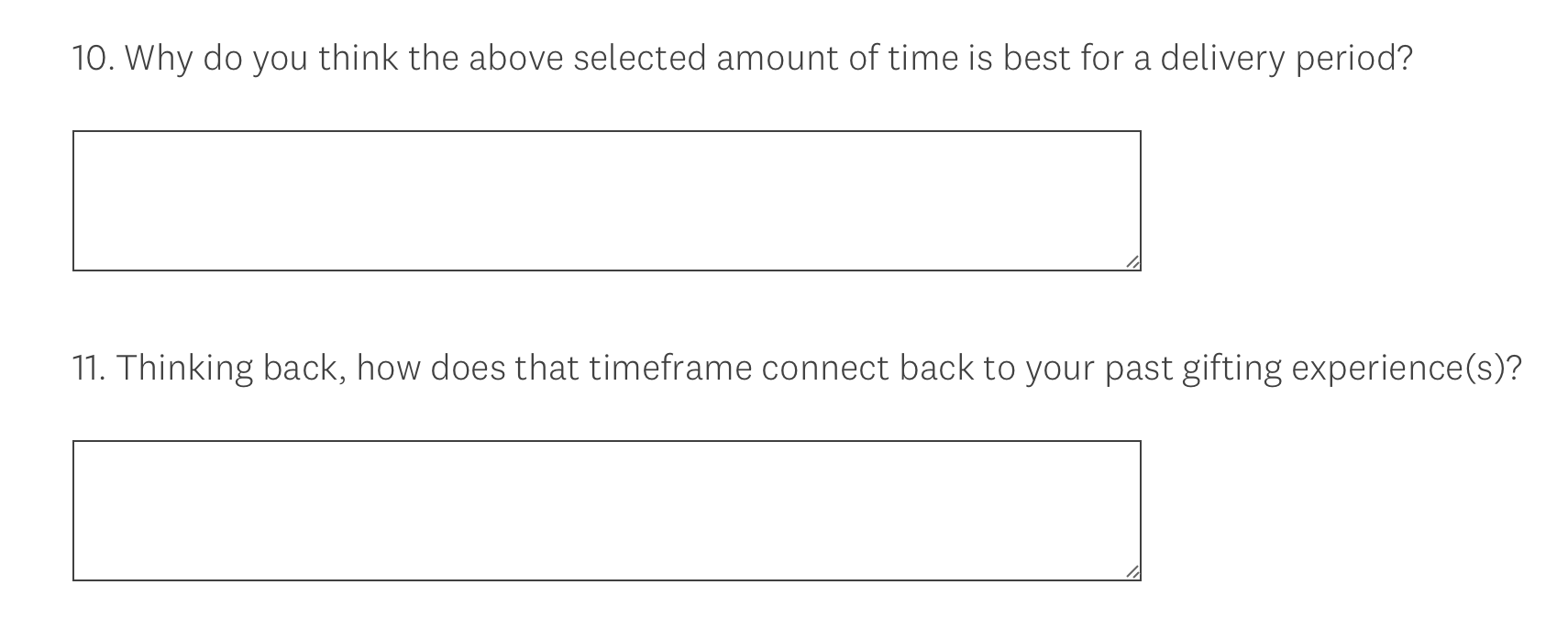
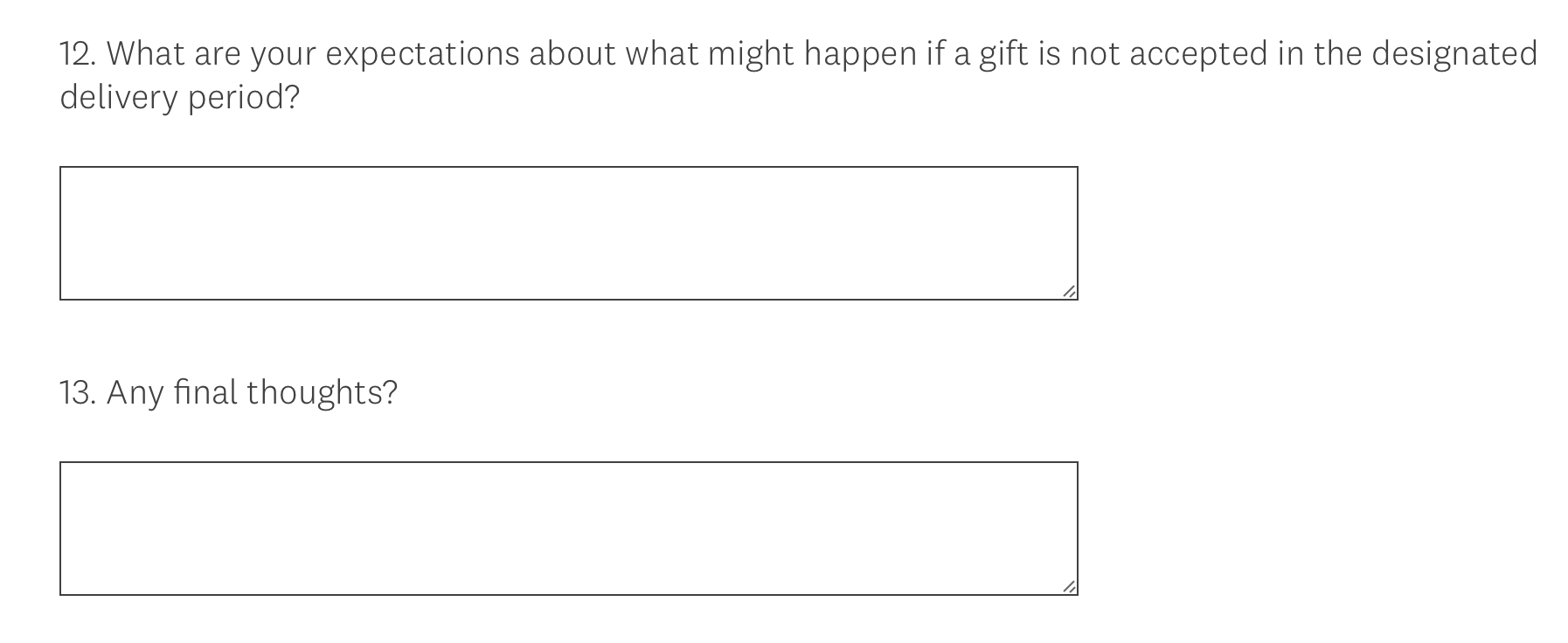
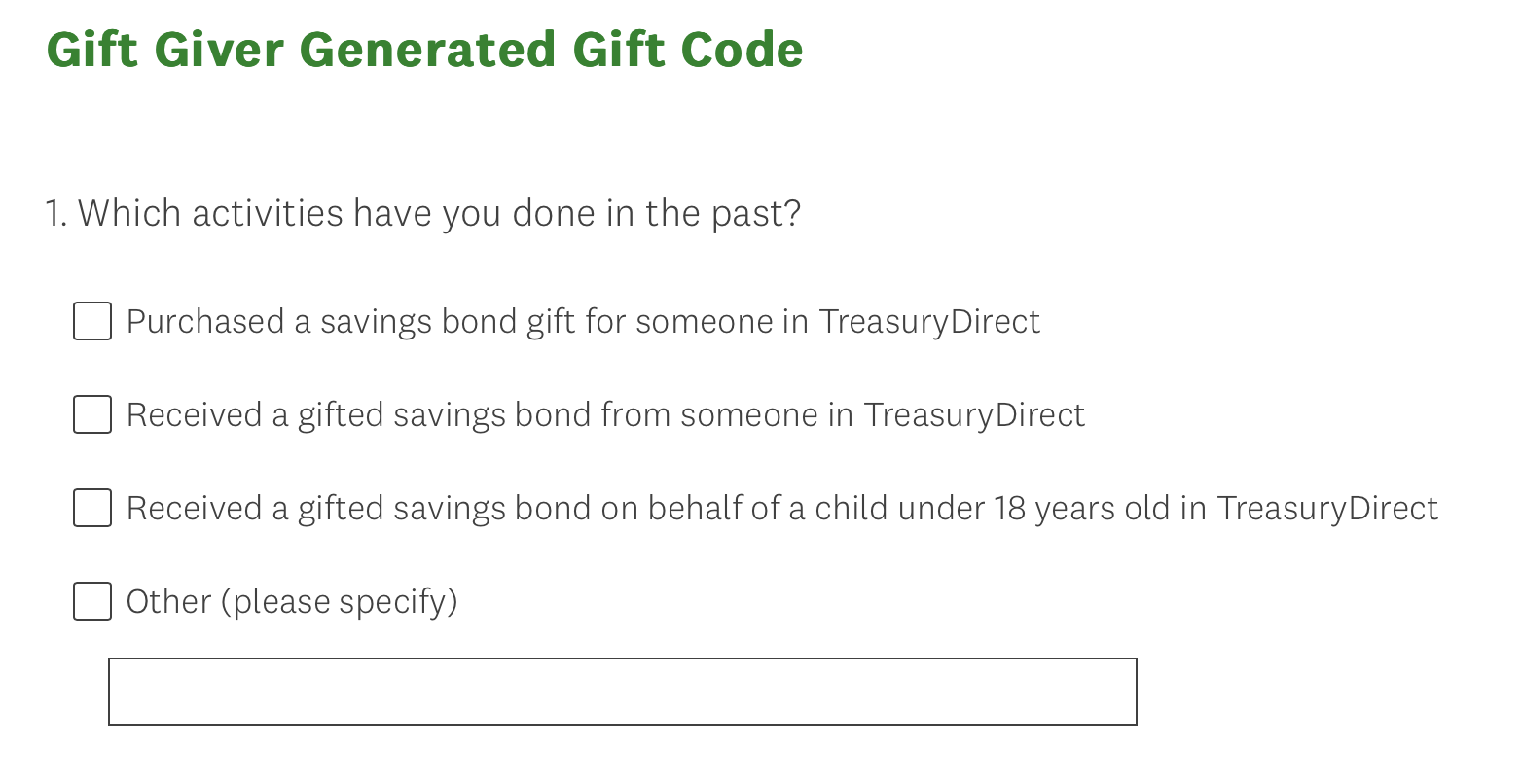
Today, TreasuryDirect began sending out an email asking investors to participate in a survey about the gift-box program. If you haven’t received the email, I am presenting the questions here for all of us to analyze:

Thoughts

I am still pondering what this means, but the core issue in the survey seems to be a new time limit on delivering bonds from the gift box. (There is no time limit now, and I Bonds in the gift box continue earning interest until delivered, possibly years in the future.) Some investors, I know, do not want a time limit, because these bonds are to be delivered to a child at some time in the future.

The Treasury has stipulated in the past that a gift box item is no longer the property of the giver. It can only be delivered to the recipient, who is actually the owner. But this survey seems to imply that savings bonds that aren’t delivered within some time frame (possibly up to a year) would be returned to the giver.

Returning the savings bond to the giver opens up another set of issues, but that’s too confusing to ponder with this limited information. As one Bogleheads commentator noted minutes ago:

That sounds like it’s opening up the door to gift yourself, which would be nice for unmarried people like me.

The survey also focuses on potential problems with gift-box bonds being accepted after being delivered, possibly because the recipient is unaware of the gift or does not have the required TreasuryDirect account.

And the survey really tells us nothing about the issue of using the gift box to add to holdings in a single year, bypassing the purchase limit if you have a trusted partner, such as a spouse. That’s the loophole I think should be closed, while at the same time raising the purchase limit to $20,000 per person per year.

I’m confused, but I’ve only had a few minutes to think about this. The discussion is now open. Join in with thoughts in the comments section. I will follow up with more information if I learn anything. Many thanks to readers who sent me alerts.

* * *

Follow Tipswatch on X (Twitter) for updates on daily Treasury auctions and real yield trends (when I am not traveling).

Feel free to post comments or questions below. If it is your first-ever comment, it will have to wait for moderation. After that, your comments will automatically appear. Please stay on topic and avoid political tirades. NOTE: Comment threads can only be three responses deep. If you see that you cannot respond, create a new comment and reference the topic.

David Enna is a financial journalist, not a financial adviser. He is not selling or profiting from any investment discussed. I Bonds and TIPS are not “get rich” investments; they are best used for capital preservation and inflation protection. They can be purchased through the Treasury or other providers without fees, commissions or carrying charges. Please do your own research before investing.
Posted in Cash alternatives, EE Bonds, I Bond, TreasuryDirect | Tagged , , , , , , | 35 Comments

A great mystery: I Bond buying guide for 2025

By David Enna, Tipswatch.com

April 11, 2025, update: Welcome to the I Bond ‘buying season’

April 10, 2025, update: I Bond’s variable rate will rise to 2.86% on May 1

Update, Jan 31, 2025: I noted in this article that I was going to make a “test” I Bond purchase in January 2025 to see if it would trigger a purchase limit because of gift box deliveries in 2024. The transaction was scheduled for Jan. 29 and the money was withdrawn by the Treasury on that date. A day later, TreasuryDirect showed the I Bond in the account, dated Jan 1 2025. So it all worked without a hitch.

——-

I’m a big fan of all those Agatha Christie Poirot books, Sherlock Holmes, Philip Marlow, every episode of Columbo on TV. But even those great detectives would have a hard time figuring out TreasuryDirect.

“Just one more thing.”

So now we enter a new year, and the annual $10,000 per person purchase cap for U.S. Series I Savings Bonds has reset. But one big question remains for many investors: Can I buy I Bonds this year? And for others: When should I buy I Bonds this year? Or even … Why invest in I Bonds at all?

Just a reminder: An I Bond is a U.S. Treasury security that combines a permanent fixed interest rate with a six-month variable rate, creating an inflation-protected return. They can only be purchased in electronic form at TreasuryDirect.

Can I buy this year?

TreasuryDirect created a lot of confusion in October when it sent an email to investors holding I Bonds in a “gift box” for later delivery. The email seemed to urge delivery of those I Bonds “as soon as possible.” The email was strange, but it was authentic.

Read this for more information: “Deciphering TreasuryDirect’s mysterious gift-box email.”

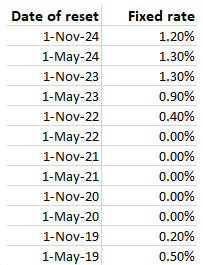
The gift box program is a widely used loophole that allows people with a trusted partner (such as a spouse) to expand their purchases of I Bonds beyond the $10,000 per person limit. The idea in early 2024 was 1) buy gift I Bonds now to lock in the attractive 1.3% fixed rate, and then 2) deliver them in future years when the fixed rate is lower.

We all assumed one thing: You could not deliver gift I Bonds to anyone who had already purchased up to the limit in that year. TreasuryDirect’s email threw that assumption out the window. I called TreasuryDirect to try to get an explanation, and so did hundreds of my readers and fellow Bogleheads. We learned (unofficially):

  • TreasuryDirect would like you to deliver gift I Bonds as soon as possible.
  • It would be OK to deliver I Bonds to a person who had already reached the purchase cap.
  • And … maybe (or maybe not) … the person receiving I Bonds over the limit would be locked out of buying I Bonds in future years, depending on the amount delivered.
  • Unspecified “changes” may (or may not) be coming to the savings bond program.

In my case, last year: 1) My wife and I each bought one set of 1.3% I Bonds early in the year, along with two sets each for the gift box. After getting the Treasury’s directive, we successfully delivered those gift box purchases in November 2024.

Now it is January 2025 and I am ready find out: Am I subject to a purchase limitation this year? The answer apparently is “no.”

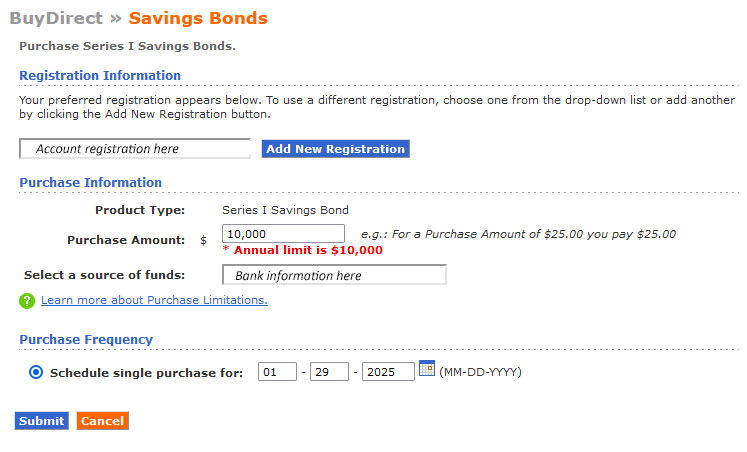
Last week, I logged into TreasuryDirect to place an I Bond order for my wife’s account:

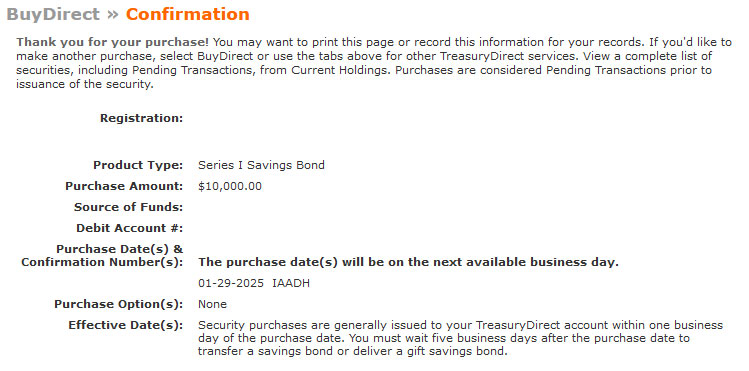
Everything here is totally normal. Note that I set the purchase date for Jan. 29 because I Bonds earn interest for an entire month, no matter the day they are purchased. I clicked “submit,” looked at the review page and clicked submit again.

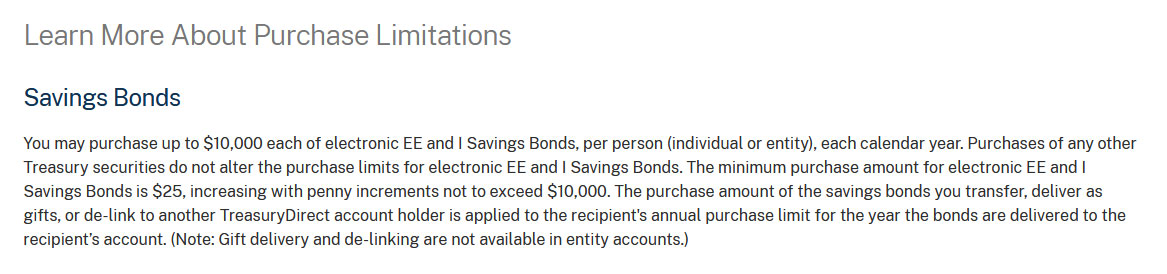
Again, totally normal. No warnings. No alerts. I think this purchase will go through on Jan. 29 as a routine transaction. Also, on the BuyDirect page, I noticed a link to “Learn more about Purchase Limitations.” I clicked and found this:

Click on image for larger version.

Notice this key wording: “The purchase amount of the savings bonds you transfer, deliver as gifts, or de-link to another TreasuryDirect account holder is applied to the recipient’s annual purchase limit for the year the bonds are delivered …”

My translation: If you receive $10,000 in gift I Bonds before you make your regular $10,000 purchase, you will not be able to buy more that year. But … if you make your regular purchase first, you can receive additional gift deliveries that year.

Important takeaway: If you are planning to deliver gift I Bonds this year, make sure to purchase your regular allocation before any delivery. Then, it appears, the gift I Bonds can still be delivered.

Also: If you made gift I Bond deliveries over the limit last year, you won’t be locked out of making a regular purchase in 2025. This is NOT official, but it is what I and others have experienced.

When should I buy I Bonds this year?

Although I set up a purchase for Jan. 29 to test my purchase theories, my usual advice would not be to buy in January, unless you feel the need to get the one-year-to-redemption clock ticking.

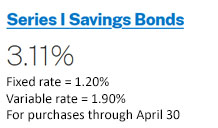
The current I Bond will pay 3.11% nominal for six months. You can do 100 basis points better in a decent money market account or high-yield savings account, for the time being. So there is no rush. Instead, be patient. I Bonds are a long-term investment.

April 10, 2025. We will get the March CPI report at 8:30 a.m. EDT, which will lock in the I Bond’s new six-month variable rate. We will also have a lot more information on whether the fixed rate will be likely to rise at the May 1 reset.

The period from April 10-28 is an ideal time to make a decision: Buy in April or buy in May, or continue waiting?

At this point, it looks possible the I Bond’s fixed rate could increase at the May 1 reset. For that to happen, using our back-of-the-envelope theory, the 5-year TIPS real yield would need to average at least 1.92% from November to April. That would get you back to 1.3%. At this writing, the 5-year TIPS is yielding 1.97%.

We won’t know until later this year. It is smart to wait. The variable rate is not a key factor in this decision, unless you want to make a short-term investment. The fixed rate is much more important for a long-term investor.

Oct. 15, 2025. The September inflation report will be issued on this day, locking in the next variable rate, and by then we will have information on the fixed rate reset coming Nov. 1. So the period from Oct. 15-29 is another potential “prime time” for an I Bond purchase.

Why invest in I Bonds at all?

Yes, at this point you can get a better nominal yield on a 13-week T-bill (4.36%) or a better real yield on a 5-year Treasury Inflation-Protected Security (1.97%). Both of those are attractive, safe investments. (And I invest in both.)

I Bonds, however, have unique qualities. They are an extremely safe and conservative investment. Interest accrues monthly and principal can never decline, even in times of deflation. Earnings are free of state income taxes and federal taxes can be deferred until the I Bond is redeemed or matures.

Also, I Bonds are a simple investment to buy and track, much simpler than a TIPS with a constantly changing market value and inflation accruals that update daily.

With an I Bond purchased today, you are guaranteed to earn 1.2% more than official U.S. inflation, with interest constantly compounding tax-deferred. You can redeem the I Bond after one year with a 3-month interest penalty, or after 5 years with no penalty.

My argument is that I Bonds should be viewed as a cash alternative in the form of a high-quality secondary emergency fund. You can let the principal grow without facing taxes, then after 5 years withdraw money as you need it, paying federal tax on the interest earned.

A lot of shorter-term, yield-hungry investors won’t see the appeal of I Bonds in 2025. That’s fine; there are great short-term options available right now. But many longer-term investors interested in building a sizable reserve of inflation-protected cash will want to buy I Bonds in 2025, up to the limit.

Rolling over 0.0% fixed-rate I Bonds

If you joined the mass movement into I Bonds back in October 2022, when the I Bond’s variable rate was about to reset from 9.62% to 6.48%, you are holding I Bonds with a fixed rate of 0.0% and your composite rate is going to be 1.90% for six months. That’s not a disaster, but many I Bond investors have been redeeming the 0.0% I Bonds and reinvesting the money into 1.3% or 1.2% fixed-rate versions over the last year. Or moving money into other investments.

That was the reason the gift box was so popular in recent years. Investors could redeem 0.0% sets, pay the tax on the interest, and then stash $10,000 into gift-box I Bonds to be delivered in future years. Then the Treasury set off chaos by encouraging these investors to deliver the gift-box bonds as soon as possible.

In the last two years, I have redeemed all our 0.0% fixed rate I Bonds and reinvested the money into the 1.3% or 1.2% versions (as of the scheduled Jan. 29 purchase). This makes sense for me, because I have large holdings in I Bonds and TIPS. Other people, still in the “accumulation phase” of I Bond investing, may want to hold the 0.0% versions and let them continue growing with inflation, tax-deferred.

The rollover process can be a little confusing, based on the limited information TreasuryDirect gives you for each holding. I wrote a guide back in September 2024.

“Just one more thing”

I think Treasury will make changes to the gift box program this year, but even if it doesn’t, I don’t plan to use it again in 2025. Under current rules, it appears that any amount of gift I Bonds can be delivered after an initial $10,000 purchase, Treasury has opened a gaping loophole, but only for people with a trusted partner.

What are your thoughts? Post your ideas and strategies in the comments section below. If you will bypass I Bonds this year, what alternatives are you considering?

Confused by I Bonds? Read my Q&A on I Bonds

Let’s ‘try’ to clarify how an I Bond’s interest is calculated

Inflation and I Bonds: Track the variable rate changes

I Bonds: Here’s a simple way to track current value

I Bond Manifesto: How this investment can work as an emergency fund

* * *

Follow Tipswatch on X (Twitter) for updates on daily Treasury auctions and real yield trends (when I am not traveling).

Feel free to post comments or questions below. If it is your first-ever comment, it will have to wait for moderation. After that, your comments will automatically appear. Please stay on topic and avoid political tirades. NOTE: Comment threads can only be three responses deep. If you see that you cannot respond, create a new comment and reference the topic.

David Enna is a financial journalist, not a financial adviser. He is not selling or profiting from any investment discussed. I Bonds and TIPS are not “get rich” investments; they are best used for capital preservation and inflation protection. They can be purchased through the Treasury or other providers without fees, commissions or carrying charges. Please do your own research before investing.
Posted in Cash alternatives, I Bond, Inflation, Savings Bond, TreasuryDirect | Tagged , , , , | 55 Comments