2024: An inflation-watcher’s year in review

By David Enna, Tipswatch.com

This year 2024 brought many surprises. For example:

  • Did you think the stock market would soar higher after the Federal Reserve started lowering short-term interest rates? OK, that seemed predictable.
  • But then did you foresee that longer-term interest rates would move higher as the Fed cut short-term rates? I had a feeling that could happen.
  • And then that the stock market would continue soaring higher even as longer-term rates were rising?
  • And that a high-risk, speculative investment like Bitcoin would rise 53% in the 45 days after the November presidential election?
  • Or that the incoming Trump administration would at first cause stock-market froth and then trigger investor regret about potential policies, all in a two-month span?
  • Or that the Federal Reserve would end the year apparently ready to pause its rate-cutting path into 2025?

The year 2025 is bringing uncertainty. I would not be surprised to see a fairly large sell-off in stock prices early in the year, with investors eager to harvest gains in the new tax year. But I am not a stock market expert and I have no crystal ball. So instead, here is a look back at 2024:

U.S. inflation

In November 2023, annual U.S. inflation stood at 3.1% for all-items and 4.0% for core. Today, as of November 2024, those numbers are 2.7% for all-items and 3.3% for core. That indicates progress. But the troubling thing — and what is clearly worrying the Fed — is that both inflation measures have been rising in recent months.
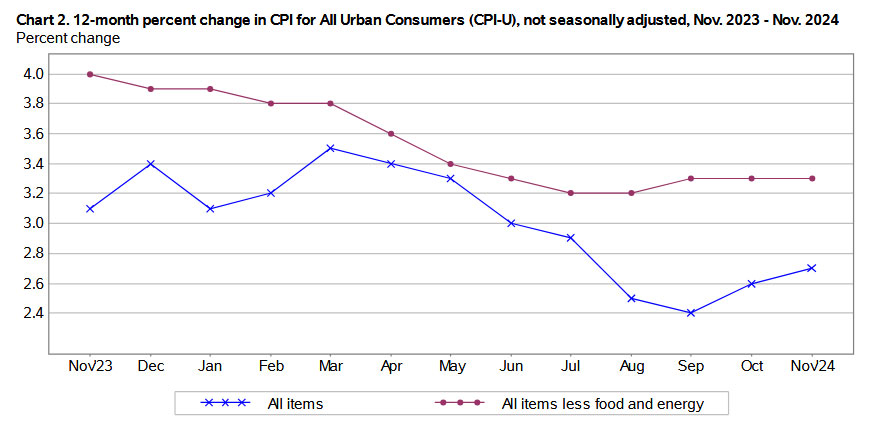
At its most recent meeting, Fed officials raised their 2025 inflation predictions for the Personal Consumption Expenditures Price Index (PCE) to 2.5% for both all-items (up from the previous estimate of 2.1%) and core (up from 2.2%). And at the same time, it cut interest rates.
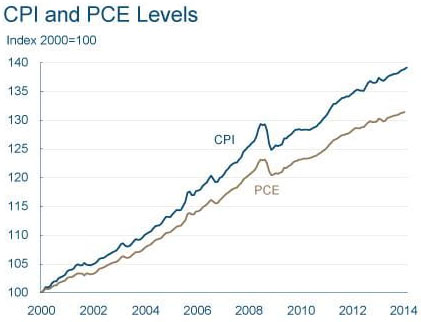
Click image for larger version.

PCE tends to track lower than headline CPI, as shown in this chart from the Cleveland Fed. So that means, probably, that official U.S. inflation will rise by a rate higher than 2.5% in 2025 based on the Fed predictions. In other words, we could be seeing 2.7% to 3.0% inflation for many months to come.

In addition, you can add in the potential for higher inflation from Trump administration policy decisions on tariffs and deportations.

Again, the theme is uncertainty.

Treasury Inflation-Protected Securities

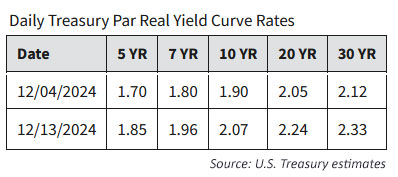
The past year was a stellar time for building a ladder of TIPS investments across the full maturity spectrum. Several times over the year, including this week, real yields were close to or above 2.0% across 5-, 10- and 30-year maturities. That offered a unique opportunity to build a ladder quickly and be done. I wrote about this last month.

Even investors in TIPS mutual funds and ETFs did relatively well in 2024, despite the upswing in real yields in recent weeks. The TIP ETF — with the full range of maturities — had a year-to-date total return of 1.48%. The short-term-focused VTIP ETF did better at 4.56%.

Here is a look at the 12 TIPS auctions through the year:

I have highlighted highs and lows for the year, but in my opinion every one of these auctions had a decent result for investors. Outside of the auctions, there were many mid-year and late-year opportunities to purchase TIPS on the secondary market with real yields close to or higher than 2.0%, a historically attractive target if held to maturity.

Click on image for larger version.

I would judge 2024 to be an excellent year for TIPS investing, based on the opportunities to snag attractive yields. But note: Real yields could rise higher, especially if inflation continues increasing and U.S. borrowing continues at very high levels. I wrote about this a week ago.

Bloomberg this morning has a detailed article focused on growing pressures in the U.S. Treasury market as the debt level swells. It explains that the primary dealer system may no longer be fully capable of dealing with bond-market disruptions.

“Issuance has gone up almost threefold in the last 10 years and the anticipation is for it to close to double to $50 trillion outstanding in the next 10 years, whereas dealer balance sheets haven’t grown at that magnitude,” said Casey Spezzano, head of US customer sales and trading at primary markets dealer NatWest Markets. … “You’re trying to put more Treasuries through the same pipes, but those pipes aren’t getting any bigger.”

U.S. Series I Savings Bonds

These inflation-protected savings bonds started the year with a fixed rate of 1.3% and a six-month composite rate of 4.28%. Today, the fixed rate for new purchases has fallen just a bit, to 1.2%, but the composite rate is sharply lower at 3.11%.

I am still a fan of and strong advocate for these Nov 2024 – Apr 2025 I Bonds, a unique, super-simple, super-safe investment that will provide tax-deferred returns exceeding inflation for as long as you hold them. My advice is to ignore the composite rate and focus on the 1.2% fixed rate, which is attractive. If inflation continues running at high levels through 2025 and beyond, these savings bonds provide protection in the form of a cash-equivalent savings account that is adjusted for inflation.

At this point, it looks possible the I Bond’s fixed rate could increase at the May 1 reset. For that to happen, using our back-of-the-envelope theory, the 5-year TIPS real yield would need to average at least 1.92% from November to April. That would get you back to 1.3%. At this writing, the 5-year TIPS is yielding 1.99%.

However, because the 5-year TIPS is sensitive to changes in short-term rates, I’d say the 5-year real yield will probably be heading lower.

Next year, changes may be coming to the savings bond program, especially to the much-used “gift-box” loophole for adding to your holdings with a trusted partner. But at this point, we know nothing. The Treasury in the last year has halted issuance of paper I Bonds in lieu of a federal tax refund, and also ended its Payroll Savings Plan for automatic contributions into TreasuryDirect.

This will be something to watch in the coming weeks.

In summary

Uncertainty seems to be my word of the day, maybe for the entire year 2025. And I believe uncertainty causes market disruptions. Things could keep humming along, but it’s probably time for a reality check for over-heated stock and alternative-investment markets.

To quote a famous American: “Be there, will be wild!”

Conservative investors will survive.

* * *

Follow Tipswatch on X (Twitter) for updates on daily Treasury auctions and real yield trends (when I am not traveling).

Feel free to post comments or questions below. If it is your first-ever comment, it will have to wait for moderation. After that, your comments will automatically appear. Please stay on topic and avoid political tirades. NOTE: Comment threads can only be three responses deep. If you see that you cannot respond, create a new comment and reference the topic.

David Enna is a financial journalist, not a financial adviser. He is not selling or profiting from any investment discussed. I Bonds and TIPS are not “get rich” investments; they are best used for capital preservation and inflation protection. They can be purchased through the Treasury or other providers without fees, commissions or carrying charges. Please do your own research before investing.

Posted in Federal Reserve, I Bond, Inflation, Investing in TIPS, Savings Bond, Treasury Bills, TreasuryDirect | Tagged , , , , , | 33 Comments

Could the 10-year Treasury yield hit 6% in 2025?

It is a possibility, says a T.Rowe Price analyst. We haven’t seen that level in 25 years.

By David Enna, Tipswatch.com

The chief investment officer at T.Rowe Price is making a bold prediction: Yields on the 10-year Treasury note could reach 6% in 2025.

“Is a 6% 10‑year Treasury yield possible? Why not? But we can consider that when we move through 5%,” Arif Husain wrote in a T.Rowe Price report. He is predicting the benchmark yield may reach 5% in 2025 before climbing higher. He writes:

I continue to expect higher intermediate‑ and long‑term Treasury yields, steepening the curve as Federal Reserve (Fed) rate cuts anchor short‑term yields.

Husain says the U.S. economy is now in a “calm before the storm.” Here are some of his key takeaways:

  • Increases in U.S. government spending and potential tax cuts, combined with a healthy economy, are likely to push Treasury yields higher.
  • Decreasing foreign demand for U.S. Treasurys could further elevate yields.
  • The incoming U.S. administration creates uncertainty. Policies on tariffs and immigration are potentially inflationary.

Husain sees little chance for a U.S. recession in 2025, which could help ease interest rates. His prediction came just before a too-hot CPI inflation report issued Dec. 11 was followed a week later by hawkish Federal Reserve signals, which sent Treasury yields surging higher.

The 10-year Treasury yield has increased 33 basis points in the month of December. It is a key data point across the U.S. economy, influencing everything from corporate debt to mortgages, even car loans.

Reaction

I agree that yields on the 10-year Treasury note could climb above 5% in coming months. That’s possible, but not a sure thing. We are heading into a time of economic uncertainty as President-elect Trump unveils new policies. Last week’s debt-crisis-gambit was not a good start.

The 10-year Treasury yield closed Friday at 4.52%, but the high for 2024 was 4.70% set on April 25. I’d say 5% would be within reach in the aftermath of any market-disturbing event, even if the Federal Reserve cautiously lowers short-term interest rates in 2025.

“Longer‑term Treasury yields should be increasing, steepening the yield curve,” Husain writes.

What would a 5% 10-year mean for TIPS? If 10-year inflation expectations hold around 2.4% (not desirable) you’d probably see the real yield on a 10-year TIPS rising to 2.6%, or higher, from the current 2.23%.

6% is a lofty target

Let’s look back at the last time the U.S. had a 10-year Treasury note yielding at or above 6%. That was January 2000, another time of market turmoil: A dot-com bubble about to burst, plus mania over the year 2000 crashing computers worldwide, resulting in massive corporate spending to avoid the problem.

Click on image for larger version.

Interesting fact: On January 12, 2000, a 10-year TIPS was auctioned with a real yield to maturity of 4.338% and a coupon rate of 4.250%, which probably ranks as the “greatest” 10-year TIPS auction of all time. The inflation breakeven rate was 2.38%, very close to a typical rate today.

At that point, in 2000, TIPS were a very new investment product, with just a three-year history. But it does show that the 6.7% nominal rate of early 2000 was not a reaction to high inflation.

Some facts about that time, 25 years ago:

  • U.S. Gross National Product grew at a real rate of 4.79% in 1999, the highest rate for any year since then until the pandemic bounce-back in 2021 at 5.80%. In 2024, GDP is growing at a rate of about 3.1%.
  • U.S. inflation increased 2.7% in 1999, which matches the current U.S. rate as of November 2024. In the year 2000, it surged to 3.4%.
  • The U.S. unemployment rate at the end of 1999 was 4.2%, which again matches the rate of 4.2% for November 2024.
  • The federal funds rate was 5.5% in January 2000, with another 100 basis points in increases coming by May 2000. Today, that rate is effectively 4.3%.
  • The U.S. budget deficit in 1999 was … actually, it was a surplus of $126 billion. Hard to believe, isn’t it? For 2024, the U.S. budget deficit is running at about $1.8 trillion.

Looking at these factors, except for the strong GDP growth of 1999 and higher short-term interest rates, you could almost assume longer-term interest rates should be higher in 2025 than in early 2000. Inflation rates and unemployment rates are quite similar. But the size of the U.S. budget deficit heading into 2025 is massively higher.

Getting the federal deficit under control should not be a Democratic vs. Republican issue, or liberal vs. conservative. It has to be done, either through spending cuts or tax increases or a combination of the two. It will take a brave politician to advocate for either. Husain writes:

With the Trump administration promising to cut taxes, there is little chance that the deficit will meaningfully decrease. The Treasury Department will need to continue to flood the market with new debt issuance to fund the budget deficit, pressuring yields higher.

I think a yield of 6% still looks unlikely in 2025, but if nominal Treasury yields surge above 6%, the nation’s problems will only get worse.

Click here for a .pdf version of Husain’s report.

* * *

Follow Tipswatch on X (Twitter) for updates on daily Treasury auctions and real yield trends (when I am not traveling).

Feel free to post comments or questions below. If it is your first-ever comment, it will have to wait for moderation. After that, your comments will automatically appear. Please stay on topic and avoid political tirades. NOTE: Comment threads can only be three responses deep. If you see that you cannot respond, create a new comment and reference the topic.

David Enna is a financial journalist, not a financial adviser. He is not selling or profiting from any investment discussed. I Bonds and TIPS are not “get rich” investments; they are best used for capital preservation and inflation protection. They can be purchased through the Treasury or other providers without fees, commissions or carrying charges. Please do your own research before investing.
Posted in Federal Reserve, Inflation, Investing in TIPS, Treasury Bills | Tagged , , , , | 32 Comments

Weak demand results in real yield of 2.121% for 5-year TIPS reopening auction

By David Enna, Tipswatch.com

The U.S. stock and bond markets were sent into turmoil Wednesday by confusing messaging from the Federal Reserve on future inflation and interest rates. As a result, the stock market plummeted and Treasury yields surged higher.

While that turmoil has lessened today, it had a strong effect on the Treasury’s auction of $22 billion in a reopened 5-year Treasury Inflation-Protected Security, CUSIP 91282CLV1. Before the Fed action on Thursday, this TIPS was trading on the secondary market with a real yield to maturity of about 1.85%. In the aftermath Wednesday afternoon, the yield surged to about 2.02%.

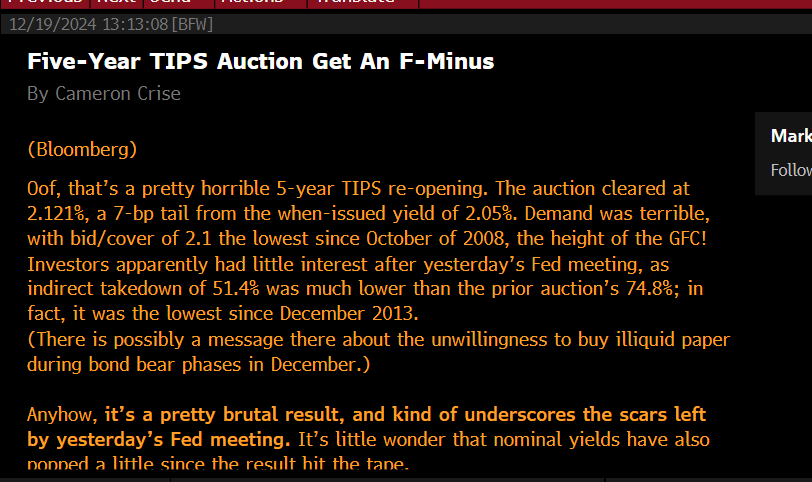
And then … today’s auction resulted in a real yield of 2.121%, about 7 basis points higher than the “when-issued” prediction of 2.05% set just before the auction’s close. The bid-to-cover ratio was 2.1, by far the lowest for any 4- or 5-year auction since I began tracking this number in 2019. (The lowest previously was 2.36 in October 2023.)

In other words, demand for this TIPS was extremely weak. But for investors, the result was excellent: a real yield to maturity of 2.121% and a price below par value.

Definition: The “real yield” of a TIPS is its yield above or below official future U.S. inflation, over the term of the TIPS. So a real yield of 2.121% means an investment in this TIPS would provide a return that exceeds U.S. inflation by 2.121% for 4 years, 10 months.

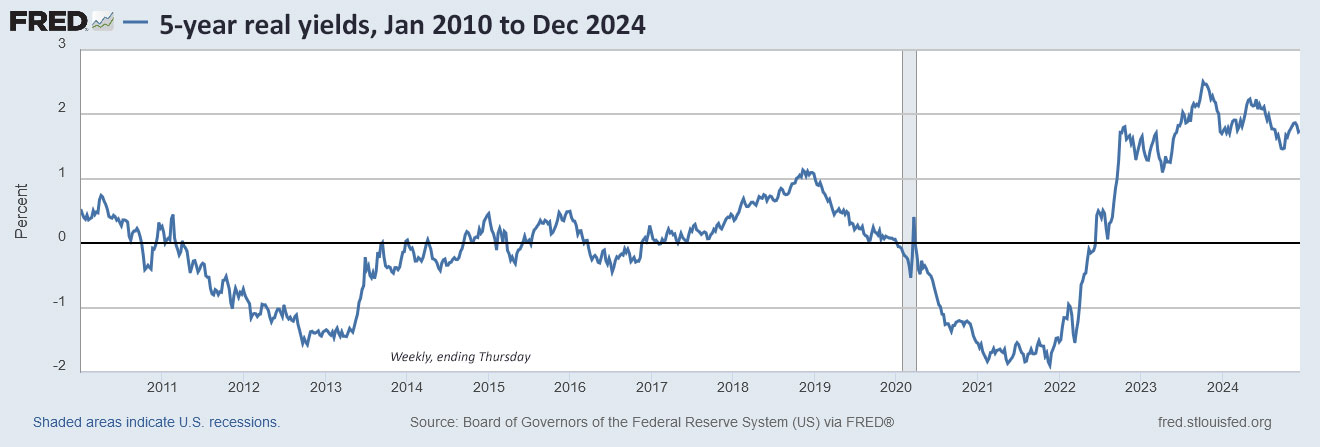
Here is the trend in the 5-year real yield over the last four years, ending on Tuesday, a day before the surge higher:

Click on image for larger version.

Pricing

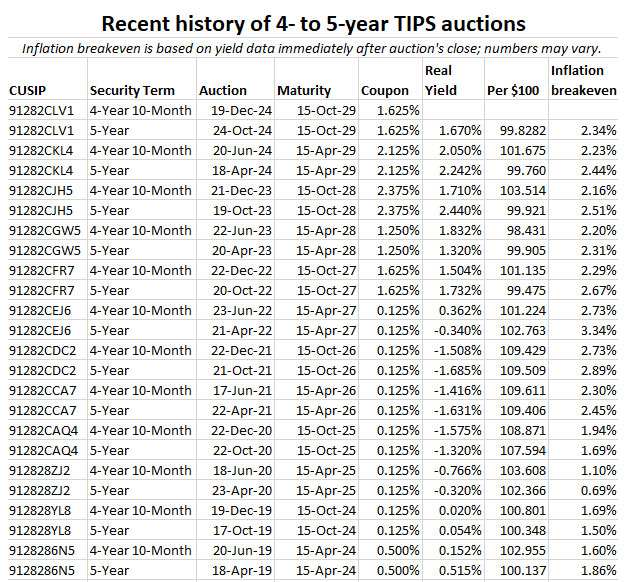
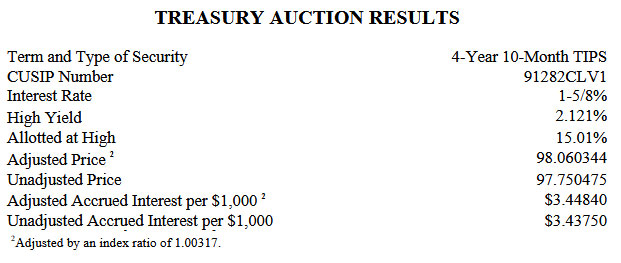
CUSIP 91282CLV1’s coupon rate of 1.625% was set by the originating auction on Oct. 24, which resulted in a real yield of just 1.670%, a remarkable 45 basis points lower than today’s result. Today’s auction got an unadjusted price of 97.750475. It also will carry an inflation index of 1.00317 on the settlement date of Dec. 31. With that information, we can calculate the cost of $10,000 par value at this auction:

  • Par value: $10,000.
  • Actual principal purchased: $10,000 x 1.00317 = $10,031.70
  • Cost of investment: $10,031.70 x 0.97750475 = $9,806.04
  • + Accrued interest of $34.48.

In summary, at investment of $10,000 par at this auction cost $9,806.04 for $10,031.70 principal on the settlement date of Dec. 31. After that, the investor will receive inflation accruals plus an annual coupon rate of 1.625% until maturity.

Inflation breakeven rate

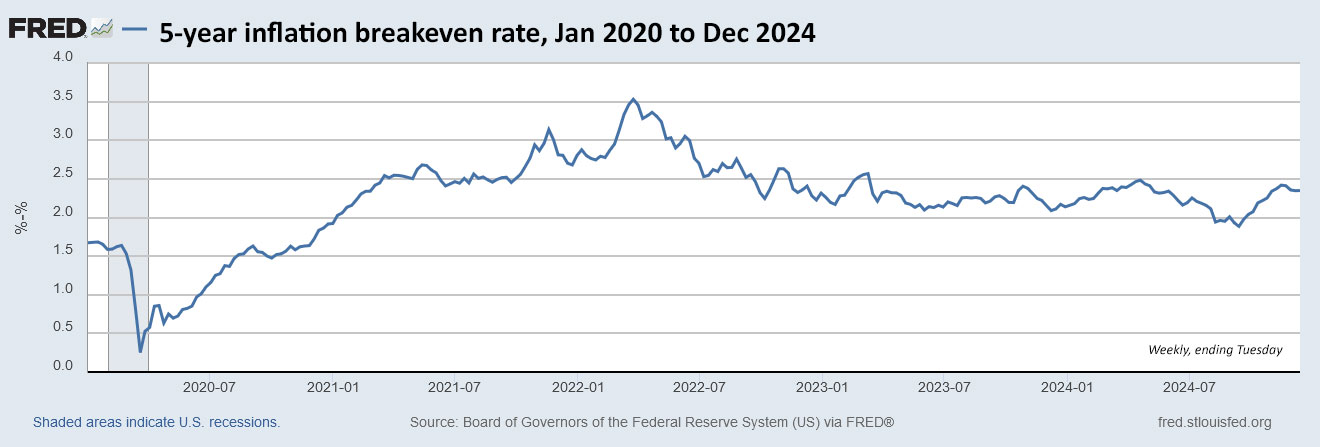
With a 5-year nominal Treasury note yielding 4.44% at the auction’s close, this TIPS gets an inflation breakeven rate of 2.32%, a bit lower than looked likely last week. This means it will outperform the 5-year T-note if inflation averages more than 2.32% over the next 4 years, 10 months.

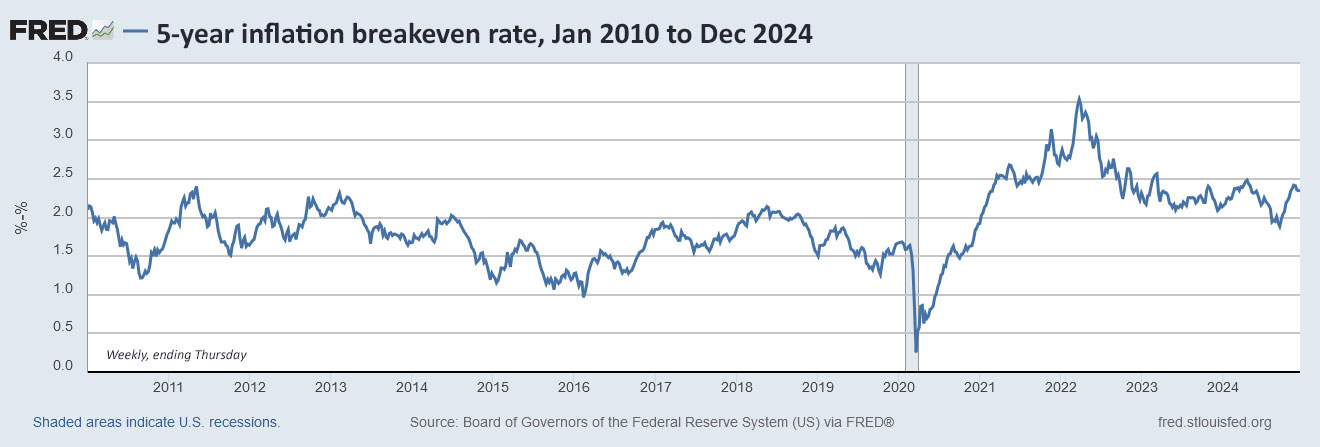
Here is the trend in the 5-year inflation breakeven rate over the last four years:

Click on image for larger version.

Reaction to the auction

The fact that demand was so weak is a stunner. It could be that investors were reacting to the Fed’s apparently renewed commitment to fighting inflation. The dip in the inflation breakeven rate backs that up. It could also be that nominal Treasurys are looking more attractive by comparison with yields in the 4.40% range.

This is from MarketWatch’s coverage posted after the auction close:

Thursday afternoon’s $22 billion sale of 5-year Treasury inflation-protected securities came in “very weak” with a tail of 6.7 basis points, according to BMO Capital Markets strategist Vail Hartman.

And here is a bit more blunt reaction from Bloomberg’s Cameron Crise, picked up from a tweet:

Buyers at this auction should be pleased. This is one where the auction ended up producing a better result than buying on the secondary market. The weak demand seems obviously related to uncertainty about future inflation and a potential hold in short-term interest rates.

And then, on top of all that, Congress is now struggling to avoid a government shutdown. Fun times, huh?

This was the last TIPS auction of 2024. The next auction will Jan. 23, 2025, with the unveiling of a new 10-year TIPS to mature in 2035. I plan to be a buyer of that one.

Now is an ideal time to build a TIPS ladder

Confused by TIPS? Read my Q&A on TIPS

TIPS in depth: Understand the language

TIPS on the secondary market: Things to consider

TIPS investor: Don’t over-think the threat of deflation

Upcoming schedule of TIPS auctions

* * *

Follow Tipswatch on X (Twitter) for updates on daily Treasury auctions and real yield trends (when I am not traveling).

Feel free to post comments or questions below. If it is your first-ever comment, it will have to wait for moderation. After that, your comments will automatically appear. Please stay on topic and avoid political tirades. NOTE: Comment threads can only be three responses deep. If you see that you cannot respond, create a new comment and reference the topic.

David Enna is a financial journalist, not a financial adviser. He is not selling or profiting from any investment discussed. I Bonds and TIPS are not “get rich” investments; they are best used for capital preservation and inflation protection. They can be purchased through the Treasury or other providers without fees, commissions or carrying charges. Please do your own research before investing.
Posted in Federal Reserve, Inflation, Investing in TIPS | Tagged , , , | 18 Comments

Rise in real yields (once again) makes 5-year TIPS auction look attractive

By David Enna, Tipswatch.com

Update, Thursday 1:35 p.m. ET: Weak demand results in real yield of 2.121% for 5-year TIPS reopening auction

Update, Wednesday 5:17 pm ET: The Federal Reserve’s mixed messaging on inflation (expected to be a bit higher next year) and interest rates (going ahead with some cuts, but fewer) caused a strong market reaction, sending both real and nominal yields higher. This TIPS, CUSIP 91282CLV1, closed Wednesday with a real yield of 2.03%.

This could be a temporary move and could revert lower in the morning. No way to know.

——————-

Just a week ago, I posted an article theorizing that real yields for Treasury Inflation-Protected Securities were beginning to crest, especially for shorter-term issues.

Note to readers: Sometimes I am wrong, especially when trying to pinpoint trends in real yields. In the last week, spurred by a too-high U.S. inflation report and fears of future rate “holds” from the Federal Reserve, both nominal and real yields have jumped higher.

This was even more true for nominal Treasurys. The yield on a 10-year Treasury note jumped from 4.19% on December 4 to 4.40% at the close Friday, an increase of 21 basis points.

All of this is leading up to Thursday’s reopening auction of CUSIP 91282CLV1, creating a 4-year, 10-month TIPS. Its coupon rate was set at 1.625% by the originating auction on October 24 and it closed Friday on the secondary market with a real yield of 1.83% and a price of 99.04.

Definition: The “real yield” of a TIPS is its yield above or below official future U.S. inflation, over the term of the TIPS. So a real yield of 1.83% means an investment in this TIPS would provide a return that exceeds U.S. inflation by 1.83% for 4 years, 10 months.

One semi-interesting fact about this auction: The Treasury set the size at $22 billion, which is the largest in history for a 5-year reopening. Last December, the auction size was $20 billion. Could these growing auction sizes eventually hold down demand? (Probably not, at this point.)

Here is the trend in the 5-year real yield over the last 14 years, showing that while yields have fallen off highs of October 2023, they remain attractive by the standards of the last decade-plus:

Click on image for larger version.

Pricing

If real yields hold at these higher levels, this TIPS reopening should get a price discount of about 1% to accrued principal. It will carry an inflation index of 1.00317 on the settlement date of December 31. All of this means it should end up auctioning at a price very close to, or below, par value.

Here is a look at a potential $10,000 par-value investment, based on Friday’s market close:

  • Par value: $10,000
  • Actual principal purchased: $10,000 x 1.00317 = $10,031.70
  • Cost of investment: $10,031.70 x 0.9904 = $9,935.40
  • + Accrued interest: About $34.45

In this scenario, which will change before the auction’s close, an investor would pay $9,935.40 for $10,031.70 of principal and then get inflation accruals for 4 years, 10 months, plus annual coupon payments of 1.625%, distributed in April and October. The cost of the accrued interest will be returned at the first semi-annual coupon payment on April 15.

There is no particular reason for an investor to wait for the Thursday auction to purchase CUSIP 91282CLV1. It could be purchased any time on the secondary market. The auction result could end up better, or worse, but the yield will be uncertain until the auction close. On the secondary market, you can buy when you find the yield attractive.

Inflation breakeven rate

With the 5-year nominal Treasury note closing Friday at 4.25% (pretty attractive, in my opinion) this TIPS currently has a rather-high inflation breakeven rate of 2.42%. However, annual inflation over the last 5 years has averaged 4.2% and over 10 years, 2.9%. So 2.42% doesn’t look unreasonable, and reflects market fears that U.S. inflation is proving to be “sticky” in this range of 2.5% or higher.

Here is the trend in the 5-year inflation breakeven rate over the last 14 years, showing that inflation expectations have fallen off in the last two years, but remain relatively high by historical standards:

Click on image for larger version.

I’ll remind you that the inflation breakeven rate is not a predictor of future inflation. It simply measures market sentiment by comparing nominal and real yields. However, if inflation did remain at 2.42% or higher over the next five years, I think we could expect a continued diet of relatively high Treasury yields. The Fed should not be easing if inflation remains elevated.

Thoughts

I won’t be a buyer this week because the 2029 rung of my TIPS ladder is fully loaded. But I think CUSIP 91282CLV1 looks like an attractive purchase if its real yield holds around 1.80%.

I hear from a lot of readers holding out to purchase TIPS with real yields higher than 2.0%, a number I often call “historically attractive.” Patience may pay off … or it won’t. Real yields are notoriously finicky. A real yield of 1.83% on a 5-year TIPS is attractive, and the maturity date is only 4 years, 10 months away.

On the other hand, if you want to balance off TIPS and I Bonds with some shorter-term nominal investments, a nominal yield of 4.25% on a 5-year Treasury note also looks attractive. I tend to prefer TIPS for terms of two years or longer, however, for the inflation protection over the longer term.

This TIPS auction closes Thursday at 1 p.m. EST. Non-competitive bids at TreasuryDirect must be placed by noon Thursday. If you are putting an order in through a brokerage, make sure to place your order Wednesday or very early Thursday, because brokers cut off auction orders before the noon deadline.

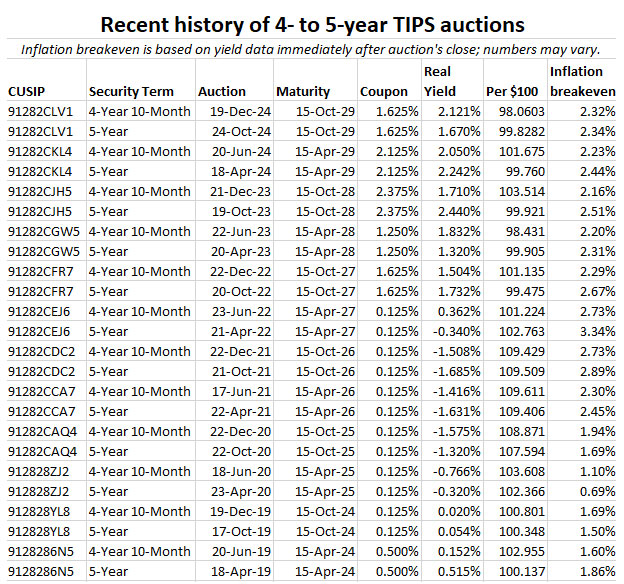
I will be posting the auction results soon after the close on Thursday. Here is a history of auction results for this term over the last 5 years:

Now is an ideal time to build a TIPS ladder

Confused by TIPS? Read my Q&A on TIPS

TIPS in depth: Understand the language

TIPS on the secondary market: Things to consider

TIPS investor: Don’t over-think the threat of deflation

Upcoming schedule of TIPS auctions

* * *

Follow Tipswatch on X (Twitter) for updates on daily Treasury auctions and real yield trends (when I am not traveling).

Feel free to post comments or questions below. If it is your first-ever comment, it will have to wait for moderation. After that, your comments will automatically appear. Please stay on topic and avoid political tirades. NOTE: Comment threads can only be three responses deep. If you see that you cannot respond, create a new comment and reference the topic.

David Enna is a financial journalist, not a financial adviser. He is not selling or profiting from any investment discussed. I Bonds and TIPS are not “get rich” investments; they are best used for capital preservation and inflation protection. They can be purchased through the Treasury or other providers without fees, commissions or carrying charges. Please do your own research before investing.
Posted in Bank CDs, Inflation, Investing in TIPS, TreasuryDirect | Tagged , , , , | 28 Comments

Treasury is ending its Payroll Savings Plan for purchasing savings bonds

By David Enna, Tipswatch.com

I was alerted by a reader yesterday about an email sent from TreasuryDirect informing him that it is “discontinuing the ability” to fund savings bond purchases through payroll deductions.

Of course, the Treasury didn’t make this easy to understand. Technically, it said Treasury is ending payroll contributions to its zero-interest Certificate of Indebtedness (C of I) account, which is then used to buy savings bonds at regular intervals.

The email said:

As of January 31, 2025, TreasuryDirect customers will no longer be able to fund C of I from their paycheck. Contact your payroll provider to stop electronic deposits before January 31, 2025. After this date, any deposits to your C of I will be rejected.

The email links to TreasuryDirect user guide sections 301 to 310, which give “clarification” for this change. These instructions, naturally, are quite dense and mysterious, as is common with communications from TreasuryDirect. From User Guide 307:

The Payroll Zero-Percent Certificate of Indebtedness (Payroll C of I) is a Treasury security that does not earn any interest. It was previously intended to be used as a source of funds for purchasing Series EE and Series I Savings Bonds through the Payroll Savings Plan in TreasuryDirect, which will be discontinued on January 31, 2025.

The Payroll Savings Plan will be discontinued on January 31, 2025. You must contact your employer (payroll office) to have your payroll allotment/direct deposit stopped.

Rewriting history

The history of the payroll deduction program dates back at least to 1942, when the Treasury approved use of payroll deductions for the purchase of War Bonds. This later became known as the Payroll Savings Plan.

TreasuryDirect has a page providing a history of its Payroll Savings plan, noting that “In the minds of millions of Americans who grew up from the 1940’s through the 1990’s, savings bonds and payroll savings are synonymous. Many have never bought a bond in any other way.” But …

Payroll savings began a long decline in the 1980’s, as markets changed, and new financial products were created and began to be offered by employers. Products including 401(k) plans and employee stock option plans, both designed to help employees save for their futures as defined benefit retirement plans, gradually became the rule rather than the exception among large employers. These plans were more attractive to many employees, despite being less liquid.

In early 2003, Congress ended funding for the marketing of savings bonds, accelerating a previously slow decline for the payroll savings plan.

And then … “The payroll savings plan will be discontinued on January 31, 2025.”

And that means?

I suspect this is part of changes we will see in the savings bond program in the early months of 2025. I doubt the payroll-deduction plan is widely used anymore, so this may not affect many investors. Many employers, apparently, do not participate.

We know from recent “mysterious hints” from TreasuryDirect that changes could be coming to gift-box purchases of savings bonds, a purchase loophole that has been widely used in recent years as Series I Savings Bonds became attractive. And earlier this year, Treasury eliminated the ability to purchase paper savings bonds in lieu of a federal tax refund.

It seems odd that Treasury would eliminate the payroll-purchase program, which would appeal to ultra-small investors who might want to buy $100 lots of savings bonds at regular intervals. But, as I noted, this could be little used and a maintenance nightmare for the Treasury.

A lingering question would be: Is the zero-interest C of I being shut down completely? I doubt that, because this is where Treasury places funds with no known destination. This can happen when a user has incorrect banking information or no connected bank account. It is also where some investors briefly park money from maturing investments to await reinvestment.

And of course, some people are going to ask: Is Treasury preparing to close down the savings bond program entirely? I really don’t think so. That would be a disaster, because for many small-scale investors I Bonds are only easily accessible inflation-protected investment.

In addition, I Bonds and EE Bonds generally pay lower interest rates than most other Treasury investments, so the Treasury actually saves on borrowing costs by issuing savings bonds. Plus, actual payments to investors are usually deferred for many years.

As usual, Treasury could have done better with this communication. For example, it could have provided this information …

A simple alternative

If you were using the payroll deduction program and want to continue regular purchases of savings bonds, you can do this easily at TreasuryDirect.

  • First, log into your account and navigate to the “BuyDirect” page.
  • Select the savings bond you wish to purchase.
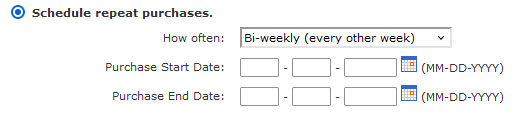
  • Then, in the “purchase frequency” section, set up repeat purchases. Options are weekly, biweekly, monthly, quarterly etc.

Reminder: Your total purchases for a calendar year can’t exceed the purchase limit of $10,000 per person per year.

Confused by I Bonds? Read my Q&A on I Bonds

Let’s ‘try’ to clarify how an I Bond’s interest is calculated

Inflation and I Bonds: Track the variable rate changes

I Bonds: Here’s a simple way to track current value

I Bond Manifesto: How this investment can work as an emergency fund

* * *

Follow Tipswatch on X (Twitter) for updates on daily Treasury auctions and real yield trends (when I am not traveling).

Feel free to post comments or questions below. If it is your first-ever comment, it will have to wait for moderation. After that, your comments will automatically appear. Please stay on topic and avoid political tirades. NOTE: Comment threads can only be three responses deep. If you see that you cannot respond, create a new comment and reference the topic.

David Enna is a financial journalist, not a financial adviser. He is not selling or profiting from any investment discussed. I Bonds and TIPS are not “get rich” investments; they are best used for capital preservation and inflation protection. They can be purchased through the Treasury or other providers without fees, commissions or carrying charges. Please do your own research before investing.
Posted in Cash alternatives, EE Bonds, I Bond, Investing in TIPS, TreasuryDirect | Tagged | 14 Comments