
Part B costs, deductibles and IRMAA surcharges will increase about 5.9% next year.
By David Enna, Tipswatch.com
Just a month ago, Social Security beneficiaries learned their benefits would rise by 2.5% starting in 2025, the lowest increase in four years. But the good news was that the increase slightly outpaced U.S. inflation up to that point, 2.4%.
And now, the bad news: The Centers for Medicare & Medicaid Services just announced that monthly costs for Medicare Part B premiums, annual deductible and IRMAA surcharges will rise by a much higher amount, about 5.9%, for 2025.
Any day now, if you are on Medicare, you will get a letter from CMS informing you of these new premium and deductible costs for 2025. If you planned poorly, you may be meeting up with IRMAA, the Income-Related Monthly Adjustment Amount. These surcharges can be lofty, so it’s smart to plan ahead to limit these costs.
Here is a summary of the price changes:
- The Part B deductible is rising 7.1% to $257.
- The Part B base monthly premium is rising 5.9% to $185.
- The IRMAA surcharge levels (for both Part B and Part D) are rising 5.9%.
- The IRMAA income tiers that trigger the surcharges are increasing at a lower rate, generally around 3%.

Let’s dive into the key Medicare changes for 2025.
Part A premium and deductible
Most people who reach age 65 go on Medicare Part A, even if they are still working. Medicare Part A covers inpatient hospital, skilled nursing facility and some home health care services. About 99% of Medicare beneficiaries do not have a Part A premium since they have at least 40 quarters of Medicare-covered employment.
Although coverage is generally free, Part A has some sizable deductibles and coinsurance costs, and those will be rising about 2.7% in 2025.

Keep in mind that most people on Medicare have a Medigap or Medicare Advantage plan that will cover all or most of the Part A deductible and coinsurance amounts. For example, all standardized Medicare Supplement (Medigap) plans, A through N, provide coverage for Part A coinsurance, and most also cover all or most of the Part A deductible costs.
Part B: Medical insurance
Medicare Part B can be described as covering “outpatient services,” things like doctor visits, some lab tests, an annual wellness exam, diabetes screenings, etc. Medicare Part B generally pays 80% of approved costs of covered services, and you pay the other 20%. Some services, like flu shots, Covid vaccines and a wellness visit, may cost you nothing.
Part B deductible. Before Medicare pays anything, you have to meet your Part B deductible each year. The annual deductible for all Medicare Part B beneficiaries will be $257 in 2025, an increase of 7.1% over the annual deductible of $240 in 2024. As of January 2020, Medigap plans sold to new enrollees were not allowed to cover the Part B deductible. But once the deductible is met, Medicare and Medigap plans will cover some or all of your Part B costs.
Part B premium. The standard monthly premium for Medicare Part B enrollees will be $185.00 for 2025, an increase of $10.10 from $174.90 in 2024. This Part B premium is paid by all people on original Medicare and is incorporated into Medicare Advantage pricing, which may or may not result in a baseline monthly cost.
So, for most people on original Medicare, Medicare Part B is going to cost $185 a month for the premium, plus the cost of the $257 deductible. That’s a total cost of $2,477 a year, up about 6% from this year’s costs.
And then … IRMAA
Since 2007, a beneficiary’s Part B monthly premium is based on reported income, known as MAGI, or modified adjusted gross income. According to the Social Security Administration handbook, for Medicare’s purposes MAGI is adjusted gross income (line 11 of your 2023 federal income tax form) plus tax-exempt interest.
Note that I mentioned your 2023 income tax return. That’s the one you filed earlier this year and now, in November, CMS announced the IRMAA surcharge brackets applied to that 2023 return. In other words, you could not know the surcharge levels until after the fact. And this is a rather brutal surcharge, because going just $1 over any limit can trigger thousands of dollars of one-year costs.
CMS says about 8% of people on Medicare pay these surcharges, up from 7% a year ago. It’s important to note that people on Medicare Advantage plans continue to pay the Part B premium, and are also subject to the IRMAA surcharges. And keep in mind that for a couple, the costs are doubled because each person pays the surcharge.
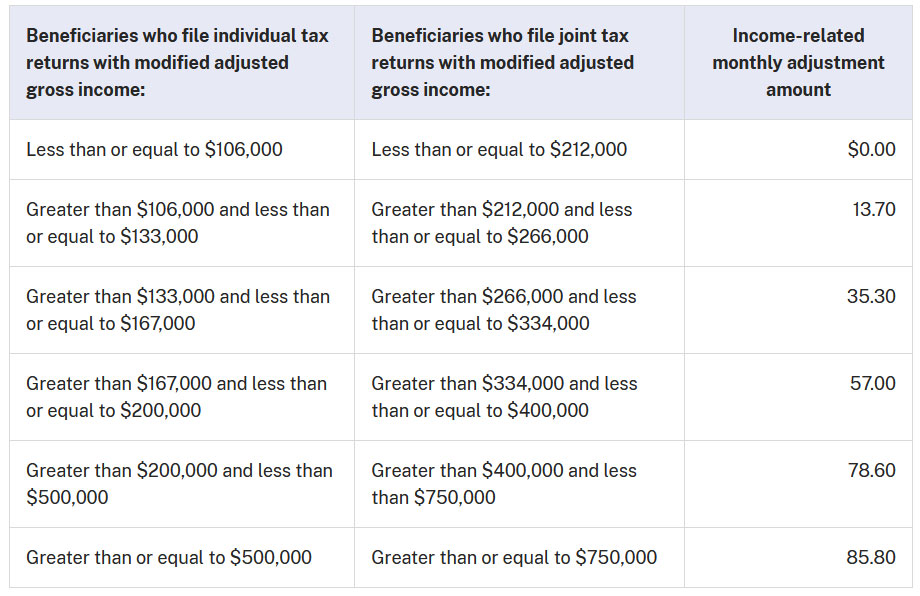
Part B. Here are the 2025 Part B total premiums and surcharges for high-income beneficiaries, which apply to income reported on your 2023 tax return:

Annual income of $212,000+ for a couple may sound like a lot, but the lower IRMAA levels can easily be reached through Roth conversions, stock sales to fund a major purchase, a new pension starting up, etc. Be aware of the potential to trigger the IRMAA surcharges and plan around that possibility.
Part D. Medicare income-related surcharges also apply to Part D, the drug program which is offered by private insurers working with Medicare. Part D premiums vary by plan, but the Part D surcharges are deducted from Social Security benefit checks or paid directly to Medicare.
People in Medicare Advantage plans don’t pay a separate Part D premium, since those plans include Medicare Advantage Prescription Drug (MAPD) coverage. But Part D is built into Medicare Advantage, and the IRMAA surcharge still applies.
Be aware of IRMAA
If you are just a couple years away from going on Medicare, it’s a great idea to plan your total income for this year to avoid triggering IRMAA surcharges two years later. The surcharges last only one year and then get reset the next year. The costs can be substantial for people hitting the top IRMAA tiers.

And I repeat: When you filed your federal tax return in early 2024 for the 2023 tax year you could not know what these IRMAA brackets or surcharges would be. They were just announced on Nov. 8. They are called the “2025 IRMAA levels” but apply to your 2023 tax return.
When you file your 2024 return next year, realize that you won’t know the relevant IRMAA levels until October or November 2025, many months after you have filed. Your only option is to use the 2024 numbers as a guideline. It’s a crazy system.
You can appeal an IRMAA ruling
The Social Security Administration has very specific rules that will allow you to get a waiver of the IRMAA surcharge, if you meet certain criteria for a “life-changing event,” which include:
- Work stoppage
- Work reduction
- Employer settlement payment
- Death of spouse
- Divorce
- Loss of pension income
You’ll need to fill out IRS Form SSA-44 to request the waiver.
Final thoughts
It isn’t unusual, unfortunately, for Medicare costs to be rising at a faster pace than the Social Security COLA. From a recent USA Today report:
2025 isn’t an outlier. Medicare Part B premiums have been rising faster than COLA for years, data show, which is part of the reason many seniors have been struggling. From 2005 to 2024, Part B premiums increased on average by 5.5% per year, while COLAs averaged less than half that rate at just 2.6%.
In 2025, the typical Social Security recipient will receive about $588 more because of the increase in the COLA. For a typical person on Medicare, avoiding IRMAA, costs of the Part B premium and deductible will increase about $140 next year. So for the average person nearly a quarter of the COLA increase will be snatched back by higher Medicare costs.
Also, other Medicare costs are likely to rise. The cost of our Part G supplemental plan increased 13% earlier this year, and some increase is likely again in 2025.
However …
Sometimes I feel the need to remind younger people: “Medicare is not free.” There are expenses and I am fortunate to say that — so far — my payments into Medicare have been higher than the services I have received. That means I am healthy. I’ll take that trade any day.
Original Medicare with a good supplement is very good insurance and worth the cost. But … don’t pay more than you need to. Keep an eye on IRMAA.
* * *
Follow Tipswatch on X (Twitter) for updates on daily Treasury auctions and real yield trends (when I am not traveling).
Feel free to post comments or questions below. If it is your first-ever comment, it will have to wait for moderation. After that, your comments will automatically appear. Please stay on topic and avoid political tirades. NOTE: Comment threads can only be three responses deep. If you see that you cannot respond, create a new comment and reference the topic.
David Enna is a financial journalist, not a financial adviser. He is not selling or profiting from any investment discussed. I Bonds and TIPS are not “get rich” investments; they are best used for capital preservation and inflation protection. They can be purchased through the Treasury or other providers without fees, commissions or carrying charges. Please do your own research before investing.





 Treasury Inflation-Protected Securities
I worked for Lockheed Martin in the '90s. They practically forced us to buy Ibonds (as a payroll deduction) to…