10-year TIPS reopening auction gets real yield of 2.184%, highest since 2009

By David Enna, Tipswatch.com

Today’s 10-year reopening of CUSIP 91282CJY8 — a 9-year, 8-month Treasury Inflation-Protected Security — generated a surprisingly high real yield to maturity of 2.184%, the highest for this term at auction since January 2009.

The auction apparently drew weak demand, with a sub-par bid-to-cover ratio of 2.33. The “when-issued” auction prediction, released just before the close at 1 p.m. EDT, was 2.16%. Investors were not snapping this one up, and that meant a higher real yield than expected.

This TIPS trades on the secondary market, and around 8 a.m. today it was trading with a real yield to maturity of 2.08%. That secondary-market yield climbed to 2.15% just before the auction’s close.

Definition: A TIPS is an investment that pays a coupon rate well below that of other Treasury investments of the same term. But with a TIPS, the principal balance adjusts each month (usually up, but sometimes down) to match the current U.S. inflation rate. So, the “real yield to maturity” of a TIPS indicates how much an investor will earn above inflation each year until maturity.

For today’s investors, the weak demand meant that this TIPS will outperform official U.S. inflation by 2.184% over the next 9 years, 8 months. We haven’t seen an auctioned yield that high for this term since January 2009, when a 10-year originating auction got a real yield of 2.245%.

Here is the trend in market 10-year real yields over the last 15 years, showing the dramatic round-trip to yields surpassing 2.0%:

Pricing

CUSIP 91282CJY8 carries a coupon rate of 1.75% that was set by the January originating auction. Investors got an unadjusted price of 96.249477, which reflects the spread between the auctioned real yield and the coupon rate. In addition, this TIPS will carry an inflation index ratio of 1.01586 on the settlement date of May 31.

With this information, we can calculate the investment cost of purchasing $10,000 par of this TIPS at today’s auction:

  • Par value of investment: $10,000
  • Inflation index at settlement date: 1.01586
  • Accrued principal on settlement date: $10,158.60
  • Cost of investment: $10,158.60 x 0.96249477 = $9,777.60
  • + accrued interest of $66.91

In summary, an investor purchasing $10,000 par at this auction paid $9,777.60 for $10,158.60 of principal and will receive accruals matching inflation for the next 9 years, 8 months, plus an annual coupon rate of 1.75% on accrued principal.

Inflation breakeven rate

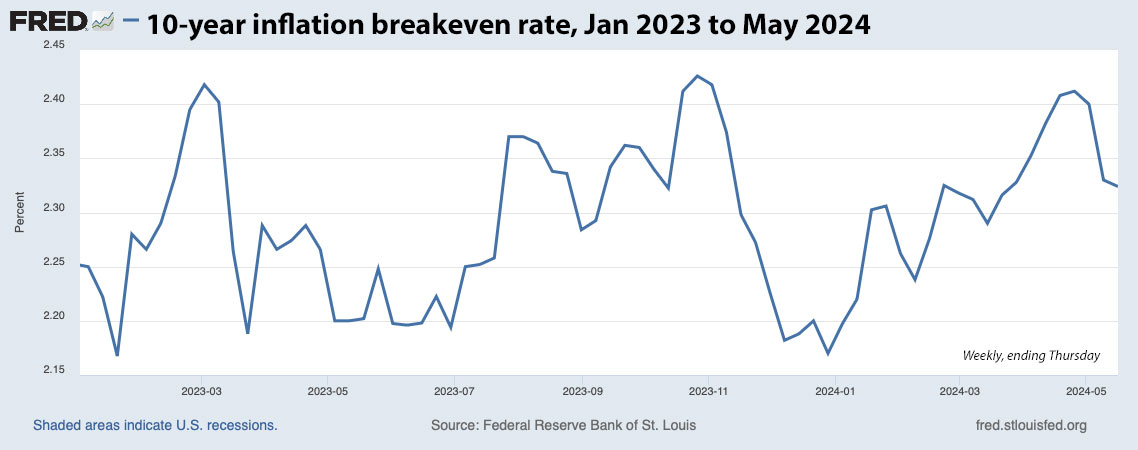
With the nominal 10-year Treasury note trading at 4.48% at the auction’s close, this TIPS gets an inflation breakeven rate of 2.30%, a bit lower than expected earlier today. It is significant to note that while the TIPS yield rose about 3 basis points at the auction’s close, the 10-year Treasury note held steady at 4.48%.

The breakeven rate is an indicator of investor expectations of inflation, but should not be considered an accurate predictor of future inflation.

Here is the trend in the 10-year inflation breakeven rate over the last 15 years, showing that today’s rate remains in the higher range, but well below the highs of early 2022.

Thoughts

I didn’t get a lot of feedback on my preview article for this auction, so I suspect there wasn’t a lot of reader interest. But the result was quite good for investors. Keep in mind that just five months ago, this TIPS originated with a real yield to maturity of 1.810%, 37 basis points below today’s result. That’s a big move.

From today’s Reuters report:

The Treasury’s $16 billion auction of 10-year Treasury Inflation-Protected Securities (TIPS) was poorly-received, suggesting investors expect price pressures will decline in the coming years. The high yield was 2.184%, higher than the expected rate at the bid deadline, which meant that investors demanded a premium to take down the note.

The bid-to-cover ratio, a gauge of demand, was 2.33, slightly lower than the previous auction’s 2.35, and the 2.40 average.

Were you an investor? What was your reaction?

Treasury will be auctioning a new 10-year TIPS on July 18. It will be interesting to watch how conditions change in the next two months.

Today’s auction closes out the history of CUSIP 91282CJY8, a TIPS that gave investors a solid first option for filling the 2034 rung of their investment ladders.

Now is an ideal time to build a TIPS ladder

Confused by TIPS? Read my Q&A on TIPS

TIPS in depth: Understand the language

TIPS on the secondary market: Things to consider

Upcoming schedule of TIPS auctions

* * *

Feel free to post comments or questions below. If it is your first-ever comment, it will have to wait for moderation. After that, your comments will automatically appear.Please stay on topic and avoid political tirades.

David Enna is a financial journalist, not a financial adviser. He is not selling or profiting from any investment discussed. I Bonds and TIPS are not “get rich” investments; they are best used for capital preservation and inflation protection. They can be purchased through the Treasury or other providers without fees, commissions or carrying charges. Please do your own research before investing.

Posted in Inflation, Investing in TIPS, Retirement | Tagged , , , , | 29 Comments

This week’s 10-year TIPS reopening auction looks attractive

By David Enna, Tipswatch.com

Real yields have had a bumpy ride over the last several weeks, but as things settle down, it looks like this week’s reopening auction of a 10-year Treasury Inflation-Protected Security could be a promising investment.

This is CUSIP 91282CJY8, and the auction will create a 9-year, 8-month TIPS. Here is the history of that TIPS, which also trades on the secondary market:

  • Jan. 18, 2024: The originating auction generated a real yield to maturity of 1.810% and set the coupon rate at 1.75%. The unadjusted price was 99.454975, reflecting the discount investors received because of the lower coupon rate.
  • March 21, 2024: The first reopening auction got a real yield to maturity of 1.932% and the unadjusted price for investors fell to 98.380142.
  • May 17, 2024: As I am writing this on Friday at 12:20 p.m. EDT, this TIPS is trading on the secondary market with a real yield of 2.09% and a price of 97.07.

So, as I noted, as we head toward Thursday’s auction conditions are looking promising. But there is one problem: Real yields have actually been falling in recent weeks, with the 10-year dropping from its 2024 high of 2.28% on April 30 to 2.07% at Thursday’s market close.

That 21-basis-point drop was triggered by a “fairly” positive inflation report for April, which for the first time in three months matched investor expectations. Real yields initially dipped and then rebounded a bit after that report.

Here is the trend in the 10-year real yield since January 2023, showing that yields remain relatively attractive despite the recent dip, but also well below the highs of October 2023:

Click on image for larger version.

Definition: A TIPS is an investment that pays a coupon rate well below that of other Treasury investments of the same term. But with a TIPS, the principal balance adjusts each month (usually up, but sometimes down) to match the current U.S. inflation rate. So, the “real yield to maturity” of a TIPS indicates how much an investor will earn above inflation each year until maturity.

Pricing

CUSIP 91282CJY8 is available to purchase at any time on the secondary market, so there is no compelling reason to wait until Thursday’s auction to pull the trigger on an investment.

The advantage of buying at auction, especially through TreasuryDirect, is that even small-lot purchases will get the auction’s high yield. The advantage of the secondary market is that you can see exactly the price and real yield you will be receiving. The negative is that you may face a small bid-ask spread. Most of the time, it doesn’t make a huge difference, but if you see a real yield you like, know that you can probably get it on the secondary market without dealing with the auction’s uncertainty.

As of Friday afternoon, this is how an auction purchase of $10,000 par of CUSIP 91282CJY8 would look (realize that conditions will change before Thursday’s auction):

  • Par amount: $10,000.
  • Inflation index on settlement date of May 31: 1.01586
  • Principal purchased: $10,158.60.
  • Price: 97.07
  • Cost of investment: $9,860.95.
  • + about $66.91 of accrued interest.

In this scenario, the investor would be paying $9,860.95 for $10,158.60 of principal and then will earn a coupon rate of 1.75% and principal accruals matching inflation for 9 years, 8 months.

Inflation breakeven rate

With a 10-year nominal Treasury note yielding 4.41% on Friday afternoon, this TIPS currently has an inflation breakeven rate of 2.32%, which is high by historical standards but seems about right in today’s elevated inflationary environment. A breakeven rate of 2.32% means that this TIPS would outperform the nominal Treasury if inflation averages more that 2.32% over 9 years, 8 months.

This chart shows the rather wild track of the 10-year inflation breakeven rate since January 2023:

Click on image for larger version.

Thoughts (from Portugal)

I am writing this Friday afternoon in Lamego, Portugal. It has been a beautiful day in the Douro Valley, with great food, wine and of course … port tastings. The people are friendly and the prices are at times amazingly cheap. I bought an excellent bottle of tawny port today at a vineyard for 8 Euros. “This price is ridiculous,” I said. The clerk said, “Everybody says that.”

Back to the TIPS …

I consider any real yield above 2.0% to be attractive, at least by standards of the last 15 years. Of course, real yields could climb higher, as they did in October 2023, or even dramatically higher if the Federal Reserve changes course toward higher rates. We can’t be sure, but collecting 2.0% above inflation is a positive thing, in my opinion.

Sanctuary of Our Lady of Remédios in Lamego, Portugal.

I won’t be a buyer at Thursday’s auction. Why? Because I already purchased this TIPS at the originating auction (real yield of 1.810%) in January and then again on April 4 on the secondary market (real yield of 2.043%). So I have now completed the 2034 tier of my TIPS ladder.

Thursday’s result could get a better real yield than either of my purchases, so … as I said … this auction remains attractive.

The TIPS auction closes Thursday at 1 p.m. EDT. Non-competitive bids at TreasuryDirect must be placed by noon Thursday. If you are putting an order in through a brokerage, make sure to place your order Wednesday or very early Thursday, because brokers cut off auction orders before the noon deadline.

You can check the current real yield for this TIPS on Bloomberg’s U.S. Yields page.

I should be back in the United States by Thursday, and I will be posting the auction results soon after the close. Here is a history of auction results for this term over the last 9 years:

Now is an ideal time to build a TIPS ladder

Confused by TIPS? Read my Q&A on TIPS

TIPS in depth: Understand the language

TIPS on the secondary market: Things to consider

Upcoming schedule of TIPS auctions

* * *

Feel free to post comments or questions below. If it is your first-ever comment, it will have to wait for moderation. After that, your comments will automatically appear.Please stay on topic and avoid political tirades.

David Enna is a financial journalist, not a financial adviser. He is not selling or profiting from any investment discussed. I Bonds and TIPS are not “get rich” investments; they are best used for capital preservation and inflation protection. They can be purchased through the Treasury or other providers without fees, commissions or carrying charges. Please do your own research before investing.

Posted in Federal Reserve, Inflation, Investing in TIPS, TreasuryDirect | 3 Comments

April inflation matches expectations; markets celebrate

Both all-items and core inflation increased 0.3% in April, as predicted.

By David Enna, Tipswatch.com

After three months of higher-than-expected inflation, U.S. prices in April increased on target, setting off a euphoric mood in the stock and bond markets.

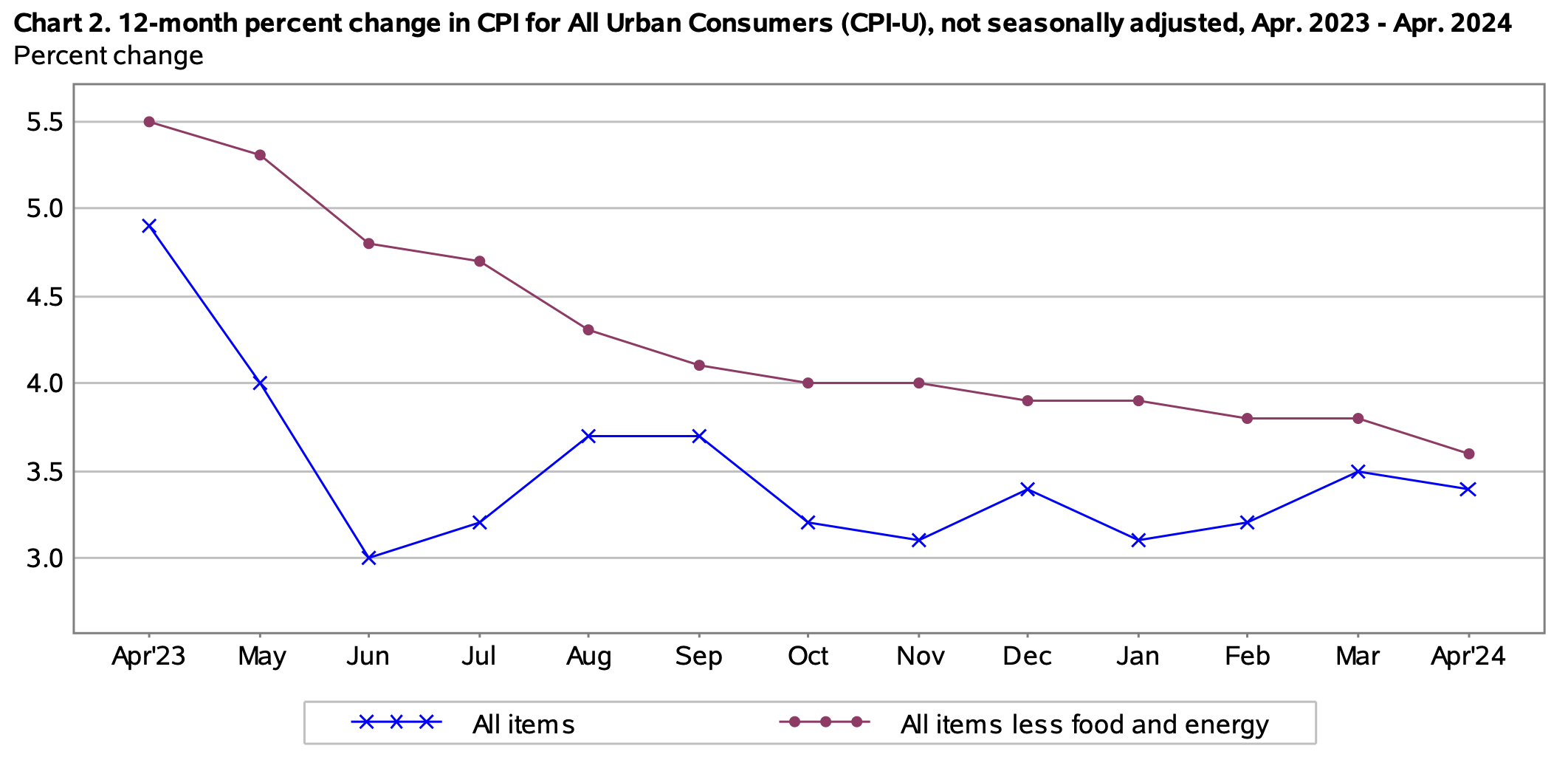
The Consumer Price Index for All Urban Consumers increased 0.3% in April on a seasonally adjusted basis, the U.S. Bureau of Labor Statistics reported today. Over the last 12 months, the all items index increased 3.4%. Those numbers exactly matched expectations.

Core inflation, which removes food and energy, also matched expectations, coming in at 0.3% for the month and 3.6% year over year.

For stock and bond markets, meeting expectations was just fine. By 11 a.m. EDT, the Standard & Poor 500 index was up about 0.85% for the day, and the total bond market was up about 0.57%. A lot of media headlines were putting a positive spin on the BLS report, noting that annual inflation dipped from 3.5% in March to 3.4% in April.

Of course, I could point out that all-items inflation had fallen to 3.1% in January, well below the current 3.4%. On the other hand, core inflation has been steadily declining since November 2023, and fell from 3.8% in March to 3.6% in April, a positive trend.

So, yes, overall this was a positive inflation report and one the markets needed to see. The BLS noted that increases in shelter costs (up 0.4% in April and 5.5% year over year) and gasoline prices (up 2.8% for the month but only 1.1% for the year) accounted for 70% of the all-items increase for April. More from the report:

  • The cost of food at home fell 0.2% in April and is up only 1.1% year over year. The overall food index was unchanged for the month.
  • Costs of used cars and trucks fell 1.4% for the month and are down 6.9% for the year.
  • New vehicle prices fell 0.4% for the month and year.
  • Costs for motor vehicle insurance increased 1.8% for the month and a whopping 22.6% over the last year.
  • Apparel costs increased 1.2% in April and are up 1.3% year over year.
  • The medical care index rose 0.4% in April after rising 0.5% in March.

What this means for TIPS and I Bonds

Investors in Treasury Inflation-Protected Securities and U.S. Series I Savings Bonds are also interested in non-seasonally-adjusted inflation, which is used to adjust principal balances on TIPS and set future interest rates for I Bonds. For April, the BLS set the CPI inflation index at 313.548, an increase of 0.39% over the March number.

For TIPS. The April inflation report means that principal balances for all TIPS will increase 0.39% in June, after rising 0.65% in May. Keep in mind that non-seasonally adjusted inflation tends to run higher that headline CPI from January to June, and then lower from July to December.

Here are the new June Inflation Indexes for all TIPS.

For I Bonds. The April inflation report is the first of a six-month string that will determine the I Bond’s new inflation-adjusted variable rate, which will be reset on November 1 based on inflation from April to September 2024. So far, for one month, inflation has increased 0.39%. We can’t make any assumptions from that single month. Here are the relevant data:

View historical information on my Inflation and I Bonds page.

What this means for future interest rates

The April report solidifies the Federal Reserve’s recent statements that short-term interest rates may not need to rise higher. And it probably could create momentum toward a cut in the federal funds rate later this summer. But it was just one month, and inflation came in “as expected,” still well above the Fed’s potential target of 2.0%. (The Fed more closely follows a different inflation index, Personal Consumption Expenditures, but can’t ignore a high rate of CPI.)

From today’s Bloomberg report:

While the figures may offer the Fed some hope that inflation is resuming its downward trend, officials will want to see additional readings to gain the confidence they need to start thinking about cutting interest rates. … “It does open the door to a potential rate cut later in the year,” said Kathy Jones, Charles Schwab’s chief fixed-income strategist. “It will take a few more readings indicating that inflation is coming down for the Fed to act.”

The report had an immediate effect on longer-term nominal and real yields, with the yield on a 10-year Treasury note falling about 9 basis points to 4.36% — far below the 4.65% reading at the beginning of May. The real yield on a 10-year TIPS fell about 7 basis points today to 2.05%.

* * *

Feel free to post comments or questions below. If it is your first-ever comment, it will have to wait for moderation. After that, your comments will automatically appear.Please stay on topic and avoid political tirades.

David Enna is a financial journalist, not a financial adviser. He is not selling or profiting from any investment discussed. I Bonds and TIPS are not “get rich” investments; they are best used for capital preservation and inflation protection. They can be purchased through the Treasury or other providers without fees, commissions or carrying charges. Please do your own research before investing.

Posted in Federal Reserve, I Bond, Inflation, Investing in TIPS, Savings Bond | Tagged , , , , | 5 Comments

My schedule … and what’s coming up

By David Enna, Tipswatch.com

No, we are not hiking El Camino de Santiago, but will walk on it a bit.

If you’ve been reading this Tipswatch site for long, you know what that headline means. I am traveling again. By the time you read this Tuesday morning, I will be somewhere in northern Spain.

And that means I will have an uncertain schedule and possibly awful Internet connections for the next two weeks. While I will try to check in on reader comments and financial news, expect my responses to be minimal.

Fortunately, we are heading into a fairly slow time for this site, since the I Bond’s fixed rate and composite rates were just set for the May to October cycle.

For certain, we can expect:

Wednesday, May 15: April CPI report. This will be issued at 8:30 a.m. Wednesday EDT, which equates to 2:30 p.m. in northwestern Spain. I am sure I will be out and about most of that day, but I will try to post a basic update in the evening. We’ll see. This report isn’t crucial, since it is the first of six that will determine the I Bond’s next fixed rate. But it could give the bond market the shivers.

Sunday, May 19, preview of 10-year TIPS auction. Because I can write this a day or two in advance, I should be able to post a preview Sunday morning on the 9-year, 8-month TIPS reopening auction set for May 23. It should be an attractive auction, but real yields have been volatile over the last week, dropping 10 basis points from Wednesday to Friday.

Thursday, May 23, 1 p.m., result of 10-year TIPS auction. If all goes well, I should be back in Charlotte by May 23 to post the auction results. Beware of jet-lagged conclusions, however.

There is an unfortunate tradition to my travels: They always seem to trigger some sort of financial crisis. It’s probably just my imagination. (And by the time I get home everything seems back to normal.) Let’s hope for calm days.

* * *

Feel free to post comments or questions below. If it is your first-ever comment, it will have to wait for moderation. After that, your comments will automatically appear.Please stay on topic and avoid political tirades.

David Enna is a financial journalist, not a financial adviser. He is not selling or profiting from any investment discussed. I Bonds and TIPS are not “get rich” investments; they are best used for capital preservation and inflation protection. They can be purchased through the Treasury or other providers without fees, commissions or carrying charges. Please do your own research before investing.

Posted in I Bond, Inflation, Investing in TIPS | 8 Comments

How much are your I Bonds actually earning?

By David Enna, Tipswatch.com

Last week, the Treasury set the fixed rate for I Bonds purchased from May to October 2024 at 1.3%, which combined with a variable rate of 2.96% results in a composite rate of 4.28% for six months.

As it turns out, that 4.28% composite rate also applies to I Bonds purchased from November 2023 to April 2024, because those also had a fixed rate of 1.3%. But what about I Bonds purchased in previous years, with fixed rates as low as 0.0%?

All I Bonds — no matter when they were purchased — will have the inflation-adjusted 2.96% variable rate applied for a full six months. The starting month depends on the original month of purchase, following this chart from TreasuryDirect:

For example: If you bought I Bonds in January 2024, that investment will earn a composite rate of 5.27% for six months, and then in July will begin earning 4.28% for six months. A purchase in April 2024 will earn 5.27% for six months, and then in October begin earning 4.28% for six months.

But what about those earlier I Bonds in your inventory, with much lower (or possibly higher) fixed rates? Any I Bond with a fixed rate of 0.0% is going to earn the variable rate, with no added fixed rate. So those will transition from earning the previous variable rate of 3.94% for six months to 2.96% for six months.

In this chart, I have compiled the new composite rates (which will roll into effect based on the original month of purchase) for all I Bonds back to November 2016, and then selected I Bonds with varying fixed rates back to May 1999. The chart also shows the current value of these I Bonds, assuming the I Bonds were purchased in the first month of each time period:

Note that the May 1 value shows total interest earned, ignoring the Treasury’s three-month penalty for redemptions before five years.

Thoughts

Because of the inflation protection built into I Bonds, earning 2.96% for six months isn’t a dreadful thing. Get over it! But … at a time when 4-week Treasury bills are yielding 5.47%, that 2.96% is looking weak. You can reach a similar conclusion with other low fixed rates:

  • A fixed rate of 0.10% will generate a composite rate of 3.06% for six months.
  • 0.20% = 3.16%
  • 0.30% = 3.26%
  • 0.40% = 3.37%
  • 0.50% = 3.47%
  • 0.70% = 3.67%

As I have written recently, this year I have redeemed 0.0% I Bonds to purchase the new 1.3% I Bonds, both in the traditional way in March and in gift-box swaps in April. I still have one set of 0.0% bonds remaining (from 2017) and a rather large collection of 0.1% fixed-rate I Bonds dating back to 2013.

At this point, I would not redeem any I Bond with a fixed rate of 0.2% or higher.

Also in the chart, notice the I Bonds issued from May to October 2007 with a fixed rate of 1.3%, same as today’s. Those I Bonds are very close to doubling in value in 17 years. They have generated a tax-deferred, annualized nominal return of 3.92% over a time when inflation averaged 2.4%. We can expect similar performance from these 2024 I Bonds.

My thinking: If market real yields remain high into the end of 2024, I will be looking to redeem — selectively — my remaining set of 0.0% I Bonds and some 0.1% versions to make gift-box purchases at 1.3%. I am in no rush to do this, because the 1.3% fixed rate will apply to all I Bond purchases through the end of October.

But what if real yields start declining, deeply? Then I will be definitely looking to make the swap to the 1.3% fixed rate because the November fixed-rate reset will be likely be lower than 1.3%.

At this point, there is no way to know. So just wait it out to October.

I am not a fan of stacking 10+ sets of gift-box swaps, because that will lock up the money for future distribution. One of the advantages of I Bonds is the ability to redeem after one year. But no one can redeem an I Bond that can’t be delivered because of the purchase cap.

Another option. If you are committed to redeeming low-fixed-rate I Bonds to buy the 1.3% version later this year, you could redeem now, place the proceeds in a money market account or in rolling 4-week T-bills earning 5.5% and then use that cash to buy the I Bonds in October, or possibly November.

You’d probably earn more than the 2.96% variable rate for several months. But there are two negatives to this strategy: 1) You will owe 2024 federal taxes on the interest earned, and 2) There is a slim chance that short-term yields could fall off sharply in the next few months.

Here’s a decent summary of the situation from CNBC, which includes (of course) a financial adviser telling you to sell your I Bonds:

If you need the money …

I keep stressing that the proper approach to I Bonds is to build a large reserve of inflation-protected, tax-deferred cash. At some point, you should start spending that money, either in retirement or to achieve other life goals. If you need the money, target the lower-fixed-rate I Bonds for the first redemptions.

Confused by I Bonds? Read my Q&A on I Bonds

Let’s ‘try’ to clarify how an I Bond’s interest is calculated

Inflation and I Bonds: Track the variable rate changes

I Bonds: Here’s a simple way to track current value

I Bond Manifesto: How this investment can work as an emergency fund

* * *

Feel free to post comments or questions below. If it is your first-ever comment, it will have to wait for moderation. After that, your comments will automatically appear.Please stay on topic and avoid political tirades.

David Enna is a financial journalist, not a financial adviser. He is not selling or profiting from any investment discussed. I Bonds and TIPS are not “get rich” investments; they are best used for capital preservation and inflation protection. They can be purchased through the Treasury or other providers without fees, commissions or carrying charges. Please do your own research before investing.
Posted in Cash alternatives, I Bond, Inflation, Retirement, TreasuryDirect | 29 Comments