May’s inflation report gives the Fed breathing room

Both all-items and core inflation came in below expectations.

By David Enna, Tipswatch.com

The Federal Reserve, which is set to provide future rate predictions this afternoon, got a bit of good news this morning from the May inflation report. Inflation came in below expectations, across the board.

The Consumer Price Index for All Urban Consumers was unchanged in May on a seasonally adjusted basis, the U.S. Bureau of Labor Statistics reported. Over the last 12 months, the all-items index increased 3.3%. Both of these numbers came in lower than the expectations for 0.1% monthly and 3.4% annual.

Core inflation, which removes food and energy, also fell below expectations, rising 0.2% for the month and 3.4% year-over-year. Annual core inflation, while still too high, has now fallen from 5.3% in May 2023 to 3.4% in May 2024, a very encouraging trend.

The BLS pointed to two key factors in the May report: Gasoline prices fell 3.6% for the month and are now up 2.2% year-over-year. That was offset by a continuing increase in shelter costs, up 0.4% for the month and 5.4% year-over-year. More data from the report:

  • The costs of food at home were unchanged in May and are up only 1.0% for the year.
  • The medical care index rose 0.5% in May after rising 0.4% in April.
  • Costs of prescription drugs rose 2.1% for the month.
  • Airline fares fell 3.6% in May and are down 5.9% for the year.
  • Costs for used cars and trucks rose 0.6% but are down 9.3% year over year.
  • Costs for new vehicles fell 0.5% and are down 0.8% for the year.
  • Apparel costs fell 0.3% for the month.
  • Costs of motor vehicle insurance fell a meager 0.1% for the month, but are up 20.3% for the year.

Here is the one-year trend for annual all-items and core inflation, showing how core inflation has finally begun falling from levels near 4.0%:

What this means for TIPS and I Bonds

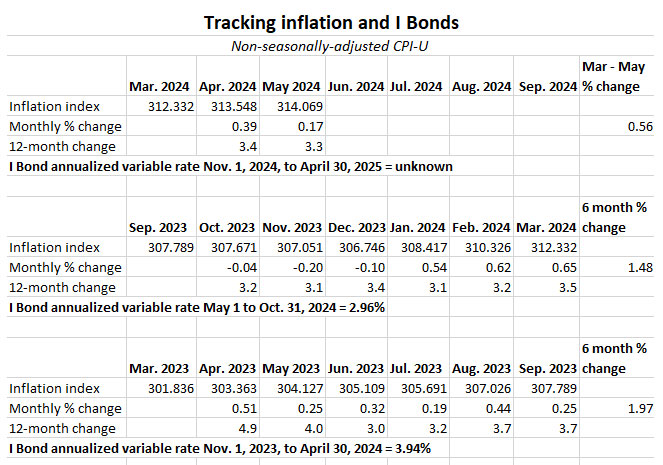
Investors in Treasury Inflation-Protected Securities and U.S. Series I Savings Bonds are also interested in non-seasonally adjusted inflation, which is used to adjust principal balances on TIPS and set future interest rates for I Bonds. For May, the BLS set the inflation index at 314.069, an increase of 0.17% over the April number.

For TIPS. The May CPI index will reset principal balances for all TIPS higher by 0.17% in July, after rising 0.39% in June. Keep in mind that non-seasonal inflation tends to run higher than headline CPI from January to June, and then lower at the end of the year. Eventually, over a year, the numbers balance out.

Here are the new July Inflation Indexes for all TIPS.

For I Bonds. The May report is the second in a six-month string that will set the I Bond’s new inflation-adjusted variable rate, which will be reset on November 1 and eventually roll into effect for all I Bonds. At this point, after two months, inflation has increased 0.56%. It is too early to draw any conclusions, but note that in 2023 March to May inflation increased 0.76%.

Here are the relevant data:
Track historical data on my Inflation and I Bonds page.

What this means for future interest rates

Obviously, the Federal Reserve can breathe a sigh of relief, with inflation coming in below market expectations and annual core inflation falling 20 basis points. This is good news in the battle against U.S. inflation.

Does this mean we will get a rate cut this afternoon? That is highly unlikely, but here is Bloomberg’s headline this morning: “US CPI Report Opens Door to Multiple 2024 Fed Rate Cuts“. Selected quotes from the article:

The good news on inflation extended to the so-called “supercore” measure of core services less housing. On a monthly basis, the measure was negative (-0.04%) for the first time since late 2021.

The expectation at this point in markets will be that the Fed later today projects two rate cuts for 2024. If we only get one, that could see a negative reaction in Treasuries and stocks.

“A 0.2% monthly core CPI reading should be the base case for the balance of the year, especially as it looks more and more like the long-awaited slowdown in shelter costs will hit as soon as the next report.” (quote from Omair Sharif of Inflation Insights)

We are seeing an immediate effect on the markets, with the S&P 500 trading up about 1% this morning in the premarket, just minutes from the opening. Real yields have taken a sharp dip lower, with the 5-year falling from 2.16% at yesterday’s close to 2.08% this morning. The 10-year is at 2.05%, down from yesterday’s 2.12%.

Of course, we have seen a lot of head-fakes on U.S. inflation over the last four years. This time, the trend does look positive, but the Fed knows the battle must continue. Expect rate cuts to come at a measured, cautious pace.

* * *

Follow Tipswatch on X (Twitter) for updates on daily Treasury auctions and real yield trends (when I am not traveling).

Feel free to post comments or questions below. If it is your first-ever comment, it will have to wait for moderation. After that, your comments will automatically appear.Please stay on topic and avoid political tirades.

David Enna is a financial journalist, not a financial adviser. He is not selling or profiting from any investment discussed. I Bonds and TIPS are not “get rich” investments; they are best used for capital preservation and inflation protection. They can be purchased through the Treasury or other providers without fees, commissions or carrying charges. Please do your own research before investing.

Posted in Federal Reserve, Inflation, Investing in TIPS, Savings Bond | Tagged , , , , , , | 13 Comments

Real yields continue their wild ride

By David Enna, Tipswatch.com

If you follow me on Twitter (yes, I still call it Twitter), you might have seen a very recent (June 5) post observing that real yields appeared to be heading back below 2.0%, breaking a two-month trend.

Meaningful shift? I was wrong. That was just two market days ago, but things reversed rather dramatically in reaction to the May jobs report released Friday morning. The report was much more positive than expected, raising concerns that the Federal Reserve will now put off any rate cuts until 2025. From the UPI report:

Hiring accelerated in May as employers added a robust 272,000 jobs … Economists had estimated that 185,000 jobs were added last month, according to a Bloomberg survey. Average hourly pay rose 14 cents to $34.91, pushing up the yearly increase to 4.1%.

“These data are in no way supportive of an imminent move by the Fed to lower rates,” economist Rubeela Farooqi of High Frequency Economics wrote in a note to clients.

This report hit the bond market hard, with the the total bond market (BND ETF) falling 0.80% in one day. The TIP ETF, which holds the full range of maturities of Treasury Inflation-Protected Securities, fared even worse, down 0.82%. The Treasury’s estimate of the 10-year real yield rose 13 basis points in one day, to close Friday at 2.13%.

It’s been a crazy year so far for real yields, as summarized in this chart:

A year ago, on June 8, 2023, the 10-year real yield stood at 1.53%, a whopping 60 basis points lower than today’s 2.13%. At that time, the Fed was still one month away from its final rate increase. On July 26, 2023, it raised its federal funds rate target to 5.25% to 5.50%, where it remains today.

The 10-year real yield reached its 2023 high on Oct. 25 at 2.53% before gradually sliding to 1.74% to begin 2024. The market still hasn’t matched that high in 2024. Could it? A week ago, I had my doubts, but the apparently robust U.S. economy opens the door to higher yields.

At the same time, inflation seems to be weakening. The Cleveland Fed’s Inflation Nowcasting site is predicting CPI inflation of just 0.08% for May and 0.14% for June. U.S. gas prices have fallen nearly 7% since early April. The U.S. dollar strengthened Friday in reaction to the jobs report, plus rate cuts this week by the both European and Canadian central banks. A stronger dollar tends to hold down inflation.

Weaker inflation could give the Fed the opening it needs to cut interest rates later this summer, but then the fall national election begins looming. The Fed seems comfortable with holding rates at these levels for many months.

What does this mean?

This week’s boost in real yields opens another buying opportunity for people looking to build a ladder of TIPS to hold to maturity. Real yields are again solidly above 2.0%, a historically attractive level. And they could go higher. Who knows?

Here is a year-to-date chart of the net asset value of the TIP ETF, which holds the full range of maturities.

Net asset value does not include distributions. TIP has had a total return of 0.05% year-to-date.

This chart could be painful for investors looking for capital gains on their TIPS holdings. But for investors holding individual TIPS to maturity, market swings don’t matter. An investor in an individual TIPS today can earn 2.0%+ above inflation for the length of the term. Here is a look at assorted secondary-market offerings I found Saturday on Vanguard’s platform:

I set the search for maturities from 2029 to 2043 and there are a lot of interesting offerings — 19 in total –some with high coupons (and premium prices), some with low coupons (and discounted prices). All 19 have real yields above 2.0%.

Despite the yield swings, TIPS remain an attractive investment.

Now is an ideal time to build a TIPS ladder

Confused by TIPS? Read my Q&A on TIPS

TIPS in depth: Understand the language

TIPS on the secondary market: Things to consider

Upcoming schedule of TIPS auctions

* * *

Feel free to post comments or questions below. If it is your first-ever comment, it will have to wait for moderation. After that, your comments will automatically appear.Please stay on topic and avoid political tirades.

David Enna is a financial journalist, not a financial adviser. He is not selling or profiting from any investment discussed. I Bonds and TIPS are not “get rich” investments; they are best used for capital preservation and inflation protection. They can be purchased through the Treasury or other providers without fees, commissions or carrying charges. Please do your own research before investing.

Posted in Federal Reserve, Inflation, Investing in TIPS | Tagged , , , , , | 23 Comments

AllianceBernstein suggests a 60/30/10 portfolio to protect against inflation

Investment firm sees ‘higher and spikier’ inflation looming.

By David Enna, Tipswatch.com

AllianceBernstein, a global investment firm with about $725 billion in assets under management, is now advising its clients to replace the traditional 60% stocks / 40% bonds portfolio with a 60/30/10 model, with the 10% being allocated to inflation protection.

AllianceBernstein has its headquarters in Nashville and offices in 26 countries.

The strategy grew out of an April 2 report by two senior bond experts at the firm — Serena Zhou and AJ Rivers — who made the case that inflation protection in the form of Treasury Inflation-Protected Securities is now a “unique opportunity.”

As inflation recedes from recent cyclical highs, many investors are selling their holdings of inflation-protected securities. The result? Explicit inflation protection has become unusually cheap. Investors needing to boost their strategic allocations to inflation strategies may wish to take advantage of this opportunity—securing inexpensive “flood” insurance ahead of higher structural inflation over the coming decade.

The authors theorize that global economies are moving toward an era of “higher and spikier” inflation, triggered by three powerful forces:

  • Deglobalization, which leads to potential labor shortages, higher labor costs, and potential supply shortages.
  • Aging demographics, which also shrinks the labor pool.
  • Climate change, which could drive energy, transportation, insurance, food and other costs higher in the future.

The authors point out that in the last three years, U.S. consumers lost 16% of their purchasing power. While inflation seems to be easing in 2024, the dangers remain:

(W)e think it’s more likely that 2% becomes a lower bound for inflation, rather than a central-bank target. Indeed, it’s highly likely we’ve already entered this new regime … Yet even marginally higher inflation represents a key risk. For example, if inflation persists at just 2.8%, an unprotected investor will have lost 35% of purchasing power 15 years from today.

The authors note: “That’s why, in our view, the wisest defense against unexpected inflation is to maintain a strategic allocation to an active inflation strategy that includes explicit inflation protection in the form of TIPS.”

The price of protection

In the 27-year history of TIPS, the authors note, these securities have yielded an average of 90 basis points below GDP growth. Today, with real yields well above 2% across the TIPS maturity spectrum, TIPS have yields close to or above GDP growth predictions for the next decade.

In other words, TIPS are abnormally cheap today relative to long-term averages; they’re also cheap if inflation surprises to the upside in the near future; and they’re cheap given our expectations for higher long-term inflation over the next decade.

Click on image for larger version

The investment strategy

The authors suggest that investors should increase allocations to inflation protection.

In our analysis, a 10% allocation to inflation protection—for example, shifting from a typical 60/40 portfolio to a 60/30/10 allocation—may meaningfully improve risk-adjusted potential return under the new inflation regime.

Will that shift reduce investment returns? The authors theorize that it won’t and in fact could enhance returns. They suggest concentrating on shorter average duration to reduce interest-rate risk while retaining inflation protection. They conclude:

In our view, the right active inflation strategy should help investors beat inflation without sacrificing return. Between the low price of getting inflation protection today and the high cost of not having such insurance tomorrow, we believe the time is right to beat the inflationary tide.

The authors, unfortunately, then revert to “global investment firm” advice by suggesting backing up the TIPS holdings with high-yield bonds and emerging market debt. I am not a fan of that advice. Keep your bond allocation in safe investments and take risk elsewhere.

Thoughts

The AllianceBernstein authors raised an interesting point about real yields currently matching or potentially exceeding future GDP growth, which makes TIPS look like an under-priced investment. At the same time, investor interest is waning.

“Investors have been selling inflation protection in the mistaken belief that it’s no longer needed,” Rivers and Zhou wrote. Total net assets in this category have declined in each quarter from mid-2022 through March. In an interview with Barrons, Rivers noted that investors shouldn’t try to time inflation protection. From that article:

By buying TIPS “you’re getting a real yield of 2% plus any inflation accretion,” says Serena Zhou, portfolio manager for Fixed Income US Multi-Sector at AllianceBernstein. “If there are any unexpected inflation hikes, you are immunized from those spikes.”

Although my personal portfolio has only a 35% allocation to stocks, I have tried to achieve a 15% asset allocation in inflation protection. So my target would be more like 35% in stocks, 50% in bonds, CDs & cash, and 15% in I Bonds and individual TIPS held to maturity.

Over most of the past 13 years, attempting to build an inflation-protected allocation has been frustrating, with real yields often well below zero. That made I Bonds look super attractive with a fixed rate of only 0.0%. Today, the situation is reversed. Real yields are attractive. They could go higher, but today’s real yields are historically attractive.

My allocation is an outlier. For most people approaching or in retirement, this 60 / 30 / 10 recommendation from AllianceBernstein passes the “common sense” test. Placing 10% of your portfolio in TIPS and I Bonds is a quality recommendation for the cautious investor.

Now is an ideal time to build a TIPS ladder

Confused by TIPS? Read my Q&A on TIPS

TIPS in depth: Understand the language

TIPS on the secondary market: Things to consider

Upcoming schedule of TIPS auctions

* * *

Feel free to post comments or questions below. If it is your first-ever comment, it will have to wait for moderation. After that, your comments will automatically appear.Please stay on topic and avoid political tirades.

David Enna is a financial journalist, not a financial adviser. He is not selling or profiting from any investment discussed. I Bonds and TIPS are not “get rich” investments; they are best used for capital preservation and inflation protection. They can be purchased through the Treasury or other providers without fees, commissions or carrying charges. Please do your own research before investing.

Posted in Cash alternatives, Investing in TIPS, Retirement | Tagged , , , , , | 42 Comments

iShares launches its 2034 target-date TIPS ETF

By David Enna, Tipswatch.com

As I predicted might happen in a December article on this topic, Blackrock’s iShares division last week launched a unique ETF holding just one bond: CUSIP 91282CJY8, a 10-year TIPS that matures in January 2034.

The ticker is IBIK and the technical name is “iShares iBonds Oct 2034 Term TIPS ETF.” See the fact sheet here and download the prospectus here.

I’m not a fan of Blackrock using the term iBonds in the fund name, since this can easily cause confusion with U.S. Series I Savings Bonds, usually called I Bonds. But I am sure the Treasury won’t be filing a trademark lawsuit.

IBIK joins a collection of these defined-maturity, single-year TIPS funds, which begin maturing in October 2024 and now run through 2034 with the addition of IBIK.

As you can see, the iShares ETFs are extremely small funds, especially compared to giants like Schwab’s U.S. TIPS (SCHP) and Vanguard’s Short-Term TIPS (VTIP). The tiny daily volume numbers would seem to indicate that purchases of these funds would create a bid-ask spread. For IBIJ, for example, Blackrock sets the predicted premium/discount at 0.20%.

Later this year, IBIK will add a second 10-year TIPS, the new one set to be originated in a July 18 auction. And then in 2029 it will add two more, the two 5-year TIPS to be issued that year and maturing in 2034.

Analysis

Reminder: These funds are designed to be held to maturity and the asset value will rise and fall with market trends through maturity, just like any other bond fund.

Because the expense ratio is just 0.1%, I really have no problem with using these funds as an alternative to buying individual TIPS. You could quickly build out a ladder through 2034 in 15 to 30 minutes, assuming the small daily volume doesn’t create issues.

In addition, the limited span of maturities means these ETFs aren’t the total solution for building an inflation-protected ladder of investments to cover 20 to 30 years.

iShares says these ETFs are designed to mature like a bond, trade like a stock. It says: “Combine the defined maturity and regular income distribution characteristics of a bond with the transparency and tradability of a stock.”

As for investment objectives, iShares notes the ETFs could be used to achieve multiple objectives. “Use to seek inflation protection with U.S. TIPS, build a bond ladder, and manage interest rate risk.”

Is there a required minimum investment?

No. The minimum investment would be the cost of one share (around $24.78 for IBIK) plus any possible brokerage commission. There are no limits on redemptions. iShares notes there can be a bid/ask spread on purchases and sales. That seems especially likely for an ETF that trades at such a low volume. The iShares prospectus notes:

When the Fund’s size is small, the Fund may experience low trading
volume and wide bid/ask spreads. In addition, the Fund may face the risk of being delisted if the Fund does not meet certain conditions of the listing exchange.

Traders in individual TIPS face these same bid-ask issues and at times can have trouble buying or selling TIPS in small numbers. This new ETF resolves the small-lot issue, at least. You can buy as little as one share.

Income and inflation accrual distributions

One of the advantages of owning a TIPS to maturity is that inflation accruals continue to build over time, increasing the amount of principal and also increasing the semi-annual coupon payment as the principal increases. An individual TIPS gets the benefit of compounding, even though the coupon is distributed twice a year.

But one of the disadvantages of a TIPS is that if held in a taxable account, those inflation accruals are subject to “phantom” federal income taxes in the current year, even though they are not paid out. Plus, if your account is at TreasuryDirect, you will face the “dreaded 1099-OID,” the cryptic form reporting your taxable accruals.

The plus. These defined-maturity ETFs “fix” the OID issue because inflation accruals will be paid out in the current year, along with the coupon interest. (This is the same way traditional TIPS funds work). That distribution makes these iShares TIPS ETFs more attractive for holding in a taxable account, because it eliminates the phantom income problem.

I assume this also means your broker will provide a single 1099-DIV tax form covering both coupon payments and inflation accruals.

The minus. Distributing the inflation accruals in the current year means that at maturity you will be receiving only the original par value and final coupon payment, since all the inflation accruals would have been distributed.

So to get the full benefits of compounding and true inflation protection you would need to reinvest all inflation-accrual distributions back into these TIPS ETFs or another similar product. That could be a problem because of the very low volume. For example, Vanguard says this on reinvestments in general: “A security’s distributions will not be reinvested if the security has a low average daily trading volume.”

For example, financial author Allan Roth ran into a low-volume problem while building his ladder of these defined maturity ETFs:

I thought it would be a piece of cake to buy these, but I was wrong—at least on two of them. Using the Fidelity retail website, all went through except two. For IBIC and IBIF, I got error notifications that the share quantity I entered was greater than the maximum allowed.

How could buying fewer than 25 shares for about $900 be too high? I followed up with Fidelity and eventually found out I was violating Market Access Rules. Fidelity explained that the quantity I was buying was too high relative to the average volume over the past 90 days. They were eventually able to solve it for me, but I couldn’t buy the exact dollar amount I wanted.  

I suppose my best test-case solution would be to buy one of these funds in a Vanguard account and see if dividends will get reinvested. If anyone has experience with these, post your findings in the comments section.

Final thoughts

Will I be investing in this new ETF, IBIK? No, because I have already purchased CUSIP 91282CJY8 as part of my TIPS ladder, filling the 2034 rung. But I can see the appeal for investors looking for a simpler way to invest in TIPS, especially in a taxable account.

The expense ratio of 0.1% is very good, especially if you can make your trades commission-free. But I do warn against using these ETFs in an assets-under-management account, which could wipe out 1% to 2% of your annual earnings.

One other issue is the fact that these funds don’t offer true inflation protection over the long term, since they pay out the inflation accruals in the current year. That is great for people seeking cash flow. But an investor seeking inflation protection would need to figure out a way to reinvest distributions.

Now is an ideal time to build a TIPS ladder

Confused by TIPS? Read my Q&A on TIPS

TIPS in depth: Understand the language

TIPS on the secondary market: Things to consider

Upcoming schedule of TIPS auctions

* * *

Feel free to post comments or questions below. If it is your first-ever comment, it will have to wait for moderation. After that, your comments will automatically appear.Please stay on topic and avoid political tirades.

David Enna is a financial journalist, not a financial adviser. He is not selling or profiting from any investment discussed. I Bonds and TIPS are not “get rich” investments; they are best used for capital preservation and inflation protection. They can be purchased through the Treasury or other providers without fees, commissions or carrying charges. Please do your own research before investing

Posted in Cash alternatives, Inflation, Investing in TIPS, Retirement, TreasuryDirect | 21 Comments

Traveling in the endemic era

At times, it is not fun.

By David Enna, Tipswatch.com

“COVID is just a cold.”

This is how our Overseas Adventure Travel tour leader explained Europe’s (and most of the world’s) new attitude toward COVID-19. And it is a milestone in world travel, marking a dramatic change toward this now-endemic malady.

The theory is: Most people have been vaccinated. Many people have already had a bout or two with COVID. For most people, symptoms are cold-like — producing coughs, some aches and possibly a fever. Nothing too serious.

Face masks are now optional in almost all situations.

Travel policies vary from country to country, but in almost all European countries there is no need to prove you are vaccinated, wearing face masks is optional, testing for COVID is optional even if you have symptoms, and isolating is optional even if you do test positive. The European Centre for Disease Prevention and Control advises:

Travelers who develop any symptoms compatible with COVID-19 during or after travel should self-isolate and seek medical advice and test for SARS-CoV-2 to exclude a diagnosis of COVID-19.

Note the word “should.” This is not a requirement. The world is eager to bring back the flow of travelers and is transitioning to a “don’t ask / don’t tell” policy on COVID.

That is a massive change from the situation two years ago. I’ve been thinking back on our travel experiences since 2020 and realized how much things have transitioned as our fear of COVID lessens.

February 2020. During the very early days of COVID (when the U.S. probably had fewer than 100 reported cases), we traveled by boat up the Nile to Cairo. About halfway through the trip, a doctor suddenly appeared on board and hand-sanitizing stepped up. One of our travel friends was having difficulty breathing. We later learned that another Nile cruise ship — at the same ports at the same time with American travelers — had a huge outbreak of 70 cases.

We couldn’t travel overseas again for two years. But then we took off with a vengeance:

April 2022. We were with a group of 15 travelers in Sicily. To travel then you needed to 1) prove you had been vaccinated, 2) take a verified COVID test before departing and 3) take a verified COVID test before returning home. No one in our group had any symptoms of COVID. At the time, if our tour leader tested positive, he would have been banned from leading tours for one month.

May 2022. We traveled to the Czech Republic with an extension to Romania. Because of the combination of COVID and the outbreak of war in Ukraine, the main portion of the trip had only six travelers and the Romania portion, four. All the same rules applied. I can remember feeling very relieved when we tested negative for COVID in Bucharest so we could return home. No one had any symptoms of COVID.

Since June 2022, people traveling by air no longer need to provide a negative COVID test in order to enter the United States.

August 2022. This was a combination land-cruise ship experience on Viking. During the land portion (Fairbanks to Anchorage) we traveled by bus with 37 passengers. A few days in, I noticed a lot of people coughing (harshly) around us. My wife and I were wearing face masks on the bus, but many people weren’t.

To board the 900-passenger ship, you had to first test negative for COVID. Of the 37 people on our bus, 13 tested positive, including a friend we were traveling with. The 13 positive cases were sent to a hotel room and flew home the next day. No isolation was required (which wasn’t true in Canada at the time). At this point I realized that when you fly on a plane, you may be sitting next to a person with a known case of COVID.

My wife and I and our remaining friend (a doctor) boarded the Viking ship and took off. Within a couple days, we all tested positive for COVID, the first time for all of us. Symptoms were minor for us, but a bit worse for our friend. We all had come prepared with prescriptions of Paxlovid, which we began taking and isolating as much as possible. Within two days, my wife and I tested negative.

December 2022. We traveled with Overseas Adventure to Costa Rica. Travel rules had greatly eased by this point. Unfortunately, near the end of the trip, one of our travel group did get COVID and had to isolate for the remainder. So at this time, travel companies were still enforcing a five-day isolation period. The ailing person, however, flew home with the rest of us.

September 2023: We traveled in northern Greece, Albania and North Macedonia with a group of 16 that included 6 other family members. Midway through the trip, one of the cousins got COVID and he and his wife had to isolate for five days and then rejoined the trip, still wearing face masks and isolating at meals. Their rejoining caused almost-heated complaints from a couple of other travelers. But that was the policy, and the travel leader held to it.

And then … May 2024

We just returned from a 16-day trip through northern Spain and northern Portugal.

We did only the main portion of the trip, shown in center map.

As I noted earlier, European travel in 2024 is mostly “don’t ask / don’t tell” when it comes to COVID. On our trip, with 16 travelers, two arrived with active hacking coughs. By the end of the trip, that number grew to maybe 12. Face masks were not required, but my wife and I often wore them while on cross-country bus trips. Some others didn’t.

A few days before the end, my wife and I tested positive for COVID and so did at least six other people. But no testing was required and a couple travelers told us they saw no need to test <cough, cough, it’s just allergies>. I honestly think a dozen people ended up with COVID, and at least one person had more serious symptoms.

Everyone — COVID or not — flew home on the same day.

For me, the symptoms were minor — a very mild fever and a bit of congestion. My wife had a bad cough that continued for a week. We again had prepared with Paxlovid, which we began taking just before flying home. We are fine.

Final thoughts

This isn’t a travel blog, but I think this is valuable information for people who are planning overseas travel. At this point, the risks COVID presents to a vaccinated and healthy population are fairly minor … yes, more like a cold. But the risks remain.

Honestly, COVID has sapped some of the fun out of traveling. It’s not fun to travel by bus, surrounded by coughing people. It’s not fun to be constantly swapping face masks on and off and struggling to talk to people who hear only muffles.

On the other hand, this is a world we want to see and experience. So we will keep traveling. Advice:

Keep a helpful, positive spirit. If you know you are ailing, take steps to protect your fellow passengers.

Prepare for your travels by stocking up on COVID test kits and quality face masks. You may need neither, if you are lucky.

At least once a year, get a COVID vaccine booster. My most recent shot was Dec. 7, 2023. But we met a couple on this trip who were vaccinated two weeks before leaving and the husband got COVID (minor case).

Wear your face mask through the airport on your departure day and until everyone is boarded, ready for take off. That’s a pain, I know, but you do not want to get sick as you are leaving for this adventure.

If you are traveling by bus or car with people who are coughing, put on your face mask. If you are about to enter a very crowded, tight-space religious shrine …. er … skip it. Enjoy the outdoors.

If you can get a prescription to Paxlovid before you leave, do it. (Some doctors will do this; others won’t.) My doctor warned that it can have harsh side effects, but for me the only nasty effect is a lousy taste in my mouth, which remains today after my last dose Friday night.

Also, if comfort is a concern, consider traveling by river boat or a smaller cruise liner, which offer much better options for isolation and relaxation. The trade-off is losing some on-the-ground history and experiences. (There is no way I would take a 3,000-passenger cruise, however.)

Share this advice with anyone you know who is planning a trip overseas.

Happy holiday weekend, everyone.

* * *

Feel free to post comments or questions below. If it is your first-ever comment, it will have to wait for moderation. After that, your comments will automatically appear.Please stay on topic and avoid political tirades.

David Enna is a financial journalist, not a financial adviser. He is not selling or profiting from any investment discussed. I Bonds and TIPS are not “get rich” investments; they are best used for capital preservation and inflation protection. They can be purchased through the Treasury or other providers without fees, commissions or carrying charges. Please do your own research before investing.

Posted in Retirement | Tagged , , , , , | 42 Comments