I Bonds remain attractive, but when and why?
By David Enna, Tipswatch.com
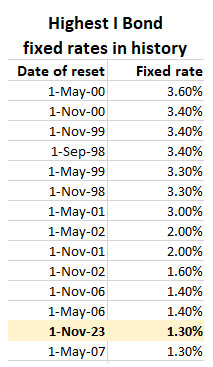
The I Bond’s new fixed rate of 1.3% — the highest in 16+ years — and the resulting composite rate of 5.27% should be creating a lot of investor interest over the next six months.
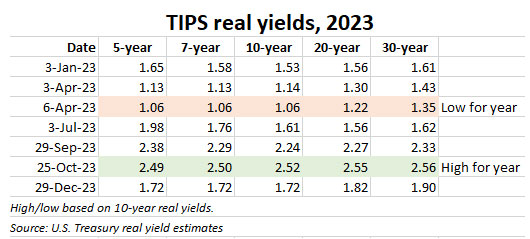
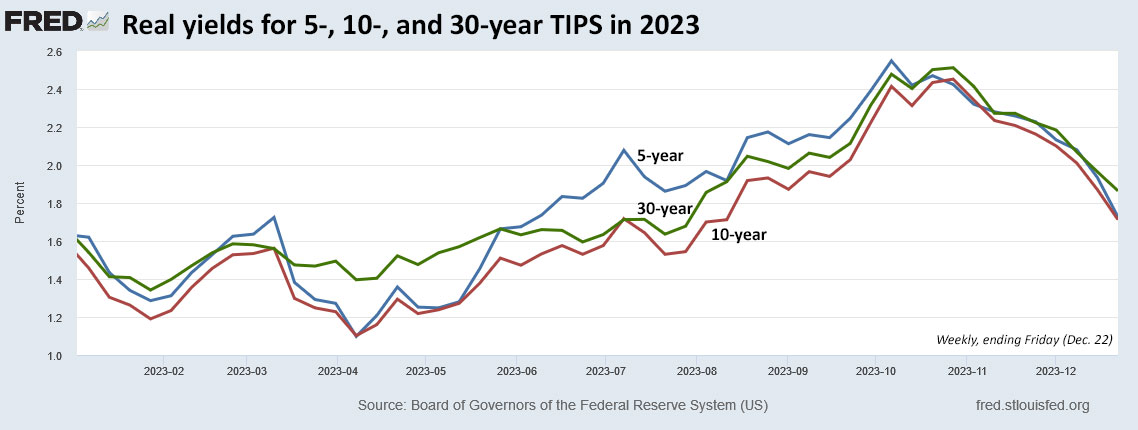
But maybe not, since this is the first time in “seems like forever” that there are a lot of very strong competitors to I Bonds — nominal Treasurys, money-market accounts, bank CDS and most notably Treasury Inflation-Protected Securities, with real yields of 2.17%+ across the maturity spectrum.
Still, there are many good reasons to invest in 1.3%-fixed-rate I Bonds through April 2024, and some reasons not to. My article on the new fixed rate generated 72 comments and climbing. Lots of opinions. Let’s discuss.
1. Short-term investors should stay away.
I am defining a short-term investor as someone looking to redeem after 12 to 18 months. The short-term play became huge last year when the I Bond was paying 9.62% annualized for six months and then 6.48% for six months. Investors poured in, causing TreasuryDirect to crash in late October 2022. At the time, a 1-year T-bill was paying about 4.5%, a much lower yield.
Today, even though an I Bond has a much more attractive fixed rate — 1.3% versus 0.0% — and a decent composite rate of 5.27%, I Bonds aren’t competitive with other safe short-term investments. First of all, that 5.27% yield lasts for only six months (the other six months are uncertain) and anyone redeeming after 12 months will lose 3 months of interest. So the resulting annual return — after the penalty — could be something like 3.7% to 4.0%.
Check the best-in-nation competition (with no withdrawal penalties):
- 1-year bank CD: about 5.75%
- Vanguard Treasury Money Market, VUSXX: 5.32%
- 1-year Treasury bill: 5.29%
- High-yield savings account: 5.25%
Short-term investors are looking for a good nominal return over the next 12 to 15 months. Inflation protection isn’t really a factor and so I Bonds aren’t the best investment for this purpose.
2. For long-term holders, I Bonds remain attractive.
The 1.3% fixed rate is something I Bond investors have been dreaming about for more than a decade, after accepting fixed rates of 0.2% or lower from May 2010 to November 2017. It’s true that TIPS have a higher real yield, but are also a more complex, market-shifting investment. I Bonds have many pluses for investors:
- First, I Bonds are probably the most conservative and most safe of all investments. Your principal will never decline, ever. If inflation falls to below zero, the inflation-adjusted rate will fall to zero, but not below zero.
- I Bonds protect you against unexpected inflation. If inflation in the next 30 years suddenly returns to 9%, your principal will increase by that amount because of the inflation-adjusted interest rate.
- I Bonds offer superior deflation protection versus TIPS, since the I Bond’s composite rate can never fall below 0.0%. So I Bonds lose no value during a deflationary stretch — unlike TIPS — and then get the full benefit of inflation rising from deflation.
- I Bonds have a flexible maturity. You can redeem them after one year, costing you three months of interest. Or redeem them after five years and pay no penalty, or just hold them for 30 years and cash out.
- I Bonds work like a stealth traditional IRA, allowing you to defer federal income taxes until you redeem them, so you pay zero in taxes until they are sold. This is a big advantage over TIPS. In addition, I Bond interest is always free of state income taxes, which isn’t true for TIPS held in a traditional IRA.
- I Bonds are simple to track as an investment. Use the web-based Savings Bond Calculator, update your information, and check it a couple times a year. Or use a site like EyeBonds.info to track current composite rates and principal balances.
So it is reasonable that a TIPS has a real yield advantage over an I Bond, given that its value shifts with market forces every day. I Bonds with a fixed rate of 1.3% are attractive.
3. Haven’t bought your full 2023 allocation yet? Do that by late December.
I am jealous. You are a patient and wise investor. The Treasury limits electronic I Bond purchases to $10,000 per person (or entity) per year, plus the possibility of $5,000 in paper I Bonds in lieu of a federal tax refund.
So, if you consider yourself an I Bond investor and you haven’t bought a full 2023 allocation, you should do that in late November (maybe Nov. 28) or late December (maybe Dec. 27). Never wait until the very last day of the month. Make sure to allow one — or better yet two — business days for TreasuryDirect to complete the purchase. You can schedule the exact purchase date inside the TreasuryDirect system.
It’s important to do this before the end of December because the $10,000 purchase limit for 2023 will switch to 2024 on January 1. If you make the purchase before the end of December, you can then make another full $10,000 purchase anytime in 2024.
4. DO NOT make gift-box purchases in 2023.
The Savings Bond Gift Box is a way of extending your purchases beyond the $10,000 limit by doing a swap with a trusted partner for delivery in a future year. Once you make the purchase, the I Bond begins earning interest just like any other I Bond. And you can make multiple sets of $10,000 purchases. But those I Bonds are no longer yours — they belong to the person getting the future gift.
Harry Sit of the TheFinanceBuff.com was the first to write about this strategy in December 2021, in an article titled “Buy I Bonds as a Gift: What Works and What Doesn’t.” When people ask me about the gift box, I point them to this article, which was well researched and thorough.
I have never used the gift-box strategy, because I thought it should be reserved for times when the I Bond’s permanent fixed rate is very high (not when the temporary variable rate is high).
So now is the time, with the fixed rate at 1.3? No, not exactly.
Anyone purchasing a traditional or gift-box I Bond through April 2024 is going to receive exactly the same return — a fixed rate of 1.3% and composite rate of 5.27% — for a full six months. So there is no reason to purchase this “extra allocation” in 2023, you can wait until after April 10, 2024, when the March 2024 inflation report is released. At that point you will know the I Bond’s new variable rate — to be reset May 1 — and have a better idea of the potential new fixed rate.
It makes no sense to rush a gift-box purchase. You have time.
5. Wait until at least April 2024 to purchase your 2024 allocation.
Again, no reason to rush this purchase. On April 10 you will know the I Bond’s next variable rate and we can speculate on the potential new fixed rate.
If real yields have risen dramatically by April, you might want to hold off on a purchase until after May 1 or even as late as mid-October, when we’ll know the variable rate to be reset on November 1.
If real yields have fallen dramatically by April, you’d want to purchase in late April to lock in that 1.3% fixed rate for the I Bond’s full term. And you also might want to consider gift-box purchases.
I won’t criticize people who buy I Bonds every January, no matter the fixed rate. That is a dedicated strategy. But for most people, waiting until at least mid-April will be the wisest move. And remember, in the meantime you can probably earn 5.0%+ on your cash.
6. Rolling over 0.0% I Bonds does make sense.
If you are holding I Bonds with 0.0% fixed rate — especially those held for five years or more — you can consider redeeming those older I Bonds for new ones with the 1.3% fixed rate. When you redeem, you will owe federal taxes on the interest earned.
If you are planning to redeem I Bonds held for less than five years, read this first: “The I Bond exit ramp is now open; proceed with caution“.
I think this is a sound strategy, especially if you don’t want to raise another $20,000 to buy I Bonds this year or next in two separate accounts.
7. I Bonds and TIPS are compatible investments
Anyone building a ladder of TIPS to provide reliable, inflation-protected money for retirement knows there is one sticky problem: There are no TIPS that mature in the years 2034 to 2039. I Bonds can be used to supplement your TIPS ladder, especially if you have a sizable allocation. I Bonds could fund your spending needs through those “gap” years.
Also, a ladder of maturing TIPS is a solid source of predictable future inflation-protected cash, but it won’t work well to meet “surprise” spending needs. Because of their flexible maturity and constant value, I Bonds are the best choice for your back-up emergency fund.
8. Don’t dump all your I Bond holdings
I have seen several comments from readers who plan to redeem almost all their I Bonds to purchase short-term Treasurys, which currently have a yield advantage. I am not a fan of this strategy. I Bonds held at least 5 years create an inflation-protected “savings account” that can be easily accessed, faces no reinvestment risk, and can never go down in value.
Why did you buy I Bonds in the first place? Probably for the inflation protection, safety and stability. I’d say all three of those factors — especially the inflation protection — are as important as ever right now.
My usual advice for years has been “don’t redeem I Bonds until you need the money.” That doesn’t mean holding to the 30-year maturity. It means using your I Bond holdings as a reserve cash account, to be used as needed.
So yes, I will probably redeem one set of 0.0% I Bonds to lock in the new 1.3% fixed rate in 2024, and possibly one more set for gift-box purchases. Otherwise, I will be holding all my stash of I Bonds.
Are you losing passion for I Bonds? Remember this: If we ever get to a period again of Federal Reserve intervention and ultra-low interest rates, an I Bond with a fixed rate of even 0.0% will continue to match inflation with zero chance of a loss.
• Confused by I Bonds? Read my Q&A on I Bonds
• Let’s ‘try’ to clarify how an I Bond’s interest is calculated
• Inflation and I Bonds: Track the variable rate changes
• I Bonds: Here’s a simple way to track current value
• I Bond Manifesto: How this investment can work as an emergency fund
* * *
Feel free to post comments or questions below. If it is your first-ever comment, it will have to wait for moderation. After that, your comments will automatically appear. Please stay on topic and avoid political tirades.
David Enna is a financial journalist, not a financial adviser. He is not selling or profiting from any investment discussed. I Bonds and TIPS are not “get rich” investments; they are best used for capital preservation and inflation protection. They can be purchased through the Treasury or other providers without fees, commissions or carrying charges. Please do your own research before investing.


Thank you! I will need to post something soon.