A Greek-Italian restaurant can tell you a lot about real world inflation

By David Enna, Tipswatch.com

Editor’s note: This is an updated version of an article I first wrote in 2017 and revised in 2021.

There’s a restaurant in my hometown – Charlotte, N.C. – that has been in business continuously at the same location on West Morehead Street since 1952. The restaurant business draws a notoriously fickle clientele, so that’s pretty remarkable.

The Open Kitchen was founded by Steve Kokenes, who was Greek, not Italian. His menu of pizza, lasagna, spaghetti and other “international” cuisine was a rarity for Charlotte in those days. The city didn’t get an authentic Italian restaurant – meaning, run by actual Italians – until the late 1980s. But that didn’t matter; the Open Kitchen specialized in simple, tasty comfort food and it prospered.

The restaurant expanded in the 1960s and 1970s. An interesting side note is that its location — once a dreary area of warehouses and factories — is now a booming area of modern apartments, art galleries, trendy breweries and “artisan” restaurants, very close to Bank of America Stadium. It’s now a very valuable piece of property. But the Open Kitchen is still there, still consistently serving “comfort food” to a loyal clientele.

The restaurant is still run by members of the Kokenes family, who wait tables and run the cash register. And they have a remarkable collection of Charlotte memorabilia displayed all over the walls. But what really caught my attention on a past visit was a 1963 menu posted by the entrance to the dining room. It’s especially interesting since today’s menu contains many of the same items – with exactly the same names – 59 years later. Aha! This offers a unique look into inflation over the last 59 years, and … what could be in store for our future.
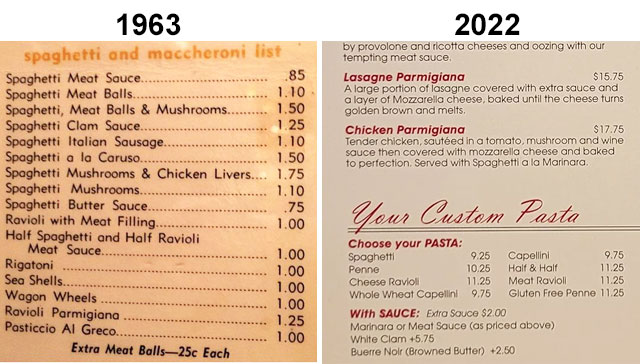
Full 2022 menu is here.

Where were you 59 years ago?

Back in 1963, $1 was worth … well, one dollar. And that is still true today. But adjusted for inflation (based on the Bureau of Labor Statistics’ Inflation Calculator) it takes $9.68 in today’s dollars (up from $8.89 last year, which is depressing) to equal the buying power of $1 in July 1963. That is an increase of 868%, and it is my baseline for comparisons of price changes from 1963 to today.
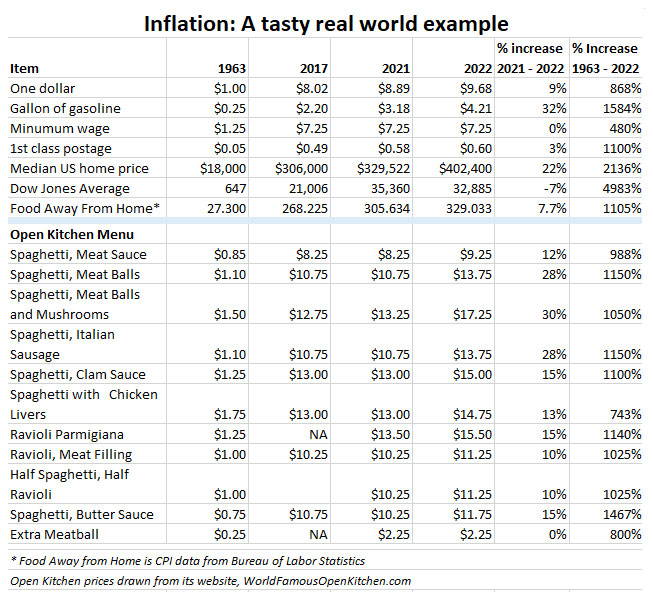
Anyone who drove a car before the 1973 gas crisis fondly remembers gasoline at 25 cents a gallon. That’s what it was selling for back in 1963. But in reality, gas prices until a couple years ago were as cheap (relatively speaking) as they were in 1963. However, even after dipping a bit this month, gas prices have almost doubled in the last five years and the cost of gasoline has now surged 1,584% since 1963, much higher than the rate of overall inflation.

And look at the median U.S. home sales price – $402,400 in 2022 – up 22% over the last year and 2,136% since 1963. Home prices have been running well above inflation. Same with the stock market, which has endured four bear markets in the last 22 years and yet is up 4,983% since 1963, nearly six times inflation.

At the same time, the U.S. minimum wage at $7.25 has lagged well behind inflation. At this point, I think, the minimum wage is an archaic idea that should be set to a realistic number ($15 an hour? $18?) and indexed to inflation, or simply abandoned.

The Open Kitchen: Then, and now

I included the Bureau of Labor Statistic’s Food Away From Home index in the chart, which should give you a realistic idea of restaurant price increases over the years. That index was up 7.7% in the last year and 1,105% over the last 59 years.

But the Open Kitchen is an interesting case study. When I did an update to this story last year, many of its prices were still very close to or the same as their 2017 levels. But in 2022, its typical prices have increased at a rate of 11% to 15%, more than the overall restaurant industry. That is realistic since it held prices close to stable from 2017 to 2021.

For example, Spaghetti with Meat Balls and Mushrooms (one of my favorite Open Kitchen offerings) costs $17.25 today versus $1.50 in 1963, a 1,050% increase that is very close to the overall Food At Home index increase of 1,105%. But the price popped up 30% in the last year, bringing it to a more realistic level, I assume.

There are a few bargains on the list: An extra meatball, for example, costs $2.25 today, same as last year, and 800% more than the 1963 cost of 25 cents. That 800% increase is lower than overall U.S. inflation and the Food at Home index. (Waiter: Extra meatball, please!)

Want the more exotic Ravioli Parmigiana? That will cost you 1,140% more than it did in 1963, and probably destroy any hope you had of maintaining your diet. Want half spaghetti, half ravioli? (Good choice.) That will cost you $11.25 and I’d say that’s a bargain, but the price is 1,025% higher than the 1963 cost. So, dang, not really a bargain.

One clear bargain is Spaghetti with Chicken Livers, which now goes for $14.75, versus a rather pricey $1.75 in 1963. That’s an increase of 743%, well below the rate of overall inflation. (This dish is now relegated to very fine print at the bottom of the current menu. Understandable.)

The Open Kitchen also offers a new dish, “Chicken Livers Greque,” with this awesome description:

Plump, juicy chicken livers sauteed in butter, delicately seasoned with oregano and lemon. Served with garden salad and French fries. ($15.50 … <up from $13.50 a year ago>)

I imagine that The Open Kitchen doesn’t sell a lot of Spaghetti with Chicken Livers or Chicken Livers Greque, but it’s a testament to their sense of tradition that they keep these on the menu.

A real world example, in our lifetimes

If you were alive in 1963 — I was 10 years old then — you and I have seen U.S. inflation rise 868% in the last 59 years. Gasoline costs are up more than 1,500%. A typical American home now goes for $402,000 versus $18,000 in 1963.

Inflation is an unrelenting force. I look at today’s Open Kitchen prices and my reaction is “perfectly reasonable.” But imagine if you saw these prices in 1968. You’d have been stunned. Now, imagine the prices you could be seeing in 20, 30, 40 years.

Inflation is dangerous. It’s a force that must be considered.

Another real world example
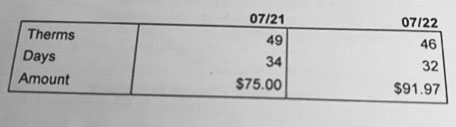
This week I received my natural gas bill for July. The cost was $91.97, which was 22.6% higher than the July 2021 bill. A year ago, in July 2021, we used more therms (49 vs. 46) and the bill was for more days (34 vs. 32), and even with that … the 2022 bill was 22.6% higher.

This is inflation. I can pay this bill. But a lot of people can’t handle a 22% increase in a basic cost of life.

Note: If you know young people who fail to understand and fear the force of inflation, please share this article with them. This all happened in our lifetimes. It will continue throughout their lifetimes.

* * *

Feel free to post comments or questions below. If it is your first-ever comment, it will have to wait for moderation. After that, your comments will automatically appear.

David Enna is a financial journalist, not a financial adviser. He is not selling or profiting from any investment discussed. The investments he discusses can be purchased through the Treasury or other providers without fees, commissions or carrying charges. Please do your own research before investing.

Posted in Inflation | 17 Comments

Confused by TIPS prices? Here’s a walk-through.

Yes, you can make sense of the complex pricing of Treasury Inflation-Protected Securities.

By David Enna, Tipswatch.com

Last week, I decided to buy $15,000 of the new 10-year Treasury Inflation-Protected Security — CUSIP 91282CEZ0 — being offered at auction by the U.S. Treasury. I was making this purchase in a Vanguard brokerage account (a traditional IRA), where I had set aside $15,095 in cash for the purchase.

The problem was: Would that $15,095 cover the cost, after any premium/discount to par value, plus any additional accrued principal and interest? The Treasury’s official announcement for the auction wasn’t much help, with all the important pricing details to be “Determined at Auction”:

So I did a quick calculation:

  1. I was buying $15,000 of par value.
  2. I knew the real yield to maturity would be at least 0.50%, because that was where the 10-year TIPS market was trading. That would mean the real yield would NOT be below the coupon rate, which only happens when the real yield is less than 0.125%.
  3. Therefore, this TIPS would be sold with at least a slight discount to par.
  4. But … this TIPS would have an inflation index of 1.00495 on the settlement date of July 29, so that would add to my purchased principal, and the cost, along with a small interest adjustment for 14 days of the coupon payment (from the July 15 issue date to the July 29 settlement date).
  5. So, I figured, the highest cost I would end up paying wound be about $15,000 x 1.00495 = $15,074. And I concluded that my $15,095 would cover the cost.

Let’s see what happened

The auction ended up producing a real yield to maturity of 0.630%, which then caused the Treasury to set the coupon rate at 0.625%. When a TIPS has a real yield of 0.125% or higher, the Treasury always sets the coupon rate to the 1/8% below the real yield … 0.125%, 0.250%, 0.375%, o.500%, 0.625% … and so on. A real yield of 0.630% gets a coupon rate of 0.625%, and the price is set at a very small discount to par. A real yield of 0.620% gets a coupon rate of 0.500%, and the price gets a bigger discount.

Here are the auction results, as reported by the Treasury in its official announcement:

So, what does this all mean — high yield, adjusted price, unadjusted price, adjusted accrued interest, index ratio — and how does it affect the price I paid?

The high yield becomes the TIPS’ official real yield to maturity in the auction records. It is the highest yield the Treasury had to grant to complete the $17 billion offering of this TIPS, and it is the real yield granted to all non-competitive bidders (that’s pretty much anyone putting in a purchase order at TreasuryDirect or through a brokerage).

After the auction was completed, Vanguard reported my cost for $15,000 of par value to be $15,070.55. What factors went into setting that price? Once the high yield was set, all the other pricing fell into place Let’s take a look:

Click on the image for a larger version.

The key factor in this chart is the unadjusted price, which was $99.9517 for $100 of par value, and that meant my core cost for the $15,000 in par value was $14,992.75.

But, because of the inflation index of 1.00495, I will be purchasing 14 days of inflation-adjusted additional principal on the settlement date of July 29. That raises my cost to $15,066.97.

In addition, I will have to pay for the 14 days of coupon rate interest that will have accumulated by July 29. Since the coupon rate is 0.625%, 14 days of interest would be about 0.0239%. That is why the adjusted accrued interest is set at $0.239 per $1,000 of par value. Since my accumulated principal will equal about $15,066.87 on July 29, my accrued interest is about $3.60.

And that sets the total cost of the investment: Inflation adjusted value + accrued interest. $15,066.87 + $3.60 = $15,070.57. (OK, Vanguard said it was 2 cents less. I’ll take it. Savings!)

The last line on that chart shows the total value of the investment on July 29, which is simply par value ($15,000) x the inflation index (1.00495) = $15,077.85. In this calculation, I am ignoring the coupon interest which will be paid out as current income twice a year. Also, don’t confuse “total value” with “market value.” Total value reflects only par value + inflation accruals. Market value adds in the fact that the price of a TIPS changes daily on the secondary market. If you are holding to maturity, you can more or less ignore market value.

Happy side note: The inflation index for this TIPS on Aug. 31 will be 1.01939, up 1.3% for the month because of the high rate of non-seasonally adjusted inflation in June. That will put its total value at $15,290.85. Not bad.

Conclusion

I hope this primer on TIPS pricing is helpful. The July 21 auction was an easy one because the real yield ended up just a hair above the coupon rate, making the unadjusted price very close to par. In the last two years that hasn’t be true, with negative real yields far below the lowest possible coupon rate of 0.125%. I am hoping we are entering a new era of positive real yields and much more sensible TIPS pricing.

* * *

Feel free to post comments or questions below. If it is your first-ever comment, it will have to wait for moderation. After that, your comments will automatically appear.

David Enna is a financial journalist, not a financial adviser. He is not selling or profiting from any investment discussed. The investments he discusses can be purchased through the Treasury or other providers without fees, commissions or carrying charges. Please do your own research before investing.

Posted in Investing in TIPS | 67 Comments

New 10-year TIPS gets real yield of 0.630% at auction, a nice result for investors

A weak bid-to-cover ratio of 2.18 indicates lousy demand from big-money investors.

By David Enna, Tipswatch.com

The Treasury’s offering of $17 billion in a new 10-year Treasury Inflation-Protected Security — CUSIP 91282CEZ0 — generated a real yield to maturity of 0.630% at auction Thursday, the highest yield at auction for this term in two years.

The coupon rate was set at 0.625%, the highest coupon for a new TIPS in three years. In fact, this auction broke a string of 15 consecutive auctions of 9- to 10-year TIPS with a coupon rate of 0.125%, the lowest the Treasury will go for a TIPS.

Definition: The “real yield” of a TIPS is its yield above or below official future U.S. inflation, over the term of the TIPS. So a real yield of 0.630% means an investment in this TIPS will exceed U.S. inflation by 0.630% for 10 years.

Investors in today’s auction should be pleased, because a surprise rate hike this morning by the European Central Bank had set both nominal and real yields sliding lower. Nothing drastic, but for much of the morning it looked like this auction’s real yield might dip below 0.60%. The bid-to-cover ratio was 2.18, a very low number and an indication that weak demand forced the real yield higher.

Because the Treasury set the coupon rate at 0.625%, slightly below the auctioned yield, investors paid an unadjusted price of about $99.95 for $100 of par value. However, because this TIPS will have an inflation index of 1.00495 on the settlement date of July 29, the adjusted price was about $100.45 for $100.49 of value, after the inflation accrual is added in.

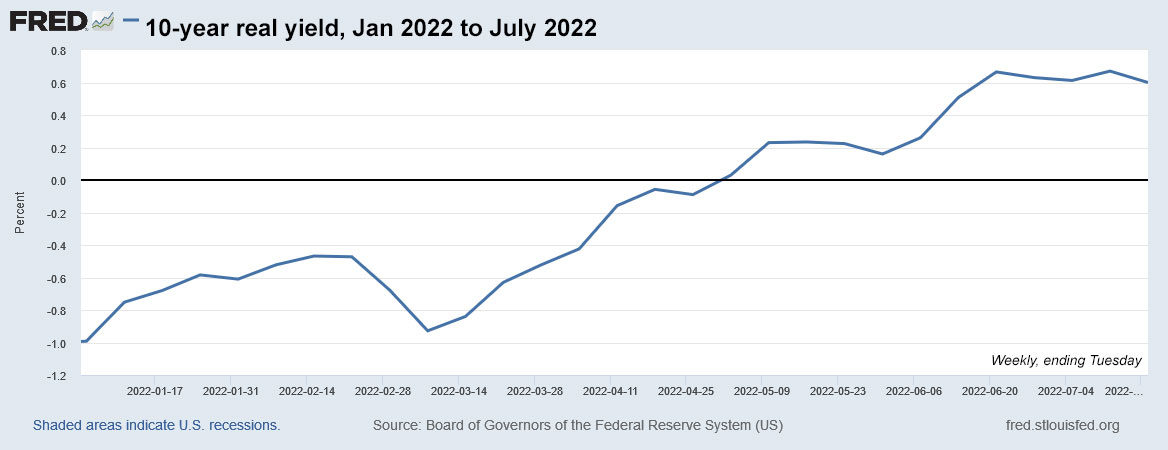
Here is the trend in 10-year real yields in 2022, showing the strong surge higher since the Federal Reserve committed to future rate hikes in March, in an effort to slow soaring U.S. inflation:

Inflation breakeven rate

With a 10-year nominal Treasury trading today with a yield of 2.96%, this TIPS gets an inflation breakeven rate of 2.33%, which looks like an attractive number. It means this TIPS will out-perform a nominal Treasury if inflation averages higher than 2.33% over the next 10 years.

U.S. inflation is currently running at an annual rate of 9.1%. While that number is expected to begin falling in future months, most experts agree it is likely to remain in the 4% to 5% range well into 2023, maybe higher. So again, this auction looks like a positive result for investors.

Here is the trend in the 10-year inflation breakeven rate through 2022, showing how inflation expectations have been falling in reaction to the Federal Reserve’s commitment to fight inflation:

Reaction to this auction

I was a buyer at today’s auction, so I was keeping my eye on TIPS trends through the morning. The European Central Bank’s surprise rate hike (the first in more than 10 years) did appear to roil the bond market, but the moves weren’t dramatic. One effect of the rate hike could be a stronger Euro and weaker dollar, which could slightly elevate inflation in the U.S., but also boost profits of U.S. corporations doing business in Europe.

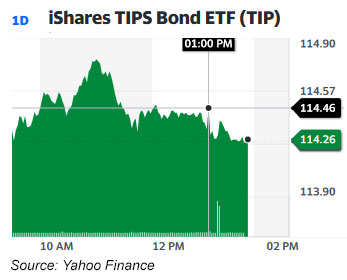
It’s possible big money investors decided to sit this auction out, especially as real yields appeared to be declining through the morning. Bloomberg’s report noted that demand was “soft” at this auction. The bid-to-cover ratio of 2.18 indicates weak demand, which forced the Treasury to accept a higher real yield. But as shown in this chart for the TIP ETF, the market reacted to the auction’s close at 1 p.m. with a yawn. Nothing to see here.

But for buyers at today’s auction, a real yield of 0.630% and a price very close to par is a welcome result. Keep in mind that principal balances for this TIPS will rise 1.37% in August, based on non-seasonally adjusted inflation in June 2022. That’s a darn good first month. (And as a side note, I will point out that the nominal 10-year German bond is currently yielding 1.22% annually, less that the upcoming one-month inflation accrual for this TIPS.)

Today’s auction of CUSIP 91282CEZ0 is the first of three for this issue. It will reopened at auctions in September and November. I think there is a reasonable chance yields will be higher at those future auctions, but a lot will depend on the state of the U.S. economy and the Federal Reserve’s commitment to fighting inflation.

Here is a chart of all 9- to 10-year TIPS auctions going back to January 2019, the last auction before the Fed abandoned its tightening policy that began, very slowly, in 2015:

* * *

Feel free to post comments or questions below. If it is your first-ever comment, it will have to wait for moderation. After that, your comments will automatically appear.

David Enna is a financial journalist, not a financial adviser. He is not selling or profiting from any investment discussed. The investments he discusses can be purchased through the Treasury or other providers without fees, commissions or carrying charges. Please do your own research before investing.
Posted in Investing in TIPS | 18 Comments

This week’s 10-year TIPS auction has ‘potential’

But beware: Real yields are volatile; even hour to hour

By David Enna, Tipswatch.com

Update, July 21: New 10-year TIPS gets real yield of 0.630% at auction, a nice result for investors

The Treasury on Thursday will auction $17 billion in a new 10-year TIPS, CUSIP 91282CEZ0, and this offering should be somewhat historic, for several reasons:

  • That $17 billion number is the highest auction amount in history for a 10-year TIPS opening or reopening. The last auction of a new 10-year, on January 20, was for $16 billion. A year before, on Jan. 21, 2021, the size was $15 billion.
  • So the amount is increasing even as the Federal Reserve is reducing its balance sheet of TIPS and other Treasurys, meaning it won’t be rolling over its current holdings. The Treasury is trusting that investor demand will pick up the slack.
  • The Treasury on Friday estimated the real yield of a 10-year TIPS at 0.57%, which would be the highest real yield at auction for this term since an auction on March 20, 2020, in the midst of pandemic panic.
  • Unfortunately, that Treasury estimate has fallen 15 basis points in the last week. This is the sort of volatility we are seeing in the Treasury market, every week, as the market reacts to potential Fed actions to combat inflation.
  • If the auctioned real yield holds above 0.50%, the coupon rate for this TIPS will be set at 0.50%, or possibly even 0.625% if the real yield can break through to 0.625% or higher. A coupon rate of 0.50% would be highest for a new TIPS since an auction on Jan. 17, 2019.

Watching market coverage this week, I was catching the drift from “experts” that the Fed will raise short-term interest rates, probably 75 basis points, later this month and then again — possibly 50 basis points? — in September and then go quiet, waiting to see how the economy reacts. The current Federal Funds Rate is in the range of 1.50% to 1.75%, but effectively 1.75%. An increase of 75 basis points brings it to 2.50% and another 50 to 3.00%.

At this point, short-term Treasury bills are already pricing for those increases, with the 13-week Treasury yielding 2.37% and the 1 year at 3.12%. But beyond those short-term rates, the yield curve goes flat, with the 5-year Treasury note at 3.05%, the 10 year at 2.93% and the 30 year at 3.10%. That’s not good news for investors in a 10-year TIPS, because lower nominal yields will drag real yields lower, most of the time.

All this could change next week, as the bond market slushes around based on the latest “theory” of the Fed’s future actions and the effects on the U.S. economy. Inflation expectations have also been sliding lower, even after last week’s dreary June inflation report, which set annual U.S. inflation at 9.1%.

Definition: The “real yield” of a TIPS is its yield above or below official future U.S. inflation, over the term of the TIPS. So a real yield of 0.57% means an investment in this TIPS will exceed U.S. inflation by 0.57% for 10 years.

I tend to believe that if inflation continues at a pace around 4% to 5%, which seems likely for many months, real yields will have to rise as the Fed continues stepping on the brakes. So is a 10-year TIPS yielding 0.57% attractive? I’d say yes, even knowing future rates could be higher. Here is a history of the 10-year real yield from 2010 to today:

Note that we have now reached the mid-point of 10-year real yields during the Fed’s last tightening cycle, which peaked in late 2018. At that time, the 10-year real yield rose to about 1.15%. Also at that time, U.S. inflation was running at 2.2%, far below today’s 9.1%. The Fed has a long way to go before it can end the current tightening cycle.

Pricing. If the real yield of this TIPS holds above 0.50%, the coupon rate will be 0.50% and the unadjusted price should be a little less than par value. However, this brand new TIPS will have an inflation index of 1.00495 on the settlement date of July 29. Why? Because non-seasonally adjusted inflation ran at 1.1% in May, so the half-month inflation accrual for this TIPS is 0.49% on the settlement date.

The inflation accrual means that investors could be paying an adjusted price of about $100.49 for about $100.49 of value, with accrued inflation. But the price will be a bit lower because the real yield will end up being higher than the coupon rate. It could balance out, but will probably be a bit above $100.00.

Inflation breakeven rate

With a 10-year Treasury note yielding 2.93% at Friday’s close, this new TIPS would have an inflation breakeven rate of 2.36%, which seems very attractive given current conditions. I’d prefer to invest in a TIPS with a yield exceeding inflation by 0.57%, versus a straight nominal yield of 2.93%.

Here is the trend in the 10-year inflation breakeven rate from 2010 to 2022:

In this chart, note that the current inflation breakeven rate of 2.36% is 20 basis points below the rate in March 2013, when annual inflation was running at a paltry 1.5%. Markets can be weird.

The recent decline in the 10-year inflation breakeven rate indicates that real yields have been holding up better than nominal yields. It also seems to indicate fairly weak demand for TIPS right now. That could be a factor in Thursday’s auction, with the Treasury issuing a record-high $17 billion in a 10-year TIPS.

Conclusion

The dip in real yields last week is a negative for investors, but I’d still be very interested in this TIPS if the real yield can hold above 0.50%. If the economy seriously weakens, we have to be prepared for the Fed to attempt a rescue, as it has continuously done over the last 20+ years. This TIPS isn’t attractive enough to “bet the house,” but a sensible investment seems fine to me.

You can check the Treasury’s real yield estimates for a full-term 10-year TIPS on its Real Yield Curve page. This auction closes at noon Thursday for non-competitive bids, like those made at TreasuryDirect. If you are putting an order in through a brokerage, make sure to place your order Wednesday or very early Thursday, because brokers cut off auction orders before the noon deadline. I’ll report the results after the auction closes at 1 p.m. EDT Thursday.

Here is a recent history of 9- to 10-year TIPS auctions, showing the long string of negative real yields in the aftermath of the pandemic outbreak, beginning in March 2020:

* * *

Feel free to post comments or questions below. If it is your first-ever comment, it will have to wait for moderation. After that, your comments will automatically appear.

David Enna is a financial journalist, not a financial adviser. He is not selling or profiting from any investment discussed. The investments he discusses can be purchased through the Treasury or other providers without fees, commissions or carrying charges. Please do your own research before investing.

Posted in Investing in TIPS | 49 Comments

Social Security COLA looks likely to rise about 10% for 2023

Want to understand how the COLA is calculated? It’s complicated. Read on …

By David Enna, Tipswatch.com

With the release of the June inflation report on Wednesday, we now have a pretty good idea of where the Social Security cost-of-living adjustment will be heading for payments in 2023, beginning with benefits received in January.

Inflation trends through June make it look likely that next year’s COLA could fall into a range of 9.6% to 10.3% for 2023, the highest increase since an 11.2% bump in 1981. But if inflation continues at its current torrid pace, the COLA could be even higher.

The Social Security Administration’s COLA formula is ridiculously complex and little understood. Is it related to U.S. inflation? Yes, but not the inflation index you hear about each month. Does it reflect 12 months of U.S. inflation? Not really. Does it underestimate actual U.S. inflation? Sometimes, but not always.

Annual U.S. inflation (measured by CPI-U) is running at 9.1% as of June, but the Social Security Administration doesn’t use CPI-U. Instead, it uses the Consumer Price Index for Urban Wage Earners and Clerical Workers (CPI-W). For that index, the June annual increase was actually higher, at 9.8%.

The Senior Citizens League, a credible advocacy group, is projecting that the 2023 COLA could be 10.5%, and I think that is possible, but also might be just a tad too high. Why the uncertainty? The SSA’s complex formula makes predictions extremely iffy and airtight accuracy is impossible. Let’s take a look at how the COLA comes together …

The Index

CPI-W includes data only from households with at least 50% of income coming from clerical or wage-paying jobs. I’ve noted in the past that CPI-W generally lags slightly behind CPI-U, which means the Social Security COLA also generally lags behind the standard measure of U.S. inflation. However, this year — and also last year — it has running higher than official inflation.

CPI-W isn’t widely tracked or reported, but the Bureau of Labor Statistics updates the index each month in its overall inflation report. Right now, you could say, “Well, CPI-W is running at an annual rate of 9.8%, so that will likely be the COLA increase for 2023.” But that’s not true. In fact, the June number isn’t necessarily an accurate indicator, as shown in this chart:

June sets the baseline for the COLA increase, but then we come to …

The Formula

The SSA doesn’t look at a full year’s data to determine the COLA. Instead it uses the average CPI-W index for the third quarter — July, August and September. Here is the definition from the SSA site, in typical crystal-clear language of government bureaucrats:

A COLA effective for December of the current year is equal to the percentage increase (if any) in the average CPI-W for the third quarter of the current year over the average for the third quarter of the last year in which a COLA became effective. If there is an increase, it must be rounded to the nearest tenth of one percent. If there is no increase, or if the rounded increase is zero, there is no COLA.

The translation: This wording means that the SSA eliminates years where inflation was zero or negative, and so there isn’t a “bounce-up” effect on benefits after a year of deflation. Instead, it goes back to the last year where there was an increase in benefits. But that won’t matter in this 2023 calculation, because the COLA rose 5.9% this year.

So, although 12-month CPI-W was up 9.8% in June, that number is only the baseline for the 2023 COLA increase. The only inflation numbers that will matter are for the third quarter: July, August and September. Last year, the CPI-W index averaged 268.421 in the third quarter. The June 2022 index was set at 292.542, which is 9.0% higher than the 3rd quarter average in 2021. So if we have zero inflation in July, August and September, the Social Security COLA will be set at 9.0%.

U.S. inflation can be stubbornly finicky in the summer months, so predicting inflation from July to September is an impossible task. Hurricanes, gas shortages, food crop failures, stock market plunges, outbreaks of war, supply shortages, pandemic resurgence, etc., etc. It’s a guessing game, and nearly every summer brings some surprises.

Plus … the U.S. economy could potentially be slowing, which could at least tame our current raging inflation, a bit.

Projecting the 2022 COLA

At this point, CPI-W is running at 9.8% over the last year, so maybe you’d expect a continued inflationary trend of nearly 0.8% through the summer months? It could happen. I don’t think it will, however. The Cleveland Fed is currently projecting an all-items inflation rate of 0.39% for July, which I’m sure is influenced by the recent decline in gas prices.

If gas prices continue slipping lower this summer — and that’s a big if, I know — then inflation should begin moderating, while staying at very high level. Could inflation run at 0.0% for three months? Doesn’t seem likely. But what about 0.4% or 0.5% a month? That seems possible. Plus, we could see an oddball month, surprisingly higher or lower. It happens almost every summer.

Let’s take a look at how differences in 3rd-quarter inflation would alter the 2023 COLA:

Where is inflation heading this summer? I really don’t know. I can tell you that last year — when inflation was beginning to percolate — CPI-W rose from 266.412 in June to 269.086 in September, an increase of 1.0%. But that 1% increase was front-loaded into a 0.52% increase in July, followed by relatively tame increases of 0.22% in August and 0.26% in September.

Inflation is hard to predict

Yeah, but I write about inflation, so why not take a stab? My thinking is that inflation is likely to average 0.3% to 0.6% a month from July to September, and that would put the Social Security COLA in a range of 9.6% to 10.3%. If current inflationary trends continue, I’ll probably end up on the low side.

So let’s nail this down to a prediction of 9.9% to 10.1%. (But I’m queasy about this.)

In 2021, I predicted a COLA increase of 6.0% “looks likely.” Correct answer: 5.9%.

In 2020, I predicted “a number very close to zero,” Correct answer: 1.3%.

In 2019, I predicted “a range of 1.6% to 1.8%.” Correct answer: 1.6%.

In 2018, I predicted a range of 3.1% to 3.2%. Correct answer: 2.8%.

In 2017, I predicted the COLA was likely to be “less than 2.2%.” Correct answer: 2.0%

So there you go, that’s my track record. The point is: You will be seeing lots of media reports in coming weeks about the Social Security COLA soaring to 10% or higher. But no one truly knows. Three months of data are needed. At least now you can understand how those predictions were made, and the complex formula that underlies the whole thing.

What this all means

For 2022, the Social Security Administration says, the average monthly benefit for retired workers is $1,666, so a 10% increase would boost that benefit to $1,833, beginning in January. If you are in the Social Security “limbo” period — older than 62 but not yet taking benefits — your future benefits would also climb by this percentage.

However, recipients can also expect that Medicare Part B costs could rise in 2023, which will subtract — at least partly — from the higher benefits. But this is a foggy issue, because the SSA pushed Part B charges 14.6% higher for 2022 because of potential approval of the Alzheimer’s drug, Aduhelm. Since then, the costs of that drug have declined, and it is not being widely used. That could mean Part B charges won’t increase greatly in 2023, or possibly even decline.

We won’t know the actual COLA number until 8:30 a.m. EDT on October 13, 2022, when the Bureau of Labor Statistics releases the September inflation report and completes the data needed for the 3rd quarter average of CPI-W. I will be tracking these numbers for July, August and September as each inflation report is issued.

I keep a running total of the CPI-W changes on my Social Security COLA page.

* * *

Feel free to post comments or questions below. If it is your first-ever comment, it will have to wait for moderation. After that, your comments will automatically appear.

David Enna is a financial journalist, not a financial adviser. He is not selling or profiting from any investment discussed. The investments he discusses can be purchased through the Treasury or other providers without fees, commissions or carrying charges. Please do your own research before investing.
Posted in Retirement, Social Security | 8 Comments