June inflation hits new highs: 1.3% for the month, 9.1% year over year

Annual inflation is now running at the hottest pace since 1981.

By David Enna, Tipswatch.com

Have we hit peak inflation yet? The answer is: we don’t know, because the June inflation report showed inflation surging ever higher, greatly exceeding already lofty expectations.

The Consumer Price Index for All Urban Consumers increased 1.3% in June on a seasonally adjusted basis, the U.S. Bureau of Labor Statistics reported today. Over the last 12 months, the all-items index increased 9.1%, the largest 12-month increase since November 1981. These results were much higher than economist expectations, which called for 1.1% for the month and 8.8% year over year.

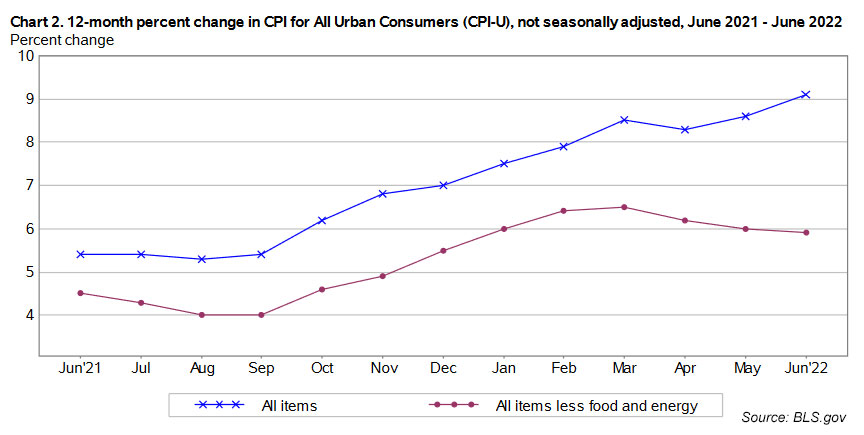
Core inflation, which eliminates food and energy, also exceeded expectations, rising a disturbing 0.7% for the month (versus a consensus of 0.5%) and 5.9% year over year (versus an expected 5.8%). This surge in core inflation indicates the broad-based nature of U.S. inflation, which looks likely to continue running hot even if gas prices start falling.

The BLS noted that June price increases struck “almost all major component indexes.” Some highlights:

  • Food at home costs increased 1.0% for the month, after rising 1.4% in May, and are now up 12.2% year over year. The dairy index rose 1.7% in the month, following a 2.9% increase in May. The sole food group to show a decline was meats and poultry, falling 0.4% in the month.
  • Gasoline prices surged 11.2% in June, and were up 59.9% over the last year. This trend seems to have reversed in July, with gas prices falling a bit throughout the month, so far.
  • The overall energy index rose 41.6% over the last year, the largest 12-month increase since the period ending April 1980.
  • Shelter costs increased 0.6% in June and are up 5.6% for the year.
  • The rent index rose 0.8% over the month, the largest monthly increase since April 1986.
  • Prices for used cars and trucks continued climbing, up 1.6% for the month.
  • Apparel prices surged 0.8% for the month and are up 5.2% for year.
  • The medical care index rose 0.7% in June, and is up 4.8% for the year.
  • Airline fares fell 1.8% in June after increasing strongly over recent months.

My overall impression is that, yes, U.S. inflation may have peaked in June because we could see gasoline prices begin to fall the rest of the summer. But clearly, even if the annual inflation rate begins to inch down from 9.1%, prices will continue to rise across the economy. Don’t be fooled by any claim in coming months that “inflation is under control.”

Here is the 12-month trend for both all-items and core inflation, showing that core inflation has started to stabilize at close to 6%, an unacceptably high rate:
What this means for TIPS and I Bonds

Investors in Treasury Inflation-Protected Securities and U.S. Series I Savings Bonds are also interested in non-seasonally adjusted inflation, which is used to adjust principal balances for all TIPS and set future interest rates for I Bonds. For June, the BLS set the inflation index at 296.311, an increase of 1.37% over the May number.

For TIPS. The June inflation index means that principal balances for all TIPS will increase 1.37% in August, after rising 1.1% in July. For the year ending in August, inflation accruals will have totaled 9.1%. Here are the new August Inflation Indexes for all TIPS.

For I Bonds. The June inflation report is the third in a six-month string — March to September — that will determine the I Bond’s new variable rate, which will be reset November 1. After three months, inflation has increased 3.06%, which would translate to a variable rate of 6.12%. But three months remain, and a lot can happen in three months, especially summer months when inflation is very hard to predict. The I Bond’s current variable rate is 9.62%.

Here are the numbers so far:

What this means for the Social Security COLA

The June inflation report sets a baseline figure for next year’s cost-of-living adjustment for Social Security, but the Social Security Administration uses a different index, Consumer Price Index for Urban Wage Earners and Clerical Workers (CPI-W). For June, CPI-W was set at 292.542, a year-over-year increase of 9.8%.

Does that mean Social Security benefits will increase 9.8% in January? No. the SSA uses the average of CPI-W over the months of July, August and September to determine the next year’s increase. Last year’s three-month average was 268.421, so at this point the increase would be 9.0%. That’s not a projection, because inflation should continue rising through the summer. But it is a starting point. I will be tracking these numbers on my Social Security COLA page.

What this means for future interest rates

I suspect that the Federal Reserve was prepared for this rather disturbing June inflation report, and will move forward with plans to increase short-term interest rates 75 basis points at it July 26-27 meeting, and then possibly again in September.

As we have seen in recent weeks, the Fed can move short-term rates higher, but has no real control over longer-term rates, which have been declining on recession fears. The nominal yield curve has flattened, with the 1-year Treasury trading at 3.18%, the 2-year at 3.18%, the 5-year at 3.11% and the 10-year at 3.02%.

Real yields on TIPS have been holding up nicely, with the 5-year now at 0.53% and the 10-year at 0.65%. I am thinking next week’s auction of a new 10-year TIPS will be a decent buying opportunity.

I wouldn’t be surprised if inflation moderates in the next few months, but continues at a historically high range. The economy is likely to weaken, and the Fed will be under pressure to “declare victory” and stop the rate hikes.

My conclusion: Take advantage of attractive short-term rates (about 2.2% on a 13-week Treasury) and continue to lock in attractive real yields on TIPS. Yes, rates are likely to go higher, but there is always the threat of the Fed backing off and intervening in a weakening economy. We’ve seen it before.

* * *

Feel free to post comments or questions below. If it is your first-ever comment, it will have to wait for moderation. After that, your comments will automatically appear.

David Enna is a financial journalist, not a financial adviser. He is not selling or profiting from any investment discussed. The investments he discusses can be purchased through the Treasury or other providers without fees, commissions or carrying charges. Please do your own research before investing.
Posted in I Bond, Inflation, Investing in TIPS, Social Security | 42 Comments

A 10-year TIPS is maturing Friday. How did it do as an investment?

Despite a real yield deeply negative to inflation, CUSIP 912828TE0 out-performed a nominal 10-year Treasury.

By David Enna, Tipswatch.com

Back on July 19, 2012, the U.S. Treasury auctioned a new 10-year TIPS, CUSIP 912828TE0, with a rather dire result: The real yield to maturity was -0.637%, which at the time was a record low for any TIPS auction of this term. The coupon rate was set at 0.125%, and buyers paid a hefty premium of about $107.84 for $100 of par value.

In July 2012 U.S. inflation was running at 1.4% and investors weren’t very interested in inflation protection, as noted in this Wall Street Journal report after the auction:

The $15 billion auction of 10-year Treasury Inflation Protected Securities, or TIPS, garnered mediocre interest given the negative-0.637% yield that was offered in a time of little inflationary threat. That’s the lowest yield the government has had to deliver in its sales of 10-year TIPS. It drew a bid-to-cover ratio of 2.62, the lowest measure of overall demand since September.

So, this was a hopeless investment, right? Not exactly. When you compare this TIPS to a nominal 10-year Treasury note available in July 2012, it turns out that — against the odds — CUSIP 912828TE0 ended up out-performing the nominal Treasury.

CUSIP 912828TE0 will mature on July 15, 2022, with an inflation index of 1.26346, meaning that a $10,000 investment at the original auction (which would have cost about $10,784 because of the premium price) will be returning $12,635 to the investor, along with that 0.125% annual coupon rate on the growing principal balance.

That’s a return of about $2,000 over 10 years on a $10,000 investment., or an annual percentage return of about 1.85%. Not stellar. But at the time, a 10-year nominal Treasury was yielding only 1.54% and would have returned only about $11,658 after 10 years, even if you figure in compounding.

So CUSIP 912828TE0 ended up being a “winning” investment, despite its deeply negative real yield to maturity. It auctioned with an inflation breakeven rate of 2.18%, and 10 years later, inflation has averaged 2.4% a year.

The big picture

Up until a year ago, TIPS had been under-performing nominal Treasurys for most of the last decade because inflation was running much lower than expectations. Obviously, with U.S. inflation currently running at 8.6%, we have turned the corner on that. Will that trend continue? It seems very likely, for awhile at least.

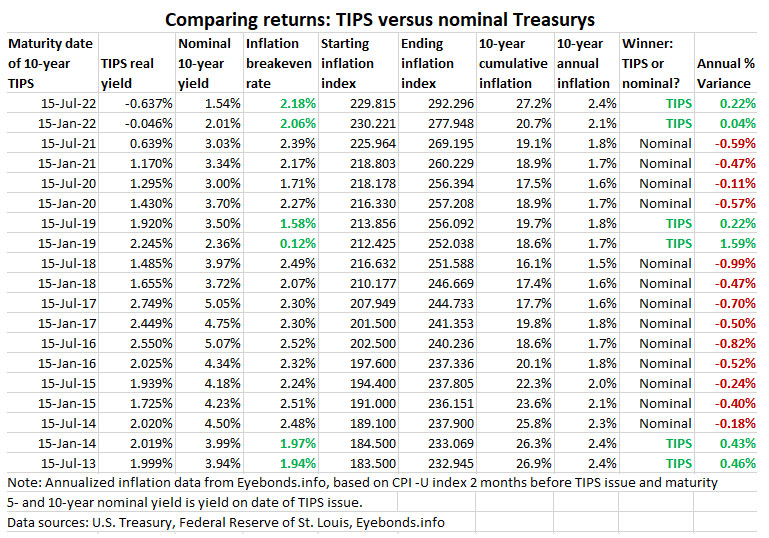
Here is how 10-year TIPS have performed versus 10-year Treasury notes for all maturities since July 2013:

Notes and qualifications

This chart is an estimate of performance, because it uses a full month of inflation in the beginning and ending months, when actually TIPS accruals are based on a half month for the first and last months, with the origination and maturity occurring on the 15th of the month.

Keep in mind that interest on a nominal Treasury and the TIPS coupon rate is paid out as current-year income and not reinvested. So in the case of a nominal Treasury, the interest earned could be reinvested elsewhere, which would potentially boost the gain. For certain, we don’t know what the investor could have earned precisely on an investment after re-investments.

In the case of a TIPS, the inflation adjustment compounds over time, and that will give TIPS a slight boost in return that isn’t reflected in the “average inflation” numbers presented in the chart.

* * *

Feel free to post comments or questions below. If it is your first-ever comment, it will have to wait for moderation. After that, your comments will automatically appear.

David Enna is a financial journalist, not a financial adviser. He is not selling or profiting from any investment discussed. The investments he discusses can be purchased through the Treasury or other providers without fees, commissions or carrying charges. Please do your own research before investing.
Posted in Inflation, Investing in TIPS | 7 Comments

Looking to put cash to work? Consider short-term Treasury bills

13- and 26-week Treasury bills are an ideal way to maximize yield on your short-term savings. Here’s how to get started …

By David Enna, Tipswatch.com

When you get to be a certain age, cash becomes a lovely thing. Anyone who is retired and lacking steady income from work knows what I am talking about: It’s great to have a stockpile of cash to use for daily expenses and splurges like travel, but also for sudden disasters like the day two weeks ago when my 12-year-old KitchenAid dishwasher went dead.

I define cash as a safe investment — savings account, bank CD, federal money market account, U.S. Treasury bill — with a term of up to one year. But the problem over the last few years has been that safety also meant pathetically low returns, with yields typically topping out at 0.05% on money market accounts and maybe 0.2% in an online savings account.

For much of that time, inflation was very low, which held down the pain of very low yields. Now U.S. inflation is running at an annual rate of 8.6%, and looks likely to remain high for many months into the future. So there’s the dilemma: Where can we get better returns on our cash stockpile?

Let’s take a look at some possibilities, all very safe, in order of potential yield:

  • 1-year Treasury bills, now yielding 2.79%
  • 26-week Treasury bills, now yielding 2.62%
  • 1 year bank CDs, typically yielding close to 2%
  • 13-week Treasury bills, now yielding 1.73%
  • 4-week Treasury bills, now yielding 1.27%
  • Vanguard Treasury Money Market Fund, yielding 1.11%
  • Online bank savings accounts, typically yielding 1% to 1.2%
  • 6-month bank CDs, typically yielding 0.75% to 1%
  • Fidelity Treasury Money Market Fund, yielding 0.98%
  • 3-month bank CDs, typically yielding about 0.35%

I highlighted two investments in this list — the 13-week and 26-week Treasury bills — because I think they offer the best combination of safety, current yield, length of term and potential to adjust to higher yields as the Fed continues raising short-term interest rates.

For well over year, I’ve been holding cash in a T-Mobile Money banking account, which pays 4% on the first $3,000 invested (under certain circumstances) and 1% on the remainder. I wrote about this account back in July 2021 and I have been happy with it, because that 1% was at least 2 times what I could earn elsewhere. But now — sorry T-Mobile — 1% is no longer an attractive rate.

I like short-term Treasurys because these issues will react very quickly to any future rate increases by the Fed. You can easily schedule and stagger purchases on TreasuryDirect, and then have the investments roll over every 13 or 26 weeks, riding interest rates higher. The 13-week and 26-week Treasurys are auctioned every week, on Monday. (But it’s Tuesday this week because of the July 4th holiday.) This makes it very easy to stagger purchases to allow you to have access to your money on short notice.

For example, let’s say you have $60,000 in cash you want to put to work.

13-week Treasurys. You could make three purchases of $20,000 each, four weeks apart. Then you can roll these purchases over on TreasuryDirect, meaning you will always have access to $20,000 within about 4 weeks. Through the process, you will be riding interest rates higher if the Fed continues on its current course. Staggering 13-week Treasury bills is a good strategy for someone who might need the cash back in a short time.

26-week Treasurys. You could make three purchases of $20,000 each, eight weeks apart. Again you could roll these purchases over, riding interest rates higher, and always have access to $20,000 within eight weeks. Staggering 26-week Treasurys is a good strategy for someone who feels comfortable with a little longer delay in re-accessing the cash.

A combination. Put $30,000 in staggered 13-week Treasury bills, and $30,000 in staggered 26-week Treasury bills. You’d ride interest rates higher, get a slight yield boost for the 26-week term, and still have access to $10,000 within four weeks.

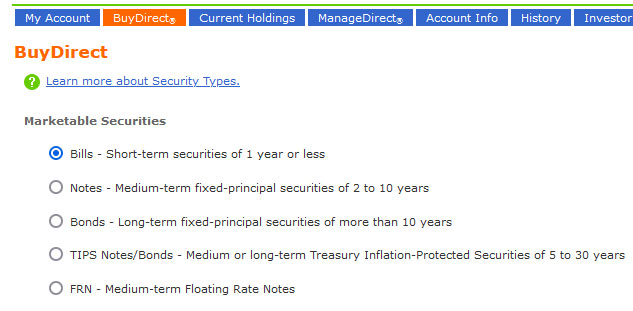
Scheduling these purchases on TreasuryDirect is simple, and I am assuming all my readers now have TreasuryDirect accounts because of the current I Bond mania. (If not, here’s my guide to opening an account.) Simply log into TreasuryDirect, and then click on BuyDirect in the top line of links. Here is what you will see:

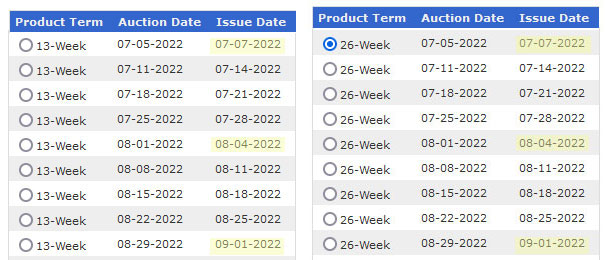
Click on Bills and then click Submit. That will take you to the full list of near-future auctions of Treasury bills, all with terms of 1 year or less. For the 13-week and 26-week Treasurys, you will see lists like these:

In this example, I have highlighted how you could stagger purchases of the Treasurys, but when you go to schedule a purchase, you have to enter each one separately. You can schedule purchases out two months on TreasuryDirect, and note that these issues auction each Monday and settle each Thursday.

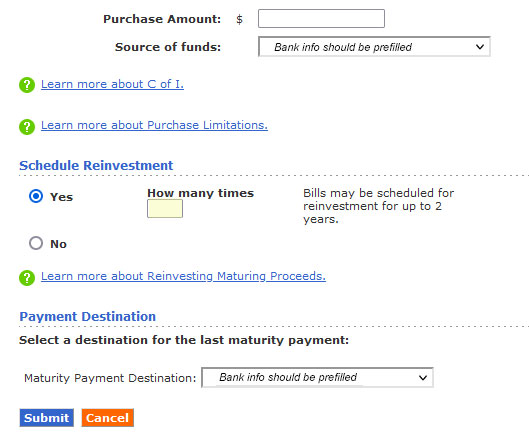
At the bottom of this page is where you enter the amount of each individual purchase, designate the source of the funds and note that you want to schedule reinvestments, and how many. Here is what that looks like:

Reinvestments can only be made for two years out, so that will limit you to 7 reinvestments of the 13-week bills, and 3 reinvestments of 26-week bills. To extend those reinvestments, you’d need to log into TreasuryDirect in the future and set them up. Also, when you need to retrieve the cash, you can log into TreasuryDirect at any time and cancel one or all your reinvestments. After maturity, the cash will return to your linked bank or brokerage account.

This strategy of rolling over short-term Treasurys will be most beneficial while the Federal Reserve is continuing to raise short-term interest rates. When the Fed stalls on rate increases or begins cutting rates, then you may want to look at investing elsewhere, or go with a longer-term Treasury or bank CD.

TreasuryDirect says you can schedule a reinvestment either when you buy your original security or up to four business days before the original security matures. Once you schedule a reinvestment, you can edit or cancel it within the same time frame.

How Treasury bills work

Treasury bills (often called T-bills) are a bit different than your standard bank account or CD. They are zero-coupon bonds, meaning an investor buys them at a discount to par value. Instead of paying a coupon interest rate, T-bills are eventually redeemed at par value to create a positive yield to maturity.

Here is what the auction result looks like, using the auction result for last week’s 13-week Treasury bill as an example:

In this auction, a person making a non-competitive bid (that is all of us little guys) got the high rate of 1.75% (annualized) and an investment rate of 1.782%. The investment rate extrapolates a higher annualized return if the proceeds are reinvested. The Treasury calls this the “equivalent coupon-issue yield.” An investor buying $10,000 of this T-bill would have paid about $9,955.76 and will get $10,000 at the Sept. 29 maturity.

These short-term Treasurys react very quickly to Fed rate increases. Two months ago, on May 9, a 13-week Treasury got an investment rate of 0.915%. Four months ago, on March 7, the auction got a rate of 0.386%.

When the T-bill reaches maturity and is not reinvested, TreasuryDirect will deposit the principal into your designated bank account. The deposit is made on the day the security matures.

* * *

Feel free to post comments or questions below. If it is your first-ever comment, it will have to wait for moderation. After that, your comments will automatically appear.

David Enna is a financial journalist, not a financial adviser. He is not selling or profiting from any investment discussed. The investments he discusses can purchased through the Treasury or other providers without fees, commissions or carrying charges. Please do your own research before investing.
Posted in Bank CDs, Cash alternatives, Treasury Bills | 82 Comments

Are TIPS broken?

Are declines in your TIPS funds stressing you out? Today’s article is a guest offering from Adam Collins, a Tipswatch reader and flat fee financial adviser. He explains why TIPS are needed in a portfolio, and which TIPS funds might work best.

By Adam Collins, Eversight Wealth

Adam Collins

Inflation and higher rates wrecked bond funds in 2022. Treasury Inflation-Protected Securities are supposed to outperform in this environment, yet most TIPS funds are down.

Did TIPS fail? Or did some investors pick the wrong fund?

This post explains:

  1. How TIPS funds can have massively different performance.
  2. What surging real yields mean for future TIPS returns.
  3. Why passive investors need more inflation protection.

TIPS performance explained

Inflation has increased 8.6% over the past year. TIP, the most popular inflation-protected fund with $30 billion in assets, fell 4%.

Total returns including distribution reinvestment as of June 22, 2022. These are not an indicator of future results and do not represent returns any investor actually earned.

Here’s how that loss could have been avoided.

Besides inflation adjustments that increase their prices, TIPS also pay interest. This interest rate is a real yield because it’s how much the bond will return net of inflation. So a real yield of 1% means you will earn 1% above future inflation — but only if you hold the bond to maturity.

In the short-term, TIPS prices move opposite to yields. TIPS trailed inflation in 2022 because price declines due to rising rates exceeded inflation adjustments.

TIPS funds have different sensitivities to changing yields. Duration measures this and ranges from 3 for funds that own short-term bonds (like VTIP) to 20 for long-term funds (like LTPZ). For VTIP, short-term returns are more linked to inflation and less to yield changes.

Total returns including distribution reinvestment as of June 22, 2022. These are not an indicator of future results.

In 2018, Vanguard found that short-term TIPS are more correlated to unexpected inflation. This aligns with performance in 2022.

Source: Vanguard

Future Outlook for TIPS

Rising real yields hurt short-term returns but benefit long-term investors. TIPS now offer more inflation upside despite the increase in inflation fears.

A 5-year TIPS bought today will return future inflation plus 0.36% per year, based on Friday’s market close. Compared that to last June’s yield of inflation minus 1.6% per year.

Source: FRED

Tighter correlation to unexpected inflation is the main reason I prefer short-term TIPS, but they’re not without downsides. Long-term TIPS offer higher yields and lower breakeven rates. For example, the 5-year breakeven is 2.8% and the 30-year breakeven is 2.5%. This means there’s a higher inflation hurdle for short-term TIPS to outperform regular short-term bonds.

Retirees taking withdrawals are vulnerable to a long-term TIPS fund experiencing a bad sequence of returns like in 2022. This is another advantage of short-term TIPS: their lower volatility can decrease sequence risk and increase the odds of a sustainable retirement.

Rolling peak-to-trough losses since the inception of VTIP. These are not an indicator of future results and do not represent returns any investor actually earned.

Passive Investors Need Inflation Protection

Nobody knows if inflation will keep rising. Expert predictions are often inaccurate, so I don’t have conviction in anyone’s ability to forecast inflation.

Even though inflation is unpredictable, investors should prepare for it. Yet TIPS are often missing from bond portfolios I review.

Passive bond funds tracking Bloomberg’s U.S. Aggregate Bond Index, including Vanguard’s $286 billion total bond fund, exclude TIPS. Now down 13% from its highs, the index is in its largest ever drawdown. TIPS could have helped.

I hope the next decade doesn’t evolve like the inflationary 1970s. But if it does, investors should consider investments correlated to unexpected inflation like short-term TIPS.

Summary

  • Rising yields hurt TIPS prices. Short-term funds are less affected by yield changes and more correlated to inflation.
  • Many passive bond funds exclude inflation-protected bonds.
  • Higher real yields make today a great time to consider TIPS.

P.S. Want a deeper dive on TIPS? I wrote a 5-part series on them.

About Adam Collins

Adam Collins is a flat fee investment advisor. Through his company Eversight Wealth, he helps people build diversified portfolios, create a financial plan, and save money with a flat advisory fee. Eversight manages $75 million for 35 clients in 13 states and offers free consultations. Here are links to more info on their services and about Adam.

* * *

Feel free to post comments or questions below. If it is your first-ever comment, it will have to wait for moderation. After that, your comments will automatically appear.

David Enna is a financial journalist, not a financial adviser. He is not selling or profiting from any investment discussed. The investments he discusses can purchased through the Treasury or other providers without fees, commissions or carrying charges. Please do your own research before investing.
Posted in Investing in TIPS | 53 Comments

5-year TIPS reopening auction gets a real yield of 0.362%, breaking a string of negative yields

By David Enna,Tipswatch.com

Am I a bit disappointed? Sure, but … I’ll take it: This was the first 4- to 5-year TIPS auction to get a positive real yield since December 2019, breaking a string of nine consecutive auctions of this term with negative real yields.

The Treasury’s reopening auction Thursday of CUSIP 91282CEJ6 generated a real to maturity of 0.362%, which was at least 15 basis points lower from where this TIPS was trading just a few days ago. In fact, this TIPS opened the day on the secondary market with a real yield of 0.44%, which gradually declined through the morning to 0.40% … 0.38% … 0.37% … and finally … the auction close at 0.362%.

But consider this: In December 2021, a TIPS reopening of the same 4-year, 10-month term got a real yield of -1.508%, a whopping 187 basis points lower than today’s result. Like I said … I’ll take it.

Investors paid an unadjusted price of about $98.87 for $100 of par value, because the real yield was higher than the coupon rate of 0.125%. The adjusted price was higher, however: About $101.22 for $102.38 of principal, after accrued inflation is added in. This TIPS will have an inflation index of 1.02376 on the settlement date of June 30.

In essence, if buyers invested $10,000 in this TIPS auction, they paid about $10,122 for $10,238 of principal, and will now collect a coupon payment of 0.125% every six months and see their principal balance increase (or fall) with inflation until the TIPS is sold or matures in 4 years, 10 months.

But also note that this TIPS will get an inflation adjustment of 1.1% in July, based on non-seasonally adjusted inflation in May. The inflation index on July 31 will be 1.03487, so that $10,238 in principal will grow to $10,349 by the end of next month. Not bad, and I’m expecting at least one more high inflation month to follow, based on June inflation.

Here is the trend in the 5-year real yield over the last year, showing the strong climb higher after the Federal Reserve committed to aggressive interest-rate increases in March 2021.

The flip side of the Fed’s aggressive monetary policy is that investors now fear the threat of recession, which could push interest rates down even if inflation remains elevated. In that scenario, TIPS are an attractive investment, benefiting both from lower interest rates and high inflation. So demand for TIPS could be increasing.

Inflation breakeven rate

At the auction’s close, a 5-year nominal Treasury was trading at 3.09%, meaning this TIPS gets an inflation breakeven rate of 2.73%, well below the 3.34% recorded at the originating auction on April 29. The rate indicates that CUSIP 91282CEJ6 will out-perform a nominal 5-year Treasury if inflation exceeds 2.73% over the next 4 years, 10 months. With U.S. inflation currently running at 8.6% and likely to remain elevated for months ahead, that seems like a reasonable bet.

Here is the trend in the 5-year inflation breakeven rate over the last 12 months, showing how inflation expectations have been falling over the last several months, in reaction to Federal Reserve actions to increase interest rates and reduce its balance sheet of Treasurys:

Reaction to the auction

Years ago, I often complained that Federal Reserve Chair Ben Bernanke spoiled my highly anticipated TIPS auctions by making policy statements just before the auction. It happened a lot, and it seemed to happen again this week with our current Fed chair, Jerome Powell, testifying before Congress. His words had a calming effect on markets, with stocks rising and bond yields falling:

“We can’t fail on this. We really have to get inflation down. We’re going to want to see evidence that it really is coming down before we declare ‘mission accomplished.’ “

We’ll give this round to Powell and the calming effect should last for … days? I’m expecting more inflation scares in the near future. Inflation is a global problem, and even as powerful as the Fed is, it can’t control the global economy or really do much about soaring food and energy costs.

I was a buyer at this auction, continuing my investments in TIPS as real yields continue to rise. I would have loved to have seen a real yield of 0.50% or above, but I’m thankful I jumped aboard a positive real yield, well above yields available just six months ago.

The bid to cover ratio on this auction was 2.61, which is a solid number. The auction appeared to go off without a hitch, and both the Treasury and investors can be pleased.

Next up, on July 21, the Treasury will auction a new 10-year TIPS, offering the possibility of 1) a positive real yield, 2) a discounted adjusted price and 3) a coupon rate higher than 0.125%. It will be worth watching.

Here’s a recent history of 4- to 5-year TIPS auctions, showing the nine-auction string of negative real yields, dating back to December 2019:

* * *

Feel free to post comments or questions below. If it is your first-ever comment, it will have to wait for moderation. After that, your comments will automatically appear.

David Enna is a financial journalist, not a financial adviser. He is not selling or profiting from any investment discussed. The investments he discusses can purchased through the Treasury or other providers without fees, commissions or carrying charges. Please do your own research before investing.

Posted in Inflation, Investing in TIPS | 19 Comments