February inflation rose 0.4%: What does it mean for TIPS and I Bonds?

By David Enna, Tipswatch.com

As expected, U.S. inflation surged 0.4% in February, triggered primarily by rising gasoline prices. But the overall February inflation report from the Bureau of Labor Statistics, released this morning, is a bag of mixed messages. One interesting detail is that offers some good-looking data for the next interest-rate adjustment for U.S. Series I Savings Bonds.

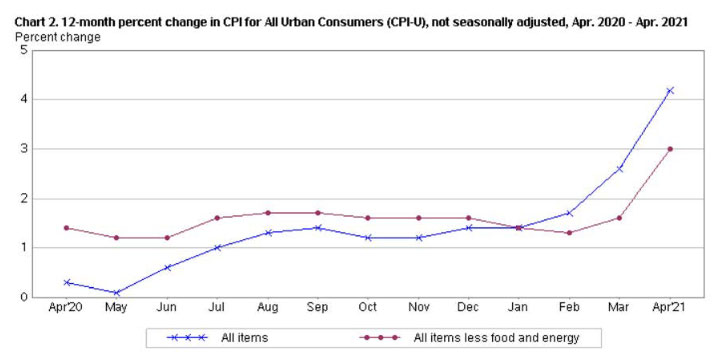
The BLS reported that the Consumer Price Index for All Urban Consumers increased 0.4% in February on a seasonally adjusted basis. Over the last 12 months, the all-items index increased 1.7%. Those numbers exactly matched the consensus forecasts.

But the core inflation numbers, which remove data for food and energy, came in at 0.1% for the month and 1.6% year over year, below the consensus estimates. So while gas prices are forcing overall inflation higher, core inflation continues to slumber along at a moderate level.

The BLS noted that gasoline prices surged 6.4% in February and accounted for more than half of the overall increase in CPI-U. Gasoline prices are now up 1.5% year over year, after falling deeply negative throughout 2020. Prices for fuel oil were also up a sharp 9.9%. The electricity and natural gas indexes also increased, and the energy index rose 3.9% over the month.

Food prices were up 0.2% in February and rose 3.6% over the last 12 months. The index for fresh fruits increased 1.8%, the largest increase in that index since March 2014. But the index for dairy and related products declined 0.2% in February after falling 0.4% the previous month.

Some other highlights from the report:

  • Apparel prices fell 0.7% and are now down 3.6% year over year.
  • The index for used cars and trucks dropped 0.9% in the month but is up 9.3% year over year.
  • Shelter costs increased 0.2% in the month and are up 1.5% for the year. But keep in mind that eviction moratoriums are holding down rent costs. That could change in coming months.
  • The cost of medical care services increased 0.5% and are up 3.0% year over year.
  • The index for airline fares continued to decline in February, falling 5.1% following a 3.2% decrease in January.

Here is the overall trend for all-items and core U.S. inflation over the last 12 months, showing the deep decline after the pandemic erupted in March 2020, and the gradual climb higher in all-items inflation, even as core inflation has remained relatively stable:

What does this mean for TIPS and I Bonds?

Investors in Treasury Inflation Protected Securities and U.S. Series I Savings Bonds are also interested in non-seasonally adjusted inflation, which is used to adjust principal balances on TIPS and set future interest rates for I Bonds. For February, the BLS set the inflation index at 263.014, an increase of 0.55% over the January number.

For TIPS. February’s inflation report means that principal balances for all TIPS will increase 0.55% in April, following a 0.43% increase in March. This is welcome news for TIPS investors, but keep in mind that in this case, non-seasonal adjusted inflation was slightly outpacing adjusted inflation, and eventually those numbers will balance out over a year.

Here are the new April Inflation Indexes for all TIPS.

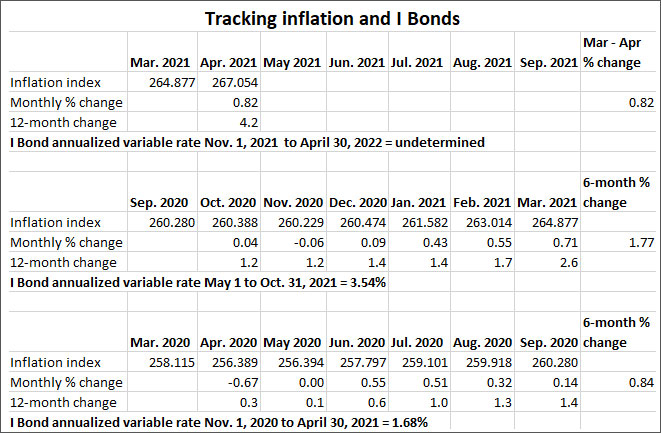
For I Bonds. The February report was the fifth in a six-month series that will set the future inflation-adjusted variable rate for U.S. Series I Savings Bonds. At this point, five months in, inflation has increased 1.05%, which translates to an annualized variable rate of 2.10%, higher than the current rate of 1.68%. Because gasoline prices are continuing to rise in March, we should see that variable rate climb even higher. But … inflation is highly unpredictable.

After the March inflation report, to be issued April 13, we will then know the I Bond’s new variable rate. I’ll have more to say about this after that report, but here’s a hint: I Bonds are going to be a very attractive investment in our current low-interest-rate environment. Could they get as popular as Bitcoin? Er …. no.

Here are the numbers, with one month remaining:

What does this mean for future interest rates?

The weaker-than-expected core inflation numbers give the Federal Reserve a lot of leeway to continue easy money policies, but those policies were going to continue anyway, no matter what this report said. I am expecting short-term interest rates to continue at near zero through 2021. Longer-term interest rates have been rising recently, but this report shouldn’t push them higher.

Inflation should rise at a higher pace in the next few months, as gas and other prices continue climbing, and the Fed knows this. It won’t be a surprise. Inflation numbers for March, April and May will be compared with very weak numbers from a year ago, so “surprisingly high” increases seem likely, and won’t actually be a surprise.

* * *

David Enna is a financial journalist, not a financial adviser. He is not selling or profiting from any investment discussed. The investments he discusses can purchased through the Treasury or other providers without fees, commissions or carrying charges. Please do your own research before investing.

Posted in I Bond, Inflation, Investing in TIPS, Savings Bond | 7 Comments

Inflation expectations are soaring, with a short-term twist

By David Enna, Tipswatch.com

I’ve been writing about inflation and inflation breakeven rates for 10 years, and I’ve never seen anything quite like the picture presented by this chart, which shows the trend in the 5-year inflation breakeven rate over the last decade:

Inflation expectations are soaring, in a way that is historically unique.

So, what is this inflation breakeven rate? It is a measure of investor sentiment toward inflation, and it is calculated by subtracting the real yield of a Treasury Inflation Protected Security from the nominal yield of a U.S. Treasury of the same term. So, in the case of the 5-year inflation breakeven rate, the calculation goes like this:

  • Five-year nominal Treasury note yield = 0.79%.
  • Five-year TIPS real yield = -1.64%
  • 0.79% – (-1.64%) = 2.43%

So, the market is forecasting that U.S. inflation will run at 2.43% over the next five years, the highest rate of market-predicted inflation since the 5-year breakeven rate hit 2.63% on July 7, 2008. That was just before the housing market crash sent stock values plummeting. Five months later, on Nov. 28, 2008, the 5-year breakeven fell to -2.24%, a remarkable crash of 487 basis points.

U.S. inflation is currently running at 1.4% and has been consistently below 2.0% since March 2020. Economists are predicting that the year-over-year number will rise to 1.7% with the February inflation report, to be issued at 8:30 a.m. EST Wednesday. That’s still a long way from an average of 2.43% over five years, but investors seem to be taking the Federal Reserve at its word when it says it is willing to force U.S. inflation above 2.0% and let it remain there for a period of time.

Still, the market-determined inflation breakeven rate measures sentiment and should not be viewed as an accurate prediction. In fact, the market often does a lousy job of predicting future inflation. The fact is, over the last decade, investors have been betting on higher inflation than actually resulted, and that has led to TIPS (in general) under-performing nominal Treasuries of the same term.

Inflation higher in the short term?

One interesting aspect of this sudden inflation mania is that is is focused more on the short term (meaning 5 years out) instead of the longer term (10 to 30 years out). The logic here, I assume, is the combination of massive fiscal stimulus from Congress, along with a Fed committed to easy-money policies well into the future.

Both real and nominal yields have been on the rise since February 1, but nominal yields are rising faster than real yields, and real yields in the shorter term have been fairly stable. And that is how you get a soaring inflation breakeven rate. Here are the numbers comparing the market yields on February 1 versus March 5:

This chart indicates that shorter-term TIPS should have been the best performing Treasury investment over the last month, and that’s true, with the Vanguard’s 0-5 year TIPS ETF (VTIP) gaining 0.33% since February 1, while the broad-based TIP ETF was down 1.93% and overall bond market (BND) was down 2.54%.

Can the inflation breakeven rate signal trouble?

Of course, no one is cheering for strongly higher future inflation, but a strongly higher inflation breakeven rate does indicate that TIPS overall are starting to get “pricey” versus nominal Treasurys. An inflation breakeven rate over 2.5% is expensive for the TIPS investor.

As the TIPS versus nominals chart showed, TIPS usually under-perform nominal Treasurys when inflation expectations get very high, in anticipation of higher inflation that never arrives.

At this point, we don’t know where inflation is heading, but my gut says it should be going higher. And yet, that is what my gut has been telling me for a decade. Must of been heartburn instead of an omen.

Buying TIPS and I Bonds provides insurance against unexpected future inflation. Although we haven’t needed that insurance over the last decade, I still like the idea of insurance.

* * *

David Enna is a financial journalist, not a financial adviser. He is not selling or profiting from any investment discussed. The investments he discusses can purchased through the Treasury or other providers without fees, commissions or carrying charges. Please do your own research before investing.
Posted in Inflation, Investing in TIPS | 9 Comments

Could rising real yields cause the Treasury to raise the I Bond’s fixed rate above 0.0%?

By David Enna, Tipswatch.com

There’s been a lively discussion going on over at the Bogleheads forum about the possibility that the recent rise in real yields could prompt the Treasury to raise the fixed rate on the Series I Savings Bond above its current 0.0%. And that leads to the question: “Should I buy I Bonds now, or wait until later in the year?”

The correct answer is: “It doesn’t matter.” The Treasury will reset the I Bond’s fixed rate on May 1 and then again on November 1. I’d say with 99% certainty that the fixed rate will remain at 0.0% in the May reset, and it’s “highly likely” it will stay at 0.0% in November. I already bought my full 2021 I Bond allocation — in January — because I had a maturing TIPS that provided the needed cash.

Want to know more about I Bonds? Check out the Q&A at the bottom of my “Tracking Inflation and I Bonds” page.

I Bonds purchased today through April 30 will carry that permanent fixed rate of 0.0% and a six-month inflation-adjusted variable rate of 1.68%. Both the fixed rate and the inflation rate will be reset on May 1. I’m predicting the fixed rate will stay at 0.0%, and the inflation rate should be somewhere close to the current 1.68%.

The reset of the inflation-adjusted rate will be determined by official U.S. inflation from September 2020 to March 2021. As of the January inflation report, inflation was running at 0.50%, with two months remaining in the rate-setting period. That translates a variable rate of 1.0%, with two months remaining. Here are the numbers:

Because gas prices have been rising recently, it looks likely that inflation is going to be moderate to moderate-high over the next two months. That should push the inflation rate up to at least the 0.80% to 1.00% range, which translates to an I Bond variable rate of 1.6% to 2.0%. It could even be higher, but guessing future inflation is a loser’s game.

Anyway, the current variable rate of 1.68% is highly attractive given near-zero interest rates for safe investments of up to five years (you can’t find bank CDs or Treasurys anywhere close to that), and the new rate coming in May should also be attractive. If you buy an I Bond today, you’d get the 1.68% annualized rate for six months, then the next annualized rate for six months. My personal opinion: Buy anytime before May 1, but it’s not going to make a huge difference.

But could the fixed rate rise on May 1?

Short answer: No. The Treasury isn’t going to raise the fixed rate of an I Bond above 0.0% as long as the real yields of 5-year and 10-year TIPS are deeply negative. Here are the Treasury’s real yield estimates at today’s market close:

Understand that the I Bond’s fixed rate of 0.0% is equivalent to its “real yield to maturity.” In other words, it will almost exactly match official U.S. inflation for as long as you hold the I Bond. Therefore it has an 172-basis-point advantage over a 5-year TIPS and a 74-basis-point advantage over a 10-year TIPS. Those are huge advantages, equivalent to 8.6% of the value of a 5-year TIPS and 7.4% of the value of a 10-year TIPS.

Because the Federal Reserve is committed to holding short-term nominal rates near zero for more than a year in the future, and may step in to knock down longer-term nominal yields, it’s not likely that real yields in the 5- to 10-year range can climb above 0.0% in 2021. So I think the I Bond’s fixed rate will stay at 0.0%, at least through May 2022.

Take a look at this chart comparing the I Bond fixed-rate resets with the current 5- and 10-year TIPS yields just before the change. I’ve highlighted all the times the Treasury set the fixed rate at 0.1%. In every one of those times, the 10-year real yield was above 0.0%. There are instances where the 5-year TIPS yield was below 0.0%, but nowhere near the current -1.72%.

However, the Treasury does do odd things at times, so I am not 100% certain. But keep this in mind: If the Treasury raises the I Bond’s fixed rate to 0.1%, that is the equivalent of $10 a year on a $10,000 investment. It is no big deal. But I totally understand the desire of I Bond investors to fret about that fixed rate, because of psychology. We want the best possible investment, and a higher fixed rate is better than a lower fixed rate, even if just $10 is at stake.

Let’s say the Treasury goes nuts and raises the I Bond’s fixed rate to 0.50% on November 1. I would celebrate, even though I have already bought my 2021 allocation of $10,000 per person per calendar year. Why? Because in January, I’d be able to snag that 0.50% fixed rate with my 2022 allocation.

So, wait or not wait to buy I Bonds? It won’t matter much. I will address this topic again late in April, after the new variable rate is set by the March inflation report. The key thing is: Buy them every year, up to the maximum or whatever level you can afford. Because of the $10,000 purchase limit, it takes years to build a sizable holding of I Bonds.

Could the Treasury set a negative fixed rate?

The Treasury does not reveal how it sets the I Bond’s fixed rate and there is no apparent formula. The evidence suggests they at least look at the 10-year TIPS real yield, but there’s no precise calculation. This has led to speculation — including by me — that the Treasury could consider setting a negative fixed rate, letting it drop below 0.0%. It has never done this, but I couldn’t find any wording on the Treasury site that guarantees this. This is the Treasury’s totally vague explanation:

Treasury announces the fixed rate for I bonds every six months (on the first business day in May and on the first business day in November). That fixed rate then applies to all I bonds issued during the next six months. The fixed rate is an annual rate. Compounding is semiannual.

But … one of the Bogleheads heros, HueyLD, solved this vagueness by finding very specific language in the Federal Register that states the I Bond’s fixed rate can never drop below 0.0%, and that its composite rate can also never drop below 0.0%, even in a time of severe deflation.

Click here to read the full citation. From that text:

The (Treasury) Secretary, or the Secretary’s designee, determines the fixed rate of return. The fixed rate is established for the life of the bond. The fixed rate will always be greater than or equal to 0.00%. The most recently announced fixed rate is only for bonds purchased during the six months following the announcement, or for any other period of time announced by the Secretary.

… Composite rates are single, annual interest rates that reflect the combined effects of the fixed rate and the semiannual inflation rate. The composite rate will always be greater than or equal to 0.00%.

So, at least that issue is settled. The I Bond’s fixed rate, under current regulations, cannot go below 0.0%, even when other real yields have fallen deeply negative. And that means that I Bonds remain the world’s best inflation-protected investment in March 2021.

* * *

David Enna is a financial journalist, not a financial adviser. He is not selling or profiting from any investment discussed. The investments he recommends can purchased through the Treasury or other providers without fees, commissions or carrying charges. Please do your own research before investing.
Posted in I Bond, Inflation, Investing in TIPS, Savings Bond | 10 Comments

The steepening real yield curve: What does it mean for TIPS investors?

By David Enna, Tipswatch.com

If you follow the bond market at all, you know that longer-term nominal yields have been inching higher since the beginning of the year, and longer-term real yields (meaning yields above inflation) have been climbing, too. But the action has been primarily focused on the 10+-year maturities, and that means that the yield curve is steepening.

Here’s the trend in nominal yields:

  • 4-week bill: Started the year at 0.09%, now at 0.03%, a decline of 6 basis points.
  • 5-year note: Started the year at 0.36%, now at 0.59%, an increase of 17 basis points.
  • 10-year note: Started the year at 0.93%, now at 1.37%, an increase of 44 basis points.
  • 30-year bond: Started the year at 1.66%, now at 2.21%, an increase of 55 basis points.

And for real yields:

  • 5-year TIPS: Started the year at -1.62%, now at -1.76%, a decrease of 14 basis points.
  • 10-year TIPS: Started the year at -1.08%, now at -0.79%, an increase of 29 basis points.
  • 30-year TIPS: Started the year at -0.39%, now at 0.08%, an increase of 47 basis points.

These moves higher in the longer terms are pretty dramatic in just two months, but at the same time, the shorter-term yields have actually declined. Here’s a chart comparing the Treasury’s real yield estimates for 5-, 10- and 30-year TIPS over the last 5+ years, with the simultaneous changes in the Federal Funds Rate during that period:

A couple of things are remarkably well demonstrated here: 1) Times of “easy money” (meaning times the Fed is holding short-term interest rates very low) tend to widen out the yield curve, and 2) times of tightening (when short-term interest rates are increasing) tend to flatten out the yield curve.

A flat yield curve, or the even more ominous inverted yield curve, is seen as an omen of upcoming economic distress. A widening yield curve, as we are seeing now, is considered a good omen for the economy. Certainly, talk in Congress of another $1.9 trillion in stimulus spending is having an effect on the longer yields.

The Federal Reserve has a lock on short-term interest rates, and Fed Chairman Jerome Powell made clear this week that very low short-term rates will continue well into the future. And he said he didn’t think increased stimulus spending would trigger higher inflation:

“Inflation dynamics do change over time but they don’t change on a dime, and so we don’t really see how a burst of fiscal support or spending that doesn’t last for many years would actually change those inflation dynamics.” …

But while the Fed can control short-term interest rates, it can only “influence” longer-term interest rates, which are much more market driven. The Fed is continuing asset purchases to stabilize the Treasury market, but hasn’t stepped up those efforts in 2021 as longer-term rates have been increasing.

And in fact, the Fed could be allowing longer-term rates to creep higher in an effort to cool speculation in stock and currency markets. From a MarketWatch report:

“The Fed is not bothered by the move and may be slow to fight it,” said Mark Cabana, head of U.S. rates strategy at BofA Global Research, in a Wednesday note. …

“It seems so far that what the Fed is viewing in the bond market as constructive,” said Padhraic Garvey, regional head of research for the Americas at ING, in an interview.

What this means for the TIPS market

If you are an investor in TIPS mutual funds or ETFs, you’ve probably seen the value of your holdings decline this year, after a very good performance in 2020. When real yields rise, the value of a TIPS declines. The TIPS universe includes only 46 total issues, and of those, 18 have maturities of 0 to 5 years, and 34 have maturities under 10 years.

So given the events of 2021 so far, you’d expect that a short-term TIPS ETF (like Vanguard’s VTIP, which holds 0-5 year maturities) to be outperforming a broad-based TIPS ETF (like iShare’s TIP, with 1-30 year maturities) or a longer-term TIPS ETF (like Pimco’s LTPZ, with TIPS of 15+ year maturities).

And that is what is happening, as this stock chart shows:

Will this trend continue?

Anything I say is pure speculation, okay? But yes, I think this trend could continue, as long as the Fed remains committed to holding short-term interest rates near zero, while also allowing the longer-term yields to climb higher.

No matter what happens in the rest of 2021, I think the Fed will resist the urge to force short-term interest rates higher. And if the pandemic wanes and the economy gradually improves, the Fed shouldn’t be overly worried as yields creep higher for longer-term bonds.

But what if the stock market hits a deep correction or even falls into a bear market? Then the Fed, as it always does, will attempt to come to the stock market’s rescue. And at that point it will try to force longer-term rates lower through aggressive bond buying. Just my opinion.

* * *

David Enna is a financial journalist, not a financial adviser. He is not selling or profiting from any investment discussed. The investments he recommends can purchased through the Treasury or other providers without fees, commissions or carrying charges. Please do your own research before investing.

Posted in Investing in TIPS | 11 Comments

One day after weak auction demand, 30-year TIPS yield climbs above zero

By David Enna, Tipswatch.com

The Treasury’s offering of a new 30-year TIPS auctioned Thursday to weak demand, generating an above-current-market real yield of -0.04%, about 6 basis points more than expected. Then, one day later, the Treasury’s estimate of 30-year real yield broke above zero, to 0.03%, rising above zero for the first time since June 9, 2020.

Here is that trend over the last year, up to Thursday’s market close:

A TIPS is an investment that pays a coupon rate well below that of other Treasury investments of the same term. But with a TIPS, the principal balance adjusts each month (usually up, but sometimes down) to match the current U.S. inflation rate. So, the “real yield to maturity” of a TIPS indicates how much an investor will earn above (or below) inflation.

TIPS real yields have been negative to inflation, across all maturities, for about 8 months, so this move on Friday is significant. Investors are seeking higher nominal and real yields, especially in the long maturities. The nominal yield for the traditional 30-year Treasury bond also has been climbing, from 1.66% on Jan. 4, 2021, to 2.14% at the market close on Friday.

The TIPS that auctioned Thursday, CUSIP 912810SV1, got a coupon rate of 0.125%, so investors had to pay a premium, an adjusted price of about $105.01, because the real yield was below the coupon rate. As of Friday’s market close, the price on the secondary market had dropped to $103.06, a fall of nearly 2% in a single day. This demonstrates the volatility of 30-year Treasury issues.

The next TIPS auction, on March 18, will be for a reopened 10-year TIPS, CUSIP 91282CBF7, but 10-year real yields remain well below zero. As of Friday’s close, this TIPS was trading with a real yield of -0.82%. The originating auction on Jan. 21 got a real yield of -0.987%, so 10-year real yields are also climbing.

This is from a Reuters report after the market close Friday:

“The bond market’s trying to reprice the fact that the Treasury is going to borrow more money to pay for the stimulus package,” said Tom di Galoma, a managing director at Seaport Global Holdings in New York. …

Meanwhile, the 30-year TIPS yield, which had been in negative territory since June, surpassed the 0% mark, rising after a weak auction of $9 billion of the securities on Thursday. …

“It’s hard to build a fundamental case for 30-year TIPS yields to be negative forever,” said Jim Vogel, senior rates strategist at FHN Financial in Memphis, Tennessee. “Over 30 years, that’s a lot of Fed accommodation for a long time.”


* * *

David Enna is a financial journalist, not a financial adviser. He is not selling or profiting from any investment discussed. The investments he recommends can purchased through the Treasury or other providers without fees, commissions or carrying charges. Please do your own research before investing.

Posted in Investing in TIPS | 6 Comments