Vanguard’s lineup of bond exchange-traded funds has long had a missing piece: An ETF that indexes the performance of the full spectrum of maturities for Treasury Inflation-Protected Securities.
Vanguard’s only option was VTIP, its Short-Term Inflation-Protected Securities ETF, which has been around since October 2012. It is based on index that includes all TIPS maturities of less than 5 years.
I like VTIP because volatility is held down by its short duration. For that reason it tends to track changes in inflation better than longer-term funds, which offer more potential for capital gains, or losses. VTIP also has an Admiral Shares mutual fund version, VTAPX.
In addition, since June 2005, Vanguard has offered a mutual fund with the full range of TIPS maturities: VAIPX is the Admiral Shares version. Now it is launching VTP, a new ETF that is similar to, but not a clone of, VAIPX.
In its press release for this ETF (one of several new issues) Vanguard notes:
VTP provides long-term investors with a robust tool designed to protect their portfolios from inflation risk. It offers exposure to the full spectrum of the U.S. TIPS market, complementing our existing Vanguard Short-Term Inflation Protected ETF (VTIP). VTP has a broader investment universe and a longer duration profile, launching with an expense ratio of 0.05%. It could be a valuable addition for those looking to hedge against inflation over extended periods.
In most cases, I’d caution against investing in a brand-new ETF, but Vanguard has a lot of experience in this sort of index investment. Most investors would prefer to go with a similar ETF over the Admiral Shares mutual fund, which requires a minimum investment of $50,000 and actually has a slightly higher expense ratio, 0.10% versus 0.05% for VTP.
The only issues are:
Would you prefer to invest in a TIPS ETF versus buying individual TIPS and holding to maturity? And then …
If you want to go the ETF route, would you prefer to go with the lower-volatility shorter duration VTIP versus the longer-range scope of VTP?
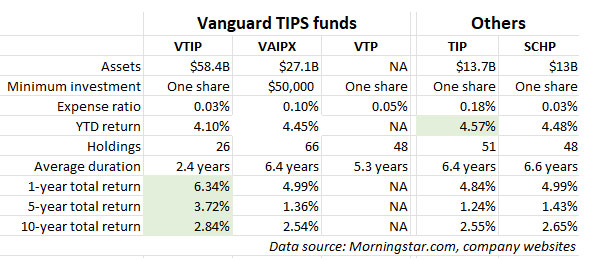
We can’t do a direct comparison of the ETFs yet, but let’s look at how VTIP and VAIPX have performed, with the addition of the full-range iShares TIP and Schwab SCHP ETFs:
This information, gathered from Vanguard’s site, shows that VTP is not an exact duplicate of VAIPX. It is holding fewer issues, and its average duration is shorter. There are 53 TIPS currently trading in the secondary market.
Also, as you can see, VTIP has out-performed the full-maturity VAIPX over 1-year, 5-year and 10-year periods, during a time of high volatility in the Treasury market. However, if we entered another era of quantitative easing, with strongly lower real yields, VAIPX and VTP (along with TIP and SCHP) would likely outperform VTIP.
Thoughts
I don’t currently invest in any TIPS mutual funds or ETFs. I have used VTIP in the past as a holding fund while waiting to make future investments. I favor VTIP because of the lower volatility. The new ETF, VTP, should over time closely track TIP, the biggest TIPS ETF, which has a higher expense ratio of 0.18%.
My preference, as always, is to build a ladder of TIPS investments to be held to maturity, providing inflation-protected cash for future needs.
Now, here is a bonus. Morningstar’s Long View podcast this week featured Salim Ramji, one year into his tenure as CEO at Vanguard. He talks about the firm’s efforts to simplify investing and improve customer service:
Donate? This site is free and I plan to keep it that way. Some readers have suggested having a way to contribute. I would welcome donations. Any amount, or skip it, your choice. This is completely optional.
Follow Tipswatch on X for updates on daily Treasury auctions and real yield trends (when I am not traveling).
Feel free to post comments or questions below. If it is your first-ever comment, it will have to wait for moderation. After that, your comments will automatically appear. Please stay on topic and avoid political tirades.NOTE: Comment threads can only be three responses deep. If you see that you cannot respond, create a new comment and reference the topic.
David Enna is a financial journalist, not a financial adviser. He is not selling or profiting from any investment discussed. I Bonds and TIPS are not “get rich” investments; they are best used for capital preservation and inflation protection. They can be purchased through the Treasury or other providers without fees, commissions or carrying charges. Please do your own research before investing.
Just to give you an idea of how complicated taxes are: For my last post, discussing the tax on Social Security benefits, I made 27 edits and revisions within a day of publishing as I received new information from commenters and other sources.
And that was just one area of the 870-page One Big Beautiful Bill. Grasping this is a challenge. Feeling daring? Read it.
Andy Panko
Now I am looking to other sources I trust for as-accurate-as-possible information. One of those is financial adviser Andy Panko, who founded Tenon Financial in 2019 and also runs Facebook’s Retirement Planning Education group, a valuable resource. Panko also has a lot of expertise in tax matters.
I’ve followed Panko’s work for at least 6 years. He admittedly is a “super nerd,” but also a straightforward communicator and — importantly — won’t try to sell you anything. His firm charges a flat fee for financial advice and management. (I am not a client and I am not connected to his firm.)
I featured Panko in an April 2022 post providing his commentary on I Bonds, unusual for a financial adviser. This week, Panko created a podcast taking a deep dive into the Big Beautiful Bill, focusing on areas that would most affect individuals nearing or in retirement.
Here is the link I posted on X:
Here is financial adviser Andy Panko's take on the Big Beautiful Bill, focused primarily on how it affects individuals and couples. https://t.co/iGZo30iVWx
This is worth a listen (45 minutes), but if you don’t have the time or patience, you can read Panko’s excellent 8-page summary of the key individual income tax provisions of the One Big Beautiful Bill.
Panko covers a lot of ground, including “things that are not changing,” which includes the tax on Social Security benefits. He says:
Contrary to what you may have heard or read (including directly from the Social Security Administration itself), the bill makes NO changes to how Social Security is taxed. Social Security is still taxable at the federal level, and the bill makes no particular carveouts or direct exemptions to this. As such, it’s flat out false for anyone to say or insinuate the bill made Social Security not taxable.
For anyone concerned, beyond this one issue Panko is steadfastly neutral politically in his analysis. These are some of the other topics covered:
Permanency of the current federal tax rates
Permanency, and a slight increase, to the current standard deduction amounts
A new temporary personal exemption up to $6,000 per person 65 or older
Permanency, and a slight increase, to the lifetime gift and estate size exemption
Permanency of the current Alternative Minimum Tax exclusion amount, but reduction/reversion of its income phase out levels
Permanency of the $750,000 limit on residential mortgage principal against which interest can be deducted
Permanency of the elimination of miscellaneous itemized deductions
Temporary increase to $40,000 for State and Local Tax (“SALT”) deductions
A new permanent charitable deduction for people who use the standard deduction, beginning in 2026.
A new minimum AGI-based floor on charitable donations before donations can be itemized deductions
A temporary exclusion from income tax of up to $25,000 tip income
A temporary exclusion from income tax of up to $25,000 of overtime income
A temporary deduction of up to $10,000 of interest loans to buy cars whose final assembly was in the U.S.
Recissions of multiple “Green New Deal” tax credits such as electric vehicle credits and residential clean energy credits
Creation of new “Trump” savings accounts for children under 18
That’s an exhaustive (or maybe exhausting) list of topics to cover in a 45-minute podcast. Panko does a great job, and for later look-backs, save a link to the document form of his analysis, which closes with:
There is A LOT going on in the OBBBA, and it will take time for me and the rest of the industry to fully digest and understand it. This was my best crack at breaking it down as quickly and thoroughly as possible.
Most likely, we will learn a few more complexities — and smart ways to take advantage of the changes — but this is a great start for your tax planning for 2025 and beyond.
—————————
Donate? This site is free and I plan to keep it that way. Some readers have suggested having a way to contribute. I would welcome donations. Any amount, or skip it, your choice. This is completely optional.
Follow Tipswatch on X for updates on daily Treasury auctions and real yield trends (when I am not traveling).
Feel free to post comments or questions below. If it is your first-ever comment, it will have to wait for moderation. After that, your comments will automatically appear. Please stay on topic and avoid political tirades.NOTE: Comment threads can only be three responses deep. If you see that you cannot respond, create a new comment and reference the topic.
David Enna is a financial journalist, not a financial adviser. He is not selling or profiting from any investment discussed. I Bonds and TIPS are not “get rich” investments; they are best used for capital preservation and inflation protection. They can be purchased through the Treasury or other providers without fees, commissions or carrying charges. Please do your own research before investing.
AI-generated image for “middle-aged couple with cash.” Source: Perchance.org
By David Enna, Tipswatch.com
I sometimes watch too much CNN (stop me!) and on Thursday I heard Republican members of Congress repeatedly state that the just-approved Big Beautiful Bill would eliminate the tax on Social Security benefits, fulfilling a campaign promise by President Trump.
And then in his celebratory speech in Iowa Thursday evening, Trump said:
“We’re making the Trump tax cuts permanent and delivering no tax on tips. No tax on overtime. And no tax on Social Security for our great seniors. Right?”
Click on image to view email.
And I received this email from the Social Security Administration Friday morning:
The Social Security Administration (SSA) is celebrating the passage of the One Big, Beautiful Bill, a landmark piece of legislation that delivers long-awaited tax relief to millions of older Americans.
The bill ensures that nearly 90% of Social Security beneficiaries will no longer pay federal income taxes on their benefits, providing meaningful and immediate relief to seniors who have spent a lifetime contributing to our nation’s economy. …
The new law includes a provision that eliminates federal income taxes on Social Security benefits for most beneficiaries, providing relief to individuals and couples. … Social Security remains committed to providing timely, accurate information to the public.
A lot of this is not true, and whoever was responsible for that email should be embarrassed. What’s even weirder: There was no reason to fudge the facts here. The bill does provide meaningful (but temporary) tax relief for most seniors, and in fact will reduce federal tax bills for most seniors. But it does not eliminate the tax on Social Security benefits, which remains intact exactly as in pre-July-4 law.
What the bill does
The Big Beautiful Bill provides a $6,000 boost to senior citizens’ standard deduction from 2025 through 2028. The new tax break — $6,000 for individuals and $12,000 for couples — is for tax filers age 65 and older. It starts phasing out for those who earn over $75,000 ($150,000 for couples).
This provision is aimed at middle- to upper-middle-income taxpayers. People with very low incomes won’t benefit (they already pay near-zero taxes) and high-income people will see the deduction phased out completely. This is from a Yahoo Finance analysis:
To be clear, this provision does not eliminate taxes on Social Security benefits as Trump promised in the campaign. It is a temporary income tax deduction, not a cut in the Social Security tax. …
In addition, under existing law, people over 65 got an add-on to the standard deduction — $2,000 for a single person and $3,200 for a couple filing jointly. The White House has issued a fact sheet that clarifies those pre-existing add-on deductions will continue:
Under current law, about 40% of people who get Social Security must pay federal income taxes on some of their benefits, according to the SSA. The tax hit begins at low levels ($32,000 for couples) and eventually caps out at $44,000, when up to 85% of the couple’s benefits may be taxable. These levels were initially set in 1983 and have not been indexed to inflation.
Again, the current tax on Social Security benefits remains intact. But the boost of $6,000 / $12,000 to the standard deduction will provide a counter-balancing tax break, potentially eliminating the effect of the Social Security tax. People who rely solely on Social Security for income will likely not pay any tax at all.
However, people under the age of 65 who have already begun collecting Social Security will be subject to the full tax — potentially on 85% of benefits — with no increase in the standard deduction.
A couple over 65 with up to $96,950 in taxable income in 2025 is in the 12% marginal tax bracket. So a boost of $12,000 to their standard deduction would provide a potential tax break of $1,400, whether or not they are collecting Social Security. A similar couple with $150,000 in taxable income is the in 22% tax bracket, and would receive a potential tax break of $2,640. That is substantial.
A couple with taxable income above $150,000 would see the deduction phase out and it would be completely gone for a couple with $250,000 income. I am assuming these people would still be eligible for the current $34,700 standard deduction for couples over 65.
The $6,000 bonus deduction would be available to taxpayers whether they take the standard deduction or itemize.
Primary Beneficiaries: The main group to benefit are middle-income seniors aged 65 and over. These are individuals whose total income is high enough to create federal tax liability but low enough to fall below the phase-out thresholds. The White House Council of Economic Advisers estimated the new deduction would benefit 33.9 million seniors.
No Benefit for the Lowest-Income Seniors: The poorest seniors, whose total income is already below existing deduction thresholds, pay no federal income tax on their Social Security benefits. For this group, an additional deduction has no effect.
No Benefit for High-Income Seniors: Wealthier retirees with incomes above the phase-out thresholds are ineligible for the deduction and see no change in their tax liability from this provision.
Harry Sit, creator of TheFinanceBuff.com, just posted a good analysis of this issue, including a chart compiling the income phaseouts:
Key takeaway: Note that some significant tax benefits remain even when a person or couple gets close to the $175,000 or $250,000 limits. Some smart income planning could result in a lower tax bill for 2025.
The new law also includes a deduction on charitable contributions, according to CNBC. The bill allows charitable taxpayers who don’t itemize to deduct up to $1,000 for single filers and $2,000 for married couples filing jointly. This begins for tax year 2026 and may also apply in some form to taxpayers who itemize.
Based on excellent information provided by commenters, it appears all the new deductions will be “below the line,” meaning they will not reduce adjusted gross income, which is used to determine Medicare surcharge levels among other things. But they will reduce taxable income.
Why this is good
The bill cleverly shifts the tax break to a 4-year increased standard deduction instead of eliminating the tax on Social Security benefits. Why is that good? Because the tax on benefits is intact and goes back into the Social Security “trust fund,” helping to pay future benefits. The trust fund is currently expected to run dry in 2032 to 2034, potentially leading to a 19%+ cut in payments to all beneficiaries.
The Committee for a Responsible Federal Budget estimates the higher senior tax deduction through 2028 would result in a loss of $66 billion in revenue over the four years. But most of that lost revenue would be outside the Social Security system.
And the downside …
Because many senior citizens will now be reporting lower adjusted gross incomes, they will in turn potentially be paying 1) less in taxes on Social Security benefits and 2) less in Medicare surcharges imposed through the Income-Related Monthly Adjustment Amount, or IRMAA. GovFacts.org says:
The nonpartisan Committee for a Responsible Federal Budget (CRFB) estimates that the “senior bonus” and other tax changes in the bill will lower revenue collected from benefit taxation by approximately $30 billion per year. …
The CRFB projects that this revenue loss is significant enough to accelerate the projected insolvency date for the Social Security OASI trust fund (which pays retirement and survivor benefits) from early 2033 to late 2032.
The IRMAA trigger levels are not directly affected by increasing the standard deduction, because IRMAA is based on adjusted gross income, before the deduction is subtracted. But with the expanded deduction, some retired people may be making smaller taxable withdrawals or stock sales to supply current income, making it easier to stay below IRMAA trigger levels.
Thoughts
No one is a “fan” of the tax on Social Security benefits, or the Medicare IRMAA surcharges for that matter. But I understand the need for these taxes and surcharges to keep these important programs going. Not every problem can be solved with a tax cut.
So, I support the tax on Social Security benefits. The problem with the tax is that the trigger levels are much too low and have never been indexed to inflation, after 42 years. Too many people at fairly low income levels are paying the tax.
The tax is crucial to help delay insolvency of the Social Security trust fund. That day is coming and a solution needs to be found. I don’t expect anything to be done in the next three years, so the problem will simply get more severe.
Trump promised “no tax on Social Security” — an idea I did not support. Congress came up with a solution to give seniors a temporary, 4-year tax cut outside of the Social Security system, adding to the federal deficit but not putting a great deal of additional strain on Social Security.
Under the fast-track legislative procedure that Republicans are using to pass their bill, they aren’t allowed to touch the Social Security trust funds, which is where some income taxes on benefits go. Republicans devised the senior bonus deduction as a way to give tax breaks to many of the same people who pay taxes on their Social Security benefits. …
“I would welcome any relief on taxes,” said Trump voter Peter Sullivan, 67, a retired financial executive in Strongsville, Ohio. He added: “It’s still short of my Social Security tax nirvana of having it completely tax-free.”
The tax on Social Security benefits is intact and under current law will continue after the $6,000 bonus standard deduction ends in 2028. My opinion: This is a good thing. I am sure some of you disagree. Express opinions in the comment section, but please avoid political attacks or tirades.
—————————
Donate? This site is free and I plan to keep it that way. Some readers have suggested having a way to contribute. I would welcome donations. Any amount, or skip it, your choice. This is completely optional.
Follow Tipswatch on X for updates on daily Treasury auctions and real yield trends (when I am not traveling).
Feel free to post comments or questions below. If it is your first-ever comment, it will have to wait for moderation. After that, your comments will automatically appear. Please stay on topic and avoid political tirades.NOTE: Comment threads can only be three responses deep. If you see that you cannot respond, create a new comment and reference the topic.
David Enna is a financial journalist, not a financial adviser. He is not selling or profiting from any investment discussed. I Bonds and TIPS are not “get rich” investments; they are best used for capital preservation and inflation protection. They can be purchased through the Treasury or other providers without fees, commissions or carrying charges. Please do your own research before investing.
For some reason, the $110 net asset value is a marker for me.
By David Enna, Tipswatch.com
I have been writing about Treasury Inflation-Protected Securities for more than 14 years, and that is plenty of time to dream up “significant patterns” in my mind. One of those was a $110 asset value for the iShares TIPS Bond ETF.
One thing to note, right away, is that the net asset value of the TIP ETF is pretty much unchanged all the way back to 2010 — 15 years with no gain. However, net asset value excludes dividends, which include inflation accruals. So in theory, the TIP ETF’s performance should closely match inflation over those years. TIP had a total annualized return of 2.71% over the last 15 years, according to Morningstar. U.S. inflation has averaged about 2.6% over that time.
I generally don’t invest in TIPS funds or ETFs, and if I did I would use VTIP, Vanguard’s short-term TIPS ETF, which has less volatility. But TIP is the largest TIPS fund and a good indicator of the overall market, since it hold TIPS of all maturities.
For many years, I used the $110 price as a “buy” signal for TIPS in general, indicating favorable market conditions for an investment. And that worked often, as shown in the chart, with TIP bouncing higher repeatedly once it hit $110. Here is an example of my writing from November 2015:
I do follow the TIP ETF to check on the overall trend in TIPS, and I have said for a long time that TIPS values would be returning to a more ‘normal’ level when the TIP ETF dropped below $110.
This was never an “investment strategy,” but an attempt to get an idea of the relative “safety” of an investment in TIPS. In September 2022, the ETF again dipped to $110 as the Fed was intensifying its battle against inflation by raising short-term interest rates and slashing its balance sheet of Treasurys. I wrote then:
The bond market is a very scary thing in September 2022 and I’m not going to argue that anyone should be pouring money into TIPS mutual funds or ETFs. But I will argue that TIPS in general — along with these funds — are much more attractive today than they were six months ago, when the 10-year TIPS was yielding -1.04% and the TIP ETF was trading at $122.46.
The background
You need to understand that I started Tipswatch.com in April 2011, at a time when the Federal Reserve was beginning a decade of significant manipulation of the Treasury market, through a bond-buying process known as “quantitative easing.” In simple terms, the Fed began buying (and holding) medium- to longer-term Treasurys, including TIPS, to force down yields.
The first phase of QE began (mildly) in November 2008 and the second phase (also mild) started in November 2010. Things stepped up dramatically in late 2012. In this process, the Fed was “printing money” by buying up and holding Treasurys in competition with bond investors.
This continued — off and on — through March 2018, when the Fed began a brief program of “quantitative tightening,” allowing Treasurys to roll off its balance sheet. But then came the COVID crisis in March 2020. At that point, the Fed’s relaunched QE in a ballistic form, as reflected in this chart:
Click on image for larger version
This chart and the next one are important in explaining the massive surge in inflation we saw in mid 2022, when the U.S. inflation rate hit a 40-year high of 9.1%. This was combined with congressional actions to push out stimulus checks to nearly all Americans. This next chart shows the incredible growth in M2, defined roughly as the U.S. supply of spendable cash:
Click on image for larger version.
You can blame the Federal Reserve, President Trump, President Biden, the COVID crisis, Vladimir Putin, etc., but the result after March 2020 was very high inflation. That problem is lessening today — thanks to aggressive braking action by the Federal Reserve — but inflation remains a bit high today at an annual rate of 2.4%.
What does it all mean?
Pretty much nothing. The $110 milestone was a creation of my imagination, but I do think it is a decent marker of equal levels of risk / potential gain in the TIPS market. The difference today is that the net asset value is rising to $110 instead of falling there. So is that a “sell” signal instead of a buy? I don’t think so, but there is no certainty today in the U.S. Treasury market, which will be strained by years of increasing U.S. budget deficits.
As I have noted, I don’t invest in these funds or ETFs and I don’t purchase individual TIPS for potential trading gains. Buying individual TIPS to hold to maturity is close to a “risk free” strategy, especially when real yields are at historically attractive levels.
Donate? This site is free and I plan to keep it that way. Some readers have suggested having a way to contribute. I would welcome donations. Any amount, or skip it, your choice. This is completely optional.
Follow Tipswatch on X for updates on daily Treasury auctions and real yield trends (when I am not traveling).
Feel free to post comments or questions below. If it is your first-ever comment, it will have to wait for moderation. After that, your comments will automatically appear. Please stay on topic and avoid political tirades.NOTE: Comment threads can only be three responses deep. If you see that you cannot respond, create a new comment and reference the topic.
David Enna is a financial journalist, not a financial adviser. He is not selling or profiting from any investment discussed. I Bonds and TIPS are not “get rich” investments; they are best used for capital preservation and inflation protection. They can be purchased through the Treasury or other providers without fees, commissions or carrying charges. Please do your own research before investing.
A looming debt-limit crisis is causing yield anomalies.
By David Enna, Tipswatch.com
In looking over this week’s auctions of Treasury bills, I noticed something unusual, but also predictable: The looming debt-limit crisis is beginning to send tremors through the short-term Treasury market.
For example, on Thursday I posted these results on X:
Also today, 77-day cash management bill, a unique term that Treasury says is needed for "debt limit-related constraints," pushing maturities out to September. Investment rate of 4.349%. up from 4.307% last week for the 16-day offering.
It’s unusual to see a 41-basis-point spread between the yields of a 4-week versus 8-week T-bill, on the same auction day. For example, on May 13 the 4-week auctioned at 4.293% while the 8-week was 4.322%, only a 3-basis point spread. That’s normal. A 41-basis-point spread is a strong indication that investors are pouring into the 4-week and shunning the 8-week, which will mature August 26, 2025, potentially in the middle of a Treasury funding crisis.
And then, also Thursday, Treasury issued $60 billion in an unusual 77-day cash management bill, which will mature Sept. 16, potentially beyond the crisis. The usual CMB size recently has been $50 billion and the term has been 14 days, sometimes 42 days. Treasury gave very specific reasoning for the change:
As noted in the May 2025 Quarterly Refunding Statement, until the debt limit is suspended or increased, debt limit-related constraints will lead to greater-than-normal variability in benchmark bill issuance and significant usage of cash management bills (CMBs).
Beginning with a CMB auction announcement on June 24, 2025, Treasury expects to issue a series of CMBs over the next month for up to $250 billion in aggregate. Each of these CMBs will mature on a Tuesday or Thursday in the second half of September. … Treasury expects that issuing these CMBs will at least partially offset the anticipated reduction to the net supply of Treasury bills associated with shrinking 4-, 6-, and 8-week benchmark bill offering sizes.
Technically, the debt-limit crisis has already begun. Since Jan. 21, Treasury has been using extraordinary measures to finance the government. And it has noted, “Treasury is not able at this time to provide an estimate of how long its cash and extraordinary measures may last.”
The expected “X-date,” as it is called, is likely to hit between Aug. 15 and Oct. 3, according to the Bipartisan Policy Center. As Aug. 15 approaches, you can expect to see anomalies popping up in T-bill auctions for issues that will mature during the potential shutdown.
We’ve seen this before
The anomalies will take two forms: 1) sharply lower yields on 4-week T-bills as long as the crisis remains more than 4 weeks away, and 2) sharply higher yields on longer-term T-bills that will mature in the “danger zone.” Eventually, as the X-date gets very close, investors will demand higher yields on the 4-week, too.
Click on image for larger version.
In 2023: The chart shows the dramatic disruption of the 4-week T-bill, with yields falling sharply at the same time the 13-week yields were rising. Once the debt limit crisis X-date reached one month away, the 4-week yield soared above the 13-week.
In 2025: At the far right of the chart, you can see the beginning of the predictable pattern: The 4-week yield is falling while the 13-week yield is rising.
I wrote about this back in April 2023, and included this chart showing the divergence in yields a month-plus before the crisis was resolved:
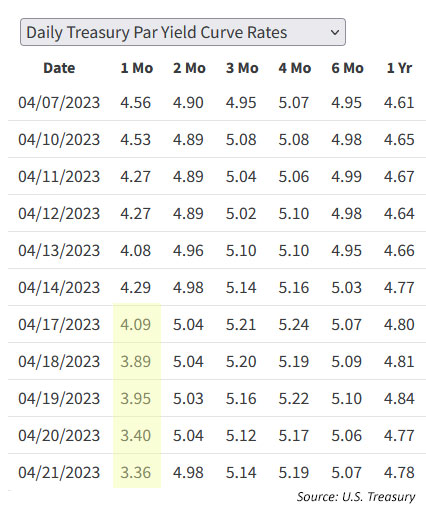
This chart, from the Treasury’s Yields Curve estimates page, shows that the 4-week T-bill’s yield fell 120 basis points in three weeks, while the 8-week was up 8 basis points and the 13-week up 19 basis points. The same is true across the T-bill spectrum — every issue except the 4-week saw yields rise in April 2023.
This disruption is routine because of the strange way the United States handles its debt limit, forcing a periodic crisis (and eventual resolution). This is a 2023 chart from Moody Analytics:
So far in June 2025, the T-bill disruption is just beginning, but it will step up in coming weeks if the debt limit is not increased:
In a normal market, the 4-week T-bill’s yield should be very close to the effective Federal Funds rate, which currently stands at 4.31%.
This is not a ‘crisis’
The issue could be resolved in the next week, if Senate and House Republicans can get near 100% agreement on President Trump’s “Big Beautiful Bill.”
In most versions of this funding farce, you had Republicans controlling at least one house of Congress, combined with a Democratic president. In only takes a handful of members of Congress to set off the crisis, usually as an attempt to to gain spending-cut concessions. Eventually, a compromise is reached.
In 2017 and 2018, under Trump, the debt limit was increased without much fanfare.
In 2025, you have a Republican Congress and a very powerful Republican president who will demand that the crisis be avoided. (Trump wants the debt limit to be abolished, a stand he shares with Sen. Elizabeth Warren.) Democrats won’t offer to “help out,” but the debt limit has never been an issue for them.
Trump’s Big Beautiful Bill, if passed, would resolve this problem by increasing the federal statutory debt limit by $5.1 trillion. The New York Times noted on June 19:
The national debt is approaching $37 trillion. This week, Senate Republicans unveiled legislation that would raise the debt limit by $5.1 trillion, higher than the $4 trillion increase that House Republicans voted for in their bill last month. Such an increase would likely extend the nation’s ability to borrow into 2028.
An increase of that magnitude would be a record and underscore the ideological flexibility that many Republicans are willing to embrace when they are in power.
In essence, a $5.1 trillion debt-limit increase would push any future crisis out of Trump’s presidency, an idea he supports. (It also provides evidence of large U.S. deficits triggered by this bill over the next few years.) Some Republicans, including Sen. Rand Paul of Kentucky, oppose the lengthy increase. Instead, Paul suggests suspending the debt limit by three months.
The Big Beautiful Bill seems likely to gain approval, as long as nearly every Republican follows the president’s wishes. But when? Trump wants the bill on his desk by July 4, but any snag in House-Senate negotiations could delay final passage. Beyond July 4, the X-date crisis clock will begin ticking.
It would be possible to separate the debt limit issue from the overall spending bill, but that might require concessions to Democrats. If the Big Beautiful Bill stalls (it probably won’t) then emergency action will be needed.
What happens in a debt-lock?
I don’t think the U.S. is going to default on its debt, but there’s a slight possibility we will see a short-term government shutdown and disruption to government payments. No one knows exactly how this would play out.
“Under the plan, there would be no default on Treasury securities. Treasury would continue to pay interest on those Treasury securities as it comes due. And, as securities mature, Treasury would pay that principal by auctioning new securities for the same amount (and thus not increasing the overall stock of debt held by the public). Treasury would delay payments for all other obligations until it had at least enough cash to pay a full day’s obligations. In other words, it will delay payments to agencies, contractors, Social Security beneficiaries, and Medicare providers rather than attempting to pick and choose which payments to make that are due on a given day.”
On Thursday, we saw the Treasury launch a plan to issue $250 billion in longer-term cash management bills in coming weeks. This is a logical strategy, pushing maturities beyond the potential X-date. At the same time it reduced Thursday’s 4- and 8-week auction sizes by $5 billion each.
Most likely, this all gets resolved in the next 5 to 10 days. But as the X-date approaches, we will see worsening disruptions to the T-bill market. People will begin asking: “Is the government going to shut down?” … “Will my T-bill mature and pay out on the predicable date?” … “Is my Social Security benefit payment going to be delayed?” … “Will there be a TIPS auction this month?”
The debt crisis will be resolved, either through the Big Beautiful Bill or through emergency congressional action. As an investor, I would not hesitate to invest in a Treasury T-bill, despite the potential disruption.
—————————
Donate? This site is free and I plan to keep it that way. Some readers have suggested having a way to contribute. I would welcome donations. Any amount, or skip it, your choice. This is completely optional.
Follow Tipswatch on X for updates on daily Treasury auctions and real yield trends (when I am not traveling).
Feel free to post comments or questions below. If it is your first-ever comment, it will have to wait for moderation. After that, your comments will automatically appear. Please stay on topic and avoid political tirades.NOTE: Comment threads can only be three responses deep. If you see that you cannot respond, create a new comment and reference the topic.
David Enna is a financial journalist, not a financial adviser. He is not selling or profiting from any investment discussed. I Bonds and TIPS are not “get rich” investments; they are best used for capital preservation and inflation protection. They can be purchased through the Treasury or other providers without fees, commissions or carrying charges. Please do your own research before investing.









Do they both have ads on their websites? The idea of ID.me trying to get you to buy something after…