
By David Enna, Tipswatch.com
The Treasury’s largest 10-year TIPS auction in history got a warm welcome from investors, generating a real yield to maturity of 1.985% — a bit below expectations, an indication of solid demand.
The auction size was $21 billion, up from $20 billion at the most recent originating auction in January, and up from $19 billion last July. But investors were not daunted. The “when-issued” yield prediction for this auction was 1.99%, but the result came in slightly lower, a good indication of demand. The bid-to-cover ratio was 2.41, also showing decent demand.
This is CUSIP 91282CNS6, a new 10-year Treasury Inflation-Protected Security that will mature on July 15, 2035. Its coupon rate was set at 1.875%.
Definition: The “real yield to maturity” of a TIPS is its yield above official future U.S. inflation, over the term of the TIPS. So a real yield of 1.985% means an investment in this TIPS would provide a return that exceeds U.S. inflation by 1.985% for 10 years.
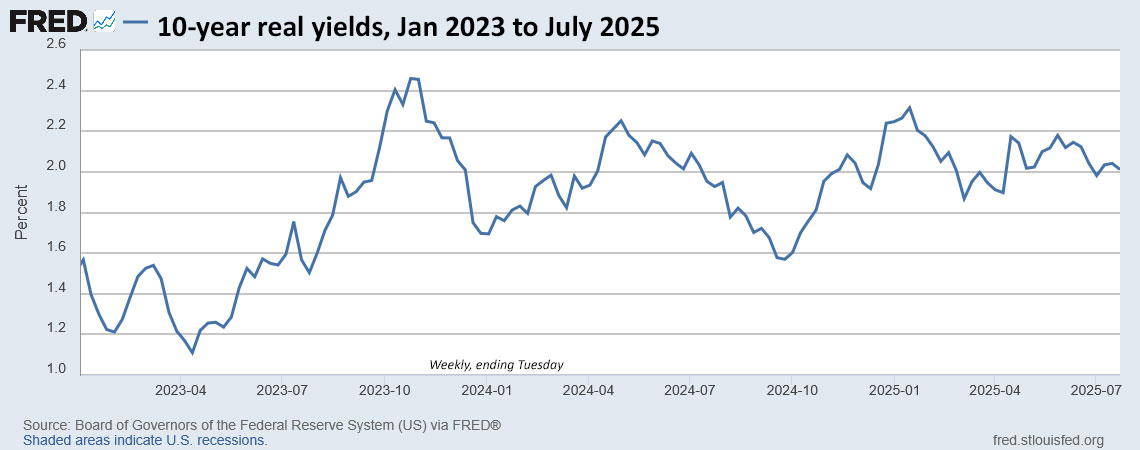
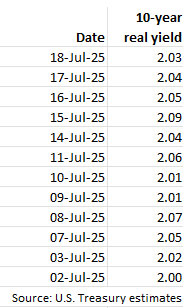
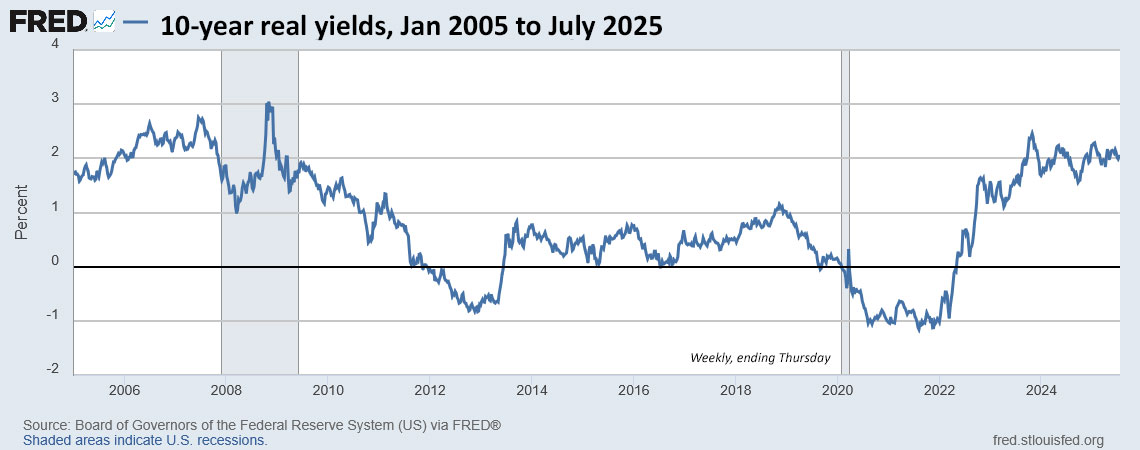
The auctioned yield was slightly below recent trading in the 10-year TIPS market, which has seen real yields hovering around 2.0%. Here is the trend in the 10-year real yield over the last 2 1/2 years:
Pricing
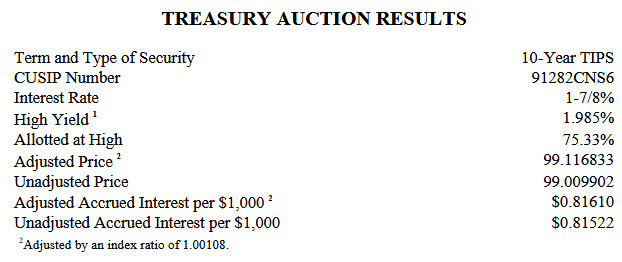
Because the real yield of 1.985% was above the coupon rate of 1.875% — which is always the case with a new TIPS — CUSIP 91282CNS6 auctioned at a discounted unadjusted price of 99.009902. In addition, this TIPS will carry an inflation index of 1.00108 on the settlement date of July 31. With that information, we can calculate the exact cost of a $10,000 par value investment at today’s auction:
- Par value: $10,000
- Actual principal purchased: $10,000 x 1.00108 = $10,010.80
- Cost of investment: $10,010.80 x 0.99009902 = $9.911.68
- + accrued interest of $8.16.
In summary, an investor purchasing $10,000 of this TIPS at today’s auction paid $9.911.68 for $10,010.80 of principal as of the July 31 settlement. From that point on, the investor will earn accruals matching U.S. inflation, plus an annual coupon rate of 1.875% applied to inflation-adjusted principal.
Inflation breakeven rate
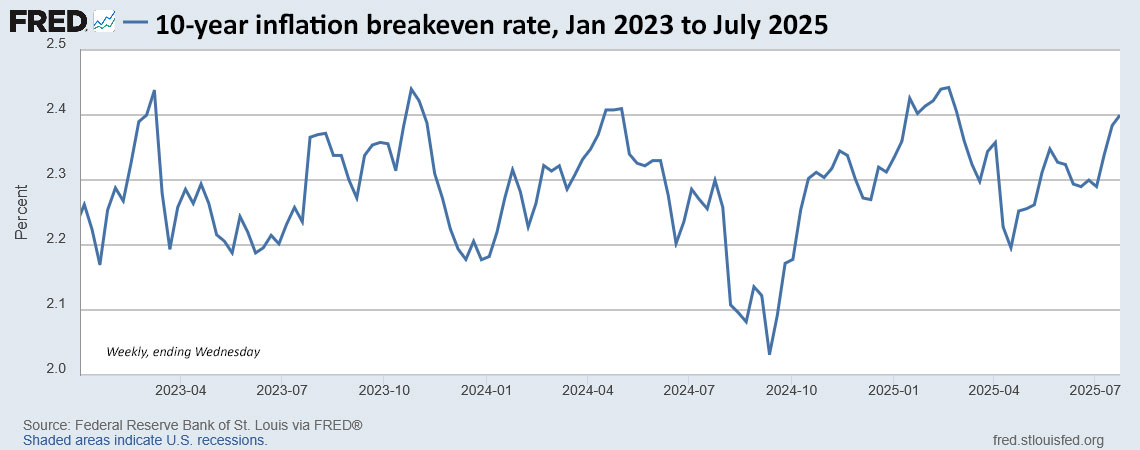
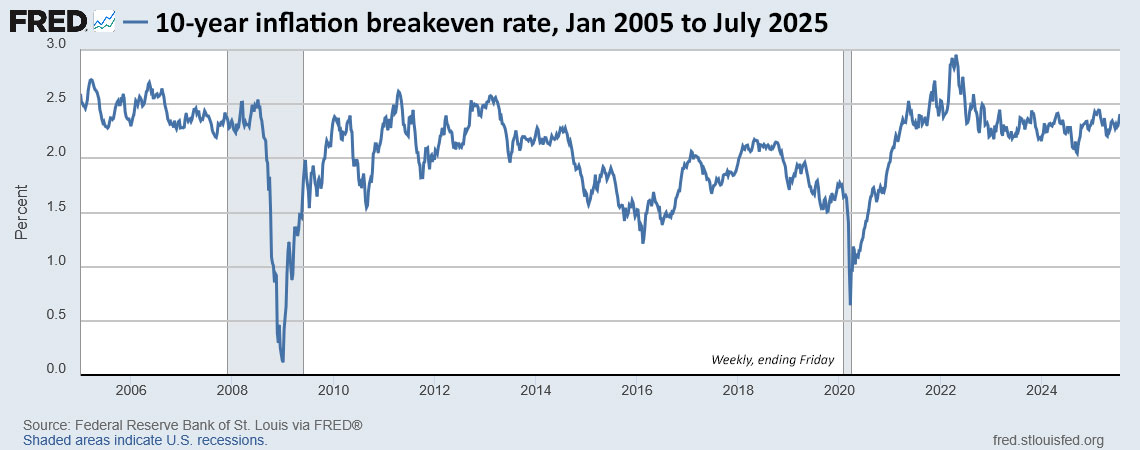
With the nominal 10-year Treasury note trading with a yield of 4.40% at the auction’s close, this TIPS gets an inflation breakeven rate of 2.41%, a bit higher than recent results. This means the TIPS will outperform the nominal Treasury if inflation averages more than 2.41% over the next 10 years. (I’d rule this as a toss-up, but I’d prefer the TIPS for its built-in inflation protection.)
Here is the trend in the 10-year inflation breakeven rate over the last 2 1/2 years, showing the high volatility in inflation sentiment:
Auction thoughts
I wasn’t an investor (the 2035 rung is full on my TIPS ladder) but nevertheless I was holding out hope for the real yield to break higher than 2.0%, a nice milestone. It was close, but apparently solid demand kept a lid on the real yield.
No matter. The real yield of 1.985% is a solid result. No need for investor despair.
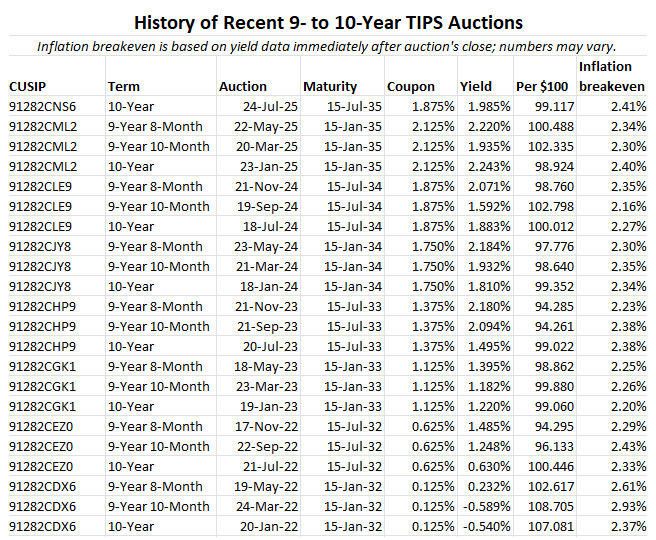
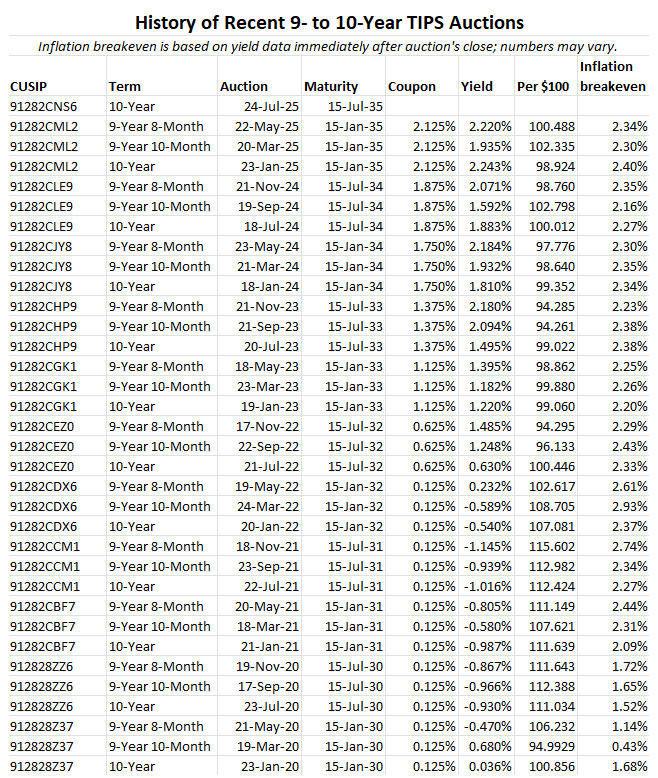
This TIPS will get reopening auctions in September and November and another new 10-year TIPS will be auctioned in January. It will be interesting to watch where the longer-term Treasury yields head in upcoming months. Here is a history of 9- to 10-year TIPS auctions over the last 3 1/2 years:
• Now is an ideal time to build a TIPS ladder
• Confused by TIPS? Read my Q&A on TIPS
• TIPS in depth: Understand the language
• TIPS on the secondary market: Things to consider
• TIPS investor: Don’t over-think the threat of deflation
• Upcoming schedule of TIPS auctions
—————————

Donate? This site is free and I plan to keep it that way. Some readers have suggested having a way to contribute. I would welcome donations. Any amount, or skip it, your choice. This is completely optional.
—————————
Follow Tipswatch on X for updates on daily Treasury auctions and real yield trends (when I am not traveling).
Feel free to post comments or questions below. If it is your first-ever comment, it will have to wait for moderation. After that, your comments will automatically appear. Please stay on topic and avoid political tirades. NOTE: Comment threads can only be three responses deep. If you see that you cannot respond, create a new comment and reference the topic.
David Enna is a financial journalist, not a financial adviser. He is not selling or profiting from any investment discussed. I Bonds and TIPS are not “get rich” investments; they are best used for capital preservation and inflation protection. They can be purchased through the Treasury or other providers without fees, commissions or carrying charges. Please do your own research before investing.





Do they both have ads on their websites? The idea of ID.me trying to get you to buy something after…