Can we build a better TIPS ETF?

Financial planner Allan Roth has an idea for using TIPS for retirement security.

By David Enna, Tipswatch.com

It’s no secret that I am not a huge fan of mutual funds and ETFs that invest in Treasury Inflation-Protected Securities, because of my long-standing strategy to buy individual TIPS at good yields and hold them to maturity.

I’m sticking to that view, which dates all the way back to May 2011, when I wrote an article: “Why I am exiting Fidelity Inflation Protected Bond (FINPX)” explaining that I had made an 18.6% profit in the fund over three years, and was ready to depart. I wrote:

My feeling is that TIPS yields are well below the historical norm, and eventually the trend will return to normal. … The TIPS fund is booming with the current surge in Treasury securities. I think that will pass.

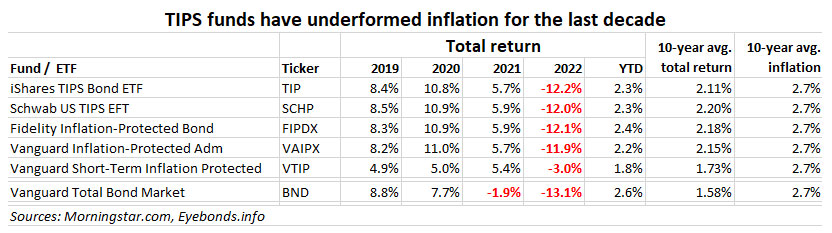
Strange thing: A year later Fidelity also exited FINPX, converting it into FIPDX, the Fidelity Inflation-Protected Bond Index Fund. That fund has had a total annual return of 2.18% over the last 10 years — not exciting, but it beats the 1.58% return of Vanguard’s Total Bond Fund (BND).

I understand that a lot of people want to combine inflation protection with the simplicity of an ETF, and TIPS funds can fill that need. But volatility in these funds can be a problem for investors seeking to fill specific income needs in the future. One bad year — like we had in 2022 — can derail longer-term bond investments.
Click on image for larger version.

Have TIPS funds failed us?

Yes, these big TIPS funds failed to keep up with inflation. And that is utterly embarrassing at time when inflation was surging to a 40-year high.

That happened for two reasons: 1) The Federal Reserve’s repeated bouts of quantitative easing sent real yields deeply negative for much of the last decade, ensuring that this investment would lag inflation, and then 2) a massive 250-basis-point increase over the last 15 months sent TIPS values plummeting. Moving from a 10-year real yield of -1.04% in March 2022 to 1.53% at Friday’s close put a pounding on TIPS funds (and the entire bond market).

Morningstar took on this issue June 12 with a Jeffrey Ptak article with a savage headline: “The Inflation Hedge That Cost Investors 17% of Their Purchasing Power.” Ptak pointed out that investors poured money into TIPS funds after seeing 10%+ plus returns in 2020, followed by a growing surge in U.S. inflation.

Most of those investors flocked to TIPS funds seeking an inflation hedge. But they got more than they bargained for, with TIPS selling off sharply in 2022 as real yields reversed direction. All told, the average inflation-protected securities fund fell 9.5% in 2022. Taken together with the 7.5% inflation rate that year, investors in TIPS funds saw a 17% loss of purchasing power in 2022.

The author points out that using TIPS funds as trading vehicles has given investors even worse performance — buying at highs and selling out at lows.

While TIPS funds can serve a useful purpose, the data we analyzed suggests that investors have struggled to use them successfully in practice. They’ve chased returns, allocating more to TIPS funds after they’ve gained and fleeing when they falter. Thus, they have little to show for their efforts: By our estimates, the average dollar invested in TIPS funds lost 0.70% per year over the 10 years ended April 30, 2023.

I can’t argue with the premise of this article, even though it is negative about the usefulness of TIPS investments. But the author hits the main point I have been stressing for a decade: Buy individual TIPS and hold them to maturity.

Other investors might want to consider bypassing TIPS funds altogether and instead investing directly in individual inflation-indexed Treasuries. To be sure, this is administratively burdensome, as the investor must select the appropriate TIPS maturities and maintain their portfolio over time. But it’s inexpensive and a TIPS ladder might give a buy-and-hold investor seeking the inflation guarantee peace of mind.

Allan Roth’s ‘new 4% rule’

Allan Roth

Allan Roth, a well-known author and hourly-fee financial adviser (one I have used in the past and will use again) made waves in the financial world last year when he suggested using a 30-year ladder of TIPS investments to guarantee a safe inflation-adjusted 4% withdrawal rate over that span.

That Oct. 24, 2022, article titled “The 4% Rule Just Became a Whole Lot Easier” detailed a technique for building a TIPS ladder — taking advantage of highly positive real yields — that could produce a 4.3% annualized real withdrawal rate for 30 years with no risk.

One day later, Roth’s idea launched a heated discussion and thorough analysis on the Bogleheads forum, generating 329 posts in just a couple days.

In December 2022, Morningstar weighed with an analysis of this idea by the site’s director of research, John Rekenthaler. He wrote:

With some effort, investors can create a TIPS portfolio that does, in fact, provide inflation-adjusted certainty of returns.

There’s even a website, Tipsladder.com, that provides a tool for designing a TIPS ladder based on the 4% withdrawal rate. (One complicating factor is that there are no TIPS maturing from 2034 to 2039. The solution is to buy a larger supply of TIPS maturing in 2033 and 2040 to cover the gap, or possibly to use I Bonds to help fill the gap.)

Roth’s Big Idea: A new TIPS ETF

On May 30, Roth wrote an article for ETF.com titled “An ETF Proposal for the 4% Rule.” He pointed out the problems with trying to build a 30-year TIPS ladder with equal amounts maturing each year:

1 It was complex and took hours to buy each of these bonds, with many of the trades not going through the first time.

2 The bid/ask spreads from buying a very small number of bonds were large and therefore took from returns.

3 While the cash flows average 4.38%, from buying a small number of bonds, the annual payouts varied a bit from that average. You can’t buy fractional amounts of TIPS as you can in a fund.

An ETF could easily solve all three of these problems.

Roth calls his ETF idea the Safe Withdrawal Rate ETF, or SWR for short. Here is how he says it could work:

The prospective consumer clicks on the SWR website to see its current real yield and annualized real cash flow. As of the time of this writing (May 2023), it would show 1.70% and 4.27%, respectively.

With a few simple clicks, one buys SWR with the intent never to sell. Let’s use $100,000 in this example. The authorized participant aggregates this purchase with many others to buy large volumes of TIPS to build the ladder ….

Then all the consumer or the ETF issuer has to do is nothing other than hold it forever. As the underlying TIPS mature, SWR would distribute the annual amount, $4,270 in this case, plus accumulated inflation.

The value of the ETF would decline over time as the TIPS mature, and would eventually reach zero in 30 years. Roth says, “In other words, SWR would be a self-liquidating ETF.” The funds could be offered in different maturities, of course. And the expense ratio in theory could be low (Roth suggests 0.05%) because no trading would happen once the fund is set.

Reaction to the idea

Roth’s idea prompted a June 16 article from Morningstar’s John Rekenthaler with the title “TIPS Ladder Funds Don’t Yet Exist, but They Should.” He points out that a such a fund would offer three advantages:

First, TIPS ladders are unique. No current fund behaves similarly. In a fund world dominated by me-too products, being different is valuable.

Second, TIPS ladders aren’t just distinctive—they’re distinctive and useful. True inflation hedges are rare. …

Third, TIPS ladders are laborious for retail investors to construct.

OK, but why not just buy a single-life annuity paying out lifetime fixed interest of maybe 6%? The problem is inflation, as Rekenthaler notes:

Why accept 4.27% from an immolating investment when one can buy a lifetime annuity that currently pays more, and which carries no expiration date? Two reasons. First … the annuity’s lifetime feature cuts both ways. Second, if inflation is substantial the real value of a nominal distribution, as made by annuities and conventional bonds, shrivels. Twelve years of 6% annual inflation halves purchasing power.

Inflation protection is the reason this SWR ETF idea is attractive. Rekenthaler points out that “every inflation-adjusted penny from a TIPS ladder is known in advance … No other investments can make such a claim.” He concludes:

Retirees need simple, effective methods for protecting their portfolios against inflation’s ravages. A TIPS ladder fund would expand their current options. It’s time for this idea to arrive.

Final thoughts

Building a long-term TIPS ladder is a laborious process, but at this point with real yields at decade-plus highs, it’s an investing opportunity for anyone who wants to preserve capital and ensure future cash flows, no matter the future rate of inflation.

Of course, for the risk-free strategy to work, the ladder-builder needs to commit to holding to maturity, using only money that can be set aside for years.

Roth’s ETF idea would simplify the process, but could face investor push-back over the idea of holding a 20- to 30-year investment to maturity, even if it was providing an inflation-adjusted, continuous return of 4.3% a year. Many of my readers, I think, would prefer the freedom to build their own TIPS ladders to meet specific needs.

But this kind of investment would simplify the process of funding retirement spending, and bring risk-free inflation protection to an entirely new market. Would it be too complicated for the average investor to grasp? Would the expense ratio truly be ultra-low, eliminating the need for self-building a TIPS ladder?

I like to see it happen.

Confused by TIPS? Read my Q&A on TIPS

TIPS in depth: Understand the language

TIPS on the secondary market: Things to consider

Upcoming schedule of TIPS auctions

Disclosure: I own VTIP in a traditional IRA account. I use it as a holding fund to make future purchases of individual TIPS.

* * *

Feel free to post comments or questions below. If it is your first-ever comment, it will have to wait for moderation. After that, your comments will automatically appear. Please stay on topic and avoid political tirades.

David Enna is a financial journalist, not a financial adviser. He is not selling or profiting from any investment discussed. I Bonds and TIPS are not “get rich” investments; they are best used for capital preservation and inflation protection. They can be purchased through the Treasury or other providers without fees, commissions or carrying charges. Please do your own research before investing.

Posted in ETFs, Investing in TIPS, Retirement | 38 Comments

5-year TIPS reopening gets real yield of 1.832%, highest in 14 years

By David Enna, Tipswatch.com

The Treasury just announced results of its $19 billion offering of a reopened 5-year TIPS, CUSIP 91282CGW5, and investors should be pleased.

This 4-year, 10-month Treasury Inflation-Protected Security got an auctioned real yield of 1.832%, the highest for any auction of this term since October 2008. There have been 46 auctions of 4- to 5-year TIPS over that time and only one other — in October 2022, got a real yield higher than 1.7%.

Real yields (meaning the yield an investor will earn above U.S. inflation) have been moving higher in recent weeks, reacting to the Federal Reserve’s potential plan to raise short-term interest rates once or twice again this year.

Definition: A TIPS is an investment that pays a coupon rate well below that of other Treasury investments of the same term. But with a TIPS, the principal balance adjusts each month (usually up, but sometimes down) to match the current U.S. inflation rate. So, the “real yield to maturity” of a TIPS indicates how much an investor will earn above inflation.

So, if inflation averages 2.5% over the next 4 years, 10 months, an investor in this TIPS would earn a nominal annualized return of 4.33%. If inflation averages 4%, the return would be 5.83% … and so on.

Here is a history of 5-year real yields over the last 14 years, showing the long periods of deeply negative real yields, right up until March 2022, when the Fed began aggressively battling inflation with higher interest rates:

Click on the image for a larger version.

Auction result, pricing

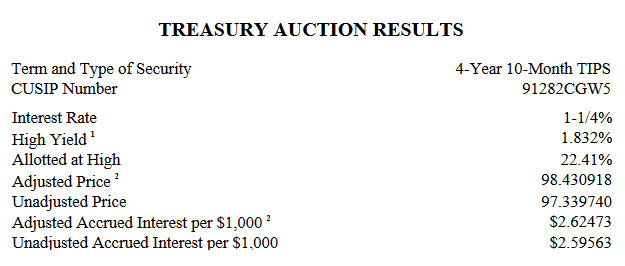
Here are details from the Treasury announcement:

Key factors for investors: 1) the unadjusted price of 97.339740 and 2) the inflation index of 1.01121 on the settlement date of June 30, 2023. This is how the investment pricing works out:

In essence, a $1,000 investment at par for this TIPS will cost $984.31 on the closing date, even though the investor will have $1,011.21 of principal on that date. From that point forward, the investor will earn the coupon rate of 1.25% applied to the principal balance, which will rise (or possibly fall) with future monthly inflation.

The prepayment of accrued interest will be returned at the first coupon payment on Oct. 15, 2023.

Calculation of real yield to maturity

Several readers have asked about how to do a calculation to check the real yield to maturity. Since this is a Treasury issue, I am confident the 1.832% real yield is accurate, and my rough estimate comes to close to that number. But reader Jim came up with the answer in the comments section below:

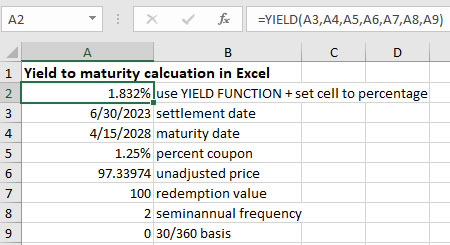
The real yield (“High Yield” in Treasury Auction Results) is a classic Yield To Maturity calculation using the issue date, maturity date, coupon rate, coupon frequency, unadjusted price and face value of the bond. It also is based on the day count assumption of a 30/360. If you wish to replicate the computation the easiest way is to use the YIELD function in excel. For this auction it would look like this, YIELD(6/30/2023,4/15/2028,1.25%,97.339740, 100,2,0). YTM is found by finding the rate necessary in the basic bond value equation so that the discounted future coupon payments and bond face amount equals the price paid for the bond. This is done by iterations using different rates until you find the correct value. Best to let a computer do it for you!

So, using Excel’s YIELD function, this is how you can set up the formula and find the result:

Inflation breakeven rate

At the auction’s close at 1 p.m. EDT, a 5-year Treasury note was trading with a nominal yield of 4.03%, creating an inflation breakeven rate of 2.2% for this TIPS. That is the lowest auctioned breakeven rate for this term since an auction in December 2020.

Although 2.2% is a relatively “highish” breakeven rate by historical standards, it seems quite reasonable at a time when U.S. inflation is running at 4.0%. In indicates that this TIPS is cheaply priced versus the nominal Treasury of the same term.

Here is the history of the 5-year inflation breakeven rate over the last 14 years:

Click on the image for a larger version.

Reaction to the auction

Things seemed to go smoothly. Through the morning, CUSIP 91282CGW5 was trading on the secondary market with a real yield in the range of 1.82% to 1.86%. The bid to cover ratio was a solid 2.56, so demand looked reasonably strong. After the auction’s close, the TIP ETF — which holds the broad range of maturities — moved slightly higher, indicating slightly lower yields. That’s an indication of a positive market reaction to the auction.

I was a buyer at this auction, even though I already purchased CUSIP 91282CGW5 at the April auction. A real yield of 1.83% was impossible to pass up. I might (or might not) have been able to do better earlier in the day on the secondary market, but Vanguard’s brokerage was only offering lot sizes of $100,000 or more.

Click on the image for a larger version.

No problem. I am happy with today’s result. If you were a buyer today, post your thoughts in the comments section below. Here are auction results for TIPS of this term over the last 5 years:

Confused by TIPS? Read my Q&A on TIPS

TIPS in depth: Understand the language

TIPS on the secondary market: Things to consider

Upcoming schedule of TIPS auctions

* * *

Feel free to post comments or questions below. If it is your first-ever comment, it will have to wait for moderation. After that, your comments will automatically appear. Please stay on topic and avoid political tirades.

David Enna is a financial journalist, not a financial adviser. He is not selling or profiting from any investment discussed. I Bonds and TIPS are not “get rich” investments; they are best used for capital preservation and inflation protection. They can be purchased through the Treasury or other providers without fees, commissions or carrying charges. Please do your own research before investing.

Posted in Investing in TIPS | 49 Comments

This week’s 5-year TIPS reopening could get the highest real yield in 14 years

By David Enna, Tipswatch.com

The U.S. Treasury on Thursday will offer $19 billion in a reopening auction of CUSIP 91282CGW5, creating a 4-year, 10-month Treasury Inflation-Protected Security.

This TIPS had its originating auction on April 20, 2023, when investors got a real yield to maturity of 1.32%. Its coupon rate was set at 1.25%. CUSIP 91282CGW5 now trades on the secondary market and at the close Friday it had a real yield to maturity of 1.81% and a discounted price of $97.43 for $100 of value.

If the real yield holds above 1.8% through Thursday’s auction, it would be the highest auctioned real yield for a TIPS of this term since October 2008.

Definition: A TIPS is an investment that pays a coupon rate well below that of other Treasury investments of the same term. But with a TIPS, the principal balance adjusts each month (usually up, but sometimes down) to match the current U.S. inflation rate. So, the “real yield to maturity” of a TIPS indicates how much an investor will earn above (or below) inflation.

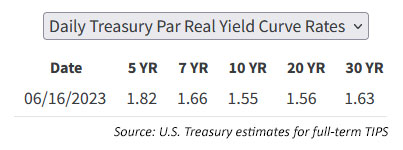
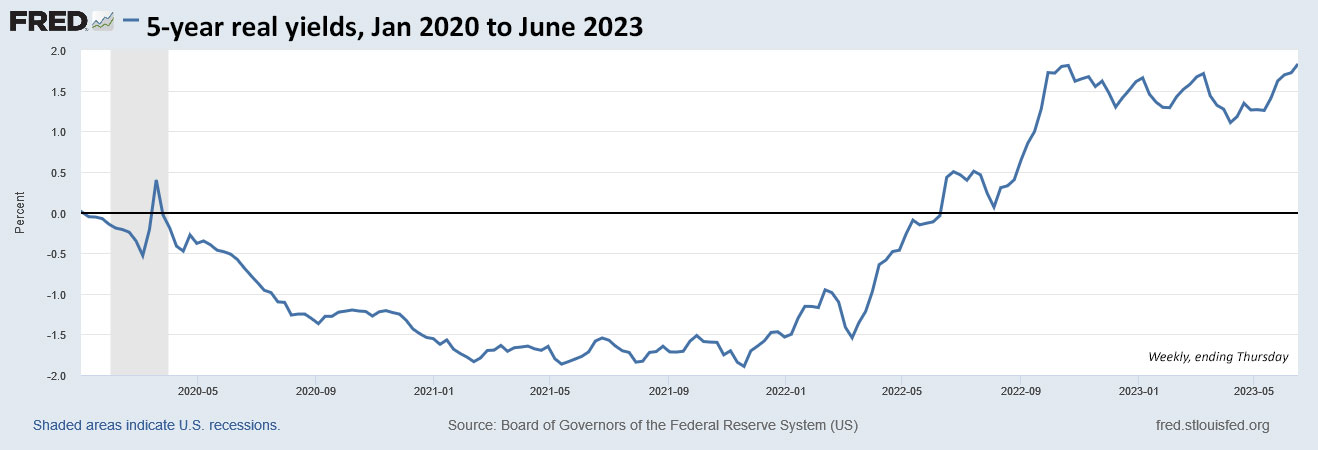
This TIPS looks attractive, in my opinion. I was a buyer at the originating auction and the real yield has risen strongly since then. The 5-year real yield — which is the most sensitive to Federal Reserve rate increases — is now the highest across the TIPS maturity spectrum:

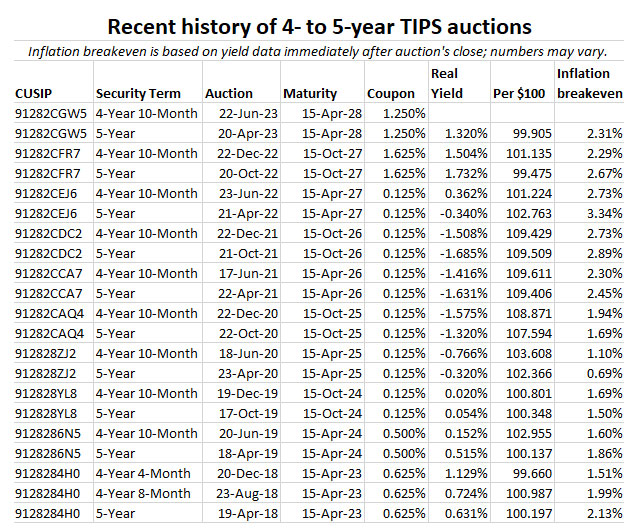
This chart shows how far we have come over the last three years, moving from dreary days of deeply negative real yields to 14-year highs. Just 2 years ago, in June 2021, a similar 5-year TIPS reopening got a real yield of -1.416%.

Click on the image for a larger version.

Pricing: On the settlement date of June 30, this TIPS will have an inflation index ratio of 1.01121, which means an order for $1,000 par would actually be purchasing $1,011.21 of principal. At the discounted price of 97.43, that would mean the investment cost would be $985.22 for $1,011.21 of principal. Plus the investor would pay an additional $2.62 per $1,000 for accrued interest. This will change by Thursday, but it does give you a rough estimate.

Inflation breakeven rate

With the nominal 5-year Treasury note trading with a yield of 3.98%, this TIPS currently has an inflation breakeven rate of 2.17%, a number I consider stunning. Investors are saying that inflation over the next 4 years, 10 months will average 2.17%? Seems mighty optimistic. If you think inflation will be higher, this TIPS is attractive, at least versus a nominal Treasury of the same term.

U.S. inflation is currently running at an annual rate of 4.0% and has averaged 3.9% over the last five years. Here is the trend in the 5-year inflation breakeven rate over the last three years:

Click on the image for a larger version.

What about bank CDs?

You can still find best-in-nation 5-year bank CDs paying 4.5% or even a bit higher. That stretches out the breakeven rate to about 2.7%, which seems more plausible. If you don’t care about inflation protection, bank CDs remain an attractive option.

What about I Bonds?

U.S. Series I Savings Bonds currently have a fixed rate of 0.9% for purchases through October. That fixed rate is equivalent to the real yield of a TIPS, and the 5-year term is an option for redemption without penalty. But a 5-year TIPS with a real yield of 1.81% is more attractive than an I Bond at 0.9%, looking purely at investment returns. I Bonds have other factors — simplicity, better deflation protection and flexible maturity date — that make them attractive. I invest in both.

Final thoughts

My TIPS ladder is already loaded with maturities in 2028. but I think I will add another purchase of CUSIP 91282CGW5, if real yields hold up next week. (Financial markets will be closed Monday for the Juneteenth holiday.) Most likely I will buy at the auction, but if I see a good price mid-week on the secondary market, I might grab it.

Keep in mind that a new 10-year TIPS will be auctioned July 20, and that one also looks like it will be worth strong consideration.

Thursday’s auction will close at 1 p.m. EDT and I will post results soon after. If you are considering bidding at Thursday’s auction, I suggest you keep an eye on Bloomberg’s Current Yields to track the yield trend. Non-competitive bids at TreasuryDirect must be placed by noon Thursday. If you are putting an order in through a brokerage, make sure to place your order Wednesday or very early Thursday, because brokers cut off auction orders before the noon deadline.

Here is the recent history of 4- to 5-year TIPS auctions, showing the transition from deeply negative real yields, beginning just a year ago:

Confused by TIPS? Read my Q&A on TIPS

TIPS in depth: Understand the language

TIPS on the secondary market: Things to consider

Upcoming schedule of TIPS auctions

* * *

Feel free to post comments or questions below. If it is your first-ever comment, it will have to wait for moderation. After that, your comments will automatically appear. Please stay on topic and avoid political tirades.

David Enna is a financial journalist, not a financial adviser. He is not selling or profiting from any investment discussed. I Bonds and TIPS are not “get rich” investments; they are best used for capital preservation and inflation protection. They can be purchased through the Treasury or other providers without fees, commissions or carrying charges. Please do your own research before investing.
Posted in Bank CDs, I Bond, Inflation, Investing in TIPS, TreasuryDirect | 66 Comments

U.S. inflation continued sliding lower in May, falling to 4.0% year-over-year

Core inflation, however, remains stubbornly high at 5.3%.

By David Enna, Tipswatch.com

The May inflation report, just released by the Bureau of Labor Statistics, brought some welcome news with seasonally-adjusted prices rising just 0.1% for the month and 4.0% year over year, down from a high of 9.1% in June 2022.

Those numbers came in below expectations, but many economists had shifted their estimates slightly lower, so this was not a surprise. Core inflation, which removes food and energy, came in at 0.4% for the month and 5.3% for the year, matching expectations.

The 4.0% annual inflation rate is the smallest increase recorded since May 2021.

This report is a mixed bag. All-items inflation is falling (partly because of very high inflation numbers a year ago) but core inflation is remaining unacceptably high, and surprisingly stable.

Gasoline prices fell 5.6% in May, after rising 3% in April, and are now down 19.7% year-over-year. Prices for the entire energy sector are down 11.7% for the year, a huge factor in the trend of moderating all-items inflation. Other highlights:

  • Food at home costs rose just 0.1% for the month and are now up 5.8% year-over year. This is a positive trend for American consumers.
  • Shelter costs rose 0.6% for the month and 8.0% year over year. The BLS said shelter costs were the largest factor to the increase in core inflation. Rent costs rose 0.5% for the month.
  • The index for used cars and trucks increased 4.4% for the month, but is down 4.2% year over year.
  • New vehicle prices fell 0.1% for the month.
  • The costs of medical care services fell 0.1% for the month and are down 0.1% year over year.

Here are the 12-month trends in all-items and core inflation, showing the steady decline in overall inflation even as core inflation remains relatively stable above 5.0%:

The decline in the annual inflation rate should continue through June, because U.S. inflation increased 1.37% in June 2022, a shockingly high number. So we should see the official U.S. inflation rate dip below 4.0% in the June report, but after that it should stabilize or potentially rise because year-ago numbers cooled off dramatically from July to the end of 2022.

So while today’s numbers mark a positive trend, in a few months we could see that trend reversing, with U.S. annual inflation inching higher or even moving sharply higher if energy prices reverse.

What this means for TIPS and I Bonds

Investors in Treasury-Inflation Protected Securities and U.S. Series I Savings Bonds are also interested in non-seasonally adjusted inflation, which is used to adjust principal balances on TIPS and set future interest rates for I Bonds. For May, the BLS set the CPI-U inflation index at 304.127, an increase of 0.25% over the April number.

For TIPS. The May inflation report means that principal balances for all TIPS will increase 0.25% in July, after increasing 0.51% in June. Here are the new July Inflation Indexes for all TIPS.

For I Bonds. The May inflation report is the second of a six-month string that will determine the I Bond’s new variable rate, which will be reset November 1. So far, inflation has increased 0.76% in that period, which translates to a variable rate of 1.52%. But four months remain.

Also, in the July to December period, you can expect non-seasonally adjusted inflation to run slightly lower than the official seasonally-adjusted numbers. This happens every year. Here are the numbers I am tracking:

View historical data on my Inflation and I Bonds page.

What this means for future interest rates

My immediate reaction is that the Federal Reserve can go ahead with its planned one-month pause in raising interest rates. That announcement is coming tomorrow. Today’s inflation report matched expectations. But there is nothing here to celebrate, given that core inflation remains stubbornly high and the inflation trend from July through the end of 2023 could move higher.

After this one-month pause, who knows? The June inflation report, coming July 12, is likely to look benign, which would leave the door open for a longer or even permanent pause. From this morning’s Bloomberg report:

“This is a pretty good print in terms of signaling that we are likely to see the core CPI soften materially starting next month,” Omair Sharif, president of Inflation Insights LLC, said in a note. “The way things are going now, I suspect we’ll see a soft core that will tamp down odds of a July hike.”

A lot will depend on the price trend later in 2023. It seems likely the Fed has not yet hit its “terminal rate,” and is highly unlikely to begin cutting interest rates this year.

* * *

Feel free to post comments or questions below. If it is your first-ever comment, it will have to wait for moderation. After that, your comments will automatically appear. Please stay on topic and avoid political tirades.

David Enna is a financial journalist, not a financial adviser. He is not selling or profiting from any investment discussed. I Bonds and TIPS are not “get rich” investments; they are best used for capital preservation and inflation protection. They can be purchased through the Treasury or other providers without fees, commissions or carrying charges. Please do your own research before investing.

Posted in Federal Reserve, I Bond, Inflation, Investing in TIPS | 40 Comments

What’s ahead in this busy news week?

Upcoming: Auctions to watch, decisions from the Federal Reserve, and an important inflation report.

By David Enna, Tipswatch.com

I have to admit that things have seemed pretty sleepy in the peaceful aftermath of the doomsday debt-ceiling crisis. So much “excitement,” and then … naptime.

But things will change this week:

Monday, June 12: The Treasury will auction $65 billion in a 13-week T-bill and $58 billion in a 26-week T-bill. These should provide attractive yields. The auction sizes are larger than normal as the Treasury is working to rebuild its coffers. So far, yields on T-bills have been fairly stable, once the debt-crisis volatility ended. Will the increased issuance cause any cracks?

Also Monday, the Treasury will auction $40 billion in a 3-year Treasury note and $32 billion in a 9-year, 11-month note reopening.

Tuesday, June 13: The Bureau of Labor Statistics will release the May inflation report at 8:30 a.m. EDT. U.S. all-items inflation as of April was running at an annual rate of 4.9%, down from a high of 9.1% in June 2022. Core inflation, though, has been holding steady at around 5.5% through all of 2023.

According to Barron’s, the consensus estimate for May all-items inflation is 0.1%, down from 0.4% in April. But Econoday.com pegs the consensus estimate for all-items inflation at 0.2% for the month and 4.1% year over year.

A 4.1% year-over-year inflation rate would be great news for the Fed — showing the trend it wants — but a high core number could tamp down the optimism. Here is the annual trend through April:

This will be an important inflation report because on Wednesday the Federal Reserve will announce if it will in fact pause increases in short-term interest rates, along with providing future guidance.

Also Tuesday, the Treasury will auction $38 billion in a one-year T-bill. Plus, it will stage a 6-week cash management auction for $45 billion.

And one more thing on Tuesday … Treasury will auction $18 billion in a 29-year, 11-month bond reopening.

Wednesday, June 14. Sometime just after 2 p.m. EDT, the Federal Reserve will announce its decision on short-term interest rates. Because the Fed has signaled strongly that it “may” pause rate hikes this month, that is what I expect will happen. (The Fed uses this signaling as a market-calming strategy.) But markets will be watching closely to see what guidance Fed Chair Jay Powell provides on the Fed’s future plans. I am expecting him to leave the door open to further rate hikes and dismiss any speculation about rate cuts in 2023.

Also Wednesday, the Treasury will auction a 17-week T-bill. The amount has not yet been announced.

Thursday, June 15. Treasury will make a routine announcement about its upcoming reopening auction for CUSIP 91282CGW5, creating a 4-year, 10-month Treasury Inflation Protected Security. The auction will close at 1 p.m. June 22. I will be posting a preview article on that auction next Sunday morning.

Also Thursday, Treasury will auction 4- and 8-week T-bills. The amounts have not yet been announced.

Another thing to watch

I continue to be fascinated by TIPS maturing in the 2040-to-2043 range because real yields remain especially attractive in this 20-year range. My idea is to lock up longer-term real yields of 1.7%+ and hold to maturity. That still isn’t possible for the one year I need for my ladder, 2040. Yields have actually declined slightly in the last few days. From Vanguard:

Click on image for a larger version.

My expectation has been that when the Fed actually halts interest-rate increases, we should see a more-traditional steeping of the yield curve, with the 5-year TIPS declining a bit and the longer-term yields rising. Instead, we currently have an odd pattern of peaks and valleys, with the 10-year having the lowest real yield:

These are U.S. Treasury estimates for full-term TIPS at par value, in other words eliminating any effects from coupon rate premiums or accrued inflation. But as you can see by comparing this to the Vanguard secondary offerings, TIPS in that 2040 to 2043 range remain at attractive yields.

* * *

Feel free to post comments or questions below. If it is your first-ever comment, it will have to wait for moderation. After that, your comments will automatically appear. Please stay on topic and avoid political tirades.

David Enna is a financial journalist, not a financial adviser. He is not selling or profiting from any investment discussed. I Bonds and TIPS are not “get rich” investments; they are best used for capital preservation and inflation protection. They can be purchased through the Treasury or other providers without fees, commissions or carrying charges. Please do your own research before investing.

Posted in Federal Reserve, Inflation, Investing in TIPS, Treasury Bills | 9 Comments