5-year TIPS reopening gets a real yield of 1.504%, a bit higher than expected

By David Enna, Tipswatch.com

The Treasury’s offering today of $19 billion in a reopening of a 5-year Treasury Inflation-Protected Security generated a real yield to maturity of 1.504%, a good result for investors. This is CUSIP 91282CFR7, and the reopening created a 4-year, 10-month TIPS.

This TIPS was created in an originating auction on Oct. 22, 2022, and at that time got a real yield of 1.732%, the highest for any TIPS of this term in 15 years. The coupon rate was set at 1.625%, also a 15-year high.

In the two months since that original auction, real yields have been drifting lower. Before today’s auction closed at 1 p.m ET, this TIPS was trading on the secondary market with a real yield of about 1.48%, so the auction result of 1.504% was a positive result for investors. Since April 2009, this is only the third auction of the 4- to 5-year term to get a real yield higher than 1%.

Here is the trend in 5-year real yields over the last two years, showing the sharp rise higher beginning in spring 2022, and then the drift lower in the last two months:

Click on the image for a larger version.

Pricing. Because the auctioned real yield came in below the coupon rate of 1.625%, investors had to pay a premium price for this TIPS. The unadjusted price was about $100.56 for $100 of value. The adjusted price was about $101.14 for $100.58 of value, including accrued inflation. This TIPS will have an inflation index of 1.00576 on the settlement date of Dec. 30.

In addition, investors will pay about 34 cents per $100 of value for coupon interest through the settlement date. That money will be returned at the first coupon payment on April 15.

Inflation breakeven rate

At the auction close at 1 p.m., the nominal 5-year Treasury note was trading with a yield of 3.77%, creating an inflation breakeven rate of just 2.26% for this TIPS. That looks highly attractive and means that this TIPS will outperform the nominal Treasury if inflation averages higher than 2.26% over the next 4 years, 10 months.

Later this afternoon, three hours after the auction close, the 5-year nominal rose to 3.80% and this TIPS was trading with a real yield of 1.53%, even higher than the auction result. That pushed the market’s breakeven rate slightly higher, to 2.27%.

Here is the trend in the 5-year inflation breakeven rate over the last two years, showing the remarkable decline lower since the spring, as the Federal Reserve has taken a hawkish posture against inflation:

Click on the image for a larger version.

Reaction to the auction

Something interesting was happening here, but I’m not exactly sure what. The auctioned real yield climbed higher than expected, which would indicate weak demand. The bid-to-cover ratio was 2.59, which indicates acceptable demand. But my curiosity was aroused when I saw that the high yield of 1.504% was allocated to only 33% of investors. At the October auction, the “allocated at high” was 58%. Last December, it was 82%.

What does it all mean? Who knows, but today’s auction ended up with a real yield above 1.5%, which I consider attractive, along with a lower-than-expected inflation breakeven rate. Investors can be happy with this result.

This auction closes the books on CUSIP 91282CFR7, one of the most attractive TIPS offerings in more than a decade. A new 5-year TIPS will be auctioned April 20, 2023.

Coming Tuesday. I will be publishing a guide to the “Language of TIPS,” the result of a “valiant” effort to explain the complex terminology and processes. Did I succeed? Look for that Tuesday morning.

* * *

Feel free to post comments or questions below. If it is your first-ever comment, it will have to wait for moderation. After that, your comments will automatically appear.Please stay on topic and avoid political tirades.

David Enna is a financial journalist, not a financial adviser. He is not selling or profiting from any investment discussed. The investments he discusses can be purchased through the Treasury or other providers without fees, commissions or carrying charges. Please do your own research before investing.

Posted in Investing in TIPS | 44 Comments

Despite volatility, this week’s 5-year TIPS reopening remains appealing

By David Enna, Tipswatch.com

Opinion: Nominal and real yields for mid- to longer-term Treasurys are lower than they should be. The Federal Reserve is aggressively tightening, sending clear signals it wants interest rates heading higher. But the result is lower yields on 5- to 30-year Treasurys.

Why is this happening? Some guesses: 1) The bond (and stock) markets are beginning to price in a slowdown in U.S. economic growth, most likely leading to a recession in 2023; 2) The markets don’t fully buy the Fed’s determination to keep fighting inflation no matter what; and/or 3) The markets believe that U.S. inflation is under control and will slip much lower in 2023.

Since Nov. 1, the nominal yield on a 5-year Treasury note has declined 57 basis points, from 4.18% to 3.61%. The real yield on a full-term 5-year Treasury Inflation-Protected Security has declined 15 basis points, from 1.61% to 1.47% as of Friday’s market close, based on Treasury estimates.

That’s significant. TIPS yields have been holding at higher levels than comparable nominal Treasurys. When that happens, the market is pricing in lower future inflation. And when that happens, TIPS go on sale versus their nominal counterparts. TIPS are attractive right now.

Thursday’s 5-year TIPS reopening

On Dec. 22, the Treasury will offer $19 billion in a reopening auction of CUSIP 91282CFR7, creating a 4-year, 10-month TIPS. (FYI, that $19 billion size is the largest in history for any 5-year TIPS reopening, up from $17 billion in last December’s comparable auction.)

CUSIP 91282CFR7 had an originating auction on Oct. 10, 2022, which at the time I called a “unicorn event” because of a slew of factors making that offering attractive. It ended up auctioning with a real yield of 1.732%, highest for this term in 15 years, and the coupon rate was set at 1.625%, also the highest for this term in more than 15 years.

And now it will be reopened Thursday. This TIPS trades on the secondary market, and you can track its current real yield and price in real time on Bloomberg’s Current Yields page. At Friday’s close it was trading with a real yield of 1.46% and a price of $100.76 for $100 of value. The price is at a premium because the real yield is now below the coupon rate of 1.625%.

Definition: The “real yield” of a TIPS is its yield above official future U.S. inflation, over the term of the TIPS. So a real yield of 1.46% means an investment in this TIPS will exceed U.S. inflation by 1.46% for 4 years, 10 months. If inflation averages 2.2%, you’d get a nominal return of 3.66%, on par with a nominal U.S. Treasury. But if inflation averages 4.5%, you’d get a nominal return of 5.96%.

Pricing. This TIPS will carry an inflation index of 1.00576 on the settlement date of Dec. 30. That means investors at Thursday’s auction will be paying roughly $101.34 for about $100.58 of accrued principal, along with an additional 34 cents of accrued interest. Put another way, an investor placing an order for $10,000 of par value of this TIPS will be paying about $10,134 for $10,058 of principal. That’s a rough estimate and things could change by Thursday.

Here’s the trend in the 5-year real yield over the last 4 1/2 years, showing how yields have declined since peaking in October, but remain historically attractive:

Inflation breakeven rate

With a 5-year nominal Treasury note closing Friday with a yield of 3.62%, this TIPS currently has an inflation breakeven rate of 2.16%, a rate that seems surprisingly low for a short-term investment in a time of 7.1% U.S. inflation. Over the last five years, inflation has been averaging about 3.9%.

So we come back to my point that real yields on TIPS have been declining much less than those on nominal Treasurys of the same term. Why? Investors are betting that U.S. inflation will decline to historical levels very quickly. I’ll take the other side of that bet: I think inflation will average more than 2.16% over the next five years, so this TIPS is an attractive investment.

Here is the trend in the 5-year inflation breakeven rate over the last 4 1/2 years, showing that inflation expectations have been sliding lower since March 2022.

Final thoughts

Although I have loaded up on TIPS maturing in 2027 this year, I am likely to be a buyer at Thursday’s auction. A real yield of 1.46% is historically attractive. Yes, yields could climb higher, but this TIPS is a safe hold-to-maturity investment. I will also be looking with strong interest at the new 10-year TIPS to be auctioned Jan. 19, filling a 2033 spot in my TIPS ladder.

Some TIPS investors don’t like buying additional principal at a premium price, but I think a real yield of around 1.46% — if it holds through Thursday — is good enough to overcome that objection. Since October 2009, there have been 41 TIPS auctions of the 4- to 5-year term and only two have generated a real yield above 1%. Real yields could eventually head even higher, but I feel the need to nibble away at these while they are available.

One note: I do think U.S. inflation (specifically non-seasonally adjusted inflation) could hit a brief, illusionary low-inflation or deflationary spell early in 2023. The year-ago inflation numbers will be hard to beat: January, 0.84%; February, 0.81%; March, 1.34%, April, 0.56%, May 1.10% and June, 1.37%. That will mean the annual inflation number should be declining, even as U.S. prices continue to increase. It’s something to be aware of if you fret about your TIPS investments month to month.

My schedule

When this auction closes at 1 p.m. Thursday, I am likely to be on the road to visit relatives for the holiday. I won’t be able to post the results immediately. You can find results on this page soon after the auction closes.

Non-competitive bids at TreasuryDirect must be placed by noon Thursday. If you are putting an order in through a brokerage, make sure to place your order Wednesday or very early Thursday, because brokers cut off auction orders before the noon deadline.

Here’s a history of recent 4- to 5-year TIPS auctions, highlighting the only two auctions over the last 13 years with real yields higher than 1%.

* * *

Feel free to post comments or questions below. If it is your first-ever comment, it will have to wait for moderation. After that, your comments will automatically appear.Please stay on topic and avoid political tirades.

David Enna is a financial journalist, not a financial adviser. He is not selling or profiting from any investment discussed. The investments he discusses can be purchased through the Treasury or other providers without fees, commissions or carrying charges. Please do your own research before investing.
Posted in Inflation, Investing in TIPS | 67 Comments

U.S. inflation rose 0.1% in November, well below expectations

Stock and bond markets are celebrating, with good reason.

By David Enna, Tipswatch.com

For the second month in a row, U.S. inflation came in below expectations in November, clearing the way for speculation that the Federal Reserve could soon pivot away from interest rate increases in 2023.

The Consumer Price Index for All Urban Consumers rose just 0.1% in November on a seasonally adjusted basis, the U.S. Bureau of Labor Statistics reported today. Over the last 12 months, the all-items index increased 7.1%. Both of those numbers were below expectations of 0.3% for the month and 7.3% year over year.

Core inflation, which removes food and energy, also came in below expectations, rising 0.2% for the month and 6.0% for the year.

The all-items increase of 7.1% was the smallest 12-month increase since the period ending December 2021, the BLS said. The core increase of 6.0% was the smallest since August 2021.

Obviously, this inflation report will be greeted with joy in the stock and bond markets, providing a clear signal that the Federal Reserve can set a path toward less-aggressive monetary tightening. Just a few minutes ago, I heard a Bloomberg commentator suggest that we need to revive the “transitory” description for U.S. inflation. Uh … let’s not get ahead of ourselves.

The BLS noted that the cost of shelter (up 0.6% for the month and 7.1% for the year) was the biggest factor in all-items inflation, more than offsetting a 2.0% decline in the cost of gasoline (which is still up 10.1% year over year.). Other highlights from the report:

  • Food costs were up 0.5% for the month, continuing a string of sharply higher monthly price reports. Food at home costs are now up 12.0% year over year.
  • The index for fruits and vegetables increased 1.4% in November, after falling 0.9% in October. On the positive side, the index for meats and poultry fell 0.2% for the month.
  • Apparel costs were up 0.2% for the month and 3.6% for the year.
  • The costs of medical care services fell 0.7% for the month.
  • Costs for used cars and trucks fell for the fifth month in a row, down 2.9% for the month and 3.3% year over year (after rising sharply in 2021).
  • Costs of new vehicles held stable, but are up 7.2% year over year.
  • The index for airline fares fell 3.0% over the month, following a 1.1% decrease in October.

Overall, this was a positive inflation report, with the one exception of food prices, which are continuing to increase at a brisk pace. The cost of shelter, also higher, is considered a lagging indicator of past price increases rolling into effect. Shelter costs could eventually begin to fall in 2023.

Here is the trend in all-items and core inflation over the last 12-months, showing the consistent declines in all-items inflation since early summer, drawing closer to core inflation as gasoline prices have declined:

What this means for TIPS and I Bonds

Investors in Treasury Inflation-Protected Securities and U.S. Series I Savings Bonds are also interested in non-seasonally adjusted inflation, which is used to adjust principal balances on TIPS and set future interest rates on I Bonds. For November, the BLS set the CPI-U inflation index at 297.711, down 0.1% from October.

For TIPS. The November report means that principal balances for all TIPS will decline 0.1% in January, after rising 0.41% in December. However, TIPS principal balances will have increased 7.1% for the year ending on January 31. Here are the new January inflation indexes for all TIPS.

Today’s report is sending real yields down sharply, which could affect the Dec. 22 reopening auction of CUSIP 91282CFR7, which two months ago auctioned with a real yield of 1.732%. This morning that TIPS is trading on the secondary market with a real yield of 1.27%.

For I Bonds. The November report is the second in a six-month string that will determine the I Bond’s new inflation-adjusted variable rate, which will be reset on May 1 based on inflation from October 2022 to March 2023. As of November, inflation is up 0.3%, which translates to an variable rate of. 0.60%. But it’s far too early to say where inflation is heading over the next four months. Here are the numbers:

View historical data back to 2012 on my Inflation and I Bonds page.

What this means for future interest rates

The U.S. stock market is set to open sharply higher in a few minutes, a predictable response to this inflation report. And in the bond market, yields are sharply lower. All of this is anticipating that weakening inflation will allow the Federal Reserve to gradually stall future increases in interest rates. I think the Fed will go ahead with a 50-basis-point increase tomorrow, but give dovish signals about future rate increases.

It’s impossible to say at this point that inflation has truly been “tamed,” but we will now be entering a phase where year-over-year comparisons should cause inflation to continue declining. In January 2022, non-seasonally adjusted inflation increased 0.84%; in February 2022, 0.91%; and in March 2022, 1.34%. It’s unlikely U.S. inflation in future months will match those numbers, so year-over-year inflation should continue to decline in early 2023.

The Federal Reserve appears to have a path ahead that will allow it to hold short-term interest rates near the level it announces tomorrow.

* * *

Feel free to post comments or questions below. If it is your first-ever comment, it will have to wait for moderation. After that, your comments will automatically appear.Please stay on topic and avoid political tirades.

David Enna is a financial journalist, not a financial adviser. He is not selling or profiting from any investment discussed. The investments he discusses can be purchased through the Treasury or other providers without fees, commissions or carrying charges. Please do your own research before investing.

Posted in Federal Reserve, I Bond, Inflation, Investing in TIPS | 22 Comments

Real yields have been slipping, but don’t lose heart

By David Enna, Tipswatch.com

Back in early November I worked with financial adviser (and overall economic guru) Allan Roth on an article he was writing for AARP. The topic: How surging real yields of Treasury Inflation-Protected Securities now made these investments more attractive than Series I Savings Bonds.

A month later, on Nov. 28, the article went live on the AAAP site, with the headline: “Today’s Best Inflation Buster: Treasury Inflation-Protected Securities“. Here is Roth’s main conclusion:

While the I Bond bought today gives you a 0.4 percent rate above inflation, that five-year TIPS mentioned earlier yields inflation plus 1.625 percent. That’s 1.23 percentage points in yield more than an I Bond. I … think TIPS are generally superior to I Bonds right now, since they provide a greater yield. But that could change at some point.

As Roth noted, “That could change.” And yes, things have changed in the short time since that article was published. The 5-year TIPS yield dropped as low as 1.16% on Dec. 2, a substantial decline from the 1.63% just a few days earlier in November. In recent days, the 5-year real yield has rebounded, closing Friday at 1.45%, based on Treasury estimates.

Yeah, we all had dreams of TIPS yielding 2.0%+ above inflation, but that doesn’t look likely anytime soon. (It still could happen, based on recent market volatility. One bad inflation report and … watch out.)

I believe TIPS yields remain attractive, while not spectacular, at these current levels. And there is no way to know how long this phase of high real yields will continue. If the U.S. economy goes sour, and inflation begins to wane, the Federal Reserve could again move to stimulate the economy. The result could be deeply lower yields.

Back on Nov. 20 when I wrote my article on I Bonds vs. TIPS I noted a “sense of urgency” in TIPS investing. Grab the good yields while they last. And I am still a buyer of TIPS at these yields.

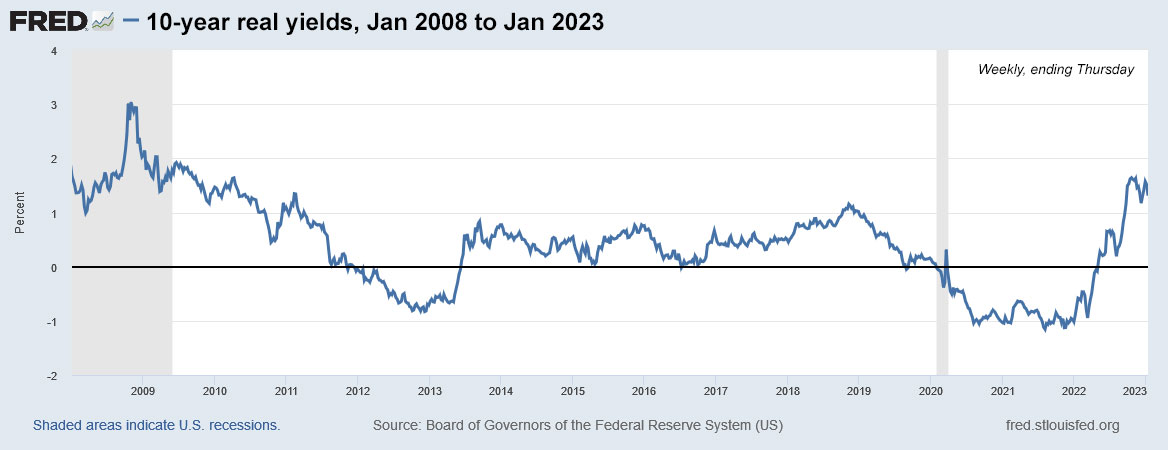
Here is a chart of 5-, 10- and 30-year real yields over the last two years. Notice how yields began flattening when the Treasury began tightening in mid-2022. This is a typical reaction to tightening, as the market begins anticipating a slower economy, or possible recession. And even though real yields have declined a bit in the last month, they remain substantially higher than the market over the last decade.

Click on the image for a larger version.

January 2021 through March 2022 was an awful time to invest in TIPS, with yields substantially negative to inflation. December 2022 looks much more attractive in comparison.

It’s almost shocking to look at how TIPS yields have surged higher in just four months. Here is a chart showing TIPS and Treasury yields for 5- and 10-year terms, and the resulting inflation breakeven rates. As TIPS yields have been moving higher since August, the inflation breakeven rate has been declining. In other words, TIPS are now “on sale” versus similar nominal Treasurys. That’s a positive factor for TIPS investors. Here’s the chart:

In conclusion

Real yields have softened a bit from their highs in early November, triggered primarily by two “milder than expected” inflation reports, combined with vague pivot language from the Federal Reserve. But we can be certain that the Fed will raise short-term interest rates by 50 basis points at its meeting Dec. 13-14. A week later, on Dec. 22, the Treasury will auction a reopened 5-year TIPS.

If real yields hold at the current level of about 1.45%, I’d be a buyer of that 5-year TIPS, even though I’m loaded with 2027 maturities. I’d also be very likely to buy the new 10-year TIPS to be auctioned in January, filling a 2033 spot on my TIPS ladder.

That’s my plan. I’d love even higher yields, but I’ll take what I can get at this point in the tightening cycle. Remember, do your own research before investing.

* * *

Feel free to post comments or questions below. If it is your first-ever comment, it will have to wait for moderation. After that, your comments will automatically appear.Please stay on topic and avoid political tirades.

David Enna is a financial journalist, not a financial adviser. He is not selling or profiting from any investment discussed. The investments he discusses can be purchased through the Treasury or other providers without fees, commissions or carrying charges. Please do your own research before investing.

Posted in Federal Reserve, I Bond, Investing in TIPS | 43 Comments

My schedule … and what’s coming up

By David Enna, Tipswatch.com

View from our room near Alajuela, Costa Rica.

I’m traveling in Costa Rica for a couple weeks and I will often be in areas with weak or zero Internet connections. So I won’t be writing much and I may miss responding to some of your questions.

The holiday season is here but the news never stops. Fed Chairman Jerome Powell gave the stock and bond markets a boost Wednesday by suggesting that the December rate move by the Fed might be less aggressive. In other words, an increase of 50 basis points is coming. Just like everyone already knew. This was the Fed “signaling” the obvious. And of course the stock and bond markets are celebrating with a rally — stocks higher and bond yields lower.

On Dec. 13 at 8:30 a.m. EST the Bureau of Labor Statistics will release the November inflation report. I will be back at work that day, but I have no idea what to expect. The Cleveland Fed’s Inflation Nowcasting site is projecting an all-items increase of 0.47% for November and 7.49% year over year. But these Nowcasting predictions have been too high recently. We’ll see.

One day later, on Dec. 14, the Federal Reserve will announce its decision on the new federal funds rate. The obvious expectation is a 50-basis-point increase to a range of 4.25% to 4.50%. The Fed could be closing in on a “terminal” rate, but a lot will depend on future inflation reports and the status of the U.S. economy.

Then, a week later, on Dec. 22 at 1 p.m., the Treasury will close its auction of a reopening of CUSIP 91282CFR7, creating a 4-year, 10-month Treasury Inflation-Protected Security. This will be an interesting auction, coming a week after both the November inflation report and the Fed’s rate hike decision. Because this TIPS has a coupon rate of 1.625%, it’s possible it will be selling at a premium price. It is currently trading on the secondary market with a real yield of 1.29%, a stunning decline from the originating auction’s yield of 1.732% just six weeks ago. (And I’m just reminding everyone I called that October auction a unicorn — a rarely seen event. Looks like I might have been right.)

I will be posting a preview story on that TIPS auction on Sunday, Dec. 18, and posting the result on Dec. 22 after the auction closes.

Finally, on Jan. 1, 2023, the I Bond purchase calendar will reset and allow new purchases of up to $10,000 per person for that calendar year. Because the I Bond’s fixed rate is now 0.4% these savings bonds will remain attractive. I’ll be posting an I Bond buying guide for 2023 in early January.

Happy holidays and thanks for reading.

* * *

Feel free to post comments or questions below. If it is your first-ever comment, it will have to wait for moderation. After that, your comments will automatically appear.Please stay on topic and avoid political tirades.

David Enna is a financial journalist, not a financial adviser. He is not selling or profiting from any investment discussed. The investments he discusses can be purchased through the Treasury or other providers without fees, commissions or carrying charges. Please do your own research before investing.

Posted in Federal Reserve, I Bond, Inflation, Investing in TIPS, Savings Bond | 10 Comments