Treasury sets I Bond’s new fixed rate at 0.4%; composite rate is now 6.89%

Fixed rate for Series EE Savings Bonds soars from 0.1% to 2.1%; doubling period remains at 20 years.

By David Enna, Tipswatch.com

The U.S. Treasury announced this morning it is raising the fixed rate of the U.S Series I Savings Bond from 0.0% to 0.4% for I Bonds purchased from November 2022 through April 2023. This combines with the new inflation-adjusted variable rate of 6.48% to create a composite return of 6.89% for purchases from November to April.

Here is the announcement:

The composite rate for Series I Savings Bonds is a combination of a fixed rate, which applies for the 30-year life of the bond, and the semiannual inflation rate. The 6.89% composite rate for I bonds bought from November 2022 through April 2023 applies for the first six months after the issue date. The composite rate combines a 0.40% fixed rate of return with the 6.48% annualized rate of inflation as measured by the Consumer Price Index for all Urban Consumers (CPI-U). The CPI-U increased from 287.504 in March 2022 to 296.808 in September 2022, a six-month change of 3.24%.

And here is my translation:

  • An I Bond earns interest based on combining a fixed rate and a semi-annual inflation rate. The fixed rate – which now rises to 0.4% – will never change. So I Bonds purchased from November 1, 2022, to April 30, 2023, will carry a fixed rate of 0.4% through the 30-year potential life of the bond.
  • The inflation-adjusted rate (also called the variable rate) changes every six months to reflect the running rate of non-seasonally adjusted inflation. That rate is now set at 6.48% annualized, down from the current 9.62%. It will update again on May 1, 2023, based on U.S. inflation from September 2022 to March 2023.
  • The combination of the fixed rate and inflation-adjusted rate creates the I Bonds’ composite interest rate, which was 9.62% but now falls to 6.89%, still very attractive. An I Bond bought today will earn 6.89% (annualized) for six months and then get a new composite rate every six months for its 30-year term. The fixed rate will remain at 0.4% for the life of the I Bond.

Here is how the Treasury calculated the I Bond’s new composite rate:

It’s important to note, however, that all I Bonds — no matter when they were issued — will get that 6.48% inflation-adjusted rate for six months (annualized), on top of any existing fixed rate. So an I Bond purchased in October will receive 9.62% for six months, and then 6.48% for six months.

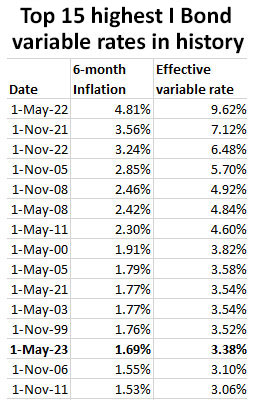
There has been a lot of news coverage lately noting that the I Bond’s variable rate was “falling off a cliff,” but that 6.48% rate is highly attractive and is the third-highest inflation-adjusted rate in I Bond history.

Here are the inflation numbers used to determine the new inflation-adjusted variable rate:

Obviously, I Bonds remain a very attractive investment. A higher fixed rate is always preferable, since it remains with the I Bond for the entire potential term of 30 years. The composite rate of 6.89% is much better than any other very safe investment, and this one comes with future inflation protection.

I advise using I Bonds as a long-term investment, building up a large store of inflation-protected cash. And I’d absolutely advise against selling any I Bonds you currently own until three months beyond the time when both the 9.62% and 6.48% variable rates are complete. (If you haven’t owned the I Bond for 5 years, you will lose the latest three months of interest.)

The month that triggers the new 6.48% variable rate depends on the month that you originally bought the I Bond.

Issue month of your bondNew rates take effect
JanuaryJanuary 1 and July 1
FebruaryFebruary 1 and August 1
MarchMarch 1 and September 1
AprilApril 1 and October 1
MayMay 1 and November 1
JuneJune 1 and December 1
JulyJuly 1 and January 1
AugustAugust 1 and February 1
SeptemberSeptember 1 and March 1
OctoberOctober 1 and April 1
NovemberNovember 1 and May 1
DecemberDecember 1 and June 1

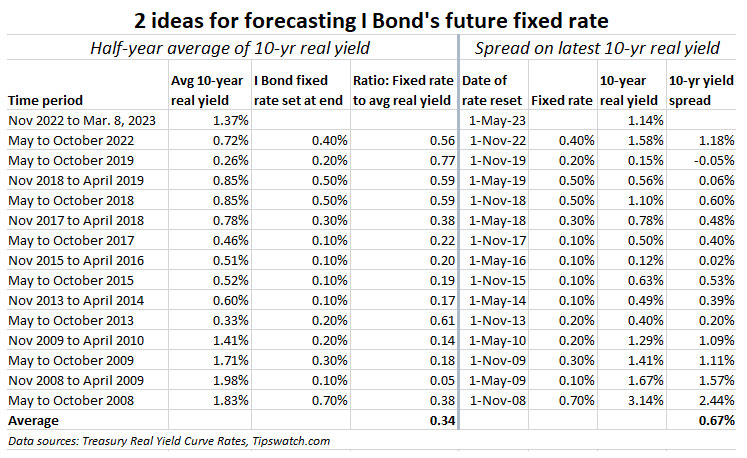
The fixed rate of an I Bond is equivalent to the “real yield” of a Treasury Inflation-Protected Security. It tells you how much the I Bond will yield above the official U.S. inflation rate. So, for these new I Bonds issued from November to April, the investment will earn 0.4% above official U.S. inflation for up to 30 years. A higher fixed rate is a very good reason to hold the I Bond long term.

And remember: The I Bond’s purchase cap of $10,000 per person per year will reset on January 1, so everyone will have access to this 0.4% fixed rate in 2023.

EE Bond gets higher fixed rate

Here is the Treasury’s announcement:

Series EE bonds issued from November 2022 through April 2023 earn today’s announced rate of 2.10%. All Series EE bonds issued since May 2005 earn a fixed rate in the first 20 years after issue. At 20 years, the bonds will be worth at least two times their purchase price. The bonds will continue to earn interest at their original fixed rate for an additional 10 years unless new terms and conditions are announced before the final 10-year period begins.

And here is my translation:

  • The EE Bonds’ fixed rate soars from a paltry 0.1% (where it has been since November 2015) to a more competitive 2.1%. This is a huge upgrade for EE Bond investors, but keep in mind …
  • An EE Bond held for 20 years immediately doubles in value, creating an investment with a compounded return of 3.53%, tax-deferred. So, if you invest $10,000 at age 40, you can collect $20,000 at age 60, with $10,000 of that total becoming taxable.
  • After the doubling in value at 20 years, the EE Bond will revert to earning 2.1 % for another 10 years.

This change to the fixed rate is a big deal because under the old fixed rate of 0.1%, it made no sense to invest in an EE Bonds unless you could absolutely hold it for 20 years. Now it makes sense to hold for 20 years, but it isn’t an absolute necessity.

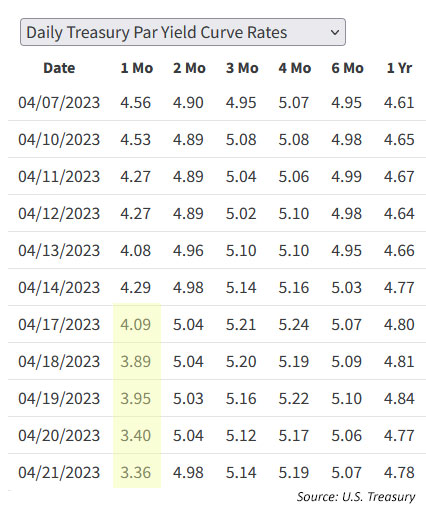
But even with the higher fixed rate, EE Bonds in November 2022 aren’t particularly attractive, since you can get 4.66% right now on a 1-year Treasury bill, or 4.44% on a 20-year bond.

The EE Bond will outperform an I Bond with a fixed rate of 0.4% if inflation averages less than about 3.1% a year over the next 20 years. I think that is a possibility (but who knows, given current inflation trends).

Confused by I Bonds? Read my Q&A on I Bonds

Let’s ‘try’ to clarify how an I Bond’s interest is calculated

Inflation and I Bonds: Track the variable rate changes

I Bond Manifesto: How this investment can work as an emergency fund

* * *

Feel free to post comments or questions below. If it is your first-ever comment, it will have to wait for moderation. After that, your comments will automatically appear.

David Enna is a financial journalist, not a financial adviser. He is not selling or profiting from any investment discussed. The investments he discusses can be purchased through the Treasury or other providers without fees, commissions or carrying charges. Please do your own research before investing.

Posted in Investing in TIPS | 60 Comments

Coming tomorrow: The Treasury’s decision on the I Bond’s fixed rate

By David Enna, Tipswatch.com

Just a heads up to readers: Right after 10 a.m. EDT Tuesday, the Treasury will announce the new composite rate for I Bonds issued between November 2022 and April 2023. Will the I Bond’s fixed rate go higher? We will find out … tomorrow.

Unfortunately, at that hour, I will be in a car heading down an interstate to a family-reunion vacation on Hilton Head Island, S.C. This reunion was rescheduled twice and unfortunately got moved to begin on November 1, the rate announcement day. Oh well …

I will post what I can from the car (I won’t be driving) as soon as I can tomorrow, then I will update that posting with more analysis later in the day.

Also tomorrow, we will get confirmation that the I Bond’s new variable rate will be an annualized 6.48% for six months for all I Bonds, no matter when they were issued. The fixed rate decision, however, is a great unknown. I have been saying the fixed rate should be boosted from 0.0% to 0.5%, but it could very well stay at 0.0% or go even higher than 0.5%.

In addition, we will learn if the Treasury will raise the fixed rate on Series EE Savings Bond from an embarrassingly low 0.1%, where it has been stuck since Nov. 1, 2015. The EE Bonds double in value if held for 20 years, creating an effective return of 3.53% a year. I doubt the Treasury will change the 20-year doubling term. Seems highly unlikely.

Wildly unlikely would be a Treasury decision to allow a higher purchase limit on Savings Bonds, currently $10,000 each for I Bonds and EE Bonds per person, per year. That would be huge news, but there is no indication this is coming.

See you tomorrow.

* * *

Feel free to post comments or questions below. If it is your first-ever comment, it will have to wait for moderation. After that, your comments will automatically appear.

David Enna is a financial journalist, not a financial adviser. He is not selling or profiting from any investment discussed. The investments he discusses can be purchased through the Treasury or other providers without fees, commissions or carrying charges. Please do your own research before investing.

Posted in EE Bonds, I Bond, Savings Bond | 23 Comments

TreasuryDirect, this is not acceptable.

By David Enna, Tipswatch.com

Over the last decade, I’ve been a defender of TreasuryDirect despite its dated website, awful tax forms and cryptic communications. In almost all cases, it has worked for me. Acceptable and most importantly, secure.

But now, weighed down this week by massive demand for U.S. Series I Savings Bonds, the site has repeatedly gone dead, failed to load, loaded a page or two and then stopped. Thousands of potential Treasury customers are furious, and some of them weren’t even looking to buy I Bonds. I’ve heard from people trying to place an order for a 4-week Treasury auction yesterday, but were locked out.

The Wall Street Journal reported yesterday that just in the final week of October, the Treasury issued $1.95 billion in I Bonds, more than the total for fiscal year 2021. In one year, 3.7 million new accounts were created on the site, more than the 2.4 million for the prior 10 years combined.

Why is demand so high? Because the I Bond’s variable rate will reset from 9.62% to 6.48% on Nov. 1. (The fixed rate could also change, but that is uncertain.) People who lock in an I Bond order before Nov. 1 will get 9.62% annualized for six months, and then 6.48% for six months. That adds up to a compounded return of about 8.2% over 12 months. Even if the investor sells after 12 months and takes a 3-month interest penalty, the return would be over 6.5%. That’s very attractive.

TreasuryDirect has responded to this overwhelming demand by posting this message on its homepage (viewable when you are lucky enough get to the homepage):

“We are currently experiencing unprecedented requests for new accounts and purchases of I Bonds. Due to these volumes, we cannot guarantee customers will be able to complete a purchase by the October 28th deadline for the current rate. Our agents are working to help customers who need assistance as quickly as possible.”

This message is typically cryptic, because it’s impossible to tell if it means all electronic orders are at risk of not being filled, or is it addressing issues with its customer service staff trying to answer phone calls dealing with purchases and account set ups?

Elsewhere on the site, TreasuryDirect says:

You must complete your purchase and receive a confirmation email by October 28, 2022, at 11:59:59 PM ET. I Bonds purchased by this deadline will have an October 1st issue date. You will receive the published rate for six months (i.e., October – March).

Due to high volumes, we cannot guarantee that your bond purchase will be completed before this deadline if your account or purchase requires additional customer support for issues such as identity verification.

That statement seems to imply that it is people needing human customer support that are most at risk of not completing the purchase. But I’ve heard from many people with active TreasuryDirect accounts who have been able to get into the site, get all the way to the I Bond purchase confirmation page, and then have the site crash. Repeatedly. Those people haven’t completed the purchase and can’t complete the purchase. But they need to keep trying.

TreasuryDirect says you must receive a confirmation email to confirm your order has been placed.

Today — Friday, Oct. 28 — is the day TreasuryDirect originally said would be the last day to place an order to be assured of getting an October-dated I Bond and that 9.62% for six months. I had been recommending making the purchase by Wednesday, Oct. 26, but unfortunately that is the day TreasuryDirect started crashing.

What happens after Oct. 28? This is what TreasuryDirect says:

Due to processing and payment settlement timeframes, bonds purchased in TreasuryDirect October 29 through October 31 will be issued in November. As a result, these bonds will receive the rate announced by Treasury on November 1. This rate will still be applied for the next six-months (i.e., November – April).

What TreasuryDirect needs to do

No. 1. Commit that all I Bond orders placed by midnight today will be recognized as October-issued I Bonds. This is an electronic system, so you know when the order was placed. You need to honor your statement that Oct. 28 orders would be completed before Nov. 1.

No. 2. Have Treasury staff work this weekend to continue helping customers set up accounts and complete orders. Make sure communications are going out to customers who have completed orders. Extend that Oct. 28 deadline for all people who have made good-faith attempts to complete the purchase by Oct. 28.

No. 3. Repair your website so that this sort of problem never happens again. TreasuryDirect is the only place an investor can buy an I Bond. It needs to work, no matter the demand.

Confused by I Bonds? Read my Q&A on I Bonds

Friday evening update

TreasuryDirect is closing down for maintenance this weekend, but that still doesn’t mean that I Bond orders completed by 11:59 p.m. won’t be accepted as an October issue. This is from a Barron’s article:

The Treasury’s website will undergo maintenance this weekend after record demand for series I inflation-linked savings bonds strained the system. Work on the TreasuryDirect website will start at 12 a.m. Saturday and continue until 11:59 p.m. Sunday Eastern Time.

During that period, individuals won’t be able to use the account management system that allows purchases of I Bonds. The rest of the site will be up and running.

* * *

Feel free to post comments or questions below. If it is your first-ever comment, it will have to wait for moderation. After that, your comments will automatically appear.

David Enna is a financial journalist, not a financial adviser. He is not selling or profiting from any investment discussed. The investments he discusses can be purchased through the Treasury or other providers without fees, commissions or carrying charges. Please do your own research before investing.

Posted in I Bond, TreasuryDirect | 77 Comments

Want to stash I Bonds in a ‘gift box’? Do it by Wednesday.

With this strategy, you can bypass the $10,000 per person purchase limit, but there are potential drawbacks.

By David Enna, Tipswatch.com

Throughout this year, I have read with — at first, disbelief, and later, fascination — as devotees of U.S. Series I Savings Bonds discovered and successfully exploited a TreasuryDirect “gift box strategy” to accumulate I Bonds beyond the $10,000 per person yearly purchase limit.

Although the strategy is legit and perfectly legal, I haven’t written about it and I don’t intend to use it. But a lot of people have asked me about it. If you intend to use this strategy, I’d advise completing the process on TreasuryDirect by Wednesday, Oct. 26, if you are aiming to lock in the current 9.62% interest rate for a full six months, and then 6.48% for the next six months.

Update: The TreasuryDirect site was overwhelmed by I Bond demand Wednesday and almost all users experienced very slow loading pages, or no loads at all. I recommended making your I Bond transactions on Wednesday for this very reason, to avoid this sort of pitfall. Making a purchase on Thursday will be fine, and Friday will also be likely to be OK. Let’s hope the site returns to normal.

Friday morning: TreasuryDirect’s opening page is now loading. It took me two times but I was able to log into my account. Good luck to all.

Harry Sit of the TheFinanceBuff.com was the first to write about this strategy on Dec. 27, 2021, in an article titled “Buy I Bonds as a Gift: What Works and What Doesn’t.” When people ask me about the gift box, I point them to this article, which was well researched and thorough. So, go read that article if you don’t know about the strategy.

Another article was just posted this week by Jeremy Keil, a financial adviser who was an early advocate of the current I Bond surge (and has written a guest post for this site). His article is titled: “Buy more than $10,000 in Series I Savings Bonds through gifting with your spouse“. Keil, who recently completed an I Bond gift box purchase, includes links to TreasuryDirect content explaining how the gift box works. He details a strategy for a couple purchasing $60,000 in I Bonds before the end of October, with $20,000 being delivered in 2023 and $20,000 in 2024.

• Confused by I Bonds? Read my Q&A on I Bonds.

Some basics of the gift box strategy:

  1. When you place an I Bond into the gift box, it begins earning interest in the month of purchase, just like any other I Bond, and continues earning interest just like any I Bond. However, this money is no longer yours. It belongs to the recipient of the gift.
  2. The purchase does not count against your purchase limit for that year. It will count against the purchase limit for the recipient, in the year it is granted.
  3. Gift purchases are limited to $10,000 for each gift, but you can make multiple gift purchases of $10,000 for the same person. But the recipient can only receive one $10,000 gift a year, and that gift counts against their purchase limit for that year.
  4. You must provide the recipient’s name and Social Security Number when you buy a gift. The recipient doesn’t need to have a TreasuryDirect account … yet. Only a personal account can buy or receive gifts. A trust or a business can’t buy a gift or receive a gift.
  5. “I Bonds stored in your gift box are in limbo,” Harry Sit notes in his article. “You can’t cash them out because they’re not yours. The recipient can’t cash them out either because the bonds aren’t in their account yet.”
  6. The recipient will need to open a TreasuryDirect account to receive the I Bond. Once it is delivered, the money is the recipient’s, who can then cash out or continue to hold the I Bond.

Here is TreasuryDirect’s video explaining the step-by-step process to complete a gift box purchase:

In his article, Harry Sit also provides a very useful step-by-step guide to completing a gift-box purchase.

Would this strategy trigger a gift tax?

Sit notes there is no limit on how much you can give your spouse as a gift, so this strategy works especially well for cross-gifting: Spouse 1 to Spouse 2 … and Spouse 2 to Spouse 1, each using their separate TreasuryDirect accounts. Rules are more complicated for gifts to a non-spouse, so refer to Harry’s article for more detail.

What are the potential negatives to this strategy?

Placing $10,000 in the gift box puts that money in limbo, awaiting future delivery. It is no longer your money, and it really isn’t the recipient’s money either until the gift is delivered. So if you stack up multiple $10,000 purchases for gifting well into the future, the potential downside is that your circumstances could change.

Also, what if the I Bond’s fixed rate rises dramatically in November 2022 or May 2023? You would probably want to bypass delivering the gift I Bond beyond 2023 to take advantage of the higher fixed rate, which is highly desirable. That means you would have to wait until the next time the I Bond’s fixed rate falls to 0.0%.

Sit also warns about forgetting about the gifts. His advice: “If you’re intentionally pre-purchasing gifts to take advantage of temporarily high interest rates, tell the recipient you’re holding a gift. Set recurring calendar reminders to tell yourself and the recipient you still have undelivered gifts in the gift box.”

What if the gift recipient dies?

When you register the gift, you can name a second owner or beneficiary for the I Bond. Sit says, “If the gift recipient dies before you deliver the gift, the designated second owner or beneficiary will inherit your gift. You can’t name yourself as the second owner of the gift but you can name yourself as the beneficiary of the gift.”

If you die before granting the gift, the recipient still owns it and will be able to claim it through TreasuryDirect.

Why didn’t I use this strategy?

I admit to being quite skeptical at first that TreasuryDirect would allow multiple, stacked $10,000 purchases in one account. But by all accounts, it has been working fine (except for a brief outage recently after a site update). I thought about doing this, but opted to just stay with my plan of buying $10,000 a year in our two accounts, every year, and hoping for a higher fixed rate in 2023 and beyond.

But is it a sound strategy? Yes, I think it is, especially for short-term investors interested in locking in a high rate of return over the next 12 to 15 months (taking into account the three-month interest penalty for redemptions within 5 years).

Why complete the gift purchase by Wednesday?

Thursday would probably be fine, but you want to make sure to complete any I Bond transaction early enough to ensure that TreasuryDirect logs it as an October 2022 purchase, which means you will receive 9.62% for a six months, and then 6.48% for six months. It’s wise to give TreasuryDirect a couple of business days to complete any transaction.

Feedback?

If you decided to use the I Bond gift strategy, feel free to post about your experience and thoughts in the comments section below.

* * *

Feel free to post comments or questions below. If it is your first-ever comment, it will have to wait for moderation. After that, your comments will automatically appear.

David Enna is a financial journalist, not a financial adviser. He is not selling or profiting from any investment discussed. The investments he discusses can be purchased through the Treasury or other providers without fees, commissions or carrying charges. Please do your own research before investing.
Posted in I Bond, Savings Bond, TreasuryDirect | 86 Comments

New 5-year TIPS auctions with a real yield of 1.732%, highest in 15 years

Still, real yield was lower than expected as inflation expectations surged higher.

By David Enna, Tipswatch.com

The Treasury’s offering of $21 billion in a new 5-year Treasury Inflation-Protected Security resulted in a mixed bag for investors: The real yield of 1.732% hit a 15-year high and was quite positive, but that yield was a bit below market levels right up to the auction.

This is CUSIP 91282CFR7, and the auction result set its coupon rate at 1.625%, the highest coupon rate for any TIPS of this term since an originating auction on April 24, 2007. Buyers paid an adjusted price of about $99.48 for about $99.98 of accrued value and interest. This TIPS will have an inflation index of 0.99982 on the settlement date of Oct. 31.

This is the first 4- to 5-year TIPS auction to result in an adjusted price below $100 since April 26, 2010. The price means than a person who bought $10,000 in par value for this TIPS paid about $9,948 for about $9,982 in accrued value, plus a very small amount of accrued interest, about $7.

So all in all, this is a very positive result for investors. It’s baffling, though, that the Treasury had estimated the real yield of a 5-year TIPS at 1.89% at yesterday’s market close, and the most recent TIPS of this term had been trading all morning on the secondary market with a real yield of about 1.85%.

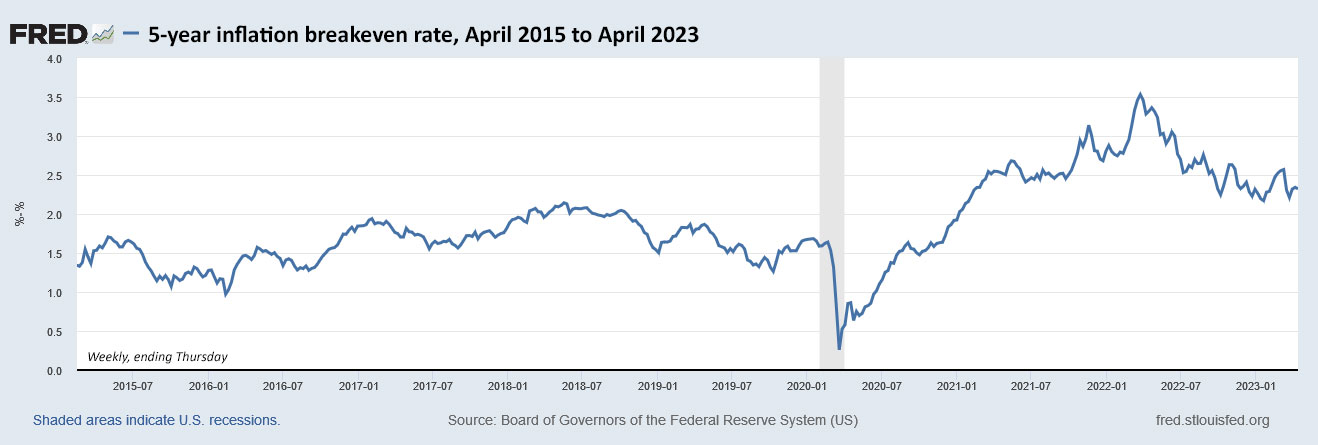
One factor is that inflation expectations seemed to surge higher, which would indicate strong demand for this TIPS, even though the bid-to-cover ratio was a mediocre 2.38. At yesterday’s market close, the Treasury estimated the five-year inflation breakeven rate at 2.46%, but this auction resulted in a breakeven rate of 2.67%. That’s a big move higher and would explain a lot of the gap between yield and expectations.

Also interesting is that non-competitive bids — made by small investors like us — totaled $256 million, nearly double the bids of $131 million for a new 5-year TIPS issued in April. But that surge higher probably had zero effect on a $21 billion offering.

Here is the trend in the 5-year real yield since the beginning of 2020, showing the remarkable surge higher after the Federal Reserve announced tightening intentions in March 2022:

Inflation breakeven rate

With a 5-year Treasury note trading at 4.40% at the auction’s 1 p.m. close, this TIPS gets an inflation breakeven rate of 2.67%. As I noted earlier, the 5-year inflation breakeven rate has been lingering around 2.45% for several days. A 22-basis-point jump is quite a move, and it indicates that investor demand for inflation protection is increasing.

Here is the trend in the 5-year inflation breakeven rate since January 2020:

Reaction to the auction

Source: Yahoo Finance

Over the last year, we’ve had a lot of upside surprises at the close of TIPS auctions, but this one was the reverse. While the real yield of 1.723% was a 15-year high and very attractive, it came in a little below expectations. (My expectations, anyway.) As you can see in this chart, the net asset value of the TIP ETF, which holds the full range of maturities, actually declined after the auction’s close at 1 p.m. That indicates higher yields.

And now, at 1:48 p.m., the real yield of the most recent TIPS traded on the secondary market has surged to 1.91%. Doesn’t make a lot of sense. I’ll look around for a logical explanation, but I don’t expect to find one. The bond market can humble you. It’s always a good reminder: never assume anything.

But I refuse to be disappointed with my purchase of a 5-year TIPS with a real yield at a 15-year high of 1.732% and a coupon rate also at a 15-year high of 1.625%. That’s a significant real yield after nearly a decade of ultra-low yields. And it means, most likely, that this TIPS will earn a return that will beat inflation, after taxes, if you are holding it in a cash or traditional tax-deferred account.

From today’s Reuters report:

“(T)he U.S. Treasury auctioned $21 billion in five-year Treasury Inflation-Protected Securities, with the high yield of 1.732% stopping short of the expected rate at the bid deadline, which suggested increased demand.

“Analysts said demand was fueled by strong participation from direct bidders. According to investment bank Jefferies, direct bidders took down 17% of the auction, which is about six percentage points higher than the average of the last four auctions. In dollar terms, Jefferies said this is the biggest takedown since December 2019.

FYI, the Treasury defines direct bidders as: “Non-Primary dealer submitters bidding for their own house accounts.” And another worthless definition, from Investopedia: “Direct bidders include primary dealers, hedge funds, pension funds, mutual funds, insurers, banks, governments and individuals.” Doesn’t that include just about everyone? More research is needed.

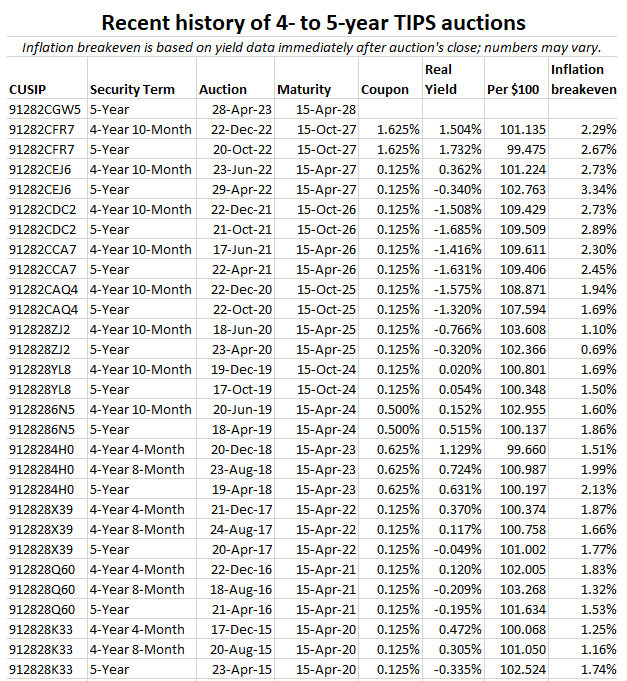
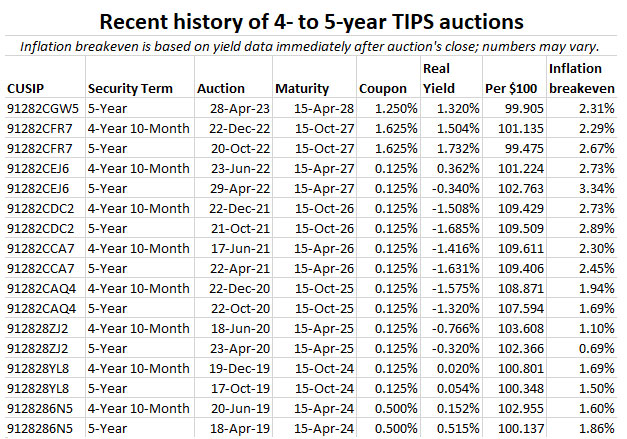
CUSIP 91282CFR7 will be reopened at auction on Dec. 22, 2022. Here’s a history of auctions of this term since 2017, showing the long string of negative real yields, including the record low real yield of -1.685% just one year ago.

* * *

Feel free to post comments or questions below. If it is your first-ever comment, it will have to wait for moderation. After that, your comments will automatically appear.

David Enna is a financial journalist, not a financial adviser. He is not selling or profiting from any investment discussed. The investments he discusses can be purchased through the Treasury or other providers without fees, commissions or carrying charges. Please do your own research before investing.

Posted in Inflation, Investing in TIPS | 73 Comments