Barron’s Live: Best Timing for I Bonds

Tipswatch.com

I participated Monday in a Barron’s Live 30-minute video podcast, hosted by Marketwatch columnist Beth Pinsker. The topic was strategies for buying Series I Savings Bonds in 2023. In January? In April? In May? Or just go with TIPS?

You can watch the video here (requires registration on the Barron’s site).

Or listen to the audio podcast on these links:

About this podcast

I Bonds, a once-obscure Treasury investment, soared in popularity last year because of its enticing inflation-adjusted rate that changes every six months, but individuals are limited by a $10,000 cap on purchases per year. Now that we’re in a new year, there are three key strategies to make the most of your investment. Join Beth Pinsker, investing columnist for MarketWatch and long-time journalist David Enna.

I Bonds: A not-so-simple buying guide for 2023

Confused by I Bonds? Read my Q&A on I Bonds

Let’s ‘try’ to clarify how an I Bond’s interest is calculated

Inflation and I Bonds: Track the variable rate changes

I Bond Manifesto: How this investment can work as an emergency fund

Posted in I Bond, Investing in TIPS, TreasuryDirect | 14 Comments

TIPS funds vs. TIPS ladder: An investor weighs in

By David Enna, Tipswatch.com

A lot of readers ask about the ladder of TIPS investments I have built over the years. Yes, I do have a ladder, and it does hit every year from 2023 to 2032, and then jumps forward to 2041 and 2042.

Notice the gap? That’s because there are no TIPS issues that mature from 2033 to 2039. Why? Because the Treasury no longer issues 20-year TIPS, leaving a gap in maturities. So I will need to pick up those missing years, one at a time, beginning with this month’s auction of a 10-year TIPS, maturing in 2033.

While it might sound like my ladder was well planned, honestly it was built haphazardly, from purchases of 5- and 10-year TIPS, mostly at auction, and only when I judged real yields to be “attractive.” So the ladder has a lot of maturities this year, in 2023, and then in 2027, because of my purchases of 5-year TIPS in 2018 and 2022, the only two years in the last decade when real yields moved well above zero.

Here is what my ladder looks like, with a few nominals thrown in and actual investment amounts removed. I use an Excel spreadsheet to update the inflation indexes (drawn from the Wall Street Journal) and adjust my principal amounts a few times a year:

Two examples show the formula: Par x inflation index = adjusted principal. The original real yield is not shown in this chart, but I make a notation off to the right.

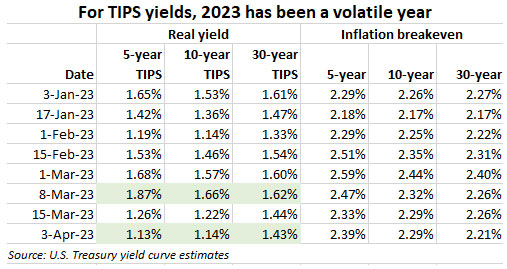
Now here we are in 2023, and again real yields are well above zero across the entire TIPS yield spectrum, with the 5-year at 1.68% and the 30-year at 1.55%. If you are interested in building a TIPS ladder, this is a great time to begin.

Why is a TIPS ladder attractive?

Wakerly

I recently read a well-thought out article titled, “TIPS Funds Vs. A Ladder,” on the SeekingAlpha site. The author is Ralph Wakerly, an investor, entrepreneur and consultant with over 35 years of investment experience. Wakerly argues that historical inflation data suggest the next decade of inflation “may run considerably above the ~3% that consumers and investors expect,” making TIPS a highly attractive investment.

I suggest that you read his entire article, but here are some of his major points:

“For investors at or near retirement, a TIPS ladder is an effective means of generating reliable, predictable income. …TIPS are most effective and reliable if held to maturity. This argues in favor of buying individual bonds via a ladder, not a mutual fund or ETF. …

“You can build an effective TIPS ladder that is relatively simple, with a manageable number of holdings via a mix of auction buys and via the secondary market. …

“A bond ladder via a brokerage account like Fidelity or Vanguard costs nothing. There are no transaction costs and no annual expenses.”

TIPS funds versus a ladder

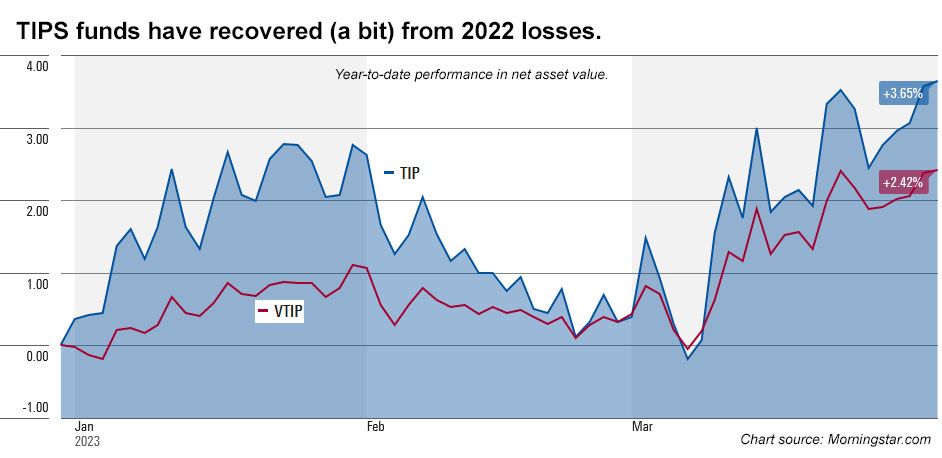
You can find many smart investors (Bogleheads, especially) who argue that a TIPS fund or ETF is no more risky that holding individual TIPS to maturity. While there may be some logic to this argument (duration matching often comes up as a reason) you have to recognize that the biggest TIPS fund, the TIP ETF, had a total return of -12.24% last year, even as inflation soared to a 40-year high. If you own individual TIPS and are holding to maturity, you can ignore these market swings and just rake in the inflation accruals. At maturity, you are going to get par value x inflation accrual.

Wakerly came up with this comparison of TIPS funds vs. individual TIPS, an excellent summation:

Consider interest rate risk

As Wakerly notes. “This was painfully evident this year. Fund investors have been punished as the 10 year real TIPS rate went from -1% to the current 1.6%. … However, individual TIPS bonds held to maturity protect against principal loss in the event of rising real rates.”

At a time of rising real yields, TIPS funds are going to suffer. But an individual TIPS will stay on its course to maturity, where it will pay par value + inflation accrual (or at the very least, par value). If you hold a TIPS in a brokerage account, it can be painful to see the loss in “market value” because that is how the broker will report it each day. But in reality, your TIPS is actually holding its principal value (unless deflation strikes), and rising with future inflation. Wakerly says:

In my opinion, this is the most important advantage of buying individual bonds in a ladder versus a fund. This is especially important for retirement investors who want predictable income and cash flow.

Is a ladder really diversified?

Of course it is, if you do a decent job of spacing out maturities and the amounts invested. The TIP ETF only has about 48 holdings — that is all the TIPS trading on secondary markets. A ladder with a few holdings with attractive real yields, maturing at a date to match your needs, is well diversified. Wakerly notes:

From a bond diversification standpoint there isn’t a need to buy a fund. Unlike corporate or muni bonds where you want to diversify default risk across issuers, TIPS are effectively riskless assets backed by the full faith and credit of the US government.

On the other hand, keep in mind that TIPS are a highly specialized investment, designed to protect assets against future inflation. Most people would want to pair their TIPS holdings with low-cost stock index funds, traditional bond funds and some nominal fixed income, such as bank CDs or Treasurys.

Building a ladder

Wakerly says he is building a ladder with an eye on future income needs, so he is focusing on TIPS with a weighted maturity of 18 years. You’d need to consider your future needs. In my case, I am already retired and just trying to protect capital against future inflation, so my ladder focuses more on the near term. Here is Wakerly’s sample ladder:

Another strategy: I have heard from many readers who say they have built a TIPS ladder in their traditional IRA account to account for future required minimum distributions long into the future.

Conclusion

I highly recommend reading Wakerly’s complete article, which goes into greater detail, and another he recently wrote on TIPS titled, “TIPS Performance Could Rival That Of The S&P 500 Over The Next Decade“. (I’m not endorsing that opinion, but after the highly volatile 2022, anything could happen.)

But I do agree with his closing opinion:

“A TIPS ladder is an effective way to invest, especially for those in or near retirement who are comfortable creating their own do-it-yourself annuity. The ladder is currently generating one of the highest yields in the past 14 years with higher certainty of returns, and better principal protection than a mutual fund or ETF.”

One more thing …

For another interesting read on TIPS ladders, check out financial adviser Allan Roth’s October article, “The 4% Rule Just Became a Whole Lot Easier” in which he describes how he painstakingly built a TIPS ladder that will allow 4.36% inflation-adjusted withdrawals over 30 years. He notes, “This is a very attractive strategy for someone wanting a guaranteed inflation-adjusted cash flow in addition to Social Security.”

Roth built this ladder with the help of a Bogleheads contributor, Bob Hinkley, and his article set off a lively — and helpful — discussion in the Bogleheads forum. The article was also referenced in a December Morningstar article titled, “How to Build a TIPS Ladder“.

Confused by TIPS? Read my Q&A on TIPS

TIPS in depth: Understand the language

Upcoming schedule of TIPS auctions

* * *

Feel free to post comments or questions below. If it is your first-ever comment, it will have to wait for moderation. After that, your comments will automatically appear.Please stay on topic and avoid political tirades.

David Enna is a financial journalist, not a financial adviser. He is not selling or profiting from any investment discussed. The investments he discusses can be purchased through the Treasury or other providers without fees, commissions or carrying charges. Please do your own research before investing.
Posted in Inflation, Investing in TIPS, Retirement | 33 Comments

I Bonds: A not-so-simple buying guide for 2023

By David Enna, Tipswatch.com

Note: I posted an updated I Bond analysis on April 14:

Update, April 28, 2023: Treasury raises I Bond’s fixed rate to 0.9%; new composite rate is 4.30%

After a year of raging-high demand, where do we stand today on U.S. Series I Savings Bonds? Are they still an appealing asset? Are they a worthy investment for 2023? Is the variable rate likely to fall at the May reset? Should you hold out for a higher fixed rate later in 2023?

I Bonds are issued and guaranteed by the U.S. Treasury.

Last year, in January 2022, I titled my year-ahead guide “I Bonds: A very simple buying guide for 2022.” At the time, I Bonds had an annualized rate of 7.12%. By comparison, a 1-year Treasury bill was yielding 0.40%. See? My advice was simple: Buy I Bonds, in January or April or anytime between. But buy I Bonds.

This year, things are more complicated. Yields on nominal Treasurys are much higher. Real yields for Treasury Inflation-Protected Securities have soared to levels we haven’t seen in 15 years. Even bank CDs and online savings accounts are getting attractive. I Bonds have competition.

Before we get into those issues, here’s a quick primer for investors who are new to I Bonds:

The basics

  • The fixed rate of an I Bond will never change. Purchases through April 30, 2023, will have a fixed rate of 0.4%, which means their return will exceed official U.S. inflation by 0.4% until the I Bond is redeemed or matures in 30 years.
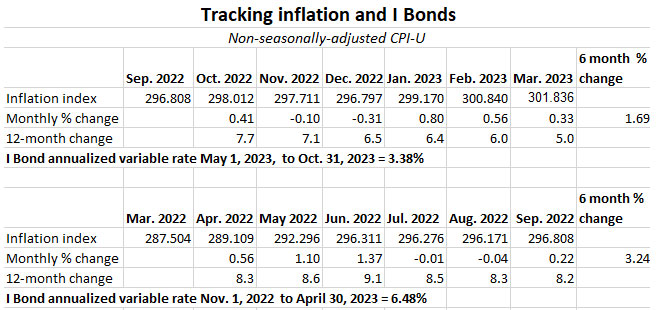
  • The inflation-adjusted rate (often called the I Bond’s variable rate) changes each six months to reflect the running rate of inflation. That rate is currently set at 6.48%, annualized, for six months. It will adjust again on May 1, 2023, rolling into effect for all I Bonds, no matter when they were purchased.
  • The current composite rate is 6.89% annualized for six months for purchases from January to April 2023.

I Bonds are an extremely safe and conservative investment. Interest accrues monthly and can never decline, even in times of deflation. Investments are limited to $10,000 per person per calendar year for electronic I Bonds held at TreasuryDirect. There is also the option to get $5,000 a year in paper I Bonds in lieu of a federal tax refund. There is also a “gift box” strategy some investors use to stack purchases for future years.

I Bonds are a unique investment with many positives. For example, earnings are free of state income taxes and federal taxes can be deferred until the I Bond is redeemed or matures. Also, I Bonds are a simple investment to buy and track, much simpler than a TIPS with a constantly changing market value and inflation accruals that update daily.

The purchase limit is the reason people ponder timing their I Bond purchases; once you hit $10,000 per person per year, you can’t purchase more, at least in the traditional way.

Are I Bonds still attractive?

I Bonds purchased from January to April 2023 will pay an annualized composite rate of 6.89% for six months, which includes the fixed rate of 0.4%. Is 6.89% attractive? Definitely. But let’s look at the alternatives:

  • A six-month Treasury bill has a nominal yield of about 4.76%.
  • Best-in-nation 6-month bank CDs are yielding about 4.4%.
  • A 1-year Treasury bill has a nominal yield of about 4.73%.
  • Best-in-nation 1-year bank CDs are yielding about 4.75%.
  • A 5-year Treasury note now yields about 4%.
  • A 5-year TIPS has a real yield of about 1.58%.

As a six-month investment, an I Bond definitely looks attractive. But keep in mind that an I Bond has to be held for at least 12 months, and redeeming before 5 years forfeits your last three months of interest. That brings uncertainty into the equation.

Short-term investment

If you are aiming to redeem the I Bond after one year, this still looks like a contender, but with complications. You are guaranteed to earn an actual return of 3.445% in the first six months (6.89%/2), and then some undetermined return in the next six months, depending on inflation from October 2022 to March 2023, plus the fixed rate of 0.4%.

And there is the problem: We can’t accurately project U.S. inflation for the October to March period. The first two months, October and November, are already in, and inflation ran at 0.30% over that period, averaging just 0.15% a month.

So I’d guess the variable rate at the May reset will be lower than the current 6.48%, but most likely will still be at least 1.8%, based on 0.15% monthly inflation on average over the six months. That’s a conservative estimate.

Add on the fixed rate of 0.4% and you can conservatively estimate an annualized return of about 2.2% in the second six months. That creates a total return of about 4.54% for one year (6.89% + 2.2% / 2 = 4.54%) Remember, this is a conservative estimate. If inflation runs higher, your return would be higher. If inflation runs at 0.4% from December to March, the new variable rate would be 3.8%. Add on the fixed rate and you get to 4.2%. Your total return after one year would be about 5.5%.

But … redeeming an I Bond after 12 months will incur a three-month interest penalty, wiping out more than 1% of that return.

Does all this mean that I think U.S. inflation has been tamed? Definitely not. But we are heading into a several-month period where the year-ago numbers will be very hard to match and exceed. So inflation should appear to “moderate” during that period. Take a look at the numbers: December 2021 at 0.31% is reasonable, but then you get January 2022 at 0.84%, February at 0.91% and March at 1.34%.

Conclusion. If your only interest in I Bonds is a quick one-year investment, you might want to look at competitive nominal investments like one-year bank CDs, online savings accounts or one-year Treasury bills. If inflation moderates, the returns could be similar but without the three-month interest penalty. The advantage of an I Bond is long-term inflation protection. If you aren’t concerned about inflation in the long term, look elsewhere.

But if you remain interested in the I Bond for one year, then I’d suggest using TreasuryDirect to set a purchase date later this month, maybe Jan. 27, to lock in January as your starting month. You could then redeem early in January 2024.

Long-term investment

Long-time fans of I Bonds buy them every year, up to the annual $10,000 per person purchase limit, to build a large cache of inflation-protected savings. After 5 years, an I Bond effectively becomes an inflation-protected, tax-deferred cash account you can draw from without penalty. (See the I Bond Manifesto for more on this.)

I am a long-time, devoted I Bond fan, and I will be buying I Bonds up to the limit this year. I want that higher fixed rate. But when to buy? The key factors in this decision are 1) potential changes in the I Bond’s variable rate, and 2) potential changes in the I Bond’s fixed rate.

Buying anytime from January through April will result in exactly the same return on your investment. That is because when you purchase an I Bond, you lock in the current composite rate (6.89%) for a full six months before the next rate reset. So a long-term investor has no urgent need to buy in January. In 2022, I bought in January to go ahead and grab the 7.12% variable rate. This year … I will wait.

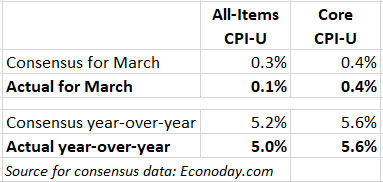
Key date: April, 12, 2023. At 8:30 a.m. ET on April 12, the Bureau of Labor Statistics will release the March inflation report, setting in stone the I Bond’s next variable rate reset, going into effect May 1. At that point, you will also have an idea of where the I Bond’s fixed rate could be heading. And you will have about 15 days to decide: Buy in April, or in May?

As I said earlier, I think the variable rate could be heading lower, somewhere in the range of 1.8% to 4.0%. That’s a guess, not a projection. If the variable rate is going to fall, buying in April makes more sense, to capture 6.89% for six months.

But then there is the issue of the fixed rate. Long-term investors in I Bonds know that a higher fixed rate is always more desirable, because it stays with the I Bond for the entire 30-year potential term. Could the fixed rate rise on May 1? My guess is yes, it is possible if real yields continue holding at current levels, with the 10-year TIPS trading with a real yield of 1.58%.

(Update on January 9: The 10-year real yield has fallen to about 1.3% in trading today, dropping about 28 basis points in a week. Not a good indicator for a higher fixed rate for the I Bond, but a lot of time remains.)

Oddly enough, 1.58% is exactly where the 10-year TIPS was trading on Oct. 31, 2022, the day before the Treasury raised the I Bond’s fixed rate from 0.0% to 0.4%. My opinion: The fixed rate should have been higher, but I was pleased with the decision to raise it at a time when TreasuryDirect was overwhelmed by demand for I Bonds.

The Treasury has no public formula for setting the I Bond’s fixed rate, but I have contended for years that the 10-year real yield is the best indicator of where the fixed rate is heading. At the November reset, the yield spread was 1.18%, the highest since November 2008. The fixed rate could have been higher.

What about waiting until the Nov. 1 rate reset? I’d say no because you could risk losing the above-zero fixed rate if the Fed changes course, plus the attractive composite rate (6.89%) for six months. Anything can happen though. On Jan. 1, 2022, a higher fixed rate did not look all likely at the November reset — the 10-year real yield was -0.97%. Ten months later it had increased 255 basis points.

Conclusion. A higher fixed rate is a possibility on May 1, even as the variable rate might be going lower. For a long-term I Bond investor, I think it makes sense to wait until April 12 to make a purchase decision. And even then the decision might be to divide your purchases, half in April and half in May, if a higher fixed rate looks at all possible.

Redeem I Bonds to purchase I Bonds?

If you are a long-time investor in I Bonds, you probably have some issues with a 0.0% fixed rate and have hit the 5-year mark so they can be redeemed without penalty. For example, I have I Bonds issued in April 2017 that qualify. If I wanted to step up to the higher fixed rate, I could sell the April 2017 I Bonds and buy the April 2023 I Bonds, getting the 0.4% fixed rate.

The negative to this strategy is that I would owe taxes on the $1,704 interest I’ve earned. That would be costly. However, the strategy still makes sense for an investor that doesn’t want to raise additional money this year to buy the 2023 allocation.

Another alternative would be to redeem I Bonds with a fixed rate of 0.0% that you’ve held just a year or two. That would cost you three months of interest, but if you delay redeeming until three months after the 6.48% variable rate cycles off, you could lower the penalty (possibly). Plus, the total taxable interest for the shorter holding shouldn’t be too painful.

I’m not a fan of rolling over I Bonds, but I can see the need for investors who need to raise the cash for a more attractive purchase.

Obvious alternative: TIPS

The one investment most similar to an I Bond is a 5-year TIPS, especially one held in a tax-deferred traditional IRA account. The I Bond can be redeemed without penalty after 5 years; the TIPS matures in 5 years. They are equally safe if you hold the TIPS to maturity. But at this point, the 5-year TIPS has a huge above-inflation yield advantage: 1.66% for a 5-year TIPS vs. 0.4% for the I Bond. This is why I recently wrote that current yields make it “advantage TIPS.”

But TIPS can be a confusing and even frustrating investment, and many investors prefer the simplicity of the I Bond, which has better deflation protection, never goes down in value, and can be redeemed in the year of your choice. I Bonds work much better as a cash alternative and can add to your tax-deferred holdings without creating worries about future required minimum distributions.

I have been buying TIPS aggressively since mid-2022 and I will keep buying the 5- to 15-year maturities as long as real yields continue at high levels. But I will also buy I Bonds in 2023. Inflation protection is a handy thing, as shown in the last two years when inflation suddenly and unexpectedly ran at 7+% annually.

Both investments can work in your portfolio.

Confused by I Bonds? Read my Q&A on I Bonds

Let’s ‘try’ to clarify how an I Bond’s interest is calculated

Inflation and I Bonds: Track the variable rate changes

I Bond Manifesto: How this investment can work as an emergency fund

Confused by TIPS? Read my Q&A on TIPS

TIPS in depth: A primer

Upcoming schedule of TIPS auctions

* * *

Feel free to post comments or questions below. If it is your first-ever comment, it will have to wait for moderation. After that, your comments will automatically appear.Please stay on topic and avoid political tirades.

David Enna is a financial journalist, not a financial adviser. He is not selling or profiting from any investment discussed. The investments he discusses can be purchased through the Treasury or other providers without fees, commissions or carrying charges. Please do your own research before investing.
Posted in Cash alternatives, I Bond, Inflation, Investing in TIPS, Savings Bond, Treasury Bills, TreasuryDirect | 93 Comments

Here’s A Step-By-Step Guide To Using The Treasury’s Savings Bond Calculator

By David Enna, Tipswatch.com

This article is repurposed from a version originally written in June 2018.

For investors in U.S. Savings Bonds – EE and I Bonds – the Savings Bond Wizard was an excellent tool for keeping an accurate inventory and tracking past and current values. But as of June 1, 2018, the U.S. Treasury discontinued the Wizard and replaced it with a Savings Bond Calculator, a tool that’s a little less user friendly.

(TreasuryDirect is adamant that the Savings Bond Calculator will not work for electronic I Bonds. But that is not true. It does work, except for the $5,000/$10,000 issue and the results you see will be accurate. But keep in mind that the calculator will not show you the last three months of interest for an I Bond held less than 5 years.)

So you have to enter $5,000 twice to reflect a $10,000 purchase. The same is true for EE Bonds, but it’s a little more tricky. If you enter a $10,000 denomination for an EE Bond, the Calculator converts that to a $5,000 issue price because the denomination equals the EE Bond’s full value in 20 years. So if you just bought $10,000 in EE Bonds, you’d need to enter two $10,000 denomination transactions. The calculator will list the issue price and current value for each correctly as $5,000.

When you hit enter, the bond is immediately added to your inventory. There is no confirmation screen. So be careful when you take this step.If you make an error – or redeem a bond and you want to remove it – just click on the ‘REMOVE’ button on the right hand side of the main-page listing.

Saving your updated Calculator file

This step is also a little tricky, and is complicated because every Web browser has different ways of saving files. Treasury Direct has a nice rundown of instructions for widely used browsers. Be aware, however, that Google Chrome and Microsoft Edge are listed as ‘not compatible.’ Here are the basic steps:

You probably want to change that file name to something more meaningful and make sure to save it to a place you can find it later. One possibility would be to name it ‘June 2018 Savings Bonds’ … but make sure to save the file as HTML ONLY. Some browsers will try to save the entire web page – photos and all – and you don’t want that.The Calculator directs you to the printer-friendly page to save, which is basic HTML. It should save cleanly.

Returning to this file in the future

I called my file ‘Sample Test File2’ and when I double click on it, it sends me to the printable list of my bonds. At this point, I am viewing the file on my computer and nothing has updated. I need to click on the ‘RETURN TO SAVINGS BOND CALCULATOR BUTTON’ to actually enter TreasuryDirect.

Also, during the entire process of writing this article, I never logged into TreasuryDirect. The Calculator is not behind a login wall, which makes it very easy to use. Does that raise security concerns? I’d say the concerns are minimal but others might find this troublesome.

At any rate, I would NOT enter the actual serial number into that column. I think very few people use that column for that purpose, anyway. The other information is fairly generic.

Posted in I Bond, Investing in TIPS, Savings Bond, TreasuryDirect | Leave a comment

2022 in review: Scary year for inflation, better year for inflation protection

By David Enna, Tipswatch.com

Goodbye 2022.

The year 2022 broke through several economic milestones, and most of them were dreadful: Highest U.S. inflation in 40 years. U.S. stock market down 20%. U.S. bond market down 13%. Federal Reserve aggressively raising interest rates. War in Europe sending gas prices soaring at mid-year. Pandemic causing supply shortages. Mortgage rates nearly doubling.

But there was a bright side: The Federal Reserve actually stuck to its plan to fight inflation despite possible damage to the U.S. economy. (I was surprised.) And interest rates — especially short-term rates — rose to attractive levels, finally giving investors a chance to build a safe, worthwhile cash holding.

Real yields on Treasury Inflation-Protected Securities also rose to attractive levels, the highest in 15 years. And U.S. Series I Savings Bonds became the surprising star of mainstream financial news.

U.S. inflation

It was easy to see this surge in inflation coming, after years of easy money from the Federal Reserve and massive stimulus payments from Congress. The Fed argued inflation was “transitory.” It wasn’t.

U.S. inflation ended 2021 at 7.0%, the highest annual rate in 40 years. And things got much worse early in 2022, with inflation rising at an annual rate of 12.2% in the six months from January to June, before moderating in the last months of the year. Year-over-year inflation peaked at 9.1% in June 2022, the largest 12-month increase since November 1981.

But since June, inflation has been slipping lower along with falling gas prices, dropping to an annual rate of 7.1% in November. Here is the year-over-year trend in U.S. inflation in the last 12 months, showing the gradual decline in all-items inflation, even as core inflation has remained stubbornly around 6%:

What’s ahead for inflation? It’s impossible to predict, but my gut feeling is that month-to-month and annual inflation will continue to moderate. One reason: Last year’s monthly inflation numbers were very high from December 2021 to June 2022, as shown in this chart:

Even if inflation runs at 0.4% to 0.5% each month through mid-2023, annual inflation will be declining because of the higher year-ago numbers. So could inflation drift toward an annual rate of 4% to 5% in 2023? It looks likely, as long as gasoline prices hold steady. But as I always note: It’s impossible to predict the future. And annual inflation of 4.8% would remain unacceptable in the long term.

I Bonds

U.S. Series I Savings Bonds were already a mainstream hit late in 2021, after the annualized composite rate rose to 7.12% on November 1, 2021. And then inflation surged even higher, pushing the next rate reset to 9.62% on May 1, 2022. For years, I Bonds had been a fairly esoteric and sleepy niche investment. I remember a day in 2021 when CNBC’s Becky Quick asked her co-hosts: “What is an I Bond? I’ve never heard of it.”

Sleepy, no more. Interest in I Bonds became so intense that buyers crafted strategies to double-, triple-, and even quadruple-dip the $10,000 annual investment limit. In October, the flood of buyers crashed the TreasuryDirect website, crippling it for days. And even with the slowdown, the Treasury sold $979 million of I Bonds in one day, on Oct. 28, the last day to lock in the 9.62% rate for six months.

Then, on Nov. 1, 2022, the Treasury made a very welcome decision. Even though it faced raging demand for I Bonds, it raised the fixed rate for I Bonds purchased from November 2022 to April 2023 to 0.4%, creating a composite rate of 6.89% for six months, still highly attractive. That move demonstrated that the Treasury does pay attention to rising real yields, and acted correctly to raise the I Bond’s fixed rate. This was a move I had been urging. Very glad to see this happen; it’s the first I Bond fixed rate above 0.0% since the November 2019 reset.

Treasury Inflation-Protected Securities

TIPS began the year as an “undesirable investment,” but by mid-year they started getting more and more desirable. The reason can be summed up in this one chart, the trend of TIPS real yields throughout 2022:

Click on the image for a larger version.

Here are the starting and ending real yields for TIPS, based on the market close on Dec. 29:

  • 5-year, started the year at -1.53%. Ending the year at 1.62%, an increase of 315 basis points.
  • 10-year, started the year at -0.97%. Ending the year at 1.56%, an increase of 253 basis points.
  • 30-year, started the year at -0.36%. Ending the year at 1.63%, an increase of 199 basis points.

Obviously, an increase of 250+ basis points of real yield makes TIPS much more attractive today, but holders of TIPS mutual funds and ETFs felt the pain in 2022, even with inflation soaring to a multi-decade high. The TIP ETF has had a total return of about -12% year to date, reflecting its duration of about 6.63 years. The increase in real yields — causing a decline in the value of the underlying TIPS — were enough to wipe out 2022’s inflation accruals.

Investors who buy individual TIPS and hold to maturity can ignore this market volatility, and this was the year when — finally — TIPS became a strong addition to an investor’s “safety” allocation, with real yields surpassing the supremely popular I Bond. Here’s a recap of the year’s TIPS auctions:

CUSIP 91282CDX6: 10-year

The first TIPS auction of the year got a real yield of -0.540%, and its first reopening in March was even worse at -0.589%. This may be the last 10-year TIPS with a coupon rate of 0.125% for awhile. (I hope.)

CUSIP 912810TE8: 30-year

The Treasury stages only two 30-year TIPS auctions a year (and that is plenty, in my opinion.) This TIPS originated in February with a real yield of 0.195% and a coupon rate of 0.125%. By the August reopening the yield was up to 0.92%, and now it trades with a real yield of 1.65% and its price has plummeted to about $64.91, a decline of about 34% in 10 months. Investing in a 30-year TIPS in a rising rate environment is a dangerous idea.

CUSIP 91282CEJ6: 5-year

The first 5-year TIPS auction of the year was in April, just as real yields were starting to inch higher. This TIPS got a real yield of -0.340%, but at least it looked attractive versus the year-earlier 5-year auction, with a real yield of -1.631%. At its only reopening two months later, the yield climbed to 0.362%.

CUSIP 91282CEZ0: 10-year

By July, 10-year real yields had climbed to 0.630%, giving this TIPS a coupon rate of 0.625%, the highest coupon for a new TIPS in three years. By November, the real yield had soared to 1.485%, even as the inflation breakeven rate was declining.

CUSIP 91282CFR7: 5-year

By October, real yields were flying high, leading to the most attractive TIPS auction of the year on Oct. 20. This TIPS got a real yield of 1.732% and a coupon rate of 1.625%, both setting 15-year highs. At the time, the result looked disappointing, but it has held up as a very strong yield. By the December reopening, the real yield had slipped to 1.504%, still attractive.

Importance of inflation protection

I know a lot of investors have been flooding into I Bonds (and more recently, TIPS) as yields have become attractive against a backdrop of harsh inflation. I’m sure many of those investors will eventually move on to the next “hot thing,” and that is fine. But I’ve argued for a decade that it makes sense to keep a certain portfolio allocation dedicated to inflation protection, through I Bonds and individual TIPS held to maturity. Maybe that allocation could be 5%? 10%? 15%?

This incredible and awful year, 2022, has demonstrated the need for inflation protection. That need will still be with us in 2023 and beyond.

Happy new year, everyone.

* * *

Feel free to post comments or questions below. If it is your first-ever comment, it will have to wait for moderation. After that, your comments will automatically appear.Please stay on topic and avoid political tirades.

David Enna is a financial journalist, not a financial adviser. He is not selling or profiting from any investment discussed. The investments he discusses can be purchased through the Treasury or other providers without fees, commissions or carrying charges. Please do your own research before investing.

Posted in I Bond, Inflation, Investing in TIPS, Savings Bond, TreasuryDirect | 30 Comments