5-year TIPS reopening gets a real yield of -1.416%, boosted by the Fed’s hints of tapering

By David Enna, Tipswatch.com

The Treasury’s reopening auction of CUSIP 91282CCA7 — creating a 4-year, 10 month Treasury Inflation-Protected Security — went off today with a real yield to maturity of -1.416%, about 31 basis points higher than where this TIPS was trading yesterday morning.

The yield got a boost Wednesday afternoon after the close of the Federal Reserve’s Open Market Committee meeting, which appeared to open the door to future tapering of the Fed’s aggressive bond-buying programs. The Fed also indicated it could begin increasing short-term interest rates in 2023, instead of 2024.

I have been theorizing that the Fed had to put tapering and interest rate increases “on the table” months before it takes those actions. And yesterday, Fed Chairman Jay Powell explicitly (and almost comically) opened that door, saying in his news conference:

But you can think of this meeting that we had as the talking about talking about meeting, if you like. And I now suggest that we retire that term, which has served its purpose well, I think.

With Wednesday’s meeting, the Fed indicated it understands that the surging inflation we have seen in recent months is a threat to be watched, and the Fed will be willing to take steps necessary to control an overheating U.S. economy. The result was: 1) to give the market a breather on inflation fears, and 2) to begin flattening the yield curve, with shorter-term rates rising and longer-term rates holding stable.

And so, just 16 hours later, we get to the Treasury’s reopening auction of $16 billion of a 5-year TIPS. CUSIP 91282CCA7 was trading on the secondary market with a real yield of -1.73% Wednesday morning, but by Thursday morning the yield had jumped to -1.49% and the eventual auction result was -1.416%. For investors, this went well. Send a thank you card to Chairman Powell.

A TIPS is an investment that pays a coupon rate well below that of other Treasury investments of the same term. But with a TIPS, the principal balance adjusts each month (usually up, but sometimes down) to match the current U.S. inflation rate. So the “real yield to maturity” of a TIPS indicates how much an investor will earn above inflation.

CUSIP 91282CCA7 has a coupon rate of 0.125%, so investors had to pay a sizable premium to make up for the -1.416% real yield. The adjusted price was about $109.61 for about $102.05 of value, after accrued inflation and interest were added in. This TIPS will have an inflation index of 1.01804 on the settlement date of April 30.

In essence, investors paid about a 7.4% upfront premium to collect an annual coupon payment of 0.125%, plus accruals matching U.S. inflation over the next 4 years, 10 months. Was that a bad deal? Probably not, as I explained in my preview article: “This TIPS might be the prettiest ugly duckling in a pond of extremely ugly ducks.” There are no safe options that will match U.S. inflation in the near- and medium-term, other than U.S. Series I Savings Bonds, which have a purchase cap of $10,000 per person per year.

A week ago, it looked highly likely that today’s auction would set a record low yield for any TIPS auction of any term. But the Fed came to the rescue, and today’s yield remained 21 basis points above the record, -1.631%, set in the originating auction for this TIPS on April 15, 2021.

Here is the trend for 5-year real yields over the last two years, showing the strong move downward after Federal Reserve’s intervention in the bond market, which began in March 2020:

Obviously, it will be a long climb higher toward positive real yields, and I expect we won’t reach those levels until well into 2013, or later. But … you never know.

Inflation breakeven rate

With a nominal 5-year Treasury note trading at 0.88% at the auction’s close, this TIPS gets an inflation breakeven rate of 2.30%, a bit lower than recent trends. This means it will out-perform a nominal Treasury of the same term if inflation averages more than 2.3% over the next 4 years, 10 months.

A week ago, this TIPS had a breakeven rate of 2.49%. But the Federal Reserve’s “wink” toward future tapering of bond purchases and potential increases in short-term rates eased inflation fears. At least a little. So the inflation breakeven rate fell.

Here is the trend in the 5-year inflation breakeven rate over the last two years, showing the surge higher after March 2020, and gradual easing in recent weeks:

Reaction to the auction

The TIP ETF (which holds the full range of TIPS maturities) had been trading slightly down all morning Thursday — indicating higher yields — but then moved positive after the auction’s close at 1 p.m. EDT. This signals a positive reaction to this auction. The bid-to-cover ratio was 2.67, also an indication of solid demand.

Oddly, by 4 p.m., the real yield on this TIPS had slid back down to -1.56%, lower than it was trading in the morning and 14 basis points lower than the auction result. Go figure.

The big “surprise” — which should have surprised no one — was the Fed’s wink and nod Wednesday toward a gradual end of its bond buying and a gradual increase in short-term interest rates. Over time, if this happens, you can expect 5-year TIPS yields to begin rising off these ultra-low levels, even though longer-term yields may remain stable. Inflation breakeven rates should also begin declining.

A lot will depend on how high inflation runs in the next six to nine months. If it begins cooling, then the Fed can hold off on tapering. If it runs hot, the Fed may be forced to step through the door it just opened.

Disclosure: I made a small investment in this TIPS, mainly to test Vanguard’s bond-trading platform. I was unsure until today if I would do it, but the rising yield settled that issue.

Today’s auction closes the history on CUSIP 91282CCA7. The Treasury will launch a new 5-year TIPS in October.

* * *

David Enna is a financial journalist, not a financial adviser. He is not selling or profiting from any investment discussed. The investments he discusses can purchased through the Treasury or other providers without fees, commissions or carrying charges. Please do your own research before investing.
Posted in Investing in TIPS | 5 Comments

Here’s why this week’s 5-year TIPS reopening auction makes investment sense

By David Enna, Tipswatch.com

Can anyone make the case that a 5-year Treasury Inflation-Protected Security with a yield lagging inflation by 1.73% and an upfront premium cost of nearly 10% makes sense as an investment?

Hey, I can.

But that doesn’t mean I will be investing in Thursday’s $16 billion reopening auction of CUSIP 91282CCA7, creating a 4-year, 10-month TIPS. I probably won’t. Nevertheless, in today’s low-interest-rate environment — accompanied simultaneously by surging inflation — this TIPS reopening remains an intriguing investment, “relatively speaking.”

A TIPS is an investment that pays a coupon rate well below that of other Treasury investments of the same term. But with a TIPS, the principal balance adjusts each month (usually up, but sometimes down) to match the current U.S. inflation rate. So the “real yield to maturity” of a TIPS indicates how much an investor will earn above inflation.

CUSIP 91282CCA7 was created in an originating auction on April 22, 2021, when it generated a real yield to maturity of -1.631%, the lowest in history for any TIPS auction of any term. The Treasury set its coupon rate at 0.125%, the lowest it will go for a TIPS. Investors had to pay a sizable premium, about about $109.41 for about $100.32 of value, after accrued inflation and interest were added in.

It now trades on the secondary market, and you can follow its current real yield and price in real time on Bloomberg’s Current Yields page. As of Friday’s market close, it was trading with a real yield of -1.73% and a price of $110.30.

If that yield holds through Thursday’s auction, it would set a new auction low for any TIPS of any term. Investors at this week’s auction will actually pay a higher price than Bloomberg indicates, while getting additional principal. Accrued inflation and interest will put the price at about $111.45 for $102 of adjusted value. This TIPS will have an inflation index of 1.01804 as of the June 30 settlement date.

(Just for nerds: As an aside, it’s remarkable that this TIPS was originated on April 15 and non-seasonally adjusted inflation has increased 1.8% since then. The inflation accrual on a TIPS is applied two months after each monthly inflation report. So the calculation for this TIPS is half of February’s rate of 0.547, which is 0.274%, plus 0.71% in March and 0.82% in April. It adds up to 1.804%, and that’s how you get an inflation index of 1.01804).

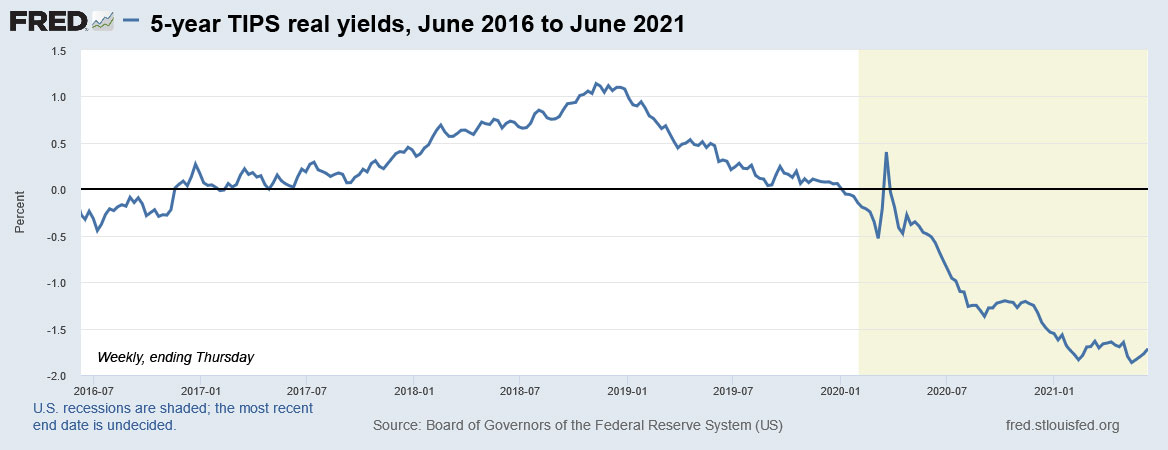
Here is the trend in the 5-year TIPS real yield over the last five years, showing the remarkable move lower after the market mania of February 2020, which triggered aggressive moves by the Federal Reserve to suppress interest rates and by Congress to stimulate the U.S. economy:

So, how could this TIPS look attractive?

Thursday’s auction could result in a record low real yield for any TIPS in history, of any term. And investors will have to pay a large premium, just to under-perform inflation by about 1.73% over the next 4 years, 10 months. How could that look appealing? It can, because this TIPS might be the prettiest ugly duckling in a pond of extremely ugly ducks.

There is only one U.S. dollar investment that is both very safe and guaranteed to match official U.S. inflation over the next five years. That is the U.S. Series I Savings Bond, which carries a real yield of 0.0%, a whopping 173 basis points better than CUSIP 91282CCA7’s current return. But I Bonds come with a purchase cap of $10,000 per person per calendar year. Once you’ve made that purchase, where do you look for a very safe 5-year investment? Five-year Treasury notes? A 5-year bank CD? Both of those options are safe, but look very likely to severely lag inflation over the next five years.

If you think we are likely to have a run of higher-than-typical inflation over the next five years, this TIPS becomes a logical investment amid a bunch of disastrous choices. Here are the numbers under varying inflation scenarios:

Once inflation averages more than 2.53% a year, this TIPS will out-perform a 5-year Treasury note at 0.76% or a 5-year bank CD at 0.80%, currently among the best in the nation. But the Treasury note and bank CD have no upside potential; they are both going to return well below 1% for five years. The TIPS has unlimited upside potential once inflation averages higher than 2.53% a year.

For that reason, I think this 5-year TIPS is an attractive alternative to other safe 5-year investments.

Inflation breakeven rate

With a 5-year Treasury note currently yielding 0.76%, this TIPS would get an inflation breakeven rate of 2.49% if it auctions with a real yield of -1.73%. That means it will out-perform a U.S. Treasury note if inflation averages more than 2.49% over the next 4 years, 10 months. That’s high, but this breakeven rate has actually dipped a bit in the last two weeks.

Here is the trend in the 5-year inflation breakeven rate over the last five years, showing the remarkable surge in inflation expectations after Federal Reserve and congressional stimulus kicked in in March 2020:

A year ago, I would have said 2.49% is a ridiculously high breakeven rate for a 5 year TIPS. A year ago, in May 2020, inflation had averaged only 1.5% in the previous 5 years. This year, after an impressive surge in inflation, that average has risen to 2.3%. I have no idea what the “new normal” is going to look like, but an inflation rate of 2.5% (or higher) in coming years looks like a reasonable bet.

Conclusion

The key question for investors is: When do you think nominal and real yields will begin rising? If you think higher rates are coming soon, waiting to invest makes sense. If you think rates will remain stable or decline further, and you want to lock in inflation protection, an investment in this TIPS is reasonable. I expect demand to be pretty strong under these market conditions.

If you are planning to invest, keep an eye on that Bloomberg Current Yields page until the morning of the auction. Real yields have been volatile in the last week. This auction closes at noon EDT Thursday for non-competitive bids and finalizes at 1 p.m. I will post the auction results soon after the auction closes.

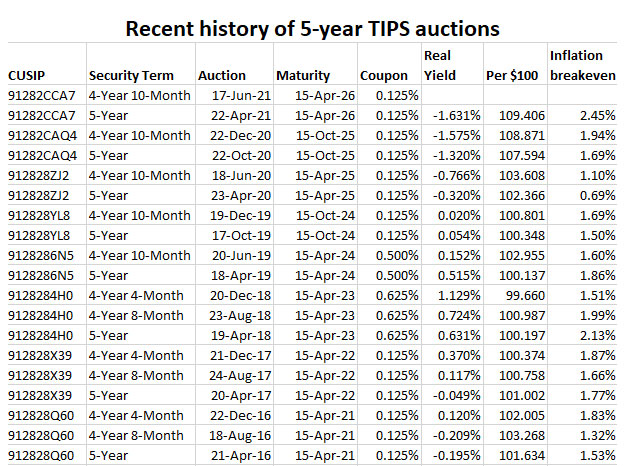
Here’s a chart of recent auction results for 4- to 5-year TIPS:

* * *

David Enna is a financial journalist, not a financial adviser. He is not selling or profiting from any investment discussed. The investments he discusses can purchased through the Treasury or other providers without fees, commissions or carrying charges. Please do your own research before investing.

Posted in Bank CDs, I Bond, Inflation, Investing in TIPS | 11 Comments

U.S. inflation surges 0.6% in May, again higher than expected

By David Enna, Tipswatch.com

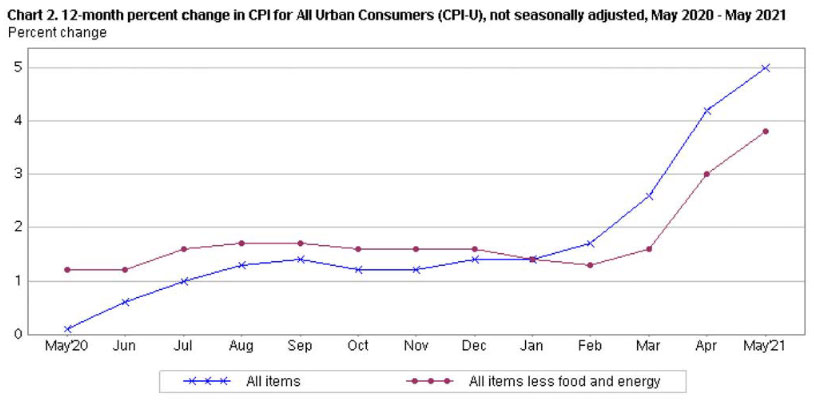
For the third month in a row, U.S. inflation surged to higher-than-expected levels in May, reaching the highest annual level in nearly 13 years, the Bureau of Labor Statistics reported today.

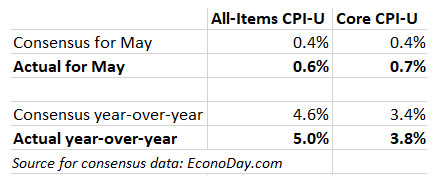
The Consumer Price Index for All Urban Consumers increased 0.6% in May on a seasonally adjusted basis, the BLS said. Over the last 12 months, the all-items index increased 5.0%; this was the largest 12-month increase since a 5.4% increase for the period ending in August 2008. The May numbers were well above the consensus forecasts of 0.4% for the month and 4.6% for the year.

Core inflation, which removes food and energy, rose 0.7% in May and 3.8% over the last 12 months, also racing well ahead of the consensus forecasts of 0.4% and 3.4%. That was the highest increase in core inflation since June 1992.

One amazing aspect of this report was that seasonally-adjusted gasoline prices actually fell in May, down 0.7% for the month but still up 56.2% over the last 12 months. I expected to see higher gas prices, caused by shortages throughout the Southeast thanks to the Colonial Pipeline shutdown. (Gasoline prices in the Southeast have definitely not fallen. Before seasonal adjustment, gasoline prices rose 4.2% in May, the BLS said.)

The index for used cars and trucks continued to rise sharply, the BLS said, increasing 7.3% in May. This increase accounted for about one-third of the all-items increase. Here are other highlights from the report:

  • Food prices increased 0.4% in May, the same increase as in April, but are up only 2.2% over the last year.
  • The May increase for food was mostly due to the index for meats, poultry, fish, and eggs, which increased 1.3% over the month. The beef index rose 2.3 percent in May.
  • The energy index was unchanged in May after declining slightly in April, but is up 28.5% over the last year.
  • Apparel prices rose 1.2% in May and are up 5.6% over the last 12 months.
  • The household furnishings and operations index increased 1.3% in May, its largest monthly increase since January 1976. Widespread shortages are being reported in furnishings.
  • The index for car and truck rentals continued to rise, increasing 12.1% after rising 16.2% the prior month.
  • The medical care index declined 0.1% in May after rising in each of the four previous months.
  • The costs of shelter rose 0.3% in May, and are up 2.2% over the last 12 months.

The May report again shows a widespread pattern of unexpectedly high inflation across the U.S. economy, with almost every category except energy showing strong price gains in the month. Here is the 12-month trend for all-items and core inflation, showing the impressive surge higher after the Federal Reserve and congressional stimulus programs stepped up in March 2020:

What this means for TIPS and I Bonds

Investors in Treasury Inflation-Protected Securities and U.S. Series I Savings Bonds are also interested in non-seasonally adjusted inflation, which is used to adjust principal balances on TIPS and set future interest rates for I Bonds. For May, the BLS set the inflation index at 269.195, an increase of 0.80% over the April number. This follows increases of 0.82% in April, 0.71% in March and 0.55% in February.

For TIPS. The new inflation index means that principal balances for all TIPS will rise 0.80% in July, following the 0.82% increase in June. Because non-seasonally adjusted inflation rose a bit faster than the seasonally adjusted number, you can expect a reversal of that trend in coming months. (Seasonal and non-seasonal numbers balance out over 12 months.) Here are the new July inflation indexes for all TIPS.

For I Bonds. The May inflation report is the second in a string of six months that will determine the I Bond’s new inflation-adjusted variable rate, which will be reset on November 1. After two months, inflation is up 1.63%, which translates to a variable rate of 3.26%, already getting close to the current rate of 3.54%. Four months remain, and a lot can happen in four months (especially summer months, when inflation is notoriously volatile.)

Here are the numbers so far:

What this means for future interest rates

The Federal Reserve continues to predict this surge in inflation will be “transitory,” but it’s disturbing that inflation has been running much higher than expectations for three months in a row, even while gas prices were stable. The Fed is hoping to discourage an “inflation psychology” seeping into our consciousness, because it could set off a snowball effect of higher wages and higher raw material costs.

From today’s Wall Street Journal report:

Food makers said their costs are climbing at an alarming rate, prompting them to raise some prices. “The inflation pressure we’re seeing is significant,” General Mills Inc. Chief Executive Jeff Harmening said at a recent investor conference. “It’s probably higher than we’ve seen in the last decade.”

He and his peers point to transportation, commodity and labor costs all increasing at the same time. They expect the trend to continue for at least the rest of this year.

The Federal Reserve tracks a different inflation index — Personal Consumption Expenditures — which was up 3.6% through April and looks likely to top 4.0% for May when that number is released later this month. The Fed wants inflation to “average” above 2.0% for a sustained time. It seems well on its way to reaching that goal.

At some point, probably soon, the Fed will need to begin “talking up” potential plans to taper its bond-buying stimulus programs, which would allow longer-term U.S. rates to begin rising. As of this morning, the stock market is rising nicely despite today’s inflation report. That indicates the financial markets don’t see Fed tapering beginning anytime soon.

But the Fed faces serious challenges if U.S. inflation continues to rise much higher than expectations.

* * *

David Enna is a financial journalist, not a financial adviser. He is not selling or profiting from any investment discussed. The investments he discusses can purchased through the Treasury or other providers without fees, commissions or carrying charges. Please do your own research before investing.
Posted in I Bond, Inflation, Investing in TIPS | 28 Comments

Want inflation protection? Be wary when the fund salesman calls.

The Lord Abbet Inflation Focused fund is a mixed-bag short-term corporate bond fund, not a typical TIPS fund

By David Enna, Tipswatch.com

I have an elderly friend (she’s 90+ years old so I think it’s OK to call her elderly) who is whip-smart and able to monitor her own finances. But sometimes she calls me for advice on safety-first investments.

I am not a financial adviser!” But I listen. In this case, she had a Goldman Sachs brokered CD that was paying 3%, but got called, leaving her with more than $50,000 in cash and no good alternatives that would yield more than 0.5%. This cash was now in the hands of a “wealth adviser” who is “affiliated” with her credit union.

She told the adviser that she is worried about surging inflation. His advice: Put that cash into the Lord Abbet Inflation Focused Fund, either class A or class C.

She asked me: “What do you think of these funds?” I think she already had a good idea what I was going to say. Like I said, she’s smart.

Well, let’s see … the class A version (LIFAX) comes with a 2.5% upfront load and an expense ratio of 0.70%, and the class C version (LIFCX) has no upfront load, but a 1.31% expense ratio and a 1% redemption fee. Does it make sense for a 90+ year old to pay a 2.5% load to buy into any mutual fund? No. Does it make sense to pay an expense ratio of 1.3% and a redemption fee of 1% when there are much cheaper options? No.

(FYI, LIFAX can be purchased at Fidelity — and probably other quality online brokers — with the load fee waived. But her wealth adviser wasn’t offering her that opportunity).

I am not a financial adviser, but this looks like questionable advice to me. My immediate advice would have been to just open an online savings account paying 0.5% and live with it. But my friend was looking for a safe investment with a reasonable return that could rise with surging inflation. She is very worried about inflation.

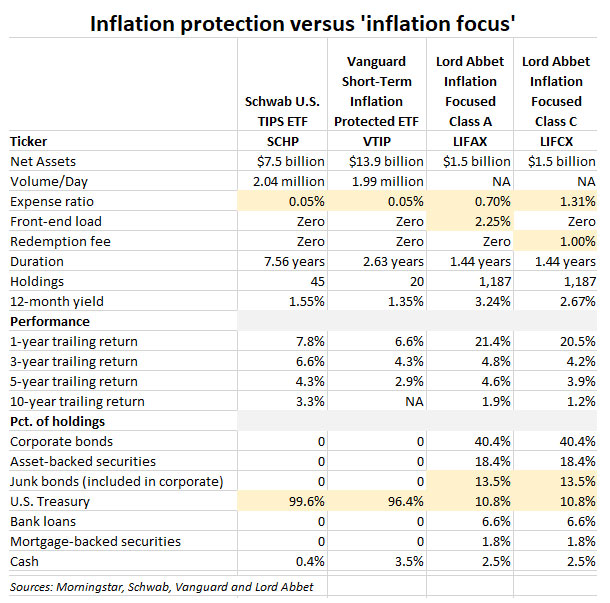
So, my suggestion was that she look at a couple of ETFs that hold Treasury Inflation-Protected Securities: Schwab’s SCHP, which holds the full range of maturities, and Vanguard’s VTIP, which holds maturities of 0 to 5 years. Both of these have expense ratios of 0.05% and can be purchased without any commissions at most brokers.

The Lord Abbet Inflation Focused fund is an easy “sell” right now because it has had a spectacular performance in the last year, with its class A shares gaining 21.4%, versus returns of about 7% for typical TIPS funds. But why was that gain so high? Because this fund skews much higher in risk, with large holdings of corporate bonds, asset-backed securities and even 13.5% of assets in junk bonds. Its U.S. Treasury holdings are right around 11% of assets. It is NOT a traditional inflation-protected fund, even though Morningstar classifies it as “Inflation-Protected Bond.”

This chart shows how it is unlike traditional inflation-protected funds, with low fees, no sales charges and investment focused on U.S. Treasurys:

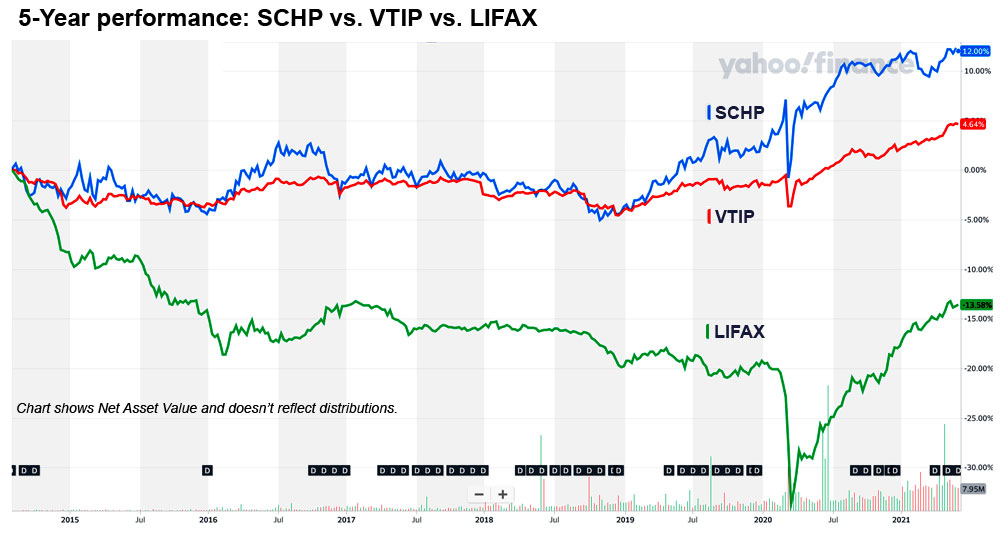
Look back 10 years, and The Lord Abbot fund’s annual return is only 1.9% (class A) and 1.2% (class C). This fund carries much higher risk than the typical TIP fund, even though its duration is quite low, at 1.44 years. Here is how LIFAX has performed versus SCHP and VTIP over the last five years:

This chart — which doesn’t reflect any load fee paid by the investor — shows how the recent out-performance of LIFAX can’t overcome years of poor performance in a time of consistently declining interest rates. This is from Morningstar’s investment analysis:

“Lord Abbett Inflation Focused’s aggressive style and unconventional inflation-protection tools have contributed to a volatile experience for investors in its otherwise conservative peer group. … This strategy’s allocation closely mirrors Lord Abbett Short Duration Income LLDYX, which carries a risky profile through significant corporate bond stakes (40%-55% of assets) and securitized credit (35%-55%). Exposure to below-investment-grade issues accounted for 14% of this portfolio at the end of July 2020 and even reached 25% back in 2014. …

“(T)his team hedges against inflation via Consumer Price Index swaps as they are less sensitive to interest-rate spikes than TIPS. Still, they can be volatile with changes in inflation expectations.”

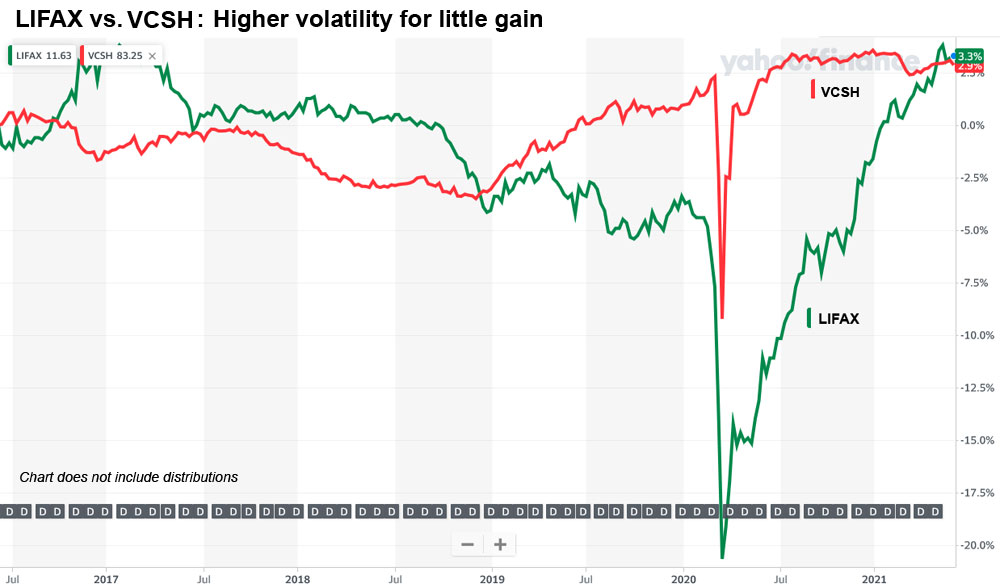
So, it is clear that Lord Abbet Inflation Focused is much more of a short-term corporate bond fund with very little direct exposure to U.S. Treasurys. That raises the question: How has it done versus more traditional short-term corporate bond funds, such as VCSH, Vanguard’s short-term corporate bond ETF, with an expense ratio of 0.05%? Here you go:

Keep in mind that this chart does not reflect the 2.5% load fee charged by advisers. LIFAX was down more than 20% in the depths of the market mania of March 2020, but has rebounded nicely since then. VCSH was less volatile.

So for the investor looking for a short-term corporate bond fund with an overlay of inflation swaps and high volatility, LIFAX could be worth a look. (But try to find a way to buy it without the load fee.) Otherwise, if you have a priority on safety and low fees, look elsewhere.

For risk-welcoming investors looking for a twist on inflation protection, I think a fund like The Quadratic Interest Rate Volatility and Inflation Hedge ETF (IVOL) is worth a look. I don’t own it and haven’t analyzed it carefully. It has an annual expense ratio of 0.99% — a negative — but at least it holds 85% of its assets in SCHP, so it is heavily exposed to TIPS. Then it adds long options tied to the U.S. interest rate curve, so it can benefit from volatility. It had a total return of 14.6% in 2020. It’s a new fund and may not have a large enough trading volume for your brokerage to allow dividends to be reinvested.

So what did my friend do?

After a couple of discussions with me — which basically confirmed her point of view — she asked her wealth adviser if he could put her $50,000 in SCHP or VTIP or some combination, and how much it would cost. She said he paused. Then he said, “I think I could do that with about a $300 commission.”

She laughed. I told you she is smart. She asked for the money to be sent to her by check, and she will no longer work with that adviser. She has a T.D. Ameritrade account where she can buy the ETFs she wants at zero cost.

* * *

David Enna is a financial journalist, not a financial adviser. He is not selling or profiting from any investment discussed. The investments he discusses can purchased through the Treasury or other providers without fees, commissions or carrying charges. Please do your own research before investing.
Disclosure: I have investments in SCHP and VTIP.

Posted in Cash alternatives, Investing in TIPS, Retirement | 11 Comments

T-Mobile Money: A weird (but insured) way to earn 1% on your cash

And here’s the thing: You don’t need to be a T-Mobile customer

By David Enna, Tipswatch.com

Back in mid-February, my cellphone carrier T-Mobile sent me an intriguing email about what seemed to be a new service offering: T-Mobile Money, an FDIC-insured savings account that paid 4% on deposits up to $3,000 and 1% on all balances above $3,000.

Was there a catch? Of course there was a catch. To get the 4% “perk” you had to make at least one $200 deposit a month into the account, either through transfer or direct deposit. Plus, you had to be an existing T-Mobile customer. Since I was already a customer — of both the company’s excellent cellular service and the ill-fated TV streaming service — I jumped aboard. I opened an account. I deposited $3,000. Then I set up an automatic transfer of $200 a month into the account.

Bingo … I earned 4% on my initial investment for the partial month of February. This was so simple! This was so great! The requirement to make one $200 deposit a month was no barrier. I loved this!

Then … less than a month later came the bad news. T-Mobile was changing the terms for the 4% perk, effective March 31. The new terms were onerous: To earn 4% on the first $3,000, I had to make 10 purchases a month using the provided MasterCard debit card. And that meant “purchases,” not simply using the ATM card to withdraw cash. So the 4% perk was now useless to me. I rarely use a debit card for purchases (especially during a pandemic) and my credit cards already provide 1% cash back.

T-Mobile continued to advertise the old terms ($200 deposit a month) well into March. My initial reaction to all of this was to throw a fit, stomp my feet, and accuse T-Mobile of a “bait and switch.” This was happening at the same time T-Mobile was dissolving its TVision television streaming service, which I was using and actually liked. Grrrr!

Count to 10, Dave, and … calm down

After a bit of research, I realized that T-Mobile Money had actually launched in 2019 and so the change in the long-standing 4% perk couldn’t really be classified as a “bait and switch.” It was a “change in terms.” Throw out the 4% perk, and what remains? 1% on all deposits, with full FDIC insurance. Does that make sense as an investment? Yes, it does.

Once you retire, you get obsessive about hoarding some level of cash, even beyond the “emergency fund” recommendations of 6 months of expected spending. Having one or two years of “after tax” cash allows you to ignore stock market fluctuations and plan for vacations, big-ticket purchases, home repairs, etc., without needing to tap retirement funds or stock investments — incurring a tax consequence.

The problem right now is that you can earn next to nothing on cash in highly safe investments like bank CDs, short-term Treasurys and money-market accounts. The typical rate paid by your brokerage or bank account is something like 0.005%, if that. So T-Mobile Money’s offer of 1% in an FDIC-insured account is way more attractive.

Here’s a comparison of potential earnings for “cash-like” investments with very little risk, showing why this T-Mobile Money account stands out in a barren wasteland:

As the amount invested increases, the value of the 4% perk declines, because it only applies to the first $3,000. T-Mobile Money, paying 1% interest, easily outshines other very safe cash-like investments. So I stuck with it, and added funds to the account. Everything can be handled on the T-Mobile Money website, and through its excellent phone app.

Do you need to be a T-Mobile customer to open an account? No you don’t. The 4% perk is limited to existing T-Mobile customers, but everyone gets the 1% interest on all deposits.

Questions and answers about T-Mobile Money

Is the T-Mobile Money account FDIC insured?

Yes. The account is actually held at BankMobile, a division of Customers Bank. The FDIC certificate number is 34444. This means your deposits are insured by the Federal Deposit Insurance Corporation up to $250,000 per customer.

Can anyone sign up for a T-Mobile Money account?

The 4% interest up to $3,000 is only available to T-Mobile customers, but you don’t need a wireless plan with T-Mobile or Sprint to sign up for a T-Mobile Money account. To sign up for an account you must:

  • Be of legal age
  • Have a US government-issued ID or state-issued driver’s license/ID
  • Have a Social Security number
  • Have a street address within the U.S. and Puerto Rico, excluding other U.S. territories

What are the monthly fees?

There are no monthly fees or minimum balance fees, no overdraft fees, no transfer fees. For ATMs, there are no fees at 55,000+ in-network Allpoint ATMs worldwide and no T-Mobile Money out-of-network fees. However, customers may incur fees from ATM providers when using out-of-network ATMs or international ATMs.

How can I deposit money?

The business model seems to be set up around direct deposit of your paycheck or government payment and then use of the ATM card. So, direct deposit is allowed, and the website and app clearly show you your account number and routing number.

You cannot deposit checks at an ATM, but you can deposit them through the T-Mobile Money app on your phone, using the phone’s camera. Mobile check deposits are limited to $3,000 a day.

You can do bank transfers into T-Mobile Money in the app, but these are limited to $3,000 a day. However, you can also set up T-Mobile Money to receive an incoming deposit from your bank or brokerage. Then the amount can be higher, up to the bank or brokerage’s outgoing per day limit. (I have tested this and it works.)

Depositing a large amount of cash? Forget it. You’ll need a money order, check or direct transfer to make a deposit.

How can I withdraw money?

It’s a similar situation to depositing money. If you are initiating a withdrawal from inside the T-Mobile Money app or website, you are limited to withdrawing $3,000 a day. But if you initiate the withdrawal from an outside source (such as your bank or brokerage connected to T-Mobile Money) you are only subject to that account’s incoming limits.

So, advice: Make sure to set up both an incoming connection to your outside account on the T-Mobile Money site ($3,000 limit in or out per day) and also a incoming/outgoing connection to T-Mobile Money from your bank or brokerage account (probably a higher limit, set by your bank or brokerage, not T-Mobile Money.)

How long does it take for deposited money to show up in your available balance?

External transfers in take 2 to 4 business days to be available. Incoming wire transfers are available on the same day they arrive. T-Mobile Money says payroll-related direct deposits can be available up to 2 days early.

Can I open a savings account instead of a checking account?

No.

Can I open an joint account?

T-Mobile says: “Joint accounts are currently unavailable. Only one account may be opened per person.” There is also no apparent way to name a beneficiary for the account. This could be a major drawback from some investors.

Does T-Mobile Money provide free checks?

No. The online account sends you to Vistaprint so you can order your own checks, at a cost ranging from 10 cents to 16 cents per check. However, T-Mobile Money does provide three free checks when it sends you your initial ATM debit card.

Does T-Mobile Money rebate ATM fees?

T-Mobile says: “If you use an out-of-network ATM, we won’t charge you, but the ATM owner probably will, and we aren’t able to rebate those fees.”

Can you get T-Mobile Money support at a T-Mobile store?

No.

How does T-Money make sense as a business?

T-Mobile says: “We expect to see revenues from merchant transaction fees when a customer pays with their T-Mobile Money MasterCard debit card. Over time, we expect to see additional operational benefits in our core business in increased customer retention and reductions in payment expenses.”

Conclusion

Despite my disappointment with the bait-and-switch … er … “change in terms” for the 4% perk, I think earning 1% in an FDIC-insured account is attractive in our current market conditions. That’s probably nearly 100 times what your bank or brokerage cash account is paying, and about double the yield of the best-in-nation online savings accounts.

There are times I feel like a T-Mobile beta-tester (the TVision streaming service was an unfortunate example), but in this case, at least so far, T-Mobile Money seems to be a solid product.

If the terms change, or interest rates elsewhere improve greatly, my deposits are always available to invest elsewhere.

Posted in Bank CDs, Cash alternatives, Retirement | 25 Comments