All of a sudden, inflation is a ‘thing’

By David Enna, Tipswatch.com

I’ve been writing about inflation and inflation-protected investments for 10 years, and most of that time, actual U.S. inflation has been sleepy and dull. Suddenly, but not too surprisingly, that has changed.
Official U.S. inflation — measured by CPI-U, the Consumer Price Index for All Urban Consumers — rose at unexpectedly high rates in March and April, well above consensus forecasts. And it looks like this could continue for several months. The result: Inflation is suddenly a very hot topic. And that actually is worrisome, because when workers begin “accepting” that future inflation will be high … wages will rise and accelerate the trend.

Google emails me a daily search alert for “Treasury Inflation-Protected Securities,” and most days in the past there would be no email at all, or an email with one or two slightly-related stories. Now, that list is booming to 12 to 15 stories a day.

So let’s take a look at what media are saying about inflation.

Wall Street Journal, May 23

The stakes are high for investors. Inflation dents the value of traditional government and corporate bonds because it reduces the purchasing power of their fixed interest payments. But it can also hurt stocks, analysts say, by pushing up interest rates and increasing input costs for companies. …

As of Friday, the yield on 10-year TIPS was minus 0.826%—meaning investors would lose money absent any inflation—compared with 1.629% for the nominal 10-year Treasury note. That means CPI growth would need to average at least 2.45% over the next 10 years for the inflation-protected security to pay as much or more than the nominal Treasury.

To some, this makes TIPS the safest and best inflation hedge. Investors are nearly guaranteed to get their principal back if they hold the bonds to maturity. At current yield differentials, they can earn significantly more than regular Treasurys if inflation fears are realized.

Still, TIPS returns are likely to be paltry under almost any scenario, particularly if inflation comes below expectations.

Yahoo! Finance, May 21

About one in three U.S. adults say they’re spending more on groceries than they were at the start of 2021, according to a Morning Consult survey of 2,200 U.S. adults conducted May 17 to 19 for Bloomberg News. Red meat was the ingredient cited most often for its higher prices, with chicken right behind.

CNBC, May 21

“In general, inflation is usually negative for stocks,” said Amy Arnott, a portfolio strategist at Morningstar. She pointed to history as proof: Between 1973 and 1981, inflation rose by more than 9% a year. During the same period, stocks shed about 4% annually. …

Another good match for investors worried about inflation are Treasury Inflation Protected Securities, or TIPS, said CFP Nicholas Scheibner, a wealth management advisor at Baron Financial Group in Fair Lawn, New Jersey. These securities carry a similar risk as other fixed income investments, he said, but they add an adjusted principal amount if inflation increases.

E-piphany by Michael Ashton, May 20

The Federal Reserve has recently started to use the word “transitory” when describing inflation pressures in the U.S. economy. What they’re trying to indicate is that we shouldn’t worry, the pressures we are seeing right now will eventually pass. But that’s stupid. All inflation is transitory. …

Maybe what they mean is that “these price changes we are seeing are all the results of supply and demand imbalances in nominal space, so they’ll all reach equilibrium and inflation will go away.” If that’s so, then (a) they’re probably wrong, (b) that’s what inflation looks like anyway; it doesn’t manifest as smooth price changes across all goods at the same time, and (c) you still haven’t told me over what period it will take for this equilibrium to occur.

New York Times, May 20

It is too soon to show up clearly in the data, but there are anecdotes aplenty that companies are rapidly increasing pay. Just this week, Bank of America said it would start a $25-per-hour minimum wage by 2025, up from $20, and major chains like McDonald’s, Starbucks and Chipotle have announced significant moves toward higher pay in recent weeks.

Associated Press, May 20

Many economists, as well as the Federal Reserve, say not to worry about any of this. They’re convinced these fast price gains will prove fleeting. If the experts are wrong, however — remember last month’s jobs data, where economists’ predictions were wildly off the mark? — it could ravage the economy and force the Fed to reverse its record-low interest rate policy and trim the bond purchases that are boosting markets. … (B)e prepared to experience even more swings in the stock market as Wall Street’s biggest question waits even longer to be answered.

Barron’s, May 17

For business owners and consumers on the ground, official inflation data and policy makers’ commentary are an alternate reality. Inflation is here, say grocery shoppers, home buyers, manufacturers, and retailers who insist that their dollars are buying less. …

The gap between reported price inflation and the experiences of businesses and consumers is a signal to investors that inflation is hotter than it looks. Implications of the disconnect are vast, affecting Social Security payments, tax-bracket adjustments, and economic growth calculations, in addition to investment returns, inflation expectations, and interest rates.

“All you have to do is open up your eyes to see there is inflation pressure everywhere,” says Ed Yardeni, president of Yardeni Research. “We are in stimulus shock.”

MarketWatch, May 12

The Fed has been hit by two major data surprises. Last Friday’s weaker-than-expected April job report and Wednesday’s hotter-than-expected April consumer prices. …

As the economy reopens, “we could have more persistent imbalances between aggregate demand and supply that would put more persistent upward pressure on inflation than we and outside forecasts expect,” (Federal Reserve Vice Chairman Richard) Clarida said Wednesday after the inflation data was published.

“I expect inflation to return to – or perhaps run somewhat above – our 2% longer-run goal in 2022 and 2023,” he said.

Final thoughts

I was at a dinner party recently (with fully vaccinated friends) and the topic turned to cooking and shopping in general. I asked the group: “Do you think prices are rising much faster right now?” The immediate reaction was a loud “YES,” across the board, with people giving examples of the price of onions, meat, lumber, used cars, housing.

Consumers have been noticing higher inflation for months. In May, the U.S. media also noticed. The overall effect is that “inflation consciousness” is seeping into the U.S. economy. This trend will continue for several months, but could dwindle later in the year. Or not. We’ll see.

* * *

David Enna is a financial journalist, not a financial adviser. He is not selling or profiting from any investment discussed. The investments he discusses can purchased through the Treasury or other providers without fees, commissions or carrying charges. Please do your own research before investing.
Posted in Inflation | 11 Comments

Reopened 10-year TIPS gets a real yield to maturity of -0.805%, a bit higher than expected

By David Enna, Tipswatch.com

The U.S. Treasury’s reopening auction of a 10-year Treasury Inflation-Protected Security — CUSIP 91282CBF7 — generated a real yield to maturity of -0.805%, a bit higher than was indicated by open-market trading in this TIPS.

This is a 9-year, 8-month TIPS and it carries a coupon rate of 0.125%, which was set by the originating auction on Jan. 21, 2021. And while an after-inflation yield of -0.805% is very low by historical standards for a TIPS of this term, it was still above the record low of -0.987% set at the January auction.

A TIPS is an investment that pays a coupon rate well below that of other Treasury investments of the same term. But with a TIPS, the principal balance adjusts each month (usually up, but sometimes down) to match the current U.S. inflation rate. So, the “real yield to maturity” of a TIPS indicates how much an investor will earn above (or below) inflation.

The negative real yield does not mean that this TIPS will have a negative nominal return. But it does mean it will have a return that lags official U.S. inflation by 0.805% over the next 9 years, 8 months.

Because the real yield was well below the coupon rate of 0.125% (the lowest the Treasury allows for a TIPS) investors at today’s auction had to pay a sizable premium for this TIPS, an adjusted price of about $111.149 for about $102.13 of value, after accrued inflation and interest is added in. This TIPS will have an inflation index of 1.0166 on the settlement date of May 28.

So, in other words, an investor who put $10,000 into this TIPS will have paid about $11,115 for $10,213 in value, and will earn an annual coupon rate of 0.125% along with inflation accruals that match U.S. inflation for 9 years, 8 months.

CUSIP 91282CBF7 trades on the secondary market, and had been trading with a real yield in a range of -0.84% to -0.85% right up to the auction’s close at 1 p.m. EDT. Because the real yield came in a bit higher at -0.805%, this indicates less-than-strong demand for this reopened TIPS. On the other hand, the bid-to-cover ratio was 2.5%, indicating decent demand.

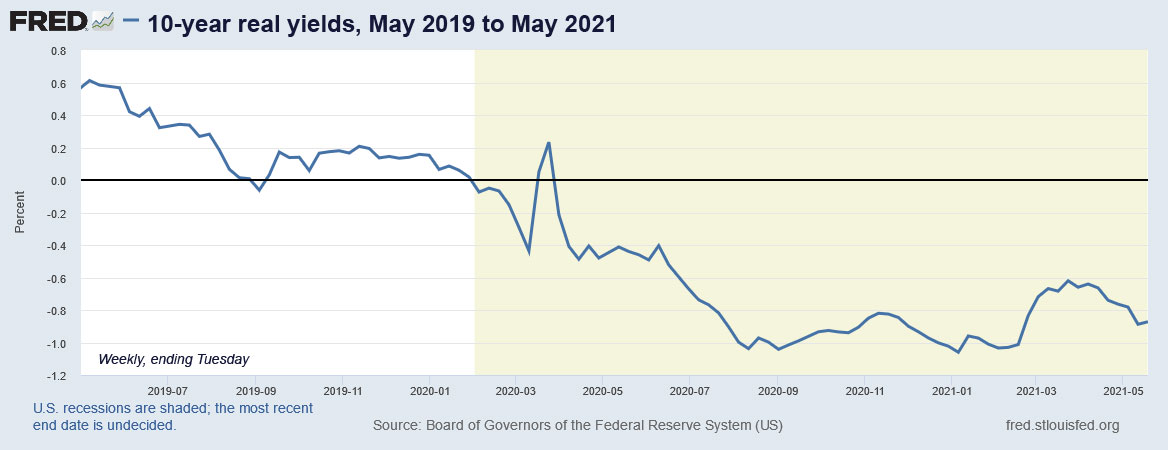
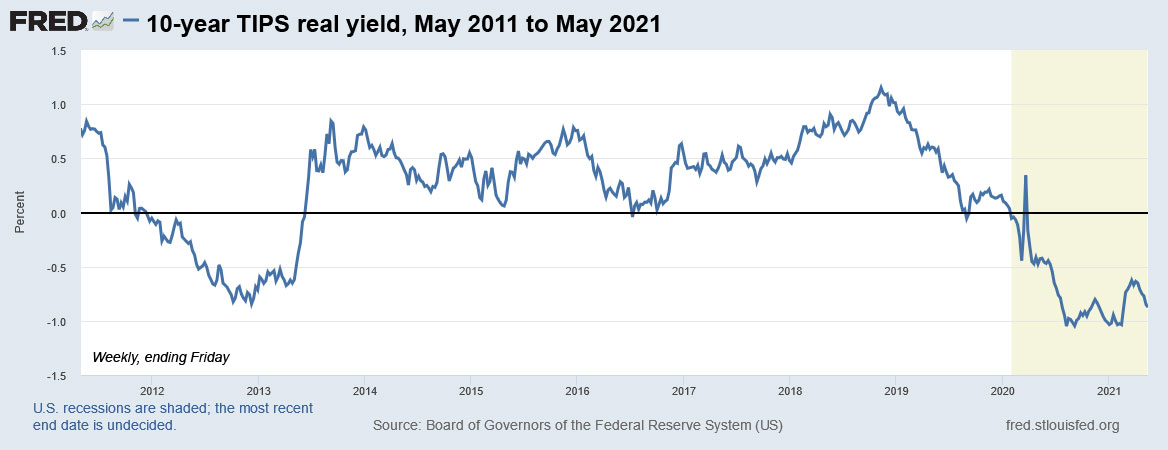
Here is a chart showing the history of 10-year real yields over the last two years, showing the dramatic bump higher in mid-March 2020, when COVID-19 fears caused a market panic, and then the dramatic fall after the Federal Reserve stepped in with its bond-buying programs, which continue today:

Inflation breakeven rate

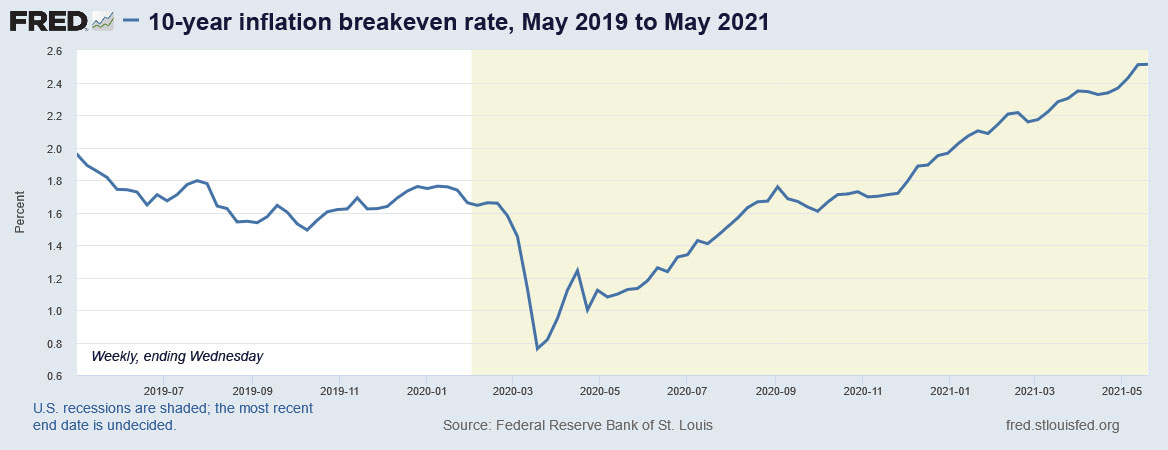
With a 10-year nominal Treasury trading with a yield of 1.63% at the auction’s close, this TIPS gets an inflation breakeven rate of 2.44%, high by historical standards. (You have to go back to 2013 to find inflation expectations higher than 2.5%.) This means that the reopened TIPS will out-perform a nominal 10-year Treasury if inflation averages higher than 2.44% over the next 9 years, 8 months. Think it will be higher? Buy a TIPS. Think it will be lower? Buy a nominal Treasury.

Before the auction, the trendline looked like the inflation breakeven rate would break the 2.5% barrier today. But investors backed off. From a Reuters report today:

Market expectations of a further rise in inflation would need evidence of the economy moving past full employment very, very rapidly, said Steven Ricchiuto, U.S. chief economist at Mizuho Securities USA LLC.

“We’ve probably already reached the peak level of economic activity, and that probably happened in March and April,” Ricchiuto said.

If you don’t “reach full peak employment very, very quickly, then you have to rethink, reset your overall expectations on the market,” he said.

Here is the trend in the 10-year inflation breakeven rate over the last two years, showing the remarkable surge higher since the Federal Reserve and Congress began aggressive stimulus programs in March 2020:

Reaction to the auction

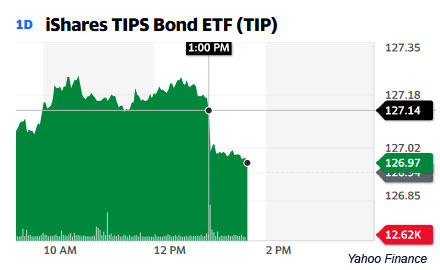
The TIP ETF, which holds the full range of maturities of TIPS, was trading slightly higher all morning, but its price fell immediately after the auction’s close at 1 p.m. EDT. This is another indication of weak demand for the reopening auction.

Overall, however, this auction result looks like was in the range of “predictable.” The Treasury was adding $13 billion in new supply, and bidders wanted a slightly higher-than-market yield.

The auction closes the history of CUSIP 91282CBF7, with three auctions that all produced real yields deeply negative to inflation. The Treasury will offer a new 10-year TIPS at auction in July and then reopen that issue in auctions in September and November.

* * *

David Enna is a financial journalist, not a financial adviser. He is not selling or profiting from any investment discussed. The investments he discusses can purchased through the Treasury or other providers without fees, commissions or carrying charges. Please do your own research before investing.
Posted in Investing in TIPS | Leave a comment

10-year TIPS will reopen at auction Thursday: Is it worth a look?

By David Enna, Tipswatch.com

This is a great time to be a holder of Treasury Inflation-Protected Securities, because probably all of your longer-term holdings are more valuable today than when you purchased them. The TIP ETF, which holds the full range of maturities, had a total return of 8.4% in 2019 and then 10.8% in 2020.

That’s the good news. The bad news is that it’s not a great time to be a buyer of TIPS. Real yields — your returns against inflation — have plummeted in 2021 and once again the full range of TIPS offerings, including the 30-year, have a real yields negative to inflation.

Of course, this is the world of safe fixed-income investing in May 2021. All safe investments, including nominal Treasurys, bank CDs and TIPS, are highly likely to under-perform official U.S. inflation into the future. The only exceptions are U.S. Savings Bonds: The I Bond will have a return matching official inflation, and the EE Bond will return 3.5% if held for 20 years, and has a good shot at beating future inflation. (Compare that with the 20-year Treasury, yielding 2.25%.)

Into this environment comes Thursday’s reopening auction of CUSIP 91282CBF7, creating a 9-year, 8-month TIPS. This is its second and final reopening auction.

  • CUSIP 91282CBF7 was created at auction on Jan. 21, 2021, and generated a real yield to maturity of -0.987%, the lowest ever for any TIPS auction of this term. The coupon rate was set at 0.125%, and investors paid a premium price of about $111.64 for about $100.01 of par value plus accrued interest.
  • It was then reopened on March 18, 2021, with a more-favorable real yield to maturity of -0.580%. The price dropped to about $107.62 for about $100.73 of value, after accrued inflation and interest was added in.

CUSIP 91282CBF7 is currently trading on the secondary market, and you can track its real yield and price on Bloomberg’s Current Yields page. As of Friday’s close it was trading with a real yield of -0.92% and a price of about $110.58. So at this point the real yield still remains a bit higher than January’s record low.

This TIPS will carry an inflation index of 1.01660 on the settlement date of May 28. That’s going to raise its adjusted price by 1.66%, but investors will get a matching amount of additional principal.

Here is a look at the trend in 10-year real yields over the last decade, a period of extremely low interest rates and relatively mild inflation:

For much of the time over the last decade, the 10-year real yield has been above zero and often in a range near 0.50%. The two exceptions are times of aggressive quantitative easing by the Federal Reserve, first from 2011 to mid 2014, and again from 2020 to today. Real yields are likely to remain well below zero at least until the Fed “hints” it will taper its bond-buying programs and eventually — after much signaling — begin raising short-term interest rates.

In the meantime, the Fed has stated it will accept “average” U.S. inflation of higher than 2%. So even though U.S. inflation is currently running at 4.2%, the Fed will ignore that until average inflation — maybe over 18 months? — rises “above 2%,” implying that 2.5% will be acceptable. The market’s reaction has been to force real yields lower, even as nominal yields were increasing. Because TIPS offer inflation protection, they are a more appealing investment under this Fed policy, so they are being bid up, forcing yields lower.

Here is a comparison of the nominal yield of a 10-year Treasury note versus the real yield of a 10-year TIPS over the last decade:

The key point is to note that while the two yields tend to rise and fall together, after February 2020 they have sharply diverted, with the nominal yield rising while the real yield is falling. And that brings us to …

10-year inflation breakeven rate

A nominal 10-year Treasury is currently trading at 1.63%, and if this reopened TIPS gets a real yield of -0.92%, it will have an inflation breakeven rate of 2.55%, which would be higher than any auction result since 2016 (when I started tracking this measure). In essence, it means that inflation will have to average more than 2.55% over the next 9 years, 8 months, for this TIPS to out-perform a nominal Treasury.

I think there will be plenty of investors willing to bet that inflation will run higher than 2.55% over the next decade, and so demand for this offering should be strong, at least versus a nominal 10-year Treasury.

Here’s a look at the trend for the 10-year inflation breakeven rate over the last decade, showing the rather mind-boggling surge higher once the Federal Reserve and Congress went into “stimulus” mode in March 2020:

When you compare a TIPS to a nominal Treasury, a TIPS is more attractive as the inflation breakeven rate declines, and less attractive as the inflation breakeven rate rises. Check out my “TIPS Vs. Nominals” page for more on that.

Conclusion

Once again, my personal investment decision is to sit out this auction, with the real yield likely to be close to a record low, the breakeven rate historically high, and the investment requiring a lofty premium price over par. At some point, nominal and real yields will climb higher, and more attractive options — eventually — will be available.

For the first $10,000 you invest in inflation protection, go with Series I Savings Bonds, which have a purchase cap of $10,000 per person per year. Right now an I Bond has 92-basis-point advantage over this TIPS, while providing tax-deferred interest and better inflation protection.

If you are interested in this auction, keep an eye on Bloomberg’s Current Yields page up to the morning of the auction, which closes to non-competitive bids at noon EDT. The 10-year TIPS listed there is CUSIP 91282CBF7, and it should be an accurate predictor of your likely yield and cost. But just be aware that an auction event can sometimes skew the yield higher or lower. As I noted, I think demand could be fairly strong for this TIPS from big-money investors.

One positive factor: April’s non-seasonally adjusted inflation rate of 0.82% is going to give an immediate boost to this TIPS’ principal balance in June, up 0.82%. And adjustments in the next few months after that could also be fairly high.

I will be posting the auction results soon after the official close at 1 p.m. EDT Thursday. Here is a history of recent 9- to 10-year TIPS auctions, showing the string of negative real yields that began in May 2020:

* * *

David Enna is a financial journalist, not a financial adviser. He is not selling or profiting from any investment discussed. The investments he discusses can purchased through the Treasury or other providers without fees, commissions or carrying charges. Please do your own research before investing.

Posted in Investing in TIPS | 2 Comments

A 5-year TIPS matured in April; how did it do as an investment?

By David Enna, Tipswatch.com

For several years, I’ve been tracking the performance of TIPS investments versus nominal Treasurys of the same term. Over the last decade, TIPS have been fairly lousy investments when compared to their nominal counterparts. That’s what happens when inflation runs at surprisingly low levels for years.

On April 15, 2021, a five-year TIPS matured. This was CUSIP 912828Q60, created at auction on April 21, 2016. In my preview article for that auction, I noted that the yield to maturity was likely to be negative to inflation, and down 68 basis points from a similar auction in December 2015. The auction a few days later ended up with a real yield to maturity of -0.195%.

So, with its negative yield to inflation, this was a lousy investment, right?

Wrong. It ended up outperforming a 5-year Treasury note, which at the time had a nominal yield of 1.35%. That created an inflation breakeven rate of 1.54%, pretty attractive. In actuality, inflation ended up averaging 2.1% over the next five years, giving this TIPS a 0.56% annual advantage over the nominal 5-year Treasury.

Understand that this is a rough estimate of performance, and it is based on inflation data starting two months before the month of TIPS issue. Inflation accruals for TIPS each month are based on inflation data from two months earlier. (That means the big jumps in inflation in March and April 2021 are not reflected in this data.)

Also, keep in mind that interest on a nominal Treasury and the TIPS coupon rate is paid out as current-year income and not reinvested. So in the case of a nominal Treasury, the interest earned could be reinvested elsewhere, which would potentially boost the gain. For certain, we don’t know what the investor could have earned precisely on an investment after re-investments.

In the case of a TIPS, the inflation adjustment compounds over time, and that will give TIPS a slight boost in return that isn’t reflected in the “average inflation” numbers presented in the chart.

Nevertheless, it is clear that CUSIP 912828Q60 ended up being a winner when compared to a 5-year nominal Treasury, because inflation ended up running higher than its rather low inflation breakeven rate.

* * *

David Enna is a financial journalist, not a financial adviser. He is not selling or profiting from any investment discussed. The investments he discusses can purchased through the Treasury or other providers without fees, commissions or carrying charges. Please do your own research before investing.
Posted in Investing in TIPS | 5 Comments

Inflation stunner: U.S. prices rose 0.8% in April, much higher than expected

By David Enna, Tipswatch.com

Memo to inflation predictors: You are going to need some new formulas.

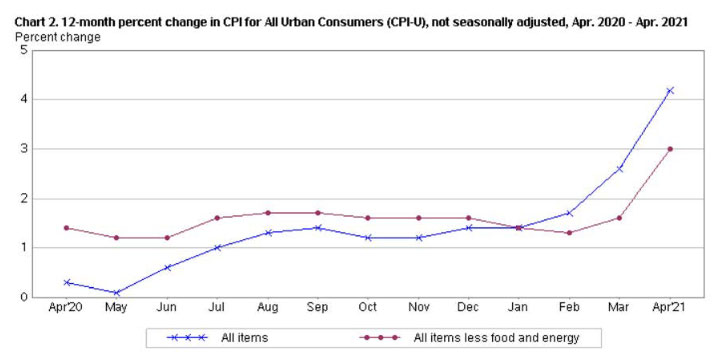
The Consumer Price Index for All Urban Consumers increased 0.8% in April on a seasonally adjusted basis after rising 0.6% in March, the U.S. Bureau of Labor Statistics reported today. Over the last 12 months, the all-items index increased 4.2%, the largest 12-month increase since a 4.9% increase in September 2008.

This result was four times the consensus estimate of 0.2% for April inflation, and the year-over-year number was also much higher than the estimate of 3.6%. Core inflation, which removes food and energy, was equally shocking: 0.9% for the month, versus an estimate of 0.3%, and 3.0% for the year, versus an estimate of 2.3%.

Clearly, economists have no way to predict U.S. inflation accurately in mid 2021, after 13 months of massive Federal Reserve and Congressional stimulus measures. And this came in a month when gasoline prices — usually a key trigger of monthly inflation — actually fell!

Here are some highlights from the BLS report:

  • The index for used cars and trucks rose 10.0% in April, the largest monthly increase in that category since this inflation series began in 1953. Used vehicle prices are up a massive 21% over the last 12 months.
  • Food prices rose 0.4% for the month and are up 2.4% year over year.
  • Gasoline prices fell 1.4% in April after rising 9.1% in March, but remain 47.6% higher year over year.
  • The shelter index rose 0.4% in April, and is up 2.1% over the year.
  • The index for airline fares also rose sharply in April, increasing 10.2%.
  • Costs of car and truck rentals rose 16.2%.
  • The costs of medical care services remained flat in April, and are up 2.2% year over year.

My takeaway from the April report is that inflation is surging across the entire economy, at a rate much higher than economists expected. And that happened even though gas prices were down for the month. Gasoline prices have already risen sharply in May, partially triggered by the East Coast pipeline shutdown.

Here is the trend over the last 12 months for both all-items and core inflation, showing the relatively moderate trend during the heart of the COVID-19 pandemic, but surging once the nation began reopening earlier this year:

What this means for TIPS and I Bonds

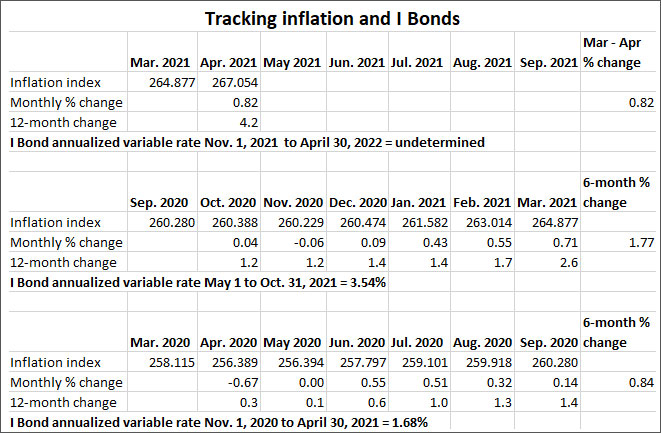
Investors in Treasury-Inflation Protected Securities and U.S. Series I Bonds are also interested in non-seasonally adjusted inflation, which is used to adjust principal balances on TIPS and set future interest rates for I Bonds. For April, the BLS set the inflation index at 267.054, an increase of 0.82% over the March number.

For TIPS. Today’s inflation report means that principal balances for all TIPS will increase by 0.82% in June, following increases of 0.55% in April and 0.71% in May. That’s a remarkable 2.07% increase in three months, and a nice demonstration of why it’s smart to have some inflation protection in your asset allocation. Here are the new June Inflation Indexes for all TIPS.

For I Bonds. Today’s report is the first of a six-month string that will determine the I Bond’s new inflation-adjusted variable rate, which will be reset in November. It’s too early to draw any conclusions, and remember that today’s report shows just how difficult inflation is to predict.

Here are the numbers:

What this means for future interest rates

The Federal Reserve has been predicting a “transitory” increase in inflation, caused partially by comparisons to the weak price trend during the early months of the COVID-19 pandemic. Note in the chart above that non-seasonally adjusted prices fell 0.67% in April 2020, followed by zero inflation in May 2020. In addition, the nation is facing some supply shortages in key items like lumber and computer chips.

The stock market isn’t reacting well to today’s news, with the S&P 500 index down nearly 1% this morning. The 10-year Treasury yield has bounced back to about 1.67%, up about 9 basis points over the last week.

But will this surge in inflation continue? From today’s Wall Street Journal report:

“I think a lot of us are expecting a pretty significant increase of spending on services in the next couple months and that’s where a lot of the pressure on CPI is going to come from,” said Richard F. Moody, chief economist at Regions Financial Corp. “It’s a question of how long that burst in spending persists. And the longer it persists, the more latitude producers have to raise prices.” …

A persistent, significant increase in inflation could prompt the central bank to tighten its easy-money policies earlier than it had planned, or to react more aggressively later, to achieve its 2% inflation goal.

Because of the weak inflation numbers in May 2020, it’s likely that core inflation will again be 3.0% or higher in the May 2021 report, well above the Fed’s stated target of “above 2.0%.” The Fed tracks a different inflation index, the Personal Consumption Expenditures index, which was 2.3% in March (the April number has not yet been released).

The Fed, however, believes this inflationary trend will be temporary, with price increases probably settling in around 2.5% by the end of the year. A few more months of the outsized inflation of March and April may force them to change their view.

* * *

David Enna is a financial journalist, not a financial adviser. He is not selling or profiting from any investment discussed. The investments he discusses can purchased through the Treasury or other providers without fees, commissions or carrying charges. Please do your own research before investing.

Posted in Investing in TIPS | 8 Comments