A 10-year TIPS matured in January. How did it do as an investment?

By David Enna, Tipswatch.com

I’ve been a big advocate of purchasing Treasury Inflation-Protected Securities over the last decade, and much of that time … I’ve been wrong.

Oops, sorry.

TIPS are investments that provide a market-based real return above (or below) inflation, and they can be directly compared with nominal Treasurys of the same term. The spread between the after-inflation (real) yield of a TIPS versus the nominal yield of a traditional Treasury is called the inflation breakeven rate.

For example:

  • A 10-year Treasury note currently has a nominal yield of 1.15%.
  • A 10-year TIPS currently has a real yield of -1.06%.
  • Today’s 10-year inflation breakeven rate is 2.21%.

An investor looking at a 10-year TIPS as a buy-and-hold-to-maturity investment today needs to ask this question: Do I believe inflation will average more than 2.21% over the next 10 years? If the answer is yes, buy the TIPS. If the answer is no, buy the nominal 10-year.

(Actually, the better solution is to first buy U.S. Series I Bonds, up to the $10,000 per person per year limit. An I Bond purchased today has a real yield of 0.0%, which is a 106-basis-point advantage over a TIPS. And the I Bond’s inflation breakeven rate is only 1.15% versus the nominal U.S. Treasury. I Bonds are the superior investment.)

For much of the time over the last decade, inflation expectations — reflected in the 10-year inflation breakeven rate — have been running above 2.0%, like they are today. However, inflation over the last 10 years has only averaged 1.7%. So TIPS have been highly likely to underperform nominal U.S. Treasurys over the last decade.

This brings us to CUSIP 912828PP9, a 10-year Treasury that matured Jan. 15, 2021. It had an originating auction on Jan. 20, 2011, which generated a real yield to maturity of 1.17% and a coupon rate of 1.125%.

Today, we’d be jumping for joy over a real yield of 1.17% on a 10-year TIPS — and in fact I was a buyer at this auction and just hand this TIPS mature. Sad moment.

But this TIPS wasn’t a relatively great investment. Why? On the date of the auction 10 years ago, a 10-year nominal Treasury note had a nominal yield of 3.34%, creating an inflation breakeven rate of 2.17%, close to where we are today.

Here’s the bad news: U.S. inflation only averaged 1.7% over the last 10 years, meaning this TIPS under-performed a nominal Treasury by about 0.47% a year over 10 years. An investor would have done better by grabbing a 10-year Treasury note yielding 3.34%.

Putting this into perspective

A TIPS investment has the advantage of protecting against unexpectedly high future inflation, but will under-perform in times of unexpectedly low future inflation. We’ve just completed a decade of unexpectedly low inflation, with 10-year average rates running as low as 1.3% for the 10 years ending in January 2017.

In general, when the inflation breakeven rate has dipped well below 2.0%, TIPS have out-performed, because they became “cheap” versus a nominal Treasury.

We don’t know what the future will bring. The market expects higher inflation, and many people foresee inflation climbing into the 3% to 4% range. It could happen. Or, it won’t. We don’t know.

A lower inflation breakeven rate makes TIPS a more attractive investment versus a nominal Treasury. That’s the lesson of the last decade.

Here are the TIPS vs. nominal results for all 5- and 10-year TIPS that have matured over since 2013:

To view this at a glance, the annual variance number in the last column shows how the inflation breakeven rate compared to actual inflation. When the numbers are green, a TIPS was the superior investment. When they are red, the nominal Treasury was the better investment.

Inflation breakeven rates of less than 2.0% are noted in green. In general, TIPS out-perform nominal Treasurys when this happens. The 10-year TIPS that matured in July 2020 had only a rounding error (less than 0.1%) of difference.

* * *

David Enna is a financial journalist, not a financial adviser. He is not selling or profiting from any investment discussed. The investments he recommends can purchased through the Treasury or other providers without fees, commissions or carrying charges. Please do your own research before investing.
Posted in Investing in TIPS | 2 Comments

January inflation rises 0.3%: What does it mean for TIPS and I Bonds?

By David Enna, Tipswatch.com

The Consumer Price Index for All Urban Consumers increased 0.3% in January on a seasonally adjusted basis, the U.S. Bureau of Labor Statistics reported today. Over the last 12 months, the all-items index increased 1.4%.

The BLS noted that gasoline prices, which were up 7.4% in January, accounted for most of the gain in overall inflation. (Gasoline prices are still down 8.6% year over year.) Food prices also increased in January by a moderate 0.1%, but are up 3.8% year over year.

Core inflation, which strips out food and energy, was unchanged in January and up 1.4% over the last 12 months. This was lower than the consensus estimates, which predicted 0.2% core inflation for the month and 1.6% year over year.

Overall, this report indicates continued low to moderate inflation in the United States, with no evidence yet of a surge caused by Federal Reserve stimulus. The Fed wants to see inflation — it uses a different index, Personal Consumption Expenditures — rise solidly above 2% for a period of time. Since the PCE Index tends to lag below CPI-U, you can expect the Fed to continue its easy money policies.

Other highlights from the report:

  • Piped fuel oil (natural gas) prices rose 0.5% in January and are up 4.3% over the last 12 months. This increase, combined with a relatively frigid winter on the East Coast, has caused some “utility bill shocks” recently. My January bill was up nearly 100% from a year ago.
  • Apparel costs rose 2.2% for the month, but remain down 2.5% over the last year.
  • The costs of used cars and trucks dropped 0.9% for the month, but are up a whopping 10% over the last year.
  • All six major grocery store food group indexes increased over the last 12 months, with increases ranging from 2.5% (cereals and bakery products) to 5.1% (meats, poultry, fish, and eggs).
  • The shelter index rose a moderate 0.1% in January and is up 1.6% year over year.
  • Costs of medical care services increased 0.5% in the month, and are up 2.9% year over year.
  • Airline fares declined 2.5% for the month and are down 21.3% over the year.

Here is the overall trend for all-items and core inflation over the last 12 months, showing a remarkably stable trend of lowish inflation over the last 6 months:

What this means for TIPS and I Bonds

Investors in Treasury Inflation-Protected Securities and U.S. Series I Savings Bonds are also interested in non-seasonally adjusted inflation, which is used to adjust principal balances on TIPS and set future interest rates for I Bonds. For January, the BLS set the inflation index at 261.582, an increase of 0.43% over the December number.

For TIPS. Today’s inflation report means that principal balances for all TIPS will rise 0.43% in March, after three months of slim increases (totaling only 0.07% from December to February). This increase is a bounce-back from recent months when non-seasonally adjusted inflation ran lower than the adjusted number. Non-seasonal and seasonal inflation increases balance off after a year.

Here are the new March Inflation Indexes for all TIPS.

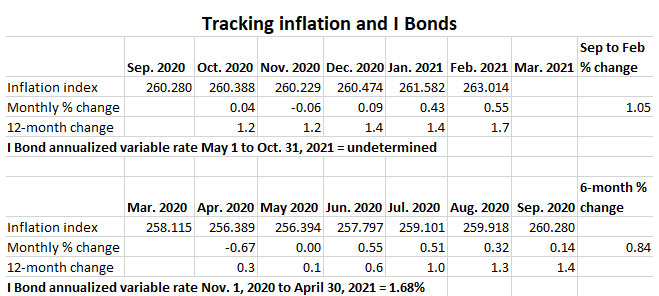
For I Bonds. The January inflation report is the fourth in a six-month series that will determine the I Bond’s new inflation-adjusted variable rate. At this point, with two months remaining, inflation is running at 0.50%, which would result in a variable rate of 1.0%, lower than the current 1.68%. However, keep in mind that two months remain, and a lot can happen in two months, up or down.

Nevertheless, even a 1.0% nominal return on an I Bond will easily out-perform any other very safe investment option.

Here are the numbers used in this calculation:

What this means for future interest rates

This report will add fuel to the argument that the economy needs more stimulus, or at least that inflation remains muted enough that more stimulus won’t overheat things. It’s a razor’s edge, of course, and once inflation surges, it is hard to control.

At this point, in my opinion, the Fed is going to keep to its course of ultra-low short-term interest rates and bond-buying to manipulate yields on longer-term Treasurys.


* * *

David Enna is a financial journalist, not a financial adviser. He is not selling or profiting from any investment discussed. The investments he recommends can purchased through the Treasury or other providers without fees, commissions or carrying charges. Please do your own research before investing.
Posted in I Bond, Inflation | 4 Comments

New 10-year TIPS auctions with a real yield of -0.987%, lowest in history for this term

By David Enna, Tipswatch.com

The U.S. Treasury just announced that its auction of $15 billion of a new 10-year Treasury Inflation-Protected Security — CUSIP 91282CBF7 — generated a real yield to maturity of -0.987%, the lowest ever for any auction of this term.

But here’s the interesting thing: At 11 a.m. EST, a similar 10-year TIPS was trading on the secondary market with a real yield of -1.06%, and even 15 minutes after today’s auction close it was still trading with a real yield of -1.07%. Today’s auction result came in about 8 basis points higher than market values, an indication of weak demand, or over supply, or both.

A TIPS is an investment that pays a coupon rate well below that of other Treasury investments of the same term. But with a TIPS, the principal balance adjusts each month (usually up, but sometimes down) to match the current U.S. inflation rate. So, the “real yield to maturity” of a TIPS indicates how much an investor will earn above (or below) inflation.

Today’s auction set the coupon rate for CUSIP 91282CBF7 at 0.125%, the lowest the Treasury will go for any TIPS. The -0.987% real yield meant that investors had to pay a sizable premium to collect the coupon rate of 0.125%, about $111.64 for about $100.005 of value, when accrued interest is added in.

The settlement date for this auction is Jan. 29, and it will carry an inflation index of 0.99972, meaning its accrued value will be slightly lower than the purchased amount. February’s inflation adjustment will be a meager 0.09%. It’s easy to see why investors might have been lukewarm about this issue.

On the other hand, the bid-to-cover ratio for this auction was 2.68%, which indicates decent demand.

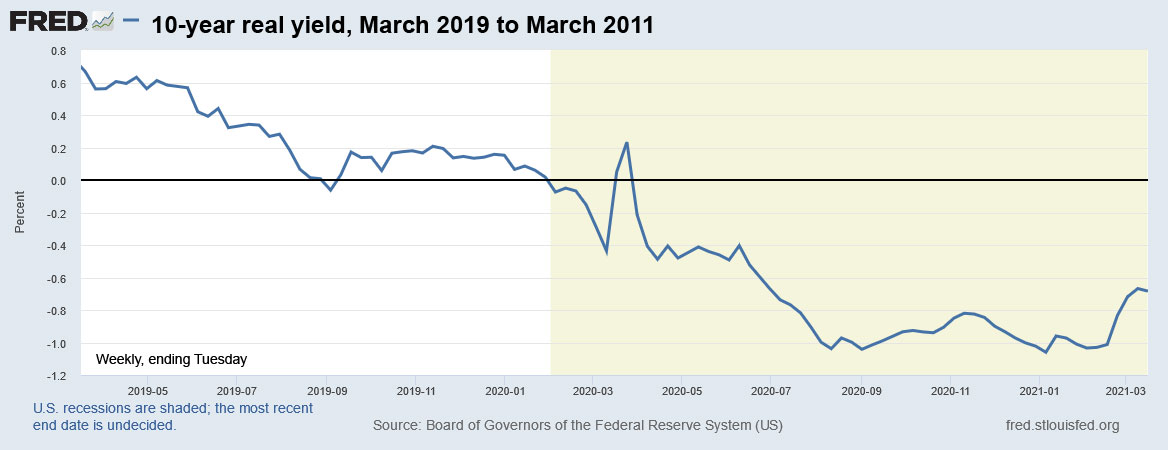
Here is the trend for 10-year real yields over the last two years, showing the steep decline after an initial burst higher during the pandemic panic of March 2020:

Inflation breakeven rate

At the auction close, a nominal 10-year Treasury note was trading with a real yield of 1.10%, meaning this new TIPS gets an inflation breakeven rate of 2.09%, the highest for any auction of this term since September 2018. Inflation expectations are rising, with recent TIPS auctions providing the solid evidence.

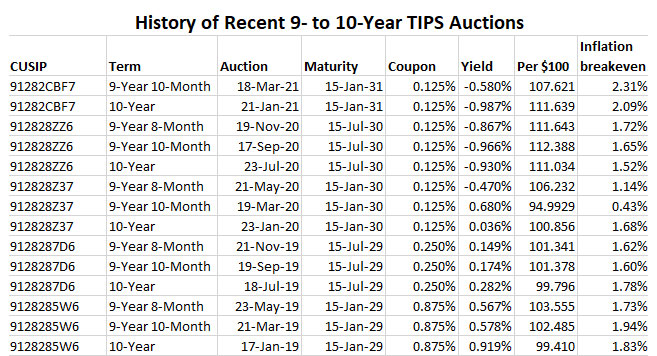
  • Jan. 21, 2020: 2.09%
  • Nov. 19, 2020: 1.72%
  • Sept. 17, 2020: 1.65%
  • July 23, 2020: 1.52%
  • May 21, 2020: 1.14%
  • March 19, 2020: 0.43%

It’s not historically unusual to see 10-year inflation breakeven rates rise above 2%, but inflation has been quite muted over the last decade, averaging just 1.7%. The market is pricing in higher future inflation.

Here is the trend in the 10-year inflation breakeven rate over the last two years, showing the dramatic increases since the March 2020:

Thoughts

The TIP ETF had been trading slightly higher all morning today, so that would seem to indicate that real yields were declining and the auction result would end up somewhere around -1.02% to -1.03%. But instead, the real yield rose a few basis points, meaning investors wanted a better deal than the current market.

After the auction close, the TIP ETF barely budged, and remains positive for the day. The current price is $127.74, very close to the all-time high of $127.92. (All-time highs make me nervous.)

* * *

David Enna is a financial journalist, not a financial adviser. He is not selling or profiting from any investment discussed. The investments he recommends can purchased through the Treasury or other providers without fees, commissions or carrying charges. Please do your own research before investing.

Posted in Investing in TIPS | Leave a comment

Up next: New 10-year TIPS will auction Jan. 21

By David Enna, Tipswatch.com

The U.S. Treasury will offer $15 billion at auction Jan. 21 in a new 10-year Treasury Inflation-Protected Security, CUSIP 91282CBF7.

The coupon rate and real yield to maturity of this TIPS will be determined by the auction. But we can say three things with certainty: 1) the coupon rate will be 0.125%, 2) the real yield to maturity will be deeply negative, and 3) investors will be paying a sizable premium above par value. And despite all that, I’d expect demand for this TIPS to be fairly high.

The Treasury, responding to the massive federal deficit of 2020 and expected deficit of 2021, has been stepping up the size of its 10-year TIPS auctions, by about 7.5% a year.

  • In January 2019, the auction of a new 10-year TIPS totaled $13 billion
  • In January 2020, same auction, $14 billion.
  • In January 2021, same auction, $15 billion.

Increased supply should begin to put pressure on TIPS yields, nudging them slightly higher. But we haven’t seen supply being much of a factor in real yields to this point, especially with the Federal Reserve ready to step in with purchases.

The U.S. Treasury currently estimates that a 10-year TIPS would have a real yield (meaning the yield above U.S. inflation) of -0.99%, which is 9 basis points higher than the level where real yields began the year. But if that yield holds through Thursday’s action, it would set a record for the lowest yield ever for any auction of a 9- to 10-year TIPS. The record low is -0.966%, set in a reopening auction on Sept. 20, 2020.

A real yield that low will mean investors will be paying more than a 11% premium over par value for that coupon rate of 0.125%.

Here is the trend in 10-year real yields over the last 5 years, showing the dramatic turbulence in yields as the COVID-19 pandemic took hold in March 2020, which then triggered the Federal Reserve’s aggressive program of bond buying to stabilize markets:

Inflation breakeven rate

With a nominal 10-year Treasury note currently yielding 1.11%, a 10-year TIPS with a real yield of -0.99% would get an inflation breakeven rate of 2.1%, much higher than recent auction trends. We haven’t seen a 9- to 10-year TIPS auction generate an inflation breakeven rate higher than 2.0% since September 2018.

Keep in mind that U.S. inflation is currently running at 1.4% and has averaged 1.7% over the last 10 years. Investors are pricing in higher future inflation, which makes TIPS “more expensive” versus their nominal Treasury counterparts.

Here is the trend in the 10-year inflation breakeven rate over the last 5 years, showing the dramatic rise higher after March 2020 in reaction to massive federal stimulus (and a resulting weaker U.S. dollar):

Quick reaction

I’ll be looking for a 10-year TIPS auction for purchase in 2021, but I’m not attracted to this one. A record low yield looks likely, and the inflation breakeven rate is making nominal rates look more attractive.

If you are planning an investment, keep an eye on the Treasury’s Real Yields page to track the current estimate. It is generally a reliable indicator, but strange things sometimes happen on auction days, especially in these volatile political times.

The auction closes to non-competitive bids at noon Thursday, and then finalizes at 1 p.m. EST. I’ll be posting the auction result soon after the close. Here’s a history of all 9- to 10-year TIPS auctions since 2016:

Posted in Investing in TIPS | 3 Comments

U.S. inflation rose 0.4% in December with rise in gas prices

By David Enna, Tipswatch.com

The Consumer Price Index for All Urban Consumers increased 0.4% in December on a seasonally adjusted basis, the U.S. Bureau of Labor Statistics reported today. Over the last 12 months, the all-items index increased 1.4%. Core inflation, which strips out food and energy, rose 0.1% in December and 1.6% for the year.

All of these number were close to the consensus predictions, with the year-over-year number missing on the high side for all-items inflation and on the low side for core inflation. In other words, no real surprises.

This report closes out the year of 2020, which ended up with annual inflation of 1.4%, the lowest rate since 0.7% in 2015.

Overall U.S. inflation surged in December primarily because of a whopping 8.4% increase in the gasoline index, which the BLS said accounted for more than half the overall inflation increase. However, gas prices were still down 15.2% for the year, indicating they have room to rise higher. Other key trends:

  • Food prices were up 0.4% for the month and up 3.9% for the year.
  • Shelter prices rose 0.1% and were up 1.6% for the year.
  • Apparel prices rose a sharp 1.4%, but were down 3.9% for the year.
  • The cost of medical care services dropped 0.1%, but was up 2.8% for the year.
  • The cost of used cars and trucks fell 1.2% for the month, but were 10% higher for the year.

Here is the 12-month trend for both all-items and core inflation in 2020, showing the sharp decline during the pandemic’s first surge in March, and then the gradual rise higher and stabilization in the second half of the year.:

What this means for TIPS and I Bonds

Investors in Treasury Inflation-Protected Securities and U.S. Series I Savings Bonds are also interested in non-seasonally adjusted inflation, which is used to adjust principal balances on TIPS and set future interest rates for I Bonds. For December, the BLS set the inflation index at 260.474, 0.09% higher than the index for November.

For TIPS. The December inflation report means that principal balances for all TIPS will rise 0.09% in February, after falling 0.06% in January. That’s only a net increase of 0.03% over two months. Keep in mind, however, that non-seasonally adjusted inflation has been running lower than seasonally adjusted. This trend will reverse in future months because both versions balance out over 12 months.

Here are the new February Inflation Indexes for all TIPS.

For I Bonds. The December report is the third in a six-month series that will determine the I Bond’s new inflation-adjusted variable rate, which will be reset on May 1. So far, halfway through the rate-setting period, inflation is 0.07% higher, which would result in a woefully small variable rate of 0.14% for I Bonds, versus the current 1.68%. But … three months remain, and a lot can happen in three months.

Here is the trend so far for the current period, along with data for recent rate resets:

Where are we heading?

Inflation was “lower than expected” in 2020, running at just 1.4%. While that is welcome news, investors in TIPS and I Bonds don’t do well when inflation runs lower than expected. But … inflation expectations are rising, with the 10-year inflation breakeven rate currently running at 2.08%, higher than recent trends.

One important factor in rising inflation — definitely reflected in rising gasoline prices — is the decline in the value of the U.S. dollar, down about 10% against international currencies since mid-2020:

Inflation fears are also rising because of recent political events, with the Democratic Party taking control of the White House and both houses of Congress. The theory is that this will increase future stimulus spending and federal deficits, spurring inflation in the U.S. economy.

Will inflation surge in the future? I don’t know. TIPS and I Bonds, however, provide protection against unexpectedly high future inflation. They continue to make sense as a allocation in your overall financial plan.

The Treasury will offer a new 10-year TIPS at auction on Jan. 21, and I will be previewing that auction over the weekend.

Posted in I Bond, Inflation | 4 Comments