
This report is going to roil financial markets.
By David Enna, Tipswatch.com
Surprises, surprises. Financial markets, which had been rallying over the last week on expectations of falling prices, got an inflation reality check today: Seasonally adjusted U.S. inflation rose 0.1% in August, and 8.3% over the last year, the Bureau of Labor Statistics reported.
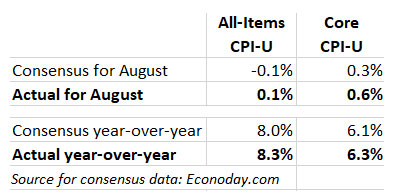
Economists had been expecting inflation to decline for the month, based on plummeting gasoline prices, which were down 10.6% for the month. Instead, both the monthly and year-over-year numbers came in higher than expectations. Core inflation, which removes food and energy, also greatly surpassed expectations, coming in at 0.6% for the month (versus an expected 0.3%) and 6.3% for the year (versus 6.1%).
My two-word analysis: “Not good.”
The BLS noted that increases in the shelter, food, and medical care indexes were the largest of “many” contributors to the all-items increase, overwhelming the deep decline in gasoline prices. Some key data from the report:
- Food prices rose 0.8% for the month (the smallest monthly increase this year) and are now up a painful 11.4% year over year. Prices for all six major grocery store indexes increased.
- The food at home index has increased 13.5% over the last 12 months, the largest one-year increase since March 1979.
- Shelter costs increased 0.7% for the month and are up 6.2% year over year. The rent index rose 0.7% for the month.
- Costs of medical care services were up 0.8% for the month and 5.6% for the year.
- The index for household furnishings increased 1.0% in August after rising 0.6% in July.
- Apparel costs were up a moderate 0.2% and 5.1% for the year.
- The index for airline fares decreased 4.6% after falling 7.8% in July.
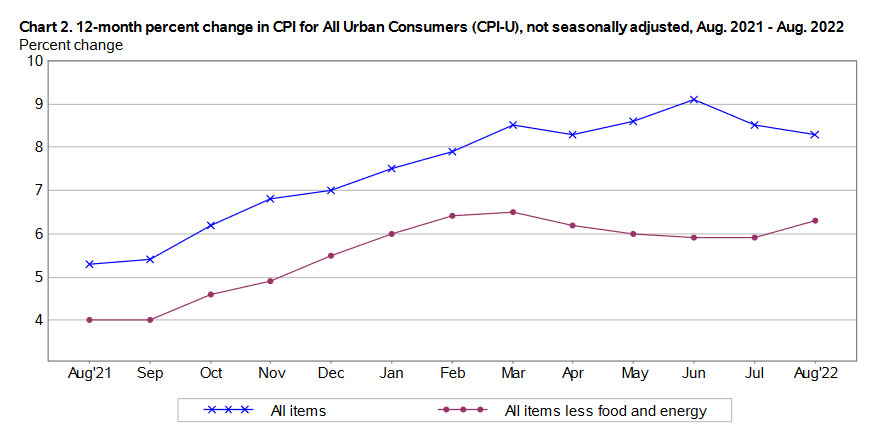
Here is the trend in annual all-items and core inflation over the last year, showing the slight rise in core inflation even as falling gasoline prices have caused all-items inflation to fall from the June peak of 9.1%.
What this means for TIPS and I Bonds
Investors in Treasury Inflation-Protected Securities and U.S. Series I Savings Bonds are also interested in non-seasonally adjusted inflation, which is used to adjust principal balances for TIPS and set future interest rates for I Bonds. For August, the BLS set the inflation index at 296.171, a decline of 0.04% from July’s 296.276. The BLS called this “unchanged.”
For TIPS. The August report means that principal balances for all TIPS will decrease 0.04% in October, after falling 0.01% in September. However, year-over-year balances will have increased 8.3% by the end of October. Here are the new October Inflation Indexes for all TIPS.
For I Bonds. The August report is the fifth in a six-month series that will set the I Bond’s new variable rate, which will begin rolling out November 1 for all I Bonds. As of August, inflation has run at a rate of 3.01%, which would translate to an I Bond variable rate of 6.02%, lower than the current rate of 9.62%. However, one month remains. Oil prices seem to have stabilized this month, so it’s possible we will see a higher number. Here are relevant data:
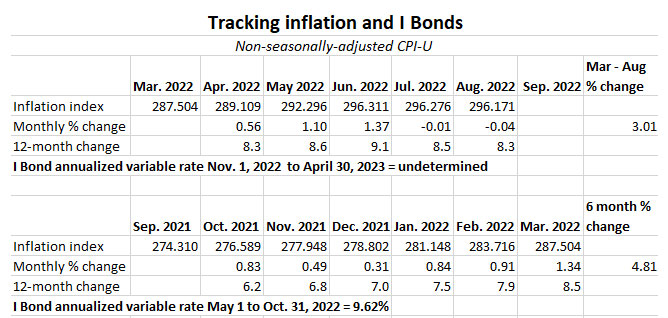
You can see historic data back to 2012 on my Inflation and I Bonds page.
What this means for Social Security COLA
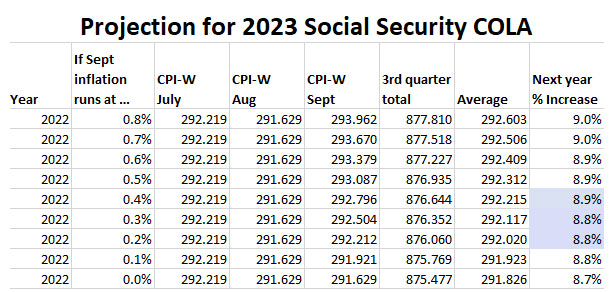
The August inflation report is the second of three — for July to September — that will set the Social Security Administration’s cost of living adjustment for 2023. The SSA uses a three-month average of a different index, the Consumer Price Index for Urban Wage Earners and Clerical Workers (CPI-W), to set its COLA.
For August, the BLS set CPI-W at 291.629, an increase of 8.7% over the last 12 months. However, CPI-W actually fell 0.2% for the month. But remember, it will be the average of July to September inflation indexes — compared to the same three-month average a year ago — that will determine the Social Security COLA. A year ago, that average was 268.421. If we have zero inflation in September, the COLA will be 8.7%.
Keep in mind that one month remains, and the COLA calculation could push slightly higher.

Here is my updated projection:
What this means for future interest rates
The S&P 500 just opened for trading today and it is down about 2.3%, after flashing higher minutes before the August inflation report was released. The reason: The markets are losing hope — a false hope in my opinion — that the Federal Reserve would begin easing off on tightening as U.S. inflation drifts lower. Although the monthly all-items number looks mundane, this was an ugly inflation report, with prices increasing across the economy despite a quick and steep decline in gasoline prices. Core inflation jumped from an annual rate of 5.9% in July to 6.3% in August.
U.S. inflation remains close to a four-decade high. This is not the time for the Federal Reserve to back off on its clear, necessary goal: to bring inflation down to a level at least approaching its target of 2%. Today’s report all but guarantees a 75-basis-point increase in the federal funds rate next week.
From today’s Wall Street Journal report:
Broad price pressures have proven resilient, causing the Federal Reserve to keep raising interest rates to fight inflation, said Kathy Bostjancic, chief U.S. economist at Oxford Economics.
“Inflationary dynamics are improving and moving in the right direction,” she said. “But they’re still running way too hot for comfort, either for individuals and businesses or the Federal Reserve.”
From Bloomberg:
The acceleration in inflation points to a stubbornly high cost of living for Americans, despite some relief at the gas pump. Price pressures are still historically elevated and widespread, pointing to a long road ahead toward the Fed’s inflation target. …
“If there was any doubt at all about 75 — they’re definitely going 75” at next week’s Federal Open Market Committee meeting, Jay Bryson, chief economist at Wells Fargo & Co., said on Bloomberg Television. “We thought they’d be stepping it back to 50 in November. At this point, you’d say 75 is certainly on the table in November.”
* * *
Feel free to post comments or questions below. If it is your first-ever comment, it will have to wait for moderation. After that, your comments will automatically appear.
David Enna is a financial journalist, not a financial adviser. He is not selling or profiting from any investment discussed. The investments he discusses can be purchased through the Treasury or other providers without fees, commissions or carrying charges. Please do your own research before investing.








 Treasury Inflation-Protected Securities
Thanks for the detailed explanation. I believe you are saying the "breakeven inflation rate" should reflect the inflation expectation rather…