
By David Enna, Tipswatch.com
EE Bonds will have a fixed rate of 0.1%, but continue doubling in value after 20 years, creating an effective interest rate of 3.5%

The U.S. Treasury just announced the May to October 2022 terms for U.S. Series I Savings Bonds and EE Bonds, and there were no surprises. I Bonds remain exceptionally attractive; they will pay an annualized composite rate of at least 9.62% for six months, for all I Bonds, no matter when they were issued.
I Bonds
Here are details from the Treasury’s announcement:
The composite rate for Series I Savings Bonds is a combination of a fixed rate, which applies for the 30-year life of the bond, and the semiannual inflation rate. The 9.62% composite rate for I bonds bought from May 2022 through October 2022 applies for the first six months after the issue date. The composite rate combines a 0.00% fixed rate of return with the 9.62% annualized rate of inflation as measured by the Consumer Price Index for all Urban Consumers (CPI-U). The CPI-U increased from 274.310 in September 2021 to 287.504 in March 2022, a six-month change of 4.81%.
And here is my translation:
- An I Bond earns interest based on combining a fixed rate and a semi-annual inflation rate. The fixed rate – which will continue at 0.0% – will never change. So I Bonds purchased from May 2, 2022, to October 31, 2022, will carry a fixed rate of 0.0% through the 30-year potential life of the bond.
- The inflation-adjusted rate (also called the variable rate) changes every six months to reflect the running rate of non-seasonally adjusted inflation. That rate is now set at 9.62% annualized. It will update again on November 1, 2022, based on U.S. inflation from March to September 2022.
- The combination of the fixed rate and inflation-adjusted rate creates the I Bonds’ composite interest rate, which was 7.12% but now rises to 9.62%, the highest in history for I Bonds. An I Bond bought today will earn 9.62% (annualized) for six months and then get a new composite rate every six months for its 30-year term.
It’s important to note, however, that all I Bonds — no matter when they were issued — will get that 9.62% inflation-adjusted rate for six months, on top of any existing fixed rate. So an I Bond purchased in April will receive 7.12% for six months, and then 9.62% for six months. I Bonds purchased back in September 1998 (with a fixed rate of 3.4%), will receive a composite rate of 13.18% for six months.
Here is the formula the Treasury used to determine the I Bond’s new composite rate:
| The composite rate for I bonds issued from May 2022 through October 2022 is 9.62% | |
|---|---|
| Here’s how the Treasury set that composite rate: | |
| Fixed rate | 0.00% |
| Semiannual inflation rate | 4.81% |
| Composite rate = [fixed rate + (2 x semiannual inflation rate) + (fixed rate x semiannual inflation rate)] | [0.0000 + (2 x 0.0481) + (0.0000 x 0.0481)] |
| Composite rate | [0.0000 + 0.0962 + 0.0000000] |
| Composite rate | 0.0962000 |
| Composite rate | 0.09620 |
| Composite rate | 9.62% |
Obviously, I Bonds remain a very attractive investment. I had been urging investors to buy in April to catch that 7.12% rate for six months, and then the 9.62% rate for six months. But if you missed that deadline — and I’ve heard from many of you that this happened — don’t worry. Just purchase I Bonds in May and get that 9.62% rate for six months, followed by another variable rate (probably fairly high) in six months.
An I Bond has to be held one year before it can be redeemed, but an investor can purchase the I Bond near the end of a month and get full credit for the month. That means an I Bond can be, effectively, an 11-month investment. I Bonds redeemed from 1 to 5 years face a penalty of three months interest; after 5 years there is no penalty.
If you are looking at an I Bond as a short-term investment, buying late in May 2022 and redeeming in early May 2023 guarantees you a return of 4.81%, even after the three-month interest penalty, which will be applied to the next variable rate. Your return will probably be much higher.
However, I advise using I Bonds as a long-term investment, building up a large store of inflation-protected cash. I’d absolutely advise against selling any I Bonds until the 9.62% rate is complete. The month that it triggers depends on the month that you originally bought the I Bond.
| Issue month of your bond | New rates take effect |
|---|---|
| January | January 1 and July 1 |
| February | February 1 and August 1 |
| March | March 1 and September 1 |
| April | April 1 and October 1 |
| May | May 1 and November 1 |
| June | June 1 and December 1 |
| July | July 1 and January 1 |
| August | August 1 and February 1 |
| September | September 1 and March 1 |
| October | October 1 and April 1 |
| November | November 1 and May 1 |
| December | December 1 and June 1 |
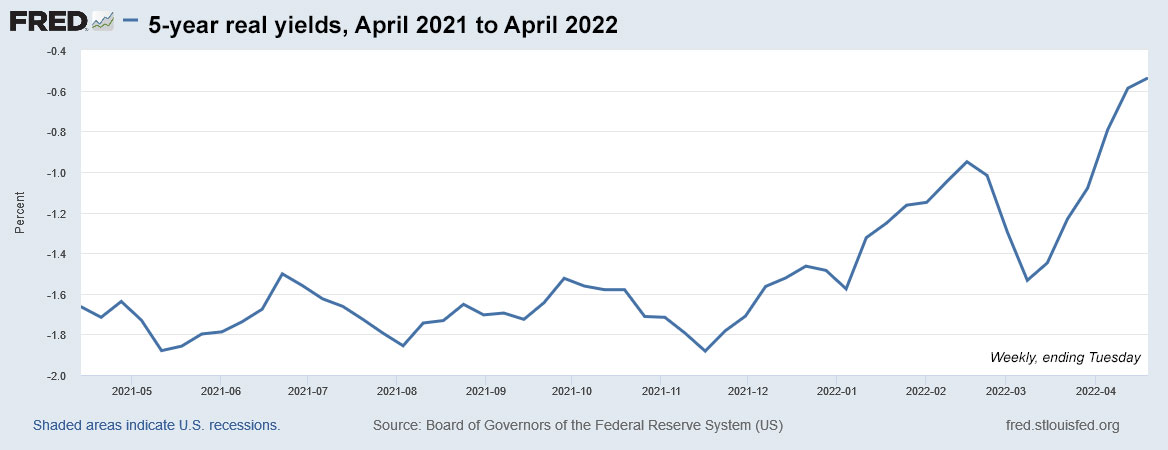
The fixed rate of an I Bond is equivalent to the “real yield” of a Treasury Inflation-Protected Security. It tells you how much the I Bond will yield above the official U.S. inflation rate. Right now, an I Bond will exactly match U.S. inflation. Because the Treasury held the I Bond’s fixed rate at 0.0%, it will track official U.S. inflation, but not exceed it, except after a period of extended deflation.
I Bonds carry a purchase limit of $10,000 per person per year, and must be purchased electronically at TreasuryDirect. Investors also have the option of receiving up to $5,000 in paper I Bonds in lieu of a federal tax refund. Learn more about I Bonds in the I Bonds Manifesto and in my Q&A on I Bonds.
EE Bonds
Here are the Treasury’s terms announced Monday:
Series EE bonds issued from May 2022 through October 2022 earn today’s announced rate of 0.10%. All Series EE bonds issued since May 2005 earn a fixed rate in the first 20 years after issue. At 20 years, the bonds will be worth at least two times their purchase price. The bonds will continue to earn interest at their original fixed rate for an additional 10 years unless new terms and conditions are announced before the final 10-year period begins.
And here is my translation:
- The EE Bonds’ fixed rate remains at 0.1%, where it has been since November 2015. Awful, right? (Check out your current money market savings rate, somewhere around 0.05%, or less.) But the EE Bonds’ fixed rate is irrelevant because…
- An EE Bond held for 20 years immediately doubles in value, creating an investment with a compounded return of 3.5%, tax-deferred. So, if you invest $10,000 at age 40, you can collect $20,000 at age 60, with $10,000 of that total becoming taxable.
- After the doubling in value at 20 years, the EE Bond reverts to earning 0.1% for another 10 years.
Retaining this 20-year doubling is a big deal. The Treasury has changed this holding period several times in the past, so there was a possibility the terms could change in 2022, with the 20-year nominal Treasury currently yielding 3.14%, still below the EE Bond’s potential of 3.5%.
But as interest rates have climbed this year, the appeal of EE Bonds is lessening. It’s possible you will be able to get 3.5% in 5-year CDs in the future. The 5-year nominal Treasury is yielding 2.92%.
You should only invest in EE Bonds if you are absolutely certain you can hold them for 20 years. (And after 20 years they should be immediately redeemed.) They are a possible “bridge” investment for someone around age 40, who can build an annual stream of income starting at age 60, potentially delaying Social Security benefits until age 70.
The EE Bond will also outperform an I Bond if inflation averages less than 3.5% a year over the next 20 years. I think that is a reasonable possibility (but who knows, given current inflation trends). For anyone with a secure 20-year timeline for investment, an EE Bond remains somewhat attractive because of the tax-deferred interest and potential to use gains tax-free for educational purposes.
* * *
Feel free to post comments or questions below. If it is your first-ever comment, it will have to wait for moderation. After that, your comments will automatically appear.
David Enna is a financial journalist, not a financial adviser. He is not selling or profiting from any investment discussed. The investments he discusses can purchased through the Treasury or other providers without fees, commissions or carrying charges. Please do your own research before investing.






 Treasury Inflation-Protected Securities
Thanks for the detailed explanation. I believe you are saying the "breakeven inflation rate" should reflect the inflation expectation rather…