I Bond’s variable rate will rise to 9.62% with the May reset

May 2, 2022 update: Treasury holds I Bond’s fixed rate at 0.0%; composite rate soars to 9.62%.

By David Enna, Tipswatch.com

Based on the March inflation report, which concluded the six-month rate setting period for the U.S. Series I Savings Bond, the inflation-adjusted variable rate of the I Bond will rise from the current annualized 7.12% to 9.62% as of the May 1 reset.

This is for all I Bonds, no matter when you purchased them. All I Bonds will get six months of the 9.62% interest rate, but the starting month for the new rate will depend on the month the I Bond was originally issued.

Here are the official inflation numbers used in this calculation:

The 7.12% variable rate was already a record high for the I Bond, which was first issued in September 1998. So the new rate of 9.62% will crash through that record high. Possibly, we may never see a rate this high again. Economists have speculated that the March inflation report will set the peak and now we will begin a gradual slide lower. But … who knows?

For a much more detailed discussion of these savings bonds, read my Q&A on I Bonds.

For reasons to use I Bonds as part of your emergency fund, read the I Bond Manifesto.

Stick with the buying strategy!

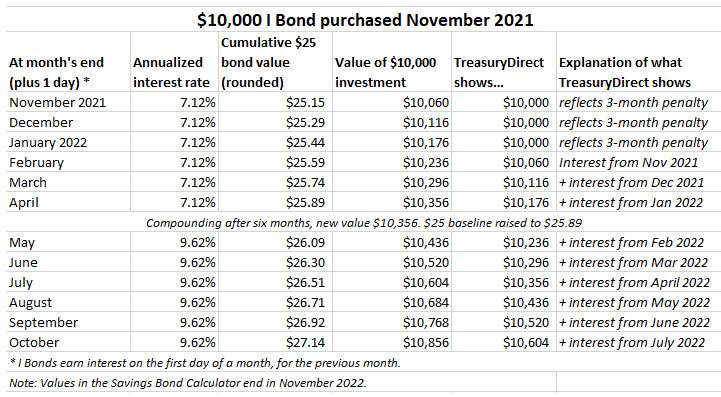
While waiting for the May 1 reset might look tempting to launch directly into the 9.62% rate, I still strongly recommend buying I Bonds before April 30, which will lock in a 7.12% rate for a full six months, followed by 9.62% for six months. That’s an annual rate of about 8.4%, and there is no other very safe investment that can match that return.

I Bonds must be held for 12 months before you can redeem them. If you redeem them before five years, you will forfeit the last three months of interest. But if you buy near the end of April 2022, you will get full credit for April and can redeem 14 months and a few days later, avoiding taking the interest penalty on the 9.62% rate.

However, I always recommend buying I Bonds every year up to the purchase cap of $10,000 per person per year and holding them until you actually need the money. People who have been buying I Bonds for years — like many of my readers — are very happy right now, collecting an annual rate of 8.4%, plus any fixed rate attached to the original purchase.

Will the I Bonds’s fixed rate rise on May 1?

I still say “no,” but conditions are getting better for a fixed rate higher than the current 0.0%. The real yield of a 10-year TIPS has now “surged” to -0.12%, an impressive rise of 85 basis points since the beginning of the year. But until it gets to at least 0.25%, I think it’s unlikely the Treasury will increase the I Bond’s fixed rate. We might see the rate rise in November, which would be available to grab when the calendar resets in January.

My advice: Don’t be waiting for a higher fixed rate that might never come, and miss out on the chance to make $840 on a $10,000 investment in one year. Invest up to the cap before May 1.

The March inflation report

Once again, this was a stunner.

The Consumer Price Index for All Urban Consumers increased 1.2% in March on a seasonally adjusted basis, the U.S. Bureau of Labor Statistics reported today. Over the last 12 months, the all-items index increased 8.5%.

Both the March and year-over-year number were higher than the consensus forecast, which has happened repeated for the last six months. However, core inflation — which removes food and energy — came in lower than expectations for the month (at 0.3%) and year-over-year (at 6.5%, the highest level for core inflation since August 1982.)

So economists might view this report as a “mixed bag,” but American consumers are seeing nothing positive about it. The year-over-year number of 8.5% was the largest 12-month increase since the period ending December 1981. Inflation is surging across almost all areas of the U.S. economy:

  • Gasoline prices rose 18.3% in March and accounted for over half of the all items monthly increase, the BLS said.
  • Food prices rose 1% for the second month in a row and are now 8.8% higher over the last year. That’s the highest annual level since December 1981.
  • Especially painful: the costs of food-at-home increased 2.0% in March.
  • The costs of shelter rose 0.5% for the month and are up 5.0% over the year. It seems likely that we will continue to see higher costs in this area as rents are adjusted higher.
  • The index for airline fares rose 10.7% in March.
  • One area with declining prices was used cars and trucks, down 3.8% but still up 35.3% over the last year.

Here is the overall trend for annual all-items and core inflation over the last year, showing the steady rise higher since September 2021. Many inflation-watchers believe inflation now will begin gradually declining, possibly to a rate of 4% to 5% by the end of the year. But the war in Ukraine has created huge volatility in fuel and food prices:

What this means for TIPS

Investors in Treasury Inflation-Protected Securities are also interested in non-seasonally adjusted inflation, which is used to adjust the principal balances of all TIPS. The March inflation report means that TIPS principal balances will rise 1.34% in May, after rising 0.91% in April. Here are the new May Inflation Indexes for all TIPS.

This year’s incredible surge in inflation demonstrates the value of placing (and keeping) a portion of your investment portfolio into inflation protection, provided by TIPS and I Bonds. When inflation surges unexpectedly, these investment become valuable insurance against losses.

For a more detailed look at TIPS, read my Q&A on TIPS.

What this means for future interest rates

As many of you know, I am writing this in the mid-afternoon in Catania, Sicily, near the end of a three-week holiday. I haven’t been tracking the Federal Reserve’s pronouncements, but obviously the Fed seems highly motivated to get interest rates higher to slow the pace of inflation. This report should add fire to the motivation.

On the positive side for the Fed, core inflation was slightly lower than expectations. But that could be caused simply by consumer spending shifting to higher food and fuel costs, leaving less disposable income. There is no evidence that inflation will suddenly plummet, so the Fed needs to stay on this course. It could take years, unless the economy slips into a deep recession.

At some point, the real yields provided by TIPS should become competitive with I Bonds and eventually surpass the I Bond’s fixed rate, even if the fixed rate rises later this year. It will be good to see TIPS back as an attractive inflation-fighting investment.

* * *

Feel free to post comments or questions below. If it is your first-ever comment, it will have to wait for moderation. After that, your comments will automatically appear.

David Enna is a financial journalist, not a financial adviser. He is not selling or profiting from any investment discussed. The investments he discusses can purchased through the Treasury or other providers without fees, commissions or carrying charges. Please do your own research before investing.

Posted in I Bond, Inflation, Investing in TIPS, Savings Bond | 51 Comments

Note to readers: I am traveling this month

By David Enna, Tipswatch.com

It’s hard to believe, but I am now traveling in southern Italy and Sicily for three weeks. Travel is wonderful, even with the Covid limitations. Trying to stay safe …

Traveling in this region means I am often in remote areas with iffy Internet connections, and little time to ponder the complications of inflation-protected investments, or to answer your questions posted in the comments. Sorry! I am trying to make sure all new comments get approved and I will try to answer questions when I can.

What this means

Sicily is 6 hours ahead of the U.S. Eastern time. That means the April 12 inflation report — one of the most important of the year — will hit at 2:30 p.m. in Italy, and I will be stuck in transit between two cities at that hour. I will not be able to post the inflation report — and its effect on the I Bond variable rate — until a few hours later. This is a key report because it will set the I Bond’s new variable rate. It will be exciting news, I am sure.

I actually try to schedule travels to avoid this happening, especially for the key April and October CPI releases, but this is a trip that was delayed and rescheduled three times because of Covid. I will try to get a post up as soon as I can on April 12, and then provide further updates.

Traveling also means I am without my usual tools for editing and calculating, so forgive any typos and miscalculations (unforgivable!) that I might make along the way.

Meantime, enjoy these photos. I you recognize the locations, you are a true world traveler:

* * *

Feel free to post comments or questions below. If it is your first-ever comment, it will have to wait for moderation. After that, your comments will automatically appear.

David Enna is a financial journalist, not a financial adviser. He is not selling or profiting from any investment discussed. The investments he discusses can purchased through the Treasury or other providers without fees, commissions or carrying charges. Please do your own research before investing.
Posted in Investing in TIPS | 9 Comments

10-year TIPS reopening gets real yield of -0.589%, higher than expected

The inflation breakeven rate hit 2.93%, the highest in history at auction for this term.

By David Enna, Tipswatch.com

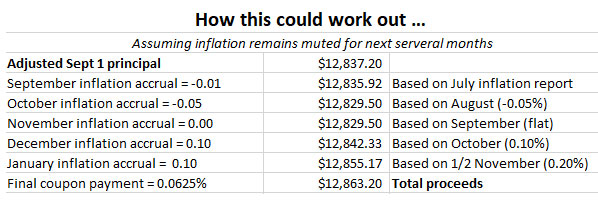
Even with U.S. inflation raging, it appears the U.S. Treasury is finding difficulty in drawing strong demand for Treasury Inflation-Protected Securities. Thursday’s reopening auction of $14 billion in CUSIP 91282CDX6 generated a real yield to maturity of -0.589%, a bit higher than looked likely just minutes before the auction closed at 1 p.m.

This TIPS, which can be purchased on the secondary market, had been trading all morning with a real yield in the range of -0.63% to -0.64%. The auction result came in 5 basis points higher — not a huge difference but an indication of lukewarm demand.

CUSIP 91282CDX6 carries a coupon rate of 0.125%, which was set at the originating auction on January 20. That auction also was met with weak demand. It’s likely that big-money TIPS investors are sitting back and waiting for rising real yields in future offerings, which seems likely as the Federal Reserve begins raising short-term rates and unwinding its huge balance sheet of U.S. Treasurys.

A TIPS is an investment that pays a coupon rate well below that of other Treasury investments of the same term. But with a TIPS, the principal balance adjusts each month (usually up, but sometimes down) to match the current U.S. inflation rate. So the “real yield to maturity” of a TIPS indicates how much an investor will earn above (or in this case, below) inflation.

Investors in today’s auction had to pay a sizeable premium above par value for this 9-year, 10-month TIPS. The adjusted price was about $108.70 for about $101.40 of principal, after accrued inflation is added in. This TIPS will carry an inflation index of 1.01396 on the settlement date of March 31.

The real yield of -0.589% means that this investment will trail official U.S. inflation by 0.589% over the next 9 years, 10 months. Does that make it unattractive? Not necessarily, with U.S. inflation currently running at 7.9%. And this TIPS will get an immediate inflation boost of 0.91% in April, reflecting non-seasonally adjusted inflation in February. An equally high number looks very likely in May.

Here is the trend in 10-year real yields over the last two years, showing how real yields sank below zero as fear of the pandemic erupted in March 2020:

Inflation breakeven rate

With a 10-year nominal Treasury trading today with a yield of 2.34%, this TIPS gets an inflation breakeven rate of 2.93%, the highest in history for any 9- to 10-year TIPS auction. This breakeven rate is 56 basis points higher than the 2.37% recorded at the originating auction, just two months ago. That shows how dramatically inflation expectations have increased in 2022.

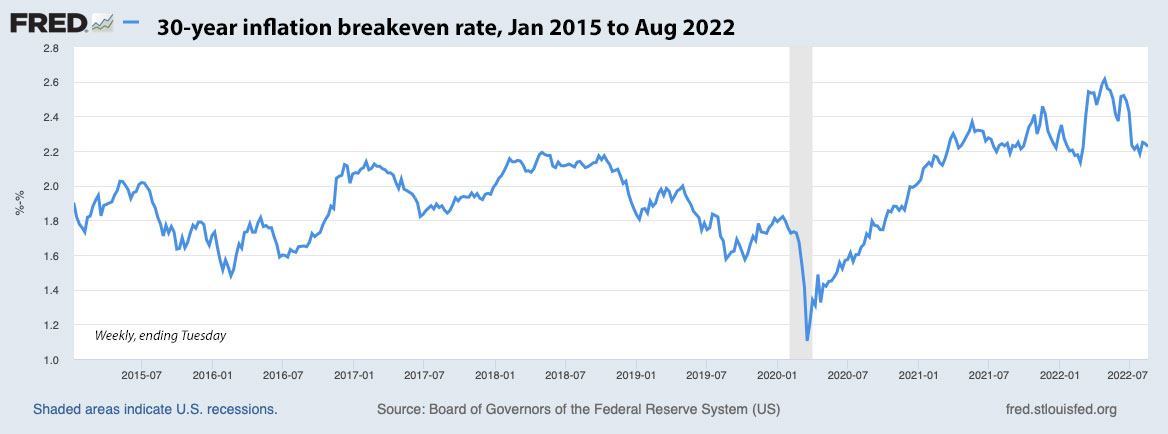
Will inflation average 2.93% over the next 10 years? I would tend to think it will be lower, but in the near term inflation is likely to continue at a high rate, probably at least 4% to 5% over the next year. Key question: Will the Federal Reserve act aggressively enough to clamp down on inflation, which is becoming an international phenomenon?

Here is the trend in the 10-year inflation breakeven rate over the last two years, showing the steady surge higher since the pandemic outbreak, which was followed by aggressive stimulus measures by the Federal Reserve and Congress:

Reaction to the auction

This is a hard one to judge. Clearly, the auction brought a higher-than-market real yield, which indicates lukewarm demand. But the bid-to-cover ratio was a decent 2.43, better than the 2.30 recorded at the January auction.

The TIP ETF, which holds the full range of TIPS maturities, had been trading slightly lower all morning, indicating slightly higher yields. After the auction closed at 1 p.m. EDT, the ETF took a slight dip and then began climbing higher. So it looks like the auction got an acceptable result.

Even more bizarre: At 1:45 p.m., this same TIPS was trading on the secondary market with a real yield of -0.67%, a pretty big swing lower after the auction set the market at -0.589%. So it goes in the always confusing TIPS market.

After the auction closed, I got this reaction from an institutional market-marker with expertise in TIPS:

“What was interesting to me was that the stats had turned to stronger demand – only 10.6% primary dealer takedown and 2.43 bid to cover, both much better than last couple auctions. What that indicates to me is there is still elevated demand for inflation protection, just at the right price. I don’t expect this demand to ebb until we start to actually see some weakness in realized CPI.”

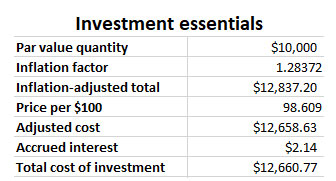
Anyway, for investors, the higher-than-market yield was a positive result. Disclosure: I made a small purchase of this TIPS in a brokerage account, mainly to test how prices are reported.

This TIPS will be reopened again at auction on May 19. Here is a history of recent TIPS auctions of this term:

* * *

Feel free to post comments or questions below. If it is your first-ever comment, it will have to wait for moderation. After that, your comments will automatically appear.

David Enna is a financial journalist, not a financial adviser. He is not selling or profiting from any investment discussed. The investments he discusses can purchased through the Treasury or other providers without fees, commissions or carrying charges. Please do your own research before investing.
Posted in Investing in TIPS | 5 Comments

10-year real yields are rising (again), but is it enough?

The Treasury will auction a reopened 10-year TIPS on Thursday. What’s the outlook?

By David Enna, Tipswatch.com

Real yields for Treasury Inflation-Protected Securities are starting to rise again, after falling dramatically in the aftermath of Russia’s invasion of Ukraine. With the Federal Reserve finally committing to raising short-term interest rates, these yields could continue rising higher, but nothing is certain.

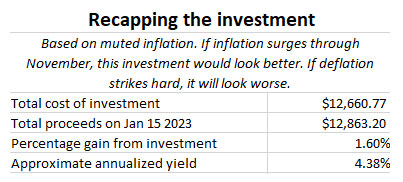
This week, on Thursday, the U.S. Treasury will offer $14 billion in a reopening of CUSIP 91282CDX6, creating a 9-year, 10-month TIPS. Its coupon rate is 0.125%, which was set at the originating auction on January 20. This TIPS currently trades on the secondary market with a real yield to maturity of -0.76% and a price of about $108.99 for $100 of par value.

Definition: The “real yield” of a TIPS is its yield above or below official U.S. inflation, over the term of the TIPS. In more normal times, a 10-year TIPS would provide a real yield about 1% or more above inflation. So the current real yield of -0.76% means that CUSIP 91282CDX6 will trail U.S. inflation by 0.76.% for 9 years, 10 months.

Real yields have been on a roller-coaster ride in 2022, rising at the beginning of the year as the financial markets anticipated future actions by the Federal Reserve to raise short-term interest rates and cease purchases of U.S. Treasurys. But then those yields began plummeting in March with Russia’s invasion of Ukraine, and in recent days have rebounded higher as the Federal Reserve solidified its interest rate increases.

Keep in mind that 50-basis-point swings in 10-year real yields are relatively rare in a span of weeks. But here’s what we’ve seen in 2022 in the Treasury’s estimates for the real yield of a full-term 10-year TIPS:

  • January 3: -0.97%
  • January 20: -0.50%
  • February 10: -0.42%
  • March 1: -0.90%
  • March 11: -0.94%
  • March 18: -0.72%

At this point, I’d say 10-year real yields are more likely to move 30 to 50 basis points higher in upcoming months, instead of 30 to 50 basis points lower. But anything can happen, especially if the U.S. economy begins to show signs of weakness. That will flatten the yield curve; so even as the Fed raises short-term interest rates (often) in 2022 and 2023, long-term real yields could stabilize at stubbornly low rates.

Here is the trend over the last decade in 10-year real yields. I believe this chart is important to study, because it shows that real yields rose — but erratically — from 2013 to 2018, a time of Fed tightening (either implied or actual), then crashed below zero in the wake of the Fed’s bond-buying stimulus after the pandemic surge of March 2020:

My opinion: We are at a point in this cycle where 10-year TIPS real yields remain unattractive, at least when considered in isolation. But there is another way of viewing 10-year TIPS …

Inflation breakeven rate

With a nominal 10-year Treasury note trading with a yield of 2.15%, CUSIP 91282CDX6 currently has an inflation breakeven rate of 2.91%, an all-time high or very close to it. This means the TIPS would out-perform a nominal Treasury if inflation averages more than 2.91% over the next 9 years, 10 months. U.S. inflation is currently running at 7.9%, but is likely to settle into a lower rate — say 4% to 5% — in upcoming months.

Will inflation average more than 2.91% over the next decade? If you answer yes, invest in the TIPS. If you say no, buy the nominal Treasury. (Side note: 10-year inflation has not averaged higher than 2.9% since the decade ending in 1998. But before that, from 1981 to 1998, every 10-year period had average inflation higher than 3.0%. Are we heading in that direction?)

Here is the trend in the 10-year inflation breakeven rate over the last decade, showing the wild swing lower during the early days of the pandemic outbreak, and steady rise higher as Federal Reserve and Congressional stimulus fired up the U.S. economy and sent inflation soaring:

What to expect at Thursday’s auction

You can track the price of CUSIP 91282CDX6 in real time on Bloomberg’s Current Yields page. As I noted earlier, it closed Friday with a real yield to maturity of -0.76% and a price of about $108.99 for $100 of value. It requires a hefty premium price because the real yield is well below the coupon rate of 0.125%, which is the lowest the Treasury will go for a TIPS.

This TIPS will carry an inflation index of 1.01396 on the settlement date of March 31, meaning that investors will pay an adjusted price about 1.4% higher than par value, but in return receive 1.4% in additional principal.

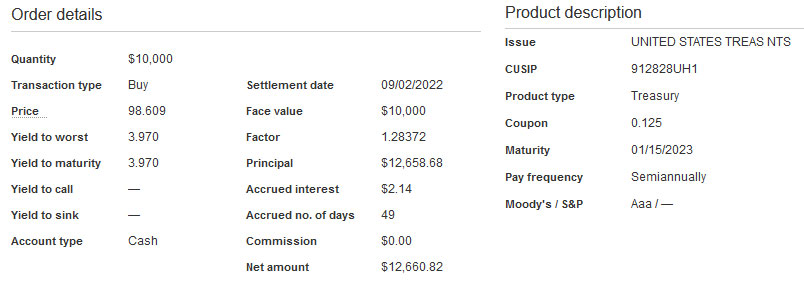
Let’s say you want to invest $10,000 in this TIPS. You will actually be purchasing $10,140 in accrued principal, and you will be paying a premium price of about 9%, for a total cost of about $11,053 for $10,140 of principal. That is a rough estimate, and things will change before Thursday’s auction.

As an example, a similar auction in May 2021 got a real yield of -0.805% and the adjusted price was about $11,115 for $10,213 in value.

The auction closes at noon Thursday EDT for non-competitive bids, like those made at TreasuryDirect. If you are making a purchase through a brokerage, place your order either the night before or before 10 a.m. EDT Thursday, depending on your broker’s rules. After the auction closes at 1 p.m., I will post the results.

Here is a history of recent TIPS auctions of this term, showing the 11 consecutive auctions with negative real yields, beginning after the Covid surge in March 2020:

* * *

Feel free to post comments or questions below. If it is your first-ever comment, it will have to wait for moderation. After that, your comments will automatically appear.

David Enna is a financial journalist, not a financial adviser. He is not selling or profiting from any investment discussed. The investments he discusses can purchased through the Treasury or other providers without fees, commissions or carrying charges. Please do your own research before investing.
Posted in Investing in TIPS | 6 Comments

Podcast: ‘The Inflation Guy’ analyzes the February inflation report

“This 7.9% rate is a jumping off point for what March will bring us.”

Tipswatch.com

As expected, U.S. inflation continued at a four-decade high in February, and things are likely to get worse with the spike in commodity and transport costs in March. Buy gas lately? Or food? Ouch.

What does it all mean? Where is inflation heading? Let’s get some answers from inflation guru Michael Ashton and his “Cents and Sensibility” podcast. I am a fan of this podcast and Ashton’s work because he has deep knowledge of how inflation works, but can explain complex issues in an entertaining way.

In this episode, Ashton asks:

  • How relevant are food and gas prices in the overall inflation picture? Why do these basic costs get excluded from “core inflation”? Won’t they eventually force wages to rise?
  • Is inflation likely to peak soon?
  • Why is it unlikely that the Federal Reserve will act decisively to drive down soaring inflation?
  • What is the pace of likely Federal Reserve rate increases?

Here is his podcast intro: “Another month, another 40+-year high in inflation. 7.9% y/y for headline, 6.4% on core, and we’re not yet at the peak. Moreover, the peak is likely to be broader and not sharp, because inflation has infected the whole basket and changed the equilibrium that we are going to recede to. It’s as if a juggler has moved from juggling two balls to juggling five; that is a stable equilibrium and will resist moving back. And the Fed is probably going to be careful before upsetting the juggler too much (the Inflation Guy really had to work hard to resist a balls pun).

Have a listen:

Direct URL: https://inflationguy.podbean.com/e/ep-22-this-month-s-cpi-report-balls-in-the-air/

Who is Michael Ashton?

His audiences know him as the “Inflation Guy.” He is a pioneer in the U.S. inflation derivatives market. Before founding his company, Enduring Investments, Ashton worked in research, sales and trading for several large investment banks including Bankers Trust, Barclays Capital, and J.P. Morgan.

Since 2003, when he traded the first interbank U.S. CPI swaps, and 2004 when he was the lead market maker for the CME’s CPI Futures contract, he has played an integral role in developing new instruments and methods for accessing and hedging various inflation exposures. In 2016, Mr. Ashton published What’s Wrong With Money? The Biggest Bubble of All. He is a graduate of Trinity University and lives in Morristown, New Jersey.

Have a question? Get the Inflation Guy app in the Apple App Store or Google Play, or email InflationGuy@enduringinvestments.com.

* * *

Feel free to post comments or questions below. If it is your first-ever comment, it will have to wait for moderation. After that, your comments will automatically appear.

David Enna is a financial journalist, not a financial adviser. He is not selling or profiting from any investment discussed. The investments he discusses can purchased through the Treasury or other providers without fees, commissions or carrying charges. Please do your own research before investing.

Posted in Inflation, Investing in TIPS | 9 Comments