
By David Enna, Tipswatch.com
Ever since COVID isolation changed our lives, my wife and I rarely eat out anymore. That leaves a six-year gap in our “restaurant awareness” and now every time we go out for breakfast, lunch, or dinner, we suffer sticker shock. These prices are crazy!
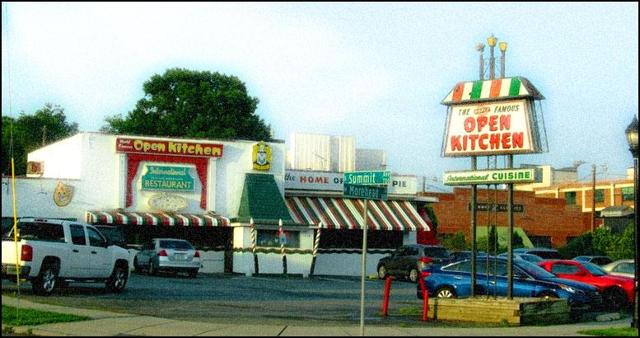
Over the years, as part of my inflation-watching duties, I have been following prices at one of my favorite “comfort food” restaurants in Charlotte, The World Famous Open Kitchen, operating since 1952 at the same location about mile and half from our home.
The restaurant was founded by Steve Kokenes, who was Greek, not Italian. His menu of pizza, lasagna, spaghetti and other “international” cuisine was a rarity for Charlotte in those days. The city didn’t get an “authentic” Italian restaurant – run by actual Italians – until the late 1980s. But that didn’t matter, the Open Kitchen specialized in simple, tasty comfort food and it prospered.
Its location — once a dreary area of warehouses and factories — is now a booming area of modern apartments, art galleries, trendy breweries and “artisan” restaurants, very close to Bank of America Stadium. It’s now a very valuable piece of property.
The restaurant is still run by members of the Kokenes family, who wait tables and run the cash register. And they have a remarkable collection of Charlotte memorabilia displayed all over the walls.
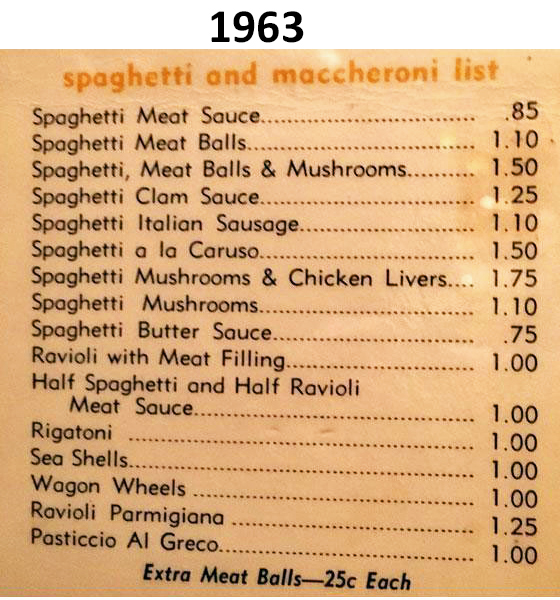
What really caught my attention on a past visit was a 1963 menu posted by the entrance. It’s especially interesting since today’s menu contains many of the same items – with exactly the same names – 63 years later. Aha! This offers a unique look into inflation over the last 63 years, and … what could be in store for our future.
Inflation is a thing
Back in 1963, $1 was worth one dollar. And that is still true today. But adjusted for inflation (based on the Bureau of Labor Statistics’ Inflation Calculator) it takes $10.99 in today’s dollars to equal the buying power of $1 in May 1963. That is an increase of 999%, and it is my baseline for comparisons of price changes from 1963 to today.
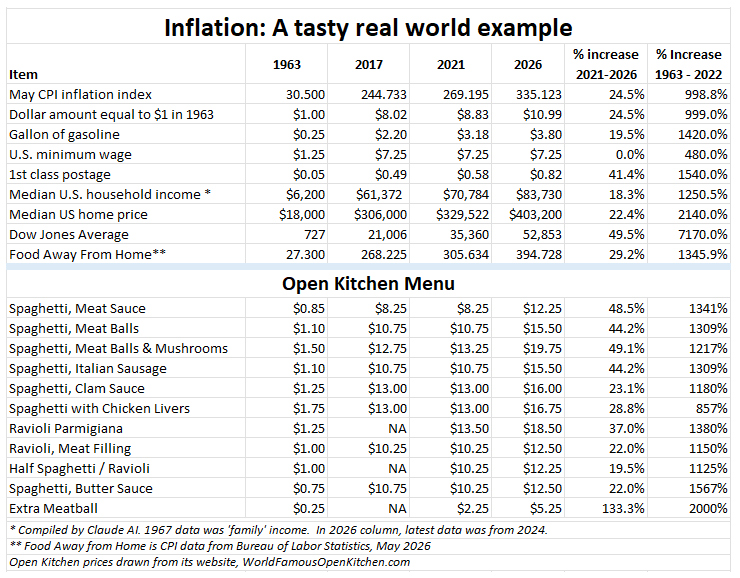
In this chart I have included data on important areas of the U.S. economy in the last 63 years. Gas prices, for example, have increased 1,420%, higher than inflation. Median home prices are up 2,140%, double the rate of U.S. inflation — which explains a lot about why housing is unaffordable.
If you were invested in the U.S. stock market, however, you did extremely well. The Dow Jones Industrial Average has increased at a rate 7 times the rate of inflation. Again, this tells you something about our long-running and seemingly never-ending bull market.
At the same time, the U.S. minimum wage at $7.25 has lagged well behind inflation. It is more or less meaningless today .
The Open Kitchen: Then, and now
Let’s look at Food Away From Home, a U.S. price index that has increased 1,345.9% over the last 63 years. Since my last price check in 2021, it is up 29.2%. This is a key variable for judging restaurant prices.
Today’s Open Kitchen menu prices are mostly higher than overall inflation (999%) but pretty much in line – with some variations – with food-away-from-home inflation (1,346%) over the last 63 years.
For example, Spaghetti with Meat Balls and Mushrooms (one of my favorite Open Kitchen offerings) costs $19.75 today versus $1.50 in 1963, a 1,217% increase — higher than overall inflation but lower than the food-away-from-home index.
Spaghetti with Chicken Livers is a fantastic bargain at $16.75, but … er … who is ordering that?
My pre-COVID memories of Open Kitchen prices generally fall around $10 to $13 for the pasta dishes (which are very good). That was the range still found in 2021. Five years later, prices are up about 40% for most items, higher than food-away-from-home inflation during that time.
A key thing to note is that Open Kitchen’s higher prices generally involve dishes with meat or sausage, where prices have skyrocketed in recent years, up about 55% during that time — well above general food-away-from-home inflation at 29.2%. (Don’t order that extra meatball!).
When my wife and I go to Open Kitchen, we generally order a large Greek salad ($12.75) and a pasta dish with either meatball or sausage ($15.50) and then we split both items. A half-liter carafe of Chianti goes for $9, a very good deal. Overall, this is comfort food at a reasonable price.
Inflation is a real danger
Yes, I was alive in 1963 but I wasn’t driving or paying for meals. My biggest expense might have been 25-cent Saturday movie matinees. I saw “Jason and the Argonauts” at least five times. Today’s price: About $12 for kids, up 4,700%. (Are today’s movies better?)
Inflation is an unrelenting force. When you take a very long view of prices, you can see how even moderate inflation is devastating to purchasing power. Inflation rose 999% over the last 63 years, and 24.5% over the last five years (an annual rate of 4.5%). It stands today at 4.2%.
Think about it: Our dollars have lost at least one-fifth of their buying power in just five years.
Even a very reasonably priced restaurant like the Open Kitchen is starting to look pricey, at least by its past standards. And then add in the expected 20% tip, up from 15% in the past, and Charlotte’s 9.25% sales tax on prepared meals (up from 3% in 1963).
Is it worth it? Yes, at least for the comfort and tradition of a restaurant like the Open Kitchen. Here’s a 2025 video history of the restaurant, where you can easily see the appeal:
—————————

Donate? This site is free and I hope to keep it that way. Some readers have suggested having a way to contribute. I welcome donations, any amount. And FYI, ads on this site pay for about one visit to Costco.
—————————
Follow Tipswatch on X for updates on daily Treasury auctions and real yield trends (when I am not traveling).
Feel free to post comments or questions below. If it is your first-ever comment, it will have to wait for moderation. After that, your comments will automatically appear. Please stay on topic and avoid political tirades. NOTE: Comment threads can only be three responses deep. If you see that you cannot respond, create a new comment and reference the topic.
David Enna is a financial journalist, not a financial adviser. He is not selling or profiting from any investment discussed. I Bonds and TIPS are not “get rich” investments; they are best used for capital preservation and inflation protection. They can be purchased through the Treasury or other providers without fees, commissions or carrying charges. Please do your own research before investing.


I wouldn’t be surprised if the size of the entree and the quality went up from 63 years ago. Portion sizes have definitely grown and independent restaurants, even those of the comfort food variety, tend to use fresher ingredients than they once did.
The tip norms may have grown but part of that is related to the low minimum wages. I do find myself tipping more as a percentage in states where I know the minimum wage is low and where menu prices are lower and 15% of pre tax in my home state of California which doesn’t have a minimum wage and base prices are higher. I really think it should be related to dollars per person and not to menu price, so $3-5 per person for a standard meal and $1 per drink should be sufficient.
Food costs are really high, and I see the Real yields on longer dated TIPS are getting closer to 3% now… pretty high.
Mamma mia! the extra meatball for only $5 looks like such a good deal. Almost as good when the annual limit to buy I bonds was $30,000 per SSN AND with credit card. From my memory of Forbes interview with Dr. Ἔννα he started buying I bonds back in 1998 when I bond fixed rate was 3.4% and that extra meatball was loose change. Tens of thousands of 3+% I bond purchases with credit card cash back and travel points probably financing all these trips around the world.
But Mr. Enna, we need you to keep up all this excellent work you do, so please do not sign up -even with personal invite from Captain Kirk- to visit any of the data centers/travel destinations in outer space.
Notes:
The U.S. Treasury officially terminated all credit card sales on December 31, 2003.
The $30,000 annual purchase limit for Series I savings bonds officially ended on December 3, 2007.
My wife insisted on making our 2001 purchase of I Bonds with credit cards because … airline miles! We still have all those I Bonds, about to pay 6.39% to 6.80%. But we will begin unloading them this year, gradually, before the 2031 maturity to avoid one giant tax hit.
Credit to the “spouse in the house” courtesy of the late and GREAT Bob Brinker who passed away 8-18-2024. Bob Brinker had been recommending on his Starship Moneytalk show in the 3+% fixed rate years of 2000 and 2001. I regret not having purchased earlier as Bob made it clear to buy.
Initial purchases finally made by family members in October 2001. These purchases automatically stop earning interest on October 1, 2031 and that will be sell date. The 2022 purchases at 0% fixed rate will be sold first.
Thank you Mr. Enna for reminder about the inevitable federal tax hit. At least no 1099-INT has been issued for the past 25 years.
In case you missed it, here is my 2024 homage to Bob Brinker: https://tipswatch.com/2024/09/04/remembering-bob-brinker-and-his-life-changing-advice/
Thank you. A beautifully written tribute to Bob Brinker.
Have you ever been approached to do a Brinker-style radio program or a podcast, or given it any thought? I bet you’d attract a crowd, especially when you regale us with your travel experiences and historical finance references, not to mention goin the inflation meat and potatoes.
I have been interviewed on a few podcasts, and got a nice mention once on Suze Orman’s podcast. Didn’t move the traffic need much. I was interviewed on NPR a couple times and BOOM … at least all my friends heard it.
I’m here to stand up for the lowly chicken livers. While I eat veggies or pescatarian 6 days a week, chicken livers give me the iron I need. I, too, have noticed that chicken livers continue to be extremely cheap. Caramelized with onions, they are delicious. If you wish to be really decadent, throw in a little bit of duck fat and a touch of brandy.
At one time in my life, when I was poor, I ate chicken livers and gizzards fairly often. Tip: They taste just like steak if you use A1 Steak Sauce on the side. (At least that is how I remember things; I won’t be trying that again.)
To simplify first there was ordinary income tax rates, then capital gains, and then inflation. Mr T and others LIKE inflation since big assets can be refinanced and money drawn out from the loan which does NOT trigger a tax! There will be more inflation! b/c that is the way the “system” was designed!
Six years after Covid and you are still afraid to eat at restaurants. Wow! This is precisely what caused the worst inflation since 1980 and the very troubling curtailment of our civil liberties during that time. Throughout history, people and countries have engaged in self-defeating behavior because of fear, which was stoked by demagogues and well-meaning but misguided politicians. Locking down the economy for an extended period during Covid was a fiasco, and we are still paying the price for it today.
Oh please. I am not afraid to eat in a restaurant. You know I was just in France for two weeks, and Japan for a month before that. But now I am ENJOYING cooking more meals at home. I’m “out of the habit” of eating out. Works for me.
It is difficult for individuals/families to run restaurants today and that is why David’s restaurant is more expensive than you might expect and only a loyal customer base can keep it operating profitably. How do families compete against national chains that can buy goods cheaper and lower prices to force out family businesses.
This is the corporatization of American. It primarily started under Reagan (i know he was very popular and he did some great things on foreign policy), but he started the movement of lowering taxes (Individual/corporate) that has taken us to today where we’re $40 trillion in debt and only the asset-owning class is thriving.
We had a strong middle class in the 1950s and ’60s and the minimum wage even kept up with inflation, which was very low then. Now were seeing the total destruction of the middle class as the corporations are reaping in the huge profits. I own stocks and have benefitted, but I was lucky because I was taught at an early age that investing in the markets was a good way to gain independence. But it’s totally out of hand now and AI will likely make it worse.
You’re seeing the rise of socialism (populism by another word) and for the most part its not anything like Trump’s “communist” claim. If anything, he’s closer to a communist in that he believes he doesn’t have to get approval to tear down parts of White House and build monuments to him.
But let’s go back to the late ’90s when the debt was $5 trillion and we balanced the budget. In fact we were on our way to paying off much of the debt. But two large tax cuts and unpaid war doubled the debt, then we had the Great Recession and high unemployment and people’s homes’ values plummeted. The corporations and others came in and “saved” the housing market and we slowly were coming back to more reasonable deficits. And if Simpson-Bowles had enacted we would have had the debt under control.
Then Trump came in and Covid struck and we had more tax cuts and large payouts to “save” the economy. It worked to some extent, but it also increased the debt. And now with the BBB we’ve cuts taxes even more, so many of our richest companies and individuals pay nowhere near what the average tax rate for individuals are.
What’s next? Some speculate the U.S. currency will be reset in order to “save” the economy. That means your cash could be worth one tenth of what is is now. I don’t know the odds of this, but everyone should be prepared and spread out their wealth to different areas –real estate, commodities and other things that may become more important.
Brent FineChandler, AZ
I’d suggest adding a line on median personal income
According to this website https://dqydj.com/individual-income-by-year/
1963 = $3000, 2025 = $53010
or 1767%
using Mr. Enna’s formula that would be 1667%
I added a line to the graph for median household income, but the numbers do not compare perfectly and the latest income data is from 2024, not 2026, so the final percentages are not accurate.
Thanks!
Apologies if this has been posted here before.
My first minimum wage job in high school paid $1.50/hr.
$1.50 in the form of 6 quarters contained just over 1 ounce of silver then (1.08), and that ounce was worth just about that buck fifty.
Today, that ounce of silver would be worth almost 8 times the legal minimum wage and 4 times the de facto wage.
Look up the Annuity ads from the early 1960’s.
I found one that talks about retiring for life on $300 a month by Phoenix Mutual. https://www.ebay.com/itm/225185759467
Note the part where the happy customer brags about how “300 dollars a month will keep us financially independent for as long as we live”. $300 a month for two people. Even back then? I think not.
There is something about Greeks and Italian restaurants. We have several in the area with names like Athens Pizza and Skopelos Italian Restaurant. Of course, some of the best Greek ruins are in Sicily. There is a historical connection,
About 20 years ago, I was in Sicily (where some of my family still lives) and walked around the most amazing Greek ruins, no other tourists around, you could go and sit in the ruins. Nowadays, those sites are packed with tourists and tightly monitored. My family name, Enna, is actually the ancient Greek name (Ἔννα) of a hill town and province in the center of Sicily.
Jay Nordlinger is currently visiting Sicily and wrote about the town of Enna.
https://www.jaynordlinger.com/p/italian-days-part-xvii
Great article. It’s weird, but my family is from Sambuca di Sicilia, not Enna. I have visited Enna, though, a year after I had been in Wales. Right atop the hill of Enna is a Norman castle, a picture-perfect match to those in Wales. It was built around the year 1,100, the same time Normans were building castles in Wales.
When I was a child (circa 1960) in New England I learned that when one Greek meets another Greek, they open an Italian restaurant.
The elephant in the room: All the menu items save one were higher than official inflation. Select 1000 consumer items and anyone who shops will bet on seeing much the same.
The government has techniques (and incentives) to understate the CPI. The switch from actual new home costs to Owners’ Equivalent Rent in 1983 reduces CPI by a couple of per cent. Then there’s hedonics (“If The Open Kitchen becomes too expensive, we assume that people will switch to a can of Spaghetti-Os at home”).
Yes – 5 general expense items and 11 food items and only 1 was lower than official inflation! Looks understated by at least a third.
Nice article to paint a picture of our reality and reinforce the value of inflation protection.
Yes, prices are up, but of course your income and you wealth are also up probably an even greater percentage. Of course minimum wage is double the federal rate or more in many states https://www.ncsl.org/labor-and-employment/state-minimum-wages . While I might get some fast food 1-2 times a month (tater tots at Sonic held me over for lunch once last week) eating out at any restaurant these days is a crap shoot in terms of quality and price IMHO. Took a buddy out to a Mexican restaurant that’s been open in Austin for 74 years for his birthday recently. The tab with his one frozen margarita (I had ice tea) was $85! Now c’mon. This is Mexican food in Texas and the real insult was that it was tasteless. The price I can handle, but the quality of the food and the service were marginal. So disappointing. So except for special occasions I select very carefully and even then my expectations are in check. My go to now is cooking at home or with friends with our own food and at the end of the meal we’ve dined well in good company for less than what a comparable meal out would have been with no disappointment. A win all around. The restaurant business is tough. A friend that owns a 50+ year old BBQ chain is always telling me about high beef prices, how they have to manage everything to the penny and that menu adjustments are routine so that they can thrive and sell a high quality product and experience for their guests. Hats off to those in the business like your friend who have made adjustments and continue their tradition.
and it wasnt even a freshly made margarita.
You brought back good memories, David. I rewatched Jason and the Argonauts many times, as well as a fun sci-fi fantasy predecessor from a few years earlier, Journey to the Center of the Earth. Now that I think about it, TIPS are like the disc taking you safely from the past, all the way up the bowels of the earth, to the present day.
When we were in Charlotte we went to The Mad Greek restaurant.
The plurality of restaurants in the Boston area are probably Greek owned as well Also many serving Italian-American food. And nearly all take out sub shops are Greek owned. They also developed their own style of pizza. The sub shops will often have a tray of baklava on the counter, usually at a reasonable price for baklava $4 dollars or so for a triangle.
Oh man, that brings back a memory. I was in Boston for a conference and stopped at a little restaurant to eat on my way back to the hotel. I was pleasantly surprised to see baklava on offer and had some.
Open Kitchen, an example of the insidious nature of inflation, the staying power of a family-owned business, and the connection between a community and a beloved restaurant. That’s a trio of Americana right there, I enjoyed the article and the video very much. Thank you. When I woke up this morning, I never expected to wonder if I Bonds had been around since 1963, how much they would’ve kept up with the price of a meatball. But here we are.
I am of Greek heritage and the Greeks have always been big in the restaurant business. Does anyone know of a diner not owned and operated by Greeks? Those prices are cheap! I’m moving to Charlotte. If you want sticker shock try Manhattan. I routinely pay $150 to go out to dinner. If taking out the boyfriend it’s $250-$300. Hang on to those I-bonds. And I doubt the new fed chair is keen to raise interest rates. He wants to placate the president. So he’s forming committees to study the issue(s), a time honored method in politics of delay and waffle.
Charlotte has a large Greek community and a lot of people work in restaurants. When I moved here in 1982, nearly every restaurant was operated by Greeks, no matter the cuisine. If you are here in September check out the Yiasou Greek Festival, Sept 11-13. It is a BIG event.
its a K economy, it dont matter to readers here. Honestly anybody cut back on anything?
Reminder: People who build wealth over a lifetime didn’t get there by spending lavishly. It’s hard to break old habits and traditions.
Re: the Greek connection, another well-known example is Cincinnati chili:
https://nkytribune.com/2024/04/our-rich-history-cincinnati-chili-a-greek-immigrant-tradition-a-fun-food-that-really-caught-on/
My Mom is from Cincinnati originally. I’m a big fan of her chili. Thanks for the link.
Study the issue? Then he has made alot of noise with no facts, what else is new? Pigs can fly?
(In good humor . . .)
I wonder if some of the price increases at Open Kitchen are attributable to its being featured more than once on Tipswatch.com, home of the famous world traveler David Enna, so that it has become a Destination, a place for the in-the-know and oh-so-chic TIPS and I Bond crowd to “see and be seen,” with interviews and fashionably posed photographs on the red carpet.
Someone needs to create a line chart of the above table and add another data point: Every mention of the restaurant by David. 😉
My first article on the Open Kitchen was in 2017, then I updated it in 2021 and now 2026. I am SO HAPPY they remain in operation. Years ago, when business was slower, I was paying my bill and talking to the owner. “How’s business?” Answer: “Not so good, everyone is using those Groupon discounts.” … And then I handed him my Groupon discount. Ouch.
They don’t do Groupon discounts anymore.