
By David Enna, Tipswatch.com
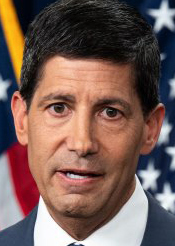
The new Federal Reserve chairman, Kevin Warsh, stood in front of reporters Wednesday afternoon and said:
For some households, businesses, and market professionals five years of high inflation have left a mistaken impression that’s hard to shake, that the Fed’s implicit inflation target was somehow above 2 percent. Let me reiterate, there is no soft inflation target. There is no soft implicit target, not on this committee’s watch. There’s only a target, and it’s 2 percent.
That seems pretty straightforward, ironically from the man who said as recently as June 17, “I tend to focus on the left of the decimal point. Well, the two is the left of the decimal point.” In other words, a month ago he wasn’t too concerned about the number to the right of the decimal point.
As was expected, the Federal Reserve’s Open Market Committee held short-term interest rates in the same range — 3.50% to 3.75% — they have been since Dec. 10, 2025. In the meantime, U.S. inflation has increased from 2.7% in December to 3.5% in June.
The “hold” decision was expected, but Warsh’s vague comments on Fed strategy spooked the stock and bond markets. Stocks fell sharply and longer-term Treasury yields rose to 19-year highs.
Warsh, who has said he wants to limit forecasts and communications from the Fed, noted the sharp increases in bond yields over the last six weeks, saying:
Nominal and real yields are materially higher across the Treasury curve. In fact, some of the increases in market interest rates between FOMC meetings are among the most significant in the last two decades. … Even while at some level we haven’t done much in 42 days, the markets have done quite a bit.
Prices reacted in real time to incoming information, and the reduction in forward guidance may have been a factor. … This is, in my view, a change for the better, and we’re just getting started.
In other words, let the bond market set the way. Fine. But it isn’t the lack of communication that is causing bond-market jitters, it is an apparently endless war with Iran, massive federal deficits, rising energy prices and huge corporate bond-market borrowing by AI-driven businesses.
The Federal Reserve controls the short-term end of the bond market, where the U.S. Treasury has been shifting its borrowing in recent months because the short-term rate of about 3.75% is a lot more appealing than a 10-year note at 4.67%.
Take a look at this chart. After recent decisions to cut short-term interest rates, the longer-end of the Treasury curve has risen, sharply. The bond market is questioning the Fed’s credibility. In fact, I think an increase in short-term rates would cause longer-term yields to fall, not rise.

Traditionally, the yield of the 2-year note (currently 4.22%) is a good indicator of the direction for short-term rates, now 3.73%. That implies the market expects two 25-basis-point rate increases in coming months. But can Warsh deliver even one before the mid-term elections?
Just as the news conference was ending, President Trump was asked about the decision to hold short-term rates steady. He said:
Kevin’s fantastic. He’s a brilliant guy, smart. I know he’d love to see lower interest rates, but he’s got a board, and it’s a political board, and they want to keep rates up.
Trump didn’t do Warsh any favors. This harms Warsh’s credibility and calls Fed independence into question. But I think the fact that there were three dissenters in the Fed decision to hold was a good thing. All three wanted a rate increase. This sends the markets a message that there is strong debate on the open market committee.
Many times, Warsh delivers strong and inspiring statements on price stability, and then drifts into new ways of measuring inflation, replacing the Fed’s standard PCE index as a basis for rate decisions:
We’re going to deliver 2 percent inflation, and not a whisper more, but to achieve that I’m looking at a broader set of inflation data than PCE. So without sort of fully revealing my cards, I’m trying to understand, like my colleagues, what’s the underlying generalized change in prices that are happening in the economy. …
And so, if you would hear a message from me, yes, I care about what the PCE prints are. I care about what the contributions are from CPI and everything else. But my lens is broader than that.
This vagueness led Fed-watcher Claudia Sahm to write a post asking: “2% of what?” She wrote:
A half hour into the press conference, Paul Wiseman of the Associated Press asked the question:
WISEMAN: When you talk about the 2 percent inflation target, what measure are you relying on?WARSH: Yeah, so, I’ll give two answers. First let me give the proper standard answer, the Federal Reserve every January outlines a statement of purposes and strategy, and in that strategy document, which I believe was dated January of this year, it describes a measure of PCE inflation as the — as the objective function there. I have enough of my — so that’s our number, we’re sticking with it. … Who knows come after next January what we might say about strategy. I suspect the task forces might have something to add.
Sahm concludes, “Warsh is using PCE as the yardstick now, but he suggested he might pick a different inflation measure in January 2027. Choosing a new inflation measure that reads 2% is not achieving price stability; it’s destroying the Fed’s credibility.”
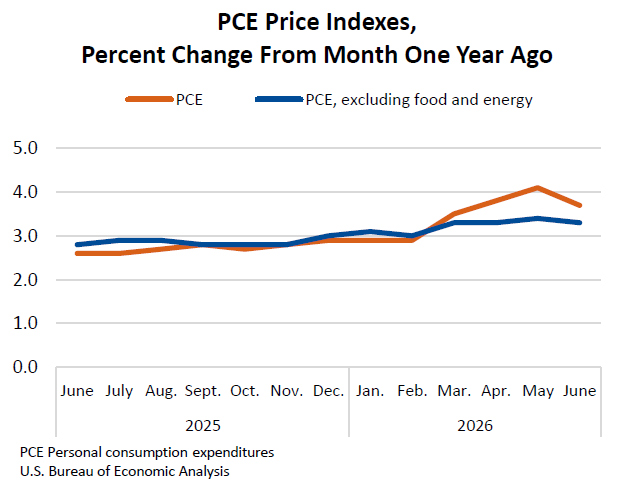
By the way, this is what PCE and core PCE look like as of the June 2026 report. Both remain above 3%, well off the Fed target:
This is what Warsh said about the difficulty of the task ahead:
We’ve got no magic wand. This isn’t something that we’re going to be able to carry out in days or weeks. …I want to leave you with the optimism of a new central banker that we’re committed as ever to deliver, and to offer an assurance we will.
The path ahead
While Warsh was speaking, the stock market began tanking, the dollar weakened and longer-term bond yields rose. “This is a classic central-bank credibility shock,” Mark Cabana, rates strategist at Bank of America, told the Wall Street Journal. And he added this key point:
“If you actually want to get long-end rates down, there’s an argument that you need to raise front-end rates right now in order to establish that credibility.”
FYI, Bank of America is projecting three rate hikes this year. My opinion: Won’t happen — not in a mid-term election year with a president ready to pounce and lay blame for any negative development.
I think Warsh will be fine in the long term, when he finds the right measure of openness and guidance. But this is a very difficult time.
The war with Iran, which seems to be broadening into a regional conflict, is a massively unpredictable factor. The Fed can do nothing to control rising oil prices and the shock that can spread across the economy.
This is very close to a crisis, and time for more specific communication from the Fed, not less. Saying nothing, even while talking 30 minutes to reporters, is not going to work.
Note: I won’t be writing this weekend. Attending a family reunion.
—————————
Donate? This site is free and I hope to keep it that way. Some readers have suggested having a way to contribute. I welcome donations, any amount. And FYI, ads on this site pay for about one visit to Costco.
—————————
Follow Tipswatch on X for updates on daily Treasury auctions and real yield trends (when I am not traveling).
Feel free to post comments or questions below. If it is your first-ever comment, it will have to wait for moderation. After that, your comments will automatically appear. Please stay on topic and avoid political tirades. NOTE: Comment threads can only be three responses deep. If you see that you cannot respond, create a new comment and reference the topic.
David Enna is a financial journalist, not a financial adviser. He is not selling or profiting from any investment discussed. I Bonds and TIPS are not “get rich” investments; they are best used for capital preservation and inflation protection. They can be purchased through the Treasury or other providers without fees, commissions or carrying charges. Please do your own research before investing.


Is Treasury Direct down today? Can’t log in, but no message about it being down for updates, etc. Anyone else having this problem?
Sunday, 7:45 a.m. ET, I was able to log in.
Great discussion and comments……thanks.
.Does anybody have a quess on when and , at what level , the 30 year Tips fixed rate ,currently around 3% is going to peak ?
are we going back to the 70s ?
Thank you, ThomT..
Hope you are right….I bought a little bit!!
July 31, 2026.
Seems my post disappeared.
Raise the rates. Kill the inflation. That’s my opinion.
In plainspoken, non-jargon terms, economist Paul Krugman gives his view of Wednesday’s presentation by the Fed chairman, the meaning of the bond market’s reaction to it, and dissension within the FOMC.
https://paulkrugman.substack.com/p/the-bond-market-doesnt-like-bullshit
If Warsh is what PK thinks, we are in for tough times.
Have to chuckle, though, when Krugman calls someone “political.” It’s damning for a Fed official but expected from a columnist.
I like how he happened the same word as you David. “credibility’.
In defense of Paul Krugman, I would point out he is a Nobel Laureate in economics. So his observations on the Fed, interest rates and inflation do carry credibility. He did concede in the piece that the argument for raising rates now is “iffy.” He can be strident (albeit entertaining) and is a Democrat for sure.
Krugman has always combined nuanced economic analysis with childish criticism that is anything but – personal, mean spirited, and simplistic – and this applies to people he disagrees with economically or politically. For me he is tough to read. Too much slop to pick through for the good ideas he does have.
If you can’t meet your inflation goal, change your metric to one that shows you’re doing better. First go from CPI to PCE and now people are talking about “trimmed mean” What a joke! So glad our Social Security COLA and our TIPS are isolated from these jokers. https://www.cnbc.com/2026/07/31/these-fed-alternative-indicators-show-inflation-is-at-lowest-in-years.html
Re: “So glad our Social Security COLA and our TIPS are isolated from these jokers.”
For now.
Good point. That would be one way to cut benefits. And it wouldn’t involve complex changes to the formula. Reduce or eliminate the COLA.
If you can’t meet your inflation goal, change your metric to one that shows you’re doing better. First go from CPI to PCE and now people are talking about “trimmed mean” What a joke! So glad our Social Security COLA and our TIPS are isolated from these jokers. https://www.cnbc.com/2026/07/31/these-fed-alternative-indicators-show-inflation-is-at-lowest-in-years.html
I know we’re only half-way there, but if my math is correct, the next I-bond fix rate is currently projecting to be 1.2%
The long dated TIPS coming in at more than 3% yield is really something. I’m tempted to sell some equity index funds and buy some TIPS.
if we average 2.03% for the 5 year TIPS from 8/3/26 to 10/30/26, then the 65% ratio will be 1.2514, which would give a rounded 1.30% fixed rate on 11/1/26. that is entirely possible. Looks like this will happen, but you never know. Maybe an Iran deal will cause the real yield to sink.
Bond Tax-Loss Harvesting?
It has been crazy to watch the bond market collapse over the past few years. The 30-year TIPS with a 2.4% real yield that I bought last year has lost almost 15% of its value.
I’d like to hear your opinion on this. With the August auction coming up, the new 30-year TIPS is expected to offer around a 3% real yield. Would it make sense to sell all of the 30-year TIPS I’m currently holding and then repurchase them at the auction? That way, I could lock in the higher real yield while also harvesting the capital loss for tax purposes.
What are the pros and cons of this strategy?
Thanks!
Dongchen
If you are holding the TIPS in a taxable account and can take a tax loss on selling it, I could see this strategy working. (I am NOT a tax expert.) I suspect the secondary market for a 30-year TIPS is pretty slim, so you might face a harsh bid-ask spread. A 30-year TIPS at 2.4% real is historically good, but after “Tariff Independence Day” in April 2025, real yields have been rising sharply. The Iran war is creating another push higher.
Thanks David for the reminder, I’ll check the spread before making the decision. It is held in a taxable account (brokerage). I don’t have enough IRA money to purchase TIPS because my IRA account is just 2-yr old…..
Dongchen
I’ve found that except for “fed day” and “auction day” (when the market makers pull back and wait for news) the secondary markets are pretty good for all dates especially compared to corporate bonds. The Feb-2056 is currently offered at $912.39 and bid at 911.66 so the spread is about 73 cents / bond. That’s the price for quantity 1 to 500. That is at Schwab, your broker may be different.
Has the bond market collapsed, or are we really just witnessing the normalization of real and nominal yields? ZIRP came into play in the dot com crash then rates went back up only to to go full ZIRP following the global financial crisis.
We have had 20 plus years of abnormally low interest rates. Looking at historical TIPS real yields ignores that for most of the time TIPS have been issued, we have been in a ZIRP, or ZIRP-on-call environment.
It has been amazing to watch how long term bond funds have been ticking lower and lower this year (with a commensurate rise in yields). Feels like a falling knife. The Vanguard long term treasury strips ETF (EDV) is down 6% ytd, down 10.46% over 5 years and -3.71 over 10 years. Does this qualify for a long term bear market for bonds? I think so. Does that mean they represent a good buy now for the brave? Probably. But it feels like the country’s finances are being progressively degraded. And at some point the stock market will have to pay the piper.
drmattnyc, EDV has simply returned to where it was the last week of October 2023. I always thought the Oct 2023 peak rates were justified and we would return there.
Is it a good buy now? Probably, as you say. I suspect there will be a flight to safety at one point not too far off. But safety is illusory and the piper is coming. Slowly, then all at once.
“ZIRP”
This is what we grew up experiencing our entire lives. These interest rates felt normal to us—the mortgages, the credit card rates, and the strong stock market. We’ve witnessed this environment since we were teenagers. Now, we’re watching everything collapsing before our eyes.
If you are selling the same Feb-2056 TIPS that is being auctioned in August (a re-opening as indicated on Tentative-Auction-Schedule.pdf) then you need to watch out for the 30 day wash sale rule. If you are selling the Feb-2055 or earlier, that is a different security so that rule would not apply.
That’s an excellent point! I’ll pay attention to the wash sell rule…
Actually, if you strip energy prices out, the inflation rate cooled considerably in June. Core CPI was 2.6% in June, dropping from 2.9% in May. Core PCI only rose 0.1% in June, decreasing to 3.3% in June from 3.4% the prior month. So the question is do you increase rates when almost all the volatility is from energy prices. I think the Fed wants to see how long this conflict with Iran will continue for before increasing rates. I will say, however, this latest round of tariff increases was not helpful.
Thank you, David, for this interesting post, and everyone for their thoughtful comments. I’m curious to see whether the shelter component of the CPI (rent of primary resident and owner-equivalent rent, about 33% of CPI-U) will continue to decelerate over the coming months. If so, and the deceleration is significant, the FOMC may decide to remain on hold at least through the beginning of next year. I think Warsh has a very difficult task, trying to bring inflation down without losing the backing of the President. At least he’s an intelligent economist with previous experience working at the Fed so most financial market participants are willing to give him the benefit of the doubt, for now.
Not sure why Word Press assigned me such a weird name – sorry about that – Cheers, Sabine
I would say Spooky etc is a great name, but in your case, I love the name Sabine.
The Fed’s official responsbilities are clearly defined by statute, and “keeping the backing of the President” is not among them. That remains true even when a specific president is especially vindictive and seems to view the federal government as his personal property.
In historical terms, the Fed has on various occasions done what it thought needed to be done, even though its actions were not pleasing to, or even did political damage to, the president then in office.
All that remains to be seen–all that ever remains to be seen after any change in Fed leadership or composition–is whether the Fed will act in accordance with its mandates, based on reliable economic fact-gathering, rather than considering who might throw a tantrum about the Fed’s best-judgment decisions. And that statement applies regardless of whether interest rates are being raised or being lowered, i.e., regardless of who is having the tantrum.
Dave, I worked closely on communcations about the FOMC for seven years, and the paradigm was broken back in 2021 when “transitory” inflation was not addressed. Had the FOMC taken action in 2021, maybe inflation would not have peaked.
On my channel, I have explained the difference between PCE and CPI, and the nuances of how both are measured. As a retiree for a decade now, it matters more than we control monetary inflation than an exact measure.
Hawks and doves are labels that seem to be applied situational. I saw one commentary call Lisa Cook as a hawk. Right now, many Fed watchers want to label anyone that will vote for a direction counter to the Administration’s preference is a “hawk” and anyone voting for the Administration is a “dove.” This is poppycock! I am not alarmed by three dissents because where there is dissent there is discussion. I’m looking forward to the five task forces. My ultimate preference is scrapping the dots, scrapping forward guidance, less discretionary policymaking, and more rules-based monetary policy.
It is interesting that after Wall Street whiplash, the market has regained today.
Enjoy the family reunion.
Regards,
Jim @Iwasretired
FYI, for readers, this is Jim’s YouTube channel … https://www.youtube.com/@IwasRetired/videos … worth a look.
I don’t think Warsh has much incentive to do otherwise.
What troubles me is that we seem to lurch from one crisis to the next, with a Congress that too often declines to exercise its constitutional responsibilities and a fragmented media increasingly driven by the next sensational headline rather than sustained scrutiny.
Thank God for the bond market. It has a way of cutting through the noise and telling us what it actually thinks.
Until better times, we’ll keep counting our TIPS and try to relax a bit.
Excellent article that is giving us more perspective on what is going on. In the end I’ll be glad I have been increasing my holdings of I-bonds and TIPS.
You mean, central casting isn’t all that matters? It’s really not even debatable that the data warrants a rate hike. The bond market is screaming it and the reaction was basically a rebuke. September seems like it will be unavoidable, though.
On the flip side, I found it interesting that Powell wasn’t among the dissenters. Perhaps it was deference to his successor, or the unprecedented pending Justice Department weaponization against him which is why he hasn’t retired, or perhaps he simply agrees with the hold. I wish we could’ve been a fly on the wall for his comments.
Warsh puts me in mind of Chance, the gardener, as played by Peter Sellers in the 1979 movie “Being There”.
This should sound familiar, fits in with the made up affordability crisis! Same play book. Im waiting for the Yuan stablecoin.
Nice article.
I agree that we’re at the point where Fed rate policy is now inversely correlated to the effect on long rates.
Historically, a rate cut would have been a vote of confidence from the Fed that inflation was under control, and the market would’ve trusted that vote of confidence and moved lower across the spectrum.
Today a rate cut (or even a lack of rate hike) is viewed by the market as the Fed not taking it’s inflation mandate seriously. Hence long rates move up on long-term inflation fears.
As you said, credibility crisis.
I initially also thought the increase in long-term yields was due to Fed credibility, but oddly the inflation breakevens stayed flat, so the market doesn’t seem to be pricing in much expectation that the Fed will lose a handle on inflation. Instead what’s up is the real yield, which had pushed up TIPS and nominal yields in tandem. That suggests some kind of loss in confidence in long Treasuries but *not* due to the inflation component..
I agree, although the inflation breakeven rate is highly unreliable as a predictor or even as a good measure of sentiment. The oil-price shock could be temporary, but the higher U.S. borrowing needs will extend out for a decade. The market does want to see a commitment to cap inflation, which has run well over target over the last five years (4.2%), 10 years (3.3%) and 30 years (2.6%).
Fair distinction to make. Indeed the oddly low breakevens are one of the primary reasons very long TIPS look quite appealing to me at present – 3% real with only 2.2% breakeven? (30yr) Sign me up.
Still, I think we might be looking at inflation fears, but it’s following a bit of a new pattern. It’s only a theory, but maybe the market also isn’t trusting the future CPI-U numbers to fully account for inflation. Thus inverstorsa aren’t willing to depend on being fully compensated for the variable inflation component but rather are demanding high fixed (real) rates that can’t be fudged.
Said another way, they expect inflation, but don’t expect it to be fully reported and integrated into TIPS returns.
This would point to another credibility problem, though not specifically the Fed.
Ok, so why did Powell cut rates when inflation clearly wasn’t back to 2%, and in the midst of a political season too?
Jason, I can remember at the time I was shocked by that 50-basis-point cut on Sept 18, 2024. The market was expecting a 25-basis-point cut. At the time, U.S. inflation was running at 2.4%, down from 3.7% a year earlier. In hindsight, most rate-watchers think that was a mistake — too large a cut. Was it political? I didn’t think so (Powell is a traditional Republican) but a LOT of people did.
PCE was falling and was down to 2.2 in August 2024. It had averaged 2.5 over the prior 3 months. It was awfully close, and there’s a lag between rate changes and inflation impacts.
They only did one rate change before election day and PCE was nearly at the target. They should have cooled the speed of the rate changes after the election, but the job market got very weak by the time they started their 2025 rate cuts.
David, I completely agree with your analysis. IMHO the best moments of the press conference came near the end when the Bloomberg and Reuter reporters asked “so what are you going to do besides talking (my paraphrase)”. It will be increasingly difficult for him to repeat the same pitch again and again. I am surprised that there were only three dissents. No doubt, the Fed is in a tight spot. Between now and the mid-term elections may test its independence, especially if the inflation data does not improve, PCE Core at 3.5% is not helping his case. Moving to other data, such as median inflation from the Dallas Fed may not help even at the margin. I believe he will have to pay attention to the long-term rates to revive housing and other sectors, Q2 1.5% economic growth is not going to cut it. Also, because I bought 20 year Treasury bonds at last week’s auction and will love to have the optionality to pick some decent capital gains..me me me…I better stop else I will go on and on…. 🙂
Dealing with long-term rates would mean another round of bond-buying quantitative easing, increasing the Fed’s balance sheet (and a potentially disastrous move, in my opinion). Warsh wants to reduce the Fed’s balance sheet, which would prop up long-term rates. It’s a pickle.
Warsh is continuing to look for a metric that he can point at so Trump can declare victory. The markets will continue to force up Treasury rates. A big mess.
Seems like a charade. He will happily and aggressively raise interest rates once we have a Democratic president.
I think this, so far, is an unknown. But I’m personally still very skeptical of Warsh. So far, he’s SAID a lot of right things (in my view) but we don’t have enough history on him to evaluate his intellectual consistency or whether his actions match his words. I’ll give him the benefit of the doubt for now, but still fear that he’s entirely driven by politics.
I am willing to give him the benefit of the doubt too – he is brand new in the job – 8 weeks a few days as he precisely corrected the always smug Steve Liesman from CNBC. He appears to be trying to build trust amongst his colleagues first rather than coming in with guns-a-blazing and asserting rapid policy changes (which will eventually come if he is true to his hawkish history). He is buying time right now. Plus, right out of the gate, he made it clear that the Fed was not going to intervene in markets so much anymore. Ever since the GFC, the Fed has continually bailed out the economy and seems to be unwilling to let even the smallest recession ever happen again. He wants less intervention, although that might not be possible anymore, but it seems like a reasonable goal to me, especially after Covid when members of Congress were continually grilling Powell to run more social policy through the Fed like housing, etc., and even suggesting that Congress be in charge of the Fed’s actions. That isn’t independence either.
I go along with the new in the job learning curve theory. No action is better than doing something worse.
Yesterday’s 1100 point Dow drop is back up 500 today. Not even much of a buying opportunity.
A good point though about Warsh trying to ride it out until the next president.
One interesting point: The two people the president has attacked — Powell and Cook — both stood with Warsh on the hold. I think both of them tend to be dovish on rates.
I tend to think they were being smart. They don’t NEED to use their firepower at this point. 7-5 is the same as 9-3 in terms of impact, but then it gives Trump something to point to as “political”. Instead, I would do the same thing in their shoes as a governor who has been attacked, hold my dissent for when my vote will make an actual difference.