
By David Enna, Tipswatch.com
While on holiday in France, I got an email from reporter Susan Tompor asking about the current attractiveness of Series I Savings Bonds. Are these investments drawing more attention as inflation rises?
My immediate reaction was, “yes, definitely.” But I added, “For savvy investors seeking inflation protection, TIPS are the more attractive investment right now, because market real yields have moved much higher than the 0.90% fixed rate on I Bonds.”
Responding to Tompor, my advice on I Bonds was to hold off on 2026 purchases until at least mid-October, when we will know the new variable rate and get a good idea of the next fixed rate, due to be reset on November 1. This is from her article:
If inflation continues to sizzle, Enna told the Detroit Free Press, it’s possible that the fixed rate could move to 1% or even 1.2% for I Bonds issued from Nov. 1, 2026, through, April 30, 2027. …
Enna said he bought I Bonds earlier this year but others may want to wait to see if they can get a higher fixed rate when buying in November or December.
It’s true that I bought my 2026 I Bond allocation in April and so I will have to be happy with a 0.90% fixed rate (which is fine). When the new fixed rate is announced in November, I will be able to load up on it through April 2027.
• Confused by I Bonds? Read my Q&A on I Bonds
I Bond watchers believe the fixed rate is based, primarily, on this formula: Apply a 0.65 ratio to the 5-year TIPS real yield over the six months before the rate reset. At the last reset on May 1, the 5-year real yield was 1.33% and has now increased to 1.91%, a massive 58-basis point move higher in just two months.
The I Bond’s fixed rate lags market changes, which can work for or against an investor. Right now the lag is a negative. Here is the trend in the 5-, 10- and 30-year TIPS real yields since March, compared to the I Bond’s fixed rate of 0.90%:
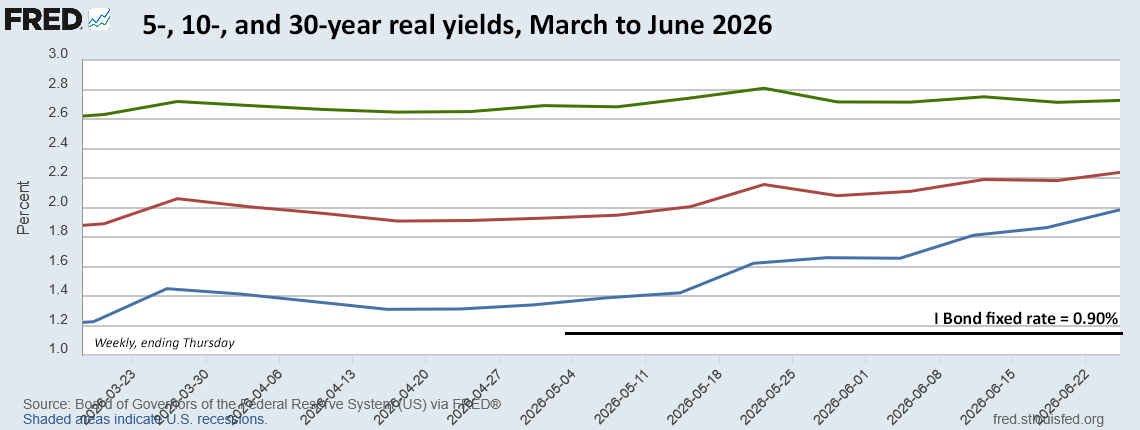
Note that the 5-year real yield — the key indicator for a future I Bond fixed rate — has been moving higher faster than the longer-term yields, which were already elevated. This should continue if the Federal Reserve decides to raise short-term interest rates later this year. (The move higher is probably an indication of market expectations of higher rates. Of the auctioned TIPS issues, the 5-year maturity is the most sensitive to Fed rate decisions.)
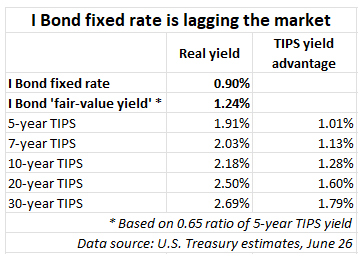
At today’s real yields, I’d assign a “fair-value real yield” of 1.24% to the I Bond, based on the 0.65 ratio of the current 5-year real yield of 1.91%. Because the 5-year TIPS has a strong yield advantage, I would favor it as an investment. The 5-year TIPS and I Bond are directly comparable, since the I Bond can be redeemed after 5 years with no penalty.
That same logic applies across the board for TIPS, because the I Bond’s fixed rate is lagging recent interest-rate increases:
What’s the strategy?
For TIPS investors, I’d say right now is a good time to build out a multi-year ladder with real yields near or above 2.0% for most maturities. Yes, real yields can continue rising, but getting a real yield of 2%+ is a good target.
For I Bond investors, do nothing right now. The fixed rate will remain at 0.90% and composite rate at 4.26% for any investment through October. So there is no need to act now to lock in a 0.90% fixed rate when it seems likely the fixed rate will rise at the November reset. And the variable rate could also rise above the current 3.34%. That seems likely, but I can’t predict future inflation.
I have been saying the November 1 composite rate could be “dazzling,” but that will depend on how quickly the oil shock recedes and other inflation cools.
If you already purchased your 2026 allocation — $10,000 per person per year — the gift box strategy remains an option for people with a trusted partner, at least for the time being. Also, the November 1 rate reset will remain in effect through April 2027, so investors can pile in after January 1.
Reminder: I Bonds have many advantages over TIPS, and those justify the 0.65 yield ratio: Rock-solid deflation protection, tax-deferred interest, full compounding of interest, flexible maturity, and lack of any market-price fluctuations.
• Now is an ideal time to build a TIPS ladder
• Confused by TIPS? Read my Q&A on TIPS
• TIPS in depth: Understand the language
• TIPS on the secondary market: Things to consider
• TIPS investor: Don’t over-think the threat of deflation
• Upcoming schedule of TIPS auctions
—————————

Donate? This site is free and I hope to keep it that way. Some readers have suggested having a way to contribute. I welcome donations, any amount. And FYI, ads on this site pay for about one visit to Costco.
—————————
Follow Tipswatch on X for updates on daily Treasury auctions and real yield trends (when I am not traveling).
Feel free to post comments or questions below. If it is your first-ever comment, it will have to wait for moderation. After that, your comments will automatically appear. Please stay on topic and avoid political tirades. NOTE: Comment threads can only be three responses deep. If you see that you cannot respond, create a new comment and reference the topic.
David Enna is a financial journalist, not a financial adviser. He is not selling or profiting from any investment discussed. I Bonds and TIPS are not “get rich” investments; they are best used for capital preservation and inflation protection. They can be purchased through the Treasury or other providers without fees, commissions or carrying charges. Please do your own research before investing.


Nice to see you quoted in Kiplingers.
https://www.kiplinger.com/personal-finance/savings-bonds/why-you-should-keep-an-eye-on-i-bonds-now
In the article, the reporter implied that I thought, “And even after the five-year mark, when the penalty no longer applies, keeping the bonds until they mature isn’t a bad idea.” … Almost! I don’t believe it is necessary to hold I Bonds to maturity and in fact that could be a bad idea for tax purposes. My feeling is that you should redeem “when you need the cash” and especially after the five-year holding period is complete. Then you have a backup inflation-adjusted savings account, ready for withdrawals.
Thanks for all the I-bond/TIPS information. Have you ever done any posts about TIAA Traditional interest rates?
I don’t know anything about TIAA Traditional, but I see it appears to be an annuity. TIAA is a good company, and has an operations center in Charlotte, where I live. If it is a straight fixed annuity, it is probably a good product. But I don’t have any information.
bdp453, it’s not clear from your brief inquiry whether you are trying to learn the basic facts about TIAA Traditional, or are already familiar with the product and are just asking if Mr. Enna the Tipswatcher can shed light on it.
There used to be a TIAA-specific forum on Morningstar, with some very knowledgeable posters, but Morningstar abolished it, along with forums on other subjects.
Most TIAA Traditional contracts have a guaranteed minimum accumulation rate plus “additional amounts” (TIAA’s term) decided by TIAA on a year-to-year basis. But the product comes in many “flavors,” i.e., contract names–Retirement Annuity, Group Retirement Annuity, Group Supplemental Retirrement Annuity, Retirement Choice, within a personal IRA, etc.–and while the investment vehicle in any of these may be TIAA Traditional, the terms depend on the contract type, and the rules of using the accumulation for lifetime annuity income or, alternatively, for periodic cash withdrawals, can also vary by contract type and, if within an employer-sponsored retirement plan, the terms of the plan.
Suggest you search for “TIAA Traditional” at:
https://www.tiaa.org/public
and less “official” discussions at:
https://www.bogleheads.org
I’m already familiar with the product and was curious if Tipswatch had ever done any rate predictions for it, like he does for I bonds.
I believe it has been a good time to build and/or add more to a TIPS ladder lately. Real yields are pretty nice on the longer dated.
I just happened to look on Tipsladder.com today to update a past article. Investors today can build a 30-year TIPS ladder with a composite real yield of 2.6% and a safe withdrawal rate of 4.7% a year in inflation-adjusted cash.
Very long dated look quite attractive right now to me, even if you’re NOT going to hold to maturity (I know, blasphemy here). 20+ year has a real yield of ~2.75% and inflation breakeven of only ~2.2%.
That would seem to provide favorable protection in both directions. In a low inflation scenario, keeping a fixed 2.75% real rate is an attractive floor. In high inflation, a 2.2% breakeven provides some slack before the real rate has to increase a lot. In the status quo scenario, it’s hard to imagine inflation being under 2.2% long term without some kind of major macro environment change.
And I would add, they have a good chance of providing solid diversification against major equity market downturns. Traditional flight-to-safety combined with long duration provides solid upside. Never guaranteed but historically has usually been true.
“Investors today can build a 30-year TIPS ladder with a composite real yield of 2.6% and a safe withdrawal rate of 4.7% a year in inflation-adjusted cash.”
That seems to be the equation for a worry-free long retirement right there.
That prompted me to add to my TIPS today.
UrsaTaurus, I have been contemplating similarly, buying long without the expectation of holding to maturity (I will be dead).
I hate long bonds, but the flight to safety – whether justified by the financial condition of the US or not – is a real possibility due to muscle memory of investors. Whether TIPS or long treasury are preferred is still unresolved in my mind, though I lean to either 20 or 30 year TIPS.
20 year has some advantages – rides down the yield curve more quickly, same real yield, I might outlive it – but also has the large inflation accrual risk which is probably not worth worrying about. That is, if the investment is go long, secure in the real yield but open to cashing out in a flight to safety, then assessing future deflation and whether to sell or hold can be made then, with more information available than speculating now.
If you only have I Bonds in Treasury Direct and set them up properly for what is essentially transfer on death, it is no hassle for your heirs, and in my experience, less hassle than most banks and brokerages.
Name your heirs as beneficiaries on the specific I bonds you want them to receive.
Upon your passing, if they do not already have one, each beneficiary creates a Treasury Direct account, which can be done entirely online iirc.
A beneficiary sends in a cover letter, a death certificate and FS Form 5511 with a signature guarantee instructing which specific bonds to transfer from the deceased’s account to the beneficiary’s account.
Other heirs do the same for the specific bonds they are to receive, but can reference the death certificate on file.
The bonds quickly showed up in the beneficiary’s account.
This bypasses probate, and avoids the complications of trusts. It is a very simple approach. Obviously, the heirs need to know the deceased’s account number, and the detail of the bonds they will receive.
If you believe I Bonds in Treasury Direct will be too much hassle for heirs, you should simply not own I Bonds. We don’t know when we will die. Could be in years, could be a few hours from now. Maybe you are the Highlander!
That is all from me on this topic.
Rocky, Thanks for the guidance on the subject of beneficiaries. My spouse and I each have an account and named the other as the beneficiary. We have about 1/3 of our I-Bonds in our trust account. We are both co-trustees, so the following only applies if we go together.
Our Trust account will simply pass to our Successor trustee using FS Form 4000. They will send the death certificates showing why original trustees are no longer acting. Also, sending a Certification of Trust which will match the one Treasury has on file.
Our trust is set up to pour-over anything in our individual accounts into the trust. Speed of settling the estate is not a concern, so we’re fine if it takes a while.
Thank you.
David, hoping you might reply here, obviously for my own interest, but also in case other readers may share it.
I’ve never been able to wrap my head around the question of whether it makes sense to pay a premium for a secondary market TIPS which, due to inflation adjustments already incorporated into the principal of the bond, carries a purchase price considerably above its par value. Example: the 10-year TIPS maturing in 2034 and 2035, which I don’t yet own, are currently going for around $10,500 or more, for 10,000 of principal. Yes, I see what the brokerage website is quoting as the real yield based on the price, but somehow I seize up about “paying extra,” which runs counter to how we shop for anything else.
If inflation continues indefinitely, then those bonds may turn out to have been a good purchase anyway. What I have trouble with is that, if there’s general deflation, then, even if the bonds are held to maturity, only the original $10,000 is guaranteed to be paid back to us.
In terms of ladder construction, I’ve thought of skipping those 10-year issues and waiting for the auctions of 5-year TIPS that mature in those years–but that means waiting for 5-year auctions in 2029, 2030, and who knows what conditions will be like then.
This seems to be one of those situations where “what you do depends on how you frame the issue,” and obviously I have trouble deciding.
Thanks for all you do here.
Should have mentioned that we already own a substantial quantity of I Bonds, which hold their previously accumulated value even in deflation. But share the concerns of other commenters here (including yourself) who are concerned that dealing with TreasuryDirect may prove to be a future nightmare for settlement of an estate. (Even now, we’re approaching 14 months’ wait since we submitted the TreasuryDirect paperwork to move I Bonds from our individual accounts to a joint trust account.) Therefore, have been thinking of increasing TIPS purchases within a brokerage Roth IRA while simultaneously embarking on a program of regular I Bond redemptions to draw down those holdings.
There was a time (seemingly in the ancient past) that I was reluctant to “pay up” to buy a TIPS on the secondary market or even at a reopening auction. Any TIPS that has existed for several years is going to have a substantial inflation index, which means the investor is buying additional principal that comes with no deflation protection. But when you say a TIPS maturing in 2034 is going for $10,500 or more for $10,000 of principal, that is not correct. You are confusing par value with principal.
Look at the TIPS maturing in Jan 2034. It has a coupon rate of 1.75% and an inflation index of 1.083 and a current price of about 98.22
So you buy $10,000 par value of that TIPS. You will be paying about $10,637 for $10,830 of principal. Your real yield to maturity would be about 2.006%. Back in 2024, if I bought $10,000 par value of that same TIPS at the original auction, I paid $9,935.15 for $9,989.60 of principal (it had a below-par inflation index of 0.99896 on the settlement date). I got a real yield of 1.1810%.
I’d argue that the TIPS maturing in 2034 is more attractive today than it was at the originating auction, despite the 8% inflation accrual since then. If you want to build a complete TIPS ladder, you need to use the secondary market and buy the additional principal.
@TipswatchChat — “I seize up about “paying extra,” which runs counter to how we shop for anything else.” Not quite anything else. I once paid 60% more to buy a ten-year old house (reasonable maintenance, no significant improvements) than the first occupant had paid the developer. I was paying for built-in inflation, even knowing that the market value could deflate to, and well beyond, the “par” value (original sale price). Of course this isn’t a fair analogy to the TIPS purchase question, because there is no deflation-proof alternative like an I-Bond.
I-bonds have some good features, and I have invested with them for almost 30 years. The continued lack of transparency from Treasury and awkwardness of the web site have led me to wind down my exposure over the coming years as my bonds get close to maturity. I would hate to expose my heirs the hassle of trying to receive money from these securities if I were to pass. TIPS work well enough in a tax protected brokerage account.
BTW, Susan Tompor is the best. Thanks for helping her out. I read all her columns in the Freep.
If your I Bonds are at Treasury Direct (not paper bonds) it really isn’t a hassle. I have dealt with this several times. Some heirs already had treasury direct accounts but some did not; nobody had problems.
This did not go through probate, heirs were added as beneficiaries prior to death.
It’s a good idea to limit the hassles your heirs have to go through, though.
I agree on TreasuryDirect being fine while you are alive and careful not to make login mistakes. But I can tell you that it’s probably advisable to clear out your account before your death — if that is feasible.
I just filled the 2037 to 2039 “hole” by buying an additional 3 years of the 2036 TIPS bond. My thinking was that taking advantage of a 2.2% real yield was too good an opportunity to miss rather than waiting for new bonds to be issued at possibly much lower yields.
It’s true I’ll need to re-invest when the bond matures to get some growth in 2037-2039 but that’s OK for me. I thought maybe this approach was worth sharing.
This is the “accepted practice” to deal with the gap years. Some people were buying additional 2040 TIPS as an alternative. In my ladder (built mostly in late 2023), I ended up with excess amounts in years 2032, 2033, and 2034. Now I am adding the new years at the standard amount, when they become available.
One advantage of your method is that the interest-rate risk declines as the I Bond nears maturity. You can probably plan on redeeming and putting the excess in T-bills.
My method is fund the gap years with VTIPS for now and purchase the missing years when they become available.
I’m one of those people that hold TIPS on both ends of the gap. Duration matching is used to determine how many. It’s fairly well explained in several threads over on the bogleheads forum.
why is the i bond yield structured to be so much lower than tips? That, along with the investment limit makes i bonds generally unattractive.
The I Bond fixed rate is based on past real yield trends for the 5-year TIPS. The fixed rate remains for six months. At times, that is a positive for I Bonds when real yield dip sharply lower. But right now, that fixed rate is lagging.
Did you ever get confirmation that this is really the case that they’re based on 5-year TIPS trends? Last I read up on this, the treasury was opaque regarding how they made I-bond fixed rate determination. Note that I’m asking whether this is what they actually do or whether it’s just a pattern that we’ve all noticed that works for the last decade or so.
It’s a 100% reliable pattern over the last 10 years. The Treasury could change course at any time.
That wasn’t my question. I asked you if you have confirmation that this is what they’re actually doing vs. a pattern you and others have found. From your response, I take it that there is no confirmation from the treasury that this is how they actually set rates but it is just a pattern that has been discovered. Curve fitting or actually causal? No way to know without a statement from the Treasury. And, as you note, even if it is actually causal, they could always change it.
They’re such different beasts in how they operate that I’ve never been convinced that a comparison makes a lot of sense.