

By David Enna, Tipswatch.com
Each July, since 2017, I have been forecasting the next year’s Social Security cost-of-living adjustment. Over the years, I have learned one thing: It’s important to be humble.
This is a nearly impossible task, combining an obscure inflation index, a weird quarter-year average, and summer months of traditionally volatile inflation. And this summer, the inflation picture is hidden in deep fog, making any projection “a wild guess.”
COLA basics
It is important to understand the needlessly complex way the COLA is calculated, which is rarely explained in mainstream media.
- The index. The Social Security Administration does not use the standard measure of inflation that you see reported each month. Instead it uses CPI-W, the Consumer Price Index for Urban Wage Earners and Clerical Workers, which often runs slightly lower than the standard CPI-U. See this.
- The time period. Instead of using a specific annual rate of inflation, the SSA looks at an average of CPI-W indexes for three months, July to September, and compares that to the average from a year earlier. In 2025, for example, the three-month average was 317.265, an increase of 2.8% over the average for 2024. So the COLA for 2026 payments was set at 2.8%.
- The summer months. Inflation can be notoriously volatile in the months of July to September. We got a hint of that when the CPI-U index for June fell by 0.35% because of plummeting gas prices (which have since mostly reversed). We’ve had at least one deflationary third-quarter month in 2014, 2015, 2016, 2017, 2019, and 2022. In other words: expect anything.
The projection
Now that you know why my forecast is likely to be wrong, let’s get on with it.
The June inflation report, released July 14, set the baseline for this COLA calculation. For June, the BLS set the CPI-W index at 333.952, an increase of 3.5% over the last year. So does that mean the Social Security COLA will end up being 3.5%? No, that is the baseline, but the actual COLA calculation will be based on the average of CPI-W indexes for July to September.
In this chart, I have provided six potential monthly inflation scenarios for the July to September period — an average of 0.0% to 0.5% per month — and then calculated the effect on the eventual Social Security COLA.
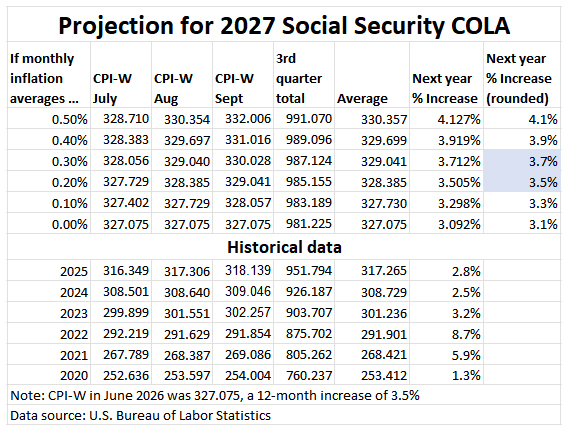
Before the surprising June “deflation” report — reflecting tumbling gas prices — I would have predicted flat overall inflation for June and then inflation of about 0.3% a month over the July to September period. That would have raised the COLA to a number around 4.0%.
June deflation skewed the equation lower. However, since July 1, the national average gas price has increased from about $3.87 on June 30 to $4.11 today, up about 6.2%. We are likely to see continued increases through the end of the month. That in itself would result in about a 0.18% increase in all-items inflation.
The Cleveland Fed, however, is currently nowcasting an all-items inflation rate of only 0.04% for July. (And that is up from -0.14% about 10 days ago.) I don’t rely on this forecast to be accurate, but it is worth considering. It would seem to indicate a fairly small CPI-W increase for July, possibly ramping up in August and September.
It’s also important to look at how much CPI-W inflation increased a year ago for the months of July to September, since this sets up the end-game calculation for the COLA.
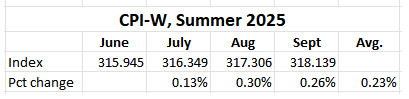
Remember that the June 2026 baseline was an increase of 3.5% in CPI-W. For that number to hold, inflation will have to average at least about 0.20% a month for the next three months. That could happen — we could a 2026 pattern similar to 2025, resulting in a COLA of 3.5%.
For my forecast, I am going to go slightly higher: 3.6%.
What others are saying
I wrote everything up to this point without looking at any other COLA forecasts — it’s my work, right or wrong. Now let’s take a look at others …
Right away, one “fun” forecast came on June 12 from CNBC: 4.7%. That followed the May inflation report, when CPI-W was up 0.7% for the month and 4.4% for the year. Then, after the release of the June report, CNBC followed up that forecast on July 14 with a lower estimate: 3.7% to 3.8%.
AARP in a July 14 article forecast an increase of 3.6% for 2027, matching my prediction.
A group I highly respect, the Senior Citizens League, a week ago was projecting an increase of 3.8% for 2027. The SCL puts a lot of research behind its forecast, so it has credibility. (Last year, the League predicted an increase of 2.7%. My prediction was 2.8% … exactly on target. I got lucky.)
What this all means
The SCL says the average monthly payment for retired workers in June 2026 was $2,084. An increase of 3.6% in 2027 payments would push the monthly amount up about $75 to $2,159.
But keep in mind that any increase in the COLA will be partially offset by rising Medicare costs in 2027. The COLA for 2026 was up 2.8% but most Medicare costs increased about 9.7%. More on that here.
SSA COLA versus CPI
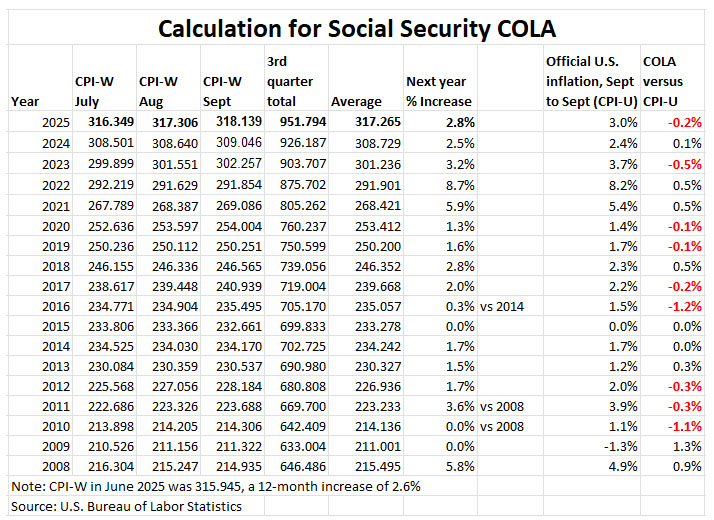
The combination of using CPI-W and the smoothing effect of a three-month average sometimes results in the Social Security COLA being lower than annual CPI. The SCL has lobbied for years to replace CPI-W with CPI-E, an index that more accurately reflects costs faced by older Americans.
For benefits in 2026 the COLA was 2.8%, trailing CPI-U at 3.0%.
More information:
— Does The Social Security COLA Shortchange Seniors?
—————————

Donate? This site is free and I hope to keep it that way. Some readers have suggested having a way to contribute. I welcome donations, any amount. And FYI, ads on this site pay for about one visit to Costco.
—————————
Follow Tipswatch on X for updates on daily Treasury auctions and real yield trends (when I am not traveling).
Feel free to post comments or questions below. If it is your first-ever comment, it will have to wait for moderation. After that, your comments will automatically appear. Please stay on topic and avoid political tirades. NOTE: Comment threads can only be three responses deep. If you see that you cannot respond, create a new comment and reference the topic.
David Enna is a financial journalist, not a financial adviser. He is not selling or profiting from any investment discussed. I Bonds and TIPS are not “get rich” investments; they are best used for capital preservation and inflation protection. They can be purchased through the Treasury or other providers without fees, commissions or carrying charges. Please do your own research before investing.


I value your humility in acknowledging how difficult these projections are, it is refreshing to see. The three-month average and summer inflation quirks make this almost an art as much as a science. Looking forward to seeing how close your 3.6% guess lands.
Schwab apparently has the money market fund sweep settlement accounts for managed accounts. They have the capability to setup sweeps for non-managed accounts, but it depends on the amount of money you have, the rep, etc. They are presently trying to get approval to setup a sweep for me.
I am not sold on Schwab or their customer service, but I would say that about every firm. Also, their bank, the 10th largest in the country, got caught up in the bank panic that sunk Silicon Valley Bank, due to losses on long bonds as interest rates rose. They likely weren’t at risk of failure because Schwab would bail them out and the belief that those covered by FDIC limits would not create a run on the bank. Still…who takes short term deposits to buy long bonds? Classic asset/liability mismatch. Note that Bank of America had bond losses that were a very substantial part of their equity balance, so Schwab was not alone, just worse off. But mark them hold to maturity and losses are no problem!
I have had no problem managing trades at Schwab. Buy something, and sell money market fund on same day and it all settles fine. I have not checked out their bond desk for things other than treasuries but I do know most brokerage firms not only charge commissions, they mark up the bonds from the dealer price, so you pay twice! At one point I took some bonds and looked at them on 3 or 4 platforms and only one did not mark up the dealer price.
Let’s see how much our Medicare premiums and supplemental insurance premiums go up taking another bite out of the COLA adjustment to our SS payments.
An unrelated topic but may be useful for this group. I want to share a nightmare scenario that I am going through with Schwab. First, I bought nominal 20 Year Reopened Treasury bonds last Wednesday (July 22nd). I had the Tentative Treasury Auction Schedule printed a couple of months ago with settlement date of July 31st for the 20 year auction. So, I kept money in their SNAXX Money Market Fund to make a decent interest until July 30th with plan to sell enough on the 30th so that it covers the cost on the 31st. Schwab pays virtually nothing on cash. Well, two bad things happened. First, in the latest version of the Tentative Schedule PDF, Treasury had changed the settlement date to 24th, of July, two days after the auction, which I did not know. Schwab started margin interest from the 24th to now, Second, they have no way to accept cash from my SNAXX until today’s sell order is executed tomorrow, another day of margin interest. Two learnings from this experience: First, check the Treasury Schedule a lot more often, especially for the reopened Treasury auction. It is costing me a lot to learn this. Second, although I have been Schwab client for 33 years, I believe they have perhaps the worst Cash management setup in the industry for self directed clients like me. Most likely, I will be moving all my money out of Schwab.
Ouch. The TIPS auctions always close on the last market day of the month. In this 20-year reopening, the date is now listed as July 24, as you note. The August 20-year auction supposedly closes on Aug 31, and the September 20-year on Sept 18. That is confusing.
David, I make two observations from the confusing changes. 1. For some of these auctions, Treasury is contracting the time between the auction and settlement dates. 2. They are changing dates because Treasury may be in a bit of a bind to get the debt money they need faster not caring about the confusion it is causing. Maybe I am over reacting, your thoughts?..as always, thanks,….and you are the best of best.
Update on my Schwab cash management nightmare: Schwab is reviewing my case and I am keeping my fingers crossed. If they let go off my first ever margin at Schwab, or anywhere, AND provide me within my self directed account a sweep Money Market Fund them I may stay with them for another 33 years or until I am 103… :)) ..after 103 that I may be resting in peace.
Final update on my Schwab Cash management scare: 1. Schwab will reimburse the charged margin; 2. They have linked my and my wife’s joint taxable account as well as my IRA account to a Sweep Government Securities Money Management Funds, similar to what Fidelity provides. 3. My financial consultant will take me and my wife out for a fancy dinner. 4. Finally, they promised to keep me alive until I am 103 and keeping me with them until then….. :))))
Glad to hear that Schwab took care of the problem for you. But to clarify, was there a settlement date shown on the order review page before you submitted the order, and did they change that date after you entered the order? I am used to enduring a series of increasingly shrill there’s-money-due-in-your-account!! emails and app notifications during the period between entering the purchase order for a TIPS auction or a soon-to-be-issued CD, but I’ve never had them change the settlement date after order entry.
Great question. I try to be very careful with my order review which I told the Schwab rep asserting that I believe the order must have shown July 31st as the settlement date. Unfortunately, I did not retain a copy of the order ticket….lesson learnt for all significant future trades. So, I really don’t remember if the date was 24th or 31st. There is a possibility that the Schwab trading desk did not update their trading database to reflect the new 31st date. They will not tell me even if that was the case.
Apologies for posting the above twice, I want to make sure woo832 sees my response….best
Thanks for your response, @chanderkhanna1. I’ve never kept copies of the order ticket either; I rely on the trade confirmation emails that come a day or so later. Maybe I need to rethink that. Something new to worry about!
How much money was involved? And, most importantly, what did they do to correct your situation for others (past/present/future)? If nothing on the latter, why are you staying there?
I am staying with Schwab mainly for two reasons: 1. Their 24×7 customer service and my relationship with local senior management. The biggest irritant was cash management and now they have set it up for me by linking our key accounts cash positions to Government MMFs; 2. Margin loan for four days, including the weekend, was more than a couple of thousand dollars; 3. Until this time I have never paid any margin loan on any platform. So, no past, and hopefully never again in the future to deal with such a situation. This all happened for two reasons: moving back and forth cash between no interest cash positions to decent interest from MMFs + Treasury changing the settlement date with no notification that I know.
Responding to wood832: Great question. I try to be very careful with my order review which I told the Schwab rep asserting that I believe the order must have shown July 31st as the settlement date. Unfortunately, I did not retain a copy of the order ticket….lesson learnt for all significant future trades. So, I really don’t remember if the date was 24th or 31st. There is a possibility that the Schwab trading desk did not update their trading database to reflect the new 31st date. They will not tell me even if that was the case.
Wait wait!!! There is a piece of stunning news in your Schwab resolution that needs clarification. You wrote “2. They have linked my and my wife’s joint taxable account as well as my IRA account to a Sweep Government Securities Money Management Funds, similar to what Fidelity provides. “
Did I read that right? Are you saying your sweep account in no longer a near zero rate account?! And you will now be paid a reasonable rate automatically? I thought that was never possible at Schwab. How did you possibly pull that off? Do you have a million dollar balance or something special.
I’m a long time Schwab customer with a taxable brokerage account that has to always manually invest my sweep funds in government money market for an acceptable rate. Tell me how I can get the same deal you did.
Much thanks for any info.
Yes, you read it right. I am not sure which factor played prominent role in them accommodating me the way they did. I have complained for this issue for the last few years when cash management became more significant. Over the last 33+ years they have always treated me very well, I have brought friends and families to Schwab over the years without expecting or getting any financial gains. I know their local leadership team well. And yes I have more money with Schwab than I had in the past. Lately Cash management became a bigger issue because I was thinking about my wife after I am gone and I let them know that I will not stay with them unless this is resolved. My rep told me that he had to go very high to get approval and they don’t do this easily. If you look at Schwab quarterly results they make a lot of money from not giving much interest on cash. Sorry for the long answer.
With Fidelity everything goes through Money Market which is earning about 3.3%. Unless you have over $100,000 in cash. Then you can get about 3.5%. So it looks like an easier process. But If I had a Schwab type account I would make sure the cash was there on the auction date and I wouldn’t care about losing a few days of interest on what for me would be a small purchase. But that is just me. I don’t like being overdrawn and I don’t have much confidence in getting all these settlement dates right.
We recently inherited a Schwab account, and I don’t have any experience with them. My first question is: Does money to be in cash to make a clean purchase? In other words, do I need to sell out of SNSXX money market *before* I make another purchase? Or will the money be drawn directly from SNSXX?
Yes, money has to be in cash to make a clean purchase. However, since the settlement for a sale from SNSXX, just like any another Mutual Fund, happens the following day so does the settlement of whatever else, such as ETFs or Stocks, that you may be buying. In other words, if you don’t have money in cash, you need to place two trades, one for SNSXX sell and one a buy order for your chosen purchase, before 4 pm. Unlike Fidelity, it’s inconvenient. One important point, when you sell individual stock, ETFs and few other assets the sale will immediately show cash on the cash line in your portfolio and it does allow you to use that cash to buy something else.
Another inconvenience has to do with maturing bonds or buying bonds where you need to wait until the settlement date. During the waiting period you want to make some interest so you will need to buy, say, SNSXX and sell it a day before the settlement date. Keeping all this requires tracking dates. I did fine for the last 4-5 years until Treasury moved the 20 year bond settlement date on July 16th from July 31st to 24th. I had considered the Tentative Schedule matrix as my ultimate go to doc. Now I know what tentative means after few thousand dollars (much more than $2K) of margin. Schwab rep has promised to reimburse because I had two calls with Schwab support before my purchase and neither one of them spotted or pointed out the settlement change. I missed it too, totally my fault. Maybe they thought I am smarter than reality. 😦 However, having spoken to makes my case stronger for reimbursement that should happen at the end of the month, fingers crossed. Another learning for us DIY or self directed cohorts, call their Fixed income desk to go through your large buys or sells in Fixed Income. They don’t charge you as long as you place the order. IMHO, all platforms have quirks and frustrating aspects, I still find Schwab support the best out there. No, I don’t own Schwab stock directly…may be through some of my ETFs… :))
I notice that the graphic design and font of the AI-generated can of “Social Security Cola” changes over time. As if it has a “branding” issue.
Or maybe the red can with simple lettering (and no ingredients listing) in this week’s Tipswatch column is Cola Lite, while this more ornate one from a year ago
https://tipswatch.com/2025/07/18/forecast-social-security-cola-for-2026-should-be-around-2-8/
was Cola Classic?
Also, this year’s can isn’t as tall as last year’s, but I don’t know if that predicts anything about the forthcoming COLA, as opposed to the cola.
🙂
Last year’s was better, but I had to change things up!
The first one looks more like a beer can to me. Or perhaps root beer. The new one looks like a generic store brand cola.
Pingback: Social Security COLA 2027: 3 Big Changes Coming for Retirees
Pingback: Social Security Payment Continues as DOGE Cuts 8,000 Workers
when the retirees get higher raises than working adults, something have gone quite wrong.
Pingback: Social Security Administration Could Deliver a 3.8% COLA in 2027
I am 66 and will reach full retirement age in October. I am abiding by the oft repeated advice to wait until age 70 to claim the maximum benefit. However I am worried that the shortfall in social security funding will result in a reduction of benefits by the time I get there. I hope COLA will be baked into my future benefits. Everything is so expensive nowdays and getting worse.
It’s a brutal decision. I waited the next year after FRA (I was 67) just to avoid tax problems in the previous year. My wife (wonderful person) was the high earner and she waited until 70. I realized later that … maybe … I should have delayed and been withdrawing from a traditional IRA instead of Social Security payment. That would reduce future RMDs, but higher Social Security income later on causes IRMAA problems. No easy answers.
I would stay with the 70 target until more is known definitively. I am also trying to hold out until 70 but considering 67.
Would there be some announcement first from Social Security that there would be some major change in benefits? So that you could make the decision to start SS in order to be grandfathered in to some kind of old rule?
You would think that whatever changes may be made that waiting until 70 will still be likely to be more advantageous than what ever differential you might have collected between 67 to 70.
I have waited until I turn 70 next month. We are going to wait for my wife until she turns 70 in 2031, of course, barring any major changes announced between now and 2031, which I doubt. Back of the envelop calculation will tell you that break even or to collect the SS that you miss between your retirement age of 67 to 70 takes about 10 to 11 years. Depending on an individual’s health one needs to decide how much risk you want to take.
Yes, if you were pretty certain that the end was coming before breakeven, that would be a reason to take it earlier. The other reason would be that you unfortunately absolutely need the money now.
I always joke that if the doctor tells me I have a year to live then I can finally buy that Cadillac instead of making sure I have enough for co-pays and deductibles for the next 30 years.
Thanks for this helpful article. Do you have access to the historical CPI-E data? If so, it might be interesting to see a chart of CPI-E vs CPI-W vs CPI-U for each year or to add CPI-E to the final chart at the bottom. It’s not clear to me how the proposals to use CPI-E in these calculations would actually differ from the current methodology.
The BLS did an experimental study of CPI-E up to 2007, so I can’t say that is very useful. Here is the trendline, showing that CPI-E almost always was higher, just by a little but that adds up over time. Source: Claude AI.

Think it is wise to save enough for retirement without ever considering Socal Security. Just consider it as cream on top, longevity insurance. It can fund travel during your “go go” retirement years with your assets growing and giving you security for what lies ahead.
Does the COLA keep up with official inflation? I understand that it mostly did until about 14 years ago but not so much lately.
I’d say it is generally close to official U.S. inflation, but slightly lags. You can see that in the chart in the article.
Informative and well-done article David! Thank you. It is informative to learn how the government does this contorted calculation and all the variables and unknowns. I trust your forecast will be as good or better than most!