
By David Enna, Tipswatch.com
The Treasury’s offering of $19 billion in a reopened Treasury Inflation-Protected Security, CUSIP 91282CRE3, generated a real yield to maturity of 2.653%, the highest for this term since an auction in October 2008.
Investor demand at the auction appeared to be a bit weak, in the wake of a Federal Reserve decision to raise interest rates on Wednesday, and signal that more increases could be coming. The auction’s bid-to-cover ratio was 2.24, the lowest for this term in a year. The “when-issued” prediction used by bond traders was 2.634%. The higher resulting yield indicates less-than-stellar demand.
For today’s auction investors, however, this adds up to good news. The real yield of 2.653% was 22 basis points higher than result for this TIPS’ originating auction on July 23, and a whopping 75 basis points higher than a similar 10-year reopening auction on March 19.
Definition: The “real yield to maturity” of a TIPS is its yield above future U.S. inflation, over the term of the TIPS. So a real yield of 2.653% means an investment in this TIPS will provide a return that exceeds official U.S. inflation by 2.653% for 9 years, 10 months.
Here is the trend in 10-year real yields since January 2025:
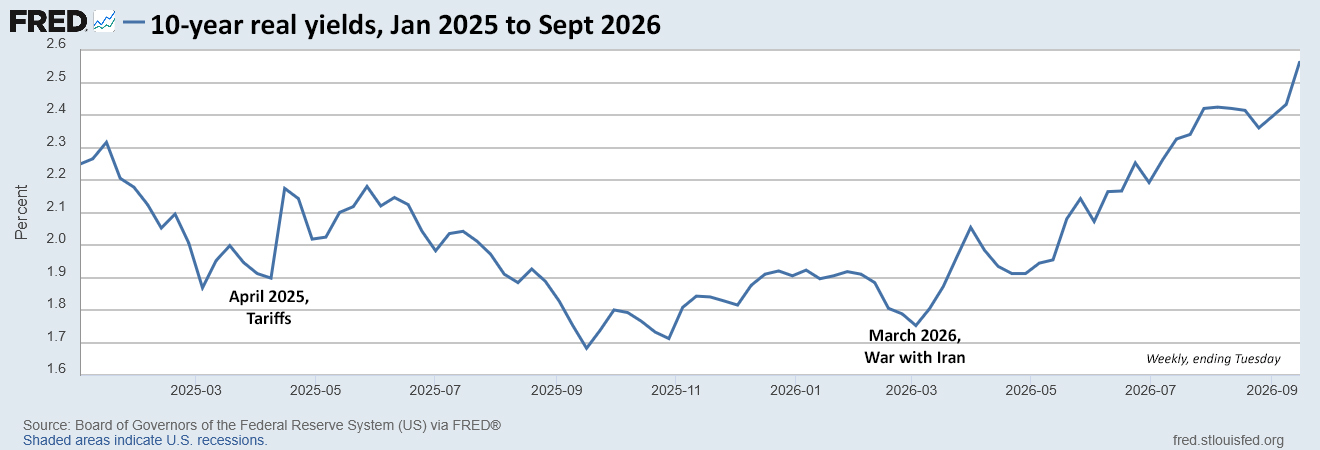
In this chart, I have noted two crucial events: 1) The launch of U.S. tariffs in April 2025 and 2) the beginning of the U.S. war with Iran in March 2026. While tariffs caused real yields to immediately surge, the market returned to normal in a few months. The war with Iran, because of its inflationary dangers and resulting surge in government borrowing, has caused real yields to soar.
This is the path of annual all-items inflation over that same period, showing the apparent inflationary effects of tariffs and the obvious and more severe effects of the war and resulting energy crisis:
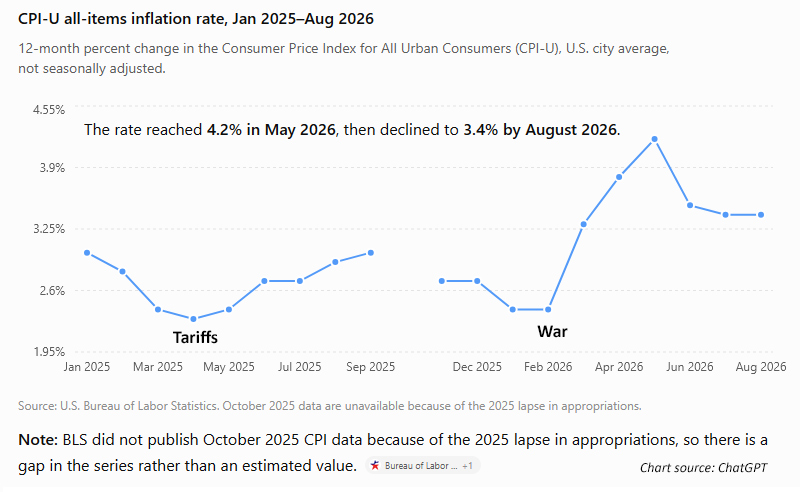
Real and nominal yields are rising for a reason. Inflation and government borrowing are not under control.
Pricing
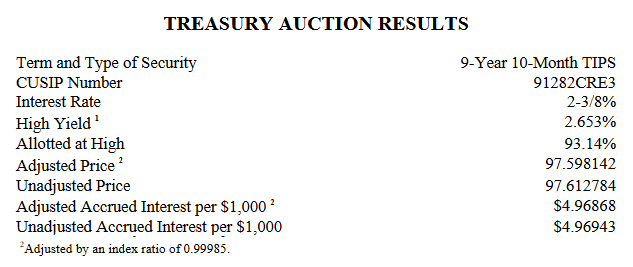
The coupon rate for CUSIP 91282CRE3 was set at 2.375% by the originating auction in July. Because today’s real yield was higher, investors got a discounted unadjusted price of 97.612784. In addition, this TIPS will carry an inflation index of 0.99985 on the settlement date of September 30. With that information, we can calculate the cost of a $10,000 par-value investment at this auction:
- Par value: $10,000.
- Adjusted principal on settlement date: $10,000 x 0.99985 = $9,998.50.
- Cost of investment: $9,998.50 x 0.97612784 = $9,759.81.
- + accrued interest of $49.69
In summary, the investor paid $9,759.81 for $9,998.50 of principal on the settlement date of September 30. From then on, the investor will earn accruals matching future U.S. inflation, plus an annual coupon rate of 2.375% for 9 years, 10 months. The accrued interest will be returned at the next coupon payment in January.
Inflation breakeven rate
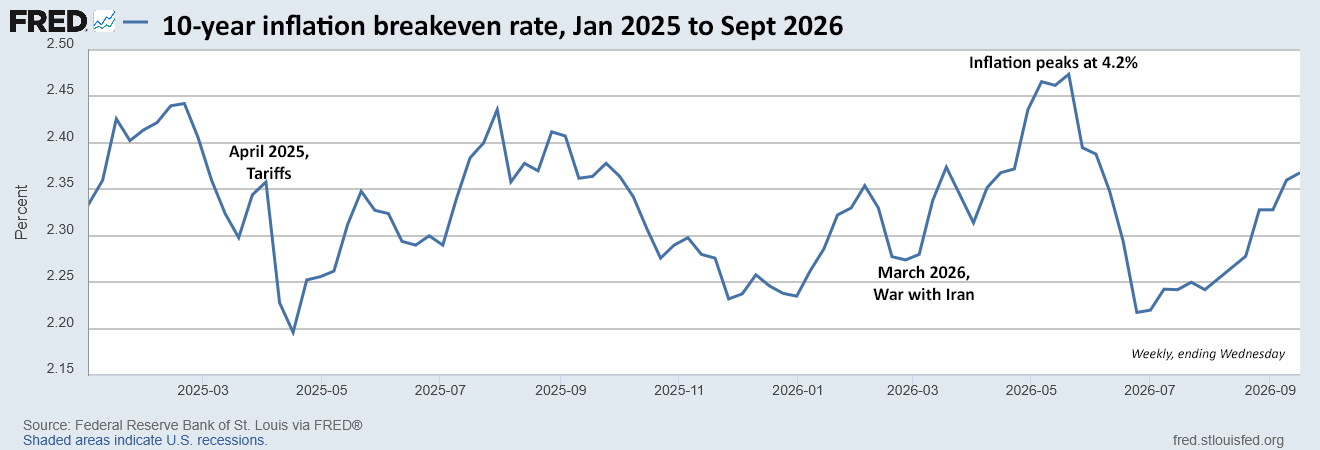
At the auction’s close, the 10-year Treasury note was trading with nominal yield of 4.95%, giving this TIPS an inflation breakeven rate of 2.30%, in line with recent results for this term. It means the TIPS will out-perform the nominal Treasury if inflation averages more than 2.3% over the next 9 years, 10 months.
Over the last 10 years, ending in August, inflation has averaged 3.4%. Here is the trend in the 10-year inflation breakeven rate since January 2025:
Thoughts
Today’s auction was a very good result for investors, netting the highest real yield since a similar auction in October 2008 — in the heart of a severe financial crisis — went off at 2.85%. There is no evidence of a crisis today, except for the excessive surge in U.S. government and corporate borrowing.
This TIPS will get another reopening auction on November 19 and then a new 10-year TIPS will be auctioned January 21, 2027. That January auction is my current target, so I hope yields remain elevated until then.
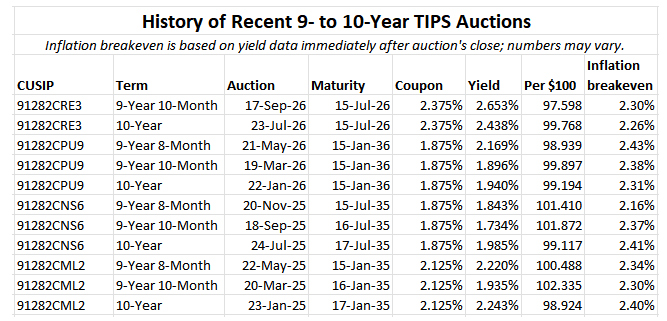
Were you an investor? Post your thoughts in the comments section. Here is a history of auctions for this term over the last two years:
• Now is an ideal time to build a TIPS ladder
• Confused by TIPS? Read my Q&A on TIPS
• TIPS in depth: Understand the language
• TIPS on the secondary market: Things to consider
• TIPS investor: Don’t over-think the threat of deflation
• Upcoming schedule of TIPS auctions
—————————

Donate? This site is free and I hope to keep it that way. Some readers have suggested having a way to contribute. I welcome donations, any amount. And FYI, ads on this site pay for about one visit to Costco.
—————————
Follow Tipswatch on X for updates on daily Treasury auctions and real yield trends (when I am not traveling).
Feel free to post comments or questions below. If it is your first-ever comment, it will have to wait for moderation. After that, your comments will automatically appear. Please stay on topic and avoid political tirades. NOTE: Comment threads can only be three responses deep. If you see that you cannot respond, create a new comment and reference the topic.
David Enna is a financial journalist, not a financial adviser. He is not selling or profiting from any investment discussed. I Bonds and TIPS are not “get rich” investments; they are best used for capital preservation and inflation protection. They can be purchased through the Treasury or other providers without fees, commissions or carrying charges. Please do your own research before investing.


Pingback: S&P 500 à 7 800 points : 5,26 % de rendement des bénéfices contre 5,28 % pour le Trésor, la prime de risque a disparu en un trimestre – La Jeune Tribune Économique
Pingback: Dave Ramsey’s skip-bonds rule faces a 6.1% inflation problem – Respect Investment
Pingback: Top 5 Leading Economic Indicators Every Investor Should Watch
Pingback: Five Percent Is Back - KinneyMunro
I’m new to TIPS, recently retired and been buying T-Bills and Notes for past couple years. Mostly to make a spreadsheet and keep math skills. I dipped by toe into TIPS this month (Sep-2026). Found your website a couple weeks ago. Been doing lots of reading and remaking Excel tables. Ready for October’s auction to add to my spreadsheet and dip my foot a little deeper into the water!
Interesting times for TIPS given current inflation and interest rates. I have/am building out a TIPS ladder from 2032 to 2044 (currently missing ‘37- ‘39) to cover anticipated RMDs.
I bought my 2036 rung earlier this year with the Jan 2026 10 yr TIP auction — 91282CPU9 with YTW of 1.94. I decided to add a bit more to the ’36 rung year after reading this post highlighting the attractive situation. (Thank you, David!)
I waited till after the Fed Wed meeting before deciding for sure. I was too late on Thursday morning to buy via the auction with Vanguard, but the secondary market was open and looked good. Bought on the secondary and received YTW of 2.635. Very nice — turned out to be the same as the auction. Like David, I will buy the next rung in Jan ’27 and hope the YTW stays close to this YTM.
Hi All, David thanks for everything you do! Some basic questions about buying on the secondary: Is the price quoted (bid, ask) the unadjusted price? It seems so but double checking. I bought the ten year today and ended up with 2.66% but how do you tell if you got a “good” price especially when your buying just 20 bonds? It as obviously not the best available price bc those you can’t easily get at that smaller quantity. I did notice that firm wouldn’t fen let me out in a more competitive limit order. Thanks for any advice.
It is the unadjusted price. It becomes the adjusted price when the additional inflation-adjusted principal is added in. When you get to the “submit bid” page, the brokerage should show you the actual cost of the investment and the real yield to maturity, which might be called “yield to worst.” Make sure to jot that down before you hit submit.
David: They showed an effective yield of 2.66. Was that a good yield/price for today? As I mentioned, it was not the best available but my quantity as 18 bonds (total of $18000). Thanks!Sent from my iPadOn Sep 18, 2026,
2.66% looks great, a little higher than the auction’s yield.
I’m trying to better understand the tips ladder approach. Say you’re 40 and still working and plan to retire at 65. Do you start building a tips ladder now since yields are so good? Do you wait u til you actually retire to start building the ladder? Are you better off buying them in your IRA or Roth? What’s a good place to go to get the basics on what that strategy is?
The key is how you want to use the future money. For example: Will you retire before 65 and need inflation-adjusted cash to pay for medical insurance and then to delay taking Social Security until 70? Age 40 would be a good age to begin building, but possibly starting the ladder’s first year into the future instead of this year, maybe covering ages 55 to 70. I’d recommend building the ladder in a traditional IRA if you are around age 40. You can take more risk in a Roth at that age. You can look at Tipsladder.com for actual construction of the individual TIPS. Financial writer Alan Roth created a good step-by-step guide: https://www.advisorperspectives.com/articles/2024/10/07/four-easy-steps-build-tips-ladder
Thank you so much for all your work David, very happy with my purchase at this auction!
I’m curious –
“That January auction is my current target, so I hope yields remain elevated until then.”
Is this part of an overall TIPS strategy you have? If so, can you briefly explain?
Yes, this is a strategy. I am trying to fill years 2037 to 2039 in my TIPS ladder (it goes to 2043). I have set up maturing investments around that purpose to make those purchases in each January. I like the January maturity because at maturity, I’ll have the cash sitting and waiting to take my RMDs.
Ah, yes that makes sense. Thank you!
Very happy with the results of the Auction. Looking forward to next month’s 5 year and November’s 10 year reopening auctions as well.
My plan is to continue harvesting gains, Roth Conversions, and looking forward to minimizing worry.
Thank you Mr. Enna for your efforts in providing this much needed education. Will have some 5 year bonds maturing in 2027 that I would have never purchased without your guidance.
i may be an outlier, but I always look forward to the February new issue of the 30y TIPS. I buy one for each of my children every year.
The February 30-year could be especially interesting if it gets a coupon rate of 3.0% or more. Fantastic for the person who can hold to maturity.
I didn’t buy the 10-year today. but I did buy the 5-year TIPS on the secondary market that originated in April 2026. Coupon in April was 1.25%. Real yield today was 2.44%. Wow!
Thanks for everyone’s last minute analysis yesterday. I loaded up today.
Maybe a schoolboy question but, what makes the real yield for this auction’s TIPS higher than the same TIPS, and coupon, from the previous auction?
Is it simply because the purchase price is lower? Given that they get the same coupon and inflation increases until term, I’ve never quite understood why that changes.
Yes, the discounted price creates the real yield to maturity. It is locked in at purchase. You got principal at a big enough discount to make the 2.375% coupon rate equate to a real yield of 2.653% to maturity. Just roughly speaking the price was discounted about 2.5%, divide that by 9.8 and you get a boost of about 0.255% a year. Add .0255 to 2.375 and you get 2.63%. That’s the way it works, roughly speaking.
Thanks. I did purchase at the auction, so am quite happy with my choice.
The only reason I have a TIPS ladder now, never mind understand it, is thanks to coming across your site. Appreciate all you do.
That is correct. When it is a “fresh” Treasury, the coupon is undetermined when the auction happens. The Treasury waits to see what the yield will be, then picks a coupon that is the nearest 1/8% that is below the yield. That is why, at original issue, the price tends to be 99 point something. When it is a reopening like this one, the coupon is already set in stone, so the only purpose of having another auction is to determine what the price will be this time, and to generate the competitive yield since interest rates have risen since the coupon was set, the price goes down to a more dramatic 97 point something.
I am not sure why they do the reopenings. Possibly to help with liquidity by reducing the number of distinct CUSIPs out there?
Technical analyst Tom McClellan:
Interest rates trend upward along gold’s prior path until they hit their projected peak in August 2028
Start at 29min
https://www.youtube.com/watch?v=w-mI47Gec7s
Thank you, David. I bought some at today’s auction.
This chart from the St. Louis Fed indisputably proves CPI disinflation is trending down at an accelerating rate. PPI indisputably proved the only items driving BLS inflation data higher are Diesel, gasoline, jet fuel, crude oil and petroleum derivatives. Core CPI (ex-food and energy) was actually down.
It’s true that core CPI is the one inflation measure that looks pretty good. The Fed focuses on PCE inflation, which often runs lower than CPI, but not now: 3.7% in July, core PCE 3.3%. The Cleveland Fed is projecting PCE to rise to 3.8% in August, then 3.9% in September. Core PCE would rise to 3.5%. Those projections, if accurate, would be disturbing for the Fed.
I put in an order on Monday and was happy to see the results. Somewhat surprised, however. And Schwab initially estimated a cost of $10,080. Now it will cost me $300 less.
Thanks for your information.
Brent Fine
Chandler, AZ
Almost triple the fixed rate of a current I-Bond.
I’m satisfied with my purchase today.
More than double the current Real returns of an I-Bond.
Swell if you’re a new buyer. Not so swell if you bought at lower real rates earlier and are now waiting it out for maturity to arrive. Keep your fingers crossed that the cpi doesn’t lag too far behind experienced inflation and that Bessent/Warsh don’t rejigger the formula to the government’s advantage and the investor’s disadvantage. It is legal to do so. Further, take a listen to Jeff Gundlach’s take on TIPS.
I have seen Gundlach speak about TIPS. I don’t think I grasp his argument entirely, but I believe he was saying that long TIPS do not protect you against inflation because nominal yields and TIPS yields trend together? So when yields increase, the the long TIPS investor sees just as painful a capital loss as the nominal investor. That would not be unexpected and needs explained to those who thought TIPS would’ve helped in 2022. But I don’t think he is contradicting that you’d prefer TIPS if inflation proves higher than expected, and nominals if inflation proves lower than expected?
I think in this case Gundlach is talking about about TIPS as a trading investment … real yields rise and your investment is under water before inflation adjustments. For example, every TIPS issued at auction in the last 15 years has a coupon rate lower than market. If you are holding to maturity, no big deal. (Except if you want to feel regret for not waiting to buy until this week.)
I am amazed when I watch financial people on TV ask, “Why are real yields rising?” The answer is: “Because nominal yields are rising.” The gap is the inflation breakeven rate, which has been remarkably stable over the last couple of years, around 2.3%. If inflation were the reason, then TIPS would have LOWER real yields and the inflation breakeven rate would be higher.
TIPS when held to maturity do provide a guaranteed inflation-adjusted return. There would be no capital loss. (Of course, you can question if inflation statistics are true.) If inflation averages more than the inflation breakeven rate, then a TIPS will out-perform the nominal Treasury. This has been the case for several years, as you can track on my TIPS vs. Nominals page.