
Avoid creating a complex, frustrating estate process.

By David Enna, Tipswatch.com
TreasuryDirect, the only source for buying and holding Series I Savings Bonds, is having quite a moment: Its customers, after years of contending with mediocre service, are enraged by the Treasury’s decision to move very quickly to a new login verification system through a private company, ID.me.
Read about that here: “TreasuryDirect is launching a controversial login system.”
But that isn’t the point of this article. Here is my message today: It makes absolutely no sense to hold I Bonds until death. The reason? Your surviving beneficiaries or estate will face months, maybe even years, of delays in distributing the account assets. Plus they may have to deal with multiple forms (long processing times) and required medallion signature guarantees (nearly impossible to get at most banks).
This is not a new issue, but it gets more pressing because we all are aging. Admit it!
I am hearing from a lot of readers who are planning to redeem or transfer all holdings at TreasuryDirect because of the ID.me transition. I am not recommending that, but I am recommending that you have a plan to exit TreasuryDirect before you die. (If that is at all possible.)
I am not an expert on this topic and have never had to deal with the death of an account holder. But I am sure many of you have, and I hope you will contribute advice in the comments section below.
A tangled bureaucracy
I have a friend who is executor for a relative’s estate. The relative, who recently died in her 90s, had a fairly large amount of converted I Bonds from 2000 and 2001, which have more than quadrupled in value.
The executor had access to the TreasuryDirect account, but had questions. She called TreasuryDirect and asked, “Can you tell me if these I Bonds have a co-owners or beneficiaries?” The answer: “No, I cannot answer that.” And then TreasuryDirect immediately locked the account, as is its standard practice after a death. This is noted here: “Death of a savings bond owner.”
TreasuryDirect does not allow joint accounts, but it does allow “co-ownership” of savings bonds. That should make things easier for a surviving spouse. TreasuryDirect says:
If a surviving co-owner or beneficiary is named on the savings bond, the bond goes directly to that person. It does not become part of the estate of the person who died.
But the actual advice is “contact us” and not much else.
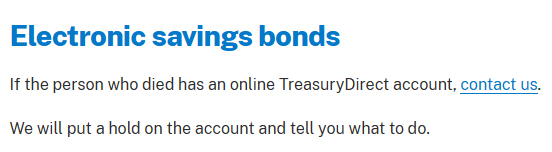
See more here: “Inheriting savings bonds as a named co-owner or beneficiary“
Question: I would love to hear feedback from surviving co-owners on how this process worked. Were there delays? Multiple forms to fill out? Or could you simply continue to maintain or transfer that account to your own, with little hassle? If so, there is no pressing need to redeem all I Bonds (even if you are at death’s door) if you have a co-owner who can take over the account with little complexity.
Sole owner: What happens next?
Let’s focus on the death of the sole owner of the savings bonds (which is the case when a co-owner died earlier). This most likely applies to my executor friend’s situation. She needs to know if the savings bonds had any beneficiaries, because that determines the next step.
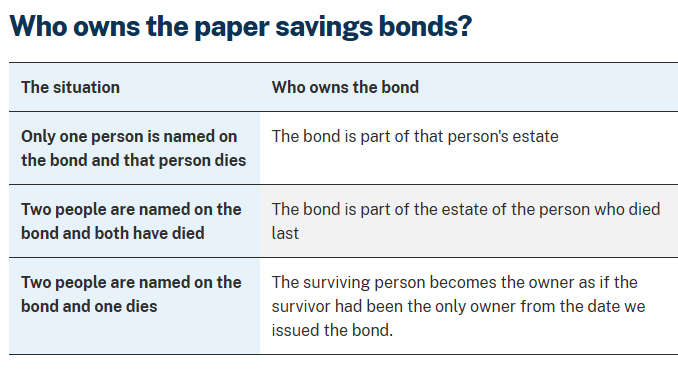
Assuming there was no co-owner or beneficiary, TreasuryDirect will look to a state court to recognize the executor who will eventually be able to distribute or redeem the savings bonds. This triggers automatically if the holdings exceeded $100,000, as was the case for my friend. (Also, my friend believes there were no named beneficiaries on these converted I Bonds, but isn’t sure since Treasury Direct will not tell her if there are beneficiaries without opening a “case” which could take up to 10 months to get the answer.)
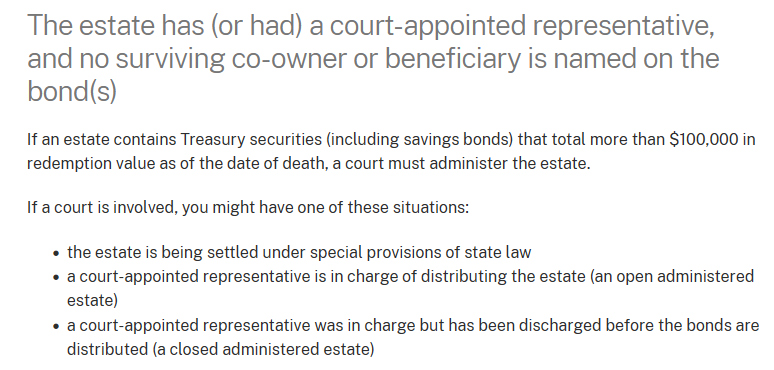
The executor will need a death certificate, plus a court-issued “Letter of Testamentary” that certifies this person has been named executor of the estate. Those forms must be sent to TreasuryDirect, which will then consider allowing the executor to control the assets. Other forms may be needed, including these:
- Form 1455, Request by Fiduciary for Distribution.
- Form 5512, Redemption and/or Bank Change Request
- Form 5511, Transfer Request, for distribution to beneficiaries.
The forms may say “notary certification is NOT acceptable,” but it appears that TreasuryDirect may be willing to waive that requirement, since medallion signature guarantees are very difficult to achieve. More on this.
The process of reviewing these forms can take up to 10 months.
Every single stage of this process can take months. If the executor decides to redeem the I Bonds inside the estate, that decision could take months. And then the eventual distribution of assets to a matching estate account outside TreasuryDirect could take additional months.
Delays are also likely if the savings bonds are going to a beneficiary, as detailed in this article at MyMoneyBlog.com, “TreasuryDirect Customer Service Delays and Estate Planning Concerns“:
My dad’s I bonds were transferred to me around the 4-5 month mark.
After that experience, I decided to liquidate all of my TD accounts, and will encourage my husband to do the same. I personally don’t want a repeat of this experience, or make my heirs go through such a lengthy process in resolving my estate.
What I learned from this experience is to not discount how much stress and mental bandwidth it takes to deal with TD when you’re also grieving the loss of a family member, and trying to settle the estate so you can move on financially.
A similar story was told in an October 2024 Bogleheads post:
An ongoing horror story. Learn something from this. Please don’t do this to your family. My sister passed away in April 2024. While going through her papers, we found a business card with an account number for Treasury Direct. (TD) Since there is no paper trail, it was a piece of luck that we found the card and then found the account.
We completed paperwork in July. We called TD and was told that everything we needed to file and created has been completed and that a TD auditor would review our claim. We were told the timeline would be about a year. …
So here we are in October 2024; six months later. We call TD monthly just to log a call. We still don’t know what’s in the account. We were hoping to close the estate by the end of the year. The TD account is the last item to be closed and TD is holding us up. Thanks to TD, we are looking at interest and penalties because we don’t have the information to file a final tax return.
In my friend’s case, she won’t have access to the relative’s account until TreasuryDirect receives and reviews the death certificate and Letter of Testamentary. And most likely she will never have actual “access” to the account. Once she is recognized as the executor, she could direct TreasuryDirect to redeem the I Bonds and deliver the proceeds to an estate account at a financial institution. But that could take months.
Eventually, the estate will owe taxes on that redemption. How much? She might know in early 2028 when 2027 taxes are filed, which means complete distribution of assets could take a very long time.
Plus, the addition of the ID.me verification layer could cause future problems in accessing account information, such as finding 1099s for 2026, to be issued in late January 2027.
Needless to say, there are only two investments a sole-owner elderly person should own at TreasuryDirect: 1) Savings bonds, because TreasuryDirect is the sole source, and 2) T-bills up to about 26 weeks, because those will mature and pay out. If you are elderly, don’t purchase Treasury Inflation-Protected Securities at TreasuryDirect. Do it at a brokerage to avoid potential estate hassles.
The I Bond strategy
My advice for TIPS is to hold to maturity, if at all possible. TIPS can be held in a tax-deferred account, with a beneficiary, or in a taxable account, where taxes are kept current on the inflation accruals. There is no big deal — tax-wise — at maturity.
This isn’t the case with I Bonds. No I Bond has ever matured; that process will begin in 2028 and beyond. There is no overriding reason to hold I Bonds to maturity. I Bonds are a cash-equivalent investment and should be redeemed when you need the money. They can never go down in value. When the time comes, cash in and enjoy life.
The ideal holding period for an I Bond is 5+ years until … you need the money.
Also see: TIPS vs. I Bonds: Let’s do the math
What about taxes?
My recommendation is going to be difficult to hear: If you are a sole owner of savings bonds at TreasuryDirect and know your life is nearing an end, immediately redeem every holding and transfer the money out of TreasuryDirect. You will then be responsible for the taxes owed on the interest, to be paid when your executor files that return in the next year. Your estate and heirs will get less money, but will be free of that tax burden and the lingering hassle of TreasuryDirect after death.
I am NOT a tax expert and I am sure many readers know more about this than I do. Here is what the IRS says for savings bonds with accrued interest collected over years:
If the bonds transferred because of death were owned by a cash method taxpayer who chose not to report the interest each year and had purchased the bonds entirely with personal funds, interest earned before death must be reported in one of the following ways.
- The person (executor, administrator, etc.) who is required to file the decedent’s final income tax return can elect to include all of the interest earned on the bonds before the decedent’s death on the return. The transferee (estate or beneficiary) then includes only the interest earned after the date of death on its return.
- If the election in (1) above wasn’t made, the interest earned to the date of death is income in respect of the decedent and isn’t included on the decedent’s final return. In this case, all of the interest earned before and after the decedent’s death is income to the transferee (estate or beneficiary). A transferee who uses the cash method of accounting and who has chosen not to report the interest annually may defer reporting any of it as income until the bonds are either cashed or reach the date of maturity, whichever is earlier. In the year the interest is reported, the transferee may claim a deduction for any federal estate tax paid that arose because of the part of interest (if any) included in the decedent’s estate.
The IRS includes a few examples on that page, but I think the core is this:
- The executor can include interest earned up to the date of death on the sole owner’s tax return, and in that case the beneficiary (or the estate) will pay taxes on interest earned after the date of death.
- Or if not option 1, then the person (or the estate) receiving the savings bonds will accept the full tax burden at redemption, which could be sizable.
- A variation on option 1 is for the executor to have TreasuryDirect redeem all the savings bonds, deliver the cash to a related estate account, reserve money for future taxes on tax returns for the sole owner and estate, and … eventually … deliver the remaining cash to beneficiaries. That will take time, but the estate will carry the tax load.
I suspect CPAs could argue about this for hours.
The better option: Redeem all I Bonds before the sole owner’s death.
I am sure many of you have different opinions. My expertise in this area is extremely limited. I believe I have only scratched the surface of these difficult issues. Please share your thoughts.
—————————

Donate? This site is free and I hope to keep it that way. Some readers have suggested having a way to contribute. I welcome donations, any amount. And FYI, ads on this site pay for about one visit to Costco.
—————————
Follow Tipswatch on X for updates on daily Treasury auctions and real yield trends (when I am not traveling).
Feel free to post comments or questions below. If it is your first-ever comment, it will have to wait for moderation. After that, your comments will automatically appear. Please stay on topic and avoid political tirades. NOTE: Comment threads can only be three responses deep. If you see that you cannot respond, create a new comment and reference the topic.
David Enna is a financial journalist, not a financial adviser. He is not selling or profiting from any investment discussed. I Bonds and TIPS are not “get rich” investments; they are best used for capital preservation and inflation protection. They can be purchased through the Treasury or other providers without fees, commissions or carrying charges. Please do your own research before investing.


TLDR every single comment. However, no where did I see anyone discuss the TD beneficiary limitations. Specifically, unlike ‘normal’ financial institutions, TD does NOT allow for the designation of non-individual human beneficiaries. Further, there is no provision for a secondary, backup, or contingency bene. And if by circumstance or choice (no living family or persons you wish to leave an I-Bond to upon death) you wish to leave the I-bond/proceeds to a charity – well you cannot. You can’t name an individual charity nor a DAF nor a trust. Further, each and every security must have a singly named beneficiary – no account-level beneficiary is allowed. I suppose I could just name the atty whom will settle my affairs upon death as a named beneficiary (lucky them), with instructions to them that they consider it ‘payment for services rendered’ rather than having the I-bond holdings sucked into the time and expense of probate. Better too than trying to transfer into a TD living trust account, given the exorbitant timelines in TD settling said transfers and trust accounts. OR just cash out and be done with it.
This article was not your best work. A much better title would be don’t hold I Bonds without designating a beneficiary. You gave ancedotal evidence rather than a first hand account. In one of your examples it sounds like the executor accessed the deceased TD account, contacted TD and TD locked the account as they should have. Anytime a financial product is not in a trust or a beneficiary it has to go through probate, nothing unique about TD in that regard. ID.Me is a separate issue and unrelated to the subject. I already had an ID.Me account to access VA Healthcare and Social Security sites. It worked flawlessly for me and TD. The best advice is be sure all I Bonds have beneficiary named, make sure they know that. Make sure your executor knows about them, your account number and rough balance. Take periodic screen shots for them. There are other financial products and institutions that take a long time to close an estate., TD isn’t special in that regard.
In this case, the I Bonds should have had a beneficiary; the executor did not know for sure. When the I Bonds were converted from paper, the manifest did name beneficiaries, but apparently those were never applied to the I Bonds. So the executor wanted to know why. That lead to the question: “Is the account owner dead?” And then the account was locked. That was unfortunate, but it does allow the I Bonds to be redeemed by the estate and have the estate pay the taxes owed. Then the money can be distributed.
I have a TD fund, entirely of I Bonds and set in a Trust. The point was to provide educational support for grandchildren as I bonds are tax free if used for approved educational purposes.
I’m still living and have not taken from the fund yet, so it remains to be seen if it all works as planned, but I’m hopeful.
It seems a shame on America that our Treasury doesn’t listen to or abide the common citizens’ concerns or wishes. Big Brother knows best we are led to believe.
To me, this looks to be another boondoggle were this time the hackers can steal it all… stealing well past your SS number when they hack ID.me
Every entity group has a lobbying consortium for their cause or business interest in Washington except the common and nonaffiliated member of the electorate.
The common worker and citizen Treasury saver’s voice seems somehow drowned out by money for business (and corruption?).
We certainly have the finest politicians and bureaucrats that money can buy, no doubt.
What will they want next… a hair or drop of blood for ID? The rest the hackers already have or will have.
So im planning to help my mom cash out all her Ibonds after this post, in part due to the potential that she will not be able to navigate ID.me well (I can just fine and do for IRS and other logins). I think this is a useful preventive measure and will help her to put the cash generated into other reasonable yield investments like CD’s.
The second part of this post is I have two friends who are siblings who just had both parents pass away, each of which had Ibonds. They otherwise had an extensive series of trusts and beneficiaries on the Ibonds set up (some to one friend some to her brother). There father passed close to 1.5 years ago and her mother 1 year ago. They just received about a month ago the mothers Ibonds and the fathers not long before (no beneficiary on some). They indeed did get medallions as they needed for other inheritance. It is just pure luck they both are working and have high income jobs and did not need any help with this but it took two graduate level professionals and a estate attorney to figure it all out. I am glad they shared their experience with me as I dont want to have the same one.
To be clear, this was a requested transfer of maturing Treasury Notes purchased at TD to my Fidelity brokerage account, on an account I had locked due to attempted fraud. TD told me neither they nor I could access the account in any way for at least six months after I had locked it, but that limitation also magically disappeared after getting my Congressman involved.
The magic of getting your Congressman involved when dealing with any Federal bureaucracy is amazing. I came to this country at the age of 3 weeks, and became a naturalized citizen “on their papers”
My parents acquired passports over the next few years, and were able to get along without their citizenship papers. But 25 years later, when I got my PhD and a first job teaching at a Canadian University, I needed proof that I was an American citizen, and my parents were unable to locate their citizenship papers that proved I was as well.
This was 50 years ago, in the dark ages when there were no digital records. My Congressman’s staff located my parents’ citizenship papers in a storage facility that resembled the last scene in “Raiders of the Lost Ark,” where the Ark is “safely” stored in a facility so huge and remote no one would ever find it.
My Congressman’s staff DID find them, sent faxed copies to INS in Chicago, and as a result, I was able to get a passport within a day.
sorry, this was meant to be a response to a reply I wrote at the bottom of the commentss
What happens to i-bonds in the “gift box?”
I’ve never used it, so I don’t know how the i-bonds are typically registered
Can i-bonds in the gift box be registered with a POD beneficiary? Do the i-bonds go into THEIR gift box?
I sold the bulk of my low yielding I-bonds (about $300K worth) some years ago (2023?) to help fund my TIPS ladder.
I still have about $20K plus worth of I-bonds at 1.3% fixed that I think about selling every month, and would have sold by now, were it not for some upcoming expenses early next year (at which time I will sell them and happily pay the fairly trivial EWP).
I-bonds made a lot of sense during the decade or more when I was purchasing them, mostly at near-zero fixed rates. They make no sense to me now that the gap between their fixed rates and TIPS yields has widened to the extent that it has.
The issue that David pointed out above justreinforces my eagerness to dump my I-bonds ASAP.
There are some advantages keeping those 1.3% i-bonds, especially if you’re in retirement and are unable to get TIPS-bound the proceeds into a tax-deferred account.
As you should probably aware, TIPS outside a tax-deferred account are a nightmare. Not only do you pay taxes each year on the coupons you receive, you are liable for taxes on the unrealized phantom income from the increased value of the inflation component of the TIPS.
Even with only a 1.3% fixed component, your i-bond interest continues to compound on a tax-deferred basis, making it a supplement to existing tax-deferred accounts
I agree that there are advantages to I-bonds over TIPS, Harry…no question about that…but today, imho, the disadvantages outweigh the advantages, given the much higher TIPS yields, the additional complexity TD adds to your account, the need to trust ID.me, and (perhaps above all), the point that David made in his post above about inheritance (at least for us septuagenarians who think about those things).
I disagree that TIPS are a “nightmare” in a taxable account. I have held about half my TIPS in taxable for the past 4 years (since I maxed out TIPS in tax-deferred), and they have done me well. The taxes need to eventually be paid one way or another, whether piecemeal annually, or, if in tax-deferred, in bulk at withdrawal. While I prefer holding TIPS in tax-deferred, which will work out better in the long run is unknown.
If you can hold as many TIPS as you want in tax-deferred, great. But if you want more, I would not hesitate buying them in taxable, despite what one reads on some web pages (or from brokers with self-interest).
And the accounting issues are trivial….I hold my TIPS at Fidelity, and it’s just a question of migrating their numbers into my tax software.
“There is no overriding reason to hold I Bonds to maturity.”
Well, if you were fortunate to buy them between May 2001 and Sept 1998, the fixed interest rate was between 3 and 3.6%. Adding in the inflation rate on top of that, then real returns are currently ~6+%. I bought some in 2000/2001 and plan on holding them to maturity.
Fine plan. But prepare for a huge tax bill on redemption. I have these, too, and I am spreading out the tax hit.
For those expecting some large redemptions and hoping to reinvest the money beyond the $10K possible in I-Bonds, what’s the best substitute in a taxable account?
(Aren’t TIPS best in a tax-deferred account?)
TIPS may be best in a tax-deferred account if you do not live in a high income tax state. I live in Maryland, so most of mine are in regular accounts, where I save the ~9% tax in return for dealing with the tax return hassles. Getting used to it…
I was in a similar situation a few years ago, and although I am 80/20 stocks/TIPS I did buy a 10 year TIPS ladder in a taxable account. I personally like it … yes I pay tax on the “phantom income” each year but a) Vanguard does a good job of calculating the OID for tax returns and b) I REALLY like having a small tax bill when the bond matures.
I am still holding a few TIPS in a taxable account (at TreasuryDirect). One will mature every year 2027 to 2029 and then another in 2041. It is good when they mature and the tax bill is essentially nothing. But that 2041 TIPS — which I bought in 2011 — is a sore point. At least the coupon rate is 2.125%, not miserably bad. I’ll stick it out.
I wish iShares had their iBonds products for TIPS past 2036. (They started for long dated Treasuries in 2024 so have 2044, 2045, 2046, 2054, 2055, and 2056, but stop at 2036 for TIPS.) That would be something I would go for, because I think that methodology of avoiding 1099-OIDs and taking the inflation adjustment as cash every year works better, plus it is just another ETF asset that can be passed around between brokers if you want to play the brokerage bonus game (which I still do, to a certain extent).
Dave,
I think your warning is very useful, but I’m not sure I agree with the categorical “don’t die with I Bonds.”
My wife and I are both 73. We each have substantial old I Bonds with good fixed rates and large amounts of deferred interest. Each of us is named POD beneficiary on the other’s bonds. If one of us dies, the survivor can take ownership without redeeming the bonds, and the deferred tax can generally remain deferred. Redeeming them now solely to simplify the estate would create a large and certain taxable event.
The real weakness, as I see it, is the second death—particularly if we both die before the survivor has had time to name new beneficiaries. Then TreasuryDirect bureaucracy and estate administration become a genuine problem. So for a sole elderly owner with no beneficiary, I think your advice is compelling. For a married couple with reciprocal POD registrations and valuable legacy I Bonds, I think the calculation is different. In our case, holding them and dealing promptly with beneficiary registrations after the first death still seems the better tradeoff.
I agree that the 2nd death, creating a sole owner, could be the trigger for estate issues. Co-owners should be fine.
Co-owners would indeed be fine, but that is not our situation. Each bond has one owner, with the other spouse named as POD beneficiary. The serious estate-administration problem arises after one spouse is gone. Then, until the survivor names a new beneficiary, there is no longer another living person in the registration chain, and the second death transfers the bond to the estate.
We setup POD registration for our heirs as well with instructions to switch registration of remaining I Bonds to them after the surviving spouse claims the bonds of the deceased one. I assume that would suffice.
Unless both die together or in near time proximity. An MVA would statistically be the most common traumatic scenario but there are other possibilities. There are medical scenarios that can happen concomitantly as well where the elderly are at higher risk of dual death (COVID is but one such example). Furthermore, never underestimate the risks of severe bereavement on morbidity and mortality in the elderly. One spouse dies, and the other subsequently dies from health events triggered by the grief, such as an MI.
Because there is no way I am subjecting my parents where English is a second language to an id.me verification call, I emptied their TD accounts this month and printed a PDF of the interest earned in the year so they don’t have to log on after the id.me transition. They only had I Bonds bought during the period when inflation was super high, or paper conversion I Bonds.
Some paper bonds were apparently registered incorrectly, because they were registered as <John and Jane Doe> instead of <John Doe and Jane Doe>. I tried depositing to both John and Jane’s account, to avoid getting the signature guarantee, and TD kept saying they should have been registered in the latter, so there is no way to avoid the signature guarantee apparently. When I did this for John, and I decided to wait out the 60 day time period and have TD mail the bonds back, and rather than calling for Jane I will just wait out the 60 days as well and have those mailed back too, and reluctantly find a bank or notary to do the signature guarantee and just cash those out. They are between 15 and 25 years old and their interest rates are high so I am not in a super big hurry, although I want to get this done before Jane has health problems.
I used TD for a time but decided buying TIPS, T-Bills and whatnot in my brokerage and IRA accounts would be simpler.
I have personally handled four estates with I Bonds, most recently a few years ago. In between estates, I dealt with setting everything up involving the I Bonds for each estate. Paper and electronic. My experience does not include trust accounts with Treasury Direct. There are four issues in the comments:
ID.me
Other types of accounts being handled quickly after death
The speed and ease of Treasury Direct processing
Mistakes
First, ID.me. It is valid to object to giving your information to a private, for-profit firm; don’t tell people to just get over it. Given the recent White House executive order, it is likely Login.gov will come to TD, we just do not know when. I will probably be liquidating some I bonds next year using paper forms. I would be surprised if the process takes more than a few months.
Estates and Probate – I have given advice to maybe 20 friends when their loved one passed. Almost all ended up going through probate because very few people have every asset setup to avoid probate. Something always falls through the cracks. And with probate, it might be 6 months before you can begin to do anything with the funds. It is rarely quick. Even outside probate, the premise that banks/brokerages/etc will quickly transfer money to heirs is a faulty premise. Payable on Death/Named Beneficiaries only work when the institution is cooperative, and I have personally experienced both large and small institutions being very uncooperative. The errors that large, well known financial institutions have made even when they cooperate are comical. In summary, whether in or outside of probate, you can experience delays and complications. You should expect them.
Treasury Direct – I had no problems nor any delays dealing with TD, but we also had things setup to minimize issues (no trusts, co-owners or beneficiaries were named, we had screenshots of the holdings). I have posted details before, not going to repeat. My most recent took maybe a month, but it might take a little longer now. Simply filled out form 5511, got the bank signature guarantee (not medallion signature – that is not required and is more difficult to get, though upon first reading you think a medallion signature is required). Even the heir that did not have a TD account had no problem setting one up and getting the bonds transferred to them.
Mistakes. A lot of problems are because people don’t plan, and don’t think through the consequences. Having no named beneficiary. Telling any institution the holder died before you have gotten the information you need if you have online access. Selling bonds of a deceased holder from the deceased’s account is a fraudulent transaction which could lead to lots of complications.
Remember, too, that while you might like I Bonds and understand them, most heirs simply cash in stuff without regard to tax consequences or rates of return.
All that said, estate simplification matters. The fewer accounts, the better for heirs.
I like the AI image.
I cannot fathom why anyone would use TreasuryDirect at this point. They lost my fund and sent it to Pathward bank to an account not in my legal name. Every time I call TreasuryDirect I get the run around that my case is pending assignment to an investigator. This happened over a year ago and all of the regulatory agencies I contacted can’t get an answer out of them. It is shady and strange.
I had something similar happen to me. While I was able to stop the transfer (I was fortunate enough to notice an email alerting me that my banking instructions had changed) TD told me it would take many months to clear things up and get my money out of TD
I contacted my Congressman’s office, signed an authorization for them to handle the case on my behalf, and everything was resolved in 1 week
hi Harry, I saw your comment below and I’m glad you were able to stop the transfer. That’s not the case unfortunately for me and many others even though some of us caught it quickly :(. We got our congressmen involved but no one has been able to reinstate our funds. They tell us they’ve been following up with TreasuryDirect but get no reply or resolution. It is a nightmarish situation.
The process described by legendarydutifullyfbea139432 is what my wife and I use and plan as well. My understanding is that probate would not be necessary (even for amounts above $100,000) unless you die as the sole registered owner of the I-bonds.
Since we have granted mutual transaction rights to each other, the survivor should be able to cash out the decedents bonds simply by going into their account. Or go through the more laborious process of arranging a transfer to the survivor’s account. Upon death, the survivor becomes the sole owner of bonds in both accounts, so must re-register the bonds to “survivor POD heir” to avoid probate once again.
Having bonds owned by a trust could alleviate the concern that we might die simultaneously and then heirs would have to go through probate. Have to weight the cost of setting up a trust vs taking a chance on simultaneous demise.
I’ve been attempting to change my bank account associated with my ITD account. I got locked out, twice, but a phone call and Treasury representative got me unlocked . The second rep tried to change the account for me and was unable. Why do all my financial account’s recognize my new bank but not Treasury Direct? The IRS and my State take money from my bank account, but Treasury Direct can not verify! I’m going to have to do this by medallion signature and forms and USPS mail. I will try to contact my US Representative and Senators first.
Thanks for the cautionary tales. So I took these precautionary actions as a result:
(1) Added ‘registrations’ to my and my wife’s account to make them jointly owned and made these joint registrations our ‘preferred’.
(2) Took screenshots of both account holdings with the new joint registration and the list of i-bonds held with valuations clearly shown.
The following remain unknown:
(1) Will the new id.me system be problematic? I don’t think so. As many others have said, I already use it for IRS. I suspect this is a nothingburger. We will soon know the answer.
(2) if my spouse and I die simultaneously, our children may have a major hassle and delay getting the funds. So, I will probably try to cash these out sometime before I am 80 or so. Obviously this does not cover sudden, unexpected joint death.
Just a story for interest: These ‘delayed release’ hassles can be infinite (not just delays of x months or years). My grandfather left a small bond he purchased in the 1930’s on his death in the 1970’s (not an ibond though), and nobody in our family has ever managed to retrieve the funds. It was only a few thousand dollars, with no continuing interest after expiry, and simply not worth the staggering effort required to get the money back.
I set up a Treasury Direct Trust account and transferred all my IBond holdings into it. It took some time to establish the trust and perform the transfers. I hope this will make it easy for the trust recipients. Nonetheless, the advice in this column is helpful. I plan not to buy any more IBonds and as my existing IBonds start to mature, I will not roll them into more IBonds.
Death of the owner causes a problem for all financial accounts. Make sure all accounts have PODs/TODs listed and/or Trust. Do not expect that having a Will makes for a smooth transition. Without a POD/TOD/Trust you will have to go through probate to have the directions in a Will implemented, and a probate attorney costs at least $3000.
good advice….but trusts are not free either……mine set up over 15 years ago cost around $ 2500.
I still have not figured out what is the most cost effective solution for each person during their life….as opposed for the heirs after death.
One thing is for sure…..Do as many POD / TOD/Beneficiaries as you can.
You are right. Mine cost $5k to set up just a couple of years ago. I would not create a trust just to handle IBonds’ inability to handle multiple beneficiaries (except by doing different PODs on different IBonds). Also it took about 9 months or so to have the IBonds transferred from a regular account to a trust account.
Maybe I’m in the minority, but I never had any difficulty transferring inherited savings bonds. When my father died, he had a large stash of paper and electronic EE and I Bonds that had not reached maturity. TreasuryDirect reissued the bonds in electronic form less than six weeks after I sent them via registered mail back in 2021.
The process was fast, but it helped that every bond had a co-owner or beneficiary. I also included a cover letter with names of any TD representatives I spoke with on the phone.
For the paper savings bonds, I mailed Forms 4000 and 3500 and included a detailed list of all paper bonds and serial numbers. For the electronic savings bonds I sent Form 5511, which requests the transfer of securities from the deceased’s account to the beneficiary. Both forms I had notarized at my local bank.
Last year I mailed the last of my paper I Bonds from tax refunds for electronic conversion, and they were added to my account within about eight weeks.
Right from the TreasuryDirect home page:
Processing Times
Currently, we are experiencing a high volume of requests, which is causing delays in our response times for requests submitted by mail.
If you have a TreasuryDirect account in your name, the processing times for specific transactions are as follows:
Searching for Lost, Stolen, or Missing Savings Bonds: Requests to locate lost, stolen, or missing savings bonds require eleven months or longer for processing.
Cashing Paper Savings Bonds: If you are named on the bonds and send them in with your request, processing may take three months or longer.
Other Paper Savings Bond Transactions (Not in Your Name): Transactions you are authorized to complete, but that are not in your name, require five months or longer to process.
Other TreasuryDirect Requests (Including Trusts): Requests related to trusts and other TreasuryDirect matters may take ten months or longer to process.
Just adding a data point from my own experience. Set up a TD account for my business, which was initially locked until I verified my ID (which is an anti-fraud procedure). On-line the description was to expect ~13 weeks for TD to process the paperwork.
I mailed the notarized form in on 8/19/2026 by USPS. I received an e-mail indicating it was received on 8/25/2026 from TD. I received an e-mail on 10/13/2026 indicating the account was unlocked (which it was). So… 7 weeks in my case to process the form.
I realize some people do get strung out in awful ways, but that may not be the norm. I didn’t think the service was bad for a big government office.
Id.me
In November 2022, a joint investigation by the House Committee on Oversight and Reform and the Select Subcommittee on the Coronavirus Crisis published official findings demonstrating that ID.me inflated pandemic fraud estimates, mischaracterized its technical verification capacity to federal agencies, downplayed facial recognition failures, and subjected applicants to video-chat wait times exceeding four to ten hours. You can review the official congressional release detailing these systemic flaws online at: https://oversightdemocrats.house.gov/news/press-releases/chairs-maloney-clyburn-release-evidence-facial-recognition-company-idme
Id.me:
Uncompeted Sole-Source Procurement: Just days after receiving its GSA Federal Supply Schedule Contract, ID.me secured a 5-year single-award Blanket Purchase Agreement (BPA) with the Department of the Treasury (Chief Information Officer Office) valued at up to $1,027,709,739.11 (Award ID: 2032L226A00006; Referenced IDV ID: 47QTCA26D002K). This award listed only 1 bidder and was not competed, raising profound procurement integrity questions about why a single commercial contractor was handed exclusive gatekeeping authority over Treasury systems without open competition or public fallbacks. You can review the official federal contract record online via the USAspending.gov database entry: https://www.usaspending.gov/award/CONT_IDV_47QTCA26D002K_4732
On the one hand, ID.me was already involved with Social Security and IRS, so it doesn’t necessarily seem far-fetched for that company to get the Treasury contract, although the lack of bidding casts doubt on the impartiality and costing of the process.
On the other hand, and not saying it’s cause-and-effect, but (helpfully posted by reader commenter “Rich” on David’s original column about the new TreasuryDirect log-in system) there was this:
https://www.documentcloud.org/documents/25498471-idme-inauguration-donation/
It’s part of a larger pattern in which so many things done by this administration seem to have difficulty cleanly passing the common-sense “smell test.”
I view my I-Bonds as essentially 5-year Treasury Notes that will come to maturity five years after the purchase date. (I certainly am not going to sell them before the three-month interest penalty expires.) Accordingly, I am paying the taxes on the appreciation every year — just as I would on a 5-year note — because I don’t want to take a big tax after year five.
My wife and I currently hold a total of $30K in I-Bonds purchased in April 2024. They have a 1.3% fixed rate and are currently paying a composite rate of 4.44%, which is more than a 2-year note is paying (4.372%) but less than a 5-year note (4.551%), so I’m very happy to hold on to them for five years. I will sell these in December 2029.
I will probably buy another $10K in November and $10K in January, hoping that they have a fixed rate of 1.3% or higher, and will sell them in December 2032, after the three-month interest penalty has expired.
If that’s your perspective, why not roll 5-year TIPS? Asking honestly.
To me, the major benefits of I bonds are tax deferral and flexibility of redemption. I’m using them as an emergency fund. 5-year TIPS wouldn’t work well for that purpose because of duration risk.
TLDR – never use Treasury Direct for any purpose other than buying and holding i-bonds. You can purchase all other Treasury securities at auction for free with all the major brokerage firms, and if you find you need to sell them, you can do so immediately.
*******************************************************I had a horrific incident with Treasury Direct a year ago. My account was hacked, someone added THEIR bank account to my banking information, and set in motion a redemption of my i-bonds to their bank.
I was fortunate that I noticed an email from TD that my “banking information had changed.” I immediately logged in with a VPN, canceled the redemption, removed the fraudlent bank, changed my password, and locked my account, thinking this was a necessary step until I could interact with Treasury Direct support.
It turns out that once you lock your account, neither you NOR TD can access or even see your account for a minimum of 6 months. I found out that I would not have access to $200,000 in TNotes maturing in the next 2 months. The funds would be held without interest for a minimum of 6 months and as much as 24 months before I could access them.
TD tells you that you can transfer Treasury Securities (other than i-bonds) to your broker. What they DON’T tell you is that they will take anywhere from 6 months to 2 years to perform the transfer – I kid you not, that is what I finally found out after multiple desperate attempts to contact them.
Fortunately, I had an experience many years ago with an instransigent Federal agency, and found that my Congressman’s office could perform miracles.
I drove to my Congressman’s local office, and filled out forms enabling them to act on my behalf. I told them what I really wanted was to transfer my Tnotes to my Fidelity account IMMEDIATELY, before maturity. Within a week, they were able to make this happen. Suddenly I began receiving very accomodating phone calls from Treasury Direct, promising to make the transfer to my Fidelity account WITHIN A DAY, which they actually did. They promised to call back within a week to make sure everything went perfectly, and they made good on that promise (I had several phone calls from my Congressman’s staff following up to make sure I was getting the service I sought).
So I repeat – there’s NO REASON to use TD for anything other than i-bonds, and many reasons NOT TO.
Wow! Thank you for sharing. That is awful you had that experience and great that you went to your Congress Member and got service. I would bet a lot of Congress Members will be contacted now by people who have posted here. Great info.
Wow terrible story. Glad you were able to stop the scam. Perhaps this is why ID.me is coming, due to the vulnerability of the current website to hacking such as you have described.
this happened to me except I was unable to stop the redemption. Was Pathward or Bancorp added as the recipient bank instead of your intended bank?
This was an eye opening article and series of comments. I’ve been buying iBonds monthly for years. Had no idea I could name a beneficiary or payee upon death. I suppose I should figure out how to do that ASAP. They are a small portion of my portfolio and based on this I’ve just stopped my automatic investment in them and will cash them out in 5 years. Hopefully I survive until then so my family doesn’t have to deal with all this TD inefficiency. I’ll probably use the money I was putting in to iBond going forward to continue building out my TIPS ladder.
Thanks all.
My dad died August 1, 2025. He had I-bonds I helped him purchase. My mom was listed as POD. TD accepted a notary vs the Medallion stamp. As referenced earlier it took 10 months from submitting the form via USPS (that’s the only way) along with a death certificate to transfer the I-bonds to my mom’s TD account.
All of her I-bonds are now POD to either my brother or me. I learned my lesson though. I won’t wait 10 months again.
I help my mom with online access and transactions for all of her financial accounts. If she doesn’t need the I-bond money before she dies I’ll either (1) cash out the I-bonds when her health deteriorates towards her dying or (2) if she dies I’ll just cash them out without telling TD she died. Yes, there’s the ID.me issue yet I think that as long as I have the UN & PW after it’s set up along with any 2FA method I’ll be able to access the TD account.
My parents had I-Bonds held by a trust, and I had no issues redeeming when they passed. The owner (trust) didn’t change post-mortem, so treasury direct interactions didn’t change. No more difficult than usual to redeem.
-Jon
Thank you for sharing your trust experience.
I appreciate this article. However, one benefit of I bonds is that they are longevity insurance. If your life expectancy is 85 and you buy and I Bond at age 80 you have ethe option of extending its life until you are 110 but you can cash it in a 85 without market risk. You cannot do that with a TIPS that has a 30-year term. (I am 64 and have stopped buying the 30-year TIPS at auction because of that factor. If the Treasury auctioned a 20-year TIPS I would buy it.) I have not heard that benefit discussed elsewhere. So if you look at I bonds the way I do you are likely to die with some still at TreasuryDirect.
Second, people really need to stop freaking out about ID.me. It will be fine. I use it for my IRS account and other federal agencies.
The ability to redeem I bonds at book value any time between 1 and 30 years is incredibly special.
The issues you mention are why many people ladder TIPS when using them for retirement savings. Buying more future rungs on the ladder from matured bonds is pretty similar to simply not redeeming I bonds.
I think people need to stop freaking out about various things at treasury direct in general. I bonds are a great deal available nowhere else. That’s worth putting up with some inconveniences.
For me as well the tax deferral/ flexible maturity is huge. Savings bonds can be a stealth extra IRA, albeit a highly conservative one. So I am reluctant to clear out my Treasury Direct. I have an ID.me account, wasn’t a big deal to set up. However in the next few years I will have some giant payouts from I bonds I bought when the fixed rates were high (1999-2002), so they will be large obligatory RMD’s if you will. I think the discussion underlines the benefits of having a clear estate plan in place. Wait times may be longer with TD but stories I have heard about disposition of assets generally following a death are equally long. But this is also true: you can’t take it with you! Enjoy life.
Thank you for your interesting articles on TIPS and I-Bonds.
I own a substantial amount of September 2001 I-Bonds. My advice is to change the ownership into a trust – usually a Revocable Living Trust (RLT) allows addition of assets. This prevents the delays caused to probate and filing an estate on the owner’s death. The successor trustee of the trust does not need to report the death of the grantor (original owner) to Treasury Direct since the trust is separate. However, on the grantor’s death the successor trustee must get a new EIN (entity identification number) and notify Treasury Direct.
It took over a year for TD to transfer I-Bonds into my RLT but it solves the problem of probate in advance since trusts do not go through probate.
Also, if the tax is pre-paid on the I-Bonds be very sure to keep exact records for when the bonds mature.
See my comment elsewhere here, in which my wife and I had been waiting 14 months for a transfer from individual accounts into our joint revocable living trust account, and I asked a TreasuryDirect employee: Suppose that all our holdings were already in the joint trust, but both of us were dead. Our successor trustee, who is also our attorney, will have the trust documents to confirm her authority, and will then be requesting total liquidation of our holdings as part of the estate settlement. Will the wait time for TreasuryDirect to accomplish that action–i.e., dead account holders, total liquidation–go any faster than these transfers have gone? Answer: No. About the same.
If that answer was correct, then a revocable living trust accout may, as you say, eliminate some of the detail work of the usual probate process, but (a separate issue) may not necessarily eliminate the extraordinary wait time for severely understaffed TreasuryDirect to perform any account action requiring the involvement of a human employee. The completion of estate settlement may still go into a state of “suspended animation,” with the successor trustee twiddling thumbs for a year or more before Treasury does something.
Yep. And that time delay in estate/trust settlement post-death causes a cascade of trust settlement taxation issues as it spans across more than one taxation year.
I don’t think its worth doing ANYTHING with TD.
Some of us heard the sirens song early and are stuck. They made em too easy to buy even use a credit card for a while, tax refund. Nobody thinks of estate planning when young.
This would be so much easier if I knew my expiration date.
your got to log on to see. Also when they mature they dont tell you but just post a 1099 if you happen to log on.
I thought Scott was referring to a different expiration date😁
That would apply to any investment. I might expire in 4 weeks, so no 4 week T-Bills for me!
Upon review of our estate last year we elected to stop purchasing I bonds as individuals with spouse as beneficiary when we discovered we could not add our two daughters as beneficiaries for the case that both of us perished at the same time. We had planned to redeem the individual I Bonds gradually and replace with I bonds thru our trust accounts. We each (my wife and I) have separate trusts and have continued buying I Bonds with our individual trust accounts (in addition to individual purchases) since inherited trusts transfer smoothly and do not go thru probate. However, the onerous process described above makes me consider redeeming all I Bonds, both individual and trust owned I bonds and, once again, blow out out IRMAA limits for 2026. I have had ID.me for several years now and recently updated with photo and drivers license picture. However, getting my wife to sit down and go thru the updated ID.me process has proven to be more difficult than dealing with the government. Getting out is a good excuse to avoid the process for both ID.me and the Treasury.
Thanks/jdl
How can you log on to sell if you dont use ID.me?
We sold all of our I Bonds (#20 in total) upon hearing of the debacle before ID.me is required. We each have one I bond held in trust reaches 1 year in April 2027 and will have to enroll ID.me to sell those and will have to be enrolled in ID.me to get our 1099’s for 2026. thanks/jdl
Is there any way to tell if the deceased had a TD account and if so, if there is anything in it? If they had held only savings bonds, there need be nothing on their tax return to alert the executor. There would be no mailed 1099.
I think there is a system to alert interested parties in the event of a death. This way SS and pension checks get stopped. It would likely get the TD account locked.
Dad passed ten years ago and Mom more recently. Did they have TD accounts? I’d guess with a SS number they could tell if there was an account, but apparently they are not allowed to divulge the contents, if any.
So bottom line, the process to administer assets after a death is the same regardless where the assets are, bank, brokerage account, or at treasury direct. It could take just one day with a brokerage account once you have a death certificate. It will just take one year or more at treasury direct..
Transferring my late wife’s bonds into my account went smoothly, and relatively quickly. We had both names on the each of our bonds. I have since registered all my bonds as POD (Payment on Death) to each of my children – my children have their own TD accounts. I balance the distribution annually and depend upon my executor to even out the distributions when the time comes.I have a linked account, called Administration, with POD to my executor for expenses. I am in the process of replacing old I-Bonds with recent I-Bonds and T-Bills so as to minimize the tax hit to the executor.As to protection following TD locking the account: Each month I copy both bond inventories to Excel files. Here are the steps: 1) In your TD account: Open the inventory in a browser. 2) Select All. On Windows Ctrl-A, on a Mac Command-A. 3) Copy. Ctrl-C, Command-C. 4) In Excel: Open a New sheet 5) Paste. Ctrl-V, Command-V. 6) File > Save As, to save in a folder as a separate file for each month or to replace the previous month’s file.
Excellent information and advice. Thank you.
Good to hear this as this is exactly how we’re set up regarding registration.
By the way, an I-bond’s current value is completely deterministic. I use some freeware on googlesheets where I originally entered the amount and date purchased for each I-bond we hold in our accounts and it takes care of the rest. It also flags any that are still within the 1 or 5 year restrctions. Once in a great while I log into TD and download and compare and they always match to the penny. It doesn’t need to log into my account to make the calculations.
Cheers.
Thank you for the tip about google sheets.
I too, have elaborated on the TD’s inventory presentation. I have appended a sheet to the right of the inventory data which includes a list of the fixed rates which the the individual bonds lookup and populate a field as a guide to which bonds to redeem first.
Additionally, since the inventory is presented by registration, the addon sheet facilitates balancing the distribution to my PODs.
My advice, given what I’ve gone through, is to take an actual picture of the screen. For one of my dad’s accounts (and IRA), the bank had no problem using a screen shot from the screen in lieu of an actual statement. But it needs to be date and time stamped.
My bank would NOT accept anything from MY accounting for it (Quicken, excel, etc.). Had to be an original statement or a view of the actual website in question.
I like the technique to get the executor some walking around money.
Nice use of the term “walking around money”!
As an editor, I love this as an example of how a dash can make a lot of difference: walking-around money or walking around money!
I can also say that transferring my late wife’s I-bonds into my account went smoothly and relatively quickly. (The published time to “process” that paperwork at the time (about two years ago) was 6 months, and this time frame was met. However, the six month published time frame now is stated as 9 months or longer, and I can see no reason to expect this 9 month number to grow “longer.”) I have also changed all I-Bonds held to a POD registration. However, it is difficult for me to cash in my existing portfolio anytime soon, in part because the older bonds have fixed rates of 3% and because adding taxable income before the end of tax year 2028 could negatively impact the “new” senior $6,000 / year federal income tax deduction for taxpayers over 65. So I am sitting pat for the time being.
The ID.me exclusive migration concerns were the wake up call. This article is the five-alarm fire. Put them together and I have circled October 2nd on my calendar. That is the day I will have my elderly mother and elderly mother-in-law redeem their I bonds and abandon their Treasury Direct accounts. My wife and I will have to hold our nose and go through the ID.me account creation process because we buy I Bonds and T-Bills this way and want to continue doing so. I will be mad if they delay the deadline or add Login.gov later on because even though that’s what I would prefer, they should do it now. FYI – the petition is up to 160 signers and has a real URL – https://www.change.org/FixTreasuryDirectIDme . Maybe that’s the reason for such a rushed implementation — not enough time to coalesce opposition.
That or it’s just aligning with what is already available at medicare.gov, ssa.gov and irs.gov
I got id.me a couple of years ago so that I could create an irs account so that I could get a PIN annually to help prevent fraud. I also pay estimated taxes through irs.gov as it’s faster than other methods. Now that I have it, it’s how I also sign into medicare and ssa.
I like the idea of leaving instructions that upon my death, my heirs should be sneaky. Cash em’ in, transfer them to the attached checking account, and just let the accounts sit empty until they die a natural death. I’m sure there’s some potential for someone getting in trouble, though, so maybe it’s time to cash them in and put them into my TIPs ladder.
Thanks for highlighting this huge issue! The continued uncertainty and lack of information from Treasury started me earlier this year to winding down my I-bond account at TD. My bonds will mature in 2030-2033 and I am pleased with the returns, but I can’t expose my wife and other heirs to this mess. I began to cash 25% of the bonds earlier this year and will be out in 2029. Id.me should be a non-issue for me as I have an account for other access, but I do not trust the implementation by TD.
I think this is worthy of more exposure, and we should contact Congressmen, Senators and the Secretary of the Treasury to tell them how horrible this is. I don’t believe we should accept bad service and lame excuses from OUR government. They work for us, not vice versa.
It wouldn’t surprise me if the Secretary of the Treasury was behind all of this. I think he’s shifty and untrustworthy.
Thanks for this informative article on an important topic!
Follow-up question: once the last bonds have been redeemed, is there a way to close the account with Treasury Direct? Any anecdotal experiences with doing so?
My husband died in 2012. His I-bonds were in a revocable living trust. Both of us were trustees for the RLT and, although it required some paperwork, I was able to transfer the bonds to the residual trust within a few months of the new EIN being issued. In 2024 I redeemed all the bonds in his residual trust. I was told by Treasury Direct that the account would remain dormant for two years and then be closed automatically. (By lucky coincidence this will be November 1, 2026, just after ID.me goes into effect).
I have a large amount of I-Bonds in my revocable living trust and have set up ID.me, but this article has given me pause as to what my executor may have to face. I’m thinking of perhaps doing a methodical redemption of the I-Bonds over time and reinvesting the funds in municipal bonds if I can ge an equivalent after-tax return.
I’ll wait and see what develops as ID.me rolls out. Hopefully Login.gov will be added as a sign on option.
Thank you for sharing your trust experience.
Thank you.
Since this article was published I did set up ID.me. The process was a real pain, but once set up, at least for my situation, it works well. When I first signed in using ID.me I was pleasantly surprised to see that both accounts appeared and I was able to choose which account to access and toggle back and forth between the two.
I’ll be checking on November 1 to see whether the residual trust account is actually cosed.
Good to know – your 9/20/26 update. Gives me hope. Thanks again!
Thanks for the information. I just created a calendar reminder for myself to sell all of our I bonds when the newest one reaches 5 years. I’ll be 68-1/2 then and my wife will be almost 67 so that seems like a reasonable time to do it (only about 3 years from now so hopefully we both survive that long!)
One important fact that the article did not mention: anyone can die unexpectedly whether “elderly” or not. Sounds like the best advice is, always specify a beneficiary and do not buy I-bonds if you can’t do that.
The travesty in this story is the Treasury Department’s apparent failure to properly handle a situation that is routine in any financial institution: death of an account holder.
I’m redeeming all the I-bonds that are redeemable. Feeling stupid that I bought some more this year.
Don’t believe the timelines Treasury Direct gives via their website or emails about transfers. I have been buying treasuries since it was Legacy Treasury Direct. I also had paper EEs. Was one of my favorite ways to buy and easy to redeem.
Over the years, service has been getting worse. Now I’m 1 1/2 years into waiting for Treasury Direct to transfer 5 Notes to my Fidelity account. Properly filled out the 5511 with medallion signature. Email responses to my inquiry say that my case has not been assigned yet and no info given about when that would be.
I do not want my children to have to deal with them on any level. Within 3 years, any remaining notes I have there will have matured. I will then redeem all my IBonds and permanently close my accounts. Hopefully I will not pass before that happens.
I don’t have any experience dealing with the TreasuryDirect account of a deceased person. But I can pass along the following real-life anecdote of understaffed TreasuryDirect’s glacial slowness in handling any transaction requiring the involvement of a human employee there.
As I’ve reported several times in other comments on this site, my wife and I have multiple TreasuryDirect accounts, to maximize the amount of I Bonds we can purchase in years when we have the inclination and funds to do so. And one of those is the joint trust account which is part of our estate planning, and which is also the ultimate destination for all our I Bonds, regardless of which account originally purchased them.
In May 2025, we filed the medallion-guaranteed TreasuryDirect paperwork to transfer holdings in each of our individual trust accounts to the joint trust. As more and more time passed, I would call TreasuryDirect occasionally, reference the case numbers, and ask if there was any problem. The answer was always: No, still waiting in the queue to be reviewed by an examiner before the transfer. And actions involving trusts usually take even longer.
In July 2026, still waiting after 14 months, I checked again. This time I also asked, Suppose that all our holdings were already in the joint trust, but both of us were dead. Our successor trustee, who is also our attorney, will have the trust documents to confirm her authority, and will then be requesting total liquidation of our holdings as part of the estate settlement. Will the wait time for TreasuryDirect to accomplish that action–dead account holders, total liquidation–go any faster than these transfers have gone? Answer: No. About the same.
So: People trying to settle estate assets at TreasuryDirect should expect estate settlement to be delayed for a prolonged period. And, although a typical purpose of establishing a trust is to avoid the valuation and reporting requirements of the default probate process, trust ownership apparently makes no difference in TreasuryDirect processing time.
Footnote: In August, having waited 15 months, we gave up and just redeemed the individual trust I Bonds we’d been trying to transfer since May 2025. But also in August, TreasuryDirect announced mandatory ID.me account access, involving biometric information being harvested by an external for-profit corporation. These two things have killed our interest in I Bonds. (As I’ve commented here previously, I Bonds represent a really attractive security subject to really appalling behind-the-scenes administrative practices.) So now we’re redeeming the rest of our holdings before the October 28 deadline for ID.me. We were already building a TIPS ladder in our brokerage Roth IRAs, which now looks better than ever and which we plan to enlarge.
I recently sent David an e-mail on this very subject after the death of my father who only owned one I-Bond that we bought back when rates were high. So it had a face value of a little over $11k. I was listed as a beneficiary as far as I can remember (as was my brother). Having gone through this recently, here is what I can tell you about my experience.
I knew my father was nearing the end on a Saturday, but did not know obviously exactly when he would pass. So I started, while I had a DPOA, to cash out some accounts and move money around in preparation. His I-Bond was one of them. Cashed out on a Saturday evening. He passed on Sunday.
On Monday I called his bank to let them know that he had passed and they updated the status of his account. Thankfully I am a co-owner of that account so I could maintain access, but remember your DPOA also ceases to exisit with the death of the principal. Even if you are the executor, oldest son, or whatever, you no longer have any authority as you did before to act on behalf of your loved one. The deposit came through on Tuesday, the bank rejected the deposit. They should not have done that, but by the time I got a hold of them the damage was already done.
Phone call a couple days later to TD. Here is the form that you need to fill out and mail send back to us (FSF5336). Since it was an electronic bond, need a bank official to sign the form and then it will be 10 months. The form, if you read it carefully, does not request a Medallion and a notary is listed as NOT acceptable. Account locked immediately.
Here is the problem with the account being locked. You can’t get access to any screen views or paperwork and no bank will sign paperwork without a statement of the account balance as they are a liability if you are lying about the amount of the account. Even his bank, who knew exactly how much the bond was worth, as they had the incoming and rejected transaction would not sign it with a Medallion stamp, would not certify the form.
A month later, when my brother and I were finally able to visit that bank in person to start the process of closing up dad’s finances there, we were able with the bank manager (who knew my dad) to call TD and the person on the phone there told her that a notary would be acceptable. But that was it. They would not answer any additional questions about the account.
So the signed form is in the mail. TD sent me an e-mail when they got the form (which went to spam) and I’ll try to paste the content below if the comments section will let me leave it so you can see the latest from them.
So yes. Much easier to transfer ahead of time. Someone is going to take the tax hit no matter what. IBonds, unlike some other accounts, does not get a stepped up basis upon death. Inheriting Savings Bonds (I Bonds & EE Bonds): Tax Rules and Options | Inheritance Advisor Match has a good explanation of what you are up against.
One last thing, no matter how many beneficiaries are listed, they will only distribute the funds, according to the form, to one person. That person if responsible for distribution of the funds according to the form. We aren’t there yet, so will see what actually happens on the other end, sometime likely next year.
For this reason, I cashed out my 2 I-Bonds this year and moved them to Fidelity where I’ll reinvest them there. For the small difference in total interest, the hassle is not worth it for my wife or my trust last to have to figure out how to file paperwork for bonds I have no paperwork for other than an account and an entry in Quicken. Way too much hassle.
—
Dear Customer,
This is a system generated email to communicate we received your Savings Bonds/Treasury Marketable Securities materials.
Requests are worked in the order they are received in our office. Your request is important to us and will receive attention as soon as possible. Please be aware of our estimated processing times to process your case which are based on the case type.
If you have a TreasuryDirect account in your name, the processing times for specific transactions are as follows:
Unlocking Your Account or Updating Banking Information: Requests to unlock your TreasuryDirect account or update your banking details may take two weeks or longer to complete.
Converting Paper Savings Bonds to Electronic Format: It may take nine months or longer to process requests to convert paper savings bonds into electronic bonds.
Searching for Lost, Stolen, or Missing Savings Bonds: Requests to locate lost, stolen, or missing savings bonds require eleven months or longer for processing.Cashing Paper Savings Bonds: If you are named on the bonds and send them in with your request, processing may take three months or longer.Other Paper Savings Bond Transactions (Not in Your Name): Transactions you are authorized to complete, but that are not in your name, require five months or longer to process.Other TreasuryDirect Requests (Including Trusts): Requests related to trusts and other TreasuryDirect matters may take ten months or longer to process.
If we require additional information to process your request, we will contact you. Thank you for your patience.
Please retain the Customer Number and Request Number referenced above to streamline any future actions associated with this request. Also note, you may receive multiple email notifications and Request Numbers depending on the type of transaction(s) you have requested.
If you have additional questions, please use the Contact Us link on TreasuryDirect.gov.
We appreciate your interest in U.S. Treasury securities.
Excellent information, MJ. Much of this mirrors what I have heard from my friend. The durable power of attorney ends at the person’s death, so it won’t help. TreasuryDirect won’t tell a bank the size of an account, which is more or less necessary for a medallion signature guarantee. TD also told my friend a notary would be acceptable for a certain form. “The instructions haven’t been updated.”
Looks like the post mangled the letter a bit. I’ve tried to clean it up a bit here as a repost. Wish there was an edit function!
Dear Customer,
This is a system generated email to communicate we received your Savings Bonds/Treasury Marketable Securities materials.
Requests are worked in the order they are received in our office. Your request is important to us and will receive attention as soon as possible. Please be aware of our estimated processing times to process your case which are based on the case type.
If you have a TreasuryDirect account in your name, the processing times for specific transactions are as follows:
Searching for Lost, Stolen, or Missing Savings Bonds: Requests to locate lost, stolen, or missing savings bonds require eleven months or longer for processing.
Cashing Paper Savings Bonds: If you are named on the bonds and send them in with your request, processing may take three months or longer.
Other Paper Savings Bond Transactions (Not in Your Name): Transactions you are authorized to complete, but that are not in your name, require five months or longer to process.
Other TreasuryDirect Requests (Including Trusts): Requests related to trusts and other TreasuryDirect matters may take ten months or longer to process.
If we require additional information to process your request, we will contact you. Thank you for your patience.
Please retain the Customer Number and Request Number referenced above to streamline any future actions associated with this request. Also note, you may receive multiple email notifications and Request Numbers depending on the type of transaction(s) you have requested.
If you have additional questions, please use the Contact Us link on TreasuryDirect.gov.
We appreciate your interest in U.S. Treasury securities.
Sincerely,
Treasury Services
I’ve previously had a long delay (and medallion challenges) with helping my daughter set up her TD account. She was locked out for over 6 months before her frozen account was restored. She’s spending down her i-Bonds to pay for college. I won’t encourage her to buy more.
For myself, this article has me rethinking i-Bonds. I already stopped buying T Bills through TD. My wife and I have a decent chunk in I Bonds as part of our cash savings. All of our I Bonds have each others’ names on them. But 1) we’re counting on Treasury Direct to act properly and timely in the event of either of our deaths — a nonzero risk; and 2) if God forbid we both pass away our daughters would likely have no ready access to these funds. I’m rethinking the value of the inflation protection we get from these bonds relative to the risks.
Thanks, David, for this thought-provoking piece.
My parents have IBonds and I am POD. We set it up where I can view their IBonds that I am POD from my account. Does anyone have experience with this ability to continue to view IBonds after TD is notified the owner has died and they lock down the account? It would be nice for tracking purposes if I was still able to view these from my account until they were transferred to me.
Death and survivorship, much less legal disability, are not mentioned in the ID.me letter and the Treasury FAQs.
Many will want to transfer I Bonds into a trust to avoid probate, but there appears no reasonable way to transfer the I Bonds and change the ID.me recognition system to a trustee. What happens on ID.me if the Trustee changes?
Probate could take an extended period and then require the lengthy Treasury and Id.me process for the executor of an estate to gain access.
There also does not seem to be a process for entities holding I Bonds. What happens if the identified corporate officer or representative resigns, dies, or becomes legally disabled?
Adding a third party, Id.me and its undefined processes, to a complex and uncertain existing Treasury system makes realization of I Bond investments more speculative.
What is the practical, realizable benefit that offsets these risks?
Ouch! Well, this article certainly woke me up on a Sunday morning! Please keep your loyal readers advised of any additional information you obtain. Meanwhile, my wife and I have iBonds in each of our names plus in the name of our Trust. Does having it in the name of a Trust help with the administrative situation at TD? It would seem to me that whoever the Grantor of the Trust is at the time could simply access our TD account (via my computer) and close it out, no?
I think you mean whomever is the Trustee of your Trust…
Thanks for this! It puts a new twist on the upcoming ID.me requirement. Ordinarily I would make a plan to redeem my bonds over the next 10 years that is hopefully tax efficient. However, it seems I only have until October 28 to take action without using the new system…
In my case, as I noted in the article, I won’t be in a rush to redeem all I Bonds. I already have an ID.me account (a hassle to set up, but it is done) and that should be OK, possibly, to view at least one of our two accounts, which both have view/transact rights. The soft launch on Sept. 13 will be interesting. I want to know how I can access both accounts.
The master of disaster for estate planning I realized years ago and quit buying.
Any opinions on how a Trust would far? Maybe this is a good reason to change ownership.
Of course just hitting the sell button is tempting.
Very useful and loaded with information.
What most people will miss is no matter if we set passing on to survivor or even detailed account access information, TD may respond very slowly.
A Medallion guarantee is extremely difficult to get. Even Citizens Bank a major banking group had very few available on appt basis in a large metro city. Had to goto another bank I did business with which took a lot of time.
If we.think we are on a good frame of mind and mentally alert now, add having to deal with any issue after we age further with under stress with the passing of our loved one.
Yes, this article serves as a well written warning. Thank you.
The long processing delay may be true for bonds titled for sole ownership. For a couple with two accounts with POD ownership for each other, I don’t think that’s the case. Reviews and AI say it takes a few weeks to get the POD executed and the bonds transferred into the account of the surviving spouse.
From what I have heard, this is accurate.
That’s definitely not correct. My wife and I had two individual accounts with all our I-bonds POD to each other. I sent in the transfer form three months ago and am still waiting. I see no reason to believe it won’t take several more months. Every other institution was done between one day and two weeks. TD is making this emotionally exhausting task drag on forever. No institution should say to expect a ten month turnaround time, no matter how compelling the product. I will be cashing out and going to a TIPS ladder at a real brokerage.
There are also some examples on bogleheads where things were dealt with in weeks instead of months, but they don’t get all that much attention. And yet people are making decisions based on anecdotal evidence from strangers. Regardless, these sorts of posts there are always short on details and it does make one wonder if there might have been some user error involved in at least some of the cases.
There are at least some indications that if every party involved also has a TD account that things might go more smoothly. Wife and I have all of our I-bonds registered in our accounts as “me WITH she” in my account and “she WITH me” in hers. Our instruction to each other is that upon the death of one, is to as soon as is practical, change the registration in our own account to “survivor POD heir” and then notify TD which, as noted in the article, will result in the deceased account being locked. Then fill out forms, etc. that TD needs and wait for the deceased’s bonds to be transferred to the survivor’s account. Upon notification of the transfer, change all registrations of the transferred bonds likewise to “survivor POD heir”. Heir also has her own TD account as well.
We have no intention whatsoever of redeeming any of our I-bonds before they mature, which will begin starting in our mid 80’s over a 10 year period. They represent but a fraction of our total wealth (which also includes TIPS in our TIRAs). Regardless, it will be worth the while for our heir to chase this down with TD if they haven’t fully gotten their act together by then.
id.me is just the latest in a long list of reasons why people choose to bail from TD. We already have id.me accounts for other reasons so this is doesn’t matter to us.
Cheers.
I will point out that TreasuryDirect explicitly told my friend that the processing time – for several steps – would be 10 months. Maybe that is an example of “under-promising,” but I know from my own experience that recognizing converted I Bonds took well over 6 months.
While they still allowed it, we always got the extra $5K in I-bonds each year via tax refund. Those were always issued as paper bonds. We diligently converted them to electronic form each year. Most years it took only 6 weeks. One year, in the middle of Covid, it took 3 months.
I’ve posted about my horror show experience with TD last year, and how TDs 6-18 month horizon for transferring Treasury Notes shrunk to 1 week after I sought help from the staff in my Congressman’s local office