
By David Enna, Tipswatch.com
The U.S. Treasury on Thursday will offer $19 billion in a reopened 10-year Treasury Inflation-Protected Security, CUSIP 91282CRE3. I’d expect demand to be strong, despite recent Treasury-market volatility. This TIPS looks attractive.
CUSIP 91282CRE3 had its originating auction on July 23, when it got a real yield to maturity of 2.438%, the highest at auction for this term since October 2008. The auction set its coupon rate at 2.375%.
This week’s auction looks likely to go even higher. CUSIP 91282CRE3 trades on the secondary market, and closed Friday with a real yield of 2.59%. If that yield holds through the auction, we are entering rare air. In the last 20 years, there have been 114 auctions of this term. These are the only ones with real yields exceeding 2.0%:
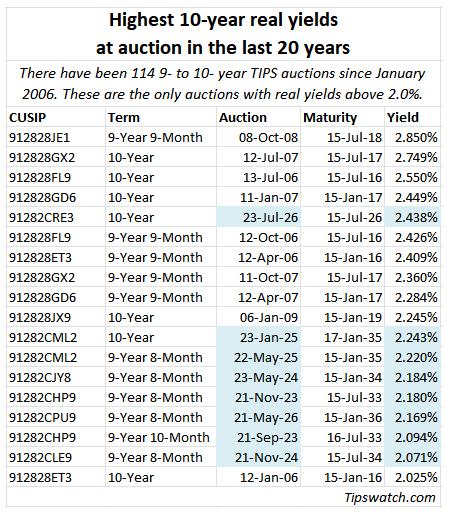
Note the time span in this chart, which includes only auctions before 2010 or after 2023. TIPS investors suffered through a 13-year period with much lower real yields, even as low as -1.145% as recently as five years ago. Of course, 10-year real yields could continue climbing higher, but getting anywhere near 2.5% is an investing opportunity, especially held to maturity.
Definition: The “real yield to maturity” of a TIPS is its yield above future U.S. inflation, over the term of the TIPS. So a real yield of 2.59% means an investment in this TIPS would provide a return that exceeds official U.S. inflation by 2.59% for 9 years, 10 months.
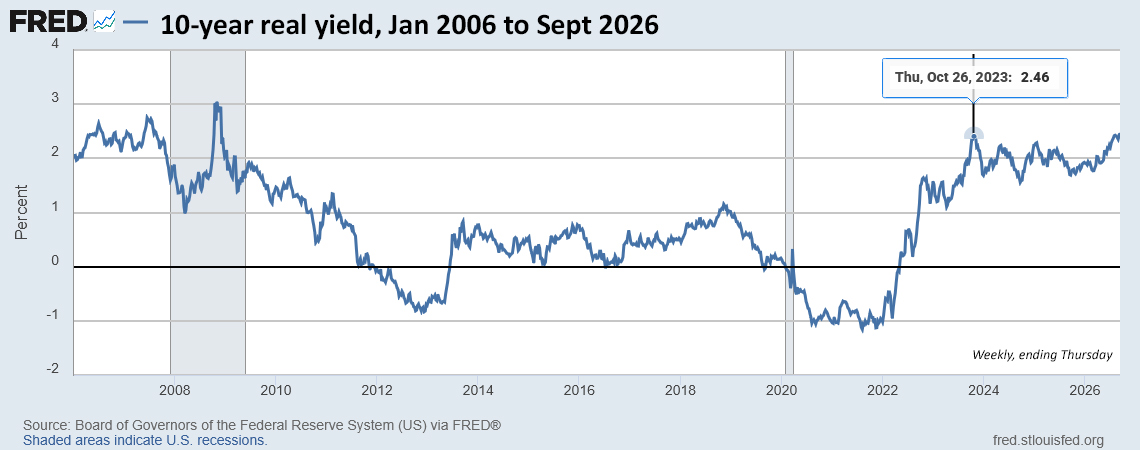
Here is the trend in the 10-year real yield over the last 20 years, showing that today’s 10-year real yield has now surpassed the recent highs set in fall 2023:
Pricing
CUSIP 91282CRE3 is going to auction at below par value. That is pretty much guaranteed because the current real yield of 2.59% is well above the coupon rate of 2.375%, plus the inflation index on the settlement date of September 30 will be 0.99985. It is slightly less than par because of very slightly negative (-0.01%) non-seasonally-adjusted inflation in July 2026.
CUSIP 91282CRE3 closed Friday with a price of 98.13. Let’s estimate the cost for a par value investment of $10,000 at this auction, assuming the real yield holds at 2.59% (it won’t, but this is an estimate):
- Par value: $10,000.
- Adjusted principal on settlement date: $10,000 x 0.99985 = $9,998.50.
- Cost of investment: $9,998.50 x 0.9813 = $9,811.53.
- + accrued interest of about $49.70.
Again, this is an estimate and market conditions will change by Thursday. In this example, the investor pays $9,811.53 for $9,998.50 in principal on the settlement date. From then on, the investor earns inflation accruals matching official inflation, plus an annual coupon of 2.375% paid on adjusted principal. The accrued interest will be returned at the first coupon payment in January.
Inflation breakeven rate
The 10-year Treasury note closed Friday with a nominal yield of 4.97%, which gives this TIPS a current inflation breakeven rate of 2.38%, in the range of recent auctions for this term. That number seems reasonable. Inflation over the last 10 years, ending in August, has averaged 3.4%.
We have to wonder, though, when that 10-year note’s nominal yield starts to look too tempting to ignore. At 5%, we are getting pretty close. But I would still prefer the TIPS for the added benefit of inflation protection.
Here is the trend in the 10-year inflation breakeven rate over the last 20 years:
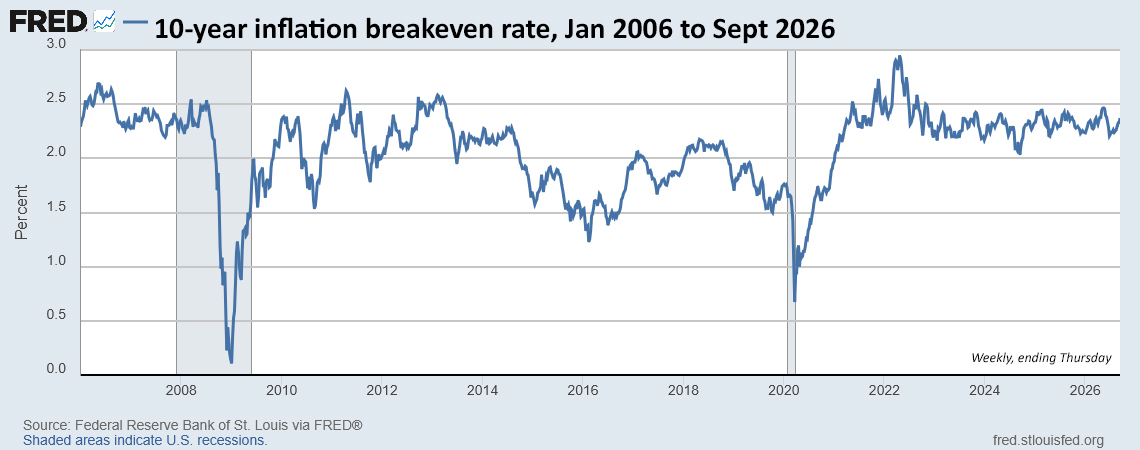
Since late 2022, we have seen a remarkably stable pattern of 10-year inflation expectations, ranging from about 2.2% to 2.5%. As I always point out, inflation breakevens are just a measure of sentiment and are a lousy predictor of future inflation.
Thoughts
This will be an attractive auction. Keep in mind, though, that CUSIP 91282CRE3 trades on the secondary market and can be purchased at any time you see a real yield you like. The advantage of buying at auction is that even small-lot purchases will get the auction’s high yield. The advantage of the secondary market is that you can see exactly the price and real yield you will be receiving. The negative is that you may face a small bid-ask spread.
At this point, I am not bothering to recommend buying at TreasuryDirect, at least until we get through this ID.me verification mess. Remember that savings bonds are the only securities you can redeem at TreasuryDirect. Everything else needs to be transferred out to be sold, which can take months.
Thursday’s auction is likely to generate a real yield around 2.5%, which we haven’t seen at auction for this term since October 2008, in the heart of a major financial crisis. Real yields could continue rising, of course, but this is an attractive milestone for a hold-to-maturity investor.
This TIPS auction closes Thursday at 1 p.m. ET. Non-competitive bids at TreasuryDirect must be placed by noon Thursday. If you are putting an order in through a brokerage, make sure to place your order Wednesday or very early Thursday, because brokers cut off auction orders before the noon deadline.
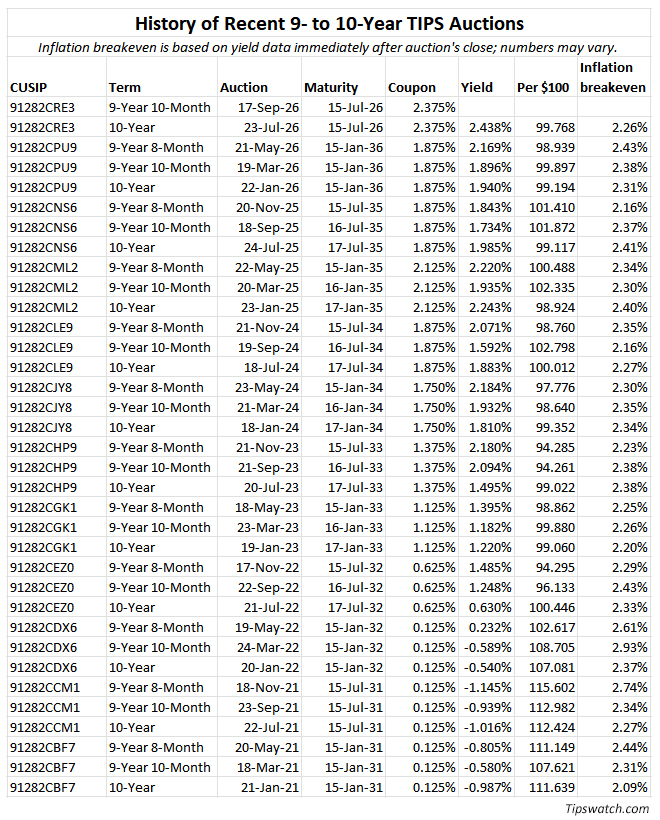
I will be posting the auction results soon after the close on Thursday. Here is a history of auction results for this term over the last 5 years:
• Now is an ideal time to build a TIPS ladder
• Confused by TIPS? Read my Q&A on TIPS
• TIPS in depth: Understand the language
• TIPS on the secondary market: Things to consider
• TIPS investor: Don’t over-think the threat of deflation
• Upcoming schedule of TIPS auctions
—————————

Donate? This site is free and I hope to keep it that way. Some readers have suggested having a way to contribute. I welcome donations, any amount. And FYI, ads on this site pay for about one visit to Costco.
—————————
Follow Tipswatch on X for updates on daily Treasury auctions and real yield trends (when I am not traveling).
Feel free to post comments or questions below. If it is your first-ever comment, it will have to wait for moderation. After that, your comments will automatically appear. Please stay on topic and avoid political tirades. NOTE: Comment threads can only be three responses deep. If you see that you cannot respond, create a new comment and reference the topic.
David Enna is a financial journalist, not a financial adviser. He is not selling or profiting from any investment discussed. I Bonds and TIPS are not “get rich” investments; they are best used for capital preservation and inflation protection. They can be purchased through the Treasury or other providers without fees, commissions or carrying charges. Please do your own research before investing.


Does tomorrow’s TIPS auction still look favorable with today’s interest rate hike?
You bet. As of about an hour ago the real yield on the 10 year TIPs is 2.68% (per the Treasury’s Daily Prices page.)
As a plus – the real yield on the 30 year TIPs is 3.09% (!!!).
AI just ran the calculation for me, if the real yield stays around 2.68%: the price should be around $975 per $1000.
Yes, I’d say it still looks attractive. Yield was up a bit this week.
Pingback: TIPS vs Treasuries at 5%: The Breakeven Is 2.36% - Wealth Engine
Ever wonder how TIPS perform compared to ordinary treasuries? Ordinary treasuries theoretically consist of a real yield demanded by investors plus expected inflation. TIPS coupon rates reflect only the real yield. The difference between the two yield is called the “breakeven” inflation rate, IOW expected inflation.
Treasury coupon rate (less) TIPS coupon rate (=) Breakeven Inflation
Today’s numbers for 5 year Treasury and TIPS: 4.8%-2.3% =2.5%
Today inflation implicitly expected by Treasury investors is about 2.5%. Annual inflation for the past two years has averaged 3.15%. Investors’ expectations (breakeven inflation) have consistently underestimated actual inflation over the past six years. Since TIPS buyers capture actual inflation, they have been realizing higher returns as a result:
With oil prices skyrocketing, it is amazing that investors supposedly expect an average of only 2.5% over the next 5 years, particularly since it has rarely been that low over the past 6 years. What’s even more amazing is that economists often treat “breakeven” inflation as a good way to forecast inflation!
I track the performance of TIPS vs. nominal Treasurys on this page: TIPS vs. Nominals . Over the last five years TIPS have out-performed by a large margin. Why? Because investors in nominal Treasurys underestimated the risk of unexpectedly high inflation, which we certainly got.
Thanks, David. I added this comment because I thought a graphical representation would dramatize the disparity between returns on TIPS and ordinary Treasuries. Interestingly, I could not find a similar image comparing them on the internet.
(I also find it very annoying when economists presume to tell us that breakeven inflation has forecasting value.)
Got into TD without issue today using my existing ID.Me account. No additional data required, No issues.
Hi,
I’ve got a ladder question that hopefully someone who’s smarter than I am can answer. As noted in the column, this week’s 10 year TIPS auction (maturing 7/15/36) looks to be strong. If I have a hole in my ladder for 2037 because there’s nothing maturing in 2037, does it make sense to load up on this week’s auction instead of waiting until 2027 to buy 10 year TIPS? Is there a rational reason to go one way or another?
Thanks!
A lot of investors use this technique, either buying extra in 2036 or 2040, which are the two ends ends of the TIPS gap. In my case, I have investments set aside to purchase my target amount in January 2027, and I hope to do that again in 2028 and 2029, using the 10-year TIPS offerings in January of each year. In my case, I am trying to get close to RMD requirements in each year.
I forgot to mention a strange sort of glitch or change I did notice on TD after logging in with Id.me. I had updated my address on my TD accounts recently, like a month ago and since then checked that it was correctly displayed. But after linking to ID.me it was back to an old address. I went out of TD and logged in separately to my Id.me account and found it had an old address and updated that. Then when I went back to TD it had the updated address which is now apparently linked to the address I have in my “wallet” on Id.me. So you have to make any address change on your Id.me account for it to show on your TD account FYI. And on ID.me it isn’t in anything labelled contact info it is actually in a page labelled wallet.
Thought I’d add that I have both personal and trust accounts at TD and when I clicked the link on TD to use the new “secure login,” it let me login with my id.me account and then took me to a page that showed both my personal and trust account where I could just click to choose which one I wanted to login into. So there was no issue “linking” them or anything like I had feared there would be. Now, every time I login I am shown both accounts and pick the one I want.
And why are we using ID.Me for TD???
White House mandates agencies use Login.gov for public-facing websites – Nextgov/FCW
I’m wondering if that white house mandate is the reason why Treasury Direct so abruptly and out of nowhere is pushing id.me. For whatever reason, TD wants to use id.me, not login.gov, and wants to have its website only allowing id.me before the WH directive takes effect. Perhaps Treasury will try to argue “id.me is already in place and working, so we’ll skip login.gov
So unimpressed with Treasury Direct. Not only do they take a year or more to release money when a person dies, now they’re requiring account holders to share highly sensitive personal info. with a questionable corporate entity. Maybe someone at TD has an interested reason to send the business to id.me
I suspect they are going to be putting behind-the-scenes programmers through hell, first changing to id.me and then changing to login.gov. I very much doubt the people who have to implement these changes are in favor of having to go through all this hoohah twice.
I already posted on the ID.me thread but wanted to also reiterate my experience here. Connecting TD with ID.me was simple and straightforward. The whole process took a couple of minutes (most of that time was spent taking screenshots.) My experience with creating an ID.me account a couple of years ago was also pretty straightforward: fill out the form, take a photo of your ID, take a selfie, done.
As for ID.me versus Login.gov, I suspect both are significantly more secure than the old TD login system. I picked ID.me at the time (good choice in retrospect) because it worked with the most agencies: Social Security, IRS, and now TD. The IRS, like TD, does not offer Login.gov. I have no way of knowing which of the two services will do a better job of safeguarding my personal information, but the reality is that no system is completely immune to breaches. Security often depends on the weakest link. All it could take is for one employee (government or private) to click on a phishing email.
Same experience. Super smooth. Took me to ID.me where I logged in, then right back to TD.
Two things:
First, the mention here that “…savings bonds are the only securities you can redeem at TreasuryDirect. Everything else needs to be transferred out to be sold, which can take months.” My understanding here is that “redeem” in this context refers to selling investments that have not fully matured; is that what was intended?
Second, I would appreciate a brief discussion of selling TIPS before maturity. While this auction is for a 10-year issue, my investment horizon might turn out to be less. If I were to purchase at this auction from a tax-deferred brokerage account, it would seem that if I wanted to cash out before maturity there would be some risk of having to sell at a loss or a reduced gain.
However, I’m not clear on how that scenario might come to pass, nor am I clear on the likelihood.
Yes, I “redeem” is the term used for selling savings bonds. I get scolded when I say “sell” for savings bonds. It just means cash them in. My philosophy on TIPS investing is buying with the intention to hold to maturity. A lot of people disagree. Yes, selling a TIPS before maturity could mean you would take a capital loss, but you could also get a capital gain. TIPS are a bit safer these days as a trading investment since the real yields are are 15+ year highs. I have never sold a TIPS before maturity.
Very helpful, thanks!
I was able to setup an id.me account. I wouldnt say easy smooth process for me. Most of the difficulties arise because I started the process on my computer and the verification process requires phone use as well. Mainly, what must be functional is a browser that doesnt have any problem with cookies, camera and microphone access. They ask for email and if the email you provide is found acceptable, your password int he alphanumeric and upper/lower case letters format they require, then drivers license, they ask for camera access to take picture of front and back, social security number you just have to enter it in, and they take a biometric selfie with phone camera and this is done through links they send and opens in browser, so browser access to camera must be working, then finally if the credit report checking process fails becos maybe an old phone number or you cant get past that, after you retry several times (yes, it allows you to restart the process and retry but it fails in same place again), finally a have a video call option is available after many attempts. Here too, microphone camera access is crucial to complete process. They ask for 2 forms of identification (camera takes the pictures) and you need to show in video call as well. After the call, you simply login to treasury direct using the secure login button option and you will be asked to agree to treasurydirect receiving all the info and you have to agree to have online access, they automatically pull up all your accounts linked to your social security number and you are all set.
I would say for me, most of the challenges were related to technical issues (browser cookies, camera, microphone access) and few due to outdated info in credit file. But in a complex system that this is, some difficulty is to be expected. I am glad this is over now:-)
“At this point, I am not bothering to recommend buying at TreasuryDirect, at least until we get through this ID.me verification mess. Remember that savings bonds are the only securities you can redeem at TreasuryDirect. Everything else needs to be transferred out to be sold, which can take months”
“Everything else needs to be transferred out to be sold, which can take months”
Months? Try YEARS. When I needed to transfer out securities, the best estimate they would give me was 6 to 24 months.
Even without the ID.me verification, there is ZERO advantage to buying anything other than savings bonds at TreasuryDirect. Customer service is a nightmare, whereas you can immediately get someone to help you on the phone at your broker.
I wrote extensively about the massive problems I encountered at TD last year. It took the involvement of my Congressman’s office to cut the Gordian knot. With that help, the securities transfer took only one week.
I was able to access my Treasury Direct account today using my ID.me account. I was able to select between my personal and entity (e.g., revocable living trust) account upon login. Once I selected an account, I was able to log out, log in and select the other account without issue. FYI for folks curious about how that process works for entity and person accounts in the same SSN.
Thank you for sharing this. I have both types of accounts also and hopefully, will have as easy a time as you did accessing both.
FWIW, I was able at 5 PM eastern to access my Treasury Direct account using the ID.me login process. Some of the pages were slow to load, but otherwise process went fine. TD site asked me to give permission to share certain personal data from 3rd party provider (ID.me) to TD. Next, accounts linked to me at TD were shown and verification requested. There was a message to call TD if an account linked to me was not among those listed. The account list for me was accurate. The next page was the usual account home page when logging into TD the traditional way.
It worked for me also. I did not have to provide additional information because I had already provided to ID.me. My spouse provided additional info – photos of either driver’s license or passport and a pic/video selfie. Going between a phone and computer added a tech layer, but all worked. Info shared with TD is info they already had – name, SSN, DOB, address, email, and phone. My trust and individual accounts both showed. TD looks the same inside, but using ID.me doesn’t include the prior log-in steps with username, email code, and password.
~2.6% !!! I’m one of those people that has always limited TIPS to tax deferred accounts. That yield is making me reconsider. My go-to fixed income alternatives for after tax accounts has always been CDs. The best brokered non-callable 10-year CDs are at 4.75% right now. If you live in a state income tax location, comparing those 4.75% CDs to TIPS, you have to add a 5-12% boost on TIPS yield and inflation adjustment since there’s no state tax on TIPS. Considering that Thursday’s auction looks pretty good . . . even for after tax money.
I like brokered CDs too, but the rate on the 10 year treasury is nearly 5%, so on an after tax basis, that makes more sense in my situation at the moment than a brokered CD at 4.75%. ideally, would like to get at least 5.5% in a brokered CD when the similar term treasury is at 5%. an investor should get some compensation for choosing the less liquid and less tax advantaged (at least in my home state) brokered CD over the treasury.
Looking at this situation, we certainly are a long way from the years when the Fed was manipulating bond market pricing so aggressively that nominal Treasury securities were yielding less than the official rate of inflation, which is when I first became aware of the term “financial repression.”
Pity the fool who competed with Treasury to buy 30 year Tbonds at less than 1% return to maturity.
I took advantage of COVID era interest rates to sell my brokered CDs at Fidelity at yields below 1%, turning future interest payments into long-term capital gains
what is the price of a security if u cant get your money for a year from id&me and a lockout because u made a mistake on td website and now trying to transfer your securities when all the phones are busy……..GOOD LUCK