I Bond buying guide for 2024: Be patient

By David Enna, Tipswatch.com

Updated analysis … I Bond dilemma: Buy in April, in May, or not at all?

If you are a longer-term investor looking for ultimate safety and protection from inflation, you are going to want to buy U.S. Series I Savings Bonds in 2024, up to the $10,000 per person limit and possibly more.

That’s what I think. Not everyone agrees, such as this recent “Buy Side” article from the Wall Street Journal, which put forth the opposite opinion:

If you buy I bonds today, you could find yourself shackled to an investment with diminishing returns, says Aaron Brachman, a financial advisor in Washington: “I’ve never thought I bonds were a good place to park cash,” he says.  … While I bonds will still keep you a step ahead of inflation, it’s obvious why their buzz has faded.

It’s no surprise to me that a financial adviser would criticize I Bonds. (No commissions, no fees, and they aren’t sexy.) But to understand why I Bonds remain attractive, even though the composite rate may slip lower, you have to understand how these investments work.

The basics

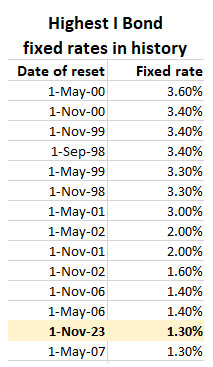
  • The fixed rate of an I Bond will never change. Purchases through April 30, 2024, will have a fixed rate of 1.3%, which means the return will exceed official U.S. inflation by 1.3% until the I Bond is redeemed or matures in 30 years. That fixed rate is the highest in 16 years.
  • The inflation-adjusted rate (often called the I Bond’s variable rate) changes each six months to reflect the running rate of inflation. That rate is currently set at 3.94%, annualized, for six months. It will adjust again on May 1, 2024, rolling into effect for all I Bonds, no matter when they were purchased.
  • The current composite rate is 5.27% annualized for six months for purchases through April 2024.

For a longer-term investor (holding 5 years or more) the fixed rate should be the focus, because it is permanent. Getting a fixed rate of 1.3% above inflation is highly attractive, historically, especially when you factor in the benefits of I Bonds.

I Bonds are an extremely safe and conservative investment. Interest accrues monthly and principal can never decline, even in times of deflation. Investments are limited to $10,000 per person per calendar year for electronic I Bonds held at TreasuryDirect. There is also the option to get $5,000 a year in paper I Bonds in lieu of a federal tax refund. There is also a “gift box” strategy some investors use to stack purchases for future years.

I Bonds are a unique investment with many positives. For example, earnings are free of state income taxes and federal taxes can be deferred until the I Bond is redeemed or matures. Also, I Bonds are a simple investment to buy and track, much simpler than a TIPS with a constantly changing market value and inflation accruals that update daily.

But I can earn more elsewhere!

Yes, you can, and that is why short-term investors with a time horizon of 18 months or less should look elsewhere. Redeeming an I Bond held less than 5 years will trigger a penalty of the last three months of interest. That’s an obstacle for short-term investors, with the 13-week T-bill currently yielding 5.47% versus the I Bond’s 5.27%. Even the 1 year T-bill at 4.84% is attractive because it matures after one year with no penalty.

Also, the current 5.27% composite rate is likely to fall lower at the May 1 reset because inflation has been trending lower. The new composite rate could be closer to 3.0% to 4.0%, or even lower. Is that a disaster? Not really, but it’s not great for a short-term investor.

The long-term investor, however, should focus on earning 1.3% above inflation until redemption or maturity in 30 years. That is very attractive for an investment with ultimate safety and ease of ownership. Do you think in the next decade we could again see a period with safe interest rates close to zero? If that happens, I Bonds paying 1.3% above inflation will be performing well.

The buying strategy: Wait.

At this point of market trends, I think we will see both the I Bond’s fixed rate and variable rate fall at the May 1 reset. Mark this date on your calendar: April 10, 2024. At 8:30 a.m. ET on that day, the BLS will issue its March inflation report, setting in stone the I Bond’s new variable rate.

Variable rate. So far, the trend is not looking good for even a moderate variable rate, but things can change in the next few months, as shown in this comparison of non-seasonally adjusted inflation for this rate-setting period in 2022-2023:

I don’t think it’s likely we will see inflation ramp up this year the way it did in early 2023, but after a low number in December, non-seasonally adjusted inflation should perk higher from January to March. However, the end result of six-month inflation could be as low as 1.0%, creating a composite rate of 3.3%. That’s just a guess.

My contention is that for a long-term investor, the variable rate isn’t a crucial factor. It creates a six-month composite rate for a 30-year investment. The fixed rate of 1.3% is crucial. It is permanent.

Fixed rate. The Treasury tracks trends in real yields (specifically yields on Treasury Inflation-Protected Securities) to help determine each reset of the I Bond’s fixed rate. Real yields are down dramatically from the November 1 reset, with the 10-year real yield falling from 2.46% on Oct. 31 to 1.83% at Friday’s close, a drop of 63 basis points.

So, at this point, it doesn’t look likely that the I Bond’s fixed rate will rise on May 1. If 10-year real yields managed to hold around 1.8% through April, the fixed rate would probably fall to about 1.2%, still attractive. But the Treasury market is highly volatile right now. Nothing is certain as the market awaits actions by the Federal Reserve. It’s possible real yields could fall another 50 basis points by the end of April. Or rise? Who knows.

What this all means

I think it is highly likely that the best decision will be to buy your full allocation of I Bonds before the end of April, to lock in both the 1.3% fixed rate and 5.27% composite rate for a full six months. But there is no reason to rush that decision. An I Bond purchased in April gets exactly the same return as one purchased in January.

So there is time. Here’s what we will want to watch:

  • Are real yields declining? In April, if you see 5- and 10-year TIPS yields falling to 1.5% or lower, you would definitely want to lock in the 1.3% fixed rate by buying in April. In fact, might want to use the gift box strategy to buy more, if you have a trusted partner for that transaction. My opinion: The gift box should only be used to lock in a high fixed rate, like the 1.3% currently in effect.
  • Are real yields rising? Despite the Fed’s intention to begin cutting short-term interest rates this year, I’ve seen speculation from market “experts” that longer-term nominal rates could still rise, possibly to 6% on the 10-year Treasury note. Other experts, like bond king Jeffery Gundlach, see 3% as more likely. If 5- and 10-year real yields actually do rise by May to levels above 2.0%, it’s possible that we will see a higher fixed rate at the May 1 reset. I think that is unlikely, but by postponing your I Bond purchase to April you can get a better idea of what’s ahead.
  • Is inflation declining? Lower inflation will cut the I Bond’s variable and composite rates, but that should not be a huge factor in this long-term investment decision.

The rollover strategy

If you are holding I Bonds with 0.0% fixed rates, you are currently earning a composite rate of 3.94%. You could redeem some of those now, park the cash in a money market account paying close to 5%, and then in April use that cash to buy I Bonds with a 1.3% fixed rate.

I generally encourage people to continue holding I Bonds “until you need the cash.” It’s great to have these savings bonds growing tax-deferred with zero risk. But this strategy of rolling over 0.0% I Bonds for a 1.3% fixed rate makes sense.

You will owe federal income taxes on the interest earned, and if your withdrawal is more than $10,000 (because of earned interest) you’ll only be able to buy $10,000 in new I Bonds in April. And if you held the I Bond less than 5 years, you will get hit with the three-month interest penalty, either at 3.38% or 3.94% or a combination, depending on your month of purchase.

The rollover strategy especially makes sense for people who are retired and have no way to raise cash for an I Bond purchase without selling an asset or withdrawing IRA money, both creating tax hits.

Reminder: When you redeem an I Bond, you earn zero interest for the month of that transaction. So the best idea is to redeem early in the month, like Jan. 2 or Feb. 2.

The TIPS alternative

For a savvy investor able to handle the complexity of investments in Treasury Inflation-Protected Securities, TIPS at this point are a “superior” investment to I Bonds because real yields are about 50 basis points higher. Plus, there is no purchase cap on TIPS or penalty for selling out early.

But TIPS are subject to market forces, rising and falling in value by the hour. In my opinion, they work best when held to maturity in a structured ladder providing inflation-protected cash for future needs. I Bonds have a flexible maturity so they can be considered more of a “cash equivalent” savings account and work well side-by-side with TIPS. And I Bonds aren’t subject to any market-price swings.

For some investors, TIPS are the preferred choice. For others, it is I Bonds. Or for people like me, a combination.

Conclusion

A lot of shorter-term, yield-hungry investors won’t see the appeal of I Bonds in 2024. That’s fine; there are great short-term options available right now. But longer-term investors interested in building a sizable reserve of inflation-protected cash will want to buy I Bonds in 2024, up to the limit.

But there is no hurry. Just mark your calendars for that April 10 inflation report.

What are your thoughts? Post your ideas and strategies in the comments section below. If you will bypass I Bonds this year, what alternatives are you considering?

Confused by I Bonds? Read my Q&A on I Bonds

Let’s ‘try’ to clarify how an I Bond’s interest is calculated

Inflation and I Bonds: Track the variable rate changes

I Bonds: Here’s a simple way to track current value

I Bond Manifesto: How this investment can work as an emergency fund

* * *

Feel free to post comments or questions below. If it is your first-ever comment, it will have to wait for moderation. After that, your comments will automatically appear. Please stay on topic and avoid political tirades.

David Enna is a financial journalist, not a financial adviser. He is not selling or profiting from any investment discussed. I Bonds and TIPS are not “get rich” investments; they are best used for capital preservation and inflation protection. They can be purchased through the Treasury or other providers without fees, commissions or carrying charges. Please do your own research before investing.

Posted in Cash alternatives, Federal Reserve, I Bond, Inflation, Retirement, Treasury Bills, TreasuryDirect | 115 Comments

2023: A good year for fighting inflation

For investors seeking safety and inflation protection, volatility brought strong opportunities.

By David Enna, Tipswatch.com

All things considered (financially speaking, that is) 2023 was a pretty good year. Maybe even very good.

The U.S. inflation rate dropped from 6.4% in January to 3.1% in November. The S&P 500 index rose a sweet 23.9% before dividends, dishing out a total return of 26.2%. The total bond market had a total return of 5.7%, following a disastrous -13.1% in 2022.

And 2023 was also a good year for investors looking for safe returns in Treasurys, money market accounts and bank CDs. The 13-week T-bill started the year at 4.53% and ended it at 5.40%, offering a solid year of high yields.

A combination of moderately-high inflation and recent declines in real yields also created a decent year for funds invested in Treasury Inflation-Protected Securities. The broad-based TIP ETF had a total return of 3.81%, and the shorter-term-focused VTIP came in at 4.62%.

Good news. Also, I have something positive to share, but you have to read to the end of this article to find out what it is.

I Bonds make history

The U.S. Series I Savings Bond started the year with a fixed rate of 0.4% and a composite rate of 6.89%, annualized for six months. The variable rate at that time was 6.48%, the 3rd highest in the history of this investment. That’s a very attractive return, but things were about to get better.

On April 28, the Treasury announced that the I Bond’s fixed rate would rise to 0.9% for purchases from May through October. The composite rate fell from 6.89% to 4.3%, but with I Bonds, a higher fixed rate is always the more-attractive option since it stays with the investment for up to 30 years.

And then on Oct. 31, Treasury set the I Bond’s fixed rate at 1.3% for purchases from November 2023 to April 2024. The composite rate rose to 5.27%. While this wasn’t the highest I Bond fixed rate in history, it was the highest since November 2007, 16 years ago.

At the time, it looked like the I Bond’s fixed rate could continue rising in 2024 as the Federal Reserve continued raising short-term interest rates. But then, in November and December, the Fed made clear that the rate-hiking cycle is over and interest rates are likely to begin falling (gradually?) in 2024.

On Oct. 31, just before the last I Bond’s fixed rate reset, the 10-year TIPS had a real yield of 2.46%. Now that has fallen 74 basis points to 1.72%. If real yields were able to hold steady at this level, it’s possible that the I Bond’s fixed rate could fall to just 1.2% or so on May 1. But the next reset is likely to be lower than that.

This means that the 1.3% fixed rate on the I Bond could have marked a high point. It is a historically attractive rate and makes I Bonds an attractive investment through April. I will be writing an I Bond buying guide in early January, and will provide more thoughts then.

A volatile, but good, year for TIPS

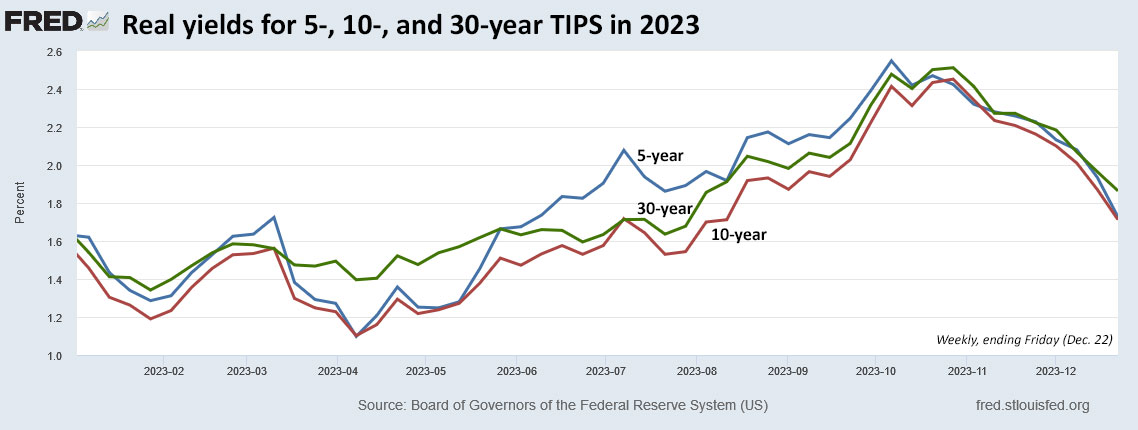
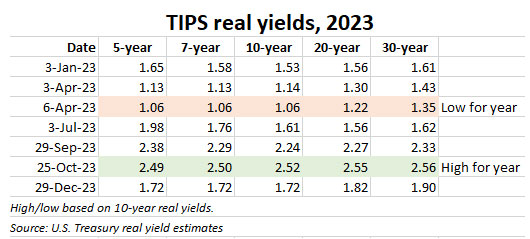
Real yields (meaning yields above U.S. inflation) had a rather wild ride in 2023, as shown in this chart:

Beginning in August, I tried to emphasis that we had entered a fantastic period for building a long-term TIPS ladder to provide inflation-protected cash well into retirement. I was fairly aggressively adding to my investments in late August and September, a bit before the October high but mostly hitting my target of real yields above 2.0%.

At this point, my TIPS ladder is complete, but I am still looking to buy the new 10-year TIPS at auction on Jan. 18, 2024. By doing that, I can fill the missing 2034 rung on my ladder.

Here is the year-long trend in real yields for TIPS, showing how yields dipped in the spring (especially for the mid- to long-term), rose dramatically and flattened out through October, and then tailed off to end the year at levels at bit higher than they began the year:

Click on image for larger version.

Let’s look back at the year in newly issued TIPS:

CUSIP 91282CGK1, 10-year TIPS

  • Originating auction on Jan. 19 with a real yield to maturity of 1.220% and a coupon rate of 1.25%.
  • Reopening on March 23, with a real yield of 1.182%, the lowest for this maturity at auction in 2024.
  • Reopening on May 18, with a real yield of 1.395%.

Throughout most of 2023 and even continuing today, the real yield of the 10-year TIPS has been the lowest — or near lowest — on the TIPS yield spectrum. Not sure why. The 5-year and 20-year yields have consistently been higher.

CUSIP 912810TP3, 30-year TIPS

  • Originating auction on Feb. 16 with a real yield to maturity of 1.550%, the highest auction yield for this term since June 2011. The coupon rate was set at 1.50%.
  • Reopening on Aug. 24 with a real yield of 1.970%.

A 30-year TIPS is a highly volatile investment. Even though the February auction got a historically high real yield, the market value of this TIPS plummeted in the months ahead as longer-term real yields soared.

As of today it is trading with a real yield of 1.90% and a price of about 91.09, a drop in value of about 7.8% since the originating auction. But things were much worse in late October when the 30-year yield hit 2.56%.

CUSIP 91282CGW5, 5-year TIPS

  • Originating auction on April 20 with a real yield to maturity of 1.320%, which at the time I called an “attractive result.” (Things would get much prettier later in the year.) The coupon rate was set at 1.250%.
  • Reopening auction on June 22 with a much higher real yield of 1.832%.

Real yields hit their 2024 low in April and then began climbing through October. The April auction, in hindsight, ended up being “just OK.”

CUSIP 91282CHP9, 10-year TIPS

  • Originating auction on July 20 with a real yield to maturity of 1.495% and a coupon rate of 1.375%. A bit disappointing at a time when real yields seemed to be trending higher.
  • Reopening auction on Sept. 21, with a real yield of 2.094%. Much better!
  • Reopening auction on Nov. 21 with a real yield of 2.180%.

By the fall reopenings, CUSIP 91282CHP9 ended up being one of the most attractive TIPS offerings of the year, but investors could have gotten higher yields by buying in the secondary market in October, when the 10-year real yield soared (briefly) to 2.52%.

CUSIP 91282CJH5, 5-year TIPS

  • Originating auction on Oct. 19 with a real yield to maturity of 2.440%, setting the coupon rate at 2.375%. This auction hit just as real yields were surging, so it ended up being a highly attractive investment, despite some confusion by investors.
  • Reopening auction on Dec. 21 with a real yield 1.710%, down a whopping 73 basis points from the originating auction two months earlier.

These two TIPS auctions demonstrate the dramatic effect of the “Fed pivot” in early December, which sent both nominal and real yields tumbling lower.

Final thoughts

I am happy about the financial events of 2023, which gave me the opportunity to stash away “emergency” cash in high-yielding T-bills and also to build out my TIPS ladder to 2043. Many of those investments had real yields at or above 2.0%, which didn’t seem possible just a few months ago.

For TIPS, this was the year of the secondary market, allowing purchases across the yield spectrum when prices looked attractive. Because real yields rose so high so quickly, it was a time for action, not sitting on the sidelines.

What is your reaction to the volatility of 2023 and the “unknown future” coming at us in 2024? Post your ideas in the comments section below.

Now, the good news …

I have been writing Tipswatch for nearly 13 years (hard to believe, huh?) and for much of that time my focus was more on posting articles on SeekingAlpha.com, where the pay was … er … “decent.” Then SA slashed its payments in November 2020 and I refocused on this website, with advertising supplying the income.

  • In 2020, Tipswatch.com got 75,008 page views.
  • In 2021, page views rose to 322,154.
  • In 2022, that number rose to 992,631.
  • In 2023, the number is 1,515,496 as of Dec. 29.

For me, surpassing 1 million page views was a personal goal for 2023, and I ended up breaking through that number by September! One of the great things about this site is the growing community of readers who participate in the comments section and offer tips, opinions and help. (This site received 2,769 comments this year.) Plus, you often quickly point out my errors. Thank you!

I have been lucky, I admit. It quickly became apparent in 2022 that U.S. inflation was surging to 40-year highs and then suddenly the I Bond was paying 7.12% and then 9.62%. Interest in inflation protection was HOT. In the last two years I have been I interviewed by the Wall Street Journal, Washington Post, Detroit Free Press, Marketwatch, CNBC, Barron’s, Money.com, ProPublica, NPR, Kiplinger’s, the AARP Bulletin and others.

Interest in inflation protection remains high, but not quite at the blazing pace of the past year. So maybe 2024 will be a bit more calm. Then again, I think I Bonds could have one more surge of interest before the May 1 reset. That will be fun.

Have a great holiday weekend, everyone!

* * *

Feel free to post comments or questions below. If it is your first-ever comment, it will have to wait for moderation. After that, your comments will automatically appear. Please stay on topic and avoid political tirades.

David Enna is a financial journalist, not a financial adviser. He is not selling or profiting from any investment discussed. I Bonds and TIPS are not “get rich” investments; they are best used for capital preservation and inflation protection. They can be purchased through the Treasury or other providers without fees, commissions or carrying charges. Please do your own research before investing.

Posted in Federal Reserve, I Bond, Inflation, Investing in TIPS, Savings Bond, Treasury Bills | 79 Comments

5-year TIPS reopening auction gets real yield of 1.710%, on target for investors

By David Enna, Tipswatch.com

There were no surprises in today’s Treasury reopening auction of $20 billion in CUSIP 91282CJH5, creating a 4-year, 10-month Treasury Inflation-Protected Security.

The real yield to maturity came in at 1.710%, which exactly matched the when-issued prediction used by bond traders. In the hours before this auction, this TIPS was trading on the secondary market with a real yield of 1.69%, so today’s investors got a 2-basis-point boost.

Definition: A TIPS is an investment that pays a coupon rate well below that of other Treasury investments of the same term. But with a TIPS, the principal balance adjusts each month (usually up, but sometimes down) to match the current U.S. inflation rate. So, the “real yield to maturity” of a TIPS indicates how much an investor will earn above inflation each year until maturity.

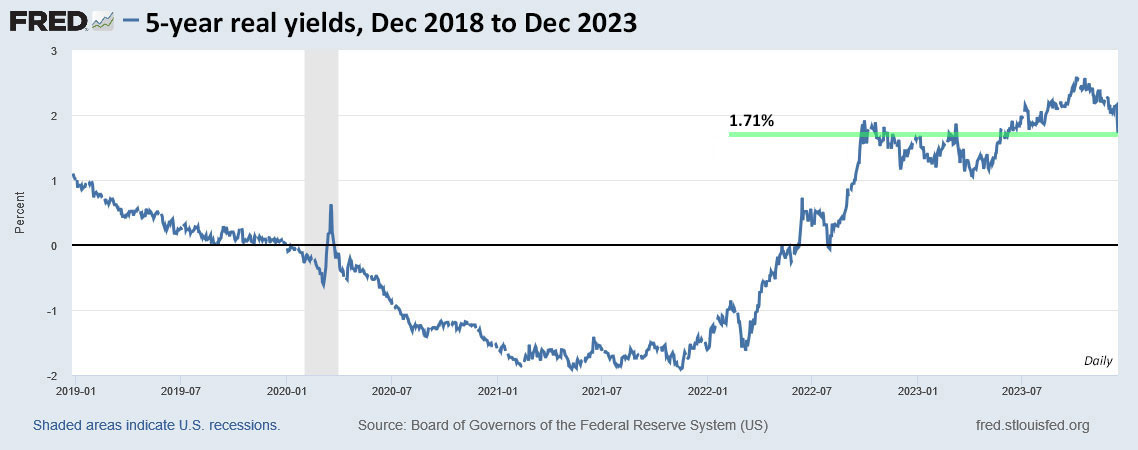
In its originating auction on Oct. 19, 2023, CUSIP 91282CJH5 got a real yield to maturity of 2.440% and its coupon rate was set at 2.375%, the highest for any 5-year TIPS since the very first TIPS auction of this term in history, which generated a coupon rate of 3.625% on July 9, 1997. Market conditions have changed dramatically in the last two months, as shown by the 1.710% real yield generated by today’s auction.

While 1.710% was well below the October auction’s real yield, it remains high by historical standards, as shown in this chart of real yields over the last 5 years:

Pricing

Because the auctioned real yield of 1.710% fell well below the coupon rate of 2.375%, investors had to pay a premium for this TIPS. This is how the Treasury reported the auction results:

The unadjusted price was 103.046880 and the inflation index will be 1.00453 on the settlement date of December 29. Let’s look at the cost of a investment of $10,000 par value for this TIPS at today’s auction:

  • Par value: $10,000
  • Coupon rate: 2.375%
  • Auctioned real yield: 1.710%
  • Adjusted principal: $10,000 par x 1.00453 = $10,045.30
  • Unadjusted price: 103.046880
  • Cost of investment: $10,045.30 x 1.03046880 = $10,351.37
  • Plus, accrued interest of about $48.88

In summary, an investor who purchased $10,000 par value paid $10,351.37 for $10,045.30 in principal and will now collect future inflation accruals and a coupon rate of 2.375% on the principal balance until maturity on Oct. 15, 2028.

Inflation breakeven rate

With the 5-year Treasury note trading with a nominal yield of 3.87% at the auction’s close, this TIPS gets an inflation breakeven rate of 2.16%, much lower than results for this maturity in recent auctions. The market is now pricing inflation through the next five years very close to the Federal Reserve target of 2%. Which raises the question: Is the market crazy?

Whatever happens over the next 4 years, 10 months, investors in CUSIP 91282CJH5 at today’s auction got a low-risk, appealing result, especially versus the 5-year nominal Treasury.

Reaction to the auction

It looks like the auction went off almost exactly as expected. The bid-to-cover ratio was 2.55, indicating decent demand. The TIP ETF, which holds the full range of maturities, barely budged after the auction’s close. Everything points to a ho-hum result.

I’ve noted in recent posts that we seem to entering a new era for Treasury yields, with somewhat lower yields likely over the next several months. At the least, yields should stabilize at current levels until the Federal Reserve reveals more exact information on its future moves.

This was the last TIPS auction of 2023. Later this month I will write a recap of the year in inflation protection, including I Bonds. The next TIPS auction will be Jan. 18, 2024, with the release of a new 10-year TIPS.

Here is the history of CUSIP 91282CJH5, which at its originating auction generated a real yield of 2.440%, the highest for this term in 15 years.

Confused by TIPS? Read my Q&A on TIPS

TIPS in depth: Understand the language

TIPS on the secondary market: Things to consider

Upcoming schedule of TIPS auctions

* * *

Feel free to post comments or questions below. If it is your first-ever comment, it will have to wait for moderation. After that, your comments will automatically appear. Please stay on topic and avoid political tirades.

David Enna is a financial journalist, not a financial adviser. He is not selling or profiting from any investment discussed. I Bonds and TIPS are not “get rich” investments; they are best used for capital preservation and inflation protection. They can be purchased through the Treasury or other providers without fees, commissions or carrying charges. Please do your own research before investing.

Advertisements

Posted in Investing in TIPS | Tagged , , , , | 29 Comments

Questions surround this week’s 5-year TIPS reopening auction

By David Enna, Tipswatch.com

The Treasury on Thursday will offer $20 billion in a reopened 5-year TIPS, CUSIP 91282CJH5, creating a 4-year, 10 month Treasury Inflation-Protected Security.

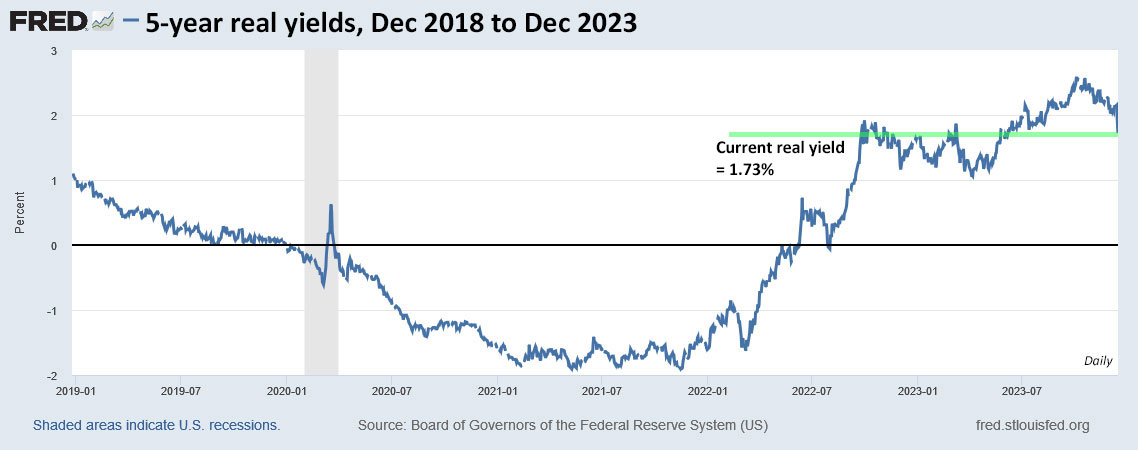
The TIPS to be reopened, CUSIP 91282CJH5, trades on the secondary market and could have been nabbed by investors just a month ago with a real yield to maturity of 2.37%. At Friday’s close, according to Bloomberg Yields Curve, that yield has now fallen to 1.73%. That’s a drop of 64 basis points in one month. Incredible.

And continued volatility is likely next week, right up to the auction’s close at 1 p.m. EST Thursday.

How attractive is this TIPS?

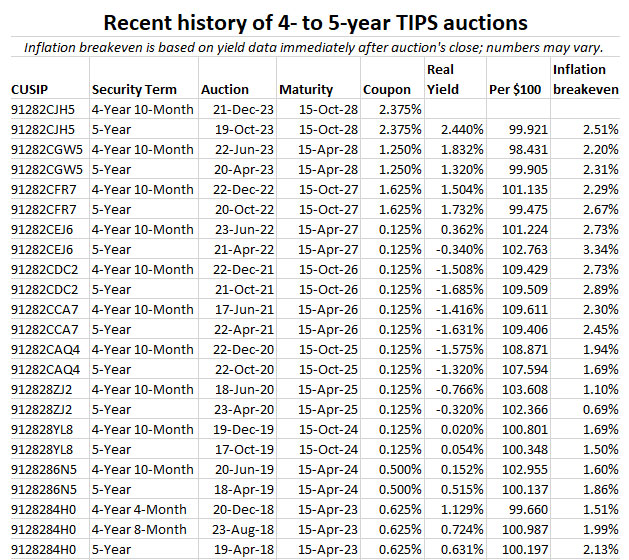
While a real yield of 1.73% seems suddenly disappointing, it is still attractive by historical standards. It could be the third or fourth highest yield for any auction of this term going back to October 2008, 48 auctions ago. Just look at the auction history for 5-year TIPS over the last year:

  • Dec. 22, 2022, reopening, real yield of 1.504%
  • April 20, 2023, new issue, real yield of 1.320%
  • June 22, 2023, reopening, real yield of 1.832%
  • Oct. 19, 2023, new issue, real yield of 2.440%

A real yield of 1.73% fits into this mix, but of course we’d all love to have bought heavily on Oct. 19 when the above-inflation yield hit 2.440%. (If you recall, this was actually a disappointing result for many investors. How times have changed!)

Here is the five-year trend in the 5-year real yield, showing that the current yield remains attractive by comparison to years of severely depressed rates:

Pricing for CUSIP 91282CJH5

If we assume that this TIPS will auction with a real yield of 1.73% (things will change, but let’s assume) then it will get a price of about 102.98, according to the Bloomberg data. Why so high? Because this TIPS has a coupon rate of 2.375% — set by that Oct. 19 auction — well above the current market real yield. It will also have an inflation index of 1.00453 on the settlement date of Dec. 29.

With that information, we can speculate on the pricing, using a purchase of $10,000 par as an example:

  • Par value: $10,000.
  • Adjusted principal on settlement date = $10,000 x 1.00453 = $10,045.30
  • Cost of investment = $10,045.30 x 1.0298 = $10,344.65
  • Plus, accrued interest, probably about $49.

So, in summary, an investor purchasing $10,000 par at Thursday’s auction will pay about $10,345 for $10,045 of principal and then receive inflation accruals and a coupon rate of 2.375% through the maturity date of Oct. 15, 2028.

This is a similar price to what you would pay on the secondary market, of course. On Saturday morning Vanguard was showing an ask price of 102.98 and a real yield of 1..73%, right in line with the Bloomberg data. But come Monday, things will change.

Inflation breakeven rate

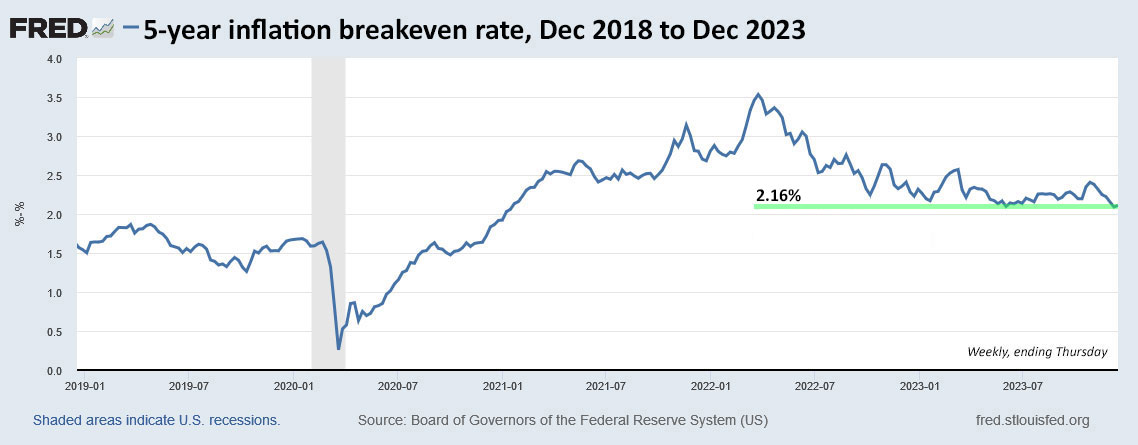
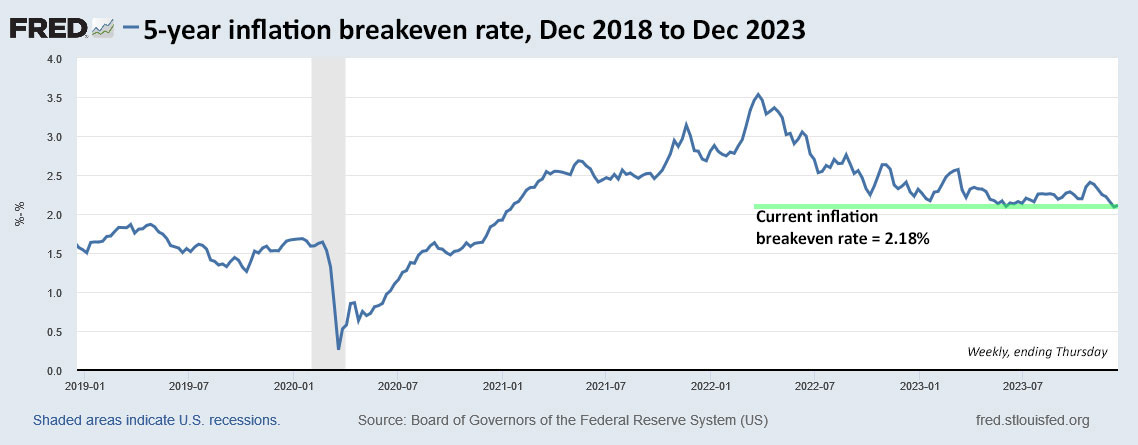
With a 5-year nominal Treasury yielding 3.91%, this TIPS currently has an inflation breakeven rate of 2.18%, well below recent auctions of this term. That is a plus for investors. It means this TIPS will outperform the nominal Treasury if inflation averages more than 2.18% over the next 4 years, 10 months. Over the last 5 years, inflation has averaged 4.0%.

Here is the trend in the 5-year inflation breakeven rate over the last five years:

Final thoughts

I won’t be a buyer because my TIPS ladder is fully loaded with 2028 maturities.

I know from feedback from readers that this particular TIPS won’t be attractive to many, either at auction or on the secondary market. Why? Because it will carry a premium price and additional principal. And a lot of investors don’t find that appealing. Does it really matter? Probably not. And sitting on the sidelines could just mean facing lower real yields in the near future. It’s a dilemma.

In the last two days, I have been tempted to say that the bond market is over-reacting to the Fed’s potential actions. The Fed, in theory, will cut short-term interest rates by 75 basis points next year. (The market thinks the cuts will be much more substantial.) The Fed is NOT launching quantitative easing and in fact will continue tightening through 2024 by reducing its balance sheet.

Future short-term rates shouldn’t have a great effect on current mid- to longer-term Treasurys. The 10-year TIPS yield has fallen 35 basis points in four days. Why? That is a real question for the markets to consider.

Plus, the Treasury next year will continue ramping up auction sizes. In fact, Thursday’s reopening auction is for $20 billion, the highest in history for an 5-year TIPS reopening. Consider this: As of this week, the U.S. public debt stood at $33.8 trillion. One year ago it was $31.3 trillion. That is an increase of 8%. How far can Treasury yields really fall?

So the Treasury market has a lot to work out. Meanwhile, I will be posting the auction results soon after the 1 p.m. ET close on Thursday. Here’s a history of recent auctions of this term:

Confused by TIPS? Read my Q&A on TIPS

TIPS in depth: Understand the language

TIPS on the secondary market: Things to consider

Upcoming schedule of TIPS auctions

* * *

Feel free to post comments or questions below. If it is your first-ever comment, it will have to wait for moderation. After that, your comments will automatically appear. Please stay on topic and avoid political tirades.

David Enna is a financial journalist, not a financial adviser. He is not selling or profiting from any investment discussed. I Bonds and TIPS are not “get rich” investments; they are best used for capital preservation and inflation protection. They can be purchased through the Treasury or other providers without fees, commissions or carrying charges. Please do your own research before investing.

Posted in Federal Reserve, Inflation, Investing in TIPS | 23 Comments

Federal Reserve launches a ‘sea change’ of uncertainty

By David Enna, Tipswatch.com

We’ve entered a new era. That’s what Bloomberg’s ever-thoughtful Tom Keene repeated over and over in Wednesday’s coverage of the Federal Reserve’s interest rate forecasts. “This is a sea change,” he said. “I have to emphasize how important this is.”

What exactly did the Fed do? It held the federal funds rate at the current level (target range of 5.25% – 5.50%) and signaled strongly that it is likely to cut short-term interest rates three times in 2024, beginning as early as March. This wasn’t unexpected, but the Fed was unusually firm in declaring that we’ve entered a new dovish era of interest rates, after nearly two years of unprecedented increases.

The Fed projections settled on 75-basis-points of rate cuts in 2024, but the stock and bond markets clearly anticipate something larger. Both markets soared Wednesday and into Thursday, with the Dow average hitting an all-time high and bond yields falling dramatically.

Significantly, however, the FOMC also reiterated its intention to continue lowering its massive balance sheet of U.S. Treasurys. It said:

In addition, the Committee will continue reducing its holdings of Treasury securities and agency debt and agency mortgage-backed securities, as described in its previously announced plans. The Committee is strongly committed to returning inflation to its 2 percent objective.

This is an important tidbit of news, because it means that while the Fed will be easing on the short-end of the yield curve, it will continue tightening on the longer end by allowing Treasurys to mature and roll off the balance sheet. That is quantitative tightening, and it should support longer-term yields.

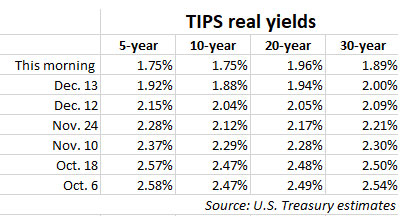
As a result, you should see a widening of the yield curve, with yields on shorter maturities falling, but rising or holding stable for longer maturities (or at least not falling as far). This was immediately evident in the way the Fed action rocked Treasury real yields:

I created this chart at about 9:10 am ET and 15 minutes later the 5-year real yield had fallen to 1.74% and the 10-year to 1.72%. There’s no way to say exactly how far this could go. But it is significant because the Treasury will be auctioning a reopened 5-year TIPS on Dec. 21 and then a new 10-year TIPS on Jan. 18, 2024. Both of those auctions could result in much lower real yields than we have seen in recent months.

The “sea change” nature of the Fed’s pronouncements can’t be underestimated. This morning, the U.S. dollar index is trading at 102.14, down about 2% since the Fed’s announcement at 2 p.m. Wednesday. A fall in the value of the dollar has an inflationary effect, especially on commodities. So it shouldn’t be a surprise that crude oil prices are up 3% this morning.

What this means for TIPS

I don’t think the Fed’s action is dire news, but it will mean lower real yields on near-future TIPS investments. We aren’t heading anywhere near the negative-real-yield fiascos of the recent past. And if the Fed continues lowering its balance sheet, the yield curve should steepen, making longer-term TIPS relatively more attractive.

The Fed must be fairly confident that inflation is indeed tamed, and it also must see some weakening in the U.S. economy. Both of those factors support lower interest rates. But if the Fed is wrong, inflation could surge again. That danger makes TIPS attractive, even if real yields decline.

One thing to celebrate: All the TIPS you currently hold rose in value yesterday as yields plummeted. The net asset value of the TIP ETF surged from $105.30 just after 1 p.m. Wednesday to $107.51 this morning, a gain of 2.1% in less than 24 hours. Of course, we are all buy-and-hold investors, right? Ignore the noise.

What this means for T-bills

Yesterday, the Treasury auctioned a 17-week T-bill that got an investment rate of 5.432%, up from 5.421% the week before. That could end up being the highest yield we will see at that term for quite awhile, but so far T-bill yields have been holding up relatively well.

The 3-month T-bill is yielding 5.36% this morning, down just 10 basis points from two days earlier. That indicates investors don’t see rate cuts happening within the next three months. Seems logical.

The 12-month T-bill is yielding 4.86%, down 27 basis points from two days ago. In this case, investors seem to be pricing in a partial year of rate cuts. Also “somewhat” logical.

And the 2-year Treasury note? It is yielding 4.37% this morning, down 34 basis points this morning. That seems attractive to me. But remember, the yield curve should grow steeper as the short-term yields fall. And also keep in mind that the market was already pricing in future rate cuts, ahead of the Fed announcement.

Final thoughts

Is inflation really tamed? That will be the key question. If you listened to Jerome Powell’s news conference, you didn’t hear that definitive statement and in fact he repeatedly stated that inflation remains a concern. But I think the Fed feels satisfied that it can gradually get to a “neutral” short term interest rate of about 3% without causing inflation to surge.

The Fed has been wrong before. But in this case I think it was time to begin very gradually easing short-term interest rates, while maintaining the commitment to lowering the Fed’s swollen balance sheet.

What are your thoughts? Do the lower real yields sidetrack your investment plans? Are short-term Treasurys and money-market funds starting to look less attractive? Will you make a move to stretch out duration? Post your ideas below.

* * *

Feel free to post comments or questions below. If it is your first-ever comment, it will have to wait for moderation. After that, your comments will automatically appear. Please stay on topic and avoid political tirades.

David Enna is a financial journalist, not a financial adviser. He is not selling or profiting from any investment discussed. I Bonds and TIPS are not “get rich” investments; they are best used for capital preservation and inflation protection. They can be purchased through the Treasury or other providers without fees, commissions or carrying charges. Please do your own research before investing.


Posted in Cash alternatives, Federal Reserve, Inflation, Investing in TIPS, Treasury Bills | 27 Comments