Medicare costs for 2024 are rising faster than U.S. inflation

Part B costs, deductibles and IRMAA surcharges will increase about 6% next year.

By David Enna, Tipswatch.com

Less than a month ago, U.S. retirees collecting Social Security learned their benefits will be increasing 3.2% beginning in January. That was the good news. The bad news is that costs for Medicare copayments and deductibles will be rising at a higher rate, about 6%.

Those costs were revealed in a little-noticed press release on Oct. 12 from the Centers for Medicare & Medicaid Services. It revealed the 2024 premiums, deductibles, and coinsurance amounts for Medicare Part A and Part B programs, and the 2024 income-related monthly adjustment amounts (IRMAA) for Parts B and D.

Any day now, if you are on Medicare, you will get a letter from CMS informing you of these new premium and deductible costs for 2024. If you planned poorly, you may be meeting up with IRMAA, and you really don’t want to meet IRMAA. These surcharges can be lofty, so it’s smart to plan ahead to limit these costs.

Let’s dive into the key Medicare changes for 2024.

Part A: Hospital insurance

Most people who reach age 65 go on Medicare Part A, even if they are still working. Medicare Part A covers inpatient hospital, skilled nursing facility and some home health care services. About 99% of Medicare beneficiaries do not have a Part A premium since they have at least 40 quarters of Medicare-covered employment.

Although coverage is generally free, Part A has some sizable deductibles and coinsurance costs, and those will be rising 2% in 2024:

Keep in mind that most people on Medicare have a Medigap or Medicare Advantage plan that will cover all or most of the Part A deductible and coinsurance amounts. For example, all standardized Medicare Supplement (Medigap) plans, A through N, provide coverage for Part A coinsurance, and most also cover all or most of the Part A deductible costs.

Part B: Medical insurance

Medicare Part B can be described as covering “outpatient services,” things like doctor visits, some lab tests, an annual wellness exam, diabetes screenings, etc. Medicare Part B generally pays 80% of approved costs of covered services, and you pay the other 20%. Some services, like flu shots, Covid vaccines and a wellness visit, may cost you nothing.

Part B costs are going up about 6% for 2024, much higher than the Social Security COLA increase of 3.2% or the current annual rate of U.S. inflation, at 3.7%.

Part B deductible. Before Medicare pays anything, you have to meet your Part B deductible each year. The annual deductible for all Medicare Part B beneficiaries will be $240 in 2024, an increase of $14 from the annual deductible of $226 in 2023. As of January 2020, Medigap plans sold to new enrollees were not allowed to cover the Part B deductible. But once the deductible is met, Medicare and Medigap plans will cover some or all of your Part B costs.

Part B premium. The standard monthly premium for Medicare Part B enrollees will be $174.70 for 2024, an increase of $9.80 from $164.90 in 2023. This Part B premium is paid by all people on original Medicare and is incorporated into Medicare Advantage pricing, which may or may not result in a baseline monthly cost.

So, for most people on original Medicare, Medicare Part B is going to cost $174.70 a month for the premium, plus the cost of the $240 deductible. That’s a total cost of $2,336.40 a year, up about 6% from this year’s costs.

CMS offered this rather cryptic explanation of the increased costs:

The increase in the 2024 Part B standard premium and deductible is mainly due to projected increases in health care spending and, to a lesser degree, the remedy for the 340B-acquired drug payment policy for the 2018-2022 period under the Hospital Outpatient Prospective Payment System.

Curious about the 340B-acquired drug payment policy? Read this.

The IRMAA ‘surprise’

Since 2007, a beneficiary’s Part B monthly premium is based on reported income, known as MAGI, or modified adjusted gross income. According to the Social Security Administration handbook, for Medicare’s purposes MAGI is adjusted gross income (line 11 of your 2022 federal income tax form) plus tax-exempt interest.

Note that I mentioned your 2022 income tax return. That’s the one you filed earlier this year and now, just a month ago, CMS announced the IRMAA surcharge brackets applied to that 2022 return. In other words, you could not know the surcharge levels until after the fact. And this is a rather brutal surcharge, because going just $1 over any limit can trigger thousands of dollars of one-year costs.

Here are the 2024 Part B total premiums and surcharges for high-income beneficiaries, which apply to income reported on your 2022 tax return:

Source: Centers for Medicare & Medicaid Services

I took a quick look at the brackets and surcharges for 2023 versus 2024, and found that the income brackets were adjusted higher by varying percentages, about 4.9% to 6.2% for each bracket. The IRMAA surcharges were also adjusted higher by 6.0%.

These income-related monthly adjustment amounts affect about 7% of people with Medicare Part B. And it’s important to note that people on Medicare Advantage plans continue to pay the Part B premium, and are also subject to the IRMAA surcharges.

Annual income of $206,000+ for a couple may sound like a lot, but the lower IRMAA levels can easily be reached through Roth conversions, stock sales to fund a major purchase, a new pension starting up, etc. Be aware of the potential to trigger the IRMAA surcharges and plan around that possibility.

Part D: Drug coverage

IRMAA surcharges also apply to Medicare’s Part D premiums for drug coverage. There is no “standard” Part D premium — the cost you pay depends on the Part D insurer and plan you choose. The IRMAA cost, if any, is added on top of your base premium. People in Medicare Advantage plans don’t pay a separate Part D premium, since those plans include Medicare Advantage Prescription Drug (MAPD) coverage. But Part D is built into Medicare Advantage, and the IRMAA surcharge still applies.

Here are the Part D IRMAA levels for 2024, based on reported income for 2022:

Wrapping things up

Here is the end result of these IRMAA surcharges for a married couple filing jointly:

Obviously, these surcharges add up to substantially higher costs for both single and married couples. A couple hitting the 3rd tier of the IRMAA surcharges would be paying more than $7,500 a year of extra costs for Medicare coverage. Hitting tier 5 sends the annual costs up more than $12,000.

And I repeat: When you filed your federal tax return in early 2023 you could not know what these IRMAA brackets or surcharges would be. They were just announced on Oct. 12. They are called the “2024 IRMAA levels” but apply to your 2022 tax return.

When you file your 2023 return next year, realize that you won’t know the relevant IRMAA levels until October or November 2024, many months after you have filed. Your only option is to use the 2024 numbers as a guideline. It’s a crazy system.

You can appeal an IRMAA ruling

The Social Security Administration has very specific rules that will allow you to get a waiver of the IRMAA surcharge, if you meet certain criteria for a “life-changing event,” which include:

  • Work stoppage
  • Work reduction
  • Employer settlement payment
  • Death of spouse
  • Divorce
  • Loss of pension income

You’ll need to fill out IRS Form SSA-44 to request the waiver.

A final thought …

One point to remember, in fairness: For people collecting Social Security, payments will increase 3.2% next year, or about $708 for an average recipient. Medicare costs for a single person will increase about $131 without IRMAA surcharges. So although Medicare costs are rising faster than the Social Security COLA, recipients will still come out ahead, if that’s any consolation.

* * *

Feel free to post comments or questions below. If it is your first-ever comment, it will have to wait for moderation. After that, your comments will automatically appear. Please stay on topic and avoid political tirades.

David Enna is a financial journalist, not a financial adviser. He is not selling or profiting from any investment discussed. I Bonds and TIPS are not “get rich” investments; they are best used for capital preservation and inflation protection. They can be purchased through the Treasury or other providers without fees, commissions or carrying charges. Please do your own research before investing.

Posted in Inflation, Medicare, Retirement, Social Security | 32 Comments

Random thoughts on I Bonds in 2023, 2024

I Bonds remain attractive, but when and why?

By David Enna, Tipswatch.com

The I Bond’s new fixed rate of 1.3% — the highest in 16+ years — and the resulting composite rate of 5.27% should be creating a lot of investor interest over the next six months.

But maybe not, since this is the first time in “seems like forever” that there are a lot of very strong competitors to I Bonds — nominal Treasurys, money-market accounts, bank CDS and most notably Treasury Inflation-Protected Securities, with real yields of 2.17%+ across the maturity spectrum.

Still, there are many good reasons to invest in 1.3%-fixed-rate I Bonds through April 2024, and some reasons not to. My article on the new fixed rate generated 72 comments and climbing. Lots of opinions. Let’s discuss.

1. Short-term investors should stay away.

I am defining a short-term investor as someone looking to redeem after 12 to 18 months. The short-term play became huge last year when the I Bond was paying 9.62% annualized for six months and then 6.48% for six months. Investors poured in, causing TreasuryDirect to crash in late October 2022. At the time, a 1-year T-bill was paying about 4.5%, a much lower yield.

Today, even though an I Bond has a much more attractive fixed rate — 1.3% versus 0.0% — and a decent composite rate of 5.27%, I Bonds aren’t competitive with other safe short-term investments. First of all, that 5.27% yield lasts for only six months (the other six months are uncertain) and anyone redeeming after 12 months will lose 3 months of interest. So the resulting annual return — after the penalty — could be something like 3.7% to 4.0%.

Check the best-in-nation competition (with no withdrawal penalties):

Short-term investors are looking for a good nominal return over the next 12 to 15 months. Inflation protection isn’t really a factor and so I Bonds aren’t the best investment for this purpose.

2. For long-term holders, I Bonds remain attractive.

The 1.3% fixed rate is something I Bond investors have been dreaming about for more than a decade, after accepting fixed rates of 0.2% or lower from May 2010 to November 2017. It’s true that TIPS have a higher real yield, but are also a more complex, market-shifting investment. I Bonds have many pluses for investors:

  • First, I Bonds are probably the most conservative and most safe of all investments. Your principal will never decline, ever. If inflation falls to below zero, the inflation-adjusted rate will fall to zero, but not below zero.
  • I Bonds protect you against unexpected inflation. If inflation in the next 30 years suddenly returns to 9%, your principal will increase by that amount because of the inflation-adjusted interest rate.
  • I Bonds offer superior deflation protection versus TIPS, since the I Bond’s composite rate can never fall below 0.0%. So I Bonds lose no value during a deflationary stretch — unlike TIPS — and then get the full benefit of inflation rising from deflation.
  • I Bonds have a flexible maturity. You can redeem them after one year, costing you three months of interest. Or redeem them after five years and pay no penalty, or just hold them for 30 years and cash out.
  • I Bonds work like a stealth traditional IRA, allowing you to defer federal income taxes until you redeem them, so you pay zero in taxes until they are sold. This is a big advantage over TIPS. In addition, I Bond interest is always free of state income taxes, which isn’t true for TIPS held in a traditional IRA.
  • I Bonds are simple to track as an investment. Use the web-based Savings Bond Calculator, update your information, and check it a couple times a year. Or use a site like EyeBonds.info to track current composite rates and principal balances.

So it is reasonable that a TIPS has a real yield advantage over an I Bond, given that its value shifts with market forces every day. I Bonds with a fixed rate of 1.3% are attractive.

3. Haven’t bought your full 2023 allocation yet? Do that by late December.

I am jealous. You are a patient and wise investor. The Treasury limits electronic I Bond purchases to $10,000 per person (or entity) per year, plus the possibility of $5,000 in paper I Bonds in lieu of a federal tax refund.

So, if you consider yourself an I Bond investor and you haven’t bought a full 2023 allocation, you should do that in late November (maybe Nov. 28) or late December (maybe Dec. 27). Never wait until the very last day of the month. Make sure to allow one — or better yet two — business days for TreasuryDirect to complete the purchase. You can schedule the exact purchase date inside the TreasuryDirect system.

It’s important to do this before the end of December because the $10,000 purchase limit for 2023 will switch to 2024 on January 1. If you make the purchase before the end of December, you can then make another full $10,000 purchase anytime in 2024.

4. DO NOT make gift-box purchases in 2023.

The Savings Bond Gift Box is a way of extending your purchases beyond the $10,000 limit by doing a swap with a trusted partner for delivery in a future year. Once you make the purchase, the I Bond begins earning interest just like any other I Bond. And you can make multiple sets of $10,000 purchases. But those I Bonds are no longer yours — they belong to the person getting the future gift.

Harry Sit of the TheFinanceBuff.com was the first to write about this strategy in December 2021, in an article titled “Buy I Bonds as a Gift: What Works and What Doesn’t.” When people ask me about the gift box, I point them to this article, which was well researched and thorough.

I have never used the gift-box strategy, because I thought it should be reserved for times when the I Bond’s permanent fixed rate is very high (not when the temporary variable rate is high).

So now is the time, with the fixed rate at 1.3? No, not exactly.

Anyone purchasing a traditional or gift-box I Bond through April 2024 is going to receive exactly the same return — a fixed rate of 1.3% and composite rate of 5.27% — for a full six months. So there is no reason to purchase this “extra allocation” in 2023, you can wait until after April 10, 2024, when the March 2024 inflation report is released. At that point you will know the I Bond’s new variable rate — to be reset May 1 — and have a better idea of the potential new fixed rate.

It makes no sense to rush a gift-box purchase. You have time.

5. Wait until at least April 2024 to purchase your 2024 allocation.

Again, no reason to rush this purchase. On April 10 you will know the I Bond’s next variable rate and we can speculate on the potential new fixed rate.

If real yields have risen dramatically by April, you might want to hold off on a purchase until after May 1 or even as late as mid-October, when we’ll know the variable rate to be reset on November 1.

If real yields have fallen dramatically by April, you’d want to purchase in late April to lock in that 1.3% fixed rate for the I Bond’s full term. And you also might want to consider gift-box purchases.

I won’t criticize people who buy I Bonds every January, no matter the fixed rate. That is a dedicated strategy. But for most people, waiting until at least mid-April will be the wisest move. And remember, in the meantime you can probably earn 5.0%+ on your cash.

6. Rolling over 0.0% I Bonds does make sense.

If you are holding I Bonds with 0.0% fixed rate — especially those held for five years or more — you can consider redeeming those older I Bonds for new ones with the 1.3% fixed rate. When you redeem, you will owe federal taxes on the interest earned.

If you are planning to redeem I Bonds held for less than five years, read this first: “The I Bond exit ramp is now open; proceed with caution“.

I think this is a sound strategy, especially if you don’t want to raise another $20,000 to buy I Bonds this year or next in two separate accounts.

7. I Bonds and TIPS are compatible investments

Anyone building a ladder of TIPS to provide reliable, inflation-protected money for retirement knows there is one sticky problem: There are no TIPS that mature in the years 2034 to 2039. I Bonds can be used to supplement your TIPS ladder, especially if you have a sizable allocation. I Bonds could fund your spending needs through those “gap” years.

Also, a ladder of maturing TIPS is a solid source of predictable future inflation-protected cash, but it won’t work well to meet “surprise” spending needs. Because of their flexible maturity and constant value, I Bonds are the best choice for your back-up emergency fund.

8. Don’t dump all your I Bond holdings

I have seen several comments from readers who plan to redeem almost all their I Bonds to purchase short-term Treasurys, which currently have a yield advantage. I am not a fan of this strategy. I Bonds held at least 5 years create an inflation-protected “savings account” that can be easily accessed, faces no reinvestment risk, and can never go down in value.

Why did you buy I Bonds in the first place? Probably for the inflation protection, safety and stability. I’d say all three of those factors — especially the inflation protection — are as important as ever right now.

My usual advice for years has been “don’t redeem I Bonds until you need the money.” That doesn’t mean holding to the 30-year maturity. It means using your I Bond holdings as a reserve cash account, to be used as needed.

So yes, I will probably redeem one set of 0.0% I Bonds to lock in the new 1.3% fixed rate in 2024, and possibly one more set for gift-box purchases. Otherwise, I will be holding all my stash of I Bonds.

Are you losing passion for I Bonds? Remember this: If we ever get to a period again of Federal Reserve intervention and ultra-low interest rates, an I Bond with a fixed rate of even 0.0% will continue to match inflation with zero chance of a loss.

Confused by I Bonds? Read my Q&A on I Bonds

Let’s ‘try’ to clarify how an I Bond’s interest is calculated

Inflation and I Bonds: Track the variable rate changes

I Bonds: Here’s a simple way to track current value

I Bond Manifesto: How this investment can work as an emergency fund

* * *

Feel free to post comments or questions below. If it is your first-ever comment, it will have to wait for moderation. After that, your comments will automatically appear. Please stay on topic and avoid political tirades.

David Enna is a financial journalist, not a financial adviser. He is not selling or profiting from any investment discussed. I Bonds and TIPS are not “get rich” investments; they are best used for capital preservation and inflation protection. They can be purchased through the Treasury or other providers without fees, commissions or carrying charges. Please do your own research before investing.

Posted in I Bond, Inflation, Investing in TIPS, Retirement, Savings Bond, Treasury Bills, TreasuryDirect | 51 Comments

I Bond’s fixed rate rises to 1.3%, highest in more than 16 years

Composite rate for I Bonds rises to 5.27%. Fixed rate for EE Bonds rises to 2.70%; doubling factor holds at 20 years.

By David Enna, Tipswatch.com

The Treasury announced today it is raising the permanent fixed rate on the U.S. Series I Savings Bond to 1.3%, the highest fixed rate since a reset in May 2007.

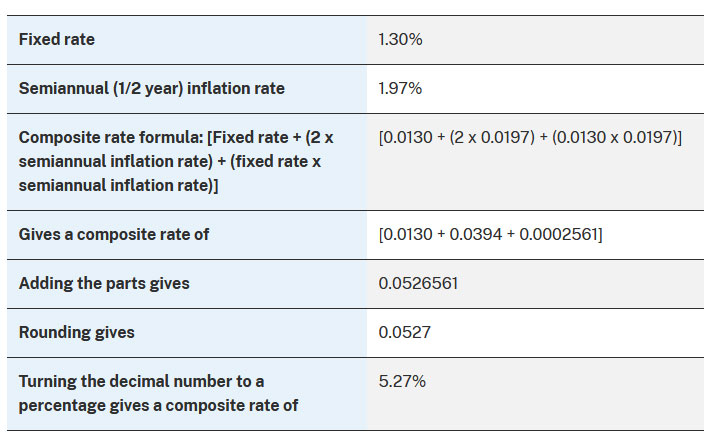
Combined with a six-month inflation-adjusted variable rate of 3.94%, I Bonds sold from November 2023 to April 2024 will get a composite rate of 5.27%, Treasury said.

The I Bond’s fixed rate is important for investors. It is permanent and stays with an I Bond until redemption or maturity in 30 years. This new fixed rate only applies to I Bonds purchased from November 2023 to April 2024.

The variable rate applies to all I Bonds, no matter when they were issued. It changes every six months and the starting date of the change depends on the month you bought the I Bond. This new 3.94% variable rate is based on non-seasonally adjusted inflation from April to September 2023.

Here is how the Treasury calculated the new composite rate:

Source: TreasuryDirect

Note that the new composite rate of 5.27% applies only to I Bonds purchased from November 2023 to April 2024. If you are holding an older I Bond with a fixed rate of 0.0%, your new composite rate will be 3.94% for six months. If you bought an I Bond from May to October 2023, it has a fixed rate of 0.9% and the new composite rate will be 4.86% for six months.

Reaction

I my most recent projection I estimated that the I Bond’s fixed rate would be set in a range of 1.1% to 1.4%, so a fixed rate of 1.3% fits into expectations. It is not spectacular, especially when a comparable investment — the 5-year Treasury Inflation Protected Security — has a real yield of 2.40%, an advantage of 110 basis points.

Not spectacular, but satisfactory and hits a 16-year high. I Bonds are a simple investment to track, earn tax-deferred interest, and can never lose a cent of accumulated value. An I Bond with a fixed rate of 1.3% remains attractive and a worthy investment.

But how worthy? I already bought my $10,000 I Bond allocation this year, back in April when the composite rate was impressive (6.89%) but the fixed rate was what we know see as mediocre (0.4%). That I Bond will soon transition to a composite rate of 4.35%. Oh well. I will still hold that one.

I am not sure a fixed rate of 1.3% is attractive enough to do a “gift-box swap” in 2023, but I will consider it. More likely I will simply wait until mid-April 2024 to decide if the 1.3% fixed rate remains highly attractive. There is no penalty for waiting to buy this 1.3% I Bond. You can purchase any time from November to April and get the same return.

From an article today on Money.com:

What’s notable about the new I bonds rate is not the overall 5.27% yield but the fixed rate. The fixed rate hasn’t exceeded 1% since before the Great Recession ….

As an example of how critical the fixed rate is, look no further than the folks who bought lots of I bonds when the rate was an eye-popping 9.62% last May. The Treasury Department says it sold billions worth in the first week alone; in the last week the rate was applicable, the website had so many visitors it crashed.

While the inflation-based rate was extremely high, the fixed rate was 0%. Without a fixed rate boosting the yield, those same I bonds purchased in 2022 are now earning only 3.94% (the inflation-portion only) — versus the 5.27% rate for I bonds purchased starting in November.

Then the next question: Is a six-month composite rate of 5.27% attractive enough for short-term investors in I Bonds, looking to redeem in 12 to 18 months? I’d guess most short-term investors (I am not in the category) will pass and look to invest in shorter-term T-bills, with the 1-year currently yielding 5.41% and no penalty for redemption after one year.

Conclusion. For longer-term investors, I’d say this new I Bond with a 1.3% fixed rate is a solid investment, considering the benefits of tax-deferral, deflation protection and exemption from state income taxes. We’ve had a long wait for a super-safe return this attractive.

Rolling over 0.0% fixed rates?

If you are holding I Bonds with 0.0% fixed rate — especially those held for five years or more — you can consider redeeming those older I Bonds for new ones with the 1.3% fixed rate. When you redeem, you will owe federal taxes on the interest earned.

If you are planning to redeem I Bonds held for less than five years, read this first: “The I Bond exit ramp is now open; proceed with caution“.

I think this is a sound strategy, especially if you don’t want to raise another $20,000 to buy I Bonds this year or next in two separate accounts.

EE Bonds

And now for the disappointing news: The Treasury raised the permanent fixed rate of EE Savings Bonds to 2.7%, up only 20 basis points from the past rate of 2.5%. It is retaining the policy that EE Bonds will double in value if held for 20 years, guaranteeing a compounded return of about 3.53%.

I’m baffled. Back in May 2023, when the EE’s fixed rate was set at 2.5%, a 10-year Treasury note was yielding 3.44%. The current yield is 4.88%, 144 basis points higher. Raising the EE’s fixed rate to 2.7% is a weak move, and guaranteeing a return of 3.53% for holding 20 years is also inadequate. You can invest in a 20-year Treasury bond and get a return of 5.21%.

The doubling period should have been shortened to 16 years, at least, which would guarantee a return of about 4.5% if held for 16 years. Even that falls short of attractive. EE Bonds can now be placed on a shelf to collect dust. They aren’t a meaningful investment in November 2023.

What’s your reaction?

Investors are going to be sorting through a lot of issues when considering this new I Bond with a fixed rate of 1.3%. Is it a better investment than a 5- or 10-year TIPS held to maturity? Or is it an acceptable tax-deferred alternative? Is the 1.3% fixed rate attractive enough to trigger gift-box purchases for future distribution? Will you invest in January 2024 or hold off until mid-April when the next variable rate will be set?

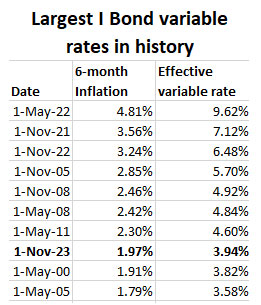
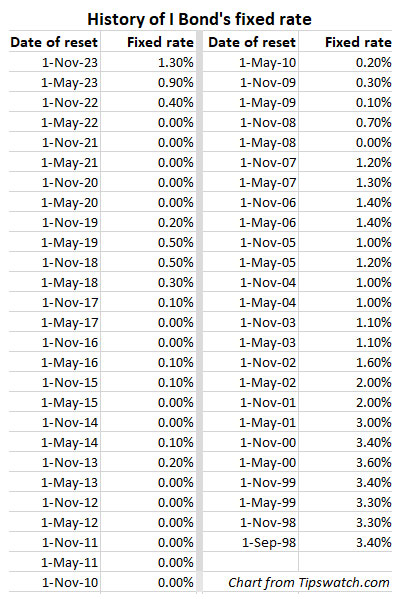
Lots of things to consider. Post your ideas in the comments section below. To close, here is the history of all fixed rates for I Bonds back to their inception in September 1998:

Confused by I Bonds? Read my Q&A on I Bonds

Let’s ‘try’ to clarify how an I Bond’s interest is calculated

Inflation and I Bonds: Track the variable rate changes

I Bonds: Here’s a simple way to track current value

I Bond Manifesto: How this investment can work as an emergency fund

* * *

Feel free to post comments or questions below. If it is your first-ever comment, it will have to wait for moderation. After that, your comments will automatically appear. Please stay on topic and avoid political tirades.

David Enna is a financial journalist, not a financial adviser. He is not selling or profiting from any investment discussed. I Bonds and TIPS are not “get rich” investments; they are best used for capital preservation and inflation protection. They can be purchased through the Treasury or other providers without fees, commissions or carrying charges. Please do your own research before investing.
Posted in Cash alternatives, EE Bonds, I Bond, Savings Bond, TreasuryDirect | 83 Comments

I Bond’s fixed rate: An updated projection

By David Enna, Tipswatch.com

Back on Oct. 8 I posted an article, “The I Bond’s fixed rate will rise. But by how much?” attempting to forecast the potential new fixed rate for the U.S. Series I Savings Bond, which will be reset by the Treasury on Nov. 1.

At the time, I noted one month of data remained — meaning through the end of October — and I warned that things change quickly in the financial markets. And of course, things did change, with the 10-year real yield initially falling from 2.47% on Oct. 6 to 2.29% a week later, before settling back to 2.44% at the market close on Oct. 26.

So here are my current projections, based on real yield data through October 26:

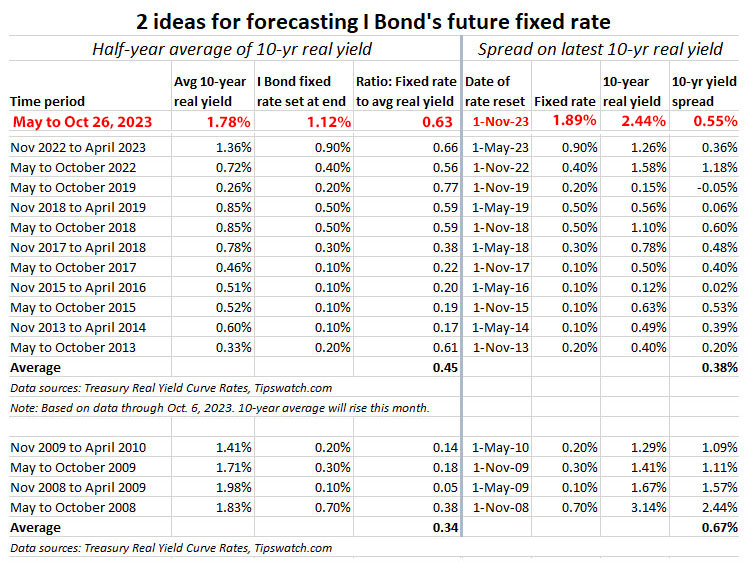
Half-year average: On the left is the projection using the half-year average 10-year real yield, which through Oct. 26 is 1.78%. This is the number I predicted in my earlier projection .

In the last five rate resets, the average ratio of fixed-rate to real yield has been 0.63. If you apply that to the 1.78% half-year average, you end up with a projection of 1.12% for the November 1 rate reset. Because the Treasury sets the fixed rate only to one decimal point, that could result in a fixed rate of 1.1% or 1.2%, above the current rate of 0.9%.

Latest 10-year real yield spread: The current real yield for a 10-year TIPS is 2.44%, much higher than the half-year average of 1.78%. This is because yields have surged nearly 50 basis points higher in the last two months.

In recent years, the typical spread between the fixed rate and the 10-year real yield has been in the range of 50 to 60 basis points. I used 55 basis points in this example. The result is a projection of 1.9% for the November 1 rate reset.

Conclusion

I believe the half-year real yield predictor (which is pointing toward a fixed rate of 1.1% to 1.2%) is a more reliable forecast. However, a fixed rate that low would be a massive 120+ basis points below the real yield of a 10-year TIPS, which would make I Bonds much less desirable in comparison.

So, if the Treasury sees this yawning gap, it should be willing to set the I Bond’s fixed rate a bit higher. Or not. Who knows?

I think right now we are heading toward a fixed rate in the range of 1.1% to 1.4%. That’s based partly on data, partly on “gut feeling.” Or possibly “wishful thinking”?

If the fixed rate ends up being 1.2%, the new composite rate will be 5.16%, below the nominal yield of a 1-year Treasury bill at 5.39%. This is a problem for short-term investors, which I addressed in my recent article, “Are U.S. Series I Savings Bonds losing their appeal?“.

What comes next

The last day you can buy an I Bond with a 0.9% fixed rate will be Monday, Oct. 30, because TreasuryDirect requires that purchases be made with one business day remaining to clear. Purchases on Tuesday, Oct. 31, are likely to be shifted to the new fixed rate (unknown) and new variable rate (3.94%).

So it is possible that the Treasury will announce the new fixed rate on the morning of Tuesday, Oct. 31. This early release is what it did at the May 1 reset and I think it is a good idea. Buyers should understand what they are purchasing.

By the way, standard practice for I Bond investors is to buy close to the end of the month because a purchase on any day of the month gets a full first month of interest. So there is no need to jump quickly into the new I Bond, no matter what the fixed rate is.

I Bonds: A not-so-simple buying guide for 2023

Confused by I Bonds? Read my Q&A on I Bonds

Let’s ‘try’ to clarify how an I Bond’s interest is calculated

Inflation and I Bonds: Track the variable rate changes

I Bonds: Here’s a simple way to track current value

I Bond Manifesto: How this investment can work as an emergency fund

* * *

Feel free to post comments or questions below. If it is your first-ever comment, it will have to wait for moderation. After that, your comments will automatically appear. Please stay on topic and avoid political tirades.

David Enna is a financial journalist, not a financial adviser. He is not selling or profiting from any investment discussed. I Bonds and TIPS are not “get rich” investments; they are best used for capital preservation and inflation protection. They can be purchased through the Treasury or other providers without fees, commissions or carrying charges. Please do your own research before investing.
Posted in Cash alternatives, I Bond, Inflation, Savings Bond, TreasuryDirect | 49 Comments

A quick update on Thursday’s 5-year TIPS auction

There is an explanation for everything, right?

By David Enna, Tipswatch.com

As they say, “You learn something every day.” At least you should learn something every day. Thursday’s TIPS auction result, which you can read about here, caused some angst among readers: Why did the real yield come in below the market?

I was especially curious when I saw that the “when-issued” real yield prediction used by bond traders was 2.42%, well below the Treasury’s yield prediction of 2.57% for a 5-year TIPS (that prediction dropped to 2.43% after the market closed yesterday.)

Unfortunately, I can’t see the when-issued prediction until the auction closes. But if it was 2.42%, that indicated bond traders knew the Treasury estimate was too high. The auction actually got fairly lukewarm demand, and the resulting real yield ended up at 2.44%, above the when-issued prediction.

So what happened, and what can we learn from this?

Thursday’s lesson was about relearning something: Seasonal variations in TIPS yields. I discussed this topic in a post on Sept. 10: “‘Inflation Guy’ explains seasonal adjustment (or lack thereof)“, where inflation expert Michael Ashton explained why there are seasonal variations in TIPS yields.

But I clearly did not realize how much these seasonal variations affect one particular auction a year: the new 5-year TIPS issued each October since 2019. Could seasonal variations be the reason bond traders saw a yield of 2.42% while the Treasury and secondary market seemed to pointing to 2.57%?

The answer seems to be yes.

Beth Stanton, an editor for U.S. interest rates at Bloomberg, posted an excellent explanation on Twitter yesterday (I refuse to call it X, by the way). Here is how the series of tweets began:

And this is her explanation that followed:

Auctions of new 5Y TIPS have been held twice a year — in April & October — since 2019. (The June and Dec 5Y TIPS auctions are reopenings of one or the other.) …

The October auction usually produces a yield *significantly lower* than the current market yield of the one from April, despite maturing 6 months later. Normally in bonds (tho not so much lately), a longer maturity warrants a *higher* yield. …

The 5Y TIPS being sold on Thursday is trading at a yield of around 2.42%. The one sold in April (auction yield 1.32%) now yields around 2.53%. That’s a big gap for 6 months, especially since the new issue is the biggest-ever TIPS auction at $22b. …

The question is, why would someone buy the new issue at a yield of 2.42% when the old one can be had at 2.53%? The main reason is what inflation people call seasonality premium. …

Interest on TIPS is paid on a principal amount that’s indexed to the CPI — with a lag. The final index values for TIPS that mature in Oct are determined by the Aug CPI. The final index values for TIPS that mature in April are determined by the Feb CPI. …

The CPI used to adjust TIPS is the not-seasonally-adjusted one. And inflation has had a strong seasonal pattern. The pattern fell apart in 2020, but prior to that, prices reliably rose more early in the year than late in the year (when discounting is rampant). …

The Oct 5Y gets inflation accruals for six months after the April one matures. The months are March-Aug, which historically have been “better” overall than Sept-Feb. That gives the Oct issue extra value that gets reflected in a lower yield (i.e. higher price) than the April one. …

Other factors contribute to the Oct 5Y TIPS yielding less than the April, such the inverted yield curve (longer maturities in general command lower yields than shorter ones) & a liquidity premium for the new issue. But inflation seasonality is the biggest piece. /END

Again, this is something I knew about, but I hadn’t associated these seasonal fluctuations directly with the auction of a new 5-year TIPS each October . It’s a hard trend to decipher because these October auctions only have a 5-year history, dating to October 2019.

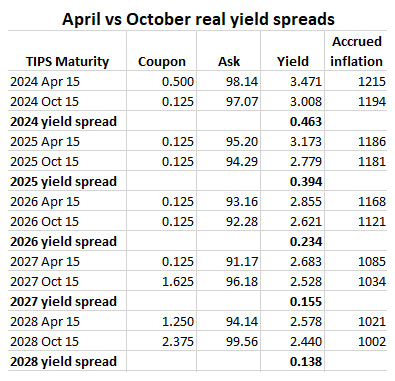
This chart proves Stanton’s point quite clearly:

The yield spreads get larger as the maturity date gets closer, because the effect of seasonality is strongest when fewer months remain. So, based on this analysis, a 14-basis-point yield spread looked predictable coming into Thursday’s auction. And it also indicates that investors at Thursday’s auction didn’t get “ripped off.”

Lesson learned. File this one away for future October auctions of 5-year TIPS.

* * *

Feel free to post comments or questions below. If it is your first-ever comment, it will have to wait for moderation. After that, your comments will automatically appear. Please stay on topic and avoid political tirades.

David Enna is a financial journalist, not a financial adviser. He is not selling or profiting from any investment discussed. I Bonds and TIPS are not “get rich” investments; they are best used for capital preservation and inflation protection. They can be purchased through the Treasury or other providers without fees, commissions or carrying charges. Please do your own research before investing.
Posted in Inflation, Investing in TIPS | 67 Comments