Question: Is inflation dead?

By David Enna, Tipswatch.com

After weeks of financial gloom and omens of disaster, we finally had a “Goldilocks” week in the U.S. financial markets. For example:

  • Debt-limit crisis? Solved.
  • Jobs report? Positive.
  • U.S. dollar? Stronger.
  • Oil prices? Still falling.
  • Stock market? Up 4% in a month.
  • Fed interest rate strategy? Temporary pause.
  • Inflation expectations? Falling.

All is good, right? But that last one — inflation expectations falling — has me wondering: Do we really think inflation is under control, just 11 months after the U.S. annual rate of inflation hit 9.1%? I am not so sure, but the financial markets continue to bet that inflation will fall to traditional levels … very soon.

Here is a look at inflation breakeven rates over the last 3 1/2 years, reflecting the difference in yield between a nominal Treasury and a Treasury Inflation-Protected Security of the same term:

One immediate takeaway from this chart is that the inflation breakeven rate is a lousy predictor of future inflation. It measures investor sentiment, and sentiment is often very wrong. Nowhere on this chart can you find inflation expectations signaling future inflation of 9%, 6%, or even 5%, numbers we saw every single month from May 2021 to March 2023.

Click on image for larger version.

This chart shows that inflation expectations did widen out in early 2022, catching a hint from the highest surge in U.S. inflation in 40 years. But only the 5-year breakeven ever touched a level above 3%. (Inflation over the last 5 years has averaged 3.9%. Over 10 years, 2.7%. Over 30 years, 2.5%)

I am amazed that the financial markets believe inflation will average less than 2.25% across the entire maturity spectrum of TIPS, from 5 to 30 years. That certainly could happen, but my gut says inflation will run higher, especially if we have entered a new era of global price pressures.

Instead, the markets seem to be pricing in sunny skies (surging stock market) and economic gloom (falling inflation expectations) at the same time.

This view is shared by inflation analyst Michael Ashton, who posted a commentary this week titled, “Is Inflation Dead … Again?” His focus is on inflation expectations through the end of the year:

But here is something that seems very weird to me. Prices of short-dated inflation swaps in the interbank market suggest that NSA headline inflation is going to rise less than 0.9% for the entire balance of 2023. … The market is pricing that between June’s CPI print and December’s CPI print the overall price level will rise 0.23%…less than ½% annualized! …

Headline inflation between June and December last year rose only 0.16%, leading to disappointing coupons on iBonds and producing proclamations that inflation was nearly beaten. Here’s the thing, though. The second half of 2022 it made perfect sense that headline inflation was mostly unchanged. Oil prices dropped from $120/bbl the first week of June, to $75 by mid-December. Nationwide, average unleaded gasoline prices dropped from $5 to $3.25 during that time period. …

A comparable percentage decline would mean that gasoline would need to drop to $2.32 from the current $3.58 average price at the pump. …

Naturally, it’s possible that inflation will suddenly flatline from here. I just don’t feel like that’s the ‘fair bet’.

The rest of 2023

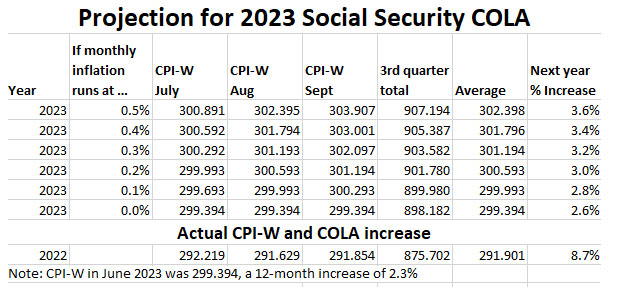
For I Bond investors and Social Security recipients awaiting new COLA numbers, inflation rates from July to December are likely to be disappointingly low. That is highly likely because non-seasonally adjusted inflation generally runs higher than the headline number from January to June, and then lower from July to December. This has been a consistent result over the last several years.

And I agree that the inflation picture is likely to look more rosy by the end of the year, especially for the all-items number, which includes food and energy. The Cleveland Fed is forecasting that the U.S. inflation rate will fall to 4.13% in the May report, coming June 13. That would be positive news, but I suspect it’s an optimistic forecast. It also sees core inflation falling to 5.3% from the current rate of 5.5%.

But inflation-watchers need to realize that these late 2023 numbers could be a head-fake, setting up a time of continued inflation above the Federal Reserve’s target of 2%. If the markets are right in seeing inflation running at 2.24% for the next 10 years, I’d have to agree that the worst of the inflationary danger has past. But we will have to wait and see. And that’s not a gamble I’m willing to take.

Next steps?

Even though short-term nominal interest rates are very attractive today on safe investments, I recommend sticking with some exposure to longer-term inflation protection. I was buying TIPS and I Bonds through a decade of lower-than-expected inflation, and finally in 2021 to 2023 that strategy paid off with much, much higher-than-expected inflation.

We might see U.S. inflation seem to wane in coming months, and it may or may not reflect a longer-term reality. I’m saying it is smart to hold on to some level of inflation insurance in your portfolio.

* * *

Feel free to post comments or questions below. If it is your first-ever comment, it will have to wait for moderation. After that, your comments will automatically appear. Please stay on topic and avoid political tirades.

David Enna is a financial journalist, not a financial adviser. He is not selling or profiting from any investment discussed. I Bonds and TIPS are not “get rich” investments; they are best used for capital preservation and inflation protection. They can be purchased through the Treasury or other providers without fees, commissions or carrying charges. Please do your own research before investing.

Posted in Federal Reserve, I Bond, Inflation, Investing in TIPS, Social Security | 29 Comments

Follow-up: I pulled the trigger on the February 2042 TIPS

By David Enna, Tipswatch.com

Last week I was doing quite a bit of research on Treasury Inflation-Protected Securities that mature from 2040 to 2045, years that “should be” near the end of my life expectancy. That resulted in an article I posted Thursday: “Looking to invest in longer-term TIPS? There’s a problem.”

Writing that article ended up being similar to volunteering at a cat & dog shelter. I found myself wanting to bring all the puppies and kitties home. Here are the six potential investment options, with prices and yields as of Wednesday afternoon:

As I noted in the article, I carry a bias — possibly overblown — against buying high inflation accruals at a premium price. So that ruled out the TIPS maturing in 2040 and 2041, both with high inflation indexes and higher-than-market coupon rates. Those two looked too pricey.

But the more I thought about it, the rest of the bunch (maturing in 2042 to 2045) looked fine, with attractive real yields and relatively high inflation accruals balanced off by below-market coupon rates. I especially liked CUSIP 912810QV3, maturing in February 2042, because it would fill a rung in my TIPS ladder between 2041 and 2043.

I hunted around Friday and noticed the real yield on CUSIP 912810QV3 had increased slightly, to 1.717% on a $10,000 purchase. So I pulled the trigger.

I know that these secondary market TIPS purchases can be confusing — balancing so many factors of cost and inflation accruals — so I’ve created a summary of that investment:

I bought $10,000 in par value of this TIPS, but because of the inflation factor of 1.33494 I was actually purchasing $13,349.40 of principal. The price was 84.57 for $100 of value, so the cost of the investment was $11,289.59.

In other words, I paid $11,289.59 for $13,349.40 of principal. The accrued interest of $27.70 will be repaid to me at the Aug. 15 coupon payment.

At this point, I have $13,349.40 earning annual interest of 0.750%. The principal total will continue climbing with inflation until maturity on Feb. 15, 2042.

With this investment, I am guaranteed to receive the $10,000 par value at maturity, even if we hit 19 years of deflation. That means $1,289.59 of my original investment is at risk if severe and extended deflation strikes. I am OK with that. The risk is extremely small. And the risk is counter-balanced by the 0.750% annual interest I will collect along the way.

What’s coming up

The June 22 reopening auction of CUSIP 91282CGW5 — creating a 4-year, 10-month TIPS — is starting to look interesting. That TIPS got a real yield of 1.32% at the originating auction on April 20, setting its coupon rate at 1.25%. As of Friday’s market close it was trading with real yield of 1.78%, up 46 basis points in just over a month.

Things can change before the June 22 auction, of course, but remember that this TIPS trades on the secondary market and could be purchased at any time along the way, if you see a real yield you find attractive. It’s inflation index is just 1.005 and the price is discounted at about 97.56.

Confused by TIPS? Read my Q&A on TIPS

TIPS in depth: Understand the language

TIPS on the secondary market: Things to consider

Upcoming schedule of TIPS auctions

* * *

Feel free to post comments or questions below. If it is your first-ever comment, it will have to wait for moderation. After that, your comments will automatically appear. Please stay on topic and avoid political tirades.

David Enna is a financial journalist, not a financial adviser. He is not selling or profiting from any investment discussed. I Bonds and TIPS are not “get rich” investments; they are best used for capital preservation and inflation protection. They can be purchased through the Treasury or other providers without fees, commissions or carrying charges. Please do your own research before investing.

Posted in Investing in TIPS | 25 Comments

Looking to invest in longer-term TIPS? There’s a problem.

By David Enna, Tipswatch.com

I recently got an email with a question from long-time site reader Jay, who included a meme to illustrate his point. Here it is:

A TIPS Conundrum:

Lately I’ve been struggling with what to do in my bond portfolio. Should I take advantage of current high real TIPS yields to lock in high returns with LT TIPS? However, doing so goes against my long held desire to avoid taking interest rate risk on long duration bonds, especially with rates jumping around. 

Which to do? Locking in high real TIPS yields for 10-20 years might be a unique opportunity. OTOH, buying LT bonds of any kind in a volatile market is very risky. 

I don’t know the answer, but I came up with this Meme to describe it.

My thoughts

I understand. I also have been looking to load up on longer-term Treasury Inflation-Protected Securities (with maturities beyond 10 years). I see the logic in locking in attractive real yields for a longer term. But that’s a difficult task for four reasons:

  1. I am nearing age 70 so my hold-to-maturity range is optimistically no more than 21 years, stretching out to potentially 2044.
  2. There is a yawning gap in TIPS available on the secondary market, with no TIPS maturing in the years 2034 to 2039.
  3. TIPS maturing in years 2040 and 2041 have a combination of a high coupon rate and a high inflation index, making them pricey investments versus par value.
  4. TIPS maturing in years 2042 to 2045 have lower coupon rates and therefore sell at a discount to par, but also have inflation factors of 28% or higher. These are more attractive, but still pricey versus par value.

Why the gap?

20-year TIPS. From July 2004 to January 2009, the Treasury issued 20-year TIPS, resulting in just five securities of that term. Then Treasury discontinued the 20-year TIPS and it has never returned. That means there are no 20-year TIPS maturing beyond the year 2029.

30-year TIPS. The Treasury offered 30-year TIPS from 1998 to 2001, and then discontinued this maturity until it was restarted in 2010. So that means there are no 30-year TIPS maturing from April 2032 to February 2040.

So we have a gap, with no TIPS available to purchase with maturities from 2034 to 2039. In a real-life portfolio, what does this mean? Here is my TIPS ladder, updated through May 2023, with all par values set to $1,000 to present as an example:

This chart shows the coupon rate, not the actual real yield to maturity at the time of investment.

The key here is that I have no TIPS maturing in the years 2034 to 2040. There are no TIPS available for years 2034 to 2039, and I don’t find the TIPS available in years 2040 and 2042 attractive enough to purchase.

In the last year, I’ve developed a habit of looking at the secondary market for TIPS maturing in my gap years. That worked out well for me in November 2022, when I grabbed CUSIP 912810RA8 — maturing in February 2043 — with a real yield to maturity of 2.02% and a total investment price below par value.

That was a lucky hit, just as TIPS real yields were peaking. I haven’t been able to find anything nearly as attractive in recent months. Here is a look at secondary market prices as of Wednesday for my gap-year TIPS:

The first two on this list, which work “better” in my life-expectancy timeline, both have higher-than-market coupon rates and high inflation factors, making their pricing at least 7.5% above purchased principal. I don’t like buying above-par principal at prices well above value. So these are out.

The last four in the list would work better for me, with coupon rates below market real yields and therefore selling at a discount. Note that CUSIP 912810RA8 — which I bought last November — now carries a real yield to maturity of about 1.7%, down from 2.02% at the time of my purchase. Plus its inflation index has now increased about 1.8%.

Of these issues, I’d be most interested in CUSIP 912810QV3, which matures in February 2042 and would fill that spot on my TIPS ladder. I’d just like to see the real yield rise a bit higher.

May 28 follow-up: I pulled the trigger on the February 2042 TIPS

My personal opinion, and you can disagree: I am OK with buying inflation-accrued principal (meaning above par value) if I can get it at a discount price. That is true for all four of the the TIPS maturing from 2042 to 2045.

When you pay a price above par value for a TIPS — which is often the case on the secondary market — you take a tiny risk because the amount above par is not guaranteed to be returned at maturity if we hit a long stretch of deflation. That is a risk I am willing to take.

What about a TIPS fund?

Another option for investors would be to look at an ETF that invests in longer-term TIPS. One option is the PIMCO 15+ Year US TIPS Index ETF (LTPZ), with an expense ratio of 0.2%. Because of its long duration (19.8 years) this fund is volatile. If real yields rise in the future, its performance would be disastrous. If they fall, it will do very well. Here are its total annual returns, from Morningstar:

This fund’s total annual return over the last five years is 1.43% and for 10 years, 1.33%. Because of its volatility, LTPZ doesn’t fit my investment style or meet my need for stability in a TIPS investment ladder. My vote is “no.”

The only TIPS fund I currently own is Vanguard’s Short-Term Inflation-Protected ETF (VTIP) with an expense ratio of 0.04% and a duration of only 2.6 years. I use this fund in a traditional IRA to hold money awaiting investment in individual TIPS. It’s not very volatile and also not very exciting, which fits my needs:

VTIP’s total annual return over the last five years was 2.81% and for 10 years, 1.53%. Both of these returns beat LTPZ’s performance, with much less risk. But while I like VTIP, it doesn’t fill my need for more exposure to longer-term TIPS.

I Bonds can fill the gap

If you purchase an I Bond today with a fixed rate of 0.9%, you get a flexible investment that you can hold for any time period, from 1 to 30 years. So I Bonds can work well to fill that TIPS gap for the years 2034 to 2039, and beyond. I Bonds don’t sell at a premium and can never lose a cent of value, even if deflation sets in or interest rates rise. For that reason, I think I Bonds are much more attractive than a long-term TIPS fund like LTPZ.

Confused by TIPS? Read my Q&A on TIPS

TIPS in depth: Understand the language

TIPS on the secondary market: Things to consider

Upcoming schedule of TIPS auctions

* * *

Feel free to post comments or questions below. If it is your first-ever comment, it will have to wait for moderation. After that, your comments will automatically appear. Please stay on topic and avoid political tirades.

David Enna is a financial journalist, not a financial adviser. He is not selling or profiting from any investment discussed. I Bonds and TIPS are not “get rich” investments; they are best used for capital preservation and inflation protection. They can be purchased through the Treasury or other providers without fees, commissions or carrying charges. Please do your own research before investing.

Posted in I Bond, Investing in TIPS, Retirement | 40 Comments

10-year TIPS reopening auction gets a real yield of 1.395%, 2nd highest in 12 years

By David Enna, Tipswatch.com

The Treasury’s auction today of CUSIP 91282CGK1 — a 9-year, 8-month Treasury Inflation Protected Security — generated a real yield to maturity of 1.395%, a good result for investors but just slightly below market trends.

Earlier in the day, this TIPS was trading on the secondary market with a real yield to maturity of 1.41%, so the auction result came in slightly lower. Pretty close. The bid-to-cover ratio was a middle-of-the-road 2.31, indicating acceptable but not stellar demand.

Definition: A TIPS is an investment that pays a coupon rate well below that of other Treasury investments of the same term. But with a TIPS, the principal balance adjusts each month (usually up, but sometimes down) to match the current U.S. inflation rate. So, the “real yield to maturity” of a TIPS indicates how much an investor will earn above inflation.

On the positive side, the real yield of 1.395% was the 2nd highest for any TIPS auction of this 9- to 10-year term dating back to a reopening auction in April 2010. The only auction with a higher result came in November 2022 at 1.485%.

Here is the trend in the 10-year real yield over the last 12 months, a remarkable period when we have seen real yields rise from 0.0% to today’s 1.395%:

Click on image for a larger version.

Pricing

CUSIP 91282CGK1 has a coupon rate of 1.125%, which was set by the originating auction on January 19. Because the auctioned real yield was higher, this TIPS sold at a discount, with an unadjusted price of 97.575406. It will have an inflation index of 1.01319 on the settlement date of May 31.

Here is how the pricing works out for today’s investors:

Note that the cost of investment came in lower than the par value, even with the addition of the 1.01319 inflation index. This is because of the 27-basis-point spread between the real yield and coupon rate, which was large enough to cover the inflation accrual. It’s not a big deal, but remember that with any TIPS par value is guaranteed to be returned at maturity, even after a long period of deflation.

Inflation breakeven rate

With a 10-year nominal Treasury note trading at 3.64% at the auction’s close, this TIPS gets an inflation breakeven rate of 2.25%, close to recent results for this term. It means that CUSIP 91282CGK1 will outperform a nominal 10-year Treasury if inflation averages more than 2.25% for the next 9 years, 8 months.

Here is the trend in the 10-year inflation breakeven rate over the last year, demonstrating that inflation expectations have been sliding lower as the Fed has raised interest rates and continued quantitative tightening:

Final thoughts

This auction was a good result for investors. Earlier in the morning, it looked like the real yield could end up around 1.41%, but this result was fine — the second highest auctioned real yield in a dozen years. I was a buyer. I’m happy.

It’s impossible to say where real yields will be heading, even in the near-term future. They could certainly go higher, but I think this period of fairly stable high real yields is a good time to continue adding to your hold-to-maturity TIPS investments.

This auction closes the books on CUSIP 91282CGK1. A new 10-year TIPS will be auctioned on July 20 and then reopened in September and November.

* * *

Feel free to post comments or questions below. If it is your first-ever comment, it will have to wait for moderation. After that, your comments will automatically appear. Please stay on topic and avoid political tirades.

David Enna is a financial journalist, not a financial adviser. He is not selling or profiting from any investment discussed. I Bonds and TIPS are not “get rich” investments; they are best used for capital preservation and inflation protection. They can be purchased through the Treasury or other providers without fees, commissions or carrying charges. Please do your own research before investing.

Posted in Inflation, Investing in TIPS | 15 Comments

Thursday’s 10-year TIPS reopening auction looks attractive; ignore the Treasury turmoil

By David Enna, Tipswatch.com

The U.S. Treasury on Thursday will auction $15 billion in a reopening of CUSIP 91282CGK1, creating a 9-year, 8-month Treasury Inflation-Protected Security.

Although the Treasury market is filled with uncertainty this month as a debt-limit disaster looms ahead, this TIPS remains an attractive investment. It carries a coupon rate of 1.125%, which was set by the originating auction on Jan. 19, when investors got a real yield to maturity of 1.22%. In its first reopening auction, on March 23, investors got a real yield of 1.182%.

This week’s auction looks likely to get a better result. CUSIP 91282CGK1 trades on the secondary market, and according to Bloomberg’s Treasury Yields listing, it closed Tuesday with a real yield of 1.33% and a price of 99.30 for $100 of value.

Definition: A TIPS is an investment that pays a coupon rate well below that of other Treasury investments of the same term. But with a TIPS, the principal balance adjusts each month (usually up, but sometimes down) to match the current U.S. inflation rate. So, the “real yield to maturity” of a TIPS indicates how much an investor will earn above inflation.

CUSIP 91282CGK1 will have an inflation index of 1.01319 on the settlement date of May 31, so investors at this point would be paying about $100.61 for $101.32 of principal. That’s a rough estimate. The actual yield and cost will be determined by Thursday’s auction.

I was a buyer of this TIPS at the originating auction and I will likely to add to the holding at Thursday’s auction. A real yield around 1.33% — if it holds — will be a decent result. (I won’t make a purchase order until later Wednesday.)

Here’s a chart of the 10-year real yield trend over the last 13 years, showing how aggressive bond-buying by the Federal Reserve suppressed real yields through much of that time:

Click on image for a larger version.

At this point, even though yields are down from their late 2022 highs, 10-year real yields remain near their highest levels in a decade. This looks like a sensible investment.

Inflation breakeven rate

With a nominal 10-year Treasury note currently trading at 3.53%, CUSIP 91282CGK1 is trading today with an inflation breakeven rate of 2.20%, which seems reasonable. That means investors are pricing in inflation of 2.2% over the next 9 years, 8 months. If you think inflation will be higher, buy the TIPS. If you think it will be lower, buy the nominal Treasury.

Here is the trend in the 10-year inflation breakeven rate over the last 13 years:

Click on image for a larger version

Inflation expectations have been sliding lower in recent months, making TIPS a more attractive investment versus the nominal Treasury, in my opinion.

Final thoughts

I am writing this Tuesday afternoon from an airport hotel in Quito, Ecuador. In a few hours I will be boarding a redeye flight back to the United States. We’ve been boating, hiking and snorkeling around the Galápagos Islands for the last 8 days. After the first night we had zero internet. Nothing. So I’ll admit I have no idea what is going on in the financial markets.

But it was a relief to see that the TIPS market didn’t go sour in the last week. I am looking forward to Thursday’s auction, which will close at 1 p.m. EDT. If you have updates or opinions on the current financial chaos, post them in the comments section below.

If you are considering bidding at Thursday’s auction, I suggest you keep an eye on Bloomberg’s Current Yields to track the yield trend. Non-competitive bids at TreasuryDirect must be placed by noon Thursday. If you are putting an order in through a brokerage, make sure to place your order Wednesday or very early Thursday, because brokers cut off auction orders before the noon deadline.

Here’s a history of 9- to 10-year TIPS auctions back to 2019:

* * *

Feel free to post comments or questions below. If it is your first-ever comment, it will have to wait for moderation. After that, your comments will automatically appear. Please stay on topic and avoid political tirades.

David Enna is a financial journalist, not a financial adviser. He is not selling or profiting from any investment discussed. I Bonds and TIPS are not “get rich” investments; they are best used for capital preservation and inflation protection. They can be purchased through the Treasury or other providers without fees, commissions or carrying charges. Please do your own research before investing.

Posted in Inflation, Investing in TIPS, TreasuryDirect | 10 Comments