I Bonds: A very simple buying guide for 2022

May 2, 2022 update: Treasury holds I Bond’s fixed rate at 0.0%; composite rate soars to 9.62%.

By David Enna, Tipswatch.com

My usual beginning-of-the-year buying guide for U.S. Series I Savings Bonds has a lot of qualifications and “what ifs,” making this a complicated and much-debated decision. Is the I Bond’s fixed rate likely to rise during the year? Should I space my purchases out over the year? Will the inflation-adjusted variable rate rise dramatically at the resets in May and November?

I Bonds are issued by and guaranteed by the U.S. Treasury

I’m telling you: All of that really doesn’t matter in 2022. It looks like the wise course will be to buy I Bonds anytime from January to April, but before the May 1 rate reset. Before we get into why, here’s a quick primer for investors who are new to I Bonds:

An I Bond is a U.S. government security that earns interest based on combining a fixed rate and an inflation-adjusted rate.

  • The fixed rate will never change. Purchases through April 30, 2022, will have a fixed rate of 0.0%, which means they will simply track official U.S. inflation over time.
  • The inflation-adjusted rate (often called the I Bond’s variable rate) changes each six months to reflect the running rate of inflation. That rate is currently set at 7.12%, annualized, for six months. It will adjust again on May 1, 2022, for all I Bonds, no matter when they were purchased. (However, the effective start date of the new interest rate will vary depending on the month you bought the I Bond.)

Investments are limited to $10,000 per person per calendar year for electronic I Bonds held at TreasuryDirect. There is also the option to get $5,000 a year in paper I Bonds in lieu of a federal tax refund. The purchase limit is the reason people ponder timing their I Bond purchases; once you hit $10,000 per person per year, you can’t purchase more, at least in the traditional way.

The value of building and holding a stockpile of I Bonds was demonstrated in 2021, with inflation surging to an annual rate of 6.8% in November. As U.S. inflation rises, the return on I Bonds increases, and the money compounds tax deferred until you redeem the I Bonds. For more detailed information, read my Q&A on I Bonds and the I Bond Manifesto.

The case for buying in January

I Bonds purchased through April 2022 will earn 7.12% interest, annualized, for a full six months. That is an exceptionally high return, and blows away other safe alternatives. With a $10,000 investment:

  • I Bond: You will earn $356 in 6 months.
  • 1 year Treasury: You will earn $40 in 1 year.
  • 1 year bank CD: You will earn $65 in 1 year.
  • 2 year Treasury: You will earn $156 in 2 years.
  • 3 year Treasury: You will earn $312 in 3 years.

A lot of people are looking at that 7.12% six-month return and deciding to invest in I Bonds for the short-term, planning to redeem after the one-year holding period. (I recommend hanging on to I Bonds for the long term, but I understand the strategy in this low-interest-rate environment.)

Short-term investment? One quirk of U.S. Savings Bonds is that if you purchase near the end of a month, you get credit for a full month of interest and ownership. So for a person viewing I Bonds as a short-term investment, placing an order at TreasuryDirect to buy on Jan. 26 or 27 makes sense. That starts the clock ticking on the one-year holding period. You will be able to redeem in early January 2023, but you will lose the last three months of interest. Still, you will earn at least $356 interest (probably more) even with the three-month interest penalty. A couple could double up on that purchase.

Long-term investment? Long-term holders of I Bonds are my favorite people, and my recommendation for them is to buy up to the full purchase cap anytime between January and April. Got the money available now? Do it in January. Need time to raise the money? Get it done before April. Any purchase of I Bonds through April will earn the 7.12% annualized rate for a full six months.

So … Buy before May. It is that simple. But you didn’t think I’d leave it at that did you?

What if the I Bond’s fixed rate increases in 2022?

I wrote an article recently speculating on the slight possibility that the I Bond’s fixed rate could rise in 2022. My conclusion was that it could happen, but it would require a massive increase in real interest rates. For example, the 10-year TIPS now has a real yield of -0.97%. That yield would need to rise 125 basis points, or more, for the Treasury to even consider raising the I Bond’s fixed rate, especially when the variable rate is already so attractive.

So, would it make sense to hold off on purchases in 2022 to see if the fixed rate rises? Nope.

Yes, I know, a higher fixed rate is always preferable. That’s the first rule of I Bond investing, since the fixed rate stays with that I Bond for the entire 30-year term, while the variable component changes every six months. But in this case, waiting beyond May 1 means missing out on a massively attractive 7.12% annualized rate for six months. That’s $356 interest in six months, equivalent to more than a decade of interest from a fixed rate of 0.2%. And that $356 initial interest will give your investment a nice boost to future returns, because it will grow with future inflation.

Sorry, but here comes a huge 19-year chart, showing how semi-annual interest earned on an I Bond purchased before May 1 will compare to a purchase after May 1 with a fixed rate of 0.2% (which is very unlikely). This chart assumes that the inflation-adjusted variable rate will remain high at the May 1 reset, and then gradually begin tapering down to an annual inflation rate of 2.2%.

This is a corrected version of a chart originally published with this story.

The key takeaway from this chart is that buying I Bonds before May 1 gives your investment a $356 head start, and that head start will continue to grow with inflation over 30 years. So even though the semi-annual accrued interest would be higher with the 0.2% fixed rate, it would take until year 13 for the 0.2% fixed rate (which is highly unlikely, remember) to catch up to the I Bond purchased before May. And if the fixed rate stays at 0.0% in May (much more likely), the investment would trail the return of the pre-May I Bond through the entire 30 years.

Is it reasonable to wait until April to see if the fixed rate is likely to rise in May? Sure, and it does no harm to your investment. But it’s still highly likely that investors will want to buy before May. Even if the fixed rate does rise in May, the investment return will lag the before-May purchase for 13 years.

But one final point, which I often say: “The Treasury does weird things.” We’ll see.

Key dates for the curious

Both the I Bond’s inflation-adjusted variable rate and the fixed rate will be reset on May 1 (actually May 2 since the 1st is a Sunday) and November 1. Investors will know the new variable rate a couple of weeks before the official reset, because it is based on six-month inflation rates.

At 8:30 a.m. EDT on April 12, 2022, the Bureau of Labor Statistics will release the March inflation report, which will set in stone the I Bond’s new inflation-adjusted variable rate, based on non-seasonally adjusted inflation from September 2021 to March 2022.

So an investor who opts to wait will have from April 12 to April 28 (a Thursday) to decide on buying before May 1, or after. But remember, the only way the I Bond’s fixed rate will rise above zero is if 10-year real yields rise about 125 basis points in the next four months.

At 8:30 a.m. EDT on Oct. 13, 2022, the BLS will release the September inflation report, which will set the I Bond’s next inflation-adjusted interest rate, based on inflation from March to September 2022.

At about 10 am. EDT on May 2 and November 1, the Treasury will announce the new fixed rate for I Bonds, which seems very likely to remain at 0.0% on May 1 but is more of an open question for November 1. However, if the fixed rate rises in November, investors who capped out purchases earlier in 2022 will have a chance to get the higher fixed rate in January 2023.

Conclusion

People looking at I Bonds as a short-term investment should purchase near the end of January to get the clock started on the one-year holding period. By purchasing near the end of the month, and redeeming near the beginning of January 2023, the holding period can be cut to 11 months and a few days. This strategy is guaranteed to return at least $356 on a $10,000 investment, even with the three-month interest penalty.

Once the year is up, investors would have to look at then-current inflation-adjusted variable rate. If it is high — anywhere above 4% — they will probably want to hold off on redeeming in January to avoid a three-month penalty on an attractive interest rate.

People looking at I Bonds as a long-term investment should plan on completing their purchases — up the full cap of $10,000 per person per year — anytime before May 1. Investors who like to be strategic can wait until mid-April to make the purchase, but most likely, they will want to buy before May 1.

My personal decision: I have placed an order to buy my full allocation on Jan. 26.

* * *

Feel free to post comments or questions below. If it is your first-ever comment, it will have to wait for moderation. After that, your comments will automatically appear.

David Enna is a financial journalist, not a financial adviser. He is not selling or profiting from any investment discussed. The investments he discusses can purchased through the Treasury or other providers without fees, commissions or carrying charges. Please do your own research before investing.


Posted in I Bond, Inflation | 100 Comments

2021: Recapping the year in inflation-protected investments

TIPS remained rather unappealing the entire year, while I Bonds became a superstar investment.

By David Enna, Tipswatch.com

Here is how I can sum up this monumental year of change:

January 2021: “Inflation will never be a problem again.”

December 2021: “We are heading toward inflation Armageddon!

In January 2021, U.S. inflation was running at an annual rate of 1.4%, continuing an 11-month string with annual inflation under 2.0%. But 11 months later, by November 2021, annual inflation had soared to 6.8%, the highest rate in 39 years. And it shows no sign of waning anytime soon. Here is the trend in annual inflation over the last year:

And yet, even with that shocking surge in inflation, U.S. interest rates continue at extremely low levels. Here are some key data points from 2021:

  • The 4-week Treasury began the year yielding 0.09% and is now at 0.01%.
  • The 30-year Treasury began the year at 1.66% and is now at 1.96%.
  • The real yield (meaning the yield above inflation) of a 5-year Treasury Inflation-Protected Security started the year at -1.62% and is now at -1.54%.
  • The real yield of a 10-year TIPS started the year at -1.08% and is now at -0.98%.
  • The real yield of a 30-year TIPS started the year at -0.39% and is now at -0.38%.
  • The SPY ETF (S&P 500) has had a total return of 29.4% year to date.
  • VTIP, Vanguard’s short-term TIPS ETF, has had a total return of 5.25% year to date.
  • SCHP, Schwab’s total TIPS fund, has had a total return of 5.48% year to date.

And finally, the 10-year inflation breakeven rate started the year at 2.01% and is now at 2.53%. In other words, investors now sense that inflation might be 52 basis points higher over the next 10 years, even though inflation has soared 540 basis points this year to a 39-year high.

Sometimes I wonder: Am I living in an alternate universe? At some point, and soon: 1) inflation will have to plummet or 2) interest rates will have to rise, dramatically. But for now, all we can do is look back on an eventful year for inflation, and an uneventful year for interest rates.

Recapping a year of TIPS auctions

CUSIP 91282CBF7, 10-year TIPS

Original auction, Jan. 21, 2021: Investors got a real yield to maturity of -0.987%, which at the time was the lowest ever for any auction of this term. The inflation breakeven rate was 2.09%, which was the highest for any auction of this term since September 2018. (Just 11 months later, that 2.09% breakeven rate looks almost nostalgic.)

Reopening auction, March 18, 2021: Investors got a much more “attractive” real yield of -0.580%, 38 basis points higher than the originating auction two months earlier. The inflation breakeven rate rose to 2.31%.

Reopening auction, May 20, 2021: The real yield came in at -0.805%, a bit higher than the record low. The inflation breakeven rate continued rising to 2.44%.

CUSIP 912810SV1, 30-year TIPS

Original auction, Feb. 18, 2021: This new 30-year TIPS auctioned with a real yield to maturity just slightly negative to inflation, at -0.04%, to fairly weak investor demand. The coupon rate of 0.125% became the record low for any 30-year TIPS auction in history. The inflation breakeven rate was 2.11%. All in all, this ended up being a fairly attractive auction, especially for TIPS traders.

Reopening auction, Aug. 19, 2021: Six months later, this TIPS reopened with a real yield to maturity of -0.292%, the lowest ever for any TIPS auction of this term. The adjusted price was a hefty $117.72 for about $104.33 of value, after accrued inflation was added in. The inflation breakeven rate was 2.17%, slightly higher than at the originating auction.

CUSIP 91282CCA7, 5-year TIPS

Original auction, April 22, 2021: The Treasury’s offering of $18 billion in a new 5-year TIPS generated a real yield to maturity of -1.631%, which at the time was the lowest real yield at auction for any TIPS in history. The inflation breakeven rate was 2.45%.

Reopening auction, June 17, 2021: This was one of the most interesting auctions of the year, and the only TIPS I actually bought in 2021. (It was a small purchase to test a new brokerage account.) This time, the real yield to maturity rose to -1.416%, boosted by the Federal Reserve’s announcement the day before that it was opening the door to tapering its aggressive bond-buying program. The real yield for this TIPS jumped by 31 basis points in a single day. The inflation breakeven rate dipped to 2.30% based on the Fed’s supposed future actions to calm inflation.

CUSIP 91282CCM1, 10-year TIPS

Original auction, July 23, 2021: There had been 110 TIPS auctions of this 9- to 10-year term since 1997 and this auction’s real yield to maturity of -1.016% set the record low yield, by a large margin. But that record wouldn’t last long. The inflation breakeven rate was 2.27%, which seems surprisingly low.

Reopening auction, Sept, 23, 2021: The real yield at this auction bounced higher, to -0.939%, again spurred by Fed statements the day before indicating actions to slow its bond-buying program. The inflation breakeven rate was 2.34%.

Reopening auction, Nov. 18, 2021: This is where things start to get weird. In November 2021, the Federal Reserve actually began tapering its bond-buying and made clear that interest-rate increases could be coming much sooner than the market expected. The market reacted with a yawn and bid the real yield to maturity of this TIPS down to -1.145%, the lowest ever for any TIPS auction of this term. The inflation breakeven rate soared to 2.74%.

91282CDC2, 5-year TIPS

Original auction, Oct. 21, 2021: Another TIPS auction, another record low yield. The Treasury’s offering of $19 billion in a new 5-year TIPS generated a real yield to maturity of -1.685%, which still stands as the lowest ever recorded for any TIPS auction of any term. The 5-year inflation breakeven rate came in at 2.89%, by far the highest rate for any 5-year TIPS auction in more than a decade. The 5-year breakeven rate was last at this level in March 2005.

Reopening auction, Dec. 22, 2021: The last TIPS auction of the year generated a real yield to maturity of -1.508% and an inflation breakeven rate of 2.73%, down from the October number.

All eyes on I Bonds

Although the fixed rate for U.S. Series I Savings Bonds stayed steady at 0.0% through 2021, the dramatic surge in U.S. inflation created intense interest in I Bonds as the inflation-adjusted variable rate jumped higher in May, and then even higher in November.

To start the year, through April 2021, I Bonds had a rather mundane six-month inflation-adjusted rate of 1.68%, but that jumped to a much more attractive 3.54% on May 1 and then to the wow-factor rate of 7.12% on November 1. The reason? U.S. inflation rose 3.56% in the six months from March to September 2021, the highest six-month increase in the 23-year history of I Bonds.

Here are the inflation numbers the Treasury uses to determine the variable rate:

Note that just two months into the next six-month rate setting period, U.S. inflation has been running at 1.33%, which would translate into an annualized six-month variable rate of 2.66%. I Bonds are likely to continue to be a very safe, very attractive investment well into 2022.

TIPS, however, remain rather unattractive, with real yields well below zero. Will 2022 bring dramatically higher real yields? I doubt those will come quickly, but once the market shifts momentum, we could see higher yields, especially for the 5-year TIPS.

At this point, I Bonds remain the most attractive inflation-protected investment in the world. As long as real yields remain depressed, your first $10,000 invested in inflation protection should be allocated to I Bonds. Then consider TIPS.

Happy New Year, everyone.

* * *

Feel free to post comments or questions below. If it is your first-ever comment, it will have to wait for moderation. After that, your comments will automatically appear.

David Enna is a financial journalist, not a financial adviser. He is not selling or profiting from any investment discussed. The investments he discusses can purchased through the Treasury or other providers without fees, commissions or carrying charges. Please do your own research before investing.

Posted in I Bond, Inflation, Investing in TIPS, Savings Bond | 24 Comments

Want to ‘double dip’ your I Bond purchases? Act fast.

By David Enna, Tipswatch.com

U.S. Series I Savings Bonds are one of the nation’s most talked-about investments of 2021, especially now that their inflation-adjusted interest rate has surged to 7.12% at the November 1 reset. Glowing articles have been popping up in Barron’s, Bloomberg, the Wall Street Journal, CNBC, USA Today, and on and on.

And now, as the year draws to a close, there is a possibility to lock down — in a two-week period — $20,000 in I Bonds (or $40,000 for a couple) and get 7.12% annualized for a full six months on the entire investment. The Treasury sets a $10,000 per person per calendar year limit on I Bond purchases, but the 2021 purchase cap ends on Dec. 31 and the 2022 cap launches on Jan. 1.

So here you go, a chance to double up on a very attractive interest rate. But you will need to act fast.

What is an I Bond?

If you are totally new to I Bonds, you can read my “Q&A on I Bonds,” which covers all of the pluses and minuses of this investment. But briefly … An I Bond is a U.S. government security that earns interest based on combining a fixed rate and an inflation-adjusted rate.

  • The fixed rate will never change. So if you bought an I Bond in 2014 with a fixed rate of 0.2%, it will continue to have a 0.2% fixed rate for the life of the bond. Purchases through April 30, 2022, will have a fixed rate of 0.0%, which means they will simply track official U.S. inflation over time.
  • The inflation-adjusted rate (often called the variable rate) changes each six months to reflect the running rate of inflation. That rate is currently set at 7.12%, annualized, for six months. It will adjust again on May 1, 2022, for all I Bonds, no matter when they were purchased. (However, the effective start date of the new interest rate will vary depending on the month you bought the I Bond.)

I Bonds are the most conservative and most safe of all investments. Your principal is 99.9999999% safe and it will never decline, ever. If inflation falls to below zero, the inflation-adjusted rate will fall to zero, but not below zero.

The value of building and holding a stockpile of I Bonds has been demonstrated in 2021, with inflation surging to an annual rate of 6.8% in November. As U.S. inflation rises, the return on I Bonds increases, and the money compounds tax deferred until you redeem the I Bonds.

The purchase limit

Investments are limited to $10,000 per person per calendar year for electronic I Bonds held at TreasuryDirect. There is also the option to get $5,000 a year in paper I Bonds in lieu of a federal tax refund. Some investors find this amount too small to make a difference in their asset allocation. However, an investor using multi-year purchases can build a substantial stake in I Bonds.

And that’s why this last week in December is so important. This week, you can lock down $10,000 with a 7.12% return for the first six months and then next week, do it again. That is a total of $20,000 for a single person, and $40,000 for a couple. For most people, that is a significant investment, especially for use as part of an emergency fund.

After six months for each investment, on June 1 for the I Bonds bought in December and July 1 for the I Bonds bought in January, the inflation-adjusted variable rate will be reset. It’s impossible to say what that new rate will be, but I think it’s likely to be in a range of anywhere from 4% to 7% … also very attractive.

I Bonds have to be held a year before they can be redeemed and there is a penalty of the last three months of interest for I Bonds held less than 5 years. But even with that penalty, any purchase of I Bonds in December and January will be guaranteed to return at least 3.56% over one year. Compare that to an insured bank CD paying 0.60%, or the 1-year Treasury paying 0.33%. It’s no wonder I Bonds are a very popular investment at the moment.

Want to do this? Get started TODAY

To buy I Bonds, you need to have an account at TreasuryDirect. If you already have an account, no problem. Just log in and make the purchase. But if you don’t have an account, time is running out. You need to place your I Bond order today, Dec. 28 (preferably) or tomorrow (last shot), to ensure that your purchase will be registered in December 2021. A purchase made Thursday might be OK, but it’s getting risky.

A lot of readers don’t like TreasuryDirect, which can be a bit clunky. But the process of buying and redeeming I Bonds at TreasuryDirect works well. First you need to open an account, and I wrote a guide to walk you through the basics: Ready to open a TreasuryDirect account? Here are some tips.

When you set up the account, you will be linking a bank or brokerage account to TreasuryDirect. Then to buy I Bonds, you simply log into TreasuryDirect, set the purchase amount and date, and the purchase will be made. You can purchase I Bonds near the end of a month and get credit for a full month of interest. TreasuryDirect makes timing the purchase easy.

Couples need two separate TreasuryDirect accounts, so allow time for that if you are using this strategy.

Then … buy in January? Or later?

I’ll be writing a guide to I Bond purchases in 2022 next month, but right now I am thinking that a purchase in January will be fine. In reality purchasing any time through April 30, 2022, will ensure six months of the 7.12% rate. So there won’t be a similar rush to buy in January.

But if the idea of a “double dip” purchase of I Bonds appeals to you — along with a super-attractive interest rate over the next year — you need to get the 2021 purchase done … RIGHT NOW.

* * *

Feel free to post comments or questions below. If it is your first-ever comment, it will have to wait for moderation. After that, your comments will automatically appear.

David Enna is a financial journalist, not a financial adviser. He is not selling or profiting from any investment discussed. The investments he discusses can purchased through the Treasury or other providers without fees, commissions or carrying charges. Please do your own research before investing.

Posted in Cash alternatives, I Bond, Savings Bond | 25 Comments

5-year TIPS reopening auction gets real yield of -1.508%

No surprises, but demand looked lukewarm

By David Enna, Tipswatch.com

The Treasury’s reopening auction of CUSIP 91282CDC2 — creating a 4-year, 10-month Treasury Inflation-Protected Security — generated a real yield to maturity of -1.508%, well off the record low for this maturity.

This TIPS carries a coupon rate of 0.125%, so buyers had to pay a lofty premium to balance off an auctioned real yield well below zero. The adjusted price was about $109.43 for about 101.19 in value, after accrued inflation is added in. This TIPS will carry an inflation index of 1.01192 on the settlement date of Dec. 31.

A TIPS is an investment that pays a coupon rate well below that of other Treasury investments of the same term. But with a TIPS, the principal balance adjusts each month (usually up, but sometimes down) to match the current U.S. inflation rate. So the “real yield to maturity” of a TIPS indicates how much an investor will earn above (or in this case, below) inflation.

So, while investors at today’s auction got a real yield to maturity of -1.508%, that doesn’t mean they are accepting a negative nominal return. Instead, this investment will lag official U.S. inflation by 1.508% over the next 4 years, 10 months. If inflation averages 3.0% over that time, the nominal return will be about 1.49%. To put that in perspective, a 5-year Treasury note is currently yielding 1.22%.

The record low yield for this 4- to 5-year TIPS maturity was set at the originating auction for this TIPS, on Oct. 21, 2021, with a real yield to maturity of -1.685%.

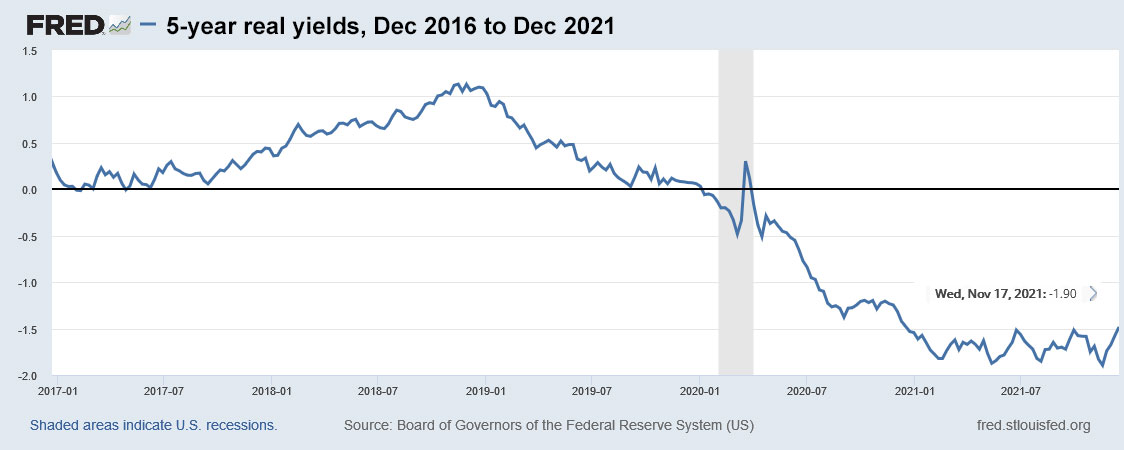
Here is the trend for the real yield of a full-term 5-year TIPS over the last three years, as estimated by the U.S. Treasury, showing how real yields have been climbing slightly higher in the wake of Federal Reserve moves to scale down economic stimulus:

Inflation breakeven rate

With a 5-year nominal Treasury trading today with a yield of 1.22%, this TIPS gets a 5-year inflation breakeven rate of 2.73%, a bit below the Oct. 21 result of 2.89%. The breakeven rate means that this TIPS will outperform a nominal Treasury if inflation averages more than 2.73% over the next 4 years, 10 months.

A breakeven rate of 2.73% certainly looks fair, given that U.S. inflation is currently running at 6.8% and looks likely to maintain a high rate well into 2022.

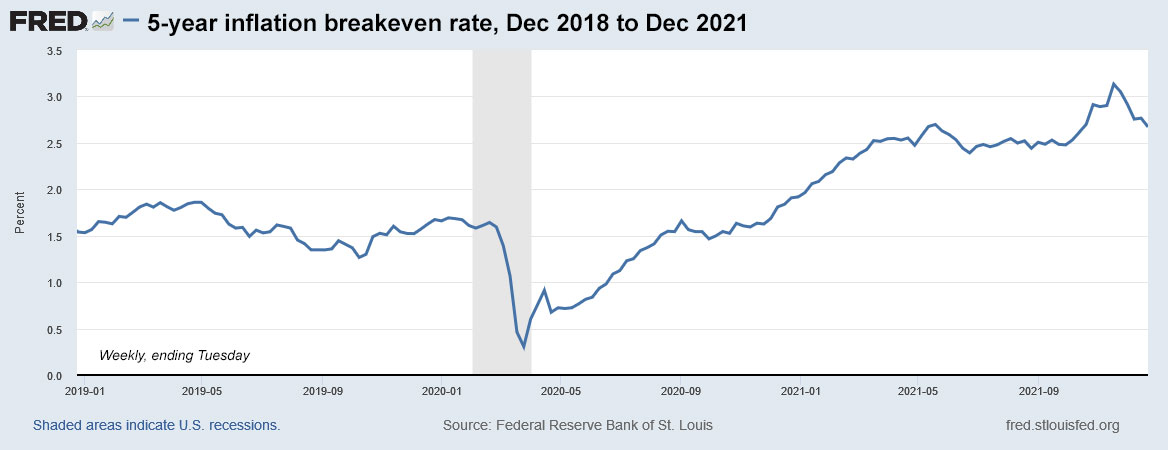
Here is the trend in the 5-year inflation breakeven rate over the last three years, showing that while inflation expectations surged after the pandemic mania of March 2020, they have eased off recently in reaction to the Federal Reserve’s “hawkish” announcements:

Reaction to the auction

This TIPS had closed on the secondary market Tuesday with a real yield of -1.53%, so today’s auction result of -1.508% came in slightly higher, indicating lukewarm demand. The bid-to-cover ratio was 2.42, the lowest for the 10 most recent auctions of this term. Again, indicating lukewarm demand.

The TIP ETF, which holds the full range of maturities of TIPS, had been trading a bit higher all morning, indicating lower real yields. After the auction closed at 1 p.m. … nothing happened. It looks like the Treasury market was happy enough with the auction result.

This auction closes the history of CUSIP 91282CDC2, which did manage to set the record low yield for any TIPS of this term at its originating auction. The Treasury will offer a new 5-year TIPS in April, potentially very close to the Fed’s first moves to raise short-term interest rates. Let’s hope we see some more attractive TIPS offerings in 2022.

* * *

Feel free to post comments or questions below. If it is your first-ever comment, it will have to wait for moderation. After that, your comments will automatically appear.

David Enna is a financial journalist, not a financial adviser. He is not selling or profiting from any investment discussed. The investments he discusses can purchased through the Treasury or other providers without fees, commissions or carrying charges. Please do your own research before investing.

Posted in Investing in TIPS | 1 Comment

5-year TIPS real yield will be omen of things to come

Treasury will reopen a 5-year TIPS at auction Wednesday, as real yields are creeping higher.

By David Enna, Tipswatch.com

The last TIPS auction of the year is coming Wednesday, a day early because of the holiday season, when the U.S. Treasury will offer $17 billion in a reopening of CUSIP 91282CDC2, creating a 4-year, 10-month Treasury Inflation-Protected Security.

This auction follows just a week after the Federal Reserve announced it will accelerate tapering of its bond-buying program, cutting its January purchases by $20 billion for Treasury securities and $10 billion for mortgage-backed securities. Federal Reserve Chairman Jerome Powell said Wednesday the bond-buying should end by March 2022:

“If the economy evolves broadly, as expected, similar reductions in the pace of net-asset purchases will likely be appropriate each month, implying that increases in our securities holdings would cease by mid-March, a few months sooner than we anticipated in early November. “

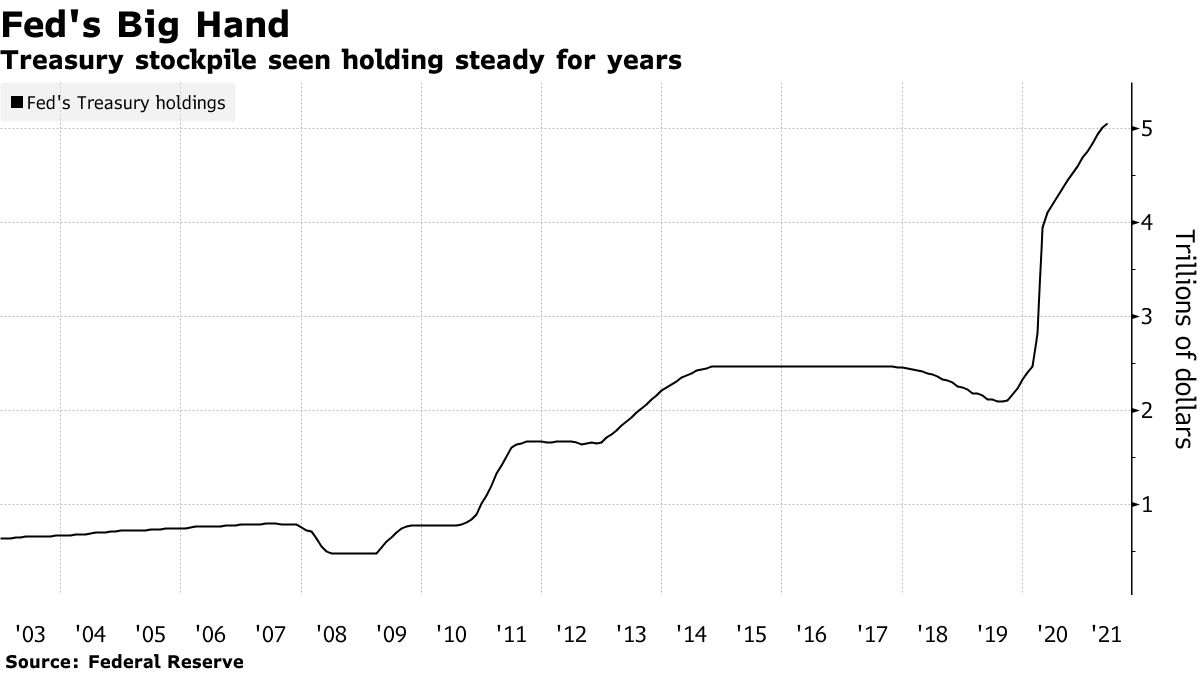
You’d think the end to Treasury purchases by the Fed would lead — at least — to a tick higher in real yields (meaning the yield TIPS provide above or below inflation) but this isn’t a sure thing. The Fed is likely to continue rolling over its past purchases, keeping its balance sheet stable. The Fed now owns well over 20% of the entire Treasury market, so its influence over future yields will continue, even without a bond-buying program. This Bloomberg chart shows the massive escalation of the Fed’s Treasury ownership over the last two years:

The point is: An end to the Fed’s bond-buying program will not end its dominance of the Treasury market. That will continue until the Fed begins shrinking its balance sheet, an event that could cause panic in the stock and bond markets. If you examine that chart, you can see that despite the tapering event of 2014, the Fed’s balance sheet remained stable until well into 2017.

But hey, we have actually seen 5-year real yields tick higher this month, possibly triggered by the Fed’s other announcement: That is is preparing to raise short-term interest rates in 2022, potentially three times to range of 0.75% to 1.00%. The 5-year TIPS is the maturity most sensitive to increases in the Federal Funds Rate. Here is the trend we’ve seen, using Treasury estimates of 5-year real yields:

  • Aug. 1. 5-year real yield -1.85%
  • Sept. 1. -1.70%
  • Oct. 1. -1.58%
  • Nov. 1. -1.66%
  • Dec. 17. -1.47%

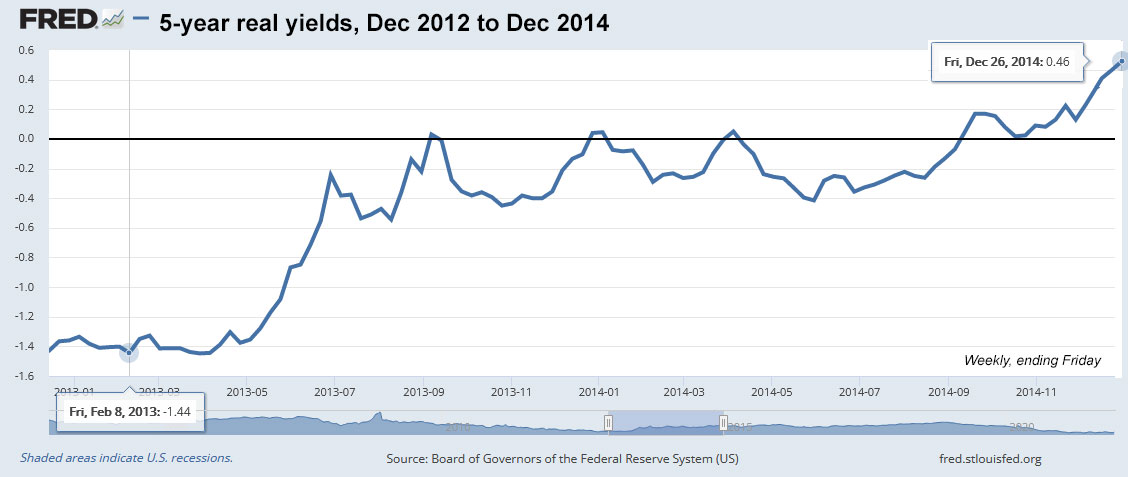
Another reason for the tick higher in the 5-year real yield is that inflation expectations are falling, slightly, in reaction to the Fed’s hawkish stance. That means real yields have room to move higher as nominal rates also increase. Sometime in the near future, will we see a strong surge to higher real yields, as we did in the two years from December 2012 to December 2014?

Notice that the 5-year yield started that period at -1.44%, very close to where it is today, and ended the period at 0.46%, 190 basis points higher. And this happened a full year before the Fed began raising the Federal Funds Rate in December 2015. The funds rate didn’t reach 0.75% — where it is expected to be next year — until March 2017. All of this shows the accelerated path today’s Fed is taking under our current threat of looming inflation.

Just out of curiosity, I looked to see where the 5-year real yield was on March 16, 2017, just after the Fed’s third rate increase in that tightening cycle:

  • 5-year TIPS: 0.18%
  • 5-year Treasury note: 2.05%
  • 5-year inflation breakeven rate: 1.87%

Clearly, we should be seeing higher real yields in coming months, making TIPS more attractive. The 5-year TIPS will be the most sensitive, rising the fastest in the wake of Fed actions. Longer-term real yields, however, could be suppressed as fears of recession rise and the yield curve flattens.

Wednesday’s reopening auction

Oh, well, back to the mundane reality of Treasury auctions. CUSIP 91282CDC2 trades on the secondary market, so you can check its current real yield to maturity and price on Bloomberg’s Current Yields page. As of Friday’s market close, it was trading with a real yield of -1.54% and price of about $108.36 for $100 of value.

A TIPS is an investment that pays a coupon rate well below that of other Treasury investments of the same term. But with a TIPS, the principal balance adjusts each month (usually up, but sometimes down) to match the current U.S. inflation rate. So the “real yield to maturity” of a TIPS indicates how much an investor will earn above (or in this case, below) inflation.

CUSIP 91282CDC2 has a coupon rate of 0.125% but a real yield to maturity of -1.54%, so investors have to pay about an 8.4% premium to par value to purchase this TIPS. In addition, it will have an inflation index of 1.01192 on the settlement date of Dec. 31, meaning investors will be buying an additional 1.19% in principal over par.

So, add this up. An investor putting in an order for $10,000 of this TIPS will actually be purchasing $10,119 in principal. Tack on the 8.4% premium, and the adjusted cost of this investment will be about $10,969 for $10,119 in principal.

Of course, real yields can change before Wednesday’s auction closes at 1 p.m. EDT. If you are investing in this TIPS auction, keep an eye on Bloomberg’s Current Yields page, which shows real-time trading.

Here is the trend in 5-year real yields over the last five years, showing how real yields have been creeping higher since mid November:

Inflation breakeven rate

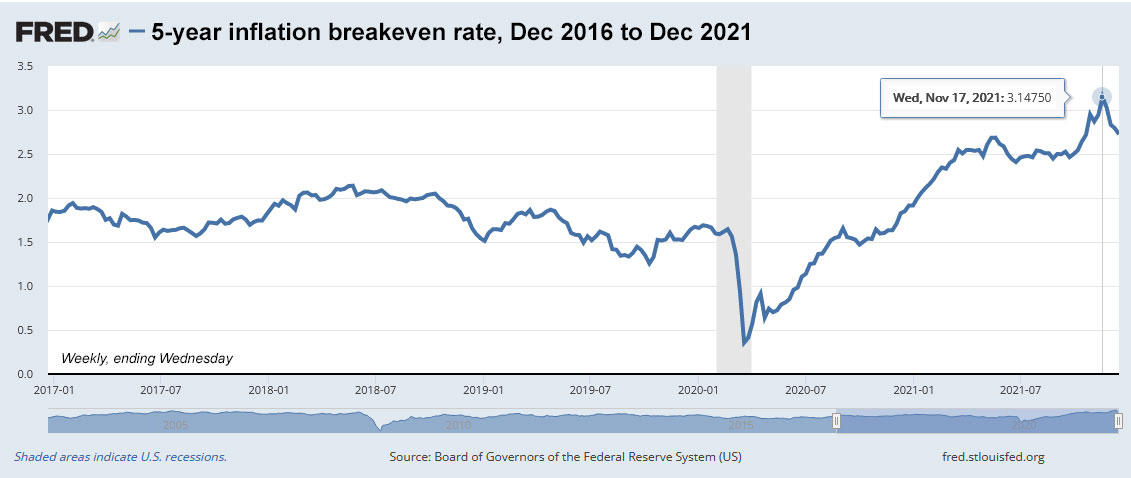
With a 5-year nominal Treasury currently trading with a yield of 1.17%, this TIPS currently has a five-year inflation breakeven rate of 2.71%, which seems like a reasonable number. Here is the trend in the 5-year inflation breakeven rate over the last five years, also showing how inflation expectations have been waning a bit as the Fed prepares to ease off on economic stimulus:

Conclusion

I was a buyer at only one TIPS auction this year, on June 17 when a 5-year reopening got a real yield to maturity of -1.416%, which seemed “decent” at the time. Wednesday’s auction could see a real yield rising to that level; it will depend on investor demand. I’m not particularly interested this time around, however, because I see the potential for higher real yields in the future.

OK, full disclosure, my track record as a “predictor of the future” is pretty poor. I will be reporting the auction results soon after the close at 1 p.m. Wednesday.

As a side note, if you haven’t purchased your full allocation of U.S. Series I Bonds this calendar year — $10,000 per person — you should do that before you invest in a 5-year TIPS. The I Bond is clearly the better investment, with a 150-basis-point advantage over a 5-year TIPS.

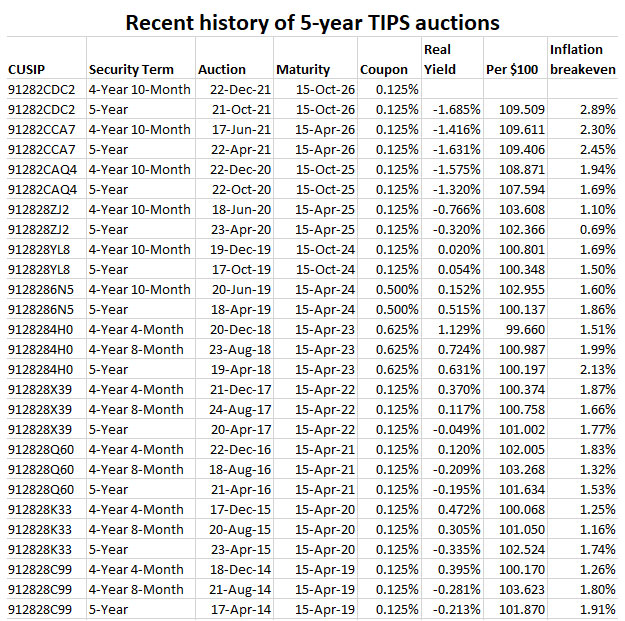
Here’s a history of recent TIPS auctions of this term:

* * *

Feel free to post comments or questions below. If it is your first-ever comment, it will have to wait for moderation. After that, your comments will automatically appear.

David Enna is a financial journalist, not a financial adviser. He is not selling or profiting from any investment discussed. The investments he discusses can purchased through the Treasury or other providers without fees, commissions or carrying charges. Please do your own research before investing.

Posted in Investing in TIPS | 1 Comment